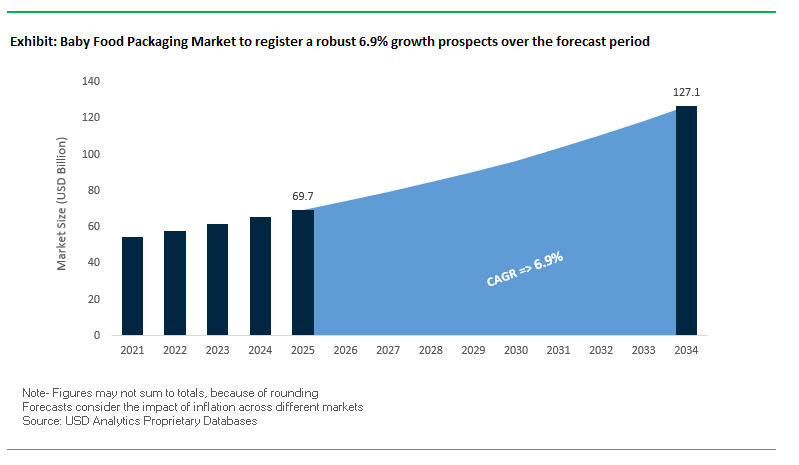
The Global Baby Food Packaging Market is projected to grow from $69.7 billion in 2025 to $127.1 billion by 2034, expanding at a healthy CAGR of 6.9%. Packaging plays a pivotal role in ensuring the safety, freshness, and convenience of baby food, with innovation largely driven by regulatory compliance, sustainability, and evolving parental preferences. Plastic remains the dominant material due to its lightweight durability and tamper-resistant qualities, while spout pouches have emerged as the most popular format, prized for portability and spill resistance.
Growing environmental concerns are pushing manufacturers toward eco-friendly packaging solutions, including recyclable plastics, biodegradable polymers, and paper-based alternatives. A survey by Ipsos shows that 67% of consumers prefer eco-friendly baby food packaging, compelling brands to innovate with BPA-free, recyclable, and compostable options. At the same time, the market is shaped by convenience trends, as dual-income households demand on-the-go feeding solutions with resealable and portion-controlled designs.
Strict regulations further define the sector, with tamper-evident seals, airtight closures, and non-toxic materials being mandatory to ensure product safety and consumer trust. This regulatory framework, combined with rising sustainability expectations, is fueling global adoption of innovative baby food packaging formats.
Key Insights for Industry Professionals
Plastic and spout pouches dominate the baby food packaging market due to convenience and safety.
Eco-friendly packaging adoption is rising, with strong consumer preference for recyclable and biodegradable materials.
Working parents drive demand for portable, resealable, and portion-controlled packaging formats.
Stringent safety standards ensure packaging remains tamper-evident, airtight, and free of harmful chemicals.
Market Analysis: Recent Industry Developments in Baby Food Packaging
The baby food packaging industry has seen a wave of sustainability-focused innovations and strategic portfolio realignments. In August 2025, Mondi introduced a paper-based diaper packaging solution for Drylock, underscoring its role in driving sustainable materials in baby care and adjacent categories. In the same month, Constantia Flexibles announced a €100 million investment to expand its production network and enhance sustainable pouch solutions, particularly for baby food and fruit puree.
In July 2025, Amcor expanded its healthcare packaging network in Costa Rica, strengthening its ability to serve Latin American markets with food-safe, medical-grade packaging expertise. That same month, Mondi invested in paper-based air cushioning and recyclable bubble wrap, reinforcing its commitment to recyclable packaging solutions.
Earlier in April 2025, Sonoco divested its thermoformed and flexible packaging business to TOPPAN Holdings for $1.8 billion, streamlining its portfolio to focus on core capabilities. In March 2025, Constantia Flexibles and Aluflexpack AG formed a strategic alliance, enhancing their leadership in premium flexible packaging solutions. Going back to August 2024, Pactiv Evergreen launched Recycleware® Reduced-Density Polypropylene trays, while Berry Global partnered with Nestlé Purina to launch 100% recycled-content canisters, highlighting the industry-wide momentum toward circularity.
Key Trends and Lucrative Opportunities Driving the Baby Food Packaging Market
Strategic Shift Toward Plastic-Free and Alternative Material Platforms
The baby food packaging market is witnessing a strategic transition toward plastic-free and alternative material platforms, driven by sustainability commitments, regulatory scrutiny, and consumer demand for safer packaging. Leading brands like Nestlé’s Gerber are committing to make 100% of their packaging recyclable or reusable by 2025. Innovations include single-material pouches made entirely from polypropylene (PP) that are “designed-to-be-recycled,” replacing traditional multi-material laminates. Regulatory pressures, such as the EU ban on bisphenol A (BPA) in baby food contact materials, are accelerating the adoption of safer alternatives. Consumers also demand “clean” packaging free from contaminants, with brands like Once Upon a Farm and Beech-Nut earning recognition through initiatives such as the Clean Label Project Purity Award, reinforcing the market’s push toward safer, plastic-free packaging solutions.
Integration of Advanced Safety and Tamper-Evidence Features
Safety remains paramount in baby food packaging, driving the integration of advanced tamper-evident and authenticity-verification features. Inspired by the “Tylenol Effect” of the 1980s, today’s packaging includes irreversible multi-layer seals, audible and visible indicators, and tamper-evident shrink bands. Modern lids for glass jars, for instance, are designed to “pop” when opened, providing caregivers with clear signs of breach. These multi-layer security measures ensure unauthorized access is immediately noticeable, enhancing consumer trust while meeting stringent regulatory requirements. Advanced tamper-evidence also allows brands to move beyond basic protection, creating a higher level of perceived safety and confidence for parents.
Development of High-Barrier, Mono-Material Recyclable Pouches
A major opportunity exists in developing high-performance, recyclable mono-material pouches that maintain essential barrier properties against oxygen and moisture while being fully recyclable. Multi-material laminates present significant recycling challenges, which brands like Nestlé are addressing through collaborations with converters like Gualapack. New all-PE or all-PP pouches are designed to match traditional laminate performance metrics, such as oxygen transmission rate (OTR) and water vapor transmission rate (WVTR), ensuring product integrity. Collaborative innovation between brand owners, material producers, and packaging converters, such as SIG and Danone, is creating circular economy solutions while enhancing convenience, performance, and sustainability for caregivers.
Expansion of Smart Packaging for Enhanced Traceability and Usage Tracking
Smart packaging is emerging as a critical opportunity to improve transparency, traceability, and consumer engagement in baby food. Upcoming regulations, such as the California law effective January 2025, require monthly testing for heavy metals with results accessible via QR codes on packaging. This enables real-time consumer access to product safety information and sets a potential national standard. Beyond regulatory compliance, smart packaging offers opportunities for value-added engagement linking QR codes to recipes, feeding guidance, and brand content transforming static packaging into an interactive platform that strengthens trust and loyalty while providing brands with data on product usage and consumer preferences.
Competitive Landscape: Leading Companies in Global Baby Food Packaging Industry
The baby food packaging market is highly competitive, with global packaging giants and specialized firms leveraging sustainability, safety, and convenience innovations to secure market share.
Amcor plc: Advancing Baby Food Packaging with Retort and Recyclable Solutions
Amcor offers a diverse portfolio of baby food packaging, including jars, bottles, and retort pouches. Its AmLite HeatFlex™ and HeatReady™ solutions deliver high-barrier protection and reduced carbon footprints. Amcor’s strategic focus is on sustainability, targeting 100% recyclability or reusability of its portfolio by 2025. With a presence in over 40 countries, Amcor provides global access to local brands, making it a key enabler in the baby food packaging industry.
Constantia Flexibles: Expanding Sustainable Pouch Solutions for Baby Food
Constantia Flexibles is a leader in flexible packaging, offering stand-up and retort pouches for baby food and fruit purees. In March 2025, it launched EcoVer pouches, a mono-material polypropylene solution for spouted fruit puree applications, strengthening its eco-friendly lineup. With a €100 million investment announced in August 2025, Constantia is scaling production to meet surging demand for sustainable baby food packaging worldwide.
Mondi Group: Driving Fiber-Based Innovation in Baby Food Packaging
Mondi delivers a wide range of paper and plastic-based baby food packaging solutions, including mono-material pouches and recyclable paper-based alternatives. It has pioneered FunctionalBarrier Papers, offering fiber-based replacements for conventional plastic. In August 2025, Mondi launched paper-based diaper packaging for Drylock, highlighting its diversified role in sustainable baby and childcare packaging. Mondi’s strong innovation pipeline positions it as a global leader in eco-conscious packaging design.
Gerresheimer AG: Bringing Glass and Plastic Safety to Baby Food Packaging
Gerresheimer is known for its high-quality glass and plastic containers, ensuring hygiene and compliance with stringent safety standards. In August 2025, the company announced plans to sell its moulded glass division as part of a strategic realignment toward pharmaceuticals, but its glass containers remain critical in the baby food packaging sector. Gerresheimer’s commitment to renewable energy use and CO2 reduction by 2030 strengthens its sustainability credentials.
Sonoco Products Company: Delivering Rigid and Flexible Packaging Expertise
Sonoco offers a wide portfolio of rigid paper containers and flexible packaging for baby food. In April 2025, it divested its thermoformed and flexible packaging business to focus on core strengths, while maintaining expertise in food-safe and temperature-assured solutions. With ISC Labs® for design and validation, Sonoco ensures its packaging complies with global food safety regulations while innovating for portability and reliability.
Berry Global Group, Inc.: Innovating Plastic Packaging for Child Care and Baby Food
Berry Global manufactures baby bottles, food containers, and child care packaging with a focus on lightweight and safe plastics. Its partnership with Mars in August 2024 to transition pantry jars to 100% recycled plastic showcases its strong emphasis on circularity. Berry Global continues to integrate post-consumer recycled content into its baby food packaging lines, meeting customer demand for sustainable yet cost-effective solutions
Baby Food Packaging Market Share Insights
Pouches Hold the Largest Market Share by Product Type in Baby Food Packaging
Pouches dominate baby food packaging with a 45% share, reflecting a fundamental shift in modern parenting preferences toward convenience and portability. Spouted pouches are widely used for fruit purees, yogurt blends, and weaning foods because they enable mess-free feeding and easy portion control, making them ideal for on-the-go consumption. Their lightweight design reduces transportation costs and aligns with e-commerce distribution, though sustainability remains a challenge as multi-laminate structures are often non-recyclable. Nevertheless, brands continue to innovate with mono-material and recyclable pouch options to meet regulatory and consumer scrutiny. Pouches also serve as powerful branding platforms, with vibrant graphics and transparent windows enhancing shelf appeal. Their centrality to toddler-stage nutrition ensures they remain the cornerstone of baby food packaging innovation.
Supermarkets Lead Market Share by End-User in Baby Food Packaging
Supermarkets and hypermarkets command the largest distribution share at 40%, driven by their role as one-stop destinations where parents prefer to inspect products physically before purchase. Shelf placement within these outlets is a critical battleground for baby food brands, with premium glass jars and value-oriented pouches competing side by side. However, supermarkets’ dominance is increasingly challenged by e-commerce, which already accounts for 35% and is expanding rapidly due to subscription-based models that streamline replenishment of bulky products like formula and pouches. E-commerce also amplifies packaging requirements for durability in shipping and storage, reshaping material selection and secondary packaging formats. Convenience stores and pharmacies retain smaller but strategic roles, serving immediate-need purchases and trust-driven specialized formula distribution, respectively. This evolving channel dynamic highlights the dual importance of physical presence and digital adaptability in sustaining baby food packaging growth.
United States: Sustainability and Consumer Transparency Driving Baby Food Packaging
The U.S. baby food packaging market is experiencing strong growth due to rising consumer awareness of sustainability and demand for eco-friendly, recyclable, and compostable packaging solutions. Companies such as Plum Organics are innovating by redesigning nutritious pouches and snacks to provide clear ingredient information, helping parents make informed purchasing decisions. In 2024, Amcor introduced a new recyclable pouch line tailored for baby food brands, while Gerber partnered with TerraCycle to recycle flexible pouches that are not accepted in municipal recycling streams, highlighting the industry's commitment to sustainability.
The rapid expansion of e-commerce is driving demand for lightweight, durable, and cost-effective packaging for shipping. Customization is becoming key, with packaging tailored to new product formats such as toddler meals, vitamin boosters, and smoothies. Regulatory compliance is a critical factor, as the FDA mandates tamper-evident packaging, clear labeling, and product safety standards to ensure the well-being of infants and young children. This combination of sustainability, innovation, and regulatory adherence is shaping the U.S. baby food packaging landscape.
Germany: Circular Economy and Advanced Safety Features Shaping Baby Food Packaging
The German baby food packaging market is heavily influenced by a stringent regulatory framework, including the EU Packaging and Packaging Waste Regulation (PPWR) effective from February 2025. These regulations drive demand for eco-friendly and highly recyclable packaging solutions. Germany’s leadership in the circular economy ensures producers are responsible for the entire life cycle of their packaging, incentivizing innovations such as mono-material solutions and fiber-based alternatives.
Technological advancements are evident in product innovations, such as HiPP’s infant formula packaging utilizing Aptar Neo tamper-evident closures, which provide secure locking and audible feedback. Government mandates under the PPWR and regulatory shifts favoring fiber-based packaging have added momentum to eco-friendly packaging development. Investments in high-speed, precision filling and sealing equipment enhance production efficiency and ensure quality, making Germany a hub for advanced, sustainable, and safe baby food packaging solutions.
China: Premiumization and Green Transformation Driving Packaging Innovation
China’s baby food packaging market is being shaped by the government’s dual carbon goal, which promotes eco-friendly and reusable materials. Regulatory reforms in February 2023, aimed at improving infant formula safety and quality, have introduced stricter standards for nutrient levels and banned certain elements, thereby enforcing robust quality control in packaging.
The market is witnessing a trend toward premiumization, with higher-quality, innovative packaging solutions signaling superior product standards to consumers. Technological advancements, including automation, AI, and “5G plus industrial internet” integration, are enhancing production efficiency and enabling flexible manufacturing capabilities. These trends drive demand for high-quality, safe, and visually appealing baby food packaging, particularly for premium and imported brands.
India: Regulatory Support and Eco-Friendly Solutions Boost Baby Food Packaging
India’s baby food packaging industry is benefiting from governmental initiatives such as “Make in India” and “Zero Effect Zero Defect”, which encourage quality domestic production and support industrial infrastructure. The Production Linked Incentive (PLI) Scheme, with an outlay of INR 10,900 crore, is enhancing manufacturing capabilities, driving demand for standardized, high-quality packaging solutions.
Regulatory policies like the Plastic Waste Management (Amendment) Rules and initiatives by FSSAI are promoting eco-friendly alternatives and reducing the country’s plastic footprint. Rising disposable income and urbanization are shifting consumer preferences toward convenient, single-serve, on-the-go products, increasing the adoption of pouches and ready-to-use containers. Combined with a focus on sustainable materials and corporate social responsibility, India’s baby food packaging market is evolving rapidly to meet both consumer and environmental demands.
Baby Food Packaging Market Report Scope
Baby Food Packaging Market
Parameter
Details
Market Size (2025)
$69.7 Billion
Market Size (2034)
$127.1 Billion
Market Growth Rate
6.9%
Segments
By Material Type (Plastics, Glass, Metal, Paper & Paperboard, Bioplastics), By Product Type (Bottles & Jars, Pouches, Cans, Cartons, Other Product Types), By Application (Dried Baby Food, Prepared Baby Food, Milk Formula, Other Applications), By End-User (Retail, E-commerce, Supermarkets/Hypermarkets, Convenience Stores)
Study Period
2019- 2024 and 2025-2034
Units
Revenue (USD)
Qualitative Analysis
Porter’s Five Forces, SWOT Profile, Market Share, Scenario Forecasts, Market Ecosystem, Company Ranking, Market Dynamics, Industry Benchmarking
Companies
Amcor plc, Mondi Group, Berry Global Inc., Sonoco Products Company, Huhtamaki Oyj, Tetra Pak International S.A., AptarGroup, Inc., Gerresheimer AG, O-I Glass, Inc., Ardagh Group S.A., Silgan Holdings Inc., DS Smith plc, Greiner Packaging International GmbH, Ball Corporation, ProAmpac LLC
Countries
US, Canada, Mexico, Germany, France, Spain, Italy, UK, Russia, China, India, Japan, South Korea, Australia, South East Asia, Brazil, Argentina, Middle East, Africa
Baby Food Packaging Market Segmentation
By Material Type
Plastics
Glass
Metal
Paper & Paperboard
Bioplastics
By Product Type
Bottles & Jars
Pouches
Cans
Cartons
Other Product Types
By Application
Dried Baby Food
Prepared Baby Food
Milk Formula
Other Applications
By End-User
Retail
E-commerce
Supermarkets/Hypermarkets
Convenience Stores
Countries Analyzed
North America (US, Canada, Mexico)
Europe (Germany, UK, France, Spain, Italy, Russia, Rest of Europe)
Asia Pacific (China, India, Japan, South Korea, Australia, South East Asia, Rest of Asia)
South America (Brazil, Argentina, Rest of South America)
Middle East and Africa (Saudi Arabia, UAE, Rest of Middle East, South Africa, Egypt, Rest of Africa)
Top Companies in Baby Food Packaging Market
Amcor plc
Mondi Group
Berry Global Inc.
Sonoco Products Company
Huhtamaki Oyj
Tetra Pak International S.A.
AptarGroup, Inc.
Gerresheimer AG
O-I Glass, Inc.
Ardagh Group S.A.
Silgan Holdings Inc.
DS Smith plc
Greiner Packaging International GmbH
Ball Corporation
ProAmpac LLC
* List Not Exhaustive
Methodology
USDAnalytics employed a robust research methodology to deliver a comprehensive analysis of the global Baby Food Packaging Market, combining primary and secondary sources to provide actionable insights for industry professionals. Our approach involved interviews with packaging manufacturers, baby food producers, regulatory bodies, and retail stakeholders, alongside detailed reviews of corporate announcements, M&A activity, product innovations, and sustainability initiatives. Market sizing and forecasts were derived from historical trends, evolving regulations, consumer behavior, and shifts toward eco-friendly, tamper-evident, and convenient packaging formats. The study segments the market by material type, product type, application, and end-user channels while providing regional insights covering the U.S., Germany, China, and India. Competitive intelligence highlights leading players such as Amcor, Constantia Flexibles, Mondi, Berry Global, and Sonoco, examining their strategies in sustainable, smart, and safety-focused packaging innovations. By synthesizing regulatory compliance, technological integration, premiumization trends, and circular economy initiatives, USDAnalytics equips stakeholders with a detailed understanding of market dynamics, growth drivers, and investment opportunities in the baby food packaging sector.
Deliverables:
Comprehensive Market Research Report (PDF and Excel) with detailed tables, charts, and interactive visualizations.
Country-Specific Forecasts & Analysis.
Segment-Wise Revenue Forecasts (2025–2034).
Competitive Analysis, Benchmarking, and SWOT Profiles.
Recent Developments & Innovation Tracker.
Executive Summary & Analyst Commentary.
Post-Purchase Analyst Support for Client-Specific Questions and Custom Data Requirements.
Table of Contents: Global Baby Food Packaging Market
2. Baby Food Packaging Market Landscape & Outlook (2025–2034)
2.1. Introduction to Baby Food Packaging Market
2.2. Market Valuation and Growth Projections (2025–2034)
2.3. Industry Drivers: Safety, Convenience, and Sustainability
2.4. Regulatory Environment and Compliance Requirements
2.5. Consumer Behavior and Adoption Trends
3. Innovations Reshaping the Baby Food Packaging Market
3.1. Trend: Strategic Shift Toward Plastic-Free and Alternative Material Platforms
3.2. Trend: Integration of Advanced Safety and Tamper-Evidence Features
3.3. Opportunity: Development of High-Barrier, Mono-Material Recyclable Pouches
3.4. Opportunity: Expansion of Smart Packaging for Enhanced Traceability and Usage Tracking
4. Competitive Landscape and Strategic Initiatives
4.1. Mergers, Acquisitions and Strategic Alliances
4.2. R&D and Material Innovation
4.3. Sustainability and Strategies
4.4. Market Expansion and Regional Focus
5. Market Share and Segmentation Insights: Baby Food Packaging Market
5.1. By Material Type
5.1.1. Plastics
5.1.2. Glass
5.1.3. Metal
5.1.4. Paper & Paperboard
5.1.5. Bioplastics
5.2. By Product Type
5.2.1. Bottles & Jars
5.2.2. Pouches
5.2.3. Cans
5.2.4. Cartons
5.2.5. Other Product Types
5.3. By Application
5.3.1. Dried Baby Food
5.3.2. Prepared Baby Food
5.3.3. Milk Formula
5.3.4. Other Applications
5.4. By End-User
5.4.1. Retail
5.4.2. E-commerce
5.4.3. Supermarkets/Hypermarkets
5.4.4. Convenience Stores
6. Country Analysis and Outlook of Baby Food Packaging Market
6.1. United States
6.2. Canada
6.3. Mexico
6.4. Germany
6.5. France
6.6. Spain
6.7. Italy
6.8. UK
6.9. Russia
6.10. China
6.11. India
6.12. Japan
6.13. South Korea
6.14. Australia
6.15. South East Asia
6.16. Brazil
6.17. Argentina
6.18. Middle East
6.19. Africa
7. Baby Food Packaging Market Size Outlook by Region (2025–2034)
7.1. North America Baby Food Packaging Market Size Outlook to 2034
7.1.1. By Material Type
7.1.2. By Product Type
7.1.3. By Application
7.1.4. By End-User
7.2. Europe Baby Food Packaging Market Size Outlook to 2034
7.2.1. By Material Type
7.2.2. By Product Type
7.2.3. By Application
7.2.4. By End-User
7.3. Asia Pacific Baby Food Packaging Market Size Outlook to 2034
7.3.1. By Material Type
7.3.2. By Product Type
7.3.3. By Application
7.3.4. By End-User
7.4. South America Baby Food Packaging Market Size Outlook to 2034
7.4.1. By Material Type
7.4.2. By Product Type
7.4.3. By Application
7.4.4. By End-User
7.5. Middle East and Africa Baby Food Packaging Market Size Outlook to 2034
7.5.1. By Material Type
7.5.2. By Product Type
7.5.3. By Application
7.5.4. By End-User
8. Company Profiles: Leading Players in the Baby Food Packaging Market
8.1. Amcor plc
8.2. Mondi Group
8.3. Berry Global Inc.
8.4. Sonoco Products Company
8.5. Huhtamaki Oyj
8.6. Tetra Pak International S.A.
8.7. AptarGroup, Inc.
8.8. Gerresheimer AG
8.9. O-I Glass, Inc.
8.10. Ardagh Group S.A.
8.11. Silgan Holdings Inc.
8.12. DS Smith plc
8.13. Greiner Packaging International GmbH
8.14. Ball Corporation
8.15. ProAmpac LLC
9. Methodology
9.1. Research Scope
9.2. Market Research Approach
9.3. Market Sizing and Forecasting Model
9.4. Research Coverage
9.5. Data Horizon
9.6. Deliverables
10. Appendix
10.1. Acronyms and Abbreviations
10.2. List of Tables
10.3. List of Figures
Baby Food Packaging Market Segmentation
By Material Type
Plastics
Glass
Metal
Paper & Paperboard
Bioplastics
By Product Type
Bottles & Jars
Pouches
Cans
Cartons
Other Product Types
By Application
Dried Baby Food
Prepared Baby Food
Milk Formula
Other Applications
By End-User
Retail
E-commerce
Supermarkets/Hypermarkets
Convenience Stores
Countries Analyzed
North America (US, Canada, Mexico)
Europe (Germany, UK, France, Spain, Italy, Russia, Rest of Europe)
Asia Pacific (China, India, Japan, South Korea, Australia, South East Asia, Rest of Asia)
South America (Brazil, Argentina, Rest of South America)
Middle East and Africa (Saudi Arabia, UAE, Rest of Middle East, South Africa, Egypt, Rest of Africa)
The market is driven by parental demand for safety, convenience, and eco-friendly packaging. Rising adoption of tamper-evident, airtight, and portion-controlled formats, coupled with regulatory compliance and sustainability trends, is fueling market expansion globally.
Manufacturers are shifting toward recyclable plastics, biodegradable polymers, mono-material pouches, and paper-based solutions. Brands like Nestlé and Constantia Flexibles are investing in circular economy initiatives to reduce environmental impact while maintaining product integrity.
Spouted pouches dominate with a 45% market share due to portability, spill-resistance, and convenience for on-the-go feeding. Bottles, jars, and cans remain essential for premium, prepared foods, while cartons and other formats cater to milk formula and retail distribution needs.
Smart packaging solutions, including QR codes, NFC tags, and traceability systems, provide real-time access to product safety data, heavy metal testing results, and usage guidance. This improves transparency, consumer engagement, and compliance with evolving regulations.
Key players include Amcor, Constantia Flexibles, Mondi, Berry Global, and Sonoco. They lead in sustainable, tamper-evident, and high-barrier packaging solutions, integrating safety, convenience, and eco-friendly designs for global baby food brands.