Spout Pouch Market Size, Overview, and Growth Outlook (2025–2034)
Spout Pouch Market Projected to Reach $5.8 Billion by 2034 Driven by Convenience and Sustainable Packaging Innovations
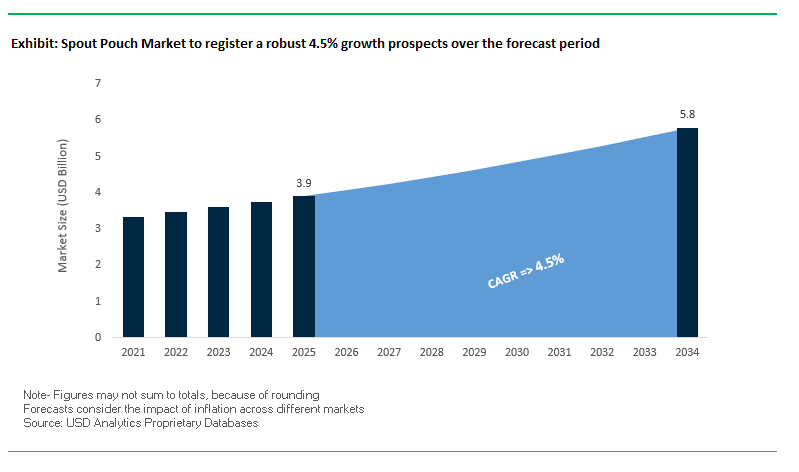
The global spout pouch market is expected to grow from $3.9 billion in 2025 to $5.8 billion by 2034, registering a CAGR of 4.5%. This market provides lightweight, flexible packaging with integrated spouts for controlled pouring and resealing, widely used across food & beverage, personal care, and household products.
Key Insights for Industry Professionals:
Consumer convenience and portability are primary growth drivers, supporting the demand for ready-to-eat and single-serve products.
Sustainability is gaining momentum, with mono-material, bio-based, and recyclable films increasingly adopted to reduce environmental impact.
High-barrier films are essential for preserving perishable products like baby food, sauces, and juices.
Smart dispensing and ergonomic spout designs enhance user experience across thick and delicate liquids.
Innovation in materials and resealable designs is enabling differentiation in crowded markets.
The spout pouch market has witnessed strategic consolidation, sustainability initiatives, and material innovations in recent years. In August 2025, ProAmpac acquired PAC Worldwide, expanding its flexible packaging capabilities and global footprint. The same month, Constantia Flexibles partnered with Syntegon to showcase high-performance mono-material pouches at Fachpack 2025, signaling the industry's commitment to recyclable solutions. In July 2025, Gualapack developed spouted pouches with tethered caps to comply with EU anti-litter legislation, reflecting regulatory influence on design innovation.
Sustainability continues to shape product development. July 2024 saw Greiner Packaging partner to create 100% recyclable cardboard spoons, part of a broader eco-friendly push. May 2024, the Duni Group discontinued PFAS-containing packaging, aligning with non-toxic material trends that also impact adhesives and coatings. Consumer preferences are driving material choices, as evidenced by a February 2024 U.S. study favoring “less-plastic” packaging alternatives, particularly in cold-chain applications.
Market expansion and strategic acquisitions illustrate the drive to reach emerging regions. October 2024, Amcor acquired Phoenix Flexibles in India, strengthening presence in a high-growth market. In September 2024, Cold Chain Technologies acquired Exeltainer, enhancing life sciences cold-chain solutions in Spain and Brazil.
Trends and Opportunities Driving Growth in the Spout Pouch Market
Adoption of High-Barrier Recyclable Mono-Material Structures
One of the most transformative trends in the spout pouch market is the accelerated adoption of recyclable mono-material structures as the industry shifts away from traditional multi-layer laminates. Historically, multi-material formats combining PET, PE, and aluminum provided excellent oxygen and moisture barriers but created major recyclability challenges, as these materials could not be separated within existing mechanical recycling systems. The new generation of mono-material pouches—primarily polyethylene (PE) or polypropylene (PP)—offers a viable solution by ensuring compatibility with established recycling streams. In June 2025, Mondi Group unveiled a PE-based mono-material pouch featuring removable decorative panels, certified as 100% recyclable by Cyclos-HTP. This innovation demonstrates how performance and recyclability can now coexist, ensuring barrier protection without compromising circularity. Moreover, technology partnerships like the Dow-Menshen collaboration on Reverse Spout Sealing Technology are resolving critical manufacturing challenges, enabling secure spout attachment on heat-sensitive mono-material films. These innovations mark a breakthrough in scaling sustainable packaging for high-performance liquid and semi-liquid products.
Expansion into New Liquid and Viscous Food Categories Beyond Beverages
The spout pouch market is rapidly diversifying its applications beyond traditional beverages such as juices and water, with growing adoption in baby food purees, yogurt, sauces, condiments, and nutraceuticals. This trend is largely driven by the consumer preference for convenience, portability, and resealability. Logos Packaging, for instance, has introduced recyclable spout pouches for baby foods and yogurt, highlighting the packaging’s ability to maintain product freshness and safety. Spout pouches for more complex food categories are being engineered to withstand pasteurization and retort sterilization, ensuring extended shelf stability and food safety without refrigeration. This positions them as an attractive format for global distribution and on-the-go consumption. With lifestyles shifting toward convenience-oriented meal solutions, spout pouches are carving out strong growth opportunities across categories previously dominated by rigid packaging.
Integration of PCR Content to Meet Corporate Sustainability Mandates
A major opportunity lies in the integration of post-consumer recycled (PCR) content into spout pouch packaging, enabling brands to achieve their ambitious sustainability commitments. Mondi Group has already begun offering recyclable spouted pouches incorporating PCR resin, providing customers with an option to align packaging with environmental pledges. As FMCG and beverage brands are under increasing scrutiny to reduce virgin plastic usage, the demand for high-quality PCR resins is creating new supply chain partnerships and investments in advanced recycling. While technical challenges persist—particularly in ensuring clarity and high-barrier performance when using recycled content—progress in extrusion and purification technologies is helping overcome these limitations. This opens a significant revenue channel for converters that can reliably scale PCR-based spout pouch solutions.
Development of Bio-Based and Compostable Material Solutions
Another promising opportunity is the development of bio-based and compostable spout pouches, particularly for regions where recycling infrastructure is limited. Swiss Pac’s Plantmade™ technology is one such example, leveraging renewable materials to produce compostable spout pouches certified for industrial composting. Beyond compostability, material science advancements are ensuring that bio-based films deliver comparable barrier performance and durability to conventional plastics. A recent technical review highlights that innovations in starch-based and PLA-based polymers are enabling compostable pouches to maintain oxygen and moisture resistance, making them suitable for high-performance food and beverage applications. These innovations not only address end-of-life challenges but also position compostable pouches as an appealing option for eco-conscious consumers and brands seeking to differentiate through circular economy strategies.
Competitive Landscape: Key Global Players Are Driving Innovation and Sustainability in Spout Pouch Packaging Solutions
The global spout pouch market is shaped by companies leveraging materials science, high-barrier technologies, and sustainable solutions to deliver convenience, durability, and eco-friendly designs for a range of consumer and industrial products.
Amcor plc: Driving Circular Economy with Recyclable and Large-Format Spout Pouches
Amcor offers spout pouches for food, beverages, and personal care, emphasizing recyclable, recycled-content, and bio-based materials. The company is committed to making all packaging recyclable or reusable by 2025 and has developed large-format, recycle-ready stand-up pouches with spouts. Amcor’s global manufacturing network and vertically integrated business model allow it to serve diverse markets efficiently, with a strategy focused on R&D for circular economy solutions and product safety.
Constantia Flexibles Group GmbH: Innovating High-Barrier Mono-Material Pouches for Sustainability
Constantia Flexibles specializes in high-barrier films and spouted pouches, including EcoVer mono-material solutions. In August 2025, it partnered with Syntegon to showcase recyclable pouches and recently won WorldStar Global Packaging Awards for sustainability. Constantia Flexibles’ core strength is customized packaging solutions across food, pet food, and pharmaceutical applications, with a strategic focus on innovative and eco-friendly flexible packaging.
ProAmpac: Expanding Global Reach and Sustainable Packaging Through Strategic Acquisitions
ProAmpac provides spout pouches for food, personal care, and industrial chemicals, emphasizing advanced barrier films and award-winning graphics. In August 2025, it acquired PAC Worldwide, expanding its global footprint. Its ProActive Sustainability platform focuses on recyclable and compostable packaging. ProAmpac’s core strength is material science innovation and consumer-friendly features, with a strategy centered on high-performance, sustainable solutions for multiple industries.
Huhtamaki Oyj: Leading Sustainable Packaging with Compostable and Recyclable Innovations
Huhtamaki offers spout pouches alongside paper, fiber, and molded fiber containers, with a focus on sustainable alternatives. In July 2025, it received an EcoVadis gold medal and launched recyclable, compostable ice cream packaging. Its global footprint and expertise across materials support comprehensive food packaging solutions, with a strategic focus on achieving its 2030 sustainability targets.
Uflex Limited: Pioneering Retortable Spouted Stand-Up Pouches in India and Beyond
Uflex specializes in spout pouches for liquids, emphasizing high-barrier films and tamper-evident features. In November 2017, it launched India’s first retortable spouted stand-up pouch, eliminating cold chain requirements. Its vertical integration ensures a complete solution from raw materials to finished packaging, and its strategy focuses on innovation and sustainable packaging solutions for evolving consumer needs.
Spout Pouch Market Share Insights, 2025-2034
Stand-Up Pouches Lead Market Share by Product Type in Spout Pouch Packaging
Stand-up pouches hold a commanding 55% share of the global spout pouch packaging market, underscoring their unmatched balance of functionality, branding, and consumer appeal. The format’s ability to stand upright on shelves creates maximum visibility, making it the preferred choice for beverages, dairy, sauces, and liquid detergents. Integrated spouts enhance convenience, enabling precise dispensing while reducing product waste. Stand-up pouches also offer superior storage efficiency and material savings compared to rigid bottles, directly aligning with sustainability targets. Their adaptability to both foodservice and household products ensures that they remain the dominant spout pouch format, with retort pouches and flat pouches serving more specialized roles.
Food & Beverages Drive Market Share by Application in Spout Pouch Packaging
Food & Beverages represent 65% of the spout pouch packaging market, making them the core application segment by a wide margin. The growth of this segment is fueled by consumer demand for portability, portion control, and lightweight packaging across categories such as baby food, yogurt drinks, smoothies, sauces, and coffee creamers. Spout pouches not only reduce the material and shipping weight compared to bottles and jars but also provide resealability and improved shelf life, directly addressing both sustainability goals and consumer convenience. Their adoption has been particularly strong in emerging markets, where affordability and ease of transport are crucial, as well as in developed markets where premium and organic brands leverage the format to differentiate on eco-friendly and functional grounds.
United States: Recycling Targets and Growth in Food & Beverage Applications
The United States spout pouch market is being shaped by the U.S. Environmental Protection Agency’s (EPA) recycling goal of 50% by 2030, pushing packaging producers to invest heavily in recycling infrastructure and sustainable materials. Companies such as ProAmpac and Amcor are leading innovation by developing mono-material recyclable pouches, reducing dependency on multi-layer laminates that are harder to recycle. In addition, the Association of Plastic Recyclers (APR) is playing a critical role by providing guidelines that encourage the adoption of washable inks, floatable films, and compatible resins, ensuring higher recyclability rates for spout pouches.
The U.S. market also reflects strong demand from the food and beverage sector, especially for dairy, baby food, and ready-to-drink beverages. There is a notable shift toward digital printing and smart labels with QR codes, which improve consumer transparency on sourcing, recycling, and authenticity. Furthermore, manufacturers are investing in high-speed filling and sealing machinery to automate production, increase throughput, and improve packaging consistency. This combination of regulatory pressure and market demand is positioning spout pouches as a sustainable, efficient, and consumer-friendly flexible packaging solution.
European Union: PPWR Regulations, Digital Product Passports, and Barrier Innovations
The European Union spout pouch market is undergoing a major transformation with the Packaging and Packaging Waste Regulation (PPWR), effective from February 2025, which mandates that all plastic packaging must contain specified percentages of recycled content by 2030. This regulation builds on the Single-Use Plastics Directive (SUPD) and adds a Digital Product Passport requirement, compelling packaging manufacturers to disclose material composition, recyclability, and origin.
Sustainability is further influenced by the restriction on per- and polyfluoroalkyl substances (PFAS) in food contact packaging by August 2026, which is driving the development of alternative barrier coatings and safer material combinations. Additionally, the EU is strongly encouraging refill and reuse systems, requiring spout pouch producers to focus on durable, refillable designs alongside lightweight recyclable formats. Innovation in the region is particularly focused on mono-material high-barrier films, ensuring pouches meet both recyclability and food safety requirements.
China: Regulations, Premiumization, and R&D in Mono-Material Films
In China, the spout pouch market is expanding quickly due to both regulatory reforms and consumer preferences. Under the 14th Five-Year Plan, new regulations effective June 1, 2025 require eco-friendly, reusable, and reduced packaging, with direct implications for spout pouch manufacturers supplying the booming e-commerce and food delivery sectors. This policy shift is encouraging local companies to adopt high-barrier mono-material PE films that align with global sustainability goals.
Consumer behavior is also shaping the market, with rising demand for premium, technologically advanced food and beverage packaging. Spout pouches are being enhanced with oxygen and UV barriers, tamper-evident seals, and attractive graphics, positioning them as a preferred choice for high-end products. Moreover, the government’s tax incentives for green technology and remanufacturing initiatives are stimulating investments in eco-friendly R&D and production capacity, making China a global leader in innovative spout pouch designs.
India: EPR Mandates and Demand from Dairy and E-Commerce Sectors
The India spout pouch market is being reshaped by strict environmental regulations under the Plastic Waste Management (Amendment) Rules, 2024, effective April 2025. The rules place strong emphasis on Extended Producer Responsibility (EPR), making manufacturers accountable for post-consumer recycling and waste management. Starting July 1, 2025, all plastic packaging must be traceable via barcodes or QR codes, enhancing compliance and transparency. Notably, MSMEs are exempt from EPR, shifting greater responsibility onto larger manufacturers and raw material suppliers.
On the demand side, India’s dairy sector, retail, and e-commerce industries are driving increased adoption of spout pouches due to their convenience, lightweight design, and hygienic appeal. Local manufacturers are focusing on cost-effective recyclable formats and multi-size packaging options to serve both rural and urban consumers. This combination of regulatory enforcement and booming consumer demand is fueling strong growth opportunities for spout pouch suppliers in India.
Japan: Plastic Circulation Strategy and Shift to Renewable Materials
The Japan spout pouch market is guided by the Plastic Resource Circulation Strategy, which requires that all plastic packaging and goods be reusable or recyclable by 2025. Reinforced by the Plastic Resource Circulation Promotion Law, effective the same year, companies must redesign or reduce their reliance on 12 categories of single-use plastics, encouraging a strong transition toward paper-based, reusable, or compostable spout pouch alternatives.
Japan is also prioritizing the use of renewable resources, aiming to double their application by 2030. This is accelerating innovation in bio-based polymers and recyclable barrier films, ensuring that spout pouches meet food safety, durability, and sustainability standards. Combined with the nation’s emphasis on waste sorting and efficient recycling infrastructure, Japan’s market is positioning spout pouches as a next-generation packaging solution aligned with circular economy goals.
Brazil: Reverse Logistics and Food Contact Regulation Updates
The Brazil spout pouch market is supported by the National Solid Waste Policy (PNRS), which emphasizes reuse, recycling, and reverse logistics systems. Under Law No. 15,088, effective January 2025, the country banned imports of plastic waste, compelling manufacturers to improve domestic waste management practices. As a result, spout pouch producers are investing in recyclable materials and collection systems to comply with regulations.
Additionally, Brazil’s Health Regulatory Agency (Anvisa) has updated food contact regulations, with amendments effective February 2025, adding new approved substances to the positive list for plastics. This directly influences material choices for food-grade spout pouches, especially in dairy, juice, and baby food applications. The government’s reverse logistics initiatives further reinforce sustainability, requiring producers to manage post-consumer collection and recycling, creating both compliance challenges and opportunities for innovation in eco-friendly pouch design.
Spout Pouch Market Report Scope
Spout Pouch Market
Parameter
Details
Market Size (2025)
$3.9 Billion
Market Size (2034)
$5.8 Billion
Market Growth Rate
4.5%
Segments
By Product Type (Stand-Up Pouches, Flat Pouches, Side Gusset Pouches, Bag-in-Box, Retort Pouches), By Closure (Screw Caps, Flip Caps, Nozzles), By Material (Plastic, Aluminum Foil, Paper & Paperboard, Bioplastics & Compostable Materials), By Application (Food & Beverages, Household & Industrial, Personal Care & Cosmetics, Pharmaceuticals)
Study Period
2019- 2024 and 2025-2034
Units
Revenue (USD)
Qualitative Analysis
Porter’s Five Forces, SWOT Profile, Market Share, Scenario Forecasts, Market Ecosystem, Company Ranking, Market Dynamics, Industry Benchmarking
US, Canada, Mexico, Germany, France, Spain, Italy, UK, Russia, China, India, Japan, South Korea, Australia, South East Asia, Brazil, Argentina, Middle East, Africa
Europe (Germany, UK, France, Spain, Italy, Russia, Rest of Europe)
Asia Pacific (China, India, Japan, South Korea, Australia, South East Asia, Rest of Asia)
South America (Brazil, Argentina, Rest of South America)
Middle East and Africa (Saudi Arabia, UAE, Rest of Middle East, South Africa, Egypt, Rest of Africa)
Top Companies in Spout Pouch Market
Amcor plc
Huhtamaki Oyj
Sealed Air Corporation
Mondi Group
ProAmpac
Sonoco Products Company
Scholle IPN
Coveris Holdings S.A.
Constantia Flexibles
Gualapack S.p.A.
Winpak Ltd.
EPL Limited
Smurfit Kappa Group plc
Swiss Pack Pvt. Ltd.
Greif, Inc.
* List Not Exhaustive
Methodology
The Spout Pouch Market analysis by USDAnalytics is based on a rigorous, multi-faceted research methodology designed to deliver actionable insights for packaging industry professionals. Primary research involved detailed interviews with packaging engineers, R&D specialists, supply chain managers, and brand managers from leading companies such as Amcor, Huhtamaki, ProAmpac, Mondi Group, and Constantia Flexibles, focusing on trends in spout pouch design, material innovation, and sustainability initiatives. Secondary research incorporated an extensive review of company reports, sustainability publications, regulatory frameworks, trade journals, and industry news to evaluate market dynamics, technological advancements, and consumer preferences. Market sizing and forecast data were developed using both top-down and bottom-up approaches, considering regional regulations including EU PPWR, U.S. recycling targets, India’s EPR mandates, China’s 14th Five-Year Plan, and Japan’s Plastic Resource Circulation Strategy. Data triangulation and cross-validation ensured reliability across product types, materials, closure systems, and applications, providing a comprehensive, professional-grade overview of market trends, competitive strategies, and growth opportunities in the global spout pouch packaging sector.
Deliverables:
Comprehensive Market Research Report (PDF and Excel) with detailed tables, charts, and interactive visualizations.
Country-Specific Forecasts & Analysis.
Segment-Wise Revenue Forecasts (2025–2034).
Competitive Analysis, Benchmarking, and SWOT Profiles.
Recent Developments & Innovation Tracker.
Executive Summary & Analyst Commentary.
Post-Purchase Analyst Support for Client-Specific Questions and Custom Data Requirements.
Table of Contents: Spout Pouch Market
1. Executive Summary
1.1. Market Highlights
1.2. Key Findings
1.3. Global Market Snapshot
2. Spout Pouch Market Landscape & Outlook (2025–2034)
2.1. Introduction to Spout Pouch Market
2.2. Market Valuation and Growth Projections (2025–2034)
2.3. Market Drivers and Consumer Trends
2.4. Regulatory Landscape and Compliance
2.5. Challenges and Market Restraints
3. Innovations Reshaping the Spout Pouch Market
3.1. Trend: Adoption of High-Barrier Recyclable Mono-Material Structures
3.2. Trend: Expansion into New Liquid and Viscous Food Categories Beyond Beverages
3.3. Opportunity: Integration of PCR Content to Meet Corporate Sustainability Mandates
3.4. Opportunity: Development of Bio-Based and Compostable Material Solutions
4. Competitive Landscape and Strategic Initiatives
4.1. Mergers, Acquisitions and Strategic Alliances
4.2. R&D and Material Innovation
4.3. Sustainability and Strategies
4.4. Market Expansion and Regional Focus
5. Market Share and Segmentation Insights: Spout Pouch Market
5.1. By Product Type
5.1.1. Stand-Up Pouches
5.1.2. Flat Pouches
5.1.3. Side Gusset Pouches
5.1.4. Bag-in-Box
5.1.5. Retort Pouches
5.2. By Closure
5.2.1. Screw Caps
5.2.2. Flip Caps
5.2.3. Nozzles
5.3. By Material
5.3.1. Plastic
5.3.2. Aluminum Foil
5.3.3. Paper & Paperboard
5.3.4. Bioplastics & Compostable Materials
5.4. By Application
5.4.1. Food & Beverages
5.4.2. Household & Industrial
5.4.3. Personal Care & Cosmetics
5.4.4. Pharmaceuticals
6. Country Analysis and Outlook of Spout Pouch Market
6.1. United States
6.2. Canada
6.3. Mexico
6.4. Germany
6.5. France
6.6. Spain
6.7. Italy
6.8. UK
6.9. Russia
6.10. China
6.11. India
6.12. Japan
6.13. South Korea
6.14. Australia
6.15. South East Asia
6.16. Brazil
6.17. Argentina
6.18. Middle East
6.19. Africa
7. Spout Pouch Market Size Outlook by Region (2025–2034)
7.1. North America Spout Pouch Market Size Outlook to 2034
7.1.1. By Product Type
7.1.2. By Closure
7.1.3. By Material
7.1.4. By Application
7.2. Europe Spout Pouch Market Size Outlook to 2034
7.2.1. By Product Type
7.2.2. By Closure
7.2.3. By Material
7.2.4. By Application
7.3. Asia Pacific Spout Pouch Market Size Outlook to 2034
7.3.1. By Product Type
7.3.2. By Closure
7.3.3. By Material
7.3.4. By Application
7.4. South America Spout Pouch Market Size Outlook to 2034
7.4.1. By Product Type
7.4.2. By Closure
7.4.3. By Material
7.4.4. By Application
7.5. Middle East and Africa Spout Pouch Market Size Outlook to 2034
7.5.1. By Product Type
7.5.2. By Closure
7.5.3. By Material
7.5.4. By Application
8. Company Profiles: Leading Players in the Spout Pouch Market
8.1. Amcor plc
8.2. Huhtamaki Oyj
8.3. Sealed Air Corporation
8.4. Mondi Group
8.5. ProAmpac
8.6. Sonoco Products Company
8.7. Scholle IPN
8.8. Coveris Holdings S.A.
8.9. Constantia Flexibles
8.10. Gualapack S.p.A.
8.11. Winpak Ltd.
8.12. EPL Limited
8.13. Smurfit Kappa Group plc
8.14. Swiss Pack Pvt. Ltd.
8.15. Greif, Inc.
9. Methodology
9.1. Research Scope
9.2. Market Research Approach
9.3. Market Sizing and Forecasting Model
9.4. Research Coverage
9.5. Data Horizon
9.6. Deliverables
10. Appendix
10.1. Acronyms and Abbreviations
10.2. List of Tables
10.3. List of Figures
Spout Pouch Market Segmentation
By Product Type
Stand-Up Pouches
Flat Pouches
Side Gusset Pouches
Bag-in-Box
Retort Pouches
By Closure
Screw Caps
Flip Caps
Nozzles
By Material
Plastic
Aluminum Foil
Paper & Paperboard
Bioplastics & Compostable Materials
By Application
Food & Beverages
Household & Industrial
Personal Care & Cosmetics
Pharmaceuticals
Countries Analyzed
North America (US, Canada, Mexico)
Europe (Germany, UK, France, Spain, Italy, Russia, Rest of Europe)
Asia Pacific (China, India, Japan, South Korea, Australia, South East Asia, Rest of Asia)
South America (Brazil, Argentina, Rest of South America)
Middle East and Africa (Saudi Arabia, UAE, Rest of Middle East, South Africa, Egypt, Rest of Africa)
The global spout pouch market is expected to grow from USD 3.9 billion in 2025 to USD 5.8 billion by 2034, registering a CAGR of 4.5%. Growth is primarily driven by increasing consumer demand for convenience, portability, and sustainable packaging solutions in food, personal care, and household products.
Plastic, aluminum foil, paper & paperboard, and bioplastics/compostable materials are the leading materials. Innovations in mono-material films and bio-based polymers are enhancing recyclability and reducing environmental impact, aligning with global sustainability trends.
Sustainability is driving the adoption of mono-material recyclable pouches, PCR content integration, and compostable bio-based films. Companies are also leveraging high-barrier recyclable structures to maintain product safety and extend shelf life while meeting regulatory and consumer expectations for eco-friendly packaging.
Stand-up pouches lead product type market share at 55%, offering convenience, shelf visibility, and integrated spouts for precise dispensing. Food & beverages dominate applications at 65%, particularly in dairy, sauces, baby food, and beverages, where portability and resealability are highly valued by consumers.
Leading companies include Amcor, Huhtamaki, ProAmpac, Mondi Group, Constantia Flexibles, and Uflex. These players focus on high-barrier films, recyclable and compostable solutions, and ergonomic spout designs, driving both innovation and sustainability in global spout pouch packaging.