Market Overview: Automation, VFFS Versatility, and High-Speed Demands
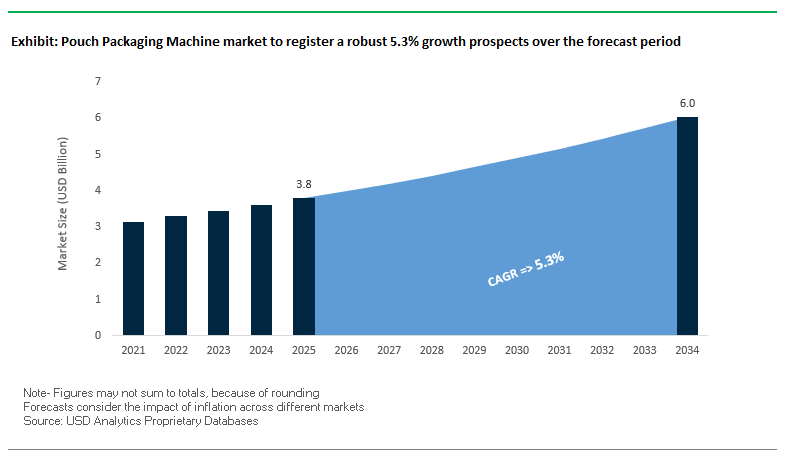
The global pouch packaging machine market is expected to grow from USD 3.8 billion in 2025 to USD 6 billion by 2034, registering a steady CAGR of 5.3%. The expansion is fueled by the food and beverage sector, which remains the largest end-user of pouch packaging equipment. Rising demand for snacks, ready-to-eat meals, dairy products, and powdered beverages continues to drive adoption of sophisticated, high-speed, and automated pouch packaging lines across global markets.
Vertical Form Fill Seal (VFFS) machines dominate the market thanks to their ability to handle powders, liquids, and solid items with equal efficiency. Their versatility makes them a cornerstone for snack, confectionery, and pet food producers. A major trend shaping the industry is automation, with more than 80% of new installations in developed markets fully automated to reduce labor dependency and maximize output. Another driver is speed new-generation machines are capable of packaging over 200 pouches per minute, meeting the growing requirements of large-scale supply chains and high-volume launches.
Key Insights for Industry Professionals:
Food & beverage leads demand with stringent quality and hygiene standards.
VFFS machines dominate due to unmatched versatility across product types.
Automation adoption exceeds 80% in developed markets, reducing costs and downtime.
High-speed machines (200+ pouches/minute) are critical to supply chain optimization.
Market Analysis: Recent Industry Developments Fueling Growth
The pouch packaging machine industry is evolving rapidly through technology innovations, sustainable material handling, and strategic mergers.
In August 2025, Syntegon unveiled Amplified Heat Sealing (AHS) technology at PACK EXPO, improving seal tightness and compatibility with sustainable mono-materials a critical innovation as the industry shifts to recyclable films. In July 2025, ProAmpac launched recyclable fiber-based barrier technology for thermoforming applications, demonstrating the need for machines adaptable to eco-friendly packaging.
The wave of consolidation continues to reshape the ecosystem. In May 2025, Amcor completed its USD 8.4 billion acquisition of Berry Global, broadening packaging capabilities and indirectly boosting machine demand across flexible formats. That same month, Sidel presented its Aseptic Combi Predis™ at ProPak Asia, combining blow-fill-cap technology for PET and pouch applications in dairy and beverage markets. Earlier in March 2025, Mondi collaborated with Proquimia to introduce paper-based stand-up pouches for dishwashing tabs, highlighting demand for machines capable of handling innovative substrates.
Meanwhile, companies are investing in sustainability-driven solutions. Klabin launched its Wicket Paper Bag in January 2025, developed with Optima and Soulpack, pushing machine suppliers to adapt to 100% recyclable and repulpable formats. This reflects the global transition toward machines engineered to handle bio-based polymers, recyclable films, and mono-materials, ensuring compliance with evolving regulations.
Emerging Trends and Opportunities Transforming the Pouch Packaging Machine Market
Integration of AI and Machine Vision for Unprecedented Quality Control and Efficiency
The pouch packaging machine market is undergoing a paradigm shift with the integration of artificial intelligence (AI) and machine vision systems. Manufacturers are moving beyond conventional automation to deploy AI-powered, high-resolution imaging that enables zero-defect packaging and predictive maintenance. This innovation is being fueled by demand from high-speed consumer packaged goods (CPG) and pharmaceutical production lines, where quality consistency and uptime are mission-critical.
AI-enabled defect detection systems, such as those pioneered by VMG Technics, are setting new benchmarks by photographing each foil pouch at high resolution and automatically rejecting faulty packs before boxing. This drastically reduces contamination risks and ensures seal integrity, which is particularly vital in food and pharma. Predictive maintenance supported by IoT sensors is another dimension of this trend, allowing operators to anticipate machine failures before they occur, slashing downtime, and improving productivity. Pilot runs in leading facilities have already reported 25% reductions in wasted plastic films. Furthermore, AI-based monitoring ensures accurate fill weights and wrinkle-free sealing, meeting the rising quality expectations in highly regulated sectors.
Rapid Reconfiguration and Modular Design for High-Mix, Low-Volume Production
Another strong trend shaping the pouch packaging machine market is the adoption of modular, reconfigurable systems tailored for high product variety and low-volume runs. With the explosion of SKUs in e-commerce, seasonal editions, and personalized packaging, brands demand equipment capable of producing multiple pouch types without extensive downtime.
Innovators like PROVOL have introduced systems that reduce changeover times to as little as 10 seconds, drastically improving Overall Equipment Efficiency (OEE). Modular architectures allow dual functionality running two product formats simultaneously saving valuable floor space and enhancing flexibility. This capability extends to handling diverse pouch formats, including pillow packs, gusseted pouches, and stand-up varieties, and materials ranging from liquids to powders. Such versatility positions modular pouch packaging systems as essential tools for manufacturers catering to diverse consumer preferences while reducing costs and time-to-market.
Development of Machines for Advanced Recyclable and Bio-Based Mono-Material Pouches
Sustainability is creating a lucrative opportunity for pouch packaging machine manufacturers to adapt systems for recyclable and bio-based mono-material pouches. Unlike conventional multi-layer films, new eco-friendly polyolefin and paper-based laminates present challenges such as narrow sealing windows and higher wrinkle risks. This has led to an urgent demand for machines that incorporate precise thermal management and next-generation sealing technologies.
For example, ExxonMobil’s recent innovation widened the sealing window of mono-material films by more than 50%, enabling smoother operation on Vertical Form Fill Seal (VFFS) lines. Meanwhile, ultrasonic sealing is gaining ground as a low-energy alternative that reduces film damage and enhances compatibility with heat-sensitive materials. Machine builders are also introducing next-generation Horizontal Form Fill Seal (HFFS) machines capable of quick adjustments between laminate and co-extruded sustainable films, enabling manufacturers to shift seamlessly toward eco-friendly packaging. This opportunity aligns closely with global regulatory pushes, such as the EU’s Packaging and Packaging Waste Regulation (PPWR) and brand commitments to eliminate multi-layer plastics from their portfolios.
Expansion of Integrated Aseptic and Low-Acid Pouch Filling Capabilities for Food and Pharma
The rising demand for shelf-stable food, nutraceuticals, and biologics is creating a high-value opportunity for pouch packaging machine builders specializing in aseptic and low-acid filling. These machines must integrate advanced sterilization systems such as H₂O₂ vapor and e-beam treatments, as well as ultra-clean environments with HEPA filtration, to comply with stringent FDA and EMA regulations.
Recent innovations are setting the pace. In August 2025, SIG launched a pre-made aseptic pouch system featuring in-line sterilization, reducing logistical complexity while ensuring product integrity. These solutions extend shelf life without refrigeration, addressing the growing consumer demand for convenient, long-lasting food products. Data from Canadian food exports illustrates the importance of aseptic technologies, as processed food and beverage exports exceeded $54 billion in 2022, much of which relied on aseptic packaging. Pharmaceutical and nutraceutical companies are equally driving adoption, as sterile pouch filling safeguards product efficacy and meets compliance standards.
Competitive Landscape: Leading Players in Pouch Packaging Machines
The pouch packaging machine market is highly competitive, led by global manufacturers advancing in automation, Industry 4.0 integration, and sustainable material handling capabilities.
Syntegon Technology GmbH: Driving Sustainability with Heat-Sealing Innovation
Syntegon (formerly Bosch Packaging Technology) provides scalable solutions from entry-level systems to fully automated pouch packaging lines. In August 2025, it launched AHS sealing technology, delivering tight seals for recyclable mono-materials. The company also integrates digital solutions like Synexio cloud platforms and Guide-by-Light systems, enabling predictive maintenance and downtime reduction. Its strategy centers on automation, labor efficiency, and recyclable material adaptability.
Ishida Co., Ltd.: Integrating Weighing and Pouch Packaging Solutions
Ishida is renowned for its multihead weighers and automated pouching equipment, particularly in food packaging. Its machines, widely adopted in snacks, frozen food, and fresh produce sectors, ensure precise weighing and consistent sealing. Ishida’s integrated solutions combine pouch machines with high-speed weighers and automated feeding systems, maximizing throughput. With its hygienic and user-friendly design, Ishida is a top choice for high-volume food processors.
Sidel Group: Aseptic and Integrated Turnkey Packaging Systems
Sidel, while best known for PET bottling lines, is expanding into pouch packaging for liquid applications. In May 2025, it showcased the Aseptic Combi Predis™ at ProPak Asia, highlighting aseptic technology as a differentiator in beverage and dairy markets. With its Evo-ON® cloud platform, Sidel ensures real-time production monitoring and optimization, offering end-to-end turnkey packaging solutions from engineering to post-installation support.
Barry-Wehmiller Companies, Inc.: Broad Portfolio with Flexible Packaging Expertise
Through BW Flexible Systems, Barry-Wehmiller provides VFFS, HFFS, and sealing systems under heritage brands like Hayssen and Symach. Known for ergonomic design and versatility, its machines support a variety of films, including eco-friendly options. Its strategy emphasizes equipment lifecycle support, offering not just new machines but also upgrades, remanufacturing, and training. This long-term customer-centric approach makes it a trusted supplier across food, beverage, hardware, and chemical industries.
Hassia-Redatron GmbH: Specialist in Sachet and Stickpack Machines
Hassia-Redatron focuses on primary packaging systems for liquids, pastes, and powders, including sachet and stickpack machines. It is advancing ultrasonic sealing and pulsed UVC-light sterilization technologies to improve barrier performance and hygiene. With dosing systems handling 3–300 ml, its machines are widely used in food, pharmaceuticals, and cosmetics. Its strength lies in aseptic packaging and CIP/SIP cleaning, making it a leader in precision-driven applications.
Pouch Packaging Machine Market Share Insights
Stand-Up Pouches Dominate Pouch Packaging Machine Market Share by Pouch Type
Stand-up pouches hold the largest share at 28% of the global pouch packaging machine market, underscoring their unmatched role in driving flexible packaging adoption. Their structural design not only enhances shelf visibility but also reduces material use compared to rigid packaging, making them the preferred format for snacks, coffee, pet food, and ready-to-eat meals. The rise of e-commerce and retail-ready convenience packaging further cements their dominance. While spouted pouches are emerging as the fastest-growing format due to their adoption in baby food, dairy, and sports nutrition, and stick packs and sachets drive immense unit volumes in single-serve foods and pharmaceuticals, it is stand-up pouches that remain the anchor segment. Their scalability, branding potential, and compatibility with high-speed automation explain why machine demand is concentrated in this category, making it the benchmark for growth and efficiency in pouch packaging machinery.
Food & Beverages Lead Pouch Packaging Machine Market Share by Application
Food & beverages account for 55% of the pouch packaging machine market, making this the undisputed leader in application demand. The segment’s dominance is rooted in the global appetite for convenience foods, portion-controlled packaging, and sustainable formats that reduce transport and storage costs. Machines designed for this sector must handle a wide variety of formats from high-barrier stand-up pouches for dry snacks to spouted pouches for beverages while ensuring seal integrity and product freshness. Pharmaceutical and healthcare applications are a fast-growing, high-margin opportunity, requiring precision and compliance with FDA and cGMP standards, while cosmetics and personal care drive premiumization with small-batch sachets and high-quality seals. Chemicals remain a niche but vital segment, demanding robust, corrosion-resistant systems for safety-critical packaging. Still, the overwhelming scale of food and beverage consumption ensures this application segment will continue to define the majority of capital investment in pouch packaging machinery.
United States: Consumer Trends and Advanced Automation Driving Pouch Packaging Machines
The U.S. pouch packaging machine market is witnessing significant growth, propelled by evolving consumer preferences for flexible, lightweight, and convenient single-serve pouches for food, beverages, and personal care products. Manufacturers are increasingly investing in high-speed, fully integrated systems with IoT and AI capabilities, enabling automation that minimizes human intervention and maximizes throughput.
Sustainability is a key driver, with companies developing machines capable of handling recyclable, biodegradable, and compostable films to meet corporate sustainability goals and growing consumer demand for eco-friendly packaging. The pharmaceutical and healthcare sectors also play a pivotal role, as hygienic, tamper-evident, and sterile packaging is critical for medical devices and medicines. Compliance with federal and state regulations, including Extended Producer Responsibility (EPR), is shaping product design, ensuring machines meet food safety standards and environmental requirements.
Germany: Circular Economy and Regulatory Compliance Shaping Market Growth
Germany’s pouch packaging machine market is strongly influenced by stringent regulations, particularly the EU Packaging and Packaging Waste Regulation (PPWR). These regulations create high demand for machinery that can efficiently process mono-material pouches and support the country’s circular economy objectives. Manufacturers are collaborating with end-users to develop systems that align with national and EU recycling targets, reflecting Germany’s leadership in sustainable packaging solutions.
Technological innovation is also a major factor. Companies like SN Maschinenbau are at the forefront, producing world-leading horizontal form, fill, and seal (HFFS) machines for food, pet food, and other products. This focus on innovation ensures Germany remains a hub for highly automated, energy-efficient, and environmentally responsible pouch packaging machinery.
China: Industrial Expansion and High-Speed Automation Driving Market Demand
China’s pouch packaging machine industry is experiencing rapid growth due to the country’s massive industrial expansion and increasing manufacturing activities across food, pharmaceutical, and logistics sectors. Chinese manufacturers are heavily investing in automation, AI, and robotics, which enhance production efficiency and create new opportunities for machines designed for automated handling.
High-speed machines are a key trend, with features such as intelligent fault diagnosis and hot and cold double sealing systems ensuring 100% airtightness. The government’s “dual carbon” goals are also shaping the market, encouraging the adoption of eco-friendly, reusable, and reduced-material packaging solutions. These factors position China as a leading market for efficient, technologically advanced, and sustainable pouch packaging machines.
India: E-commerce Expansion and Government Initiatives Accelerate Market Growth
India’s pouch packaging machine market is benefiting from government initiatives like the Production Linked Incentive Scheme, which supports food processing and pharmaceutical sectors while stimulating capital investment in automated packaging lines and cold-chain infrastructure. The rapid growth of e-commerce and online grocery platforms has created high demand for hygienic, durable, and lightweight pouch packaging solutions.
Sustainability is a major trend, driven by the Plastic Waste Management (Amendment) Rules, which promote eco-friendly and reusable materials. Strategic investments exceeding INR 10,000 crore since 2022 have upgraded wash lines, extruders, and de-contamination units, creating a need for new and advanced pouch packaging machinery. These developments reinforce India’s role as a fast-growing and technologically evolving market.
Brazil: Sustainability and Technological Advancements Driving Innovation
The Brazilian pouch packaging machine market is being propelled by regulatory measures restricting single-use plastics, including the National Solid Waste Policy, which emphasizes circular economy principles. Technological advancements, such as AI-enabled robotics, are being integrated to enhance production efficiency, from automated sorting to defect detection, improving accuracy and speed in manufacturing.
Sustainability-focused innovations are also on the rise. For example, SIG Group partnered with a major dairy producer to introduce spouted pouch packaging for yogurt, demonstrating a strong emphasis on eco-friendly, functional, and high-quality packaging solutions. These factors are driving Brazil’s market toward innovative, sustainable, and efficient pouch packaging technologies.
Japan: Advanced Recycling and Functional Innovation Leading the Market
Japan’s pouch packaging machine industry benefits from one of the world’s highest rates of plastic and paper recycling, supported by the Plastic Resource Circulation Act, providing a solid foundation for circular packaging solutions. The market is witnessing a shift toward bio-based materials, such as bio-polypropylene (bio-PP), supported by collaborations between LyondellBasell, Shiseido, Futamura Chemical, and Iwatani for cosmetic packaging.
Innovation in functionality is a key growth driver. Companies like Omori Machinery lead in horizontal form-fill-seal machines, while enhanced inspection systems, including X-ray and infrared cameras, are increasingly used to ensure food safety. These developments position Japan as a pioneer in high-quality, sustainable, and technologically advanced pouch packaging machinery.
Pouch Packaging Machine Market Report Scope
Pouch Packaging Machine market
Parameter
Details
Market Size (2025)
$3.8 Billion
Market Size (2034)
$6 Billion
Market Growth Rate
5.3%
Segments
By Pouch Type (Stand-up Pouches, Flat Pouches, Spouted Pouches, Gusseted Pouches, Stick Packs, Sachets, Other Pouch Types), By Machine Type (VFFS, HFFS, Pre-made Pouch Machines, Rotary Pouch Machines), By Application (Food & Beverages, Pharmaceuticals & Healthcare, Cosmetics & Personal Care, Chemicals, Other Applications)
Study Period
2019- 2024 and 2025-2034
Units
Revenue (USD)
Qualitative Analysis
Porter’s Five Forces, SWOT Profile, Market Share, Scenario Forecasts, Market Ecosystem, Company Ranking, Market Dynamics, Industry Benchmarking
Companies
Bosch Packaging Technology, IMA Group, ProMach Inc., SN Maschinenbau GmbH, AlliedFlex Technologies, Inc., The Viking Masek, HPM Global, Inc., Nichrome India Ltd., O.M.G. S.r.l., Omori Machinery Co., Ltd., R.A Jones, Sacmi S.c., Scholle IPN, Volpak S.A., Zip-Pak, a division of ITW
Countries
US, Canada, Mexico, Germany, France, Spain, Italy, UK, Russia, China, India, Japan, South Korea, Australia, South East Asia, Brazil, Argentina, Middle East, Africa
Europe (Germany, UK, France, Spain, Italy, Russia, Rest of Europe)
Asia Pacific (China, India, Japan, South Korea, Australia, South East Asia, Rest of Asia)
South America (Brazil, Argentina, Rest of South America)
Middle East and Africa (Saudi Arabia, UAE, Rest of Middle East, South Africa, Egypt, Rest of Africa)
Top Companies in Pouch Packaging Machine Market
Bosch Packaging Technology
IMA Group
ProMach Inc.
SN Maschinenbau GmbH
AlliedFlex Technologies, Inc.
The Viking Masek
HPM Global, Inc.
Nichrome India Ltd.
O.M.G. S.r.l.
Omori Machinery Co., Ltd.
R.A Jones
Sacmi S.c.
Scholle IPN
Volpak S.A.
Zip-Pak, a division of ITW
*List not Exhaustive
Research Coverage
This report by USDAnalytics investigates the global pouch packaging machine market, offering an in-depth analysis of recent breakthroughs, emerging technologies, and evolving market dynamics shaping flexible packaging. The analysis reviews advancements in automation, Vertical Form Fill Seal (VFFS) versatility, high-speed production capabilities, and sustainable mono-material handling, highlighting their impact on productivity, compliance, and operational efficiency. It also explores strategic developments such as mergers, acquisitions, and collaborations that influence supply chain optimization and market expansion. This report highlights innovations in AI integration, machine vision, modular designs, and aseptic filling systems, providing actionable insights for manufacturers, OEMs, and end-users. By covering competitive strategies, technological adoption, and regional growth patterns, this report is an essential resource for industry professionals seeking to make informed decisions in equipment investment, process automation, and sustainability-driven packaging solutions.
Scope Highlights:
Segmentation: By Pouch Type (Stand-up Pouches, Flat Pouches, Spouted Pouches, Gusseted Pouches, Stick Packs, Sachets, Other Pouch Types), By Machine Type (VFFS, HFFS, Pre-made Pouch Machines, Rotary Pouch Machines), By Application (Food & Beverages, Pharmaceuticals & Healthcare, Cosmetics & Personal Care, Chemicals, Other Applications)
Geographic Scope: Analysis spans 25+ countries across North America, Europe, Asia Pacific, Latin America, the Middle East & Africa
Timeframe: Historic data from 2021 to 2024 and forecast data from 2025 to 2034
Companies: Analysis and profiles of 15+ leading companies, including Syntegon, Ishida, Sidel, Barry-Wehmiller, Hassia-Redatron, Omori Machinery, Bosch Packaging Technology, and others
Methodology
USDAnalytics employed a robust combination of primary and secondary research methodologies to ensure comprehensive coverage of the pouch packaging machine market. Primary research involved structured interviews and consultations with equipment manufacturers, OEMs, distributors, and end-users to obtain firsthand insights on adoption trends, technological innovation, and regulatory impacts. Secondary research incorporated analysis of company annual reports, patent filings, government regulations, trade publications, and industry journals to compile historical data and identify growth drivers. Quantitative modeling techniques were applied to estimate market size, segment shares, and regional distribution, while qualitative assessment examined competitive strategies, sustainability integration, and operational efficiencies. The methodology provides reliable forecasts and actionable insights, enabling stakeholders to evaluate investment opportunities, optimize production processes, and anticipate market shifts in a rapidly evolving packaging landscape.
Deliverables:
Comprehensive Market Research Report (PDF and Excel) with detailed tables, charts, and interactive visualizations.
Country-Specific Forecasts & Analysis.
Segment-Wise Revenue Forecasts (2025–2034).
Competitive Analysis, Benchmarking, and SWOT Profiles.
Recent Developments & Innovation Tracker.
Executive Summary & Analyst Commentary.
Post-Purchase Analyst Support for Client-Specific Questions and Custom Data Requirements.
2. Pouch Packaging Machine Market Landscape & Outlook (2025–2034)
2.1. Introduction to Pouch Packaging Machine Market
2.2. Market Valuation and Growth Projections (2025–2034)
2.3. Automation and Vertical Form Fill Seal (VFFS) Versatility Driving Market Expansion
2.4. High-Speed Packaging Demands Transforming Operational Efficiency
2.5. Regulatory Shifts and Sustainability Standards Shaping Market Adoption
3. Innovations Reshaping the Pouch Packaging Machine Market
3.1. Trend: Integration of AI and Machine Vision for Quality Control and Predictive Maintenance
3.2. Trend: Rapid Reconfiguration and Modular Design Enabling High-Mix Production
3.3. Opportunity: Development of Machines for Recyclable and Bio-Based Mono-Material Pouches
3.4. Opportunity: Expansion of Aseptic and Low-Acid Pouch Filling Capabilities
4. Competitive Landscape and Strategic Initiatives
4.1. Mergers, Acquisitions, and Strategic Alliances
4.2. R&D and Material Innovation
4.3. Sustainability and Circular Economy Strategies
4.4. Market Expansion and Regional Focus
5. Market Share and Segmentation Insights: Pouch Packaging Machine Market
5.1. By Pouch Type
5.1.1. Stand-up Pouches
5.1.2. Flat Pouches
5.1.3. Spouted Pouches
5.1.4. Gusseted Pouches
5.1.5. Stick Packs
5.1.6. Sachets
5.1.7. Other Pouch Types
5.2. By Machine Type
5.2.1. Vertical Form Fill Seal (VFFS)
5.2.2. Horizontal Form Fill Seal (HFFS)
5.2.3. Pre-Made Pouch Machines
5.2.4. Rotary Pouch Machines
5.3. By Application
5.3.1. Food & Beverages
5.3.2. Pharmaceuticals & Healthcare
5.3.3. Cosmetics & Personal Care
5.3.4. Chemicals
5.3.5. Other Applications
6. Country Analysis and Outlook of Pouch Packaging Machine Market
6.1. United States
6.2. Canada
6.3. Mexico
6.4. Germany
6.5. France
6.6. Spain
6.7. Italy
6.8. UK
6.9. Russia
6.10. China
6.11. India
6.12. Japan
6.13. South Korea
6.14. Australia
6.15. South East Asia
6.16. Brazil
6.17. Argentina
6.18. Middle East
6.19. Africa
7. Pouch Packaging Machine Market Size Outlook by Region (2025–2034)
7.1. North America Pouch Packaging Machine Market Size Outlook to 2034
7.1.1. By Pouch Type
7.1.2. By Machine Type
7.1.3. By Application
7.2. Europe Pouch Packaging Machine Market Size Outlook to 2034
7.2.1. By Pouch Type
7.2.2. By Machine Type
7.2.3. By Application
7.3. Asia Pacific Pouch Packaging Machine Market Size Outlook to 2034
7.3.1. By Pouch Type
7.3.2. By Machine Type
7.3.3. By Application
7.4. South America Pouch Packaging Machine Market Size Outlook to 2034
7.4.1. By Pouch Type
7.4.2. By Machine Type
7.4.3. By Application
7.5. Middle East and Africa Pouch Packaging Machine Market Size Outlook to 2034
7.5.1. By Pouch Type
7.5.2. By Machine Type
7.5.3. By Application
8. Company Profiles: Leading Players in the Pouch Packaging Machine Market
8.1. Syntegon Technology GmbH
8.2. Ishida Co., Ltd.
8.3. Sidel Group
8.4. Barry-Wehmiller Companies, Inc.
8.5. Hassia-Redatron GmbH
8.6. Bosch Packaging Technology
8.7. IMA Group
8.8. SN Maschinenbau GmbH
8.9. AlliedFlex Technologies, Inc.
8.10. Viking Masek
8.11. Nichrome India Ltd.
8.12. Omori Machinery Co., Ltd.
8.13. R.A Jones
8.14. Volpak S.A.
8.15. Zip-Pak (ITW Division)
9. Methodology
9.1. Research Scope
9.2. Market Research Approach
9.3. Market Sizing and Forecasting Model
9.4. Research Coverage
9.5. Data Horizon
9.6. Deliverables
10. Appendix
10.1. Acronyms and Abbreviations
10.2. List of Tables
10.3. List of Figures
Pouch Packaging Machine Market Segmentation
By Pouch Type
Stand-up Pouches
Flat Pouches
Spouted Pouches
Gusseted Pouches
Stick Packs
Sachets
Other Pouch Types
By Machine Type
VFFS
HFFS
Pre-made Pouch Machines
Rotary Pouch Machines
By Application
Food & Beverages
Pharmaceuticals & Healthcare
Cosmetics & Personal Care
Chemicals
Other Applications
Countries Analyzed
North America (US, Canada, Mexico)
Europe (Germany, UK, France, Spain, Italy, Russia, Rest of Europe)
Asia Pacific (China, India, Japan, South Korea, Australia, South East Asia, Rest of Asia)
South America (Brazil, Argentina, Rest of South America)
Middle East and Africa (Saudi Arabia, UAE, Rest of Middle East, South Africa, Egypt, Rest of Africa)
Market growth is fueled by rising demand from food & beverage, pharmaceutical, and personal care sectors, coupled with the increasing adoption of automation, AI, and high-speed packaging systems. Sustainability initiatives and regulations promoting recyclable and bio-based materials further boost market adoption globally.
Stand-up pouches dominate due to their shelf appeal, material efficiency, and compatibility with automated lines. VFFS machines lead in versatility, handling powders, liquids, and solids efficiently, while HFFS and pre-made pouch machines are preferred for niche applications like aseptic or delicate packaging.
AI-enabled systems improve quality control, enabling zero-defect packaging by detecting seal faults, fill inconsistencies, and material defects in real time. Machine vision supports predictive maintenance, reduces downtime, and enhances operational efficiency, particularly in high-speed food, beverage, and pharmaceutical lines.
Sustainability drives the adoption of machines capable of handling mono-material, recyclable, and bio-based films. Advanced sealing technologies, ultrasonic solutions, and thermal management systems ensure eco-friendly packaging while maintaining product integrity, complying with EU and global recycling regulations.
Asia-Pacific leads due to rapid industrialization, e-commerce expansion, and government incentives for sustainable packaging. North America and Europe follow, driven by advanced automation, strict regulatory compliance, and strong food & beverage demand, while emerging markets like India and Brazil show high growth potential through policy support and technological upgrades.
More Equipment, Services and End-use Products Reports