Vacuum Grease Market Overview 2025–2034: $911.3 Million to $2,588.7 Million at 12.3% CAGR Accelerated by Semiconductor Expansion, Hydrogen Infrastructure, and Space-Grade Lubrication
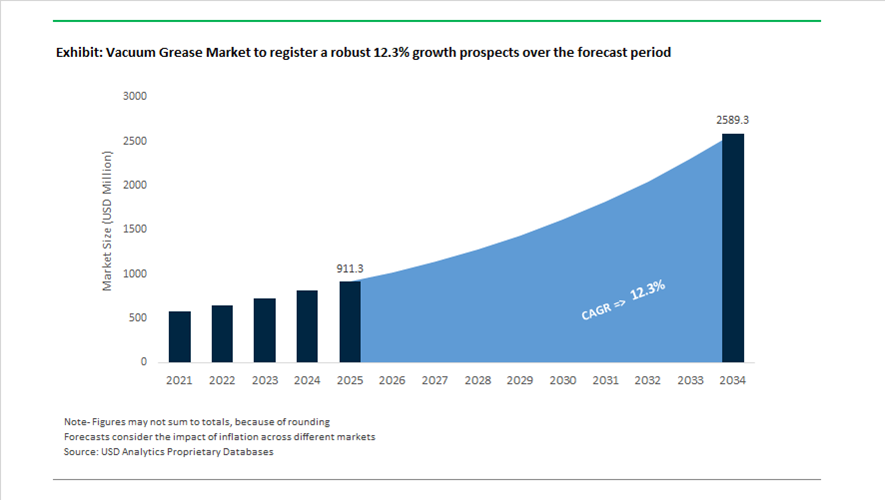
The global Vacuum Grease market is valued at $911.3 million in 2025 and is projected to reach $2,588.7 million by 2034, expanding at a strong CAGR of 12.3%. Growth is being driven by rising demand for high-vacuum lubricants, silicone-based vacuum greases, perfluoropolyether (PFPE) greases, hydrogen-compatible lubricants, semiconductor-grade sealing greases, and space-qualified ultra-high-vacuum (UHV) lubricants. Increasing capital expenditure in semiconductor fabrication, hydrogen refueling infrastructure, EV manufacturing, and aerospace programs is elevating performance standards for low vapor pressure, chemical inertness, dielectric stability, and extreme temperature resistance. Vacuum grease formulations are increasingly engineered to meet contamination-free processing requirements in electronics, cleanrooms, and high-pressure hydrogen systems while maintaining sealing integrity under ultra-low pressure environments.
Strategic consolidation and regional manufacturing investments accelerated between 2024 and 2026. In May 2024, FUCHS Group acquired LUBCON, strengthening its high-performance lubricant portfolio, particularly in vacuum and semiconductor-grade grease applications. The same month, Klüber Lubrication announced a $17.4 million investment in a new Mysore, India facility to produce specialty lubricants, including vacuum-compatible grades for South Asia’s industrial expansion. In November 2025, DuPont broke ground on a new Molykote specialty lubricant plant in Zhangjiagang, China, targeting electronics and transportation sectors, with operations expected by early 2027. Effective January 2026, Klüber Lubrication and OKS Spezialschmierstoffe integrated operations, consolidating R&D capabilities for advanced high-temperature and vacuum grease systems. In March 2025, Klüber received EcoVadis Gold recognition, reinforcing its sustainability positioning in specialty lubricants. In November 2025, M&I Materials, manufacturer of Apiezon vacuum greases, launched a sustainable feedstock challenge in partnership with Innovate UK to develop non-fossil alternatives to petroleum jelly, signaling a structural shift toward bio-based and recycled hydrocarbon feedstocks.
Application diversification into hydrogen energy, aerospace, and advanced waste processing is expanding market depth. In early 2025, DuPont confirmed that Molykote HP-300 passed hydrogen purity testing for 700-bar refueling systems, qualifying the grease for fuel-cell vehicle infrastructure without contaminating compressed hydrogen streams. Throughout 2025, Castrol announced deployment of its Braycote and Brayco vacuum-stable lubricants in lunar lander missions, addressing extreme vacuum and cryogenic temperature conditions. In May 2024, DuPont introduced Molykote Multilub Synthetic, engineered for wide-temperature operation down to -50°C, targeting low-vacuum outdoor and industrial applications. In May 2024, Beijing Oriental Fuhai Technology under the Lodolle Group launched environmentally benign vacuum greases tailored for EV and electronics manufacturing. In early 2026, Suez integrated high-integrity vacuum sealing greases into pyrocarbonisation plants developed with PYREG, where vacuum evaporation and sludge conversion systems require contamination-resistant sealing performance.
Trends and Opportunities in the Vacuum Grease Market
Reliability-Critical Formulation for Sub-2nm Semiconductor Fabrication
The transition to sub-2nm semiconductor nodes has elevated vacuum grease from a maintenance consumable to a yield-critical material. Extreme Ultraviolet lithography, atomic layer etching, and high-density plasma processes expose seals, robotic joints, and load-lock interfaces to aggressive fluorine chemistries and ultra-high vacuum conditions where even trace outgassing can trigger catastrophic contamination events. As a result, semiconductor fabs are standardizing on perfluoropolyether-based vacuum greases engineered for near-zero vapor pressure and chemical inertness.
In September 2025, leading formulators such as Chemours and FUCHS introduced next-generation PFPE vacuum greases designed to withstand continuous exposure to fluorine-rich plasmas. These products exhibit vapor pressures approaching 10⁻¹³ Torr at 20°C, ensuring that dynamic components such as wafer-handling robots and slit valves do not introduce volatile contaminants into EUV chambers.
Equipment-level specifications are reinforcing this shift. Technical briefings at SEMICON India 2025 highlighted that Tier-1 vacuum equipment suppliers, including Pfeiffer Vacuum, are now qualifying valves and seals only with greases demonstrating zero volatile condensable materials. This mandate reflects empirical data showing that organic contamination can reduce wafer yields by 15 to 20% at advanced nodes, directly linking grease selection to fab profitability and uptime.
Rigorous Standardization for Aerospace and National Security Projects
In aerospace and defense, vacuum grease demand is being reshaped by formal certification regimes rather than discretionary performance claims. Space agencies and military programs are converging on tightly defined outgassing and thermal stability thresholds to mitigate the risk of sensor fouling, actuator seizure, and seal failure in vacuum environments.
Updated ASTM E595 testing protocols reinforced in May 2025 require vacuum materials to demonstrate a Total Mass Loss below 1.0% and Collected Volatile Condensable Materials below 0.1%. These criteria are now embedded in procurement audits for satellite constellations and national security payloads, where even minor contamination can degrade optical instruments or infrared sensors. PFPE greases and specialized silicone formulations are being validated against these benchmarks to support the rapid expansion of small-satellite deployments.
Thermal resilience is equally decisive. New military-grade specifications such as MIL-PRF-27617 Type IV require vacuum greases to remain functional across an extreme temperature envelope ranging from minus 73°C to 399°C. This requirement enables lifetime lubrication of seals and actuators in deep-space missions, hypersonic platforms, and high-altitude defense systems, where repeated thermal cycling would cause conventional lubricants to crack, volatilize, or lose sealing integrity.
High-Impact Sealing for Quantum Computing Infrastructure
The commercialization of quantum computing is creating a distinct, high-margin opportunity for vacuum grease manufacturers capable of addressing ultra-low-temperature sealing challenges. Dilution refrigerators used to cool superconducting qubits operate at temperatures approaching 10 millikelvin, where helium leakage or seal failure can collapse the quantum state and halt computation.
In April 2025, ULVAC installed Japan’s first domestically built dilution refrigerator at a leading research institute, underscoring the strategic importance of localized cryogenic infrastructure. Within these systems, vacuum greases are applied to feedthroughs, flanges, and gasket interfaces to prevent helium permeation. A single vacuum breach can result in system downtime valued at approximately $100,000 per week in lost research productivity.
As quantum programs scale, technology leaders such as Google and IBM are demanding greases that remain pliable and non-brittle at near-absolute zero while maintaining ultra-low outgassing. This is driving demand for formulations supported by audited cryogenic performance data, creating a defensible niche for suppliers with validated quantum-grade solutions.
Thermally Conductive Sealing for EV Vacuum Insulation
Electric vehicle manufacturers are increasingly integrating vacuum-based thermal management solutions to extend driving range and improve cabin efficiency, opening a new application frontier for multifunctional vacuum greases. Vacuum Insulation Panels are being deployed in headliners, battery enclosures, and power electronics housings to minimize heat transfer under both hot and cold operating conditions.
Research presented in October 2025 demonstrated that EVs equipped with vacuum insulation can maintain cabin temperatures approximately 7.7°C higher in winter and 3.9°C lower in summer compared to conventional materials. This translates into a 5 to 8% reduction in auxiliary energy demand, directly enhancing vehicle range. Vacuum greases play a critical role during panel fabrication and assembly by ensuring vacuum-tight seals that prevent gradual pressure ingress and insulation degradation over the vehicle lifecycle.
Parallel to insulation, the migration toward 800V power architectures is increasing heat flux densities in inverters and power modules. Thermally conductive vacuum greases filled with boron nitride or similar fillers are being specified to eliminate air gaps while facilitating rapid heat dissipation. This dual-function requirement of sealing integrity and thermal conductivity positions EV-focused vacuum grease applications as a faster-growing segment than traditional laboratory or industrial uses, particularly as automakers pursue aggressive efficiency and durability targets.
Vacuum Grease Market Share and Segmentation Insights
Base Oil Type Market Share: Fluorinated Greases Lead with Ultra-Low Vapor Pressure and Chemical Stability
Fluorinated greases account for 42.80% of the vacuum grease market in 2025, driven by their exceptional chemical inertness, thermal stability, and ultra-low vapor pressure required for high and ultra-high vacuum environments. These perfluoropolyether-based greases are critical in preventing outgassing and contamination in sensitive applications. Silicone-based, hydrocarbon-based, and ester or polyalphaolefin greases serve less demanding vacuum conditions with cost-performance trade-offs. A key market driver is semiconductor vacuum integrity, where advanced wafer fabrication processes require contamination-free environments, increasing reliance on high-performance fluorinated greases optimized for aggressive gases and extreme process conditions.
Application Market Share: Semiconductor and Electronics Segment Leads with Cleanroom and Uptime Requirements
Semiconductor and electronics hold a 42.80% share in the vacuum grease market in 2025, supported by the extensive use of vacuum systems in wafer processing, thin-film deposition, and etching technologies. Vacuum greases are essential for sealing, lubrication, and maintaining vacuum integrity in precision equipment. Laboratory research, industrial processing, aerospace, and automotive sectors contribute additional demand across specialized applications. A key trend is the focus on equipment uptime in semiconductor fabrication facilities, where high-reliability grease formulations with extended service life and cleanroom compatibility are critical for reducing maintenance cycles and ensuring uninterrupted production in capital-intensive manufacturing environments.
Vacuum Grease Market Competitive Landscape
The Vacuum Grease market in 2026 is defined by material inertness engineering, PFPE and Z-PFPE lubricants, and hydrogen-compatible, oxygen-safe formulations designed for extreme temperatures, radiation resistance, and ultra-low outgassing across aerospace, semiconductor, and clean energy applications.
DuPont MOLYKOTE® Expands PFAS-Free and Hydrogen-Compatible Vacuum Grease Portfolio
DuPont is strengthening its leadership in the Vacuum Grease market through its MOLYKOTE® specialty lubricants portfolio, combining PFAS-free innovation with high-performance vacuum stability. The new Zhangjiagang manufacturing facility enhances regional supply for Asia’s electronics and transportation sectors. MOLYKOTE® HP-300 Grease has achieved BAM certification for oxygen service and compliance with ISO 14687 hydrogen standards, positioning it for green hydrogen infrastructure. Its silicone-based greases deliver thermal stability from -40°C to 204°C with strong oxidation resistance and adhesion. The company’s PFAS-free compounds address regulatory pressure on fluorinated materials in sensitive applications. This balance of compliance, performance, and regional expansion reinforces DuPont’s competitive position.
Castrol Braycote® Dominates Extreme Vacuum Applications in Aerospace and Space Systems
Castrol is leading the extreme vacuum grease segment through its Braycote® PFPE-based lubricants engineered for aerospace and satellite systems. These greases are deployed in mission-critical hardware on the International Space Station and Mars rovers, emphasizing ultra-low outgassing and contamination control. Castrol expanded its aviation MRO portfolio with Braycote 601 EF and Micronic 1613, supporting long-life lubrication in jet and rocket systems. The company is extending its vacuum-grade technologies into subsea robotics and deep-sea exploration, leveraging pressure and chemical stability. Its technical consulting services enable OEMs to optimize lubricant selection for cleanroom and semiconductor environments. This “ocean-to-orbit” capability strengthens Castrol’s leadership in high-reliability applications.
Chemours Krytox™ Advances Semiconductor-Grade PFPE Lubricants with Extreme Thermal Stability
Chemours is a premium player in the Vacuum Grease market with its Krytox™ PFPE lubricants designed for semiconductor and harsh chemical environments. Krytox™ VPF and LVP greases are optimized for EUV lithography and advanced chip fabrication processes, where ultra-low vapor pressure is critical. The Krytox™ 240 series offers exceptional performance across -73°C to 399°C, providing radiation resistance and long service life. The company is promoting extended lubrication intervals to support industrial decarbonization and lifecycle cost reduction. Its NSF H1-certified Krytox™ FG range addresses food-grade and packaging applications requiring vacuum-compatible lubricants. This combination of purity, durability, and regulatory compliance reinforces Chemours’ high-end positioning.
Klüber Lubrication Integrates Specialty Lubricants and Automation for Vacuum Systems
Klüber Lubrication is transforming its role in the Vacuum Grease market through strategic integration and sustainability-driven innovation. The merger with OKS Spezialschmierstoffe expands its portfolio to over 2,000 products, strengthening its expertise in high-performance lubrication. Its EcoVadis Gold recognition reflects strong progress in carbon reduction and environmental performance. Acquisition of TriboServ enables “Grease + Hardware” solutions, integrating automatic lubrication systems with precision dosing for vacuum equipment. Klüber is focusing on low-outgassing PFPE lubricants for semiconductor manufacturing, enhancing wear resistance and operational lifespan. This combination of digital maintenance, automation, and sustainability strengthens its competitive differentiation.
FUCHS SE Expands Smart Lubrication and High-Vacuum Capabilities Through Strategic Acquisitions
FUCHS SE is strengthening its presence in the Vacuum Grease market through acquisitions and digital lubrication strategies. Integration of the LUBCON Group enhances its portfolio in high-vacuum and cleanroom-compatible lubricants. Its partnership with KCF Technologies introduces AI-driven monitoring systems that predict lubricant degradation in vacuum pumps, improving reliability and uptime. Expansion of its Isando facility increases production capacity for specialty greases serving mining and industrial markets. The acquisition of IRMCO supports development of clean, low-residue lubrication technologies applicable to precision manufacturing. This focus on smart lubrication and global capacity expansion positions FUCHS as a key innovator in industrial vacuum systems.
United States Vacuum Grease Market Shaped by Lunar Missions, Semiconductor Fabs, and Circular PFPE Models
The United States vacuum grease market is being structurally reshaped by concurrent expansion in space exploration, advanced semiconductor manufacturing, and federally funded research infrastructure. In mid-2025, Castrol, part of BP, reaffirmed its long-term participation in the emerging lunar economy through the deployment of Braycote 601 EF formulations for commercial lunar lander missions. These ultra-high-performance vacuum greases are engineered to achieve total mass loss below 0.1% at pressures approaching 10−5 torr, making them indispensable for bearings, actuators, and seals operating in deep vacuum and extreme thermal cycling. This application reinforces the United States’ leadership in space-qualified lubrication technologies where outgassing control is mission critical.
Semiconductor manufacturing is a parallel demand accelerator. Under the CHIPS and Science Act, leading-edge fabrication facilities developed by Intel and TSMC in Arizona and Ohio have increased domestic consumption of Krytox VPF vacuum greases from Chemours. These perfluoropolyether-based lubricants are essential for contamination-free operation of extreme ultraviolet lithography chambers and high-vacuum transfer systems. Research intensity further supports demand. The U.S. Department of Energy reported an 8% rise in consumption of specialized vacuum lubricants in 2025, driven by maintenance of particle accelerators and high-energy physics facilities at national laboratories. Sustainability is also entering procurement decisions, as Chemours’ 2024–2025 Sustainability Report highlights circular PFPE recovery services that allow industrial users to recycle spent vacuum grease, cutting hazardous waste volumes by up to 40%. Innovation at the system level continues, with Sierra Space receiving patent approvals in late 2025 for composite spacecraft thermal regulation systems that rely on low-vapor-pressure vacuum greases to maintain seal integrity across a wide operating temperature range.
China Vacuum Grease Market Driven by EV Electronics and National Purity Standards
China’s vacuum grease market is increasingly aligned with electric vehicle manufacturing, precision electronics, and national green manufacturing targets. In May 2024, Beijing Oriental Fuhai Technology, part of the Lodolle Fine Chemicals Group, announced a breakthrough in environmentally benign vacuum grease formulations optimized for EV power electronics and sensitive electronic assemblies. These developments directly support China’s 2026 Green Manufacturing objectives, which emphasize reduced toxicity, improved photostability, and compatibility with high-vacuum environments.
Regulatory direction is reinforcing this shift. In late 2025, the Ministry of Industry and Information Technology implemented updated standards for high-purity chemicals used in Strategic Emerging Industries under the 14th Five-Year Plan. These standards mandate enhanced photostability and vacuum compatibility for lubricants deployed in precision optics and vacuum systems. On the supply side, manufacturers within the Zhejiang chemical cluster expanded production of technical-grade silicone vacuum greases during 2025. This capacity expansion has allowed Chinese suppliers to maintain a globally competitive pricing baseline, supporting steady exports to laboratory, industrial, and OEM customers worldwide while strengthening China’s role as a cost-efficient source for non-space-grade vacuum lubrication solutions.
India Vacuum Grease Market Linked to Semiconductor Localization and Space Programs
India’s vacuum grease market is transitioning from import dependence toward localized supply, driven by semiconductor investment and national space ambitions. In December 2025, the Ministry of Electronics and Information Technology approved ten semiconductor manufacturing units under the Semicon India Programme, representing investments totaling ₹1.6 lakh crore. These facilities include silicon carbide fabs and advanced packaging units that require high-vacuum-compatible sealing greases for process tools, load locks, and vacuum chambers, creating sustained domestic demand for premium lubricants.
Strategic partnerships are accelerating localization. In 2025, Chemours entered into an agreement with SRF Limited to manufacture performance chemicals in India by 2026, with fluorinated lubricants identified as a priority category. This initiative aims to shorten supply chains for vacuum greases used in high-tech manufacturing. Defense and space programs provide an additional anchor. Indian Space Research Organisation expanded its Gaganyaan vendor ecosystem in 2025 to include domestic suppliers of space-qualified vacuum lubricants, reducing reliance on imported Krytox and Braycote grades for non-critical subsystems while building indigenous capability.
South Korea Vacuum Grease Market Influenced by Advanced Cooling and Additive Chemistry
South Korea’s vacuum grease market is closely tied to high-performance computing and electronics manufacturing. In late 2024 and early 2025, Samsung Electronics qualified Chemours Opteon and related vacuum-compatible fluids for two-phase immersion cooling systems used in data centers and HPC modules. These cooling architectures depend on specialized vacuum greases to ensure leak-free sealing under high thermal loads and reduced pressure environments, positioning vacuum lubrication as a supporting technology for next-generation computing infrastructure.
At the materials level, SONGWON Industrial and other Ulsan-based chemical producers focused 2025 investments on low-outgassing stabilizers. These additives are critical in modern vacuum grease formulations to prevent oil separation and volatility under high temperatures. This upstream focus strengthens South Korea’s role as a technology enabler for advanced vacuum lubrication systems rather than a commodity grease supplier.
Germany Vacuum Grease Market Defined by REACH Compliance and EV Materials Convergence
Germany’s vacuum grease market reflects the country’s regulatory leadership and advanced automotive materials ecosystem. In November 2025, Henkel launched Loctite SI 5643, a thermally conductive silicone potting compound for electric vehicle applications. While positioned for electronics protection, the formulation leverages the same low-volatility silicone chemistry used in high-vacuum greases, highlighting convergence between EV potting materials and vacuum lubrication technologies designed for sealed, airless environments.
Regulatory compliance is a decisive market force. German chemical clusters are proactively responding to Stockholm Convention and REACH requirements by phasing out regulated surfactants. This has led to the 2025 introduction of REACH-ready vacuum lubricants formulated with short-chain fluorochemicals that meet evolving EU chemical safety standards. These products are gaining traction in analytical instrumentation, automotive testing systems, and industrial vacuum equipment, reinforcing Germany’s role as a reference market for compliant, high-purity vacuum greases.
Summary of Country-Level Vacuum Grease Market Dynamics
Vacuum Grease Market County Level Snapshot
Country
Primary Demand Driver
Key End-Use Focus
Strategic Market Role
United States
Space missions and semiconductor fabs
Lunar systems, EUV lithography, national labs
High-end innovation and circular PFPE models
China
EV electronics and purity standards
Precision electronics, optics
Cost-competitive scale and green reformulation
India
Semiconductor localization and space programs
Fabs, launch systems
Emerging domestic manufacturing base
South Korea
Advanced cooling technologies
HPC modules, electronics
Materials and additive innovation hub
Germany
REACH compliance and EV materials
Automotive testing, instrumentation
Regulatory benchmark and formulation leader
Vacuum Grease Market Report Scope
Vacuum Grease Market
Parameter
Details
Market Size (2025)
$911.3 Million
Market Size (2034)
$2588.7 Million
Market Growth Rate
12.3%
Segments
By Base Oil Type (Fluorinated Greases, Silicone-Based Greases, Hydrocarbon-Based Greases, Ester and Polyalphaolefin Greases), By Application (Semiconductor and Electronics, Aerospace and Defense, Laboratory and Scientific Research, Industrial and Chemical Processing, Automotive), By Vacuum Level (Rough Vacuum, High Vacuum, Ultra-High Vacuum)
Study Period
2019- 2025 and 2026-2034
Units
Revenue (USD)
Qualitative Analysis
Porter’s Five Forces, SWOT Profile, Market Share, Scenario Forecasts, Market Ecosystem, Company Ranking, Market Dynamics, Industry Benchmarking
Companies
The Chemours Company, DuPont, Castrol, Klüber Lubrication, Fuchs Petrolub SE, Shin-Etsu Chemical Co. Ltd., Dow Inc., Henkel AG and Co. KGaA, Apiezon, Solvay S.A., Nye Lubricants, Lodolle Fine Chemicals Group, TotalEnergies, Exxon Mobil Corporation, Hindustan Petroleum Corporation Limited
Countries
US, Canada, Mexico, Germany, France, Spain, Italy, UK, Russia, China, India, Japan, South Korea, Australia, South East Asia, Brazil, Argentina, Middle East, Africa
Vacuum Grease Market Segmentation
By Base Oil Type
Fluorinated Greases
Silicone-Based Greases
Hydrocarbon-Based Greases
Ester and Polyalphaolefin Greases
By Application
Semiconductor and Electronics
Aerospace and Defense
Laboratory and Scientific Research
Industrial and Chemical Processing
Automotive
By Vacuum Level
Rough Vacuum
High Vacuum
Ultra-High Vacuum
By Region
North America (United States, Canada, Mexico)
Europe (Germany, France, United Kingdom, Spain, Italy, Rest of Europe)
Asia Pacific (China, India, Japan, South Korea, Australia, Rest of APAC)
South and Central America (Brazil, Argentina, Rest of SCA)
Middle East and Africa (Saudi Arabia, UAE, South Africa, Rest of Middle East, Rest of Africa)
2. Vacuum Grease Market Landscape & Outlook (2025–2034)
2.1. Introduction to Vacuum Grease Market
2.2. Market Valuation and Growth Projections (2025–2034)
2.3. Semiconductor Expansion and Cleanroom Lubrication Requirements
2.4. Hydrogen Infrastructure and Aerospace-Grade Lubrication Demand
2.5. Ultra-High Vacuum Performance, Material Inertness, and Temperature Stability
3. Innovations Reshaping the Vacuum Grease Market
3.1. Trend: PFPE-Based Formulations for Sub-2nm Semiconductor Fabrication
3.2. Trend: Aerospace and Defense Standardization for Vacuum Lubricants
3.3. Opportunity: Vacuum Grease Applications in Quantum Computing Infrastructure
3.4. Opportunity: Thermally Conductive Sealing for EV Vacuum Insulation Systems
4. Competitive Landscape and Strategic Initiatives
4.1. Mergers and Acquisitions
4.2. R&D and Material Innovation
4.3. Sustainability and ESG Strategies
4.4. Market Expansion and Regional Focus
5. Market Share and Segmentation Insights: Vacuum Grease Market
5.1. By Base Oil Type
5.1.1. Fluorinated Greases
5.1.2. Silicone-Based Greases
5.1.3. Hydrocarbon-Based Greases
5.1.4. Ester and Polyalphaolefin Greases
5.2. By Application
5.2.1. Semiconductor and Electronics
5.2.2. Aerospace and Defense
5.2.3. Laboratory and Scientific Research
5.2.4. Industrial and Chemical Processing
5.2.5. Automotive
5.3. By Vacuum Level
5.3.1. Rough Vacuum
5.3.2. High Vacuum
5.3.3. Ultra-High Vacuum
5.4. By Region
5.4.1. North America
5.4.2. Europe
5.4.3. Asia Pacific
5.4.4. South and Central America
5.4.5. Middle East and Africa
6. Country Analysis and Outlook of Vacuum Grease Market
6.1. United States
6.2. Canada
6.3. Mexico
6.4. Germany
6.5. France
6.6. Spain
6.7. Italy
6.8. UK
6.9. Russia
6.10. China
6.11. India
6.12. Japan
6.13. South Korea
6.14. Australia
6.15. South East Asia
6.16. Brazil
6.17. Argentina
6.18. Middle East
6.19. Africa
7. Vacuum Grease Market Size Outlook by Region (2025-2034)
7.1. North America Vacuum Grease Market Size Outlook to 2034
7.1.1. By Base Oil Type
7.1.2. By Application
7.1.3. By Vacuum Level
7.1.4. By Region
7.2. Europe Vacuum Grease Market Size Outlook to 2034
7.2.1. By Base Oil Type
7.2.2. By Application
7.2.3. By Vacuum Level
7.2.4. By Region
7.3. Asia Pacific Vacuum Grease Market Size Outlook to 2034
7.3.1. By Base Oil Type
7.3.2. By Application
7.3.3. By Vacuum Level
7.3.4. By Region
7.4. South America Vacuum Grease Market Size Outlook to 2034
7.4.1. By Base Oil Type
7.4.2. By Application
7.4.3. By Vacuum Level
7.4.4. By Region
7.5. Middle East and Africa Vacuum Grease Market Size Outlook to 2034
7.5.1. By Base Oil Type
7.5.2. By Application
7.5.3. By Vacuum Level
7.5.4. By Region
8. Company Profiles: Leading Players in the Vacuum Grease Market
8.1. The Chemours Company
8.2. DuPont
8.3. Castrol
8.4. Klüber Lubrication
8.5. Fuchs Petrolub SE
8.6. Shin-Etsu Chemical Co. Ltd.
8.7. Dow Inc.
8.8. Henkel AG and Co. KGaA
8.9. Apiezon
8.10. Solvay S.A.
8.11. Nye Lubricants
8.12. Lodolle Fine Chemicals Group
8.13. TotalEnergies
8.14. Exxon Mobil Corporation
8.15. Hindustan Petroleum Corporation Limited
9. Methodology
9.1. Research Scope
9.2. Market Research Approach
9.3. Market Sizing and Forecasting Model
9.4. Research Coverage
9.5. Data Horizon
9.6. Deliverables
10. Appendix
10.1. Acronyms and Abbreviations
10.2. List of Tables
10.3. List of Figures
Vacuum Grease Market Segmentation
By Base Oil Type
Fluorinated Greases
Silicone-Based Greases
Hydrocarbon-Based Greases
Ester and Polyalphaolefin Greases
By Application
Semiconductor and Electronics
Aerospace and Defense
Laboratory and Scientific Research
Industrial and Chemical Processing
Automotive
By Vacuum Level
Rough Vacuum
High Vacuum
Ultra-High Vacuum
By Region
North America (United States, Canada, Mexico)
Europe (Germany, France, United Kingdom, Spain, Italy, Rest of Europe)
Asia Pacific (China, India, Japan, South Korea, Australia, Rest of APAC)
South and Central America (Brazil, Argentina, Rest of SCA)
Middle East and Africa (Saudi Arabia, UAE, South Africa, Rest of Middle East, Rest of Africa)
The vacuum grease market is valued at $911.3 million in 2025 and is projected to reach $2,588.7 million by 2034, growing at a CAGR of 12.3%. This strong expansion is driven by semiconductor fabrication, hydrogen refueling systems, and aerospace applications. Increasing demand for ultra-high vacuum (UHV) performance and contamination-free lubrication is accelerating adoption globally.
Key drivers include semiconductor miniaturization, hydrogen energy infrastructure expansion, and rising aerospace missions. Demand for low vapor pressure, chemically inert, and thermally stable lubricants is increasing across cleanroom and UHV environments. EV thermal management and advanced electronics manufacturing are also emerging as high-growth application areas.
Fluorinated greases, particularly PFPE-based formulations, dominate with 42.80% market share due to ultra-low outgassing and chemical resistance. Silicone-based greases serve mid-range vacuum needs, while advanced formulations now incorporate thermally conductive fillers. Innovation is focused on zero volatile content, hydrogen compatibility, and extreme temperature performance.
Asia-Pacific leads due to semiconductor expansion in China, India, and South Korea. The United States is driven by space programs and CHIPS Act investments, while Europe focuses on REACH-compliant formulations. High-growth industries include semiconductors, aerospace, hydrogen energy, EV manufacturing, and quantum computing infrastructure.
Major players include The Chemours Company, DuPont, Castrol, Klüber Lubrication, and Fuchs Petrolub SE. Companies are focusing on PFPE innovation, hydrogen-compatible lubricants, and cleanroom-grade formulations. Strategic investments, sustainability initiatives, and semiconductor-grade product development are key competitive differentiators.
More Petrochemical Feedstocks and Intermediates Reports