Market Overview: Amaranth Oil Market to Reach $8,118 Million by 2034 as Squalene Demand, Clean Beauty Adoption, and Advanced Extraction Technologies Accelerate Growth
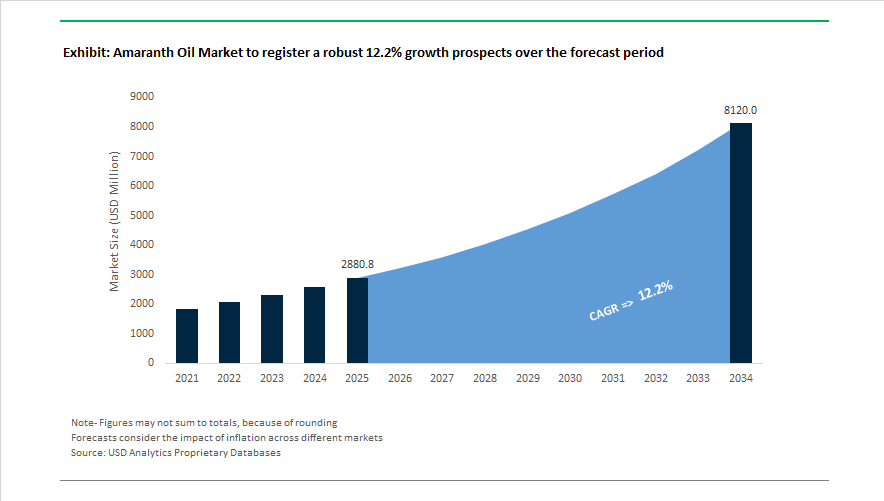
The global amaranth oil market is projected to grow from $2,880.8 Million in 2025 to $8,118 Million by 2034, registering a strong 12.2% CAGR driven by expanding use in nutraceutical supplements, premium skincare formulations, pharmaceutical lipids, functional foods, and specialty wellness products. Amaranth oil is valued for its high squalene content, tocotrienols, phytosterols, and antioxidant profile, making it a sought-after plant-based lipid in anti-aging cosmetics, heart-health supplements, and immune-support formulations. Market growth is closely tied to the shift toward vegan squalene alternatives, clean-label cosmetic ingredients, and advanced lipid delivery systems. Production technology has evolved, with supercritical CO2 extraction emerging as the dominant method by early 2026, enabling higher purity oil with preserved bioactive compounds suitable for pharmaceutical-grade applications.
Technology and supply chain modernization began advancing in late 2024 with breakthroughs in microencapsulation, allowing amaranth oil to be converted into stable powder formats for functional beverages and protein shakes. In November 2024, Russian Oliva expanded its digital distribution network, strengthening direct-to-manufacturer supply of pharmaceutical-grade oil. Demand surged in January 2025 as North America exceeded 40% global market share, supported by hundreds of new supplement product launches. Ingredient diversification continued in February 2025 when Ardent Mills expanded its specialty grain portfolio to include refined amaranth oil derivatives for fortified food products. Trade disruptions emerged in March 2025 as the U.S. introduced new import duties on oleaginous oils, temporarily elevating prices and accelerating regional sourcing strategies. Regulatory momentum strengthened in August 2025 when EU cosmetic guidelines accelerated the replacement of synthetic emollients with plant-based oils, boosting amaranth oil adoption. Product innovation expanded in August 2025 with Wellamar introducing amaranth oil gummies for nutraceutical consumers.
Premium segment expansion intensified through late 2025 as Praan Naturals launched organic virgin amaranth oil for clean beauty applications. Hybrid lipid innovation advanced in January 2026 when Aker BioMarine introduced algae-amaranth blended supplements targeting brain health and skin elasticity. Production data in January 2026 confirmed supercritical CO2 extraction as the dominant technology for preserving high squalene yields. Trade conditions shifted in February 2026 with a breakthrough India–U.S. trade agreement granting zero-duty access for Indian processed oils, reducing cost pressures for U.S. manufacturers.
Strategic Trends and High-Value Opportunities Reshaping the Amaranth Oil Market
Market Trend: Amaranth Oil Emerges as the Leading Sustainable Source for PhytoSqualane in Global Beauty and Personal Care
Cosmetic and luxury skincare manufacturers are aggressively transitioning away from shark-derived squalene following ethical policies, biodiversity concerns, and the European ban on shark liver oil in personal care. This shift is unlocking structural demand for amaranth oil, the most efficient botanical input for high-purity PhytoSqualane. While olive oil typically offers only 0.1 to 0.7% squalene, technical assessments from 2024–2025 place amaranth oil concentrations between 5 and 8 percent, a 10-fold advantage that fundamentally changes sourcing economics.
This efficiency is being commercialized at scale. Evonik’s PhytoSquene® launch confirmed that GMP-grade, European Pharmacopoeia-compliant squalene can be produced without marine harvesting, enabling premium beauty brands to achieve cruelty-free and vegan certification. Climate resilience is an additional catalyst: droughts in Mediterranean olive regions created double-digit yield declines in 2024, amplifying supply chain volatility. Amaranth’s C4 photosynthetic structure and drought tolerance offer a built-in resiliency hedge, making it strategically valuable for supply chain diversification strategies among global formulators.
Market Trend: Vertical Integration and Agronomy Control Aim to Resolve Fragmentation Risk
Historically, amaranth supply was fragmented across small-acreage farmers, limiting scalability and quality standardization. This is now changing through seed genetics optimization, contract farming, and direct investment in oil extraction capacity. The most significant agronomy milestone occurred in December 2025, when U.S. and institutional researchers narrowed 300 genotypes to commercial strains optimized for oil yield, targeting a standardized 5% lipid benchmark.
Government-backed infrastructure is accelerating capacity. South Africa’s 2025 inclusion of indigenous amaranth within national agricultural policy unlocked roughly $650 million in potential industry scale, enabling commercial farming clusters and digitized pesticide and cultivar registration. Downstream processing is also modernizing. Supercritical CO₂ extraction (SCFE) now accounts for roughly 26–30% of global output, proving popular among pharmaceutical and nutraceutical firms due to >95% preservation of bioactive squalene and the elimination of solvent residues. The market is therefore transitioning from opportunistic cultivation to integrated Seed-to-Oil industrialization, which will determine cost competitiveness over the next 3–5 years.
High-Value Market Opportunities
Market Opportunity: Premium Lipid Carrier for Pharmaceutical Bioavailability and Vaccine Delivery
Amaranth oil’s composition aligns with lipid-based drug delivery performance targets, making it a rising ingredient in pharmaceutical formulations. Clinical research in 2024 demonstrated that up to 600 mg/day doses improved coronary health markers in a sample of 125 patients by modulating membrane fluidity. This evidence is strengthening its role as a functional excipient rather than merely a nutritional input.
Pharma-grade amaranth oil is now being evaluated for nano-delivery of oncology and vaccine actives. Because its lipid profile mimics human sebum, it enables enhanced cellular uptake and biocompatibility, outperforming synthetic lipids that often require surfactants. Laboratory data suggests that its phospholipid-rich profile can improve solubility and oral absorption of poorly soluble APIs by up to 40 percent, positioning it competitively against established lipid carriers such as MCT oil and lecithin. Companies targeting chronic disease drug pipelines and low-dose nanoformulations represent the highest-potential customer tier.
Market Opportunity: "Skin-Identical" Functional Oil for High-Tech Beauty, Sun Care and Anti-Inflammatory Formulations
Beyond squalane extraction, the whole-oil cosmetic applications segment represents a second pillar of monetization. Amaranth oil offers a unique blend of gamma-tocopherol, phytosterols, and tocotrienols, which collectively increase hydration by 32% and elasticity by 19% within four weeks, according to late-2024 clinical use studies. This human-lipid-matching composition enables premium brands to claim “skin barrier support” and “biomimetic lipid repair.”
Research published in 2025 confirms that when incorporated into Nanostructured Lipid Carriers (NLCs), amaranth oil achieved 93–98% free-radical scavenging, materially boosting SPF ratings while providing deeper antioxidant protection than surface-only filters. Formulators are also using the oil to reduce reliance on synthetic preservatives, as its phytosterols and tocotrienols exhibit cytokine-blocking properties, particularly against IL-6. This makes amaranth oil highly relevant for the preservative-free, anti-inflammatory, luxury beauty product pipeline, where ingredient story and skin-identical performance directly influence sell-through rates.
Amaranth Oil Market Share and Segmentation Insights
Market Share by Extraction Technology: Cold Pressing Leads While Supercritical CO₂ Accelerates Premium Adoption
Cold pressing accounts for approximately 44% of global amaranth oil production in 2025, retaining leadership due to strong alignment with clean-label, organic, and “virgin oil” positioning. This method preserves tocopherols, phytosterols, and high squalene content, supporting premium pricing in cosmetics and specialty nutrition, despite lower yields of 65 to 75% and the need for winterization. Supercritical CO₂ extraction is the fastest-growing segment, offering solvent-free GRAS compliance, superior retention of heat-sensitive vitamin E and squalene, and higher yields of 85 to 95%, making it the preferred route for pharmaceutical-grade and luxury cosmeceutical oils. Solvent extraction is declining as hexane-based processes face consumer resistance, now confined mainly to low-cost feed and industrial applications. Ultrasonic-assisted extraction remains niche, used primarily as a pre-treatment to boost efficiency in small-batch or R&D-scale production.
Market Share by Application: Cosmetics Dominate While Dietary Supplements Deliver Growth Momentum
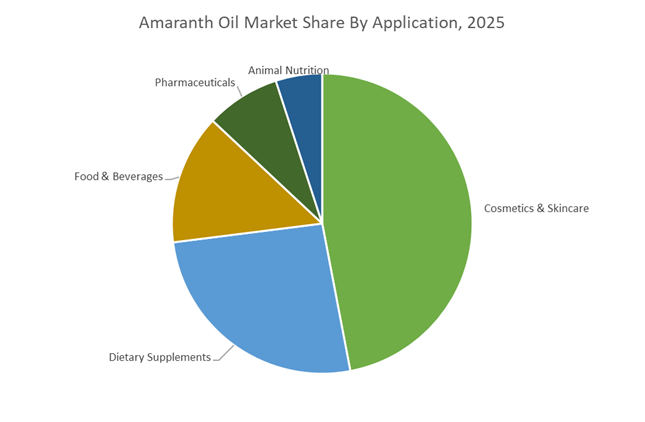
Cosmetics and skincare represent nearly 47% of amaranth oil demand in 2025, making this the highest-value application segment. Growth is driven by rising use of plant-based squalene, linoleic acid, and natural vitamin E in barrier-repair serums, vegan squalane, and non-comedogenic moisturizers, supported by shark liver oil bans and sustainability mandates. Dietary supplements rank second and are expanding at +12% YoY, fueled by cardiovascular health claims, anti-inflammatory positioning, and the convergence of nutricosmetics with premium wellness, where amaranth oil is marketed as a sustainable alternative to fish oil. Food and beverages remain niche, limited to gourmet oils and functional fortification due to high cost per liter. Pharmaceuticals form a small, high-purity segment focused on wound healing and lipophilic drug delivery research. Animal nutrition is the smallest market, with gradual uptake in pet supplements and aquaculture driven by pet humanization and immune-support positioning.
Competitive Landscape: Supercritical CO2 Extraction, Squalene-Rich Profiles, and Ingestible Beauty Driving the Amaranth Oil Market
The Amaranth Oil Market is transitioning from niche botanical oils into a premium functional lipid segment spanning cosmeceuticals, nutraceuticals, gluten-free foods, and ingestible beauty. Competitive differentiation increasingly centers on extraction purity (especially supercritical CO2), squalene and tocotrienol retention, farm-to-formula integration, and application-specific formats such as stabilized powders and gummies. Market leaders are investing in zero-residual processing, clean-label certifications, and D2C wellness platforms, while emerging suppliers leverage proximity to raw amaranth cultivation to deliver fresh-pressed, cost-efficient oils for global functional nutrition brands.
Flavex Naturextrakte GmbH sets the benchmark with supercritical CO2 amaranth oil purity
Flavex Naturextrakte GmbH leads the premium tier through pharmaceutical-grade supercritical CO2 extraction. In 2025, the company optimized its SFE process to achieve 99% retention of bioactive tocotrienols, establishing a new benchmark for oxidative stability in amaranth oil. Its flagship high-squalene Amaranth Seed CO2 extract, stabilized with rosemary antioxidant, is widely adopted in anti-aging cosmeceuticals. Flavex’s solvent-free, zero-residual chemistry eliminates the need for refining or deodorizing, preserving delicate lipid fractions. This clean-label, green beauty positioning makes Flavex a preferred supplier for European brands requiring uncompromised purity and traceability.
Nu-World Foods scales farm-to-formula amaranth oil for functional foods
Nu-World Foods, a division of Shoreline Fruit, operates as a major ancient grains hub for North America. With integrated control from contract amaranth farming to milling and oil pressing, Nu-World offers true farm-to-formula traceability. In late 2025, the company expanded its Illinois facility to strengthen its Specialty & Functional Ingredients division, supporting rising demand for gluten-free lipid fortification. Amaranth oil supplied by Nu-World is extensively used in energy bars and fortified cereals to boost superfood nutrient density. SQF Level II certification further positions Nu-World as a key partner for allergy-friendly manufacturers.
Proderna Biotech Pvt. Ltd. leverages Indian cultivation for fresh-press metabolic health oils
Proderna Biotech Pvt. Ltd. capitalizes on India’s large amaranth cultivation base to deliver competitively priced, high-purity CO2 extracts. In early 2026, Proderna launched a dedicated Metabolic Health amaranth oil line standardized for elevated linoleic acid and squalene, targeting cholesterol management formulations. Its portfolio includes Pure Virgin Amaranth Oil and custom Bio-Blends combining ancient grain lipids for nutraceutical use. Proderna expanded exports in 2025 with direct manufacturer partnerships across Southeast Asia, addressing functional beverage demand in Japan and South Korea. Proximity to raw materials enables rapid fresh-press processing, enhancing oil quality while maintaining cost efficiency.
Praan Naturals supplies clinical-grade amaranth oil for premium skincare
Praan Naturals serves as a leading distributor and formulation partner for organic and conventional oils in high-end skincare. Its Organic Virgin Amaranth Oil is prized for skin-identical lipid composition and high omega-6 content, supporting elasticity and barrier repair. In 2025, Praan introduced micro-filtered amaranth oil that preserves natural color and aroma while removing waxes that interfere with luxury serum textures. Every batch is backed by CofA and GC-MS verification of squalene content, reinforcing clinical-grade positioning. Praan’s transparency-driven sourcing appeals strongly to artisan formulators and dermatological brands.
Nans Products expands mass-market access with cold-pressed and powdered formats
Nans Products operates at the intersection of Ayurveda and modern nutraceuticals, supplying both cold-pressed amaranth oil and specialty phytochemical extracts. In 2025, the company scaled its cold-pressing division to introduce affordable natural-grade oil for the supplement mass market. Early 2026 saw the launch of a stabilized powdered amaranth oil, enabling inclusion in dry-mix protein powders and capsules without leakage. Nans’ strength lies in hepatoprotective and anti-inflammatory formulations, aligning traditional Ayurvedic claims with contemporary pharmaceutical and wellness applications.
Wellamar mainstreams amaranth oil through D2C ingestible beauty
Wellamar represents the consumer-facing evolution of the amaranth oil market, translating ingredient science into lifestyle wellness products. In 2024–2025, the brand introduced Amaranth Oil & Collagen Gummies, positioning amaranth oil as an edible beauty solution. Its product range includes pure oil drops and ingestible beauty tinctures aimed at biohacking and longevity communities. A 2025 D2C platform rollout emphasized digital education around squalene benefits, while the company’s strategy focuses on rebranding amaranth oil as a vegan alternative to fish-based omega supplements for flexitarian consumers.
Germany Amaranth Oil Market: Supercritical Extraction Leadership and Pharma-Grade Integration
Germany is positioning itself as a premium processing and formulation hub for high-squalene amaranth oil. In late 2025, FLAVEX Naturextrakte GmbH commissioned an upgraded supercritical CO₂ extraction line that delivers amaranth oil with up to 8–10% squalene content, representing a material improvement over conventional cold-pressed yields. This advancement is strengthening Germany’s role in supplying standardized, high-potency oils for regulated applications.
Downstream integration is accelerating. European pharmaceutical formulators increased adoption of German-origin amaranth oil in 2025, particularly for lipid-based nano-delivery systems in oncology therapeutics. Clinical credibility has been reinforced through collaborative research involving University of Rome La Sapienza and German technical partners, which demonstrated synergistic efficacy between amaranth oil and antifungal agents such as terbinafine in topical treatments. On the sustainability front, Germany implemented Digital Product Passports in January 2026, ensuring full traceability from Central European seed sourcing to refined oil. Companies like All Organic Treasures GmbH expanded clean-label and vegan certifications in 2025, securing new contracts for anti-aging and silicone-free cosmetic formulations aligned with EU biodegradability expectations influenced by the German Federal Environment Agency.
India Amaranth Oil Market: Policy-Backed Processing Scale and Nutraceutical Differentiation
India’s amaranth oil sector is benefiting from coordinated agricultural and processing incentives. Under the PMFME scheme, the Indian government approved over ₹1,500 crore in 2025 for value chain clusters that explicitly include pseudo-cereals such as amaranth, supporting decentralized oilseed processing. This policy momentum translated into private investment, with Sunsoil Pvt. Ltd. completing a $20 million cold-pressing facility in early 2025, significantly improving export-ready output quality.
The policy outlook extends beyond processing. A 2026 Ministry of Agriculture initiative focused on reviving forgotten superfoods has prioritized amaranth cultivation, providing certified seeds and GAP training to farmers to meet international oil quality benchmarks. On the innovation side, Sabinsa Corporation expanded its patent portfolio in 2025 to include standardized amaranth oil extracts targeting metabolic and liver health, supported by biomarkers such as ALT and AST normalization. Institutional support is also growing, as the National Institute of Food Technology Entrepreneurship and Management released a technical roadmap in 2025 to help SMEs enter high-value amaranth oil extraction and refining.
United States Amaranth Oil Market: Vertical Integration and Clean Beauty Commercialization
In the United States, amaranth oil adoption is being driven by veterinary nutrition, clean beauty, and organic food ecosystems. Regulatory clearance in late 2024 by the U.S. Food and Drug Administration enabled new uses of amaranth oil as a nutritive antioxidant in premium pet food, triggering demand growth within the Kansas Animal Health Corridor. This approval expanded amaranth oil beyond human wellness into regulated animal nutrition.
Cosmeceutical innovation is another growth vector. In 2025, Activation launched a stabilized liquid amaranth oil utilizing micellar technology to improve dermal penetration of squalene in anti-aging serums. Supply chain resilience is improving through vertical integration, with Ardent Mills expanding its specialty grain portfolio in 2025 to include organic amaranth derivatives. Retail visibility is also increasing, as major chains such as Whole Foods Market reported double-digit growth in shelf allocation for amaranth-based clean beauty products during 2025.
Russia Amaranth Oil Market: Genetic Resources and Cold-Climate Cultivar Development
Russia is approaching amaranth oil through genetic research and pharmaceutical positioning. The N.I. Vavilov All-Russian Institute of Plant Genetic Resources, which maintains one of the world’s largest amaranth germplasm collections, launched a 2025 breeding program to develop high-yield, cold-hardy oil cultivars suitable for northern climates. This initiative is designed to localize raw material supply and reduce climatic risk.
Industrial processing is progressing in parallel. RusOliva expanded domestic distribution of cold-pressed amaranth oil in 2025, positioning it as a functional lipid for pharmaceutical use, particularly in managing hepatotoxic side effects. Russian research centers are also pursuing mutation breeding techniques to raise seed oil content toward a 10% lipid yield target by 2027, reinforcing long-term feedstock efficiency.
Strategic Positioning of the Amaranth Oil Industry by Country
Amaranth Oil Market County Level Snapshot
Country
Strategic Focus
Industry Implication
Germany
Supercritical extraction and pharma integration
Premium, high-squalene oil with full traceability
India
Policy-backed processing and nutraceutical IP
Export-ready oils and standardized health ingredients
United States
Vertical integration and clean beauty uptake
Expansion across pet nutrition and cosmeceuticals
Russia
Genetic resources and cold-climate cultivation
Localized supply with pharmaceutical positioning
Amaranth Oil Market Report Scope
Amaranth Oil Market
Parameter
Details
Market Size (2025)
$2880.8 Million
Market Size (2034)
$8118 Million
Market Growth Rate
12.2%
Segments
By Extraction Technology (Supercritical CO2 Extraction, Cold Pressing, Solvent Extraction, Ultrasonic Assisted Extraction), By Product Grade (Pharmaceutical Grade, Cosmetic and Personal Care Grade, Food and Dietary Grade), By Packaging Type (Aluminum Bottles, HDPE and Steel Drums, Glass Droppers), By Application (Cosmetics and Skincare, Pharmaceuticals, Dietary Supplements, Food and Beverages, Animal Nutrition)
Study Period
2019- 2025 and 2026-2034
Units
Revenue (USD)
Qualitative Analysis
Porter’s Five Forces, SWOT Profile, Market Share, Scenario Forecasts, Market Ecosystem, Company Ranking, Market Dynamics, Industry Benchmarking
Companies
FLAVEX Naturextrakte, Activation Products, Sabinsa Corporation, All Organic Treasures, Proderna Biotech, AMR Amaranth, RusOliva, Hunan Anbang Pharmaceutical, RichOil, Connoils India, Norevo, BioHarvest Sciences, Sunsoil, Ziani Organic Oils
Countries
US, Canada, Mexico, Germany, France, Spain, Italy, UK, Russia, China, India, Japan, South Korea, Australia, South East Asia, Brazil, Argentina, Middle East, Africa
Amaranth Oil Market Segmentation
By Extraction Technology
Supercritical CO2 Extraction
Cold Pressing
Solvent Extraction
Ultrasonic Assisted Extraction
By Product Grade
Pharmaceutical Grade
Cosmetic and Personal Care Grade
Food and Dietary Grade
By Packaging Type
Aluminum Bottles
HDPE and Steel Drums
Glass Droppers
By Application
Cosmetics and Skincare
Pharmaceuticals
Dietary Supplements
Food and Beverages
Animal Nutrition
By Region
North America (United States, Canada, Mexico)
Europe (Germany, France, United Kingdom, Spain, Italy, Rest of Europe)
Asia Pacific (China, India, Japan, South Korea, Australia, Rest of APAC)
South and Central America (Brazil, Argentina, Rest of SCA)
Middle East and Africa (Saudi Arabia, UAE, South Africa, Rest of Middle East, Rest of Africa)
2. Amaranth Oil Market Landscape & Outlook (2025–2034)
2.1. Introduction to Amaranth Oil Market
2.2. Market Valuation and Growth Projections (2025–2034)
2.3. Key Growth Drivers: Vegan Squalene, Clean Beauty, and Functional Nutrition
2.4. Regulatory Environment: Cosmetic Ingredient Guidelines, Food Safety Standards, and Trade Policies
2.5. Technology Developments: Supercritical CO2 Extraction, Microencapsulation, and Lipid Delivery Systems
2.6. Supply Chain Dynamics: Agronomy Integration, Vertical Processing, and Regional Sourcing
3. Strategic Market Trends and High-Value Opportunities
3.1. Transition from Marine to Botanical Squalene
3.2. Vertical Integration and Seed-to-Oil Industrialization
3.3. Amaranth Oil as a Premium Pharmaceutical Lipid Carrier
3.4. Skin-Identical Oils in High-Tech Beauty and Sun Care
3.5. Ingestible Beauty and Nutricosmetic Convergence
4. Competitive Landscape and Strategic Developments
4.1. Supercritical Extraction Capacity Expansion
4.2. Product Innovation: Gummies, Powders, and Nano-Lipid Systems
4.3. Farm-to-Formula Integration and Contract Cultivation
4.4. Strategic Partnerships, D2C Platforms, and Clean-Label Certifications
5. Amaranth Oil Market Share and Segmentation Insights
5.1. By Extraction Technology
5.1.1. Supercritical CO2 Extraction
5.1.2. Cold Pressing
5.1.3. Solvent Extraction
5.1.4. Ultrasonic Assisted Extraction
5.2. By Product Grade
5.2.1. Pharmaceutical Grade
5.2.2. Cosmetic and Personal Care Grade
5.2.3. Food and Dietary Grade
5.3. By Packaging Type
5.3.1. Aluminum Bottles
5.3.2. HDPE and Steel Drums
5.3.3. Glass Droppers
5.4. By Application
5.4.1. Cosmetics and Skincare
5.4.2. Pharmaceuticals
5.4.3. Dietary Supplements
5.4.4. Food and Beverages
5.4.5. Animal Nutrition
6. Country Analysis and Outlook
6.1. United States
6.2. Canada
6.3. Mexico
6.4. Germany
6.5. France
6.6. United Kingdom
6.7. Spain
6.8. Italy
6.9. China
6.10. India
6.11. Japan
6.12. South Korea
6.13. Australia
6.14. Brazil
6.15. Argentina
6.16. Saudi Arabia
6.17. United Arab Emirates
6.18. South Africa
6.19. Rest of World
7. Amaranth Oil Market Size Outlook by Region (2025–2034)
7.1. North America Market Size Outlook
7.1.1. By Extraction Technology
7.1.2. By Product Grade
7.1.3. By Application
7.1.4. By Packaging Type
7.2. Europe Market Size Outlook
7.2.1. By Extraction Technology
7.2.2. By Product Grade
7.2.3. By Application
7.2.4. By Packaging Type
7.3. Asia Pacific Market Size Outlook
7.3.1. By Extraction Technology
7.3.2. By Product Grade
7.3.3. By Application
7.3.4. By Packaging Type
7.4. South and Central America Market Size Outlook
7.4.1. By Extraction Technology
7.4.2. By Product Grade
7.4.3. By Application
7.4.4. By Packaging Type
7.5. Middle East and Africa Market Size Outlook
7.5.1. By Extraction Technology
7.5.2. By Product Grade
7.5.3. By Application
7.5.4. By Packaging Type
9. Methodology
9.1. Research Scope
9.2. Market Research Approach
9.3. Market Sizing and Forecasting Model
9.4. Research Coverage
9.5. Data Horizon
9.6. Deliverables
10. Appendix
10.1. Acronyms and Abbreviations
10.2. List of Tables
10.3. List of Figures
Amaranth Oil Market Segmentation
By Extraction Technology
Supercritical CO2 Extraction
Cold Pressing
Solvent Extraction
Ultrasonic Assisted Extraction
By Product Grade
Pharmaceutical Grade
Cosmetic and Personal Care Grade
Food and Dietary Grade
By Packaging Type
Aluminum Bottles
HDPE and Steel Drums
Glass Droppers
By Application
Cosmetics and Skincare
Pharmaceuticals
Dietary Supplements
Food and Beverages
Animal Nutrition
By Region
North America (United States, Canada, Mexico)
Europe (Germany, France, United Kingdom, Spain, Italy, Rest of Europe)
Asia Pacific (China, India, Japan, South Korea, Australia, Rest of APAC)
South and Central America (Brazil, Argentina, Rest of SCA)
Middle East and Africa (Saudi Arabia, UAE, South Africa, Rest of Middle East, Rest of Africa)
The global Amaranth Oil Market was valued at $2,880.8 Million in 2025 and is projected to reach $8,118 Million by 2034, expanding at a strong 12.2% CAGR. Growth is fueled by rising demand for plant-based squalene, clean-label cosmetics, nutraceutical supplements, and pharmaceutical lipid carriers, supported by rapid adoption of supercritical CO₂ extraction.
Amaranth oil contains approximately 5 to 8% natural squalene, compared with just 0.1 to 0.7% in olive oil, giving it a major economic advantage for vegan PhytoSqualane production. This efficiency, combined with shark liver oil bans and sustainability mandates in cosmetics, is accelerating substitution toward amaranth-derived lipids across premium skincare and ingestible beauty formulations.
Cosmetics and skincare dominate with nearly 47% share in 2025, driven by barrier-repair serums, vegan squalane, and anti-aging products. Dietary supplements are the fastest-growing segment, supported by cardiovascular health, anti-inflammatory positioning, and nutricosmetics. Pharmaceuticals represent a smaller but high-purity segment focused on lipid-based drug delivery and wound-healing research.
Cold pressing still accounts for roughly 44% of production in 2025 due to clean-label appeal, but supercritical CO₂ extraction is the fastest-growing method. SCFE delivers solvent-free oil with 85 to 95% yields and over 95% retention of heat-sensitive bioactives like squalene and tocotrienols, making it the preferred route for pharmaceutical-grade and luxury cosmeceutical applications.
Key industry players include FLAVEX Naturextrakte GmbH, Sabinsa Corporation, Proderna Biotech Pvt. Ltd., Activation Products, and RusOliva. These suppliers are differentiating through supercritical CO₂ processing, high-squalene profiles, organic virgin oils, microencapsulation, and farm-to-formula integration to serve clean beauty, nutraceutical, and pharmaceutical customers worldwide.