Food Waste Reduction, Healthcare Hygiene, and Smart Packaging Push Antimicrobial Packaging Market to USD 26.8 Billion by 2034
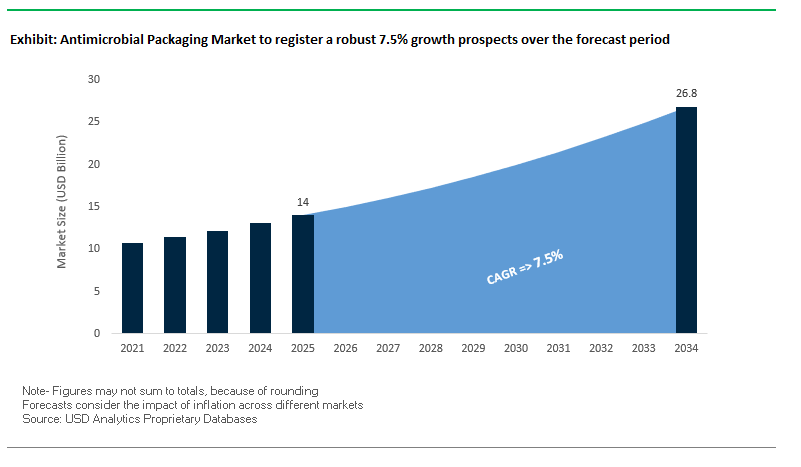
The global antimicrobial packaging market is valued at USD 14 billion in 2025 and is projected to reach USD 26.8 billion by 2034, growing at a strong CAGR of 7.5%. The market’s expansion is being fueled by the pressing need to reduce global food waste, estimated at one-third of all food produced annually. Antimicrobial packaging extends the shelf life of perishable goods by inhibiting microbial growth, playing a vital role in both food security and sustainability.
Healthcare is another critical driver, as hospitals and pharmaceutical companies require packaging with antimicrobial-enhanced properties to maintain the sterility of drugs, devices, and surgical supplies. This reduces the risk of healthcare-associated infections (HAIs) and ensures regulatory compliance. At the same time, consumer preferences are shifting toward natural antimicrobial agents including essential oils, plant extracts, and bacteriocins over synthetic additives, reflecting the rising demand for clean-label and non-toxic solutions.
The industry is also entering a new era with intelligent antimicrobial packaging, where color-changing indicators signal spoilage, and nano-material barriers provide enhanced microbial resistance. These innovations combine safety with real-time monitoring, creating a new benchmark for quality assurance in food and healthcare packaging.
Key Insights for Professionals
Food waste reduction remains the primary driver, aligning antimicrobial packaging with global sustainability goals.
Healthcare hygiene is accelerating adoption, especially for sterility-sensitive medical devices and pharmaceuticals.
Natural antimicrobial agents are gaining preference over synthetic additives, driven by consumer health awareness.
Smart antimicrobial packaging is emerging with spoilage indicators and nanotechnology-enhanced barriers.
Market Analysis: Strategic Investments, Biodegradable Innovations, and Recycling Initiatives Transform Antimicrobial Packaging Industry
The antimicrobial packaging market is experiencing momentum through investments, product launches, and breakthrough innovations. In August 2025, Constantia Flexibles invested €100 million into expanding its global production network, supporting food and pharmaceutical sectors where antimicrobial properties are increasingly vital. In July 2025, Huhtamaki introduced compostable and recyclable ice cream cups, a move that highlights how antimicrobial packaging is merging with circular economy practices.
In May 2025, Pregis expanded its blown film operations to strengthen EVOH barrier film capacity, a key material in antimicrobial food packaging. Earlier developments such as Bpacks’ bark-based packaging (April 2024) and COEXPAN’s antimicrobial mono-material trays (November 2021) illustrate the market’s pursuit of sustainable and innovative alternatives to plastics. Additionally, the U.S. Army and University of Akron (May 2024) pioneered antimicrobial textile coatings with defense applications, underscoring cross-sector synergies between military-grade coatings and medical packaging technologies.
Recycling and material innovation remain focal points. In August 2025, Amcor upgraded its UK recycling facility to enhance production of recycled polymers, advancing its goal of making all packaging recyclable or reusable by 2025. Similarly, Designsake Studio’s Matter platform (October 2020) set a precedent for antimicrobial coatings adaptable across multiple packaging formats. These developments demonstrate how the industry is converging on three pillars of transformation: sustainable innovation, circular economy integration, and advanced coatings for food and healthcare safety.
Emerging Trends and Opportunities in the Antimicrobial Packaging Market
Integration of Bio-Based and Sustainable Antimicrobial Agents
A decisive trend in antimicrobial packaging is the industry’s pivot toward bio-based antimicrobial agents derived from natural sources such as essential oils, bacteriocins, and chitosan. This shift is fueled by consumer preference for “clean label” solutions and rising regulatory restrictions on synthetic additives and migration-prone chemicals. A 2025 survey by a leading packaging company revealed that over 90% of consumers are more likely to purchase from brands offering eco-friendly packaging, underscoring the growing importance of sustainable antimicrobial solutions in consumer decision-making.
Natural antimicrobials are also demonstrating strong efficacy. Chitosan, a biopolymer extracted from crustacean shells, has been proven to inhibit Gram-positive bacteria such as Listeria monocytogenes, while bamboo extracts offer both antimicrobial and antioxidant functionality. This performance is matched by innovation: startups are developing biodegradable onion-skin fibers with antimicrobial properties, while others are introducing edible chitosan coatings that extend the shelf life of fresh produce. These developments go beyond material substitution, representing a fundamental redesign of packaging systems to ensure safety, shelf life extension, and circular economy compatibility.
Strategic M&A and Expansion into High-Growth Vertical Markets
Another trend is the wave of mergers, acquisitions, and strategic expansions targeting antimicrobial technologies. Leading corporations are diversifying beyond food packaging into high-value verticals such as pharmaceuticals, healthcare, and e-commerce logistics. SINTX Technologies’ acquisition of SiNAPTIC Surgical highlights this movement, enabling expansion into antimicrobial biomaterials for implants an application with high margins and strong demand growth.
Similarly, the pharmaceutical sector is drawing heavy investment into antimicrobial-related solutions to combat rising antimicrobial resistance (AMR). A major financial firm’s acquisition of Paratek Pharmaceuticals demonstrates investor confidence in antimicrobial-focused companies and their ability to address public health concerns. These moves reflect how antimicrobial packaging is no longer viewed solely through the lens of food preservation but also as a strategic enabler of drug safety, sterile logistics, and patient protection.
Development of Smart/Active Systems for Real-Time Spoilage Detection
A key opportunity lies in creating smart antimicrobial packaging systems that not only inhibit microbial growth but also provide real-time spoilage detection. Researchers are developing colorimetric freshness indicators using bio-based compounds like chitosan that shift color in response to microbial byproducts, offering consumers a direct visual signal of product safety. Similarly, RFID-enabled packaging systems are being explored to provide automated spoilage alerts and traceability in supply chains.
The potential impact is profound. According to UNEP, 1.3 billion tons of food are wasted globally every year, with much of it linked to uncertainty over product freshness. By providing transparent, real-time data on spoilage, smart antimicrobial packaging can directly reduce food waste, improve consumer confidence, and strengthen compliance with stricter food safety standards. For companies, this innovation not only meets sustainability goals but also unlocks new revenue streams in premium packaging segments.
Leveraging Regulatory Shifts Towards Plastic Reduction and Food Waste Mitigation
Global regulatory frameworks are also opening doors for antimicrobial packaging innovation. India’s Ministry of Environment has rolled out Extended Producer Responsibility (EPR) mandates, requiring recycled content in packaging and restricting single-use plastics. In Europe and North America, similar directives under the EU’s Circular Economy Action Plan and U.S. state-level bans are accelerating the adoption of sustainable packaging systems.
Antimicrobial packaging that extends shelf life directly aligns with these mandates by mitigating food waste while reducing dependence on conventional plastics. Organizations like the C40 Knowledge Hub highlight packaging’s critical role in food waste reduction, reinforcing its value in climate action strategies. For manufacturers, developing recyclable, compostable, or bio-based antimicrobial packaging positions them as leaders in a regulatory-driven market transition, ensuring compliance while addressing global sustainability challenges.
Competitive Landscape: Global Packaging Leaders Expand Antimicrobial Portfolios with Sustainable and High-performance Solutions
The antimicrobial packaging market’s competitive landscape is dominated by multinational packaging leaders and specialty material innovators, each leveraging sustainability, R&D investments, and advanced coatings to strengthen market presence.
BASF SE: Driving High-performance Antimicrobial Additives Through ChemCycling
BASF combines material science expertise with advanced antimicrobial technologies. Its ChemCycling initiative, developed with StePac, delivers contact-sensitive packaging for fresh produce preservation. BASF’s portfolio includes Foamaster defoamers and food-contact-compliant additives that enhance the performance of antimicrobial paper and board packaging. The company remains focused on sustainable innovation and regulatory-compliant functional coatings.
Mondi Group: Paper and Flexible Packaging Solutions with Sustainable Integration
Mondi delivers flexible and paper-based packaging across food and personal care sectors. In recent collaborations, it developed mono-material PP high-barrier packaging with meat producers, aligning sustainability with antimicrobial potential. Mondi’s vertical integration from forestry to final packaging ensures high control over quality and safety, making it a reliable partner for brands seeking eco-friendly antimicrobial packaging.
Amcor plc: Expanding Circular Packaging Capabilities with Antimicrobial Potential
Amcor is advancing its recyclable and compostable packaging portfolio, with antimicrobial compatibility. In August 2025, it upgraded its UK Heanor recycling facility to increase output of recycled polymers. Its proprietary AmLite Recyclable metal-free film delivers high-barrier protection, combining sustainability with antimicrobial enhancements, catering to food and healthcare customers seeking circular economy solutions.
Sealed Air Corporation: Protective Packaging with Enhanced Safety Capabilities
Rebranded as SEE in 2023, Sealed Air offers a portfolio spanning protective food packaging and specialty healthcare solutions. Its strength lies in customized packaging formats that combine antimicrobial potential with advanced barrier technologies. By leveraging a global footprint and strong innovation pipeline, Sealed Air addresses both brand safety and supply chain efficiency, solidifying its position as a comprehensive solutions provider.
Avient specializes in antimicrobial additives for packaging resins, coatings, and fibers. Its material science expertise ensures easy integration into extrusion and injection molding, enabling converters to adopt antimicrobial properties without major process changes. Avient’s R&D efforts are focused on healthcare and personal hygiene applications, making it a crucial supplier of specialized materials in antimicrobial packaging.
Antimicrobial Packaging Market Share Insights
Metallic Nanoparticles Lead Market Share by Antimicrobial Agent in Packaging
Metallic nanoparticles, particularly silver, zinc oxide, and copper, dominate the antimicrobial packaging materials market with an estimated 38% share, owing to their superior broad-spectrum antimicrobial efficacy and stability. Their ability to integrate seamlessly into polymer films, coatings, and multilayer structures ensures durable, long-lasting protection against bacteria, fungi, and even certain viruses, making them the preferred choice for high-performance packaging in food, healthcare, and cosmetics. Organic acids follow as the leading solution for food and beverage applications due to their low cost, strong consumer acceptance, and GRAS (Generally Recognized as Safe) regulatory status. Essential oils, supported by growing consumer demand for natural and plant-derived alternatives, are emerging as a high-growth area, aided by innovations in encapsulation technology that mitigate issues of volatility and aroma interference. Bacteriocins and enzymes remain niche but valuable for targeted food safety applications such as combating Listeria in dairy and ready-to-eat products. Meanwhile, the “Others” category featuring agents like chitosan and synthetic peptides represents the research pipeline for next-generation antimicrobial packaging designed to address microbial resistance and regulatory challenges.
Food & Beverages Dominate Market Share by End-Use in Antimicrobial Packaging
The food and beverage industry is by far the largest end-user of antimicrobial packaging, holding a commanding 62% of market share. This dominance is fueled by the global push to extend shelf-life, reduce food waste, and ensure safety in categories such as fresh produce, dairy, meat, and ready-to-eat meals. The incorporation of metallic nanoparticles, organic acids, and natural agents into films, pouches, and trays helps mitigate microbial spoilage, ensuring safer and longer-lasting food products. Healthcare packaging represents the second-largest and highest-value segment, driven by the need to maintain sterility in pharmaceuticals, diagnostic kits, and medical devices. In cosmetics and personal care, antimicrobial packaging plays a dual role: preserving the efficacy of water-based formulations such as creams and lotions, while simultaneously serving as a marketing differentiator for brands offering “clean” and preservative-free products. The consumer goods segment, though still emerging, is gaining momentum as manufacturers add antimicrobial features to packaging for electronics and household items, leveraging post-pandemic hygiene consciousness as a value-added feature.
United States: Regulatory Push and Technological Advancements Strengthen Antimicrobial Packaging
The U.S. antimicrobial packaging materials market is shaped by evolving regulations from the Food and Drug Administration (FDA) and the Environmental Protection Agency (EPA), ensuring safety for direct food contact and regulating antimicrobial additives as pesticides. Technological advancements are driving innovation, with active packaging solutions that combine oxygen scavenging and moisture absorption capabilities, exemplified by products from CSP Technologies. Corporate initiatives, such as Berry Global’s collaboration with mineral chemist Pylote to develop multi-dose eye drops with high barrier and antimicrobial properties, highlight a commitment to safe and sustainable packaging.
Consumer demand for food safety and extended shelf life is a major growth driver, boosting adoption of antimicrobial solutions in food, pharmaceuticals, and consumer goods. Key applications are concentrated in the food and healthcare sectors, where antimicrobial packaging not only prevents contamination but also extends product shelf life, crucial for pharmaceuticals and medical devices. Government initiatives, such as the National Action Plan for Combating Antibiotic-Resistant Bacteria (CARB), further encourage preventive measures like antimicrobial packaging, reinforcing the market’s growth trajectory.
Germany: Circular Economy Leadership and Sustainable Antimicrobial Packaging Innovations
Germany’s antimicrobial packaging market is governed by stringent regulations, including the EU Packaging and Packaging Waste Regulation (PPWR), which mandates fully recyclable or reusable packaging by 2030. Leadership in the circular economy is evident through the Packaging Act (VerpackG), requiring producers to manage the entire lifecycle of packaging materials. This drives innovation in recyclable antimicrobial solutions and systems for collecting and recycling packaging waste.
Technological innovation is accelerating, with companies developing next-generation substrates like grass paper and high-strength recycled fibers treated with antimicrobial coatings. Government mandates under the PPWR encourage reusable antimicrobial containers, while key applications remain in food and pharmaceuticals, particularly for pathogen-sensitive products like meat, poultry, and seafood. The market also shows a preference for “clean-label” packaging, driving the adoption of natural antimicrobial ingredients such as plant extracts, essential oils, and organic acids.
China: Sustainability Policies and Advanced Manufacturing Boost Antimicrobial Packaging
China’s antimicrobial packaging market is influenced by the government’s “dual carbon” goal and industrial green transformation policies. The Action Plan for High-Quality Development of the Aluminium Industry (2025–2027) supports sustainable materials, indirectly affecting antimicrobial packaging by promoting recycled aluminum. Technological advancements, including AI and “5G plus industrial internet” integration, optimize production efficiency and flexible manufacturing capabilities for antimicrobial packaging.
Sustainability initiatives to reduce plastic waste have driven demand for paper-based and eco-friendly alternatives. Academic research, such as antibacterial paper developed from chitosan and nanocellulose sheets at the South China University of Technology, demonstrates innovation in materials that maintain 99.9% bacteria inhibition while being recyclable up to five times. Key applications span the food and e-commerce sectors, where antimicrobial packaging ensures product safety, extends shelf life, and supports the rapidly growing packaged food industry.
India: Government Initiatives and Biodegradable Antimicrobial Packaging Solutions
India’s antimicrobial packaging market benefits from the “Make in India” and “Zero Effect Zero Defect” initiatives, which encourage quality domestic production. Regulatory oversight by the Food Safety and Standards Authority of India (FSSAI) enforces strict requirements for packaging materials, migration limits, and labeling, while banning certain materials for health reasons. Technological advancements, such as the use of halloysite nanotubes as additives, enhance antimicrobial activity and barrier properties for food and medical packaging.
Investment in infrastructure includes automated packaging systems and traceability solutions, such as QR codes, improving product safety and consumer information. The focus on biodegradable and compostable materials is strong, with startups like WOL3D and Nanosafe embedding micro-copper particles in flexible films to provide antimicrobial properties. Key applications include food, pharmaceuticals, and consumer goods, driven by rising demand for safe, sustainable, and high-performance packaging solutions.
Brazil: Circular Economy Policies and Innovative Antimicrobial Packaging Development
Brazil’s antimicrobial packaging market is guided by the National Solid Waste Policy, promoting a circular economy and encouraging reusable, durable alternatives. A 2025 law banning solid waste imports aims to strengthen domestic waste management. Technological advancements, including robotics and AI, are enhancing operational efficiency and quality control, enabling automated sorting and defect detection. Sustainability is a key trend, fostering the development of eco-friendly antimicrobial materials.
Strategic investments in Brazil’s growing pharmaceutical market drive demand for sterile and safe packaging. Key applications are concentrated in the food and beverage sectors, where antimicrobial films, tamper-evident seals, and security labels are in high demand. Regulatory alignment, such as ANVISA’s RDC No. 854 (2024) harmonizing Mercosur technical standards for metal packaging, ensures compliance and facilitates innovation in antimicrobial packaging for food contact materials.
Japan: Smart Packaging and Precision Manufacturing Transform Antimicrobial Solutions
Japan’s antimicrobial packaging market leverages advanced precision manufacturing, with AI technologies accelerating design processes and enhancing production accuracy. Regulatory updates, including the 2025 partial revision of the “Specifications and Standards for Foods, Additives, etc.” by MHLW, strengthen safety standards for food-contact packaging. The market is witnessing a shift toward smart packaging, integrating sensors and digital tools to monitor product safety and shelf life.
Innovation in functionality focuses on specialized properties such as high-dimensional stability and deformation resistance. Corporate collaborations, including Toyo Seikan Group’s work on recyclable and lightweight packaging, are expanding capabilities in antimicrobial solutions. Academic research emphasizes biopolymers and natural antimicrobial agents, enabling sustainable packaging innovations. Applications span food, pharmaceuticals, and healthcare, where high-performance antimicrobial packaging ensures safety, durability, and compliance with evolving regulatory standards.
Antimicrobial Packaging Market Report Scope
Antimicrobial Packaging Market
Parameter
Details
Market Size (2025)
$14 Billion
Market Size (2034)
$26.8 Billion
Market Growth Rate
7.5%
Segments
By Material Type (Plastics, Paper & Paperboard, Biopolymers, Metals), By Antimicrobial Agent (Organic Acids, Bacteriocins, Enzymes, Essential Oils, Metallic Nanoparticles, Others), By Technology (Active Release, Controlled Release), By End-Use Industry (Food & Beverages, Healthcare, Cosmetics & Personal Care, Consumer Goods), By Application (Trays, Bags & Pouches, Films, Clamshells, Bottles & Jars)
Study Period
2019- 2024 and 2025-2034
Units
Revenue (USD)
Qualitative Analysis
Porter’s Five Forces, SWOT Profile, Market Share, Scenario Forecasts, Market Ecosystem, Company Ranking, Market Dynamics, Industry Benchmarking
Companies
Amcor plc, Mondi Group, Berry Global Group, Inc., Smurfit Kappa Group, Huhtamäki Oyj, Sonoco Products Company, Dow Chemical Company, BASF SE, Microban International, Ltd., BioCote Limited, CCL Industries Inc., Sealed Air Corporation, WestRock Company, DuPont de Nemours, Inc., Toyo Seikan Group Holdings, Ltd.
Countries
US, Canada, Mexico, Germany, France, Spain, Italy, UK, Russia, China, India, Japan, South Korea, Australia, South East Asia, Brazil, Argentina, Middle East, Africa
Antimicrobial Packaging Market Segmentation
By Material Type
Plastics
Paper & Paperboard
Biopolymers
Metals
By Antimicrobial Agent
Organic Acids
Bacteriocins
Enzymes
Essential Oils
Metallic Nanoparticles
Others
By Technology
Active Release
Controlled Release
By End-Use Industry
Food & Beverages
Healthcare
Cosmetics & Personal Care
Consumer Goods
By Application
Trays
Bags & Pouches
Films
Clamshells
Bottles & Jars
Countries Analyzed
North America (US, Canada, Mexico)
Europe (Germany, UK, France, Spain, Italy, Russia, Rest of Europe)
Asia Pacific (China, India, Japan, South Korea, Australia, South East Asia, Rest of Asia)
South America (Brazil, Argentina, Rest of South America)
Middle East and Africa (Saudi Arabia, UAE, Rest of Middle East, South Africa, Egypt, Rest of Africa)
Top Companies in Antimicrobial Packaging Market
Amcor plc
Mondi Group
Berry Global Group, Inc.
Smurfit Kappa Group
Huhtamäki Oyj
Sonoco Products Company
Dow Chemical Company
BASF SE
Microban International, Ltd.
BioCote Limited
CCL Industries Inc.
Sealed Air Corporation
WestRock Company
DuPont de Nemours, Inc.
Toyo Seikan Group Holdings, Ltd.
* List Not Exhaustive
Methodology
USDAnalytics employs a comprehensive and systematic approach to analyze the global antimicrobial packaging market, integrating both primary and secondary research to deliver precise, actionable insights for industry professionals. Primary research encompasses interviews with key stakeholders such as packaging manufacturers, food and pharmaceutical companies, regulatory authorities, and technology innovators to capture real-time trends, adoption drivers, and emerging solutions. Secondary research leverages verified sources, including company reports, patent filings, scientific publications, industry journals, and regulatory frameworks such as the U.S. FDA, EPA guidelines, EU Packaging and Packaging Waste Regulation (PPWR), and ANVISA standards. Market sizing and forecasting are performed using quantitative models that account for historical trends, macroeconomic factors, technological advancements, and consumer preferences, including the growing demand for sustainable and natural antimicrobial agents. The analysis also evaluates competitive dynamics by profiling leading players, assessing strategic investments, mergers and acquisitions, and innovations in smart, biodegradable, and circular-economy-aligned packaging solutions. Regional insights are provided for key markets such as the U.S., Germany, China, India, Brazil, and Japan, highlighting regulatory impact, manufacturing capabilities, and sector-specific adoption trends. By triangulating multiple data sources and applying USDAnalytics’ proprietary modeling techniques, this methodology ensures a reliable, in-depth understanding of market opportunities, technology evolution, and growth trajectories across food, healthcare, and consumer goods sectors.
Deliverables:
Comprehensive Market Research Report (PDF and Excel) with detailed tables, charts, and interactive visualizations.
Country-Specific Forecasts & Analysis.
Segment-Wise Revenue Forecasts (2025–2034).
Competitive Analysis, Benchmarking, and SWOT Profiles.
Recent Developments & Innovation Tracker.
Executive Summary & Analyst Commentary.
Post-Purchase Analyst Support for Client-Specific Questions and Custom Data Requirements.
2. Antimicrobial Packaging Market Landscape & Outlook (2025–2034)
2.1. Introduction to Antimicrobial Packaging Market
2.2. Market Valuation and Growth Projections (2025–2034)
2.3. Drivers: Food Waste Reduction, Healthcare Hygiene, and Smart Packaging
2.4. Industry Investments and Strategic Developments
2.5. Sustainable Innovations and Circular Economy Integration
3. Innovations Reshaping the Antimicrobial Packaging Market
3.1. Trend: Integration of Bio-Based and Sustainable Antimicrobial Agents
3.2. Trend: Strategic M&A and Expansion into High-Growth Vertical Markets
3.3. Opportunity: Development of Smart/Active Systems for Real-Time Spoilage Detection
3.4. Opportunity: Leveraging Regulatory Shifts Towards Plastic Reduction and Food Waste Mitigation
4. Competitive Landscape and Strategic Initiatives
4.1. Mergers, Acquisitions and Strategic Alliances
4.2. R&D and Material Innovation
4.3. Sustainability and Strategies
4.4. Market Expansion and Regional Focus
5. Market Share and Segmentation Insights: Antimicrobial Packaging Market
5.1. By Material Type
5.1.1. Plastics
5.1.2. Paper & Paperboard
5.1.3. Biopolymers
5.1.4. Metals
5.2. By Antimicrobial Agent
5.2.1. Organic Acids
5.2.2. Bacteriocins
5.2.3. Enzymes
5.2.4. Essential Oils
5.2.5. Metallic Nanoparticles
5.2.6. Others
5.3. By Technology
5.3.1. Active Release
5.3.2. Controlled Release
5.4. By End-Use Industry
5.4.1. Food & Beverages
5.4.2. Healthcare
5.4.3. Cosmetics & Personal Care
5.4.4. Consumer Goods
5.5. By Application
5.5.1. Trays
5.5.2. Bags & Pouches
5.5.3. Films
5.5.4. Clamshells
5.5.5. Bottles & Jars
6. Country Analysis and Outlook of Antimicrobial Packaging Market
6.1. United States
6.2. Canada
6.3. Mexico
6.4. Germany
6.5. France
6.6. Spain
6.7. Italy
6.8. UK
6.9. Russia
6.10. China
6.11. India
6.12. Japan
6.13. South Korea
6.14. Australia
6.15. South East Asia
6.16. Brazil
6.17. Argentina
6.18. Middle East
6.19. Africa
7. Antimicrobial Packaging Market Size Outlook by Region (2025-2034)
7.1. North America Antimicrobial Packaging Market Size Outlook to 2034
7.1.1. By Material Type
7.1.2. By End-Use Industry
7.1.3. By Antimicrobial Agent
7.1.4. By Application
7.2. Europe Antimicrobial Packaging Market Size Outlook to 2034
7.2.1. By Material Type
7.2.2. By End-Use Industry
7.2.3. By Antimicrobial Agent
7.2.4. By Application
7.3. Asia Pacific Antimicrobial Packaging Market Size Outlook to 2034
7.3.1. By Material Type
7.3.2. By End-Use Industry
7.3.3. By Antimicrobial Agent
7.3.4. By Application
7.4. South America Antimicrobial Packaging Market Size Outlook to 2034
7.4.1. By Material Type
7.4.2. By End-Use Industry
7.4.3. By Antimicrobial Agent
7.4.4. By Application
7.5. Middle East and Africa Antimicrobial Packaging Market Size Outlook to 2034
7.5.1. By Material Type
7.5.2. By End-Use Industry
7.5.3. By Antimicrobial Agent
7.5.4. By Application
8. Company Profiles: Leading Players in the Antimicrobial Packaging Market
8.1. Amcor plc
8.2. Mondi Group
8.3. Berry Global Group, Inc.
8.4. Smurfit Kappa Group
8.5. Huhtamäki Oyj
8.6. Sonoco Products Company
8.7. Dow Chemical Company
8.8. BASF SE
8.9. Microban International, Ltd.
8.10. BioCote Limited
8.11. CCL Industries Inc.
8.12. Sealed Air Corporation
8.13. WestRock Company
8.14. DuPont de Nemours, Inc.
8.15. Toyo Seikan Group Holdings, Ltd.
9. Methodology
9.1. Research Scope
9.2. Market Research Approach
9.3. Market Sizing and Forecasting Model
9.4. Research Coverage
9.5. Data Horizon
9.6. Deliverables
10. Appendix
10.1. Acronyms and Abbreviations
10.2. List of Tables
10.3. List of Figures
Antimicrobial Packaging Market Segmentation
By Material Type
Plastics
Paper & Paperboard
Biopolymers
Metals
By Antimicrobial Agent
Organic Acids
Bacteriocins
Enzymes
Essential Oils
Metallic Nanoparticles
Others
By Technology
Active Release
Controlled Release
By End-Use Industry
Food & Beverages
Healthcare
Cosmetics & Personal Care
Consumer Goods
By Application
Trays
Bags & Pouches
Films
Clamshells
Bottles & Jars
Countries Analyzed
North America (US, Canada, Mexico)
Europe (Germany, UK, France, Spain, Italy, Russia, Rest of Europe)
Asia Pacific (China, India, Japan, South Korea, Australia, South East Asia, Rest of Asia)
South America (Brazil, Argentina, Rest of South America)
Middle East and Africa (Saudi Arabia, UAE, Rest of Middle East, South Africa, Egypt, Rest of Africa)
The market is driven by the urgent need to reduce global food waste, enhance healthcare hygiene, and meet consumer demand for safe, clean-label packaging. Innovations in smart packaging, biodegradable materials, and sustainable antimicrobial agents further fuel adoption across food, pharmaceutical, and consumer goods industries.
Metallic nanoparticles, particularly silver, zinc oxide, and copper, dominate due to their broad-spectrum antimicrobial efficacy and long-lasting stability. Organic acids, essential oils, bacteriocins, and enzymes are also gaining traction, especially in food packaging and clean-label applications.
Smart antimicrobial packaging integrates real-time spoilage detection, colorimetric freshness indicators, RFID tracking, and nano-barrier technologies. These systems enhance consumer confidence, reduce food waste, improve traceability, and create opportunities for value-added premium packaging solutions in food and healthcare sectors.
Food and beverage is the leading end-user, accounting for over 60% of market share, due to the need for extended shelf life and reduced microbial contamination. Healthcare follows closely, with antimicrobial packaging ensuring sterility of pharmaceuticals, medical devices, and surgical supplies. Other sectors include cosmetics, personal care, and emerging consumer goods applications.
Key trends include the shift toward bio-based and biodegradable antimicrobial agents, active and controlled-release technologies, circular economy integration, and multi-sector expansion into pharmaceuticals and e-commerce. Sustainability, regulatory compliance, and smart packaging adoption are central to driving innovation and market differentiation.