Safety, Purity, and Sustainability Drive Bag-on-Valve (BoV) Technology Market to USD 734.7 Million by 2034
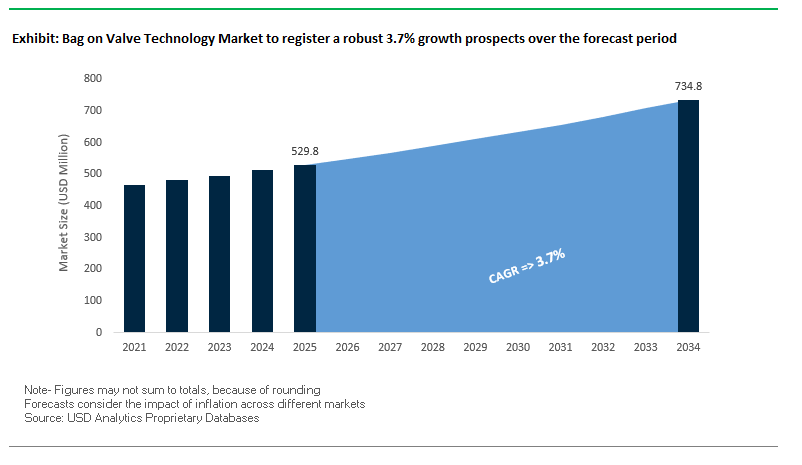
The global Bag-on-Valve (BoV) technology market is projected to expand from USD 529.8 million in 2025 to USD 734.7 million by 2034, registering a CAGR of 3.7%. Growth is underpinned by increasing demand for product purity, safe dispensing, and eco-friendly propellants across industries such as pharmaceuticals, personal care, and food packaging. Unlike traditional aerosol systems, BoV separates the product from the propellant, ensuring integrity, hygiene, and extended shelf life a crucial factor for sensitive applications.
Adoption is also being driven by the shift toward non-flammable propellants such as compressed air and nitrogen, reducing VOC emissions and improving consumer and workplace safety. Moreover, the 360-degree dispensing advantage of BoV systems enhances consumer convenience in products ranging from medical sprays to shaving gels. The ability to achieve up to 99% product evacuation further positions BoV as a sustainable and cost-efficient solution.
Key Insights for Industry Professionals
Product–propellant separation safeguards integrity in pharmaceuticals, cosmetics, and food.
Non-flammable gases reduce risks and comply with environmental standards.
Continuous 360-degree dispensing boosts user convenience and application precision.
High evacuation rates (up to 99%) minimize waste and improve sustainability.
Industry Developments Highlight Sustainability Investments and Global Production Expansion
The BoV technology industry is experiencing a wave of sustainability-driven innovations and global expansion initiatives. In August 2025, SIG advanced recyclability standards by earning APR recognition for its recycle-ready packaging, reflecting the broader push toward environmentally friendly BoV-compatible formats. Earlier, in June 2025, Hochwald transitioned to aluminum-layer-free cartons with SIG Terra solutions, marking a significant step toward lowering carbon emissions in packaging.
Sustainability milestones were further reinforced in May 2025, when SIG launched the world’s first aluminum-layer-free full-barrier packaging material, cutting carbon footprints by 61%. This was followed in February 2025 by Tetra Pak’s partnership with Nissha Metallizing Solutions to launch cartons featuring 80% paper content, a development relevant to adjacent BoV ecosystems focusing on reduced material impact.
Production expansions are also critical. In February 2025, SIG inaugurated its first aseptic carton facility in India, designed with capacity for 4 billion packs annually, signaling growth in emerging markets. Meanwhile, collaborations like BMW and Landshut University (October 2024) on AI-driven automation tools illustrate how smart technologies are increasingly tied to packaging and returnable container management.
Transformative Trends and Emerging Opportunities in the Bag-on-Valve (BoV) Technology Market
Strategic Adoption in High-Value Pharmaceutical and Biologic Drug Delivery
Bag-on-valve technology is transforming the pharmaceutical and biologics landscape by offering unmatched sterility, precise dosing, and contamination-free dispensing, making it the preferred solution for next-generation therapies. Unlike traditional aerosol systems, BoV completely separates the formulation from the propellant, ensuring that sensitive APIs remain stable and effective. This is particularly critical for sterile products such as nasal sprays, wound cleansers, and ophthalmic solutions, where regulatory requirements mandate a contaminant-free environment. Brands like Stérimar and Simply Saline have successfully adopted BoV to deliver hygienic, preservative-free products in the U.S. and Europe. Furthermore, the ability to sterilize the entire can via gamma irradiation ensures product integrity across its shelf life, providing strong alignment with patient safety and compliance standards. The versatility of BoV also enables its application in advanced drug delivery systems, including viscous gels, film-forming sprays, and barrier creams, positioning it as a future-proof platform for both established and emerging therapeutic categories.
Material Innovation Driving Recyclability and Propellant Transition
Sustainability mandates are reshaping the bag-on-valve technology market, with manufacturers pioneering recyclable aluminum can formats and transitioning to eco-friendly propellants such as compressed air and nitrogen. This shift not only reduces VOC emissions but also aligns with stringent global environmental regulations. The Aluminum Association highlights that recycling aluminum saves up to 95% of the energy compared to primary production, making BoV systems integral to circular packaging ecosystems. With up to 99% product evacuation rates, BoV significantly reduces product waste while lowering the carbon footprint compared to traditional aerosol cans. Industry leaders such as Aptar are investing heavily in sustainable BoV packaging, ensuring compliance with ESG commitments while meeting brand and consumer expectations for greener solutions. This trend positions BoV as a frontrunner in sustainable aerosol innovation, blending material science with regulatory compliance and long-term cost efficiency.
Expansion into Premium and Organic Personal Care Formulations
The bag-on-valve market is poised for substantial growth in premium skincare and organic personal care, where sensitive, preservative-free formulations demand superior protection. With consumer demand for “clean label” products free from parabens and synthetic additives at an all-time high, BoV technology delivers airtight, oxygen-free storage that preserves ingredient integrity without chemical preservatives. This is especially valuable in high-value skincare serums, sunscreens, and facial mists that rely on delicate botanicals and natural extracts. Beyond protection, BoV enhances user experience by offering 360-degree dispensing, fine spray application, and nearly zero product waste, all of which resonate strongly with luxury and eco-conscious consumers. Brands leveraging BoV systems can differentiate their offerings with both performance and sustainability, securing a competitive edge in the fast-growing organic personal care space.
Development of Connected and Dosing-Locked BoV Systems for Adherence
Smart packaging integration presents one of the most disruptive opportunities in the BoV market, particularly for pharmaceutical applications where patient adherence is a critical challenge. By embedding IoT-enabled actuators, dose counters, and locking mechanisms, connected BoV systems can track medication usage, send real-time reminders, and prevent accidental overdosing. Such innovations directly address the global issue of non-adherence, which costs healthcare systems billions annually and compromises treatment outcomes. For chronic disease management, these devices could sync with mobile apps, providing patients and healthcare providers with actionable insights into dosage compliance. Academic research and industry pilot projects are already exploring how BoV packaging can evolve into intelligent health management tools. By merging sterile drug delivery with digital health solutions, connected BoV systems represent a high-value growth avenue that could redefine the role of packaging in healthcare ecosystems.
Competitive Landscape: Global Leaders Advance BoV Technology with Innovation and Sustainability
The competitive environment of the BoV technology market is marked by leading global companies expanding their portfolios through innovation, safety features, and sustainability-focused designs.
AptarGroup, Inc.: Enhancing BoV for Medical and Personal Care Applications
Aptar is a key innovator in dispensing and active packaging systems, with BoV solutions serving pharmaceuticals, personal care, and food industries. The company is enhancing its BoV portfolio with applications in medical sprays and hygiene products, ensuring compliance with strict safety and performance standards. Its wide range of valves and actuators, combined with its strong focus on product safety and sustainability, positions Aptar as a reliable global supplier.
LINDAL Group Holding GmbH: Strengthening Global Presence in Aerosol BoV Systems
LINDAL has built a strong reputation in aerosol packaging technologies, offering a full suite of BoV valves, actuators, and can components. The company is expanding production facilities and investing in new technologies to meet growing global demand. Its R&D-driven approach, combined with a strong international footprint, reinforces its ability to launch innovative, sustainable aerosol and BoV solutions quickly across multiple markets.
Precision Valve Corporation: Delivering Integration-ready BoV Components
Precision specializes in aerosol valves, actuators, and BoV solutions tailored for industries such as home care, personal care, and pharmaceuticals. Its BoV systems are designed for easy integration into existing manufacturing lines, enabling fillers and converters to adopt BoV without disruptive process changes. By focusing on safety, product quality, and innovation, Precision strengthens its role as a dependable partner for large-scale manufacturers.
Coster Technologies Speciali S.p.A.: Innovating High-quality BoV Dispensing Systems
Coster is recognized for its expertise in aerosol and dispensing solutions, including BoV products, valves, and actuators. The company is investing in global expansion and advanced facilities to cater to rising demand in pharmaceuticals and cosmetics. Its strength lies in producing high-quality, regulation-compliant BoV systems, making it a trusted supplier for healthcare and personal care brands prioritizing safety and performance.
Bag on Valve Technology Market Share Insights
Standard BOV Systems Dominate Market Share by Product Type in Bag-on-Valve Technology
Standard bag-on-valve (BOV) systems command an overwhelming 75% share, cementing their position as the industry benchmark. Their market leadership is attributed to unmatched versatility, delivering consistent performance across a wide viscosity range from fine cosmetic mists to dense pharmaceutical creams. The technology’s design, which separates the product from the propellant, ensures sterility, complete product evacuation, and preservation of active ingredients. These attributes make standard BOV indispensable in mass-market personal care and pharmaceutical formulations. Its dominance is further reinforced by well-established filling infrastructure, regulatory approvals, and cost efficiency at scale, positioning it as the default solution for most BOV applications.
Personal Care & Cosmetics Lead Market Share by Application in Bag-on-Valve Technology
Personal care and cosmetics account for 55% of BOV applications, making the segment the undisputed leader. Global beauty brands increasingly rely on BOV technology to deliver preservative-free, clean-label products such as sunscreens, hair mousses, and skin creams that maintain purity from the first to the last dose. The airless dispensing system aligns with consumer demand for hygiene, premium quality, and sustainability by eliminating waste and reducing contamination risks. The sector’s dominance also reflects its role in brand differentiation, with BOV enabling superior product performance and luxury positioning. As premiumization accelerates in the beauty industry, BOV’s share is expected to strengthen further, with innovation in recyclable aluminum cans and bio-based bags reinforcing its value proposition.
United States: FDA and EPA Regulations Propel Sustainable Bag-on-Valve Packaging
The United States bag-on-valve technology market is heavily influenced by the regulatory landscape shaped by the U.S. Food and Drug Administration (FDA) and the Environmental Protection Agency (EPA). Since BOV products are often classified as non-flammable and non-aerosol, they benefit from exemptions such as avoiding the hot water bath test mandatory for traditional aerosols. This regulatory advantage accelerates their adoption across personal care, pharmaceutical, and food packaging applications. Technological progress has also been a cornerstone, with manufacturers developing barrier films and dispensing valves that prevent oxygen ingress, extend shelf life, and enable consistent 360-degree spraying.
Corporate innovation is another defining feature of the U.S. market. Companies like Scholle IPN are pioneering flexible and sustainable BOV packaging for beverages, pharmaceuticals, and cosmetics, highlighting a strong industry focus on consumer convenience and eco-consciousness. The pharmaceutical sector in particular has embraced BOV for sterile, preservative-free nasal sprays and topical applications, aligning with the national focus on hygiene and patient safety. With compressed air and nitrogen replacing harmful propellants, sustainability is becoming the strongest growth catalyst, reinforcing the U.S. as a leader in green packaging technologies.
Germany: EU Circular Economy Mandates Drive Recyclable Bag-on-Valve Solutions
Germany’s bag-on-valve market operates within one of the most stringent regulatory frameworks worldwide, led by the EU Packaging and Packaging Waste Regulation (PPWR) and the national Packaging Act (VerpackG). Both mandate that all packaging be fully recyclable or reusable by 2030, pushing manufacturers toward lightweight, eco-friendly, and recyclable BOV systems. The LINDAL Group, a global leader in aerosol and valve technologies, is spearheading this innovation with lightweight recyclable dispensing components and custom-engineered BOV systems designed to integrate seamlessly with circular economy requirements.
Germany also stands out for its research and development ecosystem, where collaborations between academic institutions and packaging companies are producing advanced barrier bags and refill-ready valves. With the cosmetics and pharmaceutical sectors expanding across Europe, BOV products are in high demand for their ability to deliver preservative-free formulations and maximum product evacuation. Combined with EU waste reduction targets and continuous R&D, Germany has positioned itself as the hub of sustainable and high-performance BOV packaging innovation in Europe.
China: Dual Carbon Policies and Smart Manufacturing Expand BOV Technology
The Chinese bag-on-valve technology industry is thriving under the government’s “dual carbon” policy, which aims to reduce carbon emissions and restrict non-degradable plastics. This shift is fueling demand for eco-friendly BOV packaging in personal care, food, and pharmaceuticals. Regulatory oversight by the State Administration for Market Regulation (SAMR) and updated GB standards for food-contact packaging ensure that Chinese BOV solutions align with global safety and consumer protection requirements, offering a clear framework for both domestic and international markets.
China is also rapidly embracing automation, AI, and “5G plus industrial internet” integration, making its BOV production more efficient and flexible. Local companies are scaling up domestic capacity to reduce reliance on imported technologies, particularly for booming personal care and household cleaning applications. Corporate investment in domestic manufacturing plants and advanced dispensing systems is intensifying competition while meeting surging consumer demand. As sustainability goals converge with digital transformation in packaging manufacturing, China is positioning itself as a fastest-growing hub for BOV packaging technology worldwide.
India: Make in India and Pharmaceutical Growth Power Bag-on-Valve Packaging Adoption
India’s bag-on-valve technology market is rapidly expanding under government-backed initiatives such as “Make in India” and Zero Effect Zero Defect (ZED), which encourage local production of high-quality packaging. Regulatory oversight by the Food Safety and Standards Authority of India (FSSAI) through the 2018 Packaging Regulations ensures BOV solutions for food and beverages comply with strict global safety benchmarks, covering material quality, migration limits, and labeling. These policies have built confidence among global brands sourcing BOV solutions from Indian manufacturers.
Technological advancements in automated packaging lines, customized barrier films, and moisture-resistant valves are driving adoption across the pharmaceutical and cosmetics sectors. BOV is gaining traction for nasal sprays, topical creams, and cosmetic mists, where sterile, airtight, and contamination-free packaging is critical. Sustainability is an additional driver, with Indian producers increasingly using compressed air and nitrogen-based propellants as green alternatives to hydrocarbons. With rising collaborations between corporations, research institutions, and government bodies, India is quickly becoming a cost-efficient and innovation-driven hub for BOV packaging solutions.
Brazil: ANVISA Regulations and Cosmetics Boom Strengthen Bag-on-Valve Market
Brazil’s bag-on-valve market is shaped by the National Health Surveillance Agency (ANVISA), which enforces strict safety, labeling, and quality standards for packaging in pharmaceuticals and cosmetics. Recent regulatory updates have streamlined approval pathways for lower-risk packaging products, encouraging broader adoption of innovative solutions such as BOV systems. This regulatory clarity, combined with the country’s growing personal care and cosmetics sector, has positioned Brazil as a regional leader in advanced packaging technologies.
On the technology front, Brazilian manufacturers are integrating robotics, artificial intelligence (AI), and automated inspection systems to enhance quality and reduce production errors. Sustainability is also a key focus, with increasing adoption of recyclable BOV materials in response to the government’s push toward a circular economy and responsible waste management. Strategic investments in packaging infrastructure, particularly for cosmetics, skincare, and OTC pharmaceuticals, are fueling steady growth. Together, ANVISA’s oversight and corporate sustainability initiatives are transforming Brazil into a strong growth market for eco-friendly and sterile BOV packaging solutions.
Japan: Smart Packaging and Biopolymer Research Advance BOV Innovation
Japan’s bag-on-valve technology sector is rooted in the nation’s tradition of precision manufacturing and continuous innovation. The Ministry of Health, Labour and Welfare (MHLW) recently revised its Food Sanitation Act in 2025, tightening requirements for food-contact packaging and reinforcing trust in Japanese-made solutions. BOV technology, which originated in Japan in the 1990s, continues to evolve with advanced designs that offer dimensional stability, resistance to deformation, and high-performance dispensing capabilities for sensitive applications.
The Japanese market is undergoing a transformation toward smart packaging, with companies integrating sensors and digital tools to monitor product safety and extend shelf life. Corporations such as Toyo Seikan Group are leading in recyclable and lightweight BOV designs, while universities are conducting cutting-edge research on biopolymers and natural materials to replace traditional plastics. This combination of corporate innovation and academic collaboration ensures Japan remains a global leader in high-tech, sustainable BOV packaging for pharmaceuticals, cosmetics, and premium food applications.
Bag on Valve Technology Market Report Scope
Bag on Valve Technology Market
Parameter
Details
Market Size (2025)
$529.8 Million
Market Size (2034)
$734.7 Million
Market Growth Rate
3.7%
Segments
By Product Type (Standard Bag-on-Valve Systems, Bi-component Bag-on-Valve Systems, Piston-based Bag-on-Valve Systems), By Propellant (Compressed Air, Nitrogen, Others), By Application (Personal Care & Cosmetics, Pharmaceuticals & Medical, Food & Beverages, Household & Industrial), By Material Type (Aluminum, Tinplate, Glass, Plastic), By Container Size (Small, Medium, Large)
Study Period
2019- 2024 and 2025-2034
Units
Revenue (USD)
Qualitative Analysis
Porter’s Five Forces, SWOT Profile, Market Share, Scenario Forecasts, Market Ecosystem, Company Ranking, Market Dynamics, Industry Benchmarking
US, Canada, Mexico, Germany, France, Spain, Italy, UK, Russia, China, India, Japan, South Korea, Australia, South East Asia, Brazil, Argentina, Middle East, Africa
Bag on Valve Technology Market Segmentation
By Product Type
Standard Bag-on-Valve Systems
Bi-component Bag-on-Valve Systems
Piston-based Bag-on-Valve Systems
By Propellant
Compressed Air
Nitrogen
Others
By Application
Personal Care & Cosmetics
Pharmaceuticals & Medical
Food & Beverages
Household & Industrial
By Material Type
Aluminum
Tinplate
Glass
Plastic
By Container Size
Small
Medium
Large
Countries Analyzed
North America (US, Canada, Mexico)
Europe (Germany, UK, France, Spain, Italy, Russia, Rest of Europe)
Asia Pacific (China, India, Japan, South Korea, Australia, South East Asia, Rest of Asia)
South America (Brazil, Argentina, Rest of South America)
Middle East and Africa (Saudi Arabia, UAE, Rest of Middle East, South Africa, Egypt, Rest of Africa)
Top Companies in Bag on Valve Technology Market
AptarGroup, Inc.
LINDAL Group
Scholle IPN
SUMMIT Packaging Systems, Inc.
Aurena Laboratories
Precision Valve Corporation
Coster Tecnologie Speciali S.p.A.
Bemis Company, Inc. (part of Amcor)
O.Berk Company
Shanghai Al-Can Labels Co., Ltd.
Vapro GmbH & Co. KG
Exal Corporation (part of Trivium Packaging)
TOYO & DEUTSCH CORP.
Colep
Emsar, Inc.
* List Not Exhaustive
Methodology
USDAnalytics employs a comprehensive, industry-focused research methodology to deliver accurate insights into the global bag-on-valve (BoV) technology market. Our approach integrates primary research through interviews with packaging manufacturers, pharmaceutical and personal care companies, and industry experts, alongside secondary research from verified corporate reports, regulatory filings, and trade publications. Market sizing, growth forecasts, and adoption trends are derived using proprietary quantitative models that account for factors such as product–propellant separation, 360-degree dispensing, eco-friendly propellant adoption, and high evacuation efficiency. Competitive intelligence evaluates innovation strategies, sustainability initiatives, and global production expansions by leaders such as AptarGroup, LINDAL, Precision Valve, and Coster Technologies. Regional analyses cover key markets including the U.S., Germany, China, India, Brazil, and Japan, considering regulatory frameworks, sustainability mandates, and technological advancements in smart packaging. By triangulating multiple verified sources and validating trends with industry stakeholders, USDAnalytics provides actionable, high-quality insights designed for decision-makers, supply chain strategists, and packaging professionals seeking to navigate and capitalize on BoV market opportunities.
Deliverables:
Comprehensive Market Research Report (PDF and Excel) with detailed tables, charts, and interactive visualizations.
Country-Specific Forecasts & Analysis.
Segment-Wise Revenue Forecasts (2025–2034).
Competitive Analysis, Benchmarking, and SWOT Profiles.
Recent Developments & Innovation Tracker.
Executive Summary & Analyst Commentary.
Post-Purchase Analyst Support for Client-Specific Questions and Custom Data Requirements.
Table of Contents: Bag-on-Valve (BoV) Technology Market
2. Bag-on-Valve (BoV) Technology Market Landscape & Outlook (2025–2034)
2.1. Introduction to Bag-on-Valve (BoV) Technology Market
2.2. Market Valuation and Growth Projections (2025–2034)
2.3. Market Drivers and Restraints
2.4. Regulatory and Environmental Influences
2.5. Industry Investment and Production Expansion
3. Innovations Reshaping the Bag-on-Valve (BoV) Technology Market
3.1. Trend: Strategic Adoption in High-Value Pharmaceutical and Biologic Drug Delivery
3.2. Trend: Material Innovation Driving Recyclability and Propellant Transition
3.3. Opportunity: Expansion into Premium and Organic Personal Care Formulations
3.4. Opportunity: Development of Connected and Dosing-Locked BoV Systems for Adherence
4. Competitive Landscape and Strategic Initiatives
4.1. Mergers, Acquisitions and Strategic Alliances
4.2. R&D and Material Innovation
4.3. Sustainability and Strategies
4.4. Market Expansion and Regional Focus
5. Market Share and Segmentation Insights: Bag-on-Valve (BoV) Technology Market
5.1. By Product Type
5.1.1. Standard Bag-on-Valve Systems
5.1.2. Bi-component Bag-on-Valve Systems
5.1.3. Piston-based Bag-on-Valve Systems
5.2. By Propellant
5.2.1. Compressed Air
5.2.2. Nitrogen
5.2.3. Others
5.3. By Application
5.3.1. Personal Care & Cosmetics
5.3.2. Pharmaceuticals & Medical
5.3.3. Food & Beverages
5.3.4. Household & Industrial
5.4. By Material Type
5.4.1. Aluminum
5.4.2. Tinplate
5.4.3. Glass
5.4.4. Plastic
5.5. By Container Size
5.5.1. Small
5.5.2. Medium
5.5.3. Large
6. Country Analysis and Outlook of Bag-on-Valve (BoV) Technology Market
6.1. United States
6.2. Canada
6.3. Mexico
6.4. Germany
6.5. France
6.6. Spain
6.7. Italy
6.8. UK
6.9. Russia
6.10. China
6.11. India
6.12. Japan
6.13. South Korea
6.14. Australia
6.15. South East Asia
6.16. Brazil
6.17. Argentina
6.18. Middle East
6.19. Africa
7. Bag-on-Valve (BoV) Technology Market Size Outlook by Region (2025–2034)
7.1. North America Market Size Outlook to 2034
7.1.1. By Product Type
7.1.2. By Application
7.1.3. By Propellant
7.1.4. By Material Type
7.2. Europe Market Size Outlook to 2034
7.2.1. By Product Type
7.2.2. By Application
7.2.3. By Propellant
7.2.4. By Material Type
7.3. Asia Pacific Market Size Outlook to 2034
7.3.1. By Product Type
7.3.2. By Application
7.3.3. By Propellant
7.3.4. By Material Type
7.4. South America Market Size Outlook to 2034
7.4.1. By Product Type
7.4.2. By Application
7.4.3. By Propellant
7.4.4. By Material Type
7.5. Middle East and Africa Market Size Outlook to 2034
7.5.1. By Product Type
7.5.2. By Application
7.5.3. By Propellant
7.5.4. By Material Type
8. Company Profiles: Leading Players in the Bag-on-Valve (BoV) Technology Market
8.1. AptarGroup, Inc.
8.2. LINDAL Group
8.3. Scholle IPN
8.4. SUMMIT Packaging Systems, Inc.
8.5. Aurena Laboratories
8.6. Precision Valve Corporation
8.7. Coster Tecnologie Speciali S.p.A.
8.8. Bemis Company, Inc. (part of Amcor)
8.9. O.Berk Company
8.10. Shanghai Al-Can Labels Co., Ltd.
8.11. Vapro GmbH & Co. KG
8.12. Exal Corporation (part of Trivium Packaging)
8.13. TOYO & DEUTSCH CORP.
8.14. Colep
8.15. Emsar, Inc.
9. Methodology
9.1. Research Scope
9.2. Market Research Approach
9.3. Market Sizing and Forecasting Model
9.4. Research Coverage
9.5. Data Horizon
9.6. Deliverables
10. Appendix
10.1. Acronyms and Abbreviations
10.2. List of Tables
10.3. List of Figures
Bag on Valve Technology Market Segmentation
By Product Type
Standard Bag-on-Valve Systems
Bi-component Bag-on-Valve Systems
Piston-based Bag-on-Valve Systems
By Propellant
Compressed Air
Nitrogen
Others
By Application
Personal Care & Cosmetics
Pharmaceuticals & Medical
Food & Beverages
Household & Industrial
By Material Type
Aluminum
Tinplate
Glass
Plastic
By Container Size
Small
Medium
Large
Countries Analyzed
North America (US, Canada, Mexico)
Europe (Germany, UK, France, Spain, Italy, Russia, Rest of Europe)
Asia Pacific (China, India, Japan, South Korea, Australia, South East Asia, Rest of Asia)
South America (Brazil, Argentina, Rest of South America)
Middle East and Africa (Saudi Arabia, UAE, Rest of Middle East, South Africa, Egypt, Rest of Africa)
BoV separates the product from the propellant, ensuring sterility, hygiene, and extended shelf life. Its 360-degree dispensing capability allows complete evacuation of up to 99% of the product, reducing waste. Additionally, non-flammable propellants like compressed air and nitrogen enhance consumer and workplace safety, making BoV ideal for pharmaceuticals, personal care, and food applications.
Personal care and cosmetics lead with 55% market share, followed by pharmaceuticals and medical applications. BoV is particularly valuable for preservative-free skincare, nasal sprays, topical creams, and food-safe products where maintaining purity, precise dosing, and contamination-free dispensing are critical. Its versatility also supports emerging high-value applications in organic and premium formulations.
Manufacturers are transitioning to recyclable aluminum cans, aluminum-layer-free cartons, and eco-friendly propellants to reduce carbon emissions and VOCs. High evacuation efficiency minimizes product waste, and circular economy initiatives, such as APR-certified packaging, further reinforce BoV as an environmentally responsible alternative to traditional aerosol systems.
Smart BoV solutions integrate IoT-enabled actuators, dose counters, and connected dispensing systems, enabling real-time monitoring, adherence tracking, and automated inventory management. These innovations enhance patient compliance in pharmaceuticals and optimize operational efficiency in personal care and foodservice applications, transforming packaging into a connected platform.
The U.S. leads in regulatory-driven innovation, supported by FDA and EPA guidelines. Germany and Japan focus on recyclable, high-performance systems due to circular economy mandates. China and India are expanding production under sustainability and “Make in India” initiatives, while Brazil leverages ANVISA regulations to grow its cosmetics and pharmaceutical BoV applications, reflecting a global trend toward eco-friendly, high-performance packaging.
More Equipment, Services and End-use Products Reports