Market Overview: Bismuth Nitrate Market Expansion Supported by Pharma Purity Standards, Electronics Materials, and Sustainable Substitutions (2025–2034)
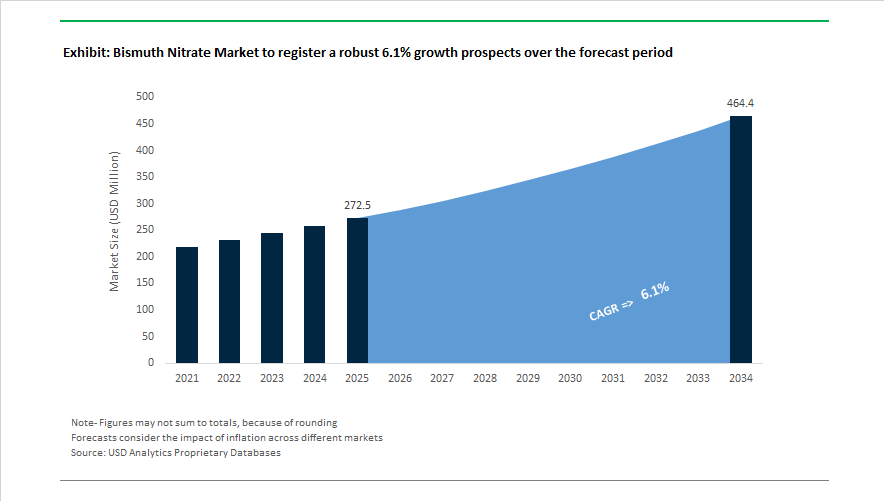
The bismuth nitrate market is projected to grow from USD 272.5 Million in 2025 to USD 464.3 Million by 2034, registering a CAGR of 6.1% driven by pharmaceutical intermediates, electronic ceramics, optical fibers, catalysts, and environmentally safer metal substitutes. Industrial momentum strengthened during 2024 when Par Pharmaceutical introduced a generic version of Pylera therapy, expanding global access to bismuth-based gastrointestinal treatments that rely on nitrate-derived intermediates. The European production landscape advanced between 2024 and 2025 when The Shepherd Chemical Company completed an $8.5 million expansion of its Mirecourt facility in France, adding R&D capacity and a dedicated reactor to scale high-purity metal salts. In the same period, Viavi Solutions and OFS initiated large-scale production of bismuth-doped optical fibers, a downstream technology dependent on ultra-pure bismuth chemical precursors.
Raw material security and emerging applications are broadening the value chain. In March 2025, a new dedicated bismuth mine in Bolivia began operations, stabilizing supply of metallic bismuth feedstock used in nitric acid conversion to bismuth nitrate. During May 2025, research teams advanced RE3Bi7 thermoelectric materials synthesized using bismuth nitrate, demonstrating potential for waste heat recovery technologies. Industrial substitution trends gained traction through 2025 as electronics manufacturers accelerated the move toward bismuth-based non-toxic solders, increasing demand for nitrate intermediates in alloy precursor synthesis. In January 2026, 5N Plus reaffirmed investment in proprietary purification technologies to serve semiconductor and electronic ceramic markets requiring crystalline bismuth nitrate of exceptional purity.
Regulatory oversight and sustainability positioning are shaping market direction entering 2026. In January 2026, the U.S. FDA introduced updated impurity thresholds for bismuth-containing drugs, requiring ultra-low lead levels and prompting manufacturers to refine crystallization processes. Nuclear medicine applications also expanded in 2025 as demand for bismuth-related isotopes such as bismuth-207 increased for diagnostics and targeted alpha therapy research, benefiting suppliers of high-purity bismuth intermediates. In February 2026, the European Bismuth Association highlighted bismuth’s role in replacing lead and chromium pigments in coatings, reinforcing its environmental profile. Industry digitization is accelerating as well. Deloitte’s December 2025 outlook noted that specialty chemical firms are deploying AI-driven R&D models to optimize synthesis routes and material performance predictions, a trend increasingly adopted by producers of bismuth nitrate catalysts and pharmaceutical intermediates.
Trends and Opportunities Transforming the Bismuth Nitrate Market
Market Trend: Bismuth Nitrate Demand Accelerates as Western Economies Prioritize Critical Mineral Security
Bismuth nitrate is shifting from a commodity chemical to a strategically protected resource as governments seek supply independence from China, which currently accounts for more than 80% of primary bismuth production. The U.S. Department of the Interior and USGS formally retained bismuth on the 2025 Federal Critical Minerals List, unlocking national-level funding mechanisms for domestic processing capacity. This policy shift enables U.S. metal refiners to expand by-product recovery systems from lead and tungsten smelting, which are now positioned as strategic feeder streams for ultra-high-purity (99.99% ) bismuth nitrate used in defense sensors, aerospace technologies, semiconductor etchants, and satellite solar cell coatings.
Corporate strategies are also changing. 5N Plus Inc. reported a 33% year-over-year revenue jump in November 2025, its highest in a decade, driven by bismuth-based materials for space-solar energy, precision electronics, and renewable power systems. Through vertically integrated supply chain models and global footprint optimization, suppliers such as 5N Plus and U.S. refineries are positioning themselves as Western-aligned alternatives, decreasing procurement risk for semiconductor fabs, battery firms, and medical-device manufacturers.
Market Trend: Green Chemistry Adoption Drives Use of Bismuth Nitrate as a Sustainable Lewis Acid Catalyst
The market is rapidly adopting bismuth nitrate pentahydrate as a “low-toxicity catalyst” in pharmaceutical and specialty chemical synthesis. Unlike toxic lanthanides and heavy-metal catalysts, bismuth nitrate functions effectively in water and remains recyclable, aligning with cost and ESG mandates. In 2025, studies published in the International Journal of Pharmaceutical Sciences & Research confirmed that plant-mediated green synthesis can convert bismuth nitrate salts into catalytic nanoparticles for heterocycle production. This accelerates the transition toward catalytic platforms that reduce solvent waste, slash energy use in reaction pathways, and enable greener fine chemical manufacturing.
Industrial case studies through early 2025 further show that bismuth nitrate significantly enhances nitro-pollutant reduction efficiency without requiring organic solvents. This is becoming a competitive advantage for pharmaceutical OEMs, agrochemical entities, and specialty manufacturers seeking compliance with EU Green Deal and U.S. “low-hazard intermediate” requirements. As fine-chemicals players decarbonize, bismuth nitrate is emerging as an essential molecule for catalyst substitution.
Market Opportunity: Precursor for High-Conductivity Bismuth-Oxide Electrolytes in Solid-State Batteries
Solid-state battery commercialization is creating a multi-billion-dollar downstream pull for bismuth nitrate as a precursor for doped bismuth oxide (Bi₂O₃) electrolytes. At the July 2025 ECS Meeting, tailored bismuth-oxide formulations demonstrated record-level oxygen-ion conductivity with intact structural stability after 100 hours of aging at 500°C. These characteristics are essential for next-generation EV batteries that must deliver thermal resilience, fast-charge functionality, and high energy density.
Market-scale transition is now policy-supported. China’s MIIT 6-billion-yuan solid-state battery program initiated in September 2025 prioritizes non-ferrous metal precursor access, including bismuth nitrate, to move oxide-electrolyte chemistries from laboratory trials to pilot-line production. This creates a multi-year supply window where upstream producers can secure long-term OEM contracts for EV, aerospace power modules, and grid-scale solid-state storage projects.
Market Opportunity: High-Contrast Radiopaque Additives for Next-Generation Medical Polymers
The medical device sector is creating a fast-growing demand stream for bismuth-derived additives that outperform traditional barium fillers. Bismuth-filled polymers provide sharper X-ray and fluoroscopy imagery at lower filler loading levels—meaning 40% bismuth compounds can deliver superior attenuation while allowing polymer substrates (TPU, PVC, PEBAX) to retain flexibility and tensile strength.
2025 research is advancing this use case even further by covalently binding bismuth elements into polymer chains, reducing leaching risks and improving long-term biocompatibility. These bismuth-integrated plastics are now being prototyped for implantable medical devices, surgical sealants, and vascular catheters requiring non-invasive radiographic visibility for 15-20-year lifecycles. As clinical safety frameworks tighten, OEMs are expected to increasingly specify bismuth nitrate-derived compounds as a replacement for barium sulfate in next-generation bio-compatible devices.
Bismuth Nitrate Market Share and Segmentation Insights
Market Share by Grade: Industrial Volume Leadership Balanced by High-Purity Growth
Industrial grade accounts for 41% of the Bismuth Nitrate Market in 2025, reflecting its role as a key precursor for bismuth oxide, bismuth subnitrate, and related salts used in catalysts, organic synthesis, and pearlescent pigments. This segment is highly volume-driven and price-sensitive, closely linked to specialty chemical and pigment production cycles. Pharmaceutical grade represents the second-largest share, supported by its use in synthesizing bismuth subsalicylate and other antimicrobial and antiulcer agents, where GMP compliance and strict heavy metal impurity control are mandatory. Reagent grade serves analytical laboratories and research institutions, providing stable but low-volume demand in spot tests and specialty chemical development. Ultra high purity grade is the fastest-growing category, required for advanced electronic materials including MOCVD precursors for III-V semiconductors and precision optical coatings, with semiconductor capacity expansion in Asia-Pacific accelerating consumption.
Market Share by End User Industry: Healthcare Dominates as Electronics Emerges as a High-Growth Engine
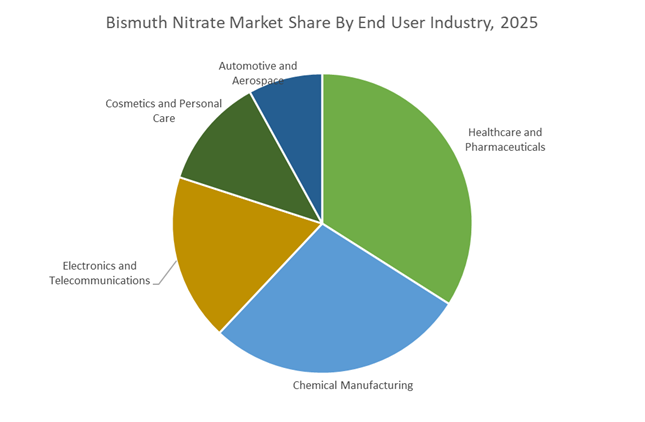
Healthcare and pharmaceuticals represent 34% of global bismuth nitrate demand in 2025, driven by use in gastrointestinal treatments, antimicrobial dressings, veterinary medicines, and radiology-related compounds, with generic drug manufacturing in India and China serving as major demand hubs. Chemical manufacturing forms a substantial secondary segment, utilizing bismuth nitrate in oxidation catalysts and the production of bismuth vanadate pigments for non-toxic yellow coloration. Electronics and telecommunications is the fastest-growing end-use, supported by ultra-high-purity material requirements in ferroelectric memory, optoelectronics, and high-k dielectric applications aligned with 5G, IoT, and advanced semiconductor packaging growth. Cosmetics and personal care rely on bismuth derivatives such as bismuth oxychloride for mineral-based pearlescent pigments, benefiting from clean beauty trends. Automotive and aerospace applications remain niche, including lubricant additives and lead-free metallurgical formulations.
Competitive Landscape Analysis of the Bismuth Nitrate Market Competitive Landscape
The global bismuth nitrate market is characterized by high-purity refinement capabilities, vertical integration into bismuth metal supply, and strong positioning across pharmaceutical synthesis, electronics materials, pigments, and advanced catalysis. Competitive intensity in 2026 is driven by traceability, sustainable sourcing, semiconductor-grade purity standards, and regulatory-compliant production. Leading players are differentiating through closed-loop recycling models, digitalized batch control systems, domestic supply chain localization, and advanced reagent catalog expansion. The market structure reflects a mix of integrated mining-to-nitrate producers and high-end specialty reagent manufacturers serving life sciences, aerospace, semiconductor fabrication, and high-performance pigment applications.
5N Plus strengthens high-purity bismuth nitrate leadership through closed-loop recycling
5N Plus operates as a refining engine within the global bismuth value chain, specializing in 5N, 6N, and 7N ultra-high-purity metals and nitrates. In 2025 and 2026, the company transitioned toward secondary stream extraction, reclaiming bismuth from industrial residues to reduce Scope 3 emissions and enhance ESG alignment. Its Puratronic and specialty chemical lines serve aerospace imaging, advanced sensors, and defense-grade applications requiring traceable sourcing. Expansion into Southeast Asia in late 2025 positioned 5N Plus to meet rising demand for catalytic and extractive materials in electronics hubs. Integrated recycling and refining capabilities provide pharmaceutical and defense clients with secure, sustainable supply assurance.
Merck KGaA advances pharmaceutical and semiconductor-grade bismuth nitrate
Merck KGaA focuses on high-precision bismuth nitrate reagents through its Life Science and Electronics divisions. Under its Level Up program, the company invested over €1.5 billion to expand lab essentials and single-use production, ensuring resilient supply for R&D-intensive markets. IoT-enabled manufacturing and Digital Twin systems at Molsheim and Cork enable batch-to-batch consistency for EMSURE and Reag. Ph Eur grades. In 2026, Merck is scaling electronics upcycle demand, positioning bismuth compounds as dielectric precursors for EUV and ALD semiconductor nodes. The company dominates pharmaceutical synthesis, where bismuth nitrate is essential for anti-cancer adjuvants and gastrointestinal drug intermediates.
American Elements expands domestic bismuth nitrate supply for aerospace and fusion research
American Elements positions itself as a specialty solutions provider for advanced materials research and high-tech manufacturing. It produces crystalline, powder, and liquid bismuth nitrate formats, offering homogeneous solutions tailored to precise stoichiometric requirements. In late 2025, the company launched a Fusion Energy Division exploring bismuth-based alloys and nitrate compounds for next-generation nuclear shielding systems. In 2026, its US Domestic Supply initiative aims to replace critical metal imports, securing Western-sourced material for aerospace and defense contractors. With solution production facilities across the US, UK, Italy, and Australia, American Elements ensures rapid-response logistics and localized technical support.
TCI Chemicals supports green catalysis and materials synthesis with high-grade bismuth nitrate
Tokyo Chemical Industry specializes in reagent-grade bismuth nitrate for organic synthesis, catalysis, and materials science. In December 2025, TCI expanded its Life Science catalog with cell culture-ready bismuth derivatives targeting antimicrobial biotech applications. Its Bismuth(III) Nitrate Pentahydrate grades, optimized between 95% and 98% purity, are widely used in green catalysis, selective oxidation, and perovskite solar cell precursor synthesis. TCI’s 2D Code product search system, fully deployed in 2026, provides instant analytical and safety documentation, streamlining procurement for high-throughput laboratories. The company maintains leadership in inorganic chemistry research and specialty pigment intermediate development.
Thermo Fisher Scientific enhances reagent traceability and AI-driven impurity matching
Thermo Fisher serves the bismuth nitrate market through its Alfa Aesar and Fisher Chemical brands, offering purity grades from analytical 98% to 99.999% metals basis. Its AI-assisted 2026 digital catalog allows customers to match impurity thresholds, such as sub-10 ppm arsenic content, to application-specific needs in pharmaceuticals and analytical chemistry. The company prioritizes localized manufacturing to reduce lead times for critical reagents like bismuth nitrate pentahydrate. Specialized packaging solutions, including scalable bottle and drum formats, support pilot plants and commercial pharmaceutical scale-up. Thermo Fisher’s quality assurance infrastructure makes it a preferred supplier for regulated laboratory and GMP environments.
Hunan Jinwang Bismuth Industry delivers vertically integrated volume supply for pigments and metallurgy
Hunan Jinwang Bismuth Industry provides the industrial backbone of the global bismuth nitrate market through complete vertical integration from mining and smelting to high-value nitrate and oxide production. In 2025 and 2026, the company implemented advanced wastewater recovery systems to meet China’s Green Factory environmental standards. Its bismuth nitrate serves as a key feedstock for bismuth oxychloride used in automotive pearlescent paints and specialty pigments. By strengthening export hubs in Europe and North America, Hunan Jinwang now competes directly on both 99.9% crystalline purity and high-volume industrial supply. Scale-driven cost efficiency ensures global price stability and material availability.
China Bismuth Nitrate Market: Output Stabilization, Export Discipline, and Environmental Upgrading
China remains the structural anchor of the global bismuth nitrate supply chain, with 2025 marking a clear rebound in refined bismuth availability after prior operational disruptions. According to March 2025 data from Shanghai Metals Market, refined bismuth production increased by 11.61% month on month as 24 producers across eight provinces normalized output following scheduled maintenance. This rebound is strategically significant because refined bismuth directly underpins the production of pharmaceutical-grade and pigment-grade bismuth nitrate, reinforcing China’s role as the primary upstream stabilizer for global downstream industries.
Policy intervention has become more explicit. In April 2025, the Ministry of Commerce of the People's Republic of China updated licensing requirements for strategic metals, tightening oversight of bismuth exports. These measures have redirected material availability toward domestic high-end semiconductors and pharmaceutical synthesis, reducing spot-market volatility but increasing lead times for export buyers. Simultaneously, chemical clusters in Hunan expanded bismuth nitrate-based pigment capacity in late 2025 to serve accelerating demand for lead-free yellow pigments in European automotive coatings and construction materials. Environmental compliance is now a decisive cost driver. The Ministry of Ecology and Environment enforced stricter wastewater discharge norms in mid-2025, compelling refineries in Jiangsu and Shandong to adopt closed-loop nitrate recovery systems, structurally raising compliance barriers while improving long-term sustainability credentials.
India Bismuth Nitrate Market: Critical Mineral Positioning and Pharmaceutical Export Momentum
India’s bismuth nitrate industry is transitioning from niche dependence to strategic relevance, driven by policy-led mineral security and pharmaceutical growth. The launch of the National Critical Mineral Mission in 2025 introduced a ₹1,500 crore incentive framework aimed at strengthening processing capacity for minerals deemed essential to defense and healthcare. Within this framework, bismuth has been identified as a priority input for pharmaceutical intermediates and specialized alloys, elevating bismuth nitrate from a low-volume import to a domestically strategic chemical.
Regulatory reform has reinforced this shift. Amendments under the Mines and Minerals (Development and Regulation) Act 2025 lowered entry barriers for private investment in bismuth-related refining and chemical processing. Downstream pull is intensifying as well. The Ministry of Health and Family Welfare reported a 15% increase in domestic prescription rates for bismuth-based gastrointestinal medications, prompting Indian manufacturers to scale IP-grade bismuth nitrate production to support export growth into North American regulated markets. Knowledge infrastructure is being built in parallel. In April 2025, the government approved guidelines for a dedicated Centre of Excellence for critical minerals, currently supervising twelve active R&D projects focused on bismuth nitrate catalysts for greener and more selective chemical synthesis.
United States Bismuth Nitrate Market: Regulatory Stringency and High-Value Medical Applications
In the United States, the bismuth nitrate market is shaped less by volume and more by regulatory rigor and advanced medical use cases. Under the 2025 revision to FDA 21 CFR 314, the U.S. Food and Drug Administration now requires manufacturers of bismuth-based OTC medicines to submit more granular stability data on bismuth nitrate precursors. This change elevates quality thresholds for suppliers and favors producers capable of consistent impurity control and long-term shelf-life validation.
Beyond traditional pharmaceuticals, bismuth nitrate is gaining strategic importance in nuclear medicine. In late 2025, U.S. biotechnology firms working alongside the U.S. Department of Energy achieved notable progress in synthesizing bismuth-213 radiopharmaceuticals for targeted alpha therapy in oncology. These applications require ultra-high-purity bismuth nitrate as a starting material, positioning the compound as a critical input for next-generation cancer treatments. Regulatory pressure from another angle is also shaping demand. EPA lead-free mandates enforced through 2025 and extending into 2026 have accelerated the substitution of lead with bismuth-nitrate-derived additives in metallurgical alloys, particularly in lead-free brass used for national plumbing and infrastructure projects.
Norway and Europe Bismuth Nitrate Market: Lead Substitution and Low-Carbon Differentiation
Across Europe, including Norway, the bismuth nitrate industry is benefiting from structural substitution away from lead and accelerating decarbonization mandates. Enforcement of REACH Annex XVII restrictions has intensified since 2025, driving a reported 17% year-on-year increase in consumption of bismuth-based pigments and catalysts across the European Economic Area. This trend reflects regulatory certainty that permanently displaces lead-based chemistries in consumer goods, coatings, and plastics.
Sustainability differentiation is emerging as the next competitive layer. German and Nordic producers, including operations linked to Evonik Industries, have begun integrating renewable hydrogen into nitric acid production. This allows suppliers to offer low-carbon bismuth nitrate grades targeted at cosmetics and personal care brands preparing for stricter 2026–2027 carbon disclosure requirements. For European buyers, traceability and carbon intensity are increasingly weighted alongside purity, favoring producers that combine REACH compliance with decarbonized process chemistry.
Country-Level Strategic Snapshot: Bismuth Nitrate Industry
By Grade (Pharmaceutical Grade, Reagent Grade, Industrial Grade, Ultra High Purity Grade), By Form (Crystalline, Anhydrous Powder, Granular), By Application (Pharmaceutical Synthesis, Chemical Catalysis, Cosmetics and Pigments, Electronics and Semiconductors, Metallurgy), By End User Industry (Healthcare and Pharmaceuticals, Chemical Manufacturing, Cosmetics and Personal Care, Electronics and Telecommunications, Automotive and Aerospace)
Study Period
2019- 2025 and 2026-2034
Units
Revenue (USD)
Qualitative Analysis
Porter’s Five Forces, SWOT Profile, Market Share, Scenario Forecasts, Market Ecosystem, Company Ranking, Market Dynamics, Industry Benchmarking
Companies
Hunan Jinwang Bismuth Industry, Five N Plus, Hunan Shizhuyuan Nonferrous Metals, Merck, American Elements, Hunan Huaxin Rare and Precious Metals, Industrias Peñoles, Omkar Speciality Chemicals, Loba Chemie, Nacalai Tesque, Zhuzhou Keneng New Material, Thermo Fisher Scientific, Y and X Beijing Technology, STREM Chemicals, Western Minmetals
Countries
US, Canada, Mexico, Germany, France, Spain, Italy, UK, Russia, China, India, Japan, South Korea, Australia, South East Asia, Brazil, Argentina, Middle East, Africa
Bismuth Nitrate Market Segmentation
By Grade
Pharmaceutical Grade
Reagent Grade
Industrial Grade
Ultra High Purity Grade
By Form
Crystalline
Anhydrous Powder
Granular
By Application
Pharmaceutical Synthesis
Chemical Catalysis
Cosmetics and Pigments
Electronics and Semiconductors
Metallurgy
By End User Industry
Healthcare and Pharmaceuticals
Chemical Manufacturing
Cosmetics and Personal Care
Electronics and Telecommunications
Automotive and Aerospace
By Region
North America (United States, Canada, Mexico)
Europe (Germany, France, United Kingdom, Spain, Italy, Rest of Europe)
Asia Pacific (China, India, Japan, South Korea, Australia, Rest of APAC)
South and Central America (Brazil, Argentina, Rest of SCA)
Middle East and Africa (Saudi Arabia, UAE, South Africa, Rest of Middle East, Rest of Africa)
2. Bismuth Nitrate Market Landscape & Outlook (2025–2034)
2.1. Introduction to Bismuth Nitrate Market
2.2. Market Valuation and Growth Projections (2025–2034)
2.3. Pharma Purity Standards and Electronic Materials Expansion
2.4. Sustainable Metal Substitution and Green Chemistry Adoption
2.5. Critical Mineral Security and Supply Chain Localization
3. Innovations Reshaping the Bismuth Nitrate Market
3.1. Trend: Critical Mineral Positioning and Western Supply Independence
3.2. Trend: Green Lewis Acid Catalysis and Sustainable Fine Chemical Synthesis
3.3. Opportunity: Solid-State Batteries Using Bismuth Oxide Electrolytes
3.4. Opportunity: Radiopaque Medical Polymers and Advanced Healthcare Devices
4. Competitive Landscape and Strategic Initiatives
4.1. Mergers and Acquisitions
4.2. R&D and Purification Technology Innovation
4.3. Sustainability and Closed-Loop Recycling Strategies
4.4. Market Expansion and Regional Production Focus
5. Market Share and Segmentation Insights: Bismuth Nitrate Market
5.1. By Grade
5.1.1. Pharmaceutical Grade
5.1.2. Reagent Grade
5.1.3. Industrial Grade
5.1.4. Ultra High Purity Grade
5.2. By Form
5.2.1. Crystalline
5.2.2. Anhydrous Powder
5.2.3. Granular
5.3. By Application
5.3.1. Pharmaceutical Synthesis
5.3.2. Chemical Catalysis
5.3.3. Cosmetics and Pigments
5.3.4. Electronics and Semiconductors
5.3.5. Metallurgy
5.4. By End User Industry
5.4.1. Healthcare and Pharmaceuticals
5.4.2. Chemical Manufacturing
5.4.3. Cosmetics and Personal Care
5.4.4. Electronics and Telecommunications
5.4.5. Automotive and Aerospace
5.5. By Region
5.5.1. North America
5.5.2. Europe
5.5.3. Asia Pacific
5.5.4. South and Central America
5.5.5. Middle East and Africa
6. Country Analysis and Outlook of Bismuth Nitrate Market
6.1. United States
6.2. Canada
6.3. Mexico
6.4. Germany
6.5. France
6.6. Spain
6.7. Italy
6.8. United Kingdom
6.9. Russia
6.10. China
6.11. India
6.12. Japan
6.13. South Korea
6.14. Australia
6.15. South East Asia
6.16. Brazil
6.17. Argentina
6.18. Middle East
6.19. Africa
7. Bismuth Nitrate Market Size Outlook by Region (2025–2034)
7.1. North America Bismuth Nitrate Market Size Outlook to 2034
7.1.1. By Grade
7.1.2. By Form
7.1.3. By Application
7.1.4. By End User Industry
7.2. Europe Bismuth Nitrate Market Size Outlook to 2034
7.2.1. By Grade
7.2.2. By Form
7.2.3. By Application
7.2.4. By End User Industry
7.3. Asia Pacific Bismuth Nitrate Market Size Outlook to 2034
7.3.1. By Grade
7.3.2. By Form
7.3.3. By Application
7.3.4. By End User Industry
7.4. South and Central America Bismuth Nitrate Market Size Outlook to 2034
7.4.1. By Grade
7.4.2. By Form
7.4.3. By Application
7.4.4. By End User Industry
7.5. Middle East and Africa Bismuth Nitrate Market Size Outlook to 2034
7.5.1. By Grade
7.5.2. By Form
7.5.3. By Application
7.5.4. By End User Industry
8. Company Profiles: Leading Players in the Bismuth Nitrate Market
8.1. Hunan Jinwang Bismuth Industry
8.2. Five N Plus
8.3. Hunan Shizhuyuan Nonferrous Metals
8.4. Merck
8.5. American Elements
8.6. Hunan Huaxin Rare and Precious Metals
8.7. Industrias Peñoles
8.8. Omkar Speciality Chemicals
8.9. Loba Chemie
8.10. Nacalai Tesque
8.11. Zhuzhou Keneng New Material
8.12. Thermo Fisher Scientific
8.13. Y and X Beijing Technology
8.14. STREM Chemicals
8.15. Western Minmetals
9. Methodology
9.1. Research Scope
9.2. Market Research Approach
9.3. Market Sizing and Forecasting Model
9.4. Research Coverage
9.5. Data Horizon
9.6. Deliverables
10. Appendix
10.1. Acronyms and Abbreviations
10.2. List of Tables
10.3. List of Figures
Bismuth Nitrate Market Segmentation
By Grade
Pharmaceutical Grade
Reagent Grade
Industrial Grade
Ultra High Purity Grade
By Form
Crystalline
Anhydrous Powder
Granular
By Application
Pharmaceutical Synthesis
Chemical Catalysis
Cosmetics and Pigments
Electronics and Semiconductors
Metallurgy
By End User Industry
Healthcare and Pharmaceuticals
Chemical Manufacturing
Cosmetics and Personal Care
Electronics and Telecommunications
Automotive and Aerospace
By Region
North America (United States, Canada, Mexico)
Europe (Germany, France, United Kingdom, Spain, Italy, Rest of Europe)
Asia Pacific (China, India, Japan, South Korea, Australia, Rest of APAC)
South and Central America (Brazil, Argentina, Rest of SCA)
Middle East and Africa (Saudi Arabia, UAE, South Africa, Rest of Middle East, Rest of Africa)
The Bismuth Nitrate Market is valued at USD 272.5 Million in 2025 and is projected to reach USD 464.3 Million by 2034, expanding at a CAGR of 6.1%. Growth is supported by pharmaceutical intermediates, ultra-high-purity electronics demand, solid-state battery precursors, and accelerating replacement of lead-based materials across coatings and alloys.
Healthcare and pharmaceuticals lead with about 34% share in 2025 due to GI drugs and antimicrobial intermediates. Electronics and telecommunications are the fastest-growing segment, fueled by optoelectronics, high-k dielectrics, and bismuth-doped fibers. Chemical catalysis and pigments add steady volume, while medical polymers and EV-related materials represent emerging premium demand.
Bismuth nitrate is benefiting from Western critical mineral strategies as over 80% of primary bismuth supply originates in China. The U.S. Critical Minerals List and EU REACH lead restrictions are accelerating domestic refining, closed-loop recycling, and lead-free pigment adoption. Green chemistry uptake is also expanding bismuth nitrate use as a low-toxicity Lewis acid catalyst in pharma synthesis.
Key opportunities include solid-state battery electrolytes based on doped bismuth oxide, radiopaque additives for next-generation medical polymers, and ultra-high-purity grades for semiconductors and optical fibers. Nuclear medicine isotopes and AI-driven catalyst design are also opening new demand channels for crystalline, electronics-grade bismuth nitrate.