Bulk Bags Market Overview: A Strategic Enabler for Global Supply Chains
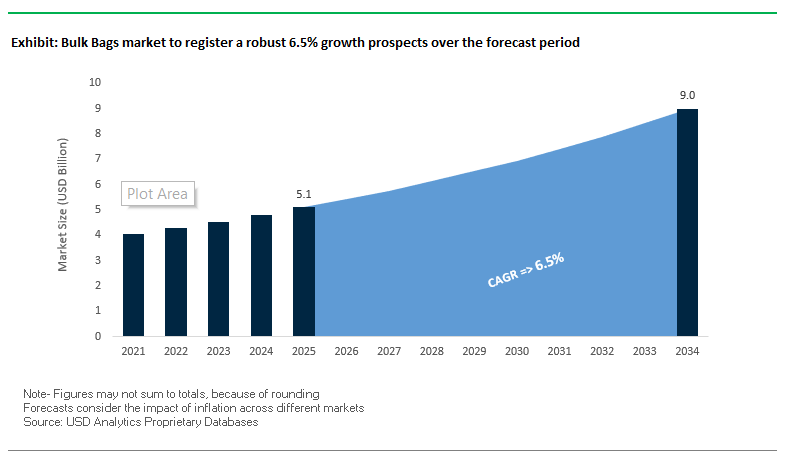
The bulk bags market is projected to grow from USD 5.1 billion in 2025 to USD 9 billion by 2034, registering a CAGR of 6.5%. As global trade volumes expand and industries seek durable, reusable, and cost-effective packaging, bulk bags are becoming indispensable to modern logistics. For industry professionals, the key question is how manufacturers will balance sustainability, safety, and performance while serving high-demand verticals like chemicals, agriculture, and construction.
Key Insights Defining the Bulk Bags Market
Over 150,000 bulk bag units shipped in the U.S. (2021) highlight the strong role of FIBCs in industrial packaging and transport.
30% reduction in incident rates demonstrates their growing contribution to worker safety and supply chain reliability.
Chemicals and fertilizers dominate demand, driven by the need for safe, contamination-free transport of hazardous goods.
Asia-Pacific leads production and consumption, with China and India anchoring global supply and export growth.
Market Analysis: Recent Global Bulk Bags Industry Developments
The past year has underscored the bulk bags industry’s pivot to sustainability, automation, and circular economy practices. In August 2025, a market report highlighted the rapid adoption of smart FIBCs with RFID and IoT sensors, enabling real-time tracking, traceability, and supply chain visibility. Around the same time, A-B-C Packaging Machine Corporation introduced automated bag-filling and discharge systems, reducing manual labor and improving throughput efficiency. These innovations reflect how digitalization and automation are reshaping bulk handling.
In July 2025, Sonoco invested USD 30 million to expand adhesives and sealants production, supporting its packaging portfolio that directly feeds into FIBC manufacturing. Earlier, in June 2025, the merger between Amcor and Berry Global Group reshaped the industrial packaging landscape, strengthening global production networks and impacting bulk bag supply chains. Academic advancements are also notable: in May 2025, researchers published new methods to chemically recycle multi-layer FIBC films, paving the way toward true circularity in industrial packaging.
Sustainability continues to be a dominant force. In February 2025, the EU launched a renewable materials initiative to promote bio-based packaging in industrial applications, further accelerating the shift from conventional polypropylene to bio-based polymers, a trend also supported by findings from a January 2025 industry study. Meanwhile, in March 2025, a logistics company launched reusable bulk containers, reinforcing a long-term move toward closed-loop supply chains that minimize waste and carbon footprint.
Emerging Trends and Opportunities Reshaping the Bulk Bags Market
Strategic Material Innovation for Enhanced Safety, Recyclability, and Performance
The bulk bags market is undergoing a materials revolution as manufacturers engineer advanced properties to improve safety, durability, and sustainability. One of the fastest-growing segments is Type D bulk bags, which feature static-dissipative properties that remove the need for grounding an essential safety advantage in industries handling flammable powders and chemicals. These bags are particularly valuable in pharmaceutical and chemical applications where traditional grounding practices are not always feasible. At the same time, FIBC manufacturers are enhancing UV resistance to extend product life in outdoor storage conditions. For example, Yuan Da’s proprietary formulations increase UV resistance from the standard 1,200 hours to over 1,800 hours, ensuring greater bag longevity in agricultural and construction use cases. Parallel to performance improvements, the industry is also advancing sustainability. The integration of post-consumer recycled (PCR) content into FIBCs allows companies to reduce virgin polypropylene usage while maintaining the durability standards required in critical applications. Together, these innovations demonstrate how material science is at the forefront of solving operational and regulatory challenges while supporting corporate ESG goals.
Integration of Tracking, Tracing, and IoT-Enabled Supply Chain Visibility
Digital transformation is reshaping the bulk bags market, with FIBCs evolving from passive containers into smart assets that enable real-time supply chain visibility. The adoption of RFID technology is gaining traction, allowing warehouses and distribution centers to conduct automated, error-free inventory counts without line-of-sight requirements. This creates efficiencies in bulk goods management, particularly in industries like chemicals, grains, and minerals, where volumes are high and traceability is essential. More advanced use cases involve embedding sensors inside FIBCs to monitor environmental conditions such as humidity and temperature. For pharmaceuticals and food ingredients, this capability provides assurance that materials are stored and transported within safe conditions, reducing the risk of spoilage or compliance breaches. Data collected from these IoT-enabled bags also supports predictive quality control, allowing manufacturers and logistics providers to identify potential risks before they impact product integrity. By integrating tracking and monitoring technologies, FIBCs are becoming an integral part of smart supply chain ecosystems that prioritize efficiency, transparency, and safety.
Development of a Circular Economy through Standardized, Returnable, and Reusable FIBC Systems
The environmental and economic costs of single-use FIBCs are driving momentum toward standardized, reusable bag systems. Manufacturers are now producing multi-trip bags with higher safety factors (SF 6:1 or 8:1), designed for repeated use in closed-loop logistics. These bags are engineered from more durable materials, enabling multiple wash and reuse cycles without compromising load-bearing capacity. Establishing an effective reverse logistics infrastructure is central to this opportunity. Companies are partnering with logistics providers and deploying asset-tracking solutions to recover, inspect, clean, and redeploy bags efficiently. This system not only lowers total cost of ownership for users but also reduces landfill waste, aligning with global sustainability mandates and corporate ESG targets. As industries like food, chemicals, and construction prioritize waste reduction, reusable FIBCs stand out as a cost-efficient and environmentally responsible packaging solution, paving the way for a more circular economy.
Advanced, Automated Manufacturing Technologies for Enhanced Quality and Customization
Manufacturing processes for bulk bags are increasingly adopting robotics and automation to improve consistency, quality, and safety. Automated systems are being used in cutting, sewing, and handling operations, ensuring high-precision seams and dimensions that meet the stringent requirements of industries like pharmaceuticals and chemicals. This automation reduces labor-intensive tasks, improves worker safety, and enhances overall throughput. At the same time, there is a growing demand for small-batch customization, driven by brands that require specialized bag designs for niche applications. Advances in digital design tools and flexible manufacturing platforms now allow producers to economically create bags with unique features such as custom sizes, remote-release discharge spouts, or reinforced lifting loops. Previously, such customization was limited to large production runs due to cost inefficiencies, but automation has made it feasible even for smaller batches. This shift toward precision manufacturing and tailored solutions is positioning FIBC suppliers to capture growth in high-value, specialized market segments.
Competitive Landscape: Key Players in the Global Bulk Bags Market
The bulk bags industry is highly competitive, with multinational corporations and specialized manufacturers leveraging scale, innovation, and regulatory compliance to build their market share.
Conitex Sonoco expands packaging leadership with sustainable FIBC solutions
Conitex Sonoco, part of Sonoco Products Company, offers a wide portfolio of FIBCs, woven polypropylene bags, and multi-wall bags. In July 2025, Sonoco announced a USD 30 million investment to expand adhesives and sealants capacity, reinforcing its packaging ecosystem. Its EPR (Extended Producer Responsibility) commitments highlight its sustainability-driven model, while its global footprint enables integrated solutions from product design to logistics.
Berry Global Group accelerates circular economy through recycling investments
Berry Global is a global leader in industrial plastics, with a strong portfolio of woven and non-woven films for FIBCs. A pioneer in circular plastics, Berry’s Impact 2025 strategy focuses on bio-based and recycled polymers. In March 2024, it expanded recycling capacity in Europe by 6,600 metric tonnes annually, demonstrating its commitment to scaling sustainable production. Its core strength lies in circularity-focused innovation, aligning with global sustainability regulations and customer demand.
Halsted Corporation delivers end-to-end bulk packaging through global sourcing
With over 150 years of packaging experience, Halsted Corporation is a trusted supplier of bulk bags, sandbags, and container liners. Its global partner network ensures competitive sourcing and custom solutions for distributors. Halsted’s strategic focus is on seamless service delivery, covering design, warehousing, logistics, and financing, making it a comprehensive partner for industrial clients.
Sackett-Wright Bulk Bags focuses on customized and secure FIBC designs
Sackett-Wright specializes in custom-engineered bulk bags for industrial applications. Its recent innovations include tamper-proof seals and security features for enhanced product integrity. The company’s ability to provide tailored solutions with additives for UV resistance, flame retardancy, and water resistance positions it as a niche innovator in safety and durability.
Bulk Corp International strengthens global reach with reusable FIBCs
Bulk Corp International Ltd. is a leading supplier of jumbo bags (FIBCs), including UN-certified bags for hazardous goods and food-grade FIBCs. The company is investing heavily in automation, smart packaging, and recyclable FIBC designs. With operations spanning the U.S., Europe, Middle East, Africa, and Asia-Pacific, its world-class infrastructure enables compliance with global quality standards.
Jumbo Bag Ltd. innovates with static-sensitive Type D FIBCs
Jumbo Bag Ltd. manufactures a full range of IEC 61340-compliant bulk bags, including Type D bags for static-sensitive materials. Its R&D teams focus on upgrading designs to meet evolving customer and regulatory requirements. Widely used across chemicals, mining, food, and carbon black industries, Jumbo Bag Ltd. exports to over 35 countries, leveraging its strength in compliance-driven and cost-effective bulk packaging solutions.
Bulk Bags market Share Insights
Market Share by Product Type in the Bulk Bags Industry
Type A bulk bags lead the global bulk bags market with a 55% share in 2025, establishing themselves as the workhorse of industrial logistics. Their dominance is due to their cost-effectiveness, versatility, and suitability for transporting non-flammable, non-combustible goods such as cement, fertilizers, sand, and foodstuffs. With no special conductive or anti-static requirements, Type A bags are the default packaging solution for inert materials, driving their widespread adoption across construction, agriculture, and general commodities. Type C conductive bulk bags hold a significant 20% share, reflecting their vital role in ensuring safety in industries dealing with flammable powders and volatile solvents. Designed with conductive threads that must be grounded during use, Type C bags are the gold standard for preventing ignition risks in chemical, petrochemical, and plastics applications. Food and pharma grade bulk bags form a high-value niche within the market, manufactured under strict hygiene and compliance frameworks (such as FDA standards) to prevent contamination and ensure purity. These bags often feature inner liners and coatings to meet the exacting needs of sugar, flour, and pharmaceutical ingredient packaging. Type B and Type D bags represent specialized solutions for static control, with Type B preventing propagating brush discharges in specific MIE environments, and Type D dissipating static without grounding, offering operational convenience in sensitive sectors. UN-certified bulk bags cut across all construction types, mandated for transporting hazardous materials globally, and account for a consistent share driven by regulatory compliance. Together, these product categories highlight how safety, compliance, and application-specific needs shape the adoption of bulk bag types across industries.
Market Share by End-Use Industry in the Bulk Bags Industry
The chemicals and petrochemicals sector leads the global bulk bags market with a 30% share in 2025, followed closely by construction and building materials at 25%. These two industries represent the industrial backbone of demand, with chemicals requiring a range of bag types from standard Type A for inert powders to conductive and dissipative variants for hazardous materials while construction remains the largest consumer of Type A bags for sand, cement, and aggregates. Food and agriculture industries form another high-volume segment, where bulk bags are used extensively for grains, sugar, flour, seeds, fertilizers, and animal feed. The demand here is directly tied to agricultural productivity and the global food supply chain, with food-grade bags playing a critical role in ensuring hygiene and safety. Mining and minerals contribute a significant but specialized portion of demand, requiring the largest and most durable FIBCs, often with high safety factors, to transport ores, abrasive powders, and heavy materials in bulk. The pharmaceutical sector, though smaller in volume, is a high-value niche, requiring the highest levels of purity, traceability, and compliance, particularly for active pharmaceutical ingredients (APIs) and excipients. Here, food/pharma grade bags with sealed liners are indispensable. Other applications, ranging from industrial chemicals to specialty products, round out the market, underscoring the versatility of bulk bags as an essential solution across virtually every sector that handles dry, flowable goods.
United States: Surge in Sustainable and Customized Bulk Packaging Solutions
The bulk bags market in the United States is being transformed by a rising commitment to sustainability and the adoption of advanced technologies across packaging operations. Companies are increasingly shifting to reusable and eco-friendly bulk bags to meet corporate sustainability goals and align with consumer and regulatory expectations for reducing single-use plastics. This trend is particularly pronounced in industries like food and agriculture, where stringent FDA guidelines require food-grade packaging solutions manufactured under cleanroom conditions. The demand for compliance-ready bulk bags is increasing for the transport of grains, sugar, flour, and other sensitive food commodities.
At the same time, U.S. manufacturers are integrating cutting-edge technology into bulk bag designs by embedding RFID tags, QR codes, and smart sensors. These features enable real-time tracking, supply chain visibility, and condition monitoring, making logistics more efficient. Additionally, the U.S. is witnessing significant demand for customized bulk bags tailored to sector-specific needs, including baffle bags for better stacking efficiency and anti-static bulk bags for handling chemicals and pharmaceuticals safely.
China: Automation and E-commerce Drive Bulk Bag Manufacturing Growth
China continues to dominate the global bulk bags market, fueled by its massive industrial output and position as the world’s largest exporter of agricultural, chemical, and construction products. The country’s role as a manufacturing powerhouse translates into constant high-volume demand for bulk bags that are durable, cost-efficient, and adaptable to various industries. Rapid industrialization and global supply chain integration make China a critical hub for bulk bag consumption.
To meet these rising demands, Chinese manufacturers are embracing automation, smart factories, and AI-driven production optimization. These advancements allow for higher throughput, better quality control, and reduced per-unit costs, giving China a competitive edge. Additionally, the booming e-commerce sector in China has heightened the need for efficient bulk packaging to support fast-moving logistics networks. Bulk bags are now a cornerstone of large-scale distribution, underpinning the movement of raw materials and finished goods across regional and global markets.
India: Expansion of Bulk Bag Manufacturing Fueled by Exports and Digital Integration
India is emerging as a dynamic market for bulk bags, driven by increasing manufacturing investments and a strong export orientation. Notably, companies like Knack Packaging are expanding production capacity through IPO-driven funding to meet surging domestic and international demand. India’s strategic role in exporting rice, maize, and polymer resins is fueling demand for export-grade bulk bags that comply with international safety and shipping standards.
The government’s “Digital India” initiative is also reshaping the sector, with small and mid-sized manufacturers adopting IoT-enabled machinery and retrofitted automation tools to improve efficiency. This modernization is allowing Indian companies to enhance productivity, reduce waste, and maintain quality benchmarks critical for international trade. Demand is also growing for specialized products, such as baffle bags for improved stackability and UN-certified bulk bags for hazardous materials, strengthening India’s position in the global bulk bag supply chain.
Brazil: Rising Industrialization and Smart Bulk Packaging Adoption
Brazil’s bulk bags market is expanding rapidly, driven by increased trade activities and the country’s industrial growth. The demand for durable packaging solutions for powder and granular materials is particularly strong across agriculture, chemicals, and mining sectors. As companies shift toward eco-friendly solutions, reusable and recyclable bulk bags are gaining traction, aligned with national sustainability initiatives and regulatory pushes to reduce plastic waste.
Global and local players are investing heavily in the country, with companies like Rishi FIBC building new facilities designed to produce food- and pharma-grade FIBCs for both domestic use and export markets. Moreover, smart bulk bag technologies such as RFID-enabled tracking and IoT monitoring are being integrated to enhance supply chain visibility and reduce logistics costs. This combination of sustainability, industrial growth, and digital adoption positions Brazil as a rising force in the global bulk bags market.
Germany: High-Performance Bulk Bags Under EU Circular Economy Mandates
Germany’s bulk bags market is shaped by strict European Union regulations, including the Packaging Act and circular economy directives that demand recyclable and eco-efficient packaging solutions. These policies are accelerating innovation in bulk bag design, focusing on recyclability and materials that support closed-loop supply chains. The emphasis on sustainability dovetails with Germany’s leadership in high-value industries such as chemicals, pharmaceuticals, and automotive, where specialized bulk bags are essential.
Demand is particularly strong for anti-static bulk bags (Types C and D) that ensure operational safety in flammable environments, making them critical for handling chemicals and hazardous goods. In addition, German machinery manufacturers are advancing automation technologies for filling and handling bulk bags, streamlining operations for industrial users. The combination of regulatory influence, high-performance applications, and precision engineering cements Germany’s role as a leader in the premium segment of the bulk bags market.
Japan: Precision-Driven Bulk Bag Market with Emphasis on Quality and Safety
Japan’s bulk bags market is characterized by its unwavering commitment to product quality, precision, and safety standards. The country places a strong emphasis on high-performance bulk bags, particularly for industries like pharmaceuticals, electronics, and specialty chemicals, where packaging integrity is non-negotiable. Manufacturers are responding with advanced quality control systems and rigorous testing procedures to ensure consistency and reliability.
The Japanese industry is also focusing on technological advancements, including the development of innovative materials and design improvements to enhance the durability and performance of bulk bags. This innovation is supported by Japan’s broader industrial culture of continuous improvement and meticulous attention to safety. As a result, Japan remains a premium market for bulk bags, with a focus on precision-engineered, high-integrity packaging solutions tailored to demanding applications.
Bulk Bags Market Report Scope
Bulk Bags market
Parameter
Details
Market Size (2025)
$5.1 Billion
Market Size (2034)
$9 Billion
Market Growth Rate
6.5%
Segments
By Product Type (Type A, Type B, Type C, Type D, UN Certified Bags, Food Grade/Pharma Grade Bags), By Design (U-Panel Bags, Baffle Bags, Circular/Tubular Bags, Four-Panel Bags, Sling Bags), By End-Use Industry (Chemicals & Petrochemicals, Food & Beverage, Construction & Building Materials, Agriculture, Mining & Minerals, Pharmaceuticals, Other Applications)
Study Period
2019- 2024 and 2025-2034
Units
Revenue (USD)
Qualitative Analysis
Porter’s Five Forces, SWOT Profile, Market Share, Scenario Forecasts, Market Ecosystem, Company Ranking, Market Dynamics, Industry Benchmarking
US, Canada, Mexico, Germany, France, Spain, Italy, UK, Russia, China, India, Japan, South Korea, Australia, South East Asia, Brazil, Argentina, Middle East, Africa
Bulk Bags Market Segmentation
By Product Type
Type A
Type B
Type C
Type D
UN Certified Bags
Food Grade/Pharma Grade Bags
By Design
U-Panel Bags
Baffle Bags
Circular/Tubular Bags
Four-Panel Bags
Sling Bags
By End-Use Industry
Chemicals & Petrochemicals
Food & Beverage
Construction & Building Materials
Agriculture
Mining & Minerals
Pharmaceuticals
Other Applications
Countries Analyzed
North America (US, Canada, Mexico)
Europe (Germany, UK, France, Spain, Italy, Russia, Rest of Europe)
Asia Pacific (China, India, Japan, South Korea, Australia, South East Asia, Rest of Asia)
South America (Brazil, Argentina, Rest of South America)
Middle East and Africa (Saudi Arabia, UAE, Rest of Middle East, South Africa, Egypt, Rest of Africa)
Top Companies in Bulk Bags Market
Berry Global Inc.
Greif Inc.
Conitex Sonoco
LC Packaging International BV
Nefab Group
RDA Bulk Packaging Ltd.
Sackmakers
Intertape Polymer Group Inc.
Rishi FIBC Solutions Pvt. Ltd.
Taihua Group Co., Ltd.
Knack Packaging Private Limited
Halsted Corporation
Dongxing Plastic Co., Ltd.
*List not Exhaustive
Research Coverage
This report by USDAnalytics investigates the evolving bulk bags (FIBC) market, highlighting recent breakthroughs in material science, automation, and sustainability. The analysis reviews the latest innovations in reusable, circular, and smart bulk bags, emphasizing how industrial stakeholders are leveraging advanced designs, IoT-enabled tracking, and high-performance materials to enhance supply chain safety, efficiency, and regulatory compliance. The report highlights the global surge in demand across key end-use industries, including chemicals, agriculture, construction, food, and pharmaceuticals, and provides a deep dive into competitive strategies of leading manufacturers. Through comprehensive insights on regional and country-level market dynamics, the report is an essential resource for executives, procurement managers, and logistics professionals seeking data-driven intelligence to optimize operations and identify high-growth opportunities. Moreover, it underscores the impact of e-commerce, sustainability regulations, and digitalization on bulk bag adoption, offering actionable perspectives for corporate decision-makers aiming to balance performance, compliance, and environmental goals. With detailed profiles of over 15 major companies and a decade-long historical and forecast perspective, this report equips professionals with critical knowledge to anticipate market shifts and implement effective strategies.
Scope Highlights:
Segmentation: By Product Type (Type A, Type B, Type C, Type D, UN Certified Bags, Food Grade/Pharma Grade Bags), By Design (U-Panel Bags, Baffle Bags, Circular/Tubular Bags, Four-Panel Bags, Sling Bags), By End-Use Industry (Chemicals & Petrochemicals, Food & Beverage, Construction & Building Materials, Agriculture, Mining & Minerals, Pharmaceuticals, Other Applications)
Geographic Scope: Analysis spans 25+ countries across North America, Europe, Asia Pacific, Latin America, the Middle East & Africa
Data Coverage: Historic data from 2021 to 2024 and forecast data from 2025 to 2034
Companies: Analysis/profiles of 15+ key players including Berry Global Inc., Greif Inc., Conitex Sonoco, LC Packaging International BV, Nefab Group, RDA Bulk Packaging Ltd., Sackmakers, Intertape Polymer Group Inc., Rishi FIBC Solutions Pvt. Ltd., Taihua Group Co., Ltd., Knack Packaging Private Limited, Halsted Corporation, Dongxing Plastic Co., Ltd.
Methodology
The study employs a robust multi-step methodology combining primary and secondary research to provide actionable insights on the global bulk bags market. Primary research included interviews with manufacturers, distributors, end-users, and industry consultants to validate emerging trends, production capacities, and technological adoption. Secondary research leveraged company reports, regulatory filings, patent databases, trade journals, and sustainability reports to build historical benchmarks from 2021 to 2024 and develop forecasts through 2034. Market sizing and forecasts were computed using a combination of top-down and bottom-up approaches, ensuring accurate cross-verification. Quantitative modeling and scenario analysis were employed to assess the impact of factors such as e-commerce growth, regulatory frameworks, technological adoption, and raw material fluctuations on market dynamics. The methodology also incorporated competitive benchmarking, product innovation tracking, and supply chain mapping to deliver insights on regional differences, end-use penetration, and growth opportunities. All data has been rigorously validated to meet the expectations of industry professionals seeking strategic guidance, ensuring USDAnalytics delivers a comprehensive, evidence-backed analysis.
Deliverables:
• Comprehensive Market Research Report (PDF and Excel) with detailed tables, charts, and interactive visualizations.
• Country-Specific Forecasts & Analysis.
• Segment-Wise Revenue Forecasts (2025–2034).
• Competitive Analysis, Benchmarking, and SWOT Profiles.
• Recent Developments & Innovation Tracker.
• Executive Summary & Analyst Commentary.
• Post-Purchase Analyst Support for Client-Specific Questions and Custom Data Requirements.
2. Bulk Bags Market Landscape & Outlook (2025–2034)
2.1. Introduction to Bulk Bags Market
2.2. Market Valuation and Growth Projections (2025–2034)
2.3. Recent Industry Developments
2.4. Sustainability and Circular Economy Trends
2.5. Automation and Digital Transformation in FIBC Manufacturing
3. Innovations Reshaping the Bulk Bags Market
3.1. Trend: Strategic Material Innovation for Enhanced Safety, Recyclability, and Performance
3.2. Trend: Integration of Tracking, Tracing, and IoT-Enabled Supply Chain Visibility
3.3. Opportunity: Development of a Circular Economy through Standardized, Returnable, and Reusable FIBC Systems
3.4. Opportunity: Advanced, Automated Manufacturing Technologies for Enhanced Quality and Customization
4. Competitive Landscape
4.1. Conitex Sonoco: Sustainable FIBC Solutions
4.2. Berry Global Group: Circular Economy Investments
4.3. Halsted Corporation: End-to-End Bulk Packaging Solutions
4.4. Sackett-Wright Bulk Bags: Customized and Secure Designs
4.5. Bulk Corp International: Reusable FIBCs and Global Reach
4.6. Jumbo Bag Ltd.: Static-Sensitive Type D FIBCs
5. Market Share and Segmentation Insights: Bulk Bags Market
5.1. By Product Type
5.1.1. Type A
5.1.2. Type B
5.1.3. Type C
5.1.4. Type D
5.1.5. UN Certified Bags
5.1.6. Food Grade/Pharma Grade Bags
5.2. By Design
5.2.1. U-Panel Bags
5.2.2. Baffle Bags
5.2.3. Circular/Tubular Bags
5.2.4. Four-Panel Bags
5.2.5. Sling Bags
5.3. By End-Use Industry
5.3.1. Chemicals & Petrochemicals
5.3.2. Food & Beverage
5.3.3. Construction & Building Materials
5.3.4. Agriculture
5.3.5. Mining & Minerals
5.3.6. Pharmaceuticals
5.3.7. Other Applications
6. Country Analysis and Outlook of Bulk Bags Market
6.1. United States
6.2. Canada
6.3. Mexico
6.4. Germany
6.5. France
6.6. Spain
6.7. Italy
6.8. UK
6.9. Russia
6.10. China
6.11. India
6.12. Japan
6.13. South Korea
6.14. Australia
6.15. South East Asia
6.16. Brazil
6.17. Argentina
6.18. Middle East
6.19. Africa
7. Bulk Bags Market Size Outlook by Region (2025–2034)
7.1. North America Bulk Bags Market Size Outlook to 2034
7.1.1. By Product Type
7.1.2. By Design
7.1.3. By End-Use Industry
7.2. Europe Bulk Bags Market Size Outlook to 2034
7.2.1. By Product Type
7.2.2. By Design
7.2.3. By End-Use Industry
7.3. Asia Pacific Bulk Bags Market Size Outlook to 2034
7.3.1. By Product Type
7.3.2. By Design
7.3.3. By End-Use Industry
7.4. South America Bulk Bags Market Size Outlook to 2034
7.4.1. By Product Type
7.4.2. By Design
7.4.3. By End-Use Industry
7.5. Middle East and Africa Bulk Bags Market Size Outlook to 2034
7.5.1. By Product Type
7.5.2. By Design
7.5.3. By End-Use Industry
8. Company Profiles: Leading Players in the Bulk Bags Market
8.1. Berry Global Inc.
8.2. Greif Inc.
8.3. Conitex Sonoco
8.4. LC Packaging International BV
8.5. Nefab Group
8.6. RDA Bulk Packaging Ltd.
8.7. Sackmakers
8.8. Intertape Polymer Group Inc.
8.9. Rishi FIBC Solutions Pvt. Ltd.
8.10. Taihua Group Co., Ltd.
8.11. Knack Packaging Private Limited
8.12. Halsted Corporation
8.13. Dongxing Plastic Co., Ltd.
9. Methodology
9.1. Research Scope
9.2. Market Research Approach
9.3. Market Sizing and Forecasting Model
9.4. Research Coverage
9.5. Data Horizon
9.6. Deliverables
10. Appendix
10.1. Acronyms and Abbreviations
10.2. List of Tables
10.3. List of Figures
Bulk Bags Market Segmentation
By Product Type
Type A
Type B
Type C
Type D
UN Certified Bags
Food Grade/Pharma Grade Bags
By Design
U-Panel Bags
Baffle Bags
Circular/Tubular Bags
Four-Panel Bags
Sling Bags
By End-Use Industry
Chemicals & Petrochemicals
Food & Beverage
Construction & Building Materials
Agriculture
Mining & Minerals
Pharmaceuticals
Other Applications
Countries Analyzed
North America (US, Canada, Mexico)
Europe (Germany, UK, France, Spain, Italy, Russia, Rest of Europe)
Asia Pacific (China, India, Japan, South Korea, Australia, South East Asia, Rest of Asia)
South America (Brazil, Argentina, Rest of South America)
Middle East and Africa (Saudi Arabia, UAE, Rest of Middle East, South Africa, Egypt, Rest of Africa)
The bulk bags market is primarily driven by increasing global trade, e-commerce expansion, and rising demand from chemicals, agriculture, and construction industries. Sustainability initiatives and the adoption of reusable, recyclable FIBCs further propel market growth, alongside innovations in smart bags with RFID and IoT-enabled tracking for improved supply chain visibility.
Asia-Pacific dominates both production and consumption, with China and India as key hubs. North America and Europe also show strong growth due to industrial demand, strict safety regulations, and sustainability mandates, while Latin America and the Middle East & Africa are emerging markets for industrial packaging solutions.
Technological advancements include automation in bag production, smart sensors, RFID integration, and IoT-enabled condition monitoring. These technologies enhance efficiency, reduce labor dependence, enable real-time tracking, and provide predictive insights for quality control across industries handling bulk powders and granular materials.
Type A bulk bags hold the largest market share for inert materials like cement, fertilizers, and sand. Type C and Type D are essential for flammable and static-sensitive materials in chemicals and petrochemicals. Food and pharma-grade FIBCs ensure hygiene and compliance, while UN-certified bags support safe transport of hazardous goods globally.
More Transit, E-commerce and Bulk Packaging Reports