Market Overview: Butylated Hydroxytoluene Market Expansion Driven by Food Antioxidant Demand, Regulatory Reviews, and Specialty Additives Realignment (2025–2034)
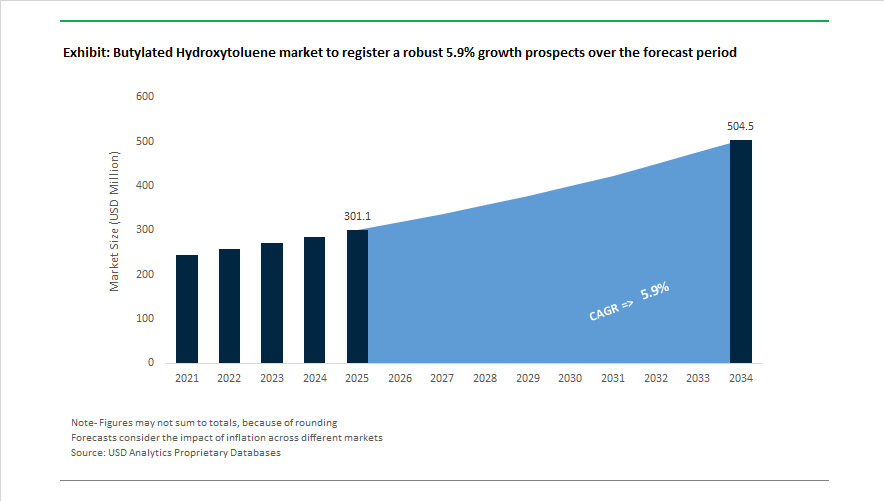
The butylated hydroxytoluene market is projected to grow from USD 301.1 Million in 2025 to USD 504.4 Million by 2034, registering a CAGR of 5.9% supported by sustained demand for synthetic antioxidants in food preservation, polymer stabilization, pharmaceuticals, cosmetics, and animal feed. Manufacturing capacity expanded in December 2024 when Clean Fino-Chem Limited commenced commercial BHT production in India using a campaign-based model integrated with its BHA and TBHQ portfolio. Pharmaceutical-grade positioning strengthened in October 2024 as Oxiris Chemicals S.A. promoted its Ionol BHT line at CPHI Barcelona to support high-stability drug formulations. Regulatory oversight intensified between March 2024 and 2025 when the U.S. Food and Drug Administration included BHT in its post-market chemical assessment program, prompting data submissions from stakeholders.
Market structure shifted during 2025 with corporate strategy changes and regional export growth. In April 2025, LANXESS completed the divestment of its Urethane Systems business to UBE Corporation to focus fully on specialty additives, including BHT. In November 2025, Yasho Industries reported an 18% increase in sales volumes, with exports accounting for two-thirds of revenue, driven by demand for food antioxidants and rubber stabilizers. December 2025 saw North American BHT prices firm amid year-end restocking, supported by stable supply chains and improved port logistics. Sustainability investments also advanced when Sasol commissioned low-carbon boilers at its Natref facility in late 2025, aligning antioxidant production with corporate decarbonization targets.
Regulatory compliance and product innovation are shaping the 2026 outlook. Between 2024 and 2025, the Scientific Committee on Consumer Safety set stricter concentration limits for BHT in cosmetics, driving reformulation among European brands. Hybrid antioxidant systems gained visibility when Brenntag and BTSA presented feed formulations combining BHT with natural tocopherols in September 2025, and Oxiris introduced Naturol blends for animal feed. In late 2025, Godavari Biorefineries partnered with Synthomer to advance bio-based monomers, signaling industry interest in renewable antioxidant precursors. February 2026 reporting from BASF India indicated softness in automotive and rubber markets, highlighting end-use cyclicality for industrial-grade BHT.
Regulatory Sunset, Polymer Migration Concerns, and Industrial Fuel Integrity Shaping Trends and Opportunities in the Butylated Hydroxytoluene Market
Consumer Market Phase-Out Driven by 2025 Regulatory Enforcement and Clean-Label Pressure
The Butylated Hydroxytoluene market is entering a decisive supply and reformulation shift due to tightening global regulations. In the UK and EU, Annex amendments to the Cosmetics Regulation establish June 24, 2025 as the final deadline for removing non-compliant BHT products from shelves. New concentration ceilings are set at 0.1% for toothpaste and 0.001% for mouthwash and leave-on oral care, effectively eliminating BHT from mainstream personal care products. In parallel, the European Food Safety Authority is re-evaluating food antioxidants under Regulation (EU) No 257/2010, driving manufacturers to phase out E321-labeled formulations and replace them with mixed tocopherols and rosemary extracts. This is especially critical for brands repositioning under “clean beauty” and food-grade transparency commitments, where supply chain traceability and marketing-claim defensibility now heavily influence BHT substitution decisions.
Polymer and Packaging Sectors Shift to Non-Migratory, Polymeric Antioxidants
Migration concerns are influencing a material substitution wave in packaging and polymer processing. Research published across 2023 and 2024 indicated that BHT migration from polyethylene and polypropylene packaging into fatty simulants reached certain test values of over 200 mg/kg, significantly exceeding Specific Migration Limits. As a result, polymer manufacturers are pivoting toward non-migratory, oligomeric phenolic antioxidants designed to remain chemically bound within the polymer chain. This shift is reflected in demand redistribution toward suppliers such as BASF and Songwon. For food-contact resin production, producers are increasingly utilizing α-tocopherol blends capable of withstanding extrusion temperatures while maintaining compliance with FDA 21 CFR 178.2010 across polyolefin formats.
BHT Retains Strategic Importance in Global Jet Fuel Stabilization and Defense-Sector Specifications
Butylated Hydroxytoluene continues to hold a mission-critical role in fuel stabilization, even as its use in consumer categories declines. Updated U.S. Department of Defense specifications under MIL-DTL-5624V and MIL-DTL-5624X reconfirm the requirement for hindered phenol antioxidants, specifically authorizing BHT to inhibit peroxide and gum formation in aviation turbine fuels such as JP-5. In commercial aviation, Jet A-1 fuel regulated by DEF STAN 91-091 mandates antioxidant inclusion in all hydroprocessed fuel batches. Because BHT is among the few cost-viable molecules capable of sustaining high thermal-oxidative stress, it remains indispensable across both civil and military aviation value chains. High-purity BHT suppliers therefore continue to benefit from aviation’s stringent risk-management culture, where additive qualification cycles are slow to change and supply agreements remain multi-year.
Stabilizer Enablement for Pyrolysis Oil and Circular Plastics Processing
Chemical recycling infrastructure growth is opening a new, strategically aligned application pathway for BHT. Waste-to-fuel pyrolysis oil is highly reactive due to its unsaturated hydrocarbon composition, creating polymerization and degradation risks during storage and thermal conversion. In February 2025, the Technology Development Board of India approved financial support to commercialize purification technologies for food-grade pyrolysis oil, reinforcing the need for antioxidants like BHT in feedstock conditioning. On the supply side, circular economy projects such as Neste’s PULSE in Finland, planned for operational scale in 2025, will process more than 150,000 tons of liquefied waste plastics annually. BHT and phosphite-based synergistic blends are already integrated into melt-processing protocols to prevent viscosity loss and oxidative degradation during conversion of recycled streams into virgin-equivalent polymers, cementing BHT’s alignment with recycled-content mandates and sustainability-linked procurement targets.
Butylated Hydroxytoluene (BHT) Market Share and Segmentation Insights
Market Share by Grade: Technical Grade Dominates Volume as High-Purity Segments Sustain Premium Demand
Technical grade holds 44% of global BHT consumption in 2025, driven by large-scale use as an antioxidant and stabilizer across plastics, synthetic rubbers, fuels, lubricants, and transformer oils. Its cost efficiency and performance in preventing thermal-oxidative degradation make it indispensable for polymer processing and energy infrastructure, with demand closely tracking industrial production and automotive output. Food grade represents the second-largest segment, protecting fats and oils in snacks, cereals, and edible oils, although clean-label momentum and substitution toward tocopherols and rosemary extract are gradually moderating growth in developed markets. Feed grade remains a significant volume contributor, preserving fat-soluble vitamins and lipid stability in pet food, aquaculture, and poultry rations, supported by rising global meat consumption and aquafeed expansion. Pharmaceutical grade is the smallest but highest-value category, supplying ultra-pure BHT for parenteral nutrition, lipid emulsions, and topical formulations, where strict USP, EP, and JP compliance drives consistent demand.
Market Share by Application: Polymer Processing Leads While Energy and Feed Maintain Structural Support
Plastics and rubbers account for 36% of BHT demand in 2025, anchored by its role in stabilizing polypropylene, polyethylene, polystyrene, ABS, and elastomers during melt processing and service life, extending durability in automotive parts, packaging films, adhesives, and sealants. Food and beverages form the second-largest segment, where BHT preserves flavor, color, and nutritional integrity in fat-rich products under regulated usage limits, with natural antioxidant alternatives intensifying competition. Animal feed represents a stable growth channel as BHT safeguards vitamin premixes and feed pellets, particularly in fast-expanding aquaculture markets across Asia and Latin America. Fuel and lubricants rely on BHT to inhibit gum formation and acid buildup in gasoline, jet fuel, hydraulic fluids, and transformer oils, linking demand to transportation activity and grid maintenance. Cosmetics and pharmaceuticals remain smaller but steady outlets, using BHT to prevent rancidity in formulations and lipid-based drug systems.
Competitive Landscape of the Butylated Hydroxytoluene (BHT) Market
The global Butylated Hydroxytoluene (BHT) market in 2026 is shaped by tightening regulatory oversight, rising demand for high-purity food-grade antioxidants, and expanding applications across EV polymers, fuels, lubricants, personal care, and animal nutrition. Competition increasingly revolves around circular raw materials, application-specific BHT blends, backward integration into phenols and isobutylene, and low-carbon manufacturing. Leading producers are differentiating through ultra-low impurity grades, customized antioxidant systems, and sustainability-certified portfolios, positioning BHT as a critical stabilizer for renewable fuels, high-voltage plastics, cosmetics, and shelf-life extension in food and feed.
Regulatory-led, circular-material BHT leadership from LANXESS AG
LANXESS anchors the premium BHT segment through its Baynox® and Vulkanox® brands, with Vulkanox® BHT serving as the 2026 industry standard for stabilizing rubber and plastics in high-voltage EV components. The launch of its Scopeblue label in early 2026 certifies BHT grades made with at least 50% circular or bio-based inputs, directly aligning with EU Green Deal additive requirements. Fully backward-integrated into isobutylene and phenols at its German Verbund sites, LANXESS maintained supply resilience during 2025 energy volatility. Strategically, the company emphasizes regulatory leadership, positioning ultra-low impurity BHT grades for pharmaceutical and sensitive consumer applications.
Mass-scale technical BHT supply powered by Sasol Limited
Sasol dominates high-volume BHT production through its coal-to-liquids integration, making it a cost leader in technical-grade antioxidants for fuels and lubricants. Operating some of the world’s largest BHT units, Sasol supplies crystal and liquid formats, including pre-dissolved BHT solutions tailored for large biodiesel producers. In late 2025, Sasol commissioned a low-carbon boiler system, cutting BHT production intensity by 15% toward its 2026 sustainability targets. Its strategic focus centers on energy-transition stabilization, supplying BHT-based antioxidant packages for renewable fuels, bio-oils, and sustainable aviation fuel storage where oxidative degradation remains a major challenge.
Cosmetic-grade and electronics-ready BHT innovation from Eastman Chemical Company
Eastman targets high-value BHT applications across personal care and advanced plastics with its Tenox™ portfolio. In 2026, Tenox™ BHT is widely used to stabilize fragrances and retinol-based skincare, while Eastman Crystal-Clear BHT supports flexible electronics by preventing yellowing in transparent barrier coatings. The company expanded its Asia-Pacific footprint with a Singapore technical service center in Q1 2026, delivering formulation support to the fast-growing regional cosmetics market. Eastman’s competitive edge lies in application-specific customization, offering tailored antioxidant blends such as BHT with BHA and citric acid optimized for premium pet food lipid profiles.
Pure-play antioxidant specialization from Oxiris Chemicals S.A.
Oxiris operates as a dedicated BHT specialist through its globally recognized IONOL® brand. In 2026, IONOL® CP Cosmetic Grade and IONOL® Food hold FDA and EU certifications for direct food contact, reinforcing Oxiris’s position in regulated markets. The company introduced Naturol™, a hybrid antioxidant combining BHT with botanical extracts, enabling manufacturers to lower synthetic loading while maintaining oxidative stability. Its Spanish R&D pilot plant supports custom synthesis of BHT derivatives for aerospace lubricants and extreme-temperature applications. With sales coverage in over 60 countries, Oxiris excels in niche sectors like transformer oils, inks, and specialty industrial fluids.
Vertically integrated feed-grade BHT scale from Camlin Fine Sciences Ltd.
Camlin Fine Sciences leads the food and animal nutrition BHT segment through its vertically integrated diphenol platform. Xtendra® BHT is a 2026 staple in aquaculture and livestock feed, preserving fatty-acid potency in high-energy diets. Early 2026 integration of its Daudhe facility with Italian and Mexican operations created a circular production loop for BHT and hydroquinone, improving cost efficiency and supply reliability. Through its ChemPoint partnership, Camlin expanded Xtendra® distribution across North America’s clean-label food sector. Strategically, Camlin targets nutrient security in Brazil, India, and Nigeria, using BHT to reduce food waste in low cold-chain regions.
Smart antioxidant systems engineered by Kemin Industries, Inc.
Kemin positions BHT within its Total Nutrition and Food Technologies platforms, emphasizing synergistic preservation. In 2026, Kemin integrates BHT into BactoCEASE® systems, combining microbial control and oxidative stability in a single solution. The company achieved 100% clean-energy-powered manufacturing for its US BHT blending units, strengthening its appeal to sustainability-focused food processors. Kemin dominates pet food stabilization, protecting omega-3 and omega-6 fatty acids in premium diets with shelf lives reaching 24 months. Its R&D pipeline focuses on next-generation smart antioxidants, using BHT as a molecular backbone for systems that activate only when oxidative thresholds are reached.
China Butylated Hydroxytoluene Market: Specialty Additive Scaling and Fuel-Grade Stabilization
China’s butylated hydroxytoluene landscape is moving decisively toward high-purity, application-specific antioxidants aligned with automotive, aviation, and advanced materials demand. A key structural milestone was reached in November 2025 when BASF commissioned a high-performance dispersant and antioxidant line at the Nanjing Jiangbei New Material Technology Park. The facility deploys Controlled Free Radical Polymerization to deliver tighter molecular weight distribution and enhanced purity, supporting coatings, plastics, and industrial lubricant formulations that require extended oxidative stability.
Consumption fundamentals remain robust. China continues to be the world’s largest consumer of technical-grade BHT, underpinned by double-digit growth in electronic information manufacturing and a parallel surge in integrated circuit output through late 2025. Strategic policy overlays are also reshaping demand. Under the Made in China 2025 framework, domestic sourcing of high-stability antioxidants for aviation turbine fuels has become a priority, reducing dependence on imported stabilizers as the C919 aircraft fleet expands. Sustainability compliance is tightening in parallel. Producers in Shandong and Jiangsu are now required to implement green manufacturing practices that specifically target reductions in 2,6-di-tert-butylphenol effluents, while smart sensor deployment at integrated sites such as Zhanjiang enables real-time purity and emissions monitoring for export-grade BHT.
United States Butylated Hydroxytoluene Market: Safety Reassessment and Functional Innovation
In the United States, the BHT market is being reshaped by regulatory scrutiny, aviation fuel standards, and innovation in controlled-release formulations. In May 2025, the U.S. Food and Drug Administration launched a more systematic post-market review of food chemicals, explicitly naming BHT for modernized, evidence-based safety reassessment. This development has accelerated investment in analytical toxicology, traceability, and documentation across the domestic antioxidant supply chain.
At the same time, functional innovation is reinforcing demand in select segments. Company disclosures from Eastman in late 2025 highlighted the commercialization of BHT blend systems featuring improved dispersibility and microencapsulation, enabling controlled antioxidant release in food packaging and polymer films. Aviation remains a structurally stable outlet. Updates issued by ASTM International in 2025 retained BHT as a mandatory antioxidant in hydro-processed jet fuels, securing long-term offtake from the aerospace sector. Across food and packaging, manufacturers are increasingly favoring crystallized solid BHT formats to align with clean-label expectations, while EPA-related maintenance fees for registered antimicrobial uses are adding a compliance cost layer ahead of 2026.
India Butylated Hydroxytoluene Market: Feedstock Diversion and Domestic Value Chain Upgrading
India’s butylated hydroxytoluene market is evolving in line with national ambitions to climb the global specialty chemicals value chain. A July 2025 policy outlook from NITI Aayog articulated a strategic pivot away from bulk commodities toward complex benzene derivatives, positioning BHT as a priority antioxidant for pharmaceuticals, plastics, and nutrition applications. This shift is already visible in petrochemical feedstock allocation. Whereas benzene historically flowed predominantly into alkylbenzene, new projects initiated in 2025–2026 are diverting larger shares toward antioxidant intermediates to support domestic consumption growth.
Financial disclosures underscore demand resilience. BASF India Limited reported strong Q1 FY 2025–2026 revenues, citing steady performance in Nutrition and Care and Industrial Solutions segments where BHT is a critical stabilizer. Policy alignment is reinforcing this trajectory. Production Linked Incentive schemes targeting electronics and advanced chemistry cells are stimulating downstream demand for BHT-stabilized polymers used in electric vehicle battery housings and consumer electronics, anchoring India’s role as a regional antioxidant manufacturing base rather than a pure importer.
European Union (Germany and Spain) Butylated Hydroxytoluene Market: Concentration Limits and Compliance-Led Portfolio Design
Across the European Union, the butylated hydroxytoluene market is governed by tightening concentration limits, cosmetics reformulation deadlines, and food-contact compliance. As of October 30, 2025, revised standards enforced by the European Chemicals Agency impose strict BHT concentration caps in oral care products, compelling reformulation by fragrance, personal care, and hygiene manufacturers. This regulatory momentum continues with Commission Regulation (EU) 2024/996, which mandates the withdrawal of cosmetic products containing restricted endocrine-disrupting substances by May 1, 2026, shaping forward demand planning for antioxidant suppliers.
Southern Europe remains an important production anchor. Spain-based Oxiris Chemicals S.A. expanded its IONOL® portfolio in late 2025, focusing on high-stability BHT grades for animal nutrition and biodiesel applications supported by a global distribution network. In parallel, the November 2025 revision of food-contact plastics rules under Regulation (EU) 2025/2240 has tightened transitional compliance requirements, requiring proof of conformity by January 31, 2026. Together, these measures are pushing the European BHT market toward lower concentrations, higher documentation intensity, and application-specific differentiation.
Comparative Snapshot of the Butylated Hydroxytoluene Industry by Country
Butylated Hydroxytoluene (BHT) Market County Level Snapshot
Country / Region
Primary Demand Anchor
Strategic Direction
China
Electronics, aviation fuels, tires
High-purity production, green manufacturing, smart monitoring
By Grade (Food Grade, Technical Grade, Pharmaceutical Grade, Feed Grade), By Physical Form (Solid, Liquid, Flaked), By Application (Food and Beverages, Plastics and Rubbers, Animal Feed, Fuel and Lubricants, Cosmetics and Personal Care, Pharmaceuticals), By Packaging Type (Paper Bags, FIBC Bags, Steel Drums)
Study Period
2019- 2025 and 2026-2034
Units
Revenue (USD)
Qualitative Analysis
Porter’s Five Forces, SWOT Profile, Market Share, Scenario Forecasts, Market Ecosystem, Company Ranking, Market Dynamics, Industry Benchmarking
Companies
BASF, LANXESS, Eastman Chemical, Oxiris Chemicals, Sasol, Honshu Chemical Industry, SI Group, Camlin Fine Sciences, Merck, Cargill, Perstorp, KH Chemicals, Finoric, Dycon Chemicals, Western Reserve Chemical
Countries
US, Canada, Mexico, Germany, France, Spain, Italy, UK, Russia, China, India, Japan, South Korea, Australia, South East Asia, Brazil, Argentina, Middle East, Africa
Butylated Hydroxytoluene Market Segmentation
By Grade
Food Grade
Technical Grade
Pharmaceutical Grade
Feed Grade
By Physical Form
Solid
Liquid
Flaked
By Application
Food and Beverages
Plastics and Rubbers
Animal Feed
Fuel and Lubricants
Cosmetics and Personal Care
Pharmaceuticals
By Packaging Type
Paper Bags
FIBC Bags
Steel Drums
By Region
North America (United States, Canada, Mexico)
Europe (Germany, France, United Kingdom, Spain, Italy, Rest of Europe)
Asia Pacific (China, India, Japan, South Korea, Australia, Rest of APAC)
South and Central America (Brazil, Argentina, Rest of SCA)
Middle East and Africa (Saudi Arabia, UAE, South Africa, Rest of Middle East, Rest of Africa)
Top Companies in Butylated Hydroxytoluene Industry
BASF
LANXESS
Eastman Chemical
Oxiris Chemicals
Sasol
Honshu Chemical Industry
SI Group
Camlin Fine Sciences
Merck
Cargill
Perstorp
KH Chemicals
Finoric
Dycon Chemicals
Western Reserve Chemical
*- List not Exhaustive
Table of Contents: Butylated Hydroxytoluene (BHT) Market
2. Butylated Hydroxytoluene Market Landscape and Outlook (2025–2034)
2.1. Introduction to BHT and Synthetic Antioxidants
2.2. Market Valuation and Growth Outlook (2025–2034)
2.3. Regulatory Reviews, Clean-Label Pressure, and Concentration Limits
2.4. Shift From Consumer Applications to Industrial Stabilization
2.5. Circular Plastics, Renewable Fuels, and Polymer Migration Concerns
3. Strategic Trends and Opportunities
3.1. Cosmetics Regulation Sunset and Food Antioxidant Reassessment
3.2. Non-Migratory Polymeric Antioxidants in Packaging
3.3. Aviation Fuel Stabilization and Defense Specifications
3.4. Pyrolysis Oil Conditioning and Circular Polymer Processing
3.5. Hybrid Antioxidant Systems and Bio-Based Precursors
4. Competitive Landscape and Strategic Developments
4.1. Backward Integration Into Phenols and Isobutylene
4.2. Low-Carbon Manufacturing and Scope 3 Reduction Initiatives
4.3. Application-Specific BHT Blends and Ultra-Low Impurity Grades
4.4. Regional Capacity Expansion and Export Positioning
4.5. Regulatory Stewardship and Documentation Readiness
5. Market Share and Segmentation Insights: BHT Market
5.1. By Grade
5.1.1. Food Grade
5.1.2. Technical Grade
5.1.3. Pharmaceutical Grade
5.1.4. Feed Grade
5.2. By Physical Form
5.2.1. Solid
5.2.2. Liquid
5.2.3. Flaked
5.3. By Application
5.3.1. Food and Beverages
5.3.2. Plastics and Rubbers
5.3.3. Animal Feed
5.3.4. Fuel and Lubricants
5.3.5. Cosmetics and Personal Care
5.3.6. Pharmaceuticals
5.4. By Packaging Type
5.4.1. Paper Bags
5.4.2. FIBC Bags
5.4.3. Steel Drums
6. Country Analysis and Outlook of Butylated Hydroxytoluene Market
6.1. United States
6.2. Canada
6.3. Mexico
6.4. Germany
6.5. France
6.6. Spain
6.7. Italy
6.8. United Kingdom
6.9. China
6.10. India
6.11. Japan
6.12. South Korea
6.13. Australia
6.14. Brazil
6.15. Argentina
6.16. Middle East
6.17. Africa
7. Butylated Hydroxytoluene Market Size Outlook by Region (2025–2034)
7.1. North America BHT Market Size Outlook
7.1.1. By Grade
7.1.2. By Physical Form
7.1.3. By Application
7.1.4. By Packaging Type
7.2. Europe BHT Market Size Outlook
7.2.1. By Grade
7.2.2. By Physical Form
7.2.3. By Application
7.2.4. By Packaging Type
7.3. Asia Pacific BHT Market Size Outlook
7.3.1. By Grade
7.3.2. By Physical Form
7.3.3. By Application
7.3.4. By Packaging Type
7.4. South and Central America BHT Market Size Outlook
7.4.1. By Grade
7.4.2. By Physical Form
7.4.3. By Application
7.4.4. By Packaging Type
7.5. Middle East and Africa BHT Market Size Outlook
7.5.1. By Grade
7.5.2. By Physical Form
7.5.3. By Application
7.5.4. By Packaging Type
8. Company Profiles: Leading Players in the BHT Market
8.1. BASF
8.2. LANXESS
8.3. Eastman Chemical
8.4. Oxiris Chemicals
8.5. Sasol
8.6. Honshu Chemical Industry
8.7. SI Group
8.8. Camlin Fine Sciences
8.9. Merck
8.10. Cargill
8.11. Perstorp
8.12. KH Chemicals
8.13. Finoric
8.14. Dycon Chemicals
8.15. Western Reserve Chemical
9. Methodology
9.1. Research Scope
9.2. Primary and Secondary Data Sources
9.3. Market Estimation Framework
9.4. Forecast Modeling Assumptions
9.5. Validation and Triangulation
10. Appendix
10.1. Acronyms and Abbreviations
10.2. List of Tables
10.3. List of Figures
Butylated Hydroxytoluene Market Segmentation
By Grade
Food Grade
Technical Grade
Pharmaceutical Grade
Feed Grade
By Physical Form
Solid
Liquid
Flaked
By Application
Food and Beverages
Plastics and Rubbers
Animal Feed
Fuel and Lubricants
Cosmetics and Personal Care
Pharmaceuticals
By Packaging Type
Paper Bags
FIBC Bags
Steel Drums
By Region
North America (United States, Canada, Mexico)
Europe (Germany, France, United Kingdom, Spain, Italy, Rest of Europe)
Asia Pacific (China, India, Japan, South Korea, Australia, Rest of APAC)
South and Central America (Brazil, Argentina, Rest of SCA)
Middle East and Africa (Saudi Arabia, UAE, South Africa, Rest of Middle East, Rest of Africa)
The Butylated Hydroxytoluene (BHT) Market is valued at USD 301.1 Million in 2025 and is forecast to reach USD 504.4 Million by 2034, expanding at a CAGR of 5.9%. Growth is supported by sustained demand in plastics and rubbers, food preservation, animal feed, pharmaceuticals, and fuel stabilization, even as cosmetics applications face regulatory phase-outs.
Regulators in Europe and the UK have introduced strict concentration limits for BHT in oral care and leave-on cosmetics, accelerating reformulation toward tocopherols and botanical antioxidants. In contrast, BHT remains technically indispensable in polymers and aviation fuels, where it inhibits thermal-oxidative degradation, peroxide formation, and gum buildup under extreme operating conditions. Defense and commercial jet fuel specifications continue to explicitly permit BHT, securing long-term industrial demand.
Technical grade BHT accounts for about 44% of total demand in 2025, driven by high-volume use in plastics, synthetic rubbers, fuels, lubricants, and transformer oils. Food grade is the second-largest segment, protecting fats and oils, while feed grade supports vitamin stability in aquaculture and livestock nutrition. Pharmaceutical grade is the smallest by volume but commands premium pricing due to ultra-low impurity requirements.
BHT is increasingly used to stabilize pyrolysis oils and recycled polymer streams, which are highly prone to oxidative degradation. During chemical recycling and melt reprocessing, BHT-based antioxidant systems prevent viscosity loss and polymer chain scission, enabling recycled plastics to meet virgin-equivalent performance. This positions BHT as a key enabler of circular economy projects and recycled-content mandates in packaging and automotive materials.
Leading producers and formulators include LANXESS, BASF, Eastman Chemical Company, Oxiris Chemicals, Sasol, Camlin Fine Sciences, and Kemin Industries. Competitive differentiation increasingly centers on low-impurity grades, circular or bio-based feedstocks, customized antioxidant blends, and compliance-ready portfolios for food, fuels, polymers, and animal nutrition.

 Market Share By Application, 2025.png)