Dipropylene Glycol N-Propyl Ether Market to Reach $25.8 Million by 2034 at 8.9% CAGR Driven by Semiconductor-Grade and Clean-Label Solvent Demand
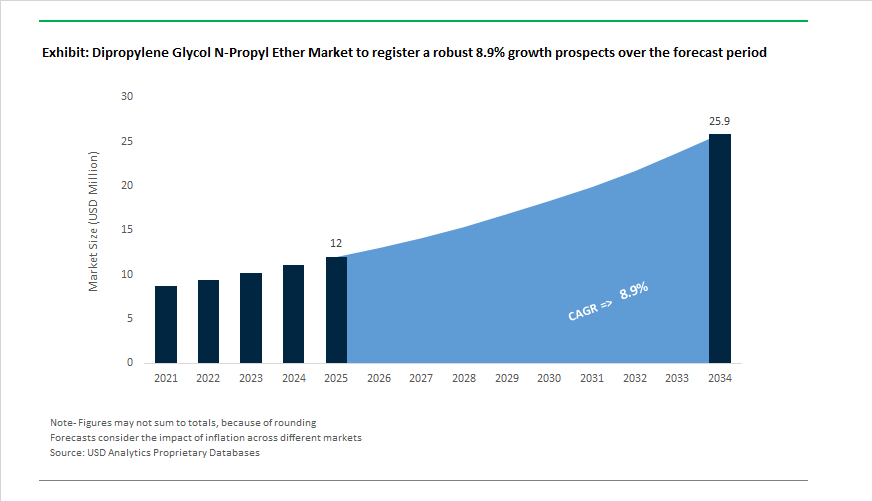
The Dipropylene Glycol N-Propyl Ether (DPnP) Market is projected to expand from $12 Million in 2025 to $25.8 Million by 2034, registering a robust CAGR of 8.9%. Growth is being fueled by rising demand for low-VOC, high-solvency P-series glycol ethers in semiconductor manufacturing, high-end personal care formulations, and industrial coatings. In April 2024, BASF inaugurated a 200,000-metric-ton-per-year glycol ether facility in Nanjing, China, significantly strengthening Asia-Pacific supply of P-series derivatives, including DPnP, for electronics and precision coatings applications. The same year, LyondellBasell expanded its intermediates and derivatives portfolio through the acquisition of Neste’s glycol ether business in March 2024, consolidating its position in propylene glycol methyl ethers and related solvent chains.
Structural shifts in petrochemical infrastructure are reshaping supply dynamics heading into 2026. In May 2024, Shell finalized the divestment of its Singapore Jurong Island petrochemical assets, a major glycol ether hub, signaling the continued exit of European energy majors from traditional petrochemicals. Meanwhile, Dow announced it will permanently shut down its Freeport, Texas propylene oxide facility by the end of 2025, a move expected to tighten domestic propylene oxide availability and directly impact DPnP production capacity across North America in 2026. This tightening is compounded by U.S. import tariff increases implemented in February 2025, which raised the landed cost of Asian and European glycol ethers, intensifying price volatility. Dow responded with multiple price adjustments, including a $0.04 per pound increase effective March 2025 across its DOWANOL™ glycol ether range and further propylene glycol price revisions in February 2026, reflecting continued feedstock inflation and weather-related supply disruptions earlier in 2025.
Strategic repositioning among leading producers continues to influence competitive intensity. In January 2026, LyondellBasell reported a $738 million net loss for 2025 and outlined a $1.3 billion Cash Improvement Plan targeting divestment of selected European assets to refocus on cost-advantaged production hubs in the U.S. and Asia. Dow’s introduction of bio-circular REN and recycled-content CIR propylene glycol lines in 2024 has enabled the development of circular DPnP variants aligned with carbon-reduction mandates in coatings and personal care. Through 2024 and 2025, manufacturers accelerated production of Ultra-High Purity DPnP grades for semiconductor fabs in the U.S. and Germany, where nanometer-scale chip fabrication requires low-residue solvents for precision cleaning and photoresist removal. Concurrently, 2025 witnessed rapid substitution of harsher E-series ethers with DPnP in no-tears cosmetics and shampoos, capitalizing on its low irritation profile and compatibility with clean-label trends. At Plastindia 2026 in February 2026, BASF underscored the role of specialty glycols as coalescing agents in UV-resistant agricultural and infrastructure coatings, reinforcing DPnP’s growing penetration in high-durability outdoor applications.
Trends and Opportunities Shaping the Dipropylene Glycol n-Propyl Ether (DPnP) Market
Integration into High-Solids and Low-VOC Industrial Maintenance Coatings
Regulatory reform in North America and Europe is directly reshaping solvent selection in industrial maintenance coatings, placing DPnP at the center of compliance-driven reformulation. The U.S. EPA’s January 2025 amendments to 40 CFR Part 59 introduced stricter Product-Weighted Reactivity limits for aerosol coatings, pushing formulators toward low-reactivity, slow-evaporating solvents. DPnP, with an evaporation rate of approximately 0.014 relative to n-butyl acetate, allows coatings manufacturers to maintain flow, leveling, and film uniformity while staying within new ozone-formation thresholds.
This regulatory alignment is translating into real-world adoption. In late 2024 and early 2025, large-scale bridge and infrastructure maintenance projects across the United States and the European Union reported a measurable shift toward DPnP-modified epoxy and polyurethane systems. These coatings demonstrated improved hydrolytic stability and corrosion resistance in high-humidity and coastal environments, where traditional higher-VOC solvents are being systematically removed from approved specifications. As infrastructure asset owners extend maintenance cycles to control lifecycle costs, DPnP’s ability to support durable, defect-free films under challenging application conditions is becoming a non-negotiable performance attribute.
DPnP as a Coupling Agent for Eco-Certified Industrial and Institutional Cleaners
Beyond coatings, Dipropylene Glycol n-Propyl Ether is consolidating its role as a preferred coupling agent in eco-certified industrial and institutional cleaning formulations. New criteria released in June 2025 under leading European ecolabel schemes prioritize solvents that are readily biodegradable, non-bioaccumulative, and safe for frequent occupational exposure. DPnP meets these requirements while delivering strong solvency for greasy and particulate soils.
Its technical advantage lies in its ability to couple hydrophobic ingredients such as pine oil and d-limonene into stable aqueous systems without phase separation. This capability is critical for professional degreasers used in food processing plants, transport hubs, and healthcare facilities. By mid-2025, market surveys indicated that more than 70% of professional cleaning service buyers actively prefer green-labeled, low-toxicity products. This preference is driving a reformulation wave across the USD 4.9 billion industrial cleaner segment, where DPnP is replacing more hazardous glycol ethers to improve indoor air quality, worker safety, and compliance with sustainability procurement frameworks.
High-Adhesion Coalescent for Waterborne Inkjet Inks in Packaging
The rapid expansion of digital printing in packaging and textiles is opening a structurally attractive opportunity for DPnP as a high-adhesion coalescent in waterborne ink systems. By July 2025, water-based inks accounted for more than 60% of total ink consumption in the flexible packaging sector, driven by e-commerce growth and retailer pressure to reduce solvent emissions.
DPnP is increasingly specified in thermal inkjet and piezo ink formulations due to its ability to control evaporation during high-speed printing on non-porous substrates such as polyester films and coated paperboard. Its inclusion improves rub resistance and color density without compromising nozzle reliability. In the textile segment, DPnP-based aqueous inks are gaining traction in direct-to-garment applications, where soft hand-feel and wash fastness are critical quality parameters. As the textile printing industry accelerates its transition toward pigment-based, low-water processes, DPnP’s evaporation control is helping prevent nozzle clogging and printhead fouling in precision equipment.
Process Aid in Battery Separators and Advanced Membrane Fabrication
The global push toward electric vehicles, energy storage, and advanced water treatment is creating emerging technical roles for Dipropylene Glycol n-Propyl Ether as a process aid and temporary plasticizer. In lithium-ion battery manufacturing, recent studies from May 2025 highlighted the use of specialty glycols in the production of PPS-based battery separators. DPnP facilitates controlled polymer processing, supporting uniform ion transport pathways while contributing to the thermal stability required for separators that must withstand temperatures approaching 290°C in automotive safety scenarios.
A parallel opportunity is developing in membrane technology. DPnP is being used as a temporary plasticizer in the casting of PVDF membranes for desalination and industrial wastewater treatment. Its high boiling point of roughly 213°C enables precise control over solvent evaporation during membrane formation, allowing manufacturers to tune pore size distribution and surface morphology. This level of control is essential for producing high-flux, mechanically robust membranes as global investment in water reuse and desalination infrastructure continues to accelerate.
Dipropylene Glycol n-Propyl Ether (DPnP) Market Share and Segmentation Insights
Surface Coatings Drive Demand Through Low-VOC and High-Performance Formulations
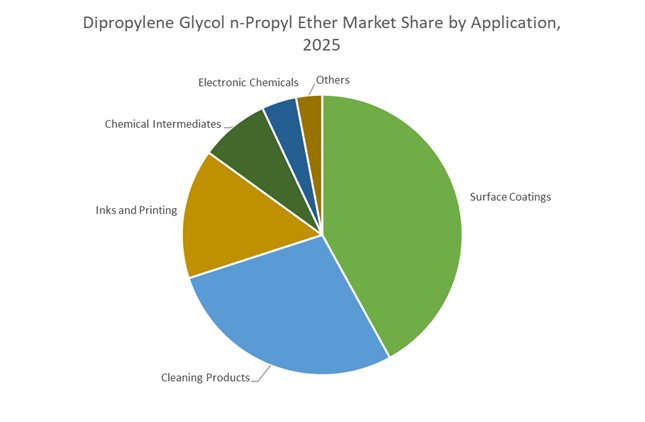
Surface coatings account for the largest share of the Dipropylene Glycol n-Propyl Ether (DPnP) market in 2025, capturing 42% of total demand. DPnP is widely valued as a slow-evaporating solvent and coalescing agent in waterborne architectural and industrial coatings, where its balanced evaporation profile enables superior film formation, flow, and leveling. The growing shift toward low-VOC, environmentally compliant coatings has reinforced DPnP adoption across premium interior and exterior paint systems. Cleaning products form the second-largest segment, leveraging DPnP’s excellent solvency and low surface tension in industrial degreasers, graffiti removers, and institutional cleaners. Inks and printing utilize DPnP in gravure, flexographic, and screen printing inks to maintain viscosity stability and prevent nozzle clogging. Chemical intermediates remain niche, supporting ester and specialty chemical synthesis. Electronic chemicals represent a fast-growing segment, with high-purity DPnP specified for photoresists, edge bead removers, and precision semiconductor cleaning.
Construction and Printing Anchor Volume as Electronics Accelerates Growth
Building and construction lead DPnP consumption with 35% market share, driven by its extensive use in architectural paints, protective coatings, and construction sealants. The global emphasis on green building certifications, sustainable materials, and low-VOC construction chemicals continues to underpin demand in this sector. Packaging and printing represent a major end-use, utilizing DPnP in high-quality inks for flexible packaging, labels, and commercial printing where consistent adhesion and color development are critical. Automotive and transportation contribute significant volume through refinish coatings, component cleaning, and assembly operations that require controlled evaporation and surface compatibility. Consumer goods and household care rely on DPnP in household cleaners, spot removers, and DIY paint products, benefiting from its safety profile and performance consistency. Electrical and electronics are the fastest-growing end-use industry, as ultra-low-impurity DPnP is increasingly adopted in semiconductor manufacturing, display fabrication, and electronic materials processing.
Competitive Landscape of the Dipropylene Glycol n-Propyl Ether (DPnP) Market
The Dipropylene Glycol n-Propyl Ether (DPnP) market is characterized by strong propylene oxide integration, regulatory-driven solvent substitution, and rising demand from waterborne coatings, semiconductor cleaning, agrochemical formulations, and industrial & institutional (I&I) cleaners. Competition is shaped by LVP-VOC compliance, mass-balance sustainability solutions, electronics-grade purity, and APAC capacity expansion, with leading producers leveraging feedstock security and formulation expertise to defend margins and capture high-value applications.
Dow Inc. leads DPnP standards through LVP-VOC compliance and mass-balance sustainability
Dow Inc. dominates the global DPnP market through its DOWANOL™ DPnP, widely recognized for consistent purity, controlled evaporation, and superior coupling efficiency. With approximately 19% water solubility at 25°C, Dow’s DPnP is a preferred solvent for waterborne coatings, industrial cleaners, and electronics-grade applications. In early 2026, Dow integrated Renuva™ and Ecolibrium™ mass-balance technologies, enabling customers to procure DPnP with a verifiably lower carbon footprint. A major competitive advantage lies in its US EPA LVP-VOC exemption, making it highly attractive for Clean Air Act–compliant architectural and industrial coatings. Dow also dominates semiconductor precision cleaning and photoresist stripping, where ultra-high purity and regulatory certainty are critical.
LyondellBasell strengthens DPnP supply via PO integration and APAC scale
LyondellBasell Industries N.V. positions itself as a volume and efficiency leader in the DPnP market by leveraging deep propylene oxide (PO) backward integration. In early 2026, the company ramped up production at its Ningbo ZRCC joint venture in China, reaching 125 kilotons of specialized glycol ether capacity to serve the fast-growing APAC electronics and coatings markets. Following European capacity rationalization in 2025, LyondellBasell shifted focus toward higher-margin specialty ethers, including DPnP for automotive OEM and refinish coatings. Its Channelview, Texas facility, producing 882 million pounds of propylene annually, ensures feedstock security. Proprietary catalytic technologies further optimize DPnP isomer yields for enhanced resin-softening and film formation.
Eastman Chemical differentiates DPnP through formulation-driven performance solutions
Eastman Chemical Company operates as a specialty solutions provider, positioning DPnP as a functional performance enhancer rather than a commodity solvent. In late 2025, Eastman introduced Smart-Coalescent DPnP blends capable of dynamically adjusting paint open time based on humidity, addressing a critical pain point for professional applicators. The company holds a strong position in agrochemical in-can formulations, where DPnP enables stable, high-active emulsions due to its balanced hydrophilic-lipophilic profile. Eastman’s Formulation as a Service model supports customers transitioning away from toxic E-series glycol ethers without compromising drying speed or film hardness. Backed by ISCC PLUS certification, Eastman is well positioned in the EU’s premium sustainable coatings and household chemicals segment.
Jiangsu Yida Chemical expands global DPnP reach through diversified ether portfolios
Jiangsu Yida Chemical Co., Ltd. is a dominant Chinese manufacturer and a major supplier in the global merchant DPnP market. By 2026, the company maintained one of the industry’s broadest portfolios, spanning 8 series and 45 alcohol ether variants, enabling flexible customer-specific formulations. Achieving ISO9001 certification for its high-purity DPnP lines drove a 20% increase in exports to North America and Western Europe in early 2026. Jiangsu Yida also established a National-Level Alcohol Ether Technology Research Center, playing a central role in shaping China’s 2026 eco-friendly solvent standards. Its key competitive edge lies in supply agility, delivering tailored DPnP blends at a 10–15% cost advantage for small and mid-sized paint, ink, and coatings manufacturers.
Monument Chemical provides high-purity DPnP via custom manufacturing agility
Monument Chemical operates as an agile independent supplier, specializing in custom manufacturing and high-purity oxygenated solvents for North America. Following the acquisition of Nova Molecular Technologies’ Bayport facility, Monument significantly enhanced its purification and distillation capabilities by early 2026. The company targets industrial & institutional cleaning applications, particularly for hard-to-remove soils where DPnP’s solvency profile delivers superior performance. Monument’s tolling and private-label manufacturing model makes it a strategic partner for multinational chemical firms requiring niche DPnP derivatives. Its U.S. Gulf Coast location offers strong logistical advantages through barge and rail connectivity, ensuring reliable supply amid global trade disruptions.
United States: Price Discipline, Supply Resilience, and Aerospace-Led Specialization
The United States dipropylene glycol n-propyl ether market in 2025 is characterized by deliberate price escalation aligned with tightening supply economics and regulatory-driven substitution. Dow implemented a sequence of price increases across its DOWANOL glycol ether portfolio, beginning with a $0.04 per pound adjustment effective March 15, 2025, followed by a broader $0.05 per pound increase in August and a further adjustment in November 2025. These moves reflect sustained pressure from propylene oxide feedstock volatility, elevated energy costs, and margin protection strategies across the North American petrochemical value chain. Import tariff measures introduced on February 14, 2025 have further altered trade economics, encouraging U.S. formulators to prioritize domestically produced, high-purity DPnP to reduce exposure to import cost uncertainty.
Operational resilience has become a defining theme following the early-2025 Arctic blast that caused freeze-offs across the U.S. Gulf Coast, temporarily disrupting DPnP output and triggering spot price spikes. In response, major producers have accelerated investments in winterization and cold-weather hardening of chemical processing units, reinforcing supply continuity as a competitive differentiator. On the demand side, regulatory momentum continues to favor DPnP. Updates to the EPA’s Safer Chemical Ingredients List in 2025 highlight DPnP’s balanced hydrophobic and hydrophilic solvency profile, driving a reported 15% increase in adoption by architectural coating manufacturers transitioning to waterborne latex systems. Beyond coatings, aerospace maintenance has emerged as a high-value niche. U.S. procurement data from 2025 shows growing use of DPnP in aircraft skin cleaners and degreasers, where its ability to remove complex hydraulic residues without degrading composite substrates supports its premium positioning.
China: Downstream Deepening and Semiconductor-Grade Purity
China’s DPnP market is advancing under a policy framework that prioritizes value-added derivatives over commodity expansion. In September 2025, the Ministry of Industry and Information Technology released a joint work plan targeting more than 5% annual growth in petrochemical added value through 2026, explicitly emphasizing downstream deepening of the propylene oxide chain into specialty ethers such as DPnP. This directive has accelerated capital allocation toward purification, quality control, and application-specific grades rather than volume-driven output.
High-purity demand is being shaped by electronics and automotive manufacturing. MIIT’s 2025 push for breakthroughs in electronic chemicals has prompted domestic producers to shift capacity toward ultra-high-purity DPnP at or above 99.9% to support semiconductor lithography and photoresist stripping. In parallel, robust automotive sales growth, with passenger vehicle retail volumes rising 14.4% year over year as of March 2025, has strengthened DPnP consumption as a coalescing agent in OEM waterborne primers. These formulations are essential to meeting China’s 2026 low-VOC cabin air standards. Structurally, large chemical clusters in Zhejiang are integrating DPnP production with on-site resin manufacturing, reducing logistics-related emissions by an estimated 12% through 2026 and reinforcing China’s transition from standalone solvent supply to integrated coating solutions.
India: Localization Incentives and Climate-Driven Coating Demand
India’s DPnP market is being reshaped by localization incentives and downstream application growth rather than export orientation. By September 2025, Production Linked Incentive programs had realized investments exceeding ₹2 lakh crore, enabling domestic producers such as Manali Petrochemicals to optimize propylene-based glycol ether capacity and reduce reliance on higher-cost East Asian imports. This shift is strategically important for Indian formulators seeking price stability and consistent supply for coatings, textiles, and specialty applications.
Urbanization and infrastructure development are key demand drivers. Expansion of the Smart Cities Mission in 2025 has boosted consumption of DPnP-based wood and floor coatings across public infrastructure, where efficient film formation under high humidity conditions is a critical performance requirement. In parallel, India’s textile sector is adopting DPnP in high-speed digital printing inks, particularly for premium silk and synthetic fibers. Reported technological shifts in late 2025 highlight DPnP’s moderate evaporation rate as instrumental in reducing nozzle clogging and improving print consistency, supporting its growing role in advanced textile processing.
Germany: Regulatory Substitution and Low-Carbon Ether Innovation
Germany represents a regulation-intensive but innovation-oriented DPnP market within the European Union. Preparations for the postponed REACH recast, alongside the November 2025 Omnibus VI package, have tightened chemical labeling and traceability obligations. German producers and distributors are now integrating Digital Product Passports to document DPnP’s environmental footprint from feedstock sourcing to end-use, aligning with forthcoming EU supply chain transparency requirements.
Substitution dynamics are equally influential. Restrictions under Commission Regulation (EU) 2025/1090 on solvents such as DMAC and NEP have accelerated the industrial shift toward DPnP as a safer, REACH-compliant alternative in the manufacture of high-performance films and man-made fibers. At the same time, German Verbund chemical parks are piloting the production of D-series ethers using biogenic propylene oxide. Early 2025 trials indicate that these green DPnP variants could deliver up to a 30% reduction in Scope 3 emissions for downstream paint and coating formulators, positioning DPnP at the intersection of regulatory compliance and decarbonization strategies.
By Purity Grade (Standard Grade, High Purity Grade, Electronic Grade), By Application (Surface Coatings, Cleaning Products, Inks and Printing, Chemical Intermediates, Electronic Chemicals, Other Applications), By End-Use Industry (Building and Construction, Automotive and Transportation, Electrical and Electronics, Packaging and Printing, Consumer Goods and Household Care)
Study Period
2019- 2025 and 2026-2034
Units
Revenue (USD)
Qualitative Analysis
Porter’s Five Forces, SWOT Profile, Market Share, Scenario Forecasts, Market Ecosystem, Company Ranking, Market Dynamics, Industry Benchmarking
US, Canada, Mexico, Germany, France, Spain, Italy, UK, Russia, China, India, Japan, South Korea, Australia, South East Asia, Brazil, Argentina, Middle East, Africa
2. Dipropylene Glycol N-Propyl Ether Market Landscape & Outlook (2026–2034)
2.1. Introduction to Dipropylene Glycol N-Propyl Ether (DPnP) Market
2.2. Market Valuation and Growth Projections (2026–2034)
2.3. Feedstock Dynamics: Propylene Oxide Integration and Trade Volatility
2.4. Regulatory Framework: VOC Reactivity Standards, TSCA, and REACH Alignment
2.5. Sustainability Transition: Bio-Circular Glycols and Low-Carbon Ether Production
3. Innovations Reshaping the Dipropylene Glycol N-Propyl Ether Market
3.1. Trend: Integration into High-Solids and Low-VOC Industrial Maintenance Coatings
3.2. Trend: Semiconductor-Grade Ultra-High Purity Solvent Adoption
3.3. Opportunity: Eco-Certified Industrial and Institutional Cleaning Reformulation
3.4. Opportunity: Advanced Membrane, Battery Separator, and Inkjet Applications
4. Competitive Landscape and Strategic Initiatives
4.1. Propylene Oxide Backward Integration and Capacity Expansion
4.2. Electronics-Grade and High-Purity Product Development
4.3. Circular Feedstock Platforms and PCF Transparency
4.4. Regional Asset Rationalization and Margin Optimization
5. Market Share and Segmentation Insights: Dipropylene Glycol N-Propyl Ether Market
5.1. By Purity Grade
5.1.1. Standard Grade
5.1.2. High Purity Grade
5.1.3. Electronic Grade
5.2. By Application
5.2.1. Surface Coatings
5.2.2. Cleaning Products
5.2.3. Inks and Printing
5.2.4. Chemical Intermediates
5.2.5. Electronic Chemicals
5.2.6. Other Applications
5.3. By End-Use Industry
5.3.1. Building and Construction
5.3.2. Automotive and Transportation
5.3.3. Electrical and Electronics
5.3.4. Packaging and Printing
5.3.5. Consumer Goods and Household Care
5.4. By Region
5.4.1. North America
5.4.2. Europe
5.4.3. Asia Pacific
5.4.4. South and Central America
5.4.5. Middle East and Africa
6. Country Analysis and Outlook of Dipropylene Glycol N-Propyl Ether Market
6.1. United States
6.2. Canada
6.3. Mexico
6.4. Germany
6.5. France
6.6. Spain
6.7. Italy
6.8. United Kingdom
6.9. Russia
6.10. China
6.11. India
6.12. Japan
6.13. South Korea
6.14. Australia
6.15. South East Asia
6.16. Brazil
6.17. Argentina
6.18. Middle East
6.19. Africa
7. Dipropylene Glycol N-Propyl Ether Market Size Outlook by Region (2026–2034)
7.1. North America Dipropylene Glycol N-Propyl Ether Market Size Outlook to 2034
7.1.1. By Purity Grade
7.1.2. By Application
7.1.3. By End-Use Industry
7.1.4. By Country
7.2. Europe Dipropylene Glycol N-Propyl Ether Market Size Outlook to 2034
7.2.1. By Purity Grade
7.2.2. By Application
7.2.3. By End-Use Industry
7.2.4. By Country
7.3. Asia Pacific Dipropylene Glycol N-Propyl Ether Market Size Outlook to 2034
7.3.1. By Purity Grade
7.3.2. By Application
7.3.3. By End-Use Industry
7.3.4. By Country
7.4. South America Dipropylene Glycol N-Propyl Ether Market Size Outlook to 2034
7.4.1. By Purity Grade
7.4.2. By Application
7.4.3. By End-Use Industry
7.4.4. By Country
7.5. Middle East and Africa Dipropylene Glycol N-Propyl Ether Market Size Outlook to 2034
7.5.1. By Purity Grade
7.5.2. By Application
7.5.3. By End-Use Industry
7.5.4. By Country
8. Company Profiles: Leading Players in the Dipropylene Glycol N-Propyl Ether Market
8.1. Dow Inc.
8.2. LyondellBasell Industries N.V.
8.3. BASF SE
8.4. Eastman Chemical Company
8.5. INEOS Oxide
8.6. SABIC
8.7. Manali Petrochemicals Limited
8.8. SKC Co., Ltd.
8.9. Shell plc
8.10. Indovinya
8.11. Yida Chemical
8.12. Jiangsu Dynamic Chemical Co., Ltd.
8.13. Monument Chemical
8.14. KH Neochem Co., Ltd.
8.15. Repsol S.A.
9. Methodology
9.1. Research Scope
9.2. Market Research Approach
9.3. Market Sizing and Forecasting Model
9.4. Research Coverage
9.5. Data Horizon
9.6. Deliverables
10. Appendix
10.1. Acronyms and Abbreviations
10.2. List of Tables
10.3. List of Figures
The Dipropylene Glycol N-Propyl Ether (DPnP) Market is forecast to grow from $12 million in 2025 to $25.8 million by 2034, registering a strong CAGR of 8.9%. Growth is driven by semiconductor-grade solvent demand, regulatory-led low-VOC substitution in coatings, and rising adoption in eco-certified cleaning and personal care formulations.
Surface coatings lead with about 42% market share in 2025, supported by infrastructure maintenance and automotive OEM waterborne systems. However, electronic chemicals represent the fastest-growing segment, as ultra-high-purity DPnP above 99.9% is increasingly specified for semiconductor photoresist stripping, wafer cleaning, and advanced display fabrication.
U.S. EPA reactivity-based VOC standards and Safer Chemical Ingredients alignment are accelerating substitution from higher-reactivity solvents toward DPnP in industrial maintenance coatings. In Europe, REACH-driven restrictions on DMAC and NEP are strengthening DPnP’s position as a compliant alternative in films and fiber manufacturing. China’s low-VOC cabin air standards for 2026 are further reinforcing adoption in automotive coatings.
Asia-Pacific remains the most dynamic region due to semiconductor expansion in China and South Korea and coatings demand linked to EV production. The United States offers premium growth in aerospace maintenance and regulation-backed solvent substitution, while India is emerging as an import-replacement market supported by infrastructure coatings and digital textile printing growth.
Key industry participants include Dow Inc., LyondellBasell Industries N.V., BASF SE, Eastman Chemical Company, and INEOS Oxide. Competitive differentiation centers on propylene oxide backward integration, electronics-grade purification, mass-balance sustainability platforms, and APAC capacity expansion strategies.