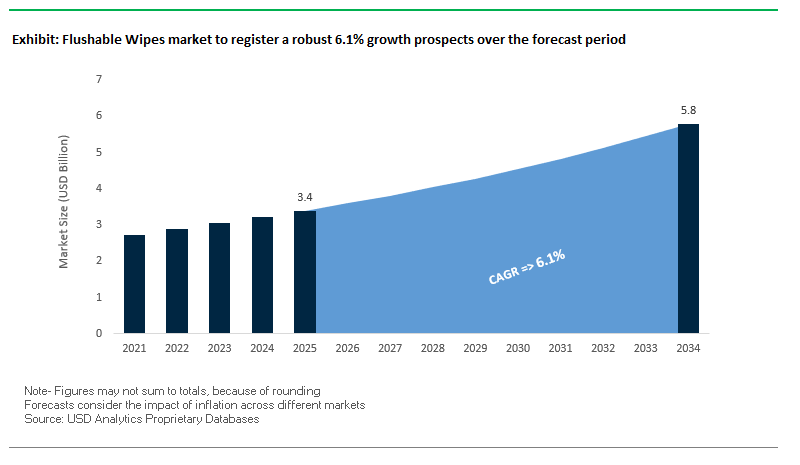
Market Overview: Flushable Wipes Market to Reach $5.8 Billion by 2034 at 6.1% CAGR
The global flushable wipes market is expected to expand from $3.4 billion in 2025 to $5.8 billion by 2034, reflecting a strong CAGR of 6.1%. The market is defined by its promise of convenience, hygiene, and dispersibility in wastewater systems, making it a critical segment within the personal care, household, and hygiene product categories. For industry professionals, the flushable wipes sector answers key questions regarding performance, sustainability, compliance, and consumer adoption, as utilities and regulators closely monitor their impact on infrastructure.
Key Insights for Industry Stakeholders:
Hygiene Awareness: Post-pandemic trends sustain demand for personal hygiene and single-use cleansing products, boosting category adoption.
Dispersibility R&D: Manufacturers are investing heavily in “truly flushable” wipes, engineered to break down up to four times faster than competing products.
Testing & Standards: Industry leaders like Kimberly-Clark publicly share rigorous test results to demonstrate compliance with municipal wastewater systems.
Sustainable Materials: Flushable wipes are increasingly made with plant-based fibers, biodegradable binders, and eco-friendly substrates, aligning with ESG goals.
Market Analysis: Strategic Mergers, Product Innovation, and Sustainable Packaging
Recent developments highlight how leading companies are reshaping the flushable wipes industry through mergers, acquisitions, product launches, and packaging innovations.
In July 2025, Nice-Pak announced a merger with Vivos Holdings, a transformative move designed to create a new market leader in wet wipes and flushable wipes with an expanded product portfolio and global reach. Similarly, March 2025 saw Diamond Wipes acquire Guy & O’Neill, consolidating expertise in private label and contract manufacturing for wet and flushable wipes.
Product innovation is also driving the sector forward. In April 2025, The Honest Company launched a new line of baby wipes, developed with plant-based, hypoallergenic formulations, meeting the rising consumer demand for eco-friendly and sensitive-skin solutions. A month earlier, Siegwerk announced leadership restructuring (March 2025) to strengthen its long-term growth in packaging inks and coatings, which play a role in wipe packaging performance. In February 2025, The Honest Company also received recyclability recognition for its wipe packaging, reinforcing the industry’s push toward circular packaging models.
On the supply chain side, Coral Products acquired Arrow Film Converters in April 2025, strengthening its flexible film converting capabilities, while Mondi partnered with Proquimia (February 2025) to introduce paper-based stand-up pouches, a material shift that could reshape packaging standards for flushable wipes. Complementing this, Amcor (August 2025) expanded its healthcare packaging network in Costa Rica, directly supporting the growing medical and hygiene wipes demand.
Trends and Opportunities Transforming the Flushable Wipes Market
Intensifying Regulatory Scrutiny and Legal Challenges Over “Flushability” Claims
The flushable wipes market is under unprecedented regulatory and legal pressure as municipal water authorities, government agencies, and consumer advocates demand accountability for the environmental and infrastructural damage caused by wipes that fail to disintegrate in sewage systems. What was once guided by industry self-regulation is rapidly moving toward binding standards and high-profile litigation.
Recent lawsuits highlight this trend: a U.S. District Court in South Carolina allowed claims from utilities against major wipes producers to move forward, emphasizing that municipalities are the “primary and direct victims” of clogged infrastructure. Similarly, Kimberly-Clark faced a proposed $20 million class-action settlement tied to its flushability claims, underscoring the financial and reputational risks for market leaders. The Wastewater Infrastructure Pollution Prevention and Environmental Safety Act (WIPPES), introduced in the U.S. Congress, aims to establish a federal baseline by mandating clear “Do Not Flush” labeling on non-flushable wipes and setting measurable flushability standards. Municipalities like New York City have already borne multimillion-dollar costs, spending more than $18 million over five years addressing wipe-related blockages, fueling public outcry and accelerating calls for stricter rules. This intensifying scrutiny is forcing brands to back claims with verifiable data or face escalating financial liability.
Material Science Innovation Focused on Rapid Disintegration and Sustainability
Parallel to regulatory pressures, the market is witnessing a technological shift in substrate engineering that prioritizes rapid disintegration and the adoption of sustainable, plant-based fibers. Unlike traditional polyester or polypropylene nonwovens, modern flushable wipes are being designed with shorter, weaker fiber bonds that disperse under turbulence in sewage systems. Research cited in H2O Global News notes that these engineering refinements are key to true flushability, where wipes mimic toilet paper behavior without compromising strength during use.
Companies such as Albaad are already leading the transition with wipes made from biodegradable, plant-derived fibers that balance performance and environmental responsibility. Meanwhile, industry heavyweights like Kimberly-Clark are securing third-party certifications, including those from the International Water Services Flushability Group (IWSFG), which evaluates dispersibility, plumbing compatibility, and sewer safety. The combined push for biodegradable substrates, rigorous testing protocols, and eco-label transparency is reshaping consumer expectations, with sustainability now a central differentiator rather than a value-add.
Market Education and “Certified Flushable” Brand Positioning
A critical opportunity exists for brands to seize market leadership by establishing trust through certification and consumer education. In a sector plagued by skepticism where many consumers assume all wipes are non-flushable brands that can credibly demonstrate compliance with IWSFG standards and market themselves as “certified flushable” or “plumber-approved” stand to gain significant competitive advantage.
Consumer research published in Kohantextile Journal (2025) revealed rising demand for products made from 100% biodegradable fibers and an increasing reliance on eco-certifications as purchase drivers. Brands that leverage transparent communication, third-party verification, and education campaigns addressing misconceptions can restore consumer confidence while alleviating municipal concerns. This approach not only strengthens brand equity but also creates a new premium segment within the flushable wipes market, defined by transparency and sustainability.
Expansion into Adjacent Markets with High-Performance Dispersion Technology
The advanced dispersion and biodegradable substrate technologies being pioneered for flushable wipes open lucrative avenues in adjacent product categories. Personal care is a clear first target: innovations are already appearing in makeup remover wipes, feminine hygiene products, and baby care, where consumers increasingly seek compostable, skin-safe, and flushable alternatives. The Honest Company’s compostable “Clean Conscious Wipes” illustrate how dispersion science can reposition conventional products into sustainable, high-growth categories.
In household care, the potential is equally strong. A flushable bathroom cleaning wipe that safely disperses after use could address a longstanding consumer frustration while opening an entirely new product category. Beyond convenience, these innovations align with global consumer demand for eco-friendly and waste-free cleaning solutions. By adapting flushability R&D into diverse applications, brands can unlock new revenue streams, differentiate themselves through sustainability, and extend their technological edge across multiple consumer goods markets.
Competitive Landscape: Key Players Driving the Flushable Wipes Market
The flushable wipes industry is competitive, with multinational leaders and specialized manufacturers differentiating through technological innovation, sustainability, and compliance with flushability standards.
Kimberly-Clark Corporation Advancing Flushability with SafeFlush Technology
Kimberly-Clark, through its Cottonelle® and Scott® brands, leads the flushable wipes category. Its SafeFlush Technology ensures wipes are strong in use but break down quickly after flushing. Recent innovations include products engineered to lose strength four times faster than competing brands, addressing consumer and regulatory concerns. With wipes made from 100% FSC-certified fibers, Kimberly-Clark emphasizes both performance and sustainability, reinforced by collaboration with wastewater professionals to validate flushability.
Nice-Pak Products, Inc. Expanding Global Reach Through Merger with Vivos Holdings
Nice-Pak is a global pioneer in wet and flushable wipes, manufacturing both branded and private-label products. The July 2025 merger with Vivos Holdings positions it as a dominant player with enhanced R&D capacity and global distribution strength. Its SecureFLUSH® technology ensures product dispersibility, while plant-based innovation and sustainably sourced ingredients align with growing consumer expectations for eco-conscious products.
Rockline Industries Private Label Leader with Strong Dispersibility Standards
Rockline Industries is a major supplier of private label flushable wipes, serving leading retailers with certified dispersible solutions. The company’s investment in a $20 million disinfecting wipe production line doubled its output capacity, showcasing its manufacturing strength. Certified by SGS, Rockline’s wipes meet strict dispersibility standards and offer hypoallergenic, unscented, and consumer-safe formulations, reinforcing its market leadership in compliance and quality.
Albaad Massuot Yitzhad Innovator with Hydrofine® Flushable Technology
Albaad is one of the largest global producers of wet and flushable wipes, best known for its Hydrofine® technology, a moist and eco-friendly flushable toilet paper alternative. It was the first worldwide to pass the IWSFG Flushability Standard Test, setting a benchmark in compliance. With R&D centers across three continents, Albaad integrates local consumer insights with global technology development, ensuring rapid innovation cycles for private-label and branded clients alike.
Guy & O’Neill, Inc. Expanding Capabilities Post-Diamond Wipes Acquisition
Guy & O’Neill, a contract and private-label manufacturer, is now part of Diamond Wipes (March 2025 acquisition). Known for its original bathing wipes patent, the company specializes in custom formulations and bio-based wipe innovations, serving major North American retailers and global brand owners. Its collaborative approach and full-service manufacturing from concept to final packaging position it as a critical partner in the evolving flushable wipes ecosystem.
Flushable Wipes market Share Insights
Moist Toilet Tissues Dominate Market Share by Product Type in Flushable Wipes
In 2025, moist toilet tissues lead the flushable wipes market with 40% share, reflecting their strong consumer pull as a convenient hygiene solution despite being the most controversial category due to infrastructure incompatibility and regulatory scrutiny. Their dominance is driven more by aggressive branding and consumer adoption than by universal acceptance as truly “flushable,” positioning them at the center of fatberg debates and wastewater utility challenges. Adult wipes, holding 25%, are the demographic growth engine, supported by global aging trends and increased demand for incontinence and hygiene products, with gradual adoption of flushable variants designed for safety and comfort. Baby wipes, once the historical giant, continue to lose share as parents heed “do not flush” warnings, while personal hygiene and household wipes remain performance-first segments where durability and chemical resistance outweigh dispersibility. Overall, product-type share reflects a paradoxical mix of growth through convenience and hygiene awareness on one hand and vulnerability to regulation and infrastructure backlash on the other, making future shifts highly dependent on technical standards for true flushability.
Residential End-Use Leads Market Share in Flushable Wipes Industry
By end-use, residential consumption accounts for 75% of the flushable wipes market in 2025, cementing households as the epicenter of both demand and controversy. Daily personal hygiene routines sustain volume, but this is also the source of severe sewer system blockages, creating pressure for regulatory clarity and consumer education. Commercial applications at 15% including offices, hotels, and restaurants are positioned as value-add hygiene offerings but amplify municipal concerns, with regulators increasingly targeting institutional use due to disproportionate environmental impact. The healthcare and medical sector, though smaller, represents a high-stakes niche where patient hygiene and incontinence care necessitate wipes, but plumbing failures in hospitals highlight the urgent need for innovations in biodegradable dispersibility. End-use distribution underscores the tension between consumer-driven demand for convenience and systemic pressures from utilities and policymakers, positioning residential and healthcare segments as both growth drivers and risk centers for the industry’s long-term viability.
United States: Regulatory Reforms and Innovation Driving Flushable Wipes Market
The U.S. flushable wipes market is undergoing transformative change, primarily driven by regulatory initiatives such as the Wastewater Infrastructure Pollution Prevention and Environmental Safety (WIPPES) Act, which establishes national standards for “Do Not Flush” labeling on non-flushable wipes. This legislation addresses sewer blockages and provides clearer guidance to consumers, compelling manufacturers to innovate and develop truly flushable wipes. Companies are investing in research to create wipes using shorter, non-plastic fibers that disperse easily in wastewater, aligning with emerging flushability standards.
Consumer demand for sustainable and eco-friendly wipes is accelerating the development of plant-based, biodegradable materials packaged in recyclable or refillable containers. Meanwhile, the growth of e-commerce and direct-to-consumer models has enabled brands to offer subscription services and specialized products for adults and children, exemplified by products like Lil' Dude Wipes by Dude Wipes. These factors collectively underscore the U.S. market’s focus on innovation, sustainability, and regulatory compliance.
United Kingdom: Plastic-Free Transition and Government Collaboration Shaping Market
The UK flushable wipes industry is being reshaped by stringent governmental regulations targeting plastic-containing wet wipes, with a phased ban across England, Scotland, Wales, and Northern Ireland. This initiative is driving companies to shift to plastic-free, fully biodegradable substrates, ensuring that wipes genuinely disperse and reduce sewer blockages that cost water companies millions annually.
Collaboration between the Department for Environment, Food and Rural Affairs (Defra) and manufacturers is pivotal to implementing clear “flushable” labeling and promoting sustainable alternatives. As a result, UK companies are increasingly focusing on eco-friendly product development, ensuring that wipes meet environmental standards while maintaining usability for consumers. The market reflects a balance between regulatory compliance, sustainability, and operational efficiency.
Germany: Advanced Materials and Ecological Innovation Leading Market Growth
Germany’s flushable wipes market is characterized by advanced material innovation and a strong commitment to sustainability. Manufacturers are investing in research and development of nonwoven fabrics that combine durability with high water dispersibility, complying with stringent environmental standards. This innovation supports Germany’s leadership in producing high-quality wipes for personal care, medical applications, and private-label European brands.
The industry places significant emphasis on ecological production practices, incorporating natural, organic, and environmentally-friendly materials. Certified production and quality assurance are central, ensuring that products meet both regulatory and consumer expectations. Germany’s market demonstrates how technological advancement and ecological responsibility drive competitiveness in the European flushable wipes sector.
China: New Standards and Rising Hygiene Awareness Accelerate Market Demand
China has introduced national standards for moist toilet tissue, clearly defining flushable versus non-flushable products and mandating specific labeling. This standardization is guiding manufacturers to develop compliant flushable wipes, improving consumer confidence and market credibility. The government and industry associations are simultaneously promoting enhanced hygiene practices, encouraging R&D investment and adoption of flushable, degradable materials.
Rising consumer awareness of health and hygiene, particularly post-COVID-19, is fueling demand for flushable wipes in both domestic and international markets. The Chinese market is witnessing growth due to a combination of regulatory enforcement, rising hygiene standards, and increasing adoption of eco-friendly products by consumers, positioning China as a key player in the global flushable wipes industry.
Brazil: Sustainability and Personal Care Trends Driving Market Expansion
The Brazilian flushable wipes market is expanding rapidly within the personal hygiene and intimate care segments, driven by increased hygiene awareness and a growing middle-class population. Consumers are gravitating towards on-the-go cleansing solutions, which has encouraged brands to innovate in the flushable wipes category.
Sustainability is a key trend, with companies introducing chemical-free, hypoallergenic, and natural ingredient-based wipes. This shift reflects changing consumer preferences toward eco-friendly and natural products, prompting brands to market wipes that balance convenience with environmental responsibility. The Brazilian market highlights the convergence of personal care innovation and sustainable practices in the flushable wipes sector.
Flushable Wipes Market Report Scope
Flushable Wipes market
Parameter
Details
Market Size (2025)
$3.4 Billion
Market Size (2034)
$5.8 Billion
Market Growth Rate
6.1%
Segments
By Product Type (Moist Toilet Tissues, Baby Wipes, Adult Wipes, Personal Hygiene Wipes, Household Wipes), By End-Use (Residential, Commercial, Healthcare & Medical), By Material (Nonwoven, Paper-Based, Plant-Based & Biodegradable Fibers), By Distribution Channel (Supermarkets & Hypermarkets, Pharmacies & Drug Stores, E-commerce, Convenience Stores, Other Channels)
Study Period
2019- 2024 and 2025-2034
Units
Revenue (USD)
Qualitative Analysis
Porter’s Five Forces, SWOT Profile, Market Share, Scenario Forecasts, Market Ecosystem, Company Ranking, Market Dynamics, Industry Benchmarking
Companies
Kimberly-Clark Corporation, Procter & Gamble Co., Unilever plc, Johnson & Johnson, Essity AB, Nice-Pak Products, Inc., SCA Tissue North America LLC, Rockline Industries, Guy & O'Neill, Inc., The Honest Company, Albaad Massuot Yitzhak Ltd., S. C. Johnson & Son, Inc., Diamond Wipes International, Inc., Cottrell Paper Company, Inc., Dude Products, Inc.
Countries
US, Canada, Mexico, Germany, France, Spain, Italy, UK, Russia, China, India, Japan, South Korea, Australia, South East Asia, Brazil, Argentina, Middle East, Africa
Flushable Wipes Market Segmentation
By Product Type
Moist Toilet Tissues
Baby Wipes
Adult Wipes
Personal Hygiene Wipes
Household Wipes
By End-Use
Residential
Commercial
Healthcare & Medical
By Material
Nonwoven
Paper-Based
Plant-Based & Biodegradable Fibers
By Distribution Channel
Supermarkets & Hypermarkets
Pharmacies & Drug Stores
E-commerce
Convenience Stores
Other Channels
Countries Analyzed
North America (US, Canada, Mexico)
Europe (Germany, UK, France, Spain, Italy, Russia, Rest of Europe)
Asia Pacific (China, India, Japan, South Korea, Australia, South East Asia, Rest of Asia)
South America (Brazil, Argentina, Rest of South America)
Middle East and Africa (Saudi Arabia, UAE, Rest of Middle East, South Africa, Egypt, Rest of Africa)
Top Companies in Flushable Wipes market
Kimberly-Clark Corporation
Procter & Gamble Co.
Unilever plc
Johnson & Johnson
Essity AB
Nice-Pak Products, Inc.
SCA Tissue North America LLC
Rockline Industries
Guy & O'Neill, Inc.
The Honest Company
Albaad Massuot Yitzhak Ltd.
S. C. Johnson & Son, Inc.
Diamond Wipes International, Inc.
Cottrell Paper Company, Inc.
Dude Products, Inc.
*List not Exhaustive
Research Coverage
This USDAnalytics report investigates the global flushable wipes market, focusing on technological breakthroughs, regulatory developments, and strategic corporate initiatives shaping the industry. The analysis reviews advances in dispersible and biodegradable materials, high-performance substrate engineering, certified flushable technologies, and sustainable packaging innovations, while highlighting mergers, acquisitions, and market consolidation trends. This report is an essential resource for product developers, brand managers, environmental compliance officers, and investors seeking actionable insights into consumer adoption, wastewater compatibility, and competitive positioning. Breakthroughs in plant-based fibers, rapid disintegration technologies, and eco-friendly binders underscore the market’s alignment with circular economy goals and municipal wastewater standards. Additionally, the report examines historical market behavior from 2021 to 2024 and projects trends through 2034, providing a comprehensive understanding of growth drivers, challenges, and opportunities for companies operating in residential, commercial, and healthcare segments. USDAnalytics delivers in-depth analysis that supports strategic decision-making, product innovation, and regulatory compliance across diverse geographic regions and end-use applications.
Scope Highlights:
Segmentation: By Product Type (Moist Toilet Tissues, Baby Wipes, Adult Wipes, Personal Hygiene Wipes, Household Wipes), By End-Use (Residential, Commercial, Healthcare & Medical), By Material (Nonwoven, Paper-Based, Plant-Based & Biodegradable Fibers), By Distribution Channel (Supermarkets & Hypermarkets, Pharmacies & Drug Stores, E-commerce, Convenience Stores, Other Channels).
Geographic Scope: Analysis spans 25+ countries across North America, Europe, Asia Pacific, Latin America, the Middle East & Africa.
Timeframe: Historical data from 2021 to 2024; forecast data from 2025 to 2034.
Companies: Profiles and analysis of 15+ leading manufacturers, including Kimberly-Clark, Procter & Gamble, Unilever, Johnson & Johnson, Essity AB, Nice-Pak, Rockline Industries, Albaad, Diamond Wipes, and The Honest Company.
Methodology
The study employs a rigorous research methodology integrating primary and secondary sources to ensure data accuracy and market reliability. USDAnalytics conducted interviews with industry executives, product developers, and regulatory experts to capture first-hand insights on flushable wipe technology, material innovations, and compliance challenges. Secondary data from corporate reports, market filings, government regulations, and trade publications were analyzed to quantify historical trends and forecast market growth. A combination of top-down and bottom-up modeling assessed segment performance by product type, end-use, material, and distribution channel. Statistical analyses incorporated adoption rates, regulatory impact, consumer preferences, and technological breakthroughs in dispersibility and biodegradability. Competitive benchmarking, scenario analysis, and validation through expert consultations ensure actionable insights, guiding strategic investment, product development, and sustainability initiatives in the flushable wipes market.
Deliverables:
• Comprehensive Market Research Report (PDF and Excel) with detailed tables, charts, and interactive visualizations.
• Country-Specific Forecasts & Analysis.
• Segment-Wise Revenue Forecasts (2025–2034).
• Competitive Analysis, Benchmarking, and SWOT Profiles.
• Recent Developments & Innovation Tracker.
• Executive Summary & Analyst Commentary.
• Post-Purchase Analyst Support for Client-Specific Questions and Custom Data Requirements.
5. Market Share and Segmentation Insights: Flushable Wipes Market
5.1. By Product Type
5.1.1. Moist Toilet Tissues
5.1.2. Baby Wipes
5.1.3. Adult Wipes
5.1.4. Personal Hygiene Wipes
5.1.5. Household Wipes
5.2. By End-Use
5.2.1. Residential
5.2.2. Commercial
5.2.3. Healthcare & Medical
5.3. By Material
5.3.1. Nonwoven
5.3.2. Paper-Based
5.3.3. Plant-Based & Biodegradable Fibers
5.4. By Distribution Channel
5.4.1. Supermarkets & Hypermarkets
5.4.2. Pharmacies & Drug Stores
5.4.3. E-commerce
5.4.4. Convenience Stores
5.4.5. Other Channels
6. Country Analysis and Outlook of Flushable Wipes Market
6.1. United States
6.2. Canada
6.3. Mexico
6.4. Germany
6.5. France
6.6. Spain
6.7. Italy
6.8. UK
6.9. Russia
6.10. China
6.11. India
6.12. Japan
6.13. South Korea
6.14. Australia
6.15. South East Asia
6.16. Brazil
6.17. Argentina
6.18. Middle East
6.19. Africa
7. Flushable Wipes Market Size Outlook by Region (2025–2034)
7.1. North America Flushable Wipes Market Size Outlook to 2034
7.1.1. By Product Type
7.1.2. By End-Use
7.1.3. By Material
7.1.4. By Distribution Channel
7.2. Europe Flushable Wipes Market Size Outlook to 2034
7.2.1. By Product Type
7.2.2. By End-Use
7.2.3. By Material
7.3. Asia Pacific Flushable Wipes Market Size Outlook to 2034
7.3.1. By Product Type
7.3.2. By End-Use
7.3.3. By Material
7.4. South America Flushable Wipes Market Size Outlook to 2034
7.4.1. By Product Type
7.4.2. By End-Use
7.4.3. By Material
7.5. Middle East and Africa Flushable Wipes Market Size Outlook to 2034
7.5.1. By Product Type
7.5.2. By End-Use
7.5.3. By Material
8. Company Profiles: Leading Players in the Flushable Wipes Market
8.1. Kimberly-Clark Corporation
8.2. Procter & Gamble Co.
8.3. Unilever plc
8.4. Johnson & Johnson
8.5. Essity AB
8.6. Nice-Pak Products, Inc.
8.7. SCA Tissue North America LLC
8.8. Rockline Industries
8.9. Guy & O'Neill, Inc.
8.10. The Honest Company
8.11. Albaad Massuot Yitzhak Ltd.
8.12. S. C. Johnson & Son, Inc.
8.13. Diamond Wipes International, Inc.
8.14. Cottrell Paper Company, Inc.
8.15. Dude Products, Inc.
9. Methodology
9.1. Research Scope
9.2. Market Research Approach
9.3. Market Sizing and Forecasting Model
9.4. Research Coverage
9.5. Data Horizon
9.6. Deliverables
10. Appendix
10.1. Acronyms and Abbreviations
10.2. List of Tables
10.3. List of Figures
Flushable Wipes Market Segmentation
By Product Type
Moist Toilet Tissues
Baby Wipes
Adult Wipes
Personal Hygiene Wipes
Household Wipes
By End-Use
Residential
Commercial
Healthcare & Medical
By Material
Nonwoven
Paper-Based
Plant-Based & Biodegradable Fibers
By Distribution Channel
Supermarkets & Hypermarkets
Pharmacies & Drug Stores
E-commerce
Convenience Stores
Other Channels
Countries Analyzed
North America (US, Canada, Mexico)
Europe (Germany, UK, France, Spain, Italy, Russia, Rest of Europe)
Asia Pacific (China, India, Japan, South Korea, Australia, South East Asia, Rest of Asia)
South America (Brazil, Argentina, Rest of South America)
Middle East and Africa (Saudi Arabia, UAE, Rest of Middle East, South Africa, Egypt, Rest of Africa)
Growth is fueled by rising hygiene awareness, post-pandemic personal care adoption, and increasing consumer demand for eco-friendly and dispersible wipes. Regulatory standards and sustainability initiatives encourage companies to innovate with plant-based fibers and biodegradable substrates, boosting adoption across residential, commercial, and healthcare segments.
Leading brands like Kimberly-Clark, Albaad, and Nice-Pak employ engineered substrates, rapid disintegration technologies, and third-party certifications such as IWSFG to ensure wipes break down safely in sewage systems. This reduces plumbing risks while meeting municipal wastewater standards and environmental guidelines.
Moist toilet tissues lead with a 40% share due to strong consumer adoption, followed by adult wipes at 25%, driven by aging populations and hygiene needs. Baby wipes are declining in flushable share, while personal hygiene and household wipes focus on chemical resistance, performance, and eco-friendly formulations.
Sustainability drives the adoption of plant-based fibers, biodegradable binders, and recyclable packaging. Companies are innovating to produce certified flushable wipes that balance consumer convenience with environmental responsibility, aligning with ESG goals and circular economy initiatives.
The U.S., UK, Germany, China, and Brazil are leading growth markets due to regulatory reforms, rising hygiene awareness, and sustainable product adoption. These regions drive innovation, eco-certification, and consumer education, positioning flushable wipes as both a convenience and eco-conscious choice.
More Equipment, Services and End-use Products Reports