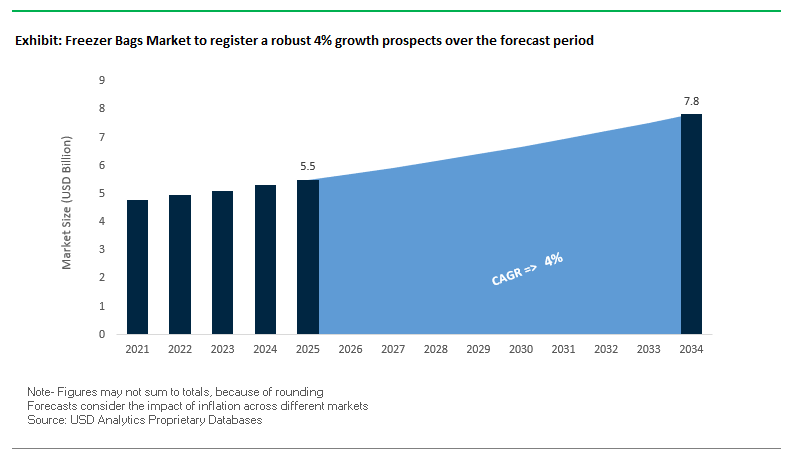
Market Overview: Freezer Bags Market Valued at $5.5 Billion in 2025
The Global Freezer Bags Market is valued at USD 5.5 billion in 2025 and projected to reach USD 7.8 billion by 2034, expanding at a CAGR of 4%. Freezer bags have become a critical tool in modern food preservation, playing a direct role in reducing food waste, ensuring product freshness, and extending shelf life. With global food waste surpassing 1.3 billion tons annually, freezer bags are increasingly positioned as a low-cost, high-impact solution for both households and institutional users.
The dominance of high-density polyethylene (HDPE) highlights the market’s material preference. HDPE-based freezer bags offer a superior barrier against air and moisture, ensuring long-term preservation without punctures or leaks. At the same time, sustainability is reshaping demand. Consumer surveys in North America and Europe show that 65% of buyers prefer BPA-free, recyclable, and reusable freezer bags, creating new opportunities for innovation.
The expansion of e-commerce food storage bag sales via Amazon, Walmart, and direct-to-consumer platforms has disrupted distribution, with online channels now accounting for a growing share of freezer bag demand. Meanwhile, single-use products continue to dominate, but reusable silicone-based freezer bags are gaining momentum, driven by both consumer preference and regulatory pressure to cut plastic waste.
Material dominance: HDPE remains the preferred material due to durability and moisture resistance.
Sustainability push: 65% of North American and European consumers prefer recyclable/reusable freezer bags.
E-commerce growth: Online retail channels are reshaping distribution models.
Reusable alternatives: Silicone and BPA-free bags are creating new product categories.
Food waste reduction: Freezer bags’ core value lies in extending shelf life and preventing freezer burn.
Market Analysis: Recent Developments in Freezer Bags Industry
The freezer bags industry in 2025 is marked by regulatory shifts, mergers, and sustainability-focused innovations, reflecting its position within the broader global packaging and consumer goods ecosystem.
In August 2025, trade reports highlighted the recovery of the DACH region’s renovation and retrofitting sector, indirectly boosting demand for freezer bags used in both construction material storage and crew food supply. That same month, Beta Glass posted a 63% revenue surge, underscoring strong performance in adjacent packaging markets that also overlap with freezer bags.
The Glass Packaging Institute (GPI) remained active, announcing an industry coalition in July 2025 to improve small-format packaging recovery and later, in June 2025, criticizing cuts to U.S. Department of Energy funding for decarbonization projects. While glass is the direct focus, these developments reflect a broader packaging industry shift toward circularity, influencing freezer bag suppliers to align with the same sustainability imperatives.
Policy changes also play a role. In April 2025, the U.S. implemented a 10% tariff on all imported goods, raising costs for raw materials used in freezer bags and other packaging categories. Meanwhile, February 2025 marked the completion of the Smurfit Kappa–WestRock merger, creating a packaging giant with extended influence across fiber-based packaging sectors. In December 2024, Amcor acquired Berry Global, forming a plastic and healthcare packaging powerhouse with strong implications for freezer bag supply and innovation pipelines.
Sustainability-led collaborations are equally critical. A landmark initiative in May 2023 saw Sabic, Estiko, and Coldwater Prawns of Norway develop an eco-friendly freezer pouch made with 60% recycled ocean-bound plastic. This innovation not only advanced sustainable seafood packaging but also established a precedent for eco-conscious freezer bag development.
Key Trends and Emerging Opportunities Shaping the Freezer Bags Market
Material Transition Towards Post-Consumer Recycled (PCR) Content
The freezer bags market is witnessing a significant shift towards integrating post-consumer recycled (PCR) materials, driven by brand sustainability mandates, consumer demand, and evolving regulations. Leading consumer packaged goods companies are reporting measurable reductions in plastic use, such as saving over 5,000 tons of plastic through lightweighting and recycled content incorporation, highlighting the strong industry push toward circularity. Regulatory frameworks, including India’s Plastic Waste Management Amendment Rules (2021), encourage the adoption of recycled content across plastic packaging, indirectly influencing freezer bag formulations. Technological innovation is also advancing this trend, with multinational flexible packaging companies developing FSSAI-compliant single-pellet solutions combining recycled PET with virgin PET. These solutions maintain high clarity, puncture resistance, and food safety, enabling manufacturers to meet sustainability objectives without compromising performance.
Product Diversification for Specialized Use Cases
Freezer bag manufacturers are expanding beyond traditional sizes to cater to specialized applications, including sous-vide cooking, meal prepping, and bulk food storage. Products are increasingly designed with enhanced features such as superior moisture barriers, puncture-resistant materials, and advanced zipper seals to prevent freezer burn and extend food shelf life. Ziploc®’s Endurables® product line exemplifies this trend, offering silicone pouches and containers that withstand extreme temperatures, including boiling and sous-vide cooking. Additionally, the growing popularity of meal prepping and portion-controlled diets drives demand for varied bag sizes from small snack packs to extra-large storage solutions addressing changing consumer lifestyles and convenience-driven needs.
Development of Certified Home-Compostable Formats
A significant market opportunity exists in the development of high-performance freezer bags that are certified for home composting, overcoming the limitations of inconsistent municipal recycling. The Biodegradable Products Institute (BPI) provides ASTM-compliant certification pathways, allowing manufacturers to substantiate their compostable claims and build consumer trust. Industry pioneers are already producing plant-based, compostable films from materials like cornstarch, demonstrating technical feasibility and market readiness. Regulatory support, such as the European Union’s Green Deal, further incentivizes R&D in bio-based, biodegradable plastics, creating a favorable environment for sustainable freezer bag innovation.
Integration of Smart Packaging Features for Food Waste Reduction
Smart packaging technologies present a transformative opportunity in the freezer bags segment, enabling consumers to monitor food quality and manage inventory more effectively. Time-temperature indicators (TTIs) can be integrated to provide visual cues on temperature fluctuations and freshness, helping reduce household food spoilage, which the U.S. EPA identifies as the largest contributor to municipal waste. Additionally, QR codes and NFC-enabled packaging can provide digital “food passports,” detailing freezing dates, origin, and storage recommendations. By combining real-time monitoring with actionable data, smart freezer bags can become active tools in food waste reduction, enhancing sustainability and consumer engagement while differentiating brands in a competitive market.
Competitive Landscape: Key Companies in Freezer Bags Market
The Global Freezer Bags Market is shaped by a few dominant players with strong brand portfolios, global distribution networks, and ongoing investment in innovation and sustainability.
S.C. Johnson & Son, Inc.: Ziploc Brand Leading in Innovation
S.C. Johnson dominates with its Ziploc freezer bags, renowned for convenience features like expandable bottoms, space-saving formats, and easy-open tabs. In July 2022, the company expanded its portfolio with Ziploc Endurables, reusable silicone pouches designed for cooking and meal prep. Its strategic focus is on innovation and sustainability, particularly incorporating post-consumer recycled (PCR) content. The brand’s household recognition and continuous product differentiation remain its strongest competitive assets.
Reynolds Consumer Products LLC: Expanding Hefty and Reynolds Brands
Reynolds Consumer Products, through its Hefty and Reynolds Kitchens brands, offers a broad portfolio of freezer bags designed for durability and leak resistance. Its strategy is centered on performance-driven products that align with evolving customer needs. Reynolds has invested heavily in sealing technologies to ensure long-term freshness and prevent freezer burn. Its strong U.S. retail presence and consumer trust give it a competitive edge in both branded and private-label freezer bag markets.
The Clorox Company (Glad Products Company): Strong Sustainability Orientation
Through its Glad Products division, Clorox is a major force in freezer bags, offering products that emphasize freshness retention and air-tight sealing. The Glad brand continues to integrate new plastic processing technologies to enhance both performance and recyclability. Its strategic commitment to sustainable packaging aligns with consumer demand for recyclable and eco-friendly alternatives. The combination of strong brand equity and continuous R&D investment ensures Glad’s continued relevance in a competitive market.
Sealed Air Corporation: Expanding Portfolio with Liquibox Acquisition
Sealed Air, traditionally known for protective and food packaging, has strengthened its position in flexible packaging through its February 2024 acquisition of Liquibox. This move expanded its freezer bag capabilities and broadened its bag-in-box and pouch solutions for food and beverage applications. With a strong focus on supply chain efficiency and waste reduction, Sealed Air leverages technology-driven solutions to meet both consumer convenience needs and sustainability goals. Its portfolio now spans from traditional freezer bags to specialty packaging formats, strengthening its role in global food storage markets.
Freezer Bags Market Share Insights
Flat Bags Dominate Market Share by Product Type in the Freezer Bags Industry
Flat bags command the largest market share at 45%, reflecting their status as the cost-effective workhorse of freezer packaging. Their dominance is underpinned by mass adoption in frozen vegetables, fruits, ice, and pre-portioned meats where simplicity, cost, and efficiency outweigh aesthetic considerations. Flat bags maximize storage density in both retail freezers and logistics containers, reducing transportation costs while optimizing cold chain utilization. They are also highly adaptable to high-speed form-fill-seal equipment, making them the default packaging choice for high-volume manufacturers. Gusseted bags, satchels, and block-bottom formats are growing in importance for value-added applications, but flat bags remain the backbone of the category due to their low material input, ability to withstand sub-zero temperatures without brittleness, and strong alignment with cost-sensitive food producers that prioritize efficiency over design.
Food and Beverage Storage Retains Majority Market Share by Application in the Freezer Bags Industry
Food and beverage storage accounts for nearly 90% of freezer bag demand, making it the undisputed driver of this market. The segment’s overwhelming dominance is tied directly to global frozen food consumption trends spanning ready meals, fresh-frozen produce, seafood, bakery products, and meat. Freezer bags in this category must provide robust barriers against freezer burn, moisture loss, and odor migration while supporting both bulk industrial packaging and consumer retail packs. Their critical role in extending product shelf life makes them integral to the $300+ billion frozen food industry, particularly as households increasingly rely on frozen options for convenience. While pharmaceuticals and medical applications provide a high-value niche requiring sterile, traceable materials, and other applications highlight versatility, the freezer bag industry remains fundamentally anchored in serving the frozen food supply chain.
United States: Consolidation, E-commerce Growth, and Sustainable Innovation Driving Market Evolution
The United States freezer bags market is undergoing a major transformation fueled by regulatory changes, sustainability goals, and strong consumer demand. The U.S. Environmental Protection Agency (EPA) has intensified its push for sustainable packaging policies, supported by incentives under the Inflation Reduction Act of 2022. This regulatory shift is encouraging brands to adopt eco-friendly freezer bags that reduce plastic waste and promote circular economy practices. A prime example of this trend is Lunchskins’ launch of compostable freezer-safe bags made from plant-based PLA and cornstarch in August 2025, signaling a new era of biodegradable solutions.
The market is also shaped by rapid advancements in product design and functionality. Manufacturers are investing in reusable, self-sealing freezer bags with enhanced insulation and puncture resistance to meet growing consumer expectations. Demand is driven not only by the meal-prepping trend and home cooking among single-person households but also by the pharmaceutical and medical device industries, which require specialized sterile storage solutions. Market leaders like S.C. Johnson, with its Ziploc brand, continue to dominate through acquisitions and expansion into eco-friendly product lines. Moreover, the boom in e-commerce and subscription meal kits is driving demand for durable freezer bags that protect product integrity during shipment.
Germany: EU PPWR Compliance and Smart Packaging Cementing Leadership in Circular Economy
Germany stands out as one of the most advanced freezer bags markets due to its stringent regulatory environment and pioneering role in the circular economy. The introduction of the EU Packaging and Packaging Waste Regulation (PPWR) in February 2025 has set ambitious targets requiring all packaging to be fully recyclable by 2030 while mandating minimum recycled content and reuse quotas. Germany’s Packaging Act further enforces producer responsibility, compelling companies to innovate in recyclability and sustainability.
In response, leading players are developing advanced solutions tailored for frozen storage. For example, Billerud introduced CrownBoard Light, a recyclable cartonboard grade designed for freezer environments, aligning perfectly with EU standards. The market is also embracing smart packaging technologies, such as humidity and temperature sensors embedded in freezer bags, helping reduce spoilage and unnecessary waste. These innovations, combined with Germany’s robust recycling infrastructure, position the country as a global benchmark for freezer bag sustainability.
China: Dual-Carbon Goals and AI-Driven Manufacturing Shaping Next-Gen Freezer Bags
China’s freezer bags market is deeply influenced by government-led sustainability initiatives and aggressive technological modernization. The nation’s “dual carbon” goals carbon peak and carbon neutrality are steering the packaging industry toward eco-friendly and reusable freezer bag materials. Regulatory restrictions on non-degradable plastics are further driving demand for paper-based and sustainable alternatives.
On the technology front, Chinese manufacturers are integrating “5G plus industrial internet” and artificial intelligence (AI) into production, enabling smarter, more flexible, and highly automated freezer bag manufacturing. The booming e-commerce ecosystem, led by platforms like Alibaba and JD.com, is amplifying demand for customizable and durable freezer bags suited for shipping perishable goods. Under the “Made in China 2025” plan, the government is also incentivizing high-tech packaging production, with a target of raising domestic content of key materials to 70% by 2025. However, stricter environmental policies are forcing consolidation, with inefficient mills exiting the market, leaving leading manufacturers to strengthen their dominance.
India: Rising Disposable Income and Regulatory Push Fueling Eco-Friendly Freezer Bags Demand
India’s freezer bags market is on an accelerated growth trajectory, supported by both government initiatives and shifting consumer lifestyles. Programs like “Make in India” and “Zero Effect Zero Defect” are fostering quality domestic production, while the Production Linked Incentive (PLI) Scheme for food processing is creating new opportunities for high-quality packaging solutions. Regulatory reforms, particularly the Plastic Waste Management (Amendment) Rules phasing out single-use plastics, are spurring demand for biodegradable and recyclable freezer bags.
Rapid urbanization, rising disposable incomes, and evolving consumer habits are significantly boosting demand for convenient and tamper-evident freezer bags. Meal prepping, single-serve packaging, and on-the-go consumption are now mainstream preferences among urban households. At the same time, India’s pharmaceutical and healthcare sectors are emerging as major consumers, requiring secure packaging for temperature-sensitive medical goods. This dual demand from households and healthcare positions India as one of the fastest-growing markets in the freezer bag industry.
Brazil: Circular Economy Mandates and Technological Advancements Reshaping the Market
Brazil’s freezer bags market is undergoing a sustainability-driven transformation underpinned by regulatory action and industry innovation. The National Solid Waste Policy is promoting a circular economy by mandating reusable, recyclable, and durable alternatives to plastics. A landmark law banning the import of solid waste, including plastic derivatives, enacted in January 2025, is further pushing domestic producers to embrace sustainable practices.
Technological upgrades are central to Brazil’s packaging industry, with companies adopting robotics and AI to improve quality and efficiency in freezer bag manufacturing. Innovation is particularly strong in high-strength materials designed to withstand Brazil’s humid climate and export logistics, especially for fresh produce and protein shipments. Companies like Klabin are also experimenting with new logistical models to cut transportation costs and reduce emissions, aligning packaging innovation with sustainability. These strategies are ensuring that Brazil not only meets domestic needs but also strengthens its competitiveness in global exports.
Japan: Advanced Recycling and Functional Innovation Defining Freezer Bags Market
Japan’s freezer bags market reflects a blend of sustainability leadership, technological efficiency, and high-value consumer expectations. The country’s Containers and Packaging Recycling Law assigns clear recycling responsibilities to businesses, creating one of the world’s most effective systems for reprocessing freezer bag materials. This robust recycling framework complements growing demand for eco-friendly and reusable freezer bags.
Japanese manufacturers are also leveraging continuous improvement philosophies like “5S” and “Muda elimination” to optimize production, reduce waste, and enhance product quality. Innovation in freezer bag design is particularly focused on functionality such as high dimensional stability, resistance to deformation, and advanced moisture protection tailored for premium applications. Additionally, the rise of e-commerce and grocery delivery services is driving demand for freezer bags with advanced branding and customization options. Japan’s market is thus defined by precision engineering, sustainability, and consumer-focused innovation, reinforcing its global reputation for high-performance packaging solutions.
Freezer Bags Market Report Scope
Freezer Bags Market
Parameter
Details
Market Size (2025)
$5.5 Billion
Market Size (2034)
$7.8 Billion
Market Growth Rate
4%
Segments
By Product Type (Flat Bags, Satchel Bags, Block Bottom Bags, Gusseted Bags), By Material Type (LDPE, HDPE, MDPE, Plant-Based Materials), By Application (Food & Beverage Storage, Pharmaceuticals & Medical Devices, Other Applications), By End-User (Residential, Commercial, Industrial)
Study Period
2019- 2024 and 2025-2034
Units
Revenue (USD)
Qualitative Analysis
Porter’s Five Forces, SWOT Profile, Market Share, Scenario Forecasts, Market Ecosystem, Company Ranking, Market Dynamics, Industry Benchmarking
Companies
S.C. Johnson & Son Inc. (Ziploc), Reynolds Consumer Products, The Glad Products Company, Inteplast Group, International Plastics Inc., Universal Plastic Bags, Weston Brands LLC, Elevate Packaging, Star Poly Bag Inc., Rutan Poly Industries Inc., Pactiv Evergreen Inc., Amcor plc, Berry Global Inc., Novolex, Lunchskins
Countries
US, Canada, Mexico, Germany, France, Spain, Italy, UK, Russia, China, India, Japan, South Korea, Australia, South East Asia, Brazil, Argentina, Middle East, Africa
Freezer Bags Market Segmentation
By Product Type
Flat Bags
Satchel Bags
Block Bottom Bags
Gusseted Bags
By Material Type
LDPE
HDPE
MDPE
Plant-Based Materials
By Application
Food & Beverage Storage
Pharmaceuticals & Medical Devices
Other Applications
By End-User
Residential
Commercial
Industrial
Countries Analyzed
North America (US, Canada, Mexico)
Europe (Germany, UK, France, Spain, Italy, Russia, Rest of Europe)
Asia Pacific (China, India, Japan, South Korea, Australia, South East Asia, Rest of Asia)
South America (Brazil, Argentina, Rest of South America)
Middle East and Africa (Saudi Arabia, UAE, Rest of Middle East, South Africa, Egypt, Rest of Africa)
Top Companies in Freezer Bags Market
S.C. Johnson & Son Inc. (Ziploc)
Reynolds Consumer Products
The Glad Products Company
Inteplast Group
International Plastics Inc.
Universal Plastic Bags
Weston Brands LLC
Elevate Packaging
Star Poly Bag Inc.
Rutan Poly Industries Inc.
Pactiv Evergreen Inc.
Amcor plc
Berry Global Inc.
Novolex
Lunchskins
* List Not Exhaustive
Methodology
The Freezer Bags Market research by USDAnalytics has been developed using a robust methodology integrating primary and secondary research, designed to provide industry professionals with actionable insights into market trends, growth drivers, and competitive dynamics. Primary research involved interviews with leading freezer bag manufacturers, flexible packaging companies, e-commerce distributors, and regulatory authorities across key regions, including the U.S., Germany, China, India, Brazil, and Japan, capturing first-hand data on product innovations, material transitions to post-consumer recycled (PCR) content, reusable silicone bag adoption, and smart packaging integration. Secondary research included the analysis of company annual reports, trade publications, government regulations, patent filings, and sustainability initiatives, enabling verification of market trends and technological developments. Historical data from 2015–2024 was assessed alongside strategic developments, mergers and acquisitions, and regulatory frameworks to forecast market growth to 2034. Advanced modeling techniques and scenario analyses were applied to evaluate the impact of e-commerce expansion, sustainability mandates, material innovations, and smart packaging technologies, ensuring precise and comprehensive insights for decision-makers navigating the evolving global freezer bags market.
Deliverables:
Comprehensive Market Research Report (PDF and Excel) with detailed tables, charts, and interactive visualizations.
Country-Specific Forecasts & Analysis.
Segment-Wise Revenue Forecasts (2025–2034).
Competitive Analysis, Benchmarking, and SWOT Profiles.
Recent Developments & Innovation Tracker.
Executive Summary & Analyst Commentary.
Post-Purchase Analyst Support for Client-Specific Questions and Custom Data Requirements.
2. Freezer Bags Market Landscape & Outlook (2025–2034)
2.1. Introduction to Freezer Bags Market
2.2. Market Valuation and Growth Projections (2025–2034)
2.3. Market Drivers: Sustainability, E-Commerce, and Food Waste Reduction
2.4. Regulatory and Policy Impacts on Market Growth
2.5. Technological Advances in Freezer Bag Manufacturing
3. Innovations Reshaping the Freezer Bags Market
3.1. Trend: Material Transition Towards Post-Consumer Recycled (PCR) Content
3.2. Trend: Product Diversification for Specialized Use Cases
3.3. Opportunity: Development of Certified Home-Compostable Formats
3.4. Opportunity: Integration of Smart Packaging Features for Food Waste Reduction
4. Competitive Landscape and Strategic Initiatives
4.1. Mergers, Acquisitions and Strategic Alliances
4.2. R&D and Material Innovation
4.3. Sustainability and Strategies
4.4. Market Expansion and Regional Focus
5. Market Share and Segmentation Insights: Freezer Bags Market
5.1. By Product Type
5.1.1. Flat Bags
5.1.2. Satchel Bags
5.1.3. Block Bottom Bags
5.1.4. Gusseted Bags
5.2. By Material Type
5.2.1. LDPE
5.2.2. HDPE
5.2.3. MDPE
5.2.4. Plant-Based Materials
5.3. By Application
5.3.1. Food & Beverage Storage
5.3.2. Pharmaceuticals & Medical Devices
5.3.3. Other Applications
5.4. By End-User
5.4.1. Residential
5.4.2. Commercial
5.4.3. Industrial
6. Country Analysis and Outlook of Freezer Bags Market
6.1. United States
6.2. Canada
6.3. Mexico
6.4. Germany
6.5. France
6.6. Spain
6.7. Italy
6.8. UK
6.9. Russia
6.10. China
6.11. India
6.12. Japan
6.13. South Korea
6.14. Australia
6.15. South East Asia
6.16. Brazil
6.17. Argentina
6.18. Middle East
6.19. Africa
7. Freezer Bags Market Size Outlook by Region (2025–2034)
7.1. North America Freezer Bags Market Size Outlook to 2034
7.1.1. By Product Type
7.1.2. By Material Type
7.1.3. By Application
7.1.4. By End-User
7.2. Europe Freezer Bags Market Size Outlook to 2034
7.2.1. By Product Type
7.2.2. By Material Type
7.2.3. By Application
7.2.4. By End-User
7.3. Asia Pacific Freezer Bags Market Size Outlook to 2034
7.3.1. By Product Type
7.3.2. By Material Type
7.3.3. By Application
7.3.4. By End-User
7.4. South America Freezer Bags Market Size Outlook to 2034
7.4.1. By Product Type
7.4.2. By Material Type
7.4.3. By Application
7.4.4. By End-User
7.5. Middle East and Africa Freezer Bags Market Size Outlook to 2034
7.5.1. By Product Type
7.5.2. By Material Type
7.5.3. By Application
7.5.4. By End-User
8. Company Profiles: Leading Players in the Freezer Bags Market
8.1. S.C. Johnson & Son Inc. (Ziploc)
8.2. Reynolds Consumer Products
8.3. The Glad Products Company
8.4. Inteplast Group
8.5. International Plastics Inc.
8.6. Universal Plastic Bags
8.7. Weston Brands LLC
8.8. Elevate Packaging
8.9. Star Poly Bag Inc.
8.10. Rutan Poly Industries Inc.
8.11. Pactiv Evergreen Inc.
8.12. Amcor plc
8.13. Berry Global Inc.
8.14. Novolex
8.15. Lunchskins
9. Methodology
9.1. Research Scope
9.2. Market Research Approach
9.3. Market Sizing and Forecasting Model
9.4. Research Coverage
9.5. Data Horizon
9.6. Deliverables
10. Appendix
10.1. Acronyms and Abbreviations
10.2. List of Tables
10.3. List of Figures
Freezer Bags Market Segmentation
By Product Type
Flat Bags
Satchel Bags
Block Bottom Bags
Gusseted Bags
By Material Type
LDPE
HDPE
MDPE
Plant-Based Materials
By Application
Food & Beverage Storage
Pharmaceuticals & Medical Devices
Other Applications
By End-User
Residential
Commercial
Industrial
Countries Analyzed
North America (US, Canada, Mexico)
Europe (Germany, UK, France, Spain, Italy, Russia, Rest of Europe)
Asia Pacific (China, India, Japan, South Korea, Australia, South East Asia, Rest of Asia)
South America (Brazil, Argentina, Rest of South America)
Middle East and Africa (Saudi Arabia, UAE, Rest of Middle East, South Africa, Egypt, Rest of Africa)
The freezer bags market is expanding due to rising food preservation needs, e-commerce growth, and sustainability trends. Increasing consumer preference for BPA-free, reusable, and recyclable bags, combined with regulatory pressures to reduce single-use plastics, is fueling innovation in materials and product designs.
Reusable silicone-based bags and home-compostable formats are gaining traction as consumers and brands prioritize sustainability. Innovations like plant-based films, recycled PET integration, and biodegradable materials enable environmentally conscious alternatives without compromising durability or food safety.
Smart packaging technologies, including time-temperature indicators and QR/NFC-enabled tracking, allow consumers to monitor food quality and reduce spoilage. These innovations enhance food waste reduction, improve supply chain transparency, and provide a competitive edge for brands emphasizing sustainability.
Flat bags lead with 45% market share due to their simplicity, cost efficiency, and suitability for frozen food storage. They maximize storage density, reduce transportation costs, and integrate easily with high-speed form-fill-seal equipment, making them ideal for mass-market and industrial applications.
Regulations like the EU Packaging and Packaging Waste Regulation (PPWR), India’s Plastic Waste Management Rules, and Japan’s Containers and Packaging Recycling Law are accelerating adoption of recyclable, biodegradable, and reusable freezer bags. Compliance drives innovation in materials, compostable solutions, and smart packaging technologies.