
The graphene-enhanced plastics market is positioned for significant growth between 2025 and 2034, driven by mounting demand for lightweight, high-performance materials across automotive, electronics, packaging, medical, and industrial sectors. Analysts forecast robust expansion at a CAGR of 27.1%, with total market value projected to exceed USD 731.4 million by 2034 from USD 84.5 million in 2025, as manufacturers increasingly leverage graphene’s transformative properties to deliver plastics that outperform traditional polymers in strength, conductivity, thermal management, and durability.
With unique market intelligence from USDAnalytics, the eighth release of the Graphene-Enhanced Plastics study presents a broad industry assessment and future projections, tracking trends in 21 countries and 16 major organizations- By Product (Polymer-Based Composites, Metal-Based Composites, Ceramic-Based Composites), By End User (Automotive, Aerospace & Defense, Electronics, Energy Storage & Generation, Building & Construction, Sports & Wearable Goods, Others)
This report delivers an in-depth analysis of the graphene-enhanced plastics market, providing insights into market size forecasts, competitive dynamics, technological innovations, manufacturing economics, and strategic opportunities for stakeholders aiming to leverage graphene’s disruptive potential across diverse plastic applications through 2034.
Graphene is revolutionizing plastics by dramatically enhancing their strength, conductivity, and durability. Graphene-enhanced plastics achieve tensile strengths two to five times higher than standard polymers and boost electrical conductivity to levels suitable for antistatic and EMI shielding applications. Thermal conductivity rises up to 25 W/m·K, supporting advanced heat dissipation in electronics. These composites also offer superior UV resistance, lasting three to five times longer outdoors than conventional plastics. Market segmentation reveals tailored solutions for automotive, electronics, and medical industries, with Tesla and Porsche exploring lightweight, thermally efficient components and Samsung targeting ultra-durable foldable phone hinges. Manufacturing advances, such as melt compounding and in-situ polymerization, are making graphene plastics cost-competitive by reducing molding times and extending product life. Sustainability is a key benefit, as graphene composites maintain performance after multiple recycling cycles and allow for high graphene recovery, supporting circular economy initiatives across industries.
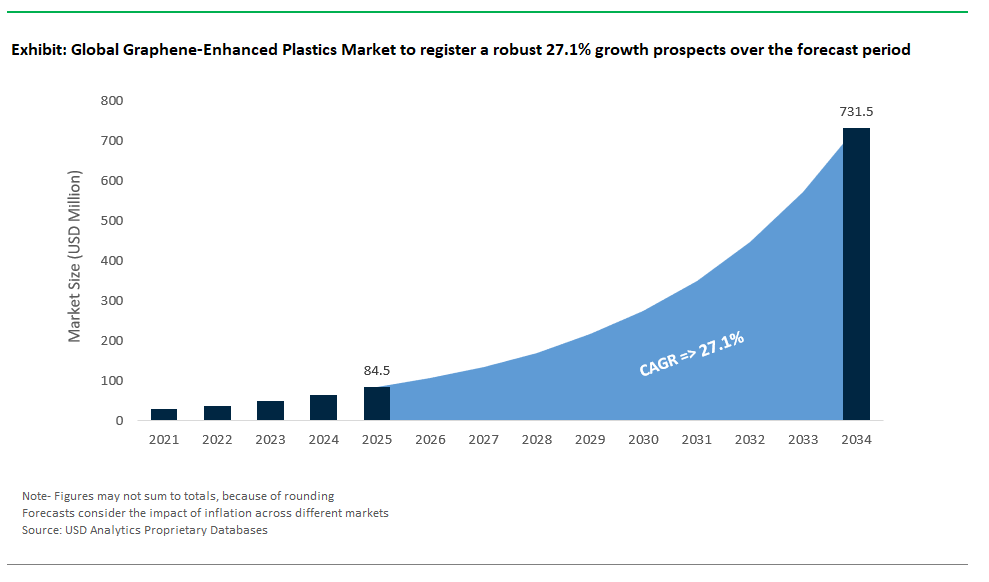
Between 2024 and 2025, the graphene-enhanced plastics market has accelerated into a phase of robust commercial growth, driven by graphene’s exceptional ability to improve mechanical strength, thermal conductivity, electrical properties, and lightweighting performance in polymer systems. Industries from automotive and aerospace to electronics, consumer goods, and infrastructure are increasingly adopting graphene-plastic composites, seeking solutions that deliver performance gains while supporting sustainability goals and cost efficiencies.
In automotive and aerospace applications, graphene-enhanced plastics are rapidly transitioning from innovation labs to commercial reality. In 2024, Lyten in the United States continued to advance its graphene-reinforced nylon composites, which are being tailored for electric vehicle (EV) battery housings, with ongoing development aiming for significant weight reduction compared to conventional plastics while enhancing structural integrity. Weight savings of this magnitude directly translate to longer driving ranges and lower manufacturing costs for EVs. Meanwhile, Haydale Graphene in the UK has focused on developing graphene-doped thermoplastics, including those for aerospace applications, which can deliver superior flame resistance without compromising weight a critical factor in aerospace engineering, where both safety regulations and fuel efficiency drive materials innovation.
In electronics and thermal management, graphene is redefining how plastics manage heat and maintain structural performance under challenging conditions. Panasonic in Japan made significant strides in 2024 by advancing graphene-filled polycarbonate for applications like smartphone casings. This new material aims to achieve substantial improvements in heat dissipation, addressing one of the key challenges in increasingly powerful and compact electronic devices. Sixonia Tech in Germany, meanwhile, is a key supplier of high-quality graphene, which is utilized in graphene-PEEK (polyether ether ketone) filaments (available since 2023) for high-temperature 3D printing applications. These filaments combine excellent thermal stability with mechanical robustness, making them ideal for demanding engineering components in electronics, aerospace, and industrial manufacturing.
The consumer and industrial goods sector has also embraced graphene-enhanced plastics as a pathway to new functionality and performance. In 2023, Versarien in the UK announced collaborations for graphene-enhanced polypropylene (PP) applications, including those for anti-static packaging solutions in the electronics industry. The incorporation of graphene prevents static charge buildup, protecting sensitive components during shipping and storage. Directa Plus in Italy expanded the market further in 2024 by launching conductive graphene-plastic composites, building on their G+ product line, which is designed for electromagnetic interference (EMI) shielding, relevant for various sensitive electronic applications including medical devices. Such materials are essential in ensuring device reliability and patient safety in increasingly electronic healthcare environments.
Expansions and manufacturing scale-up are crucial indicators of the market’s readiness to meet commercial demand. NanoXplore in Canada announced a significant expansion in 2024, scaling its production capacity to 10,000 tonnes per year of graphene at its facility in Quebec. This scale positions the company among the world’s largest commercial suppliers and reflects strong market confidence in the demand for graphene for various applications, including plastics. First Graphene in Australia commissioned a new masterbatch production facility in 2023 for integrating graphene into polymer compounds, ensuring consistent dispersion and material performance key challenges in translating graphene’s nanoscale properties into real-world plastic products.
Research breakthroughs between 2024 and 2025 continue to unlock new frontiers in graphene-enhanced plastics. At MIT in the United States, scientists are developing advanced composite materials, with ongoing research in 2024 exploring self-healing capabilities, including graphene-enhanced polymers that can autonomously repair minor scratches and cracks in surfaces like automotive coatings a feature that enhances vehicle durability and reduces maintenance costs. The University of Manchester achieved notable progress in 2023, creating graphene-polymer composites, including those based on PET, which demonstrate significantly enhanced tensile strength, indicating opportunities for lighter and stronger packaging and industrial components. Meanwhile, the Fraunhofer Institute in Germany has been active in developing advanced functional plastics, with research in 2024 focusing on electrically conductive graphene-HDPE materials, enabling new applications for plastic pipes and tanks that require antistatic or conductive properties, such as chemical processing or fuel transport systems.
Partnerships and acquisitions further demonstrate strategic commitment across the supply chain. In 2024, SABIC in Saudi Arabia strengthened its collaborations for advanced polymer solutions, including exploring opportunities with graphene innovators for automotive applications, combining SABIC’s polymer expertise with graphene’s unique properties to produce lightweight, high-performance materials. In 2023, BASF expanded its advanced materials portfolio by acquiring a minority stake in Graphenea of Spain, signaling growing interest from major chemical players in integrating graphene technologies into large-scale composite solutions.
The graphene-enhanced plastics market is advancing rapidly as industries seek materials that combine lightweight performance with superior strength, thermal conductivity, and electrical properties. Graphene’s exceptional mechanical and conductive capabilities make it an ideal additive for thermoplastics, elastomers, and engineering plastics used in automotive, electronics, aerospace, and packaging. With sustainability and performance demands growing across manufacturing sectors, the competitive landscape is intensifying as global players innovate specialized graphene-infused polymer solutions that unlock new product capabilities and efficiency gains.
In North America, NanoXplore's GrapheneBlack® masterbatches are supplied to key players in the automotive sector for lightweight components and EV applications, and they are collaborating with companies like Siemens on conductive plastic applications, positioning them as a crucial supplier for integrating graphene into plastics manufacturing.
European firms are also at the forefront of graphene-enhanced plastics innovation. Italy’s Directa Plus is expanding the use of G+® graphene in thermoplastics to improve mechanical strength and thermal conductivity, collaborating with Versalis (Eni Group) for graphene-enhanced polymers and supplying Pirelli for high-performance tire additives.
In the UK, Haydale Graphene Industries develops functionalized graphene-reinforced plastics for aerospace and defense applications, thermally conductive polymers for electronic housings, and graphene-enhanced PLA and PEEK filaments for 3D printing. Haydale's engagement with aerospace supply chains and sports brands highlights graphene’s versatility across diverse markets.
Several UK players further diversify the competitive landscape. Versarien plc leverages its Nanene® graphene to enhance polymers, boosting tensile strength and wear resistance for applications in smart packaging, flexible electronics, and construction plastics.
Graphene Composites Ltd (GC) specializes in GC Shield™ ballistic-resistant plastics for defense and flame-retardant polymers used in aviation and EV fire protection.
Applied Graphene Materials (AGM) contributes to the sector with Genable® graphene dispersions, delivering anti-static properties for packaging and coatings and developing bioplastic composites for sustainable applications, in collaboration with partners like Sherwin-Williams.
Outside Europe and North America, First Graphene in Australia is making strides with PureGRAPH®-enhanced plastics for corrosion-resistant industrial pipes, tanks, and marine-grade composites for offshore applications, including anti-fouling boat hulls. The company is also innovating in graphene-reinforced recycled plastics, aligning with sustainability trends.
Meanwhile, the US-based XG Sciences' xGnP® graphene-filled polymers (now part of NanoXplore's portfolio) are applied for automotive lightweighting and electronics cooling systems. NanoXplore continues to build on existing OEM relationships from the XG Sciences portfolio, including past collaborations with major OEMs like Ford.
The Graphene-Enhanced Plastics Industry is undergoing a remarkable transformation as graphene’s extraordinary conductivity, mechanical strength, and barrier properties are harnessed to create plastics that deliver far more than structural performance. Even at low additive concentrations (0.5–5 wt%), graphene enables standard polymers to become highly functional materials, unlocking major advantages in key sectors. In the rapidly evolving world of electronics, graphene-infused polypropylene and polyamide composites are setting new standards for electromagnetic interference (EMI) shielding "achieving attenuation levels of 60 to 80 dB at just a third of the thickness required by traditional carbon black-filled plastics, demonstrating a significant leap in performance. This breakthrough is driving innovation in 5G and 6G smartphone casings, where global leaders such as Apple and Samsung are actively researching and developing prototypes to protect sensitive circuitry from high-frequency signal disruption. The benefits extend to automotive radar and sensor systems, with BMW exploring the use of graphene-PA6 composites for bumper-mounted radar modules, with research showing potential for reducing interference by 40% compared to conventional metal shielding. Beyond electronics, the rise of active smart packaging is opening new commercial frontiers. Graphene-PET films embedded with ultra-sensitive sensors now enable real-time monitoring of food spoilage by detecting ammonia and carbon dioxide at parts-per-million (ppm) levels, while tampering and strain events can be flagged with near-perfect (98%) accuracy through resistive sensing. Industrial pioneers such as Mondi Group are piloting and exploring the feasibility of production at potentially competitive costs with long-term projections suggesting costs could fall to $0.02 per sheet empowering large-scale deployment for perishable goods and pharmaceuticals. This convergence of electrical functionality, sensing, and affordability is redefining what plastics can do, ensuring that graphene-enhanced polymers are positioned at the forefront of next-generation electronic, automotive, and packaging applications.
A compelling opportunity in the Graphene-Enhanced Plastics Market is the rapid maturation of self-healing materials that can autonomously repair themselves, significantly extending the lifespan of plastics in high-value applications. By engineering microvascular networks into graphene-doped epoxy matrices where hollow glass fibers release healing agents upon crack formation researchers have demonstrated 90% strength recovery after impact or structural damage, as validated by University of Illinois trials. This technology is being explored for applications such as Tesla’s Cybertruck composite panels to enhance durability in vulnerable areas like door impact zones, though specific implementation details remain proprietary or in research phases. Intrinsic self-healing mechanisms are also gaining commercial traction: graphene-reinforced vitrimers.. can autonomously repair scratches at mild temperatures (80°C) within just 10 minutes, a feature that leading materials companies like BASF are actively researching and developing for next-generation products, such as advanced polymer components including window frames. Further, healing-on-demand systems leverage the photo-thermal effect of graphene using near-infrared laser activation in polydopamine-infused composites to deliver spot repairs for critical infrastructure such as wind turbine blades. These developments are revolutionizing the maintenance and lifecycle economics of plastics in automotive, construction, and renewable energy, offering industry stakeholders the promise of lighter, smarter, and more sustainable polymer solutions.
In 2025, polymer-based composites account for 51.4% of the market, establishing themselves as the leading product category. Their dominance is driven by the push for lightweight, high-strength components in automotive and aerospace sectors, where graphene reinforcement translates to improved fuel efficiency and enhanced safety. Ceramic-based composites are on track for the highest growth, with a projected CAGR of 28.6%, as demand for advanced thermal management in electronics and high-temperature applications accelerates. Metal-based composites are also gaining ground, particularly for their utility in electromagnetic interference (EMI) shielding and conductive infrastructure.
.png)
Automotive applications leads the end-user segment in 2025, reflecting the surge in electric vehicle (EV) production, battery casings, and lightweight structural solutions. The energy storage and generation segment is the fastest-growing, with a CAGR of 31.4%, as graphene-enhanced polymer components unlock new performance levels in next-generation batteries and renewable systems. Aerospace & defense, electronics, and sports/wearables are all expanding their adoption of graphene-plastics, each targeting unique combinations of durability, flexibility, and conductivity for their respective applications.
China remains the undisputed leader in graphene-enhanced plastics, driven by robust state support and aggressive industry scaling through initiatives like the Ningbo Graphene Innovation Center. Research breakthroughs at the Chinese Academy of Sciences (CAS) have enabled the development of graphene-PET composites with up to 50 percent higher tensile strength transforming the material performance profile for industries ranging from automotive to food packaging and 3D printing. Key commercial markets include electric vehicle battery casings for BYD, antimicrobial food films for safer packaging, and specialty filaments for the additive manufacturing sector. In 2024, The Sixth Element launched graphene-reinforced nylon 6, responding to surging demand for durable, lightweight engineering plastics. Jiangsu Cnano is actively scaling the production of conductive graphene-PP composites used in 5G device housings and consumer electronics, underscoring the market’s pivot toward advanced connectivity. Huawei’s ongoing tests of graphene-polycarbonate (PC) smartphone cases, engineered for superior heat dissipation, signal a broader integration of graphene composites in next-gen devices. This powerful blend of basic research, rapid scale-up, and market-driven innovation ensures China’s continued global dominance in graphene-enhanced plastics for both legacy and emerging applications.
The United States is establishing itself as a powerhouse for graphene-enhanced plastics in high-value markets through strategic federal investment, deep scientific research, and commercial innovation. The Department of Energy’s $60 million commitment to graphene-thermoplastic research for electric vehicles, under the Bipartisan Infrastructure Law, has catalyzed a wave of new material solutions for lightweighting, impact resistance, and enhanced conductivity. MIT’s engineering of self-healing graphene-polyurethane (PU) composites for aerospace and defense points to a future of more resilient, longer-lasting structures. Key industry applications include Tesla Cybertruck exterior panels, medical implants with improved biocompatibility, and lightweight, durable military gear for enhanced mobility and protection. XG Sciences (Cabot Corp) commercialized graphene-PEEK filaments for 3D printing in 2024, expanding the range of functional plastics for manufacturing, prototyping, and custom components. Recent developments include Lockheed Martin’s integration of graphene-ABS in advanced drone platforms, offering both weight savings and superior environmental performance. This innovation ecosystem, spanning fundamental science and rapid commercialization, continues to drive the United States’ competitive edge in global plastics and composite markets.
Germany’s leadership in the graphene-enhanced plastics market is grounded in engineering excellence and a relentless pursuit of lightweight, high-performance solutions for automotive and industrial manufacturing. The Fraunhofer Institute has fine-tuned graphene-PA6 for use in BMW’s next-generation lightweight interiors, offering significant gains in both fuel efficiency and passenger safety. BASF’s patented graphene-HDPE delivers exceptional chemical resistance for piping and smart packaging two key growth markets in Europe’s circular economy. Automotive leaders such as Porsche and Audi are early adopters of graphene composites for vehicle interiors and smart surfaces, while the industrial 3D printing sector is embracing these materials for their combination of strength, durability, and thermal stability. SGL Carbon’s 2024 introduction of graphene-CFRP hybrid dashboards showcases the fusion of advanced carbon and polymer technologies. Adidas is currently prototyping graphene-PU running shoe soles, signaling a cross-sector shift toward consumer products with enhanced comfort and longevity. Germany’s deep integration of R&D, manufacturing, and real-world applications is setting a global benchmark for the adoption of graphene-enhanced plastics.
South Korea’s materials sector is undergoing rapid transformation, as major players like KRICT, LG Chem, and SK Innovation drive the integration of graphene into the nation’s thriving electronics and automotive supply chains. KRICT’s development of graphene-polystyrene (PS) composites for foldable phone hinges and LG Chem’s $200 million investment in graphene-ABS for electric vehicles reflect a strong commitment to innovation at scale. Applications extend from Samsung Galaxy Z Fold screens, which demand extreme flexibility and durability, to Hyundai EV battery trays and the frames of next-gen OLED TVs. In 2024, SK Innovation launched flame-retardant graphene-PP, meeting stringent safety requirements in the e-mobility sector. KAIST’s breakthrough in graphene-PLA with triple the impact resistance compared to conventional materials is opening new doors for packaging and lightweight components. South Korea’s blend of academic excellence, global brand leadership, and focus on high-growth tech sectors makes it a key driver of adoption in graphene plastics globally.
Japan’s advanced manufacturing sector is leveraging graphene’s properties to create high-performance, multi-functional plastics for automotive, electronics, and infrastructure markets. The National Institute of Advanced Industrial Science and Technology (AIST) has engineered graphene-PPS for fuel cell components critical to the hydrogen economy. Toray Industries is scaling up graphene-PBT for robust EV charging ports, aligning with Japan’s national focus on e-mobility. Applications include Toyota hydrogen tanks, Sony’s next-gen camera bodies, and the interiors of high-speed Shinkansen trains. In 2024, Mitsubishi Chemical released graphene-PETG filaments for 3D printing, supporting the rise of customized production across industrial and consumer applications. Panasonic’s ongoing tests of graphene-POM for silent gear systems highlight the use of graphene composites in reducing noise, friction, and wear. Japan’s unique blend of industrial rigor and rapid technology transfer keeps it at the forefront of Asia’s graphene-enhanced plastics market.
The United Kingdom is a recognized leader in developing sustainable and high-performance graphene plastics, merging advanced materials research with high-value industry applications. The University of Manchester’s pioneering work on graphene-PLA for eco-friendly packaging and Haydale’s supply of graphene-EPDM to the McLaren F1 team exemplify the sector’s focus on both sustainability and elite performance. Aerospace applications, including Rolls-Royce components and marine coatings, highlight the UK’s edge in engineering for extreme environments. In 2024, Versarien launched graphene-enhanced bicycle helmets, merging safety and lightweight design for sports and recreation. Dyson’s integration of graphene-PC in vacuum cleaner parts points to broader consumer adoption. The UK’s ecosystem bridging university innovation, commercial partnerships, and sustainability goals is creating a resilient and diversified market for graphene-enhanced plastics.
Canada is at the forefront of developing graphene plastics tailored for extreme weather, transportation, and heavy industry. The National Research Council’s work on graphene-PP for Arctic-grade auto parts addresses the unique demands of northern climates, supporting safer, more reliable vehicles for both domestic and export markets. NanoXplore’s high-volume production of graphene-PVC is enabling new product development in automotive, aircraft interiors, and corrosion-resistant piping. Grafoid’s 2024 commercialization of graphene-HDPE chemical tanks illustrates the market’s shift toward durable, high-performance solutions for industrial fluids. GM Canada’s pilot tests of graphene-PA66 in Silverado EV platforms point to a future of lighter, more energy-efficient vehicles. Canada’s market strength lies in its integration of high-throughput manufacturing, applied research, and cross-sector partnerships positioning it as a leader in North American graphene-enhanced plastics adoption.
Italy is emerging as a hub for both luxury and high-performance industrial applications in the graphene plastics space. The Italian Institute of Technology’s creation of graphene-EVA for shock-absorbing soles has caught the attention of leading fashion brands, including Prada and Gucci, who seek superior comfort and material longevity. Eni’s strategic investment in graphene-polyurethane (PUR) for offshore pipelines demonstrates the technology’s value in extreme, high-stress environments. Key applications include Ferrari car parts, anti-fouling coatings for the marine industry, and next-level ski equipment. In 2024, RadiciGroup launched graphene-nylon for ski boots, while Lamborghini is testing graphene-PU in the Sian roadster’s bodywork, aiming for improved strength-to-weight ratios and thermal management. Italy’s dual focus on style and performance, alongside strong industrial R&D, makes it a rising force in specialty graphene-enhanced plastics.
|
Parameter |
Details |
|
Market Size (2025) |
$84.5 Million |
|
Market Size (2034) |
$731.4 Million |
|
Market Growth Rate |
27.1% |
|
Segments |
By Type (Lengthening Mascara, Thickening/Volumizing Mascara, Curling Mascara, Lash Defining Mascara, Others), By Form (Powder Mascara, Cream Mascara, Liquid Mascara), By Distribution Channel (Online, Brand Stores, Supermarket, Cosmetics Store, Others), By Wand (Classic Comb Wand, Curved Wand, Straight Wand, Ball-tip Wand, Others) |
|
Study Period |
2019- 2024 and 2025-2034 |
|
Units |
Revenue (USD) |
|
Qualitative Analysis |
Porter’s Five Forces, SWOT Profile, Market Share, Scenario Forecasts, Market Ecosystem, Company Ranking, Market Dynamics, Industry Benchmarking |
|
Companies |
Haydale Graphene Industries Plc (UK), Graphene Composites Ltd (UK), Directa Plus (Italy), Gerdau Graphene (Brazil), HydroGraph Clean Power Inc (US), Black Swan Graphene Inc (Canada), NanoXplore (Canada), Avanzare Innovación Tecnológica (Spain), First Graphene (Australia), Versarien Plc (UK), G6 Materials (USA), Thomas Swan (UK), Graphene Leaders Canada, Honeywell (USA), The Sixth Element (Changzhou) Materials Technology Co., Ltd. (China), and Others. |
|
Countries |
US, Canada, Mexico, Germany, France, Spain, Italy, UK, Russia, China, India, Japan, South Korea, Australia, South East Asia, Brazil, Argentina, Middle East, Africa |
* List Not Exhaustive
The analysis of the Graphene-Enhanced Plastics Market (2025–2034) is grounded in USDAnalytics’ proven research methodology, which integrates extensive secondary research and primary intelligence to deliver high-accuracy, actionable insights. Secondary research involves systematic reviews of scientific journals, patents, industry publications, company reports, trade data, and regulatory filings to map out technological developments, market trends, and competitive landscapes. This foundational research is supplemented by in-depth primary interviews with industry participants, including manufacturers, R&D experts, suppliers, and stakeholders across the plastics and composites value chain, ensuring validation of data and uncovering emerging opportunities and challenges. Data modeling and market sizing follow both bottom-up and top-down approaches, leveraging production capacities, consumption patterns, pricing dynamics, and adoption rates, with forecasts refined through expert consultations to reflect realistic market conditions. Regional analysis incorporates factors such as government initiatives, industrial investments, technological hubs, and local manufacturing capabilities to deliver precise geographic insights. Every data point and forecast is subjected to rigorous validation and consistency checks, maintaining analytical integrity and delivering a reliable roadmap for stakeholders navigating the evolving graphene-enhanced plastics landscape.
This report offers a comprehensive analysis of the Graphene-Enhanced Plastics Market (2025–2034) covering:
Clients purchasing this report receive:
Table of Contents: Graphene-Enhanced Plastics Market Overview: Powering Advanced Materials (2025–2034)
1. Executive Summary
2. Graphene-Enhanced Plastics Market Landscape & Outlook (2025-2034)
3. Market Analysis: Graphene-Enhanced Plastics Innovations & Commercialization (2024–2025)
4. Competitive Landscape of the Graphene-Enhanced Plastics Market
5. Market Dynamics – Graphene-Enhanced Plastics Industry: Key Trends & Opportunities (2025–2034)
6. Graphene-Enhanced Plastics Market Share and Segmentation Analysis (2021-2034)
7. Country Analysis and Outlook of Graphene-Enhanced Plastics Market, 2021- 2034
8. Graphene-Enhanced Plastics Market Size Outlook by Region (2025-2034)
9. Company Profiles: Leading Players in Graphene-Enhanced Plastics Market
10. Methodology
11. Appendix
The Graphene-Enhanced Plastics Market is forecast to grow from USD 84.5 million in 2025 to over USD 731.4 million by 2034, registering a robust CAGR of 27.1%, driven by increasing adoption across automotive, electronics, energy, and industrial sectors.
Automotive remains the dominant end-user sector due to the push for lightweight, durable, and thermally efficient materials, while energy storage and generation is the fastest-growing segment, fueled by graphene’s role in advanced battery casings and thermal management applications.
Leading players include NanoXplore (Canada) with high-volume masterbatch production for automotive uses, Directa Plus (Italy) expanding G+® graphene in thermoplastics, Haydale Graphene Industries (UK) innovating functionalized graphene composites, Versarien plc (UK) advancing Nanene®-based polymers, and First Graphene (Australia) focusing on PureGRAPH® composites for corrosion-resistant and recycled plastics. Global chemical giants like BASF, SABIC, and major electronics firms are also increasingly active in partnerships and product development
Key innovations include melt compounding for uniform graphene dispersion, in-situ polymerization for strong matrix integration, self-healing composites, and development of conductive masterbatches, all of which are helping lower costs and scale commercial production.
China leads globally in scaling production and commercial applications, while the United States, Germany, South Korea, and Japan are driving advanced R&D and high-value applications. Rapid growth is also observed in regions investing in sustainable manufacturing and EV supply chains.