Pharmaceutical Tablet Packaging Equipment Market Size, Overview, and Growth Outlook (2025–2034)
Pharmaceutical Tablet Packaging Equipment Market to Witness Steady Growth with Increasing Automation and Patient-Centric Solutions
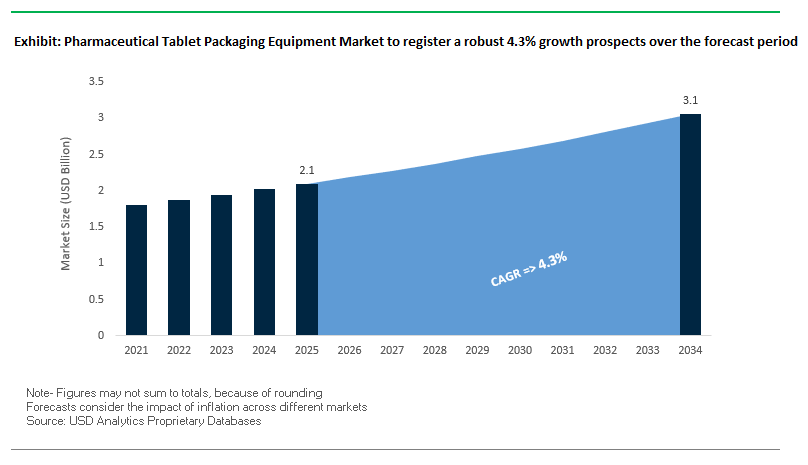
The Global Pharmaceutical Tablet Packaging Equipment Market is projected to grow from $2.1 billion in 2025 to $3.1 billion by 2034, at a CAGR of 4.3%. This market encompasses blister machines, cartoners, sachet and stick pack machines, and integrated packaging lines essential for tablet, capsule, and solid-dose pharmaceutical products.
Key Insights for industry professionals and equipment buyers:
Automation Drives Operational Efficiency: Over 50% of pharmaceutical companies now use automated packaging systems to improve accuracy, reduce labor costs, and ensure regulatory compliance.
Unit-Dose Packaging Trends Enhance Patient Safety: Rising demand for blister packs and single-dose sachets supports self-medication, personalized medicine, and patient adherence.
Serialization and Anti-Counterfeiting are Critical: Regulatory mandates like the U.S. Drug Supply Chain Security Act (DSCSA) have made serialization and track-and-trace systems standard for combating counterfeit drugs.
Integrated Packaging Solutions Streamline Production: Combining primary, secondary, and tertiary packaging in fully integrated lines enhances productivity and reduces downtime.
Sustainability and Smart Technologies Gain Traction: Equipment now incorporates eco-friendly materials, digital touchpoints like QR/NFC codes, and high-speed, precise production to meet market and regulatory demands.
Market Analysis: Industry Developments Highlight the Push Toward Sustainable, Digital, and High-Speed Tablet Packaging
The pharmaceutical tablet packaging equipment market is evolving rapidly with new product launches, sustainable innovations, and strategic expansions. In September 2025, Marchesini Group showcased its latest packaging solutions at Fachpack 2025 in Nuremberg, Germany, followed by Interphex Japan 2025 in July 2025, highlighting its continuous innovation in both pharmaceutical and beauty packaging.
Romaco Group made headlines in July 2025 by ending discussions over a potential takeover to focus on accelerating growth in biologics and nutraceutical systems. The same month, it launched the world’s first carbon-neutral blister packaging line, emphasizing the industry's focus on sustainable solutions. Keystone Folding Box, in June 2025, introduced a paperboard blister under the Push-Pak brand, providing a low-waste alternative suitable for tablets and nutraceuticals.
Other notable developments include Gerresheimer’s Connected Packaging platform launch in January 2025, integrating QR codes and NFC tags for digital touchpoints, and DSCSA full implementation in December 2024, enforcing serialization and track-and-trace requirements. Advanced technological research, such as the October 2024 study on inhibitor-modified atomic layer deposition (ALD) for ultrathin nanocoatings, is also paving the way for high-barrier, protective packaging. These initiatives underscore the market’s move toward automated, sustainable, and connected tablet packaging solutions.
Transformative Trends and Emerging Opportunities in the Pharmaceutical Tablet Packaging Equipment Market
Integration of Advanced Vision Inspection and AI for 100% Quality Control
The pharmaceutical tablet packaging equipment market is witnessing a rapid transformation through the adoption of advanced vision inspection and artificial intelligence (AI) systems. Quality control has always been a cornerstone of pharmaceutical packaging, but traditional manual methods are increasingly inadequate for today’s stringent regulatory demands. An academic study published in MDPI demonstrated how deep learning algorithms paired with high-resolution, multi-angle cameras could detect subtle defects such as ovality, short molding, or foreign matter in bottle necks, surpassing human inspection in both accuracy and consistency. This advancement ensures primary packaging integrity before the filling stage, significantly minimizing risk of contamination or compromised drug stability. Moreover, global pharmaceutical manufacturers are now deploying AI-driven vision systems on blister lines to detect microscopic defects like tablet chips, cracks, and even subtle color deviations. These systems not only verify pill integrity but also confirm the presence and alignment of patient leaflets within cartons, reducing the likelihood of compliance failures. By proactively identifying issues, AI-powered inspection systems are credited with lowering product recall risks and improving adherence to FDA, EMA, and MHRA quality standards.
Adoption of Modular and Flexible Equipment for Multi-Product Facilities
The growing diversification of pharmaceutical pipelines, particularly the rise of small-batch biologics and personalized medicines, is driving demand for modular and highly flexible packaging equipment. Contract Development and Manufacturing Organizations (CDMOs), which must handle diverse client needs, are increasingly adopting solutions like Körber Pharma’s NeoTOP x Flexx, designed to streamline format changes between small and medium batch runs. This agility allows CDMOs to service more clients without long equipment downtimes, boosting their competitiveness. A real-world case study from Combi Packaging Systems highlighted how modular case packing systems allowed a diagnostics company to simultaneously handle existing bottled assays and two new product lines. By leveraging customizable systems with bypass options for small manual runs, the company reduced labor intensity, mitigated repetitive motion injuries, and increased throughput. This modular approach aligns with the industry’s broader Pharma 4.0 vision, where multi-product flexibility, scalability, and operational efficiency are critical to meet the growing complexity of modern drug pipelines.
Development of Integrated Line Orchestration Software (Pharma 4.0)
The digitalization of pharmaceutical manufacturing is opening vast opportunities for software-driven orchestration in tablet packaging lines. A case study by MIGSO-PCUBED detailed how digitizing manual batch records and deviation workflows reduced error rates and rework time by nearly 30%. Such systems integrate seamlessly with packaging equipment, creating a paperless environment with fully traceable electronic batch records that are audit-ready for regulators. In addition to compliance benefits, advanced orchestration platforms enable predictive maintenance through real-time equipment monitoring. Providers like Vimachem have demonstrated how integrated analytics platforms can enhance Overall Equipment Effectiveness (OEE), with reports of up to a 59% increase in efficiency after deployment. Predictive alerts reduce unplanned downtime, optimize line utilization, and extend equipment lifespan, representing significant savings for pharmaceutical companies operating under slim production margins. This integration of Pharma 4.0 software into tablet packaging workflows not only modernizes operations but also transforms packaging equipment into intelligent, data-driven assets.
Engineering of Sustainable Equipment for Recyclable Material Formats
Sustainability imperatives are pushing equipment manufacturers to design systems compatible with recyclable mono-materials, directly supporting the pharmaceutical sector’s transition toward circular packaging. Traditional PVC/aluminum blisters are difficult to recycle due to multi-material composition, but innovations in polypropylene (PP) and PET mono-material films are redefining blister packaging. A collaboration between IMA Group and Südpack successfully demonstrated the machinability of PP mono-materials, highlighting improved thermoforming and sealing behavior compared to conventional laminates. Similarly, Romaco’s public demonstration at the PPMA Total Show showcased the Noack N 760 blister line producing recyclable PET-based blisters with equivalent barrier properties to traditional formats while maintaining patient usability with push-through functionality. These advancements prove that sustainable materials can meet both pharmaceutical performance requirements and environmental goals. By engineering packaging equipment specifically for recyclable materials, manufacturers are helping pharmaceutical companies achieve Extended Producer Responsibility (EPR) compliance, lower carbon emissions, and align with global ESG commitments.
Competitive Landscape: Leading Players Are Driving Automation, Sustainability, and Digital Integration in Tablet Packaging Equipment
The global pharmaceutical tablet packaging equipment market is dominated by companies leveraging automation, digitalization, and eco-friendly innovations to provide high-performance, integrated packaging systems.
Uhlmann Group: Delivering End-to-End Tablet Packaging Solutions with Integrated Digital Capabilities
Uhlmann Pac-Systeme specializes in blister, tray, bottle, and carton packaging systems for solid-dose and parenteral products. Its comprehensive portfolio includes standalone machines and fully integrated lines, complemented by digital solutions like OEE Monitoring and Track & Trace systems. Uhlmann focuses on sustainable and connected packaging, with a Packaging Competence Center supporting product innovation and operational efficiency.
IMA S.p.A.: High-Speed, Customizable Solutions with a Strong Focus on Sustainability
IMA Pharma offers blister machines, cartoners, and sachet/stick pack machines for pharmaceuticals, cosmetics, and food. The company is known for high-precision, high-speed equipment and R&D-driven innovation. IMA’s Zero program emphasizes reducing environmental impact, reflecting its strategy of providing integrated, sustainable solutions tailored for modern pharmaceutical production.
Romaco Group: Pioneering Carbon-Neutral and Automated Tablet Packaging Lines
Romaco provides blister lines, cartoners, and end-of-line equipment for tablets. In May 2025, it launched the world’s first carbon-neutral blister packaging line, demonstrating its commitment to sustainability. With a new plant in Italy and investments in digitalization and automation, Romaco continues to develop eco-friendly, high-efficiency packaging solutions for global pharmaceutical markets.
Marchesini Group: Celebrating 50 Years of Innovation with Fully Integrated Packaging Lines
Marchesini Group manufactures blister machines, cartoners, and end-of-line systems for tablets and capsules. Known for showcasing innovations at Interphex and Fachpack, it provides both standalone and fully integrated lines. Its strategy focuses on customer-centric solutions, efficiency, and advanced machine performance, marking it as a trusted partner in pharmaceutical packaging.
Syntegon Technology: Advancing Intelligent and Sustainable Packaging Post-Spin-Off
Formerly Bosch Packaging Technology, Syntegon offers high-speed tablet presses, versatile cartoners, and fully integrated lines. The 2020 transition to an independent company enables greater operational flexibility. Syntegon emphasizes intelligent, sustainable solutions, helping pharmaceutical clients enhance efficiency, meet sustainability goals, and protect product integrity across the supply chain.
Blister Packaging Equipment Leads Market Share by Product Type in Pharmaceutical Tablet Packaging Equipment
Blister packaging equipment holds the largest share of the pharmaceutical tablet packaging equipment market at 35%, underscoring its critical role as the global standard for prescription tablets and capsules. The dominance of blister systems stems from their ability to combine drug protection and patient compliance—delivering moisture and light barriers while supporting unit-dose formats with calendaring for accurate adherence. In addition, blister packs are the preferred format for integrating serialization, barcoding, and anti-counterfeiting measures at the individual dose level, which is increasingly demanded under global regulatory frameworks such as DSCSA and EU FMD. Bottle filling and capping equipment maintains a strong second position at 25%, sustained by its pivotal role in high-volume OTC and nutraceutical packaging. Its integration of counting, desiccant insertion, and torque-controlled capping systems ensures cost-effective throughput for mass-market products. Cartoning equipment also secures a significant share as a non-negotiable component of secondary packaging, ensuring serialized aggregation and logistics compliance. Labelling equipment continues to rise in importance as a compliance-critical system, while counting, strip, and wrapping machines, though niche, remain essential for specialized applications such as lozenges, effervescent tablets, and clinical trial packaging. Together, these dynamics illustrate how blister systems dominate value, while bottle and cartoning systems anchor volume, reflecting the dual pressures of regulatory compliance and production efficiency.
Pharmaceutical & Biopharmaceutical Companies Dominate Market Share by End-User in Tablet Packaging Equipment
Pharmaceutical and biopharmaceutical companies account for 50% of market demand, positioning themselves as the primary investors in high-value packaging equipment. Their dominance stems from the need to secure manufacturing control, protect intellectual property, and ensure regulatory compliance for high-value drugs, particularly biologics and specialty therapies. These companies are at the forefront of deploying integrated, high-speed, and fully validated lines that combine blistering, cartoning, and labelling into unified systems capable of meeting stringent track-and-trace and serialization mandates. Contract Manufacturing Organizations (CMOs), while holding a smaller share, represent the fastest-growing end-user segment. Their growth is powered by the outsourcing trend across the pharmaceutical supply chain, driving heavy investment in flexible, multi-format equipment capable of handling a wide array of bottle sizes, blister formats, and labelling specifications across multiple clients. Nutraceutical companies remain a cost-sensitive but steadily growing segment, emphasizing mid-speed bottle fillers, blister machines, and cartoners to meet rising consumer demand for supplements and wellness products. While they lack the regulatory pressures of pharma, their focus on branding, productivity, and shelf appeal ensures continuous demand for robust equipment solutions. Overall, the end-user landscape demonstrates how innovator pharma companies dominate in value, CMOs drive flexibility-led growth, and nutraceutical players sustain steady volume demand.
United States Pharmaceutical Tablet Packaging Equipment Market Driven by FDA DSCSA and Industry 4.0 Integration
The United States pharmaceutical tablet packaging equipment market is being reshaped by the Food and Drug Administration’s (FDA) Drug Supply Chain Security Act (DSCSA), which mandates serialization and advanced traceability. This has accelerated the adoption of high-speed automated blister packaging and bottle filling lines capable of handling diverse tablet shapes and sizes. Contract Manufacturing Organizations (CMOs) are particularly benefiting from flexible manufacturing systems that enable quick changeovers for different products and batch volumes.
Innovation is centered on Industry 4.0 integration, with predictive maintenance, IoT sensors, and real-time analytics being embedded into tablet packaging machinery to minimize downtime and maximize efficiency. The shift toward patient-centric packaging is also significant, with demand rising for unit-dose formats that improve adherence and usability. Sustainability is an emerging driver, with manufacturers developing equipment that can process paper-based blisters and recyclable materials, reducing environmental impact while meeting consumer and regulatory expectations.
European Union Pharmaceutical Tablet Packaging Equipment Market Driven by FMD and PPWR Compliance
The European Union pharmaceutical tablet packaging equipment market is shaped by strict regulatory frameworks, particularly the Falsified Medicines Directive (FMD), which enforces serialization and tamper-evident features on all packaging lines. This has created demand for high-precision labeling and coding systems seamlessly integrated into blister and bottle packaging machinery. The European Medicines Agency (EMA) requires continuous updates to product information, driving investments in advanced printing and labeling equipment.
The upcoming Packaging and Packaging Waste Regulation (PPWR), effective from 2025, introduces stringent requirements for recyclability and reusable formats, compelling manufacturers to adapt their equipment to handle eco-friendly and mono-material packaging. Leading German companies such as Uhlmann Group and Romaco Holding dominate with high-speed, fully automated lines engineered for continuous manufacturing, allowing integration of tablet production and packaging in one streamlined process. This positions the EU market as a global leader in sustainable and compliance-driven tablet packaging technology.
China Pharmaceutical Tablet Packaging Equipment Market Driven by NMPA GMP Guidelines and Serialization
The China pharmaceutical tablet packaging equipment market is undergoing a transformation under new Good Manufacturing Practice (GMP) annexes introduced by the National Medical Products Administration (NMPA). Since June 2025, pharmaceutical excipient and packaging material manufacturers must comply with enhanced quality management systems and cooperate with Marketing Authorization Holders (MAHs) during audits. This has created opportunities for automated, advanced tablet packaging lines with strict quality validation.
The Chinese Pharmacopoeia 2025 edition has further raised standards, requiring pharmaceutical companies to update their packaging control systems and testing methodologies. Growing adoption of serialization and 2D DataMatrix codes for anti-counterfeiting is driving investment in digital printing and inspection equipment. With the government promoting upgrades to pharma manufacturing and global exports, China is investing in automated blister lines, smart inspection systems, and eco-friendly packaging solutions, making it a fast-growing hub for tablet packaging technology.
India Pharmaceutical Tablet Packaging Equipment Market Strengthened by CDSCO QR Code Mandates and Export Growth
The India pharmaceutical tablet packaging equipment market is seeing rapid expansion due to new regulatory mandates from the Central Drugs Standard Control Organization (CDSCO), which require QR codes on secondary and tertiary packaging for traceability. This is fueling adoption of specialized coding, labeling, and verification systems within packaging lines. The Make in India initiative is encouraging local production of high-quality packaging equipment, reducing reliance on imports and promoting innovation.
India’s status as a global leader in generics and vaccines drives high demand for cost-effective, high-speed packaging lines capable of handling mass production. The market is also seeing growth in equipment for nutraceuticals and over-the-counter products, which require versatile closures and packaging solutions. With increasing government subsidies under the Delhi Logistics and Warehousing Policy 2025, the sector is poised for investments in eco-friendly, tamper-evident, and export-compliant packaging systems.
Japan Pharmaceutical Tablet Packaging Equipment Market Advanced by E-Labeling and Smart Packaging Trends
The Japan pharmaceutical tablet packaging equipment market is pioneering digital transformation through the government’s e-labeling mandate, which replaces physical inserts with GS1 barcodes linked to updated product information. This requires packaging lines to integrate advanced barcode printing, scanning, and verification technologies. Japanese pharmaceutical companies are also investing in smart labels with adherence tracking, creating demand for specialized labeling and packaging systems.
Stringent safety standards under the Act on Securing Quality, Efficacy, and Safety of Products are driving the adoption of tamper-evident and highly secure packaging systems. At the same time, sustainability trends are pushing innovation in biodegradable and recyclable packaging materials, requiring equipment capable of processing advanced eco-friendly substrates. With its strong focus on precision, safety, and digital integration, Japan continues to be a leader in next-generation tablet packaging solutions.
United Kingdom Pharmaceutical Tablet Packaging Equipment Market Reoriented by Windsor Framework and EPR Mandates
The United Kingdom pharmaceutical tablet packaging equipment market has been reshaped by the Windsor Framework, which requires all medicines sold in the UK to feature a ‘UK Only’ label from January 2025. By June 2025, this must be directly printed on packaging, creating demand for new high-resolution digital printing and labeling equipment. With the UK officially disapplying the EU Falsified Medicines Directive (FMD), there is also a growing need for UK-specific serialization and traceability technologies.
The Extended Producer Responsibility (EPR) framework further incentivizes the use of sustainable packaging solutions, pushing manufacturers to invest in equipment that can process recyclable and lightweight formats. Combined with government-backed innovation programs, the UK market is evolving toward a circular economy model for pharmaceutical packaging, underpinned by smart labeling, traceability, and eco-compliant equipment.
US, Canada, Mexico, Germany, France, Spain, Italy, UK, Russia, China, India, Japan, South Korea, Australia, South East Asia, Brazil, Argentina, Middle East, Africa
USDAnalytics employs a comprehensive research methodology to deliver precise, actionable insights into the Pharmaceutical Tablet Packaging Equipment Market. Our approach combines extensive primary research, including interviews with equipment manufacturers, pharmaceutical companies, contract manufacturing organizations (CMOs), and regulatory authorities, with secondary research from company reports, trade publications, patent filings, and validated databases. Market sizing, CAGR calculations, and growth projections are derived using both top-down and bottom-up approaches, considering segmentation by product type, machine type, application, and end-user. We analyze technological trends such as AI-powered vision inspection, Pharma 4.0 integrated line orchestration, modular and flexible equipment, sustainable material processing, and digital serialization for compliance with DSCSA, FMD, and global traceability regulations. Regional market dynamics, including regulatory frameworks in the U.S., EU, China, India, Japan, and the UK, are assessed alongside competitive benchmarking, highlighting strategic expansions, sustainable innovations, and smart technology adoption by leading players like Uhlmann Group, IMA S.p.A., Romaco Group, and Marchesini Group. This methodology ensures that industry professionals gain a holistic understanding of automation, patient-centric design, sustainability, and digitalization shaping the tablet packaging equipment market.
Deliverables:
Comprehensive Market Research Report (PDF and Excel) with detailed tables, charts, and interactive visualizations.
Country-Specific Forecasts & Analysis.
Segment-Wise Revenue Forecasts (2025–2034).
Competitive Analysis, Benchmarking, and SWOT Profiles.
Recent Developments & Innovation Tracker.
Executive Summary & Analyst Commentary.
Post-Purchase Analyst Support for Client-Specific Questions and Custom Data Requirements.
Table of Contents: Pharmaceutical Tablet Packaging Equipment Market
1. Executive Summary
1.1. Market Highlights
1.2. Key Findings
1.3. Global Market Snapshot
2. Pharmaceutical Tablet Packaging Equipment Market Landscape & Outlook (2025–2034)
2.1. Introduction to Pharmaceutical Tablet Packaging Equipment Market
2.2. Market Valuation and Growth Projections (2025–2034)
2.3. Market Drivers and Restraints
2.4. Emerging Trends and Technological Developments
2.5. Regulatory and Compliance Landscape
3. Innovations Reshaping the Pharmaceutical Tablet Packaging Equipment Market
3.1. Trend: Integration of Advanced Vision Inspection and AI for 100% Quality Control
3.2. Trend: Adoption of Modular and Flexible Equipment for Multi-Product Facilities
3.3. Opportunity: Development of Integrated Line Orchestration Software (Pharma 4.0)
3.4. Opportunity: Engineering of Sustainable Equipment for Recyclable Material Formats
4. Competitive Landscape and Strategic Initiatives
4.1. Mergers, Acquisitions and Strategic Alliances
4.2. R&D and Material Innovation
4.3. Sustainability and Strategies
4.4. Market Expansion and Regional Focus
5. Market Share and Segmentation Insights: Pharmaceutical Tablet Packaging Equipment Market
5.1. By Product Type
5.1.1. Blister
5.1.2. Strip
5.1.3. Bottle Filling & Capping
5.1.4. Cartoning
5.1.5. Counting
5.1.6. Wrapping
5.1.7. Labelling
5.1.8. Others
5.2. By Machine Type
5.2.1. Fully Automatic
5.2.2. Semi-Automatic
5.2.3. Manual
5.3. By Application
5.3.1. Tablets & Capsules
5.3.2. Powders
5.3.3. Liquids & Semi-Solids
5.4. By End-User
5.4.1. Pharmaceutical & Biopharmaceutical Companies
5.4.2. CMOs
5.4.3. Nutraceutical Companies
6. Country Analysis and Outlook of Pharmaceutical Tablet Packaging Equipment Market
6.1. United States
6.2. Canada
6.3. Mexico
6.4. Germany
6.5. France
6.6. Spain
6.7. Italy
6.8. United Kingdom
6.9. Russia
6.10. China
6.11. India
6.12. Japan
6.13. South Korea
6.14. Australia
6.15. South East Asia
6.16. Brazil
6.17. Argentina
6.18. Middle East
6.19. Africa
7. Pharmaceutical Tablet Packaging Equipment Market Size Outlook by Region (2025–2034)
7.1. North America Market Size Outlook to 2034
7.1.1. By Product Type
7.1.2. By Machine Type
7.1.3. By Application
7.1.4. By End-User
7.2. Europe Market Size Outlook to 2034
7.2.1. By Product Type
7.2.2. By Machine Type
7.2.3. By Application
7.2.4. By End-User
7.3. Asia Pacific Market Size Outlook to 2034
7.3.1. By Product Type
7.3.2. By Machine Type
7.3.3. By Application
7.3.4. By End-User
7.4. South America Market Size Outlook to 2034
7.4.1. By Product Type
7.4.2. By Machine Type
7.4.3. By Application
7.4.4. By End-User
7.5. Middle East and Africa Market Size Outlook to 2034
7.5.1. By Product Type
7.5.2. By Machine Type
7.5.3. By Application
7.5.4. By End-User
8. Company Profiles: Leading Players in the Pharmaceutical Tablet Packaging Equipment Market
8.1. Uhlmann Group
8.2. IMA S.p.A.
8.3. Marchesini Group
8.4. Syntegon Technology (Bosch Packaging Technology)
8.5. Romaco Group
8.6. GEA Group Aktiengesellschaft
8.7. Körber AG
8.8. ACIC Pharmaceutical Machinery
8.9. Sejong Pharmatech Co., Ltd.
8.10. LMT Group
8.11. Bausch + Strobel
8.12. MG2 S.p.A.
8.13. Accupac, LLC
8.14. Coesia S.p.A.
8.15. Vintech Systems
9. Methodology
9.1. Research Scope
9.2. Market Research Approach
9.3. Market Sizing and Forecasting Model
9.4. Research Coverage
9.5. Data Horizon
9.6. Deliverables
10. Appendix
10.1. Acronyms and Abbreviations
10.2. List of Tables
10.3. List of Figures
The global Pharmaceutical Tablet Packaging Equipment Market is expected to grow from $2.1 billion in 2025 to $3.1 billion by 2034, achieving a CAGR of 4.3%. Growth is driven by rising automation, patient-centric unit-dose formats, and the adoption of smart, sustainable, and integrated packaging lines.
Automation enhances operational efficiency, accuracy, and compliance while reducing labor costs. High-speed blister machines, cartoners, and integrated packaging lines equipped with AI and vision inspection systems ensure defect-free production, minimize recalls, and support serialization for regulatory compliance.
Sustainability is driving the adoption of recyclable mono-material films and carbon-neutral packaging lines. Equipment designed for eco-friendly substrates supports Extended Producer Responsibility (EPR) compliance, reduces carbon emissions, and aligns with pharmaceutical companies’ ESG and circular economy goals.
Blister packaging equipment leads with a 35% share, followed by bottle filling & capping systems at 25%. Pharmaceutical and biopharmaceutical companies account for 50% of demand, while CMOs are the fastest-growing segment due to flexible, multi-format equipment adoption. Cartoning, labeling, and counting machines also play essential roles in compliance and operational efficiency.
Regulatory frameworks such as the U.S. DSCSA, EU FMD and PPWR, China NMPA GMP, India CDSCO QR code mandates, UK Windsor Framework, and Japan e-labeling drive adoption of serialization, traceability, and advanced digital systems. These regulations influence equipment design, digital integration, and sustainability initiatives, shaping market growth globally.
More Equipment, Services and End-use Products Reports