Printed Carton Market Overview: Sustainability, Digital Printing, and Consumer-Centric Design
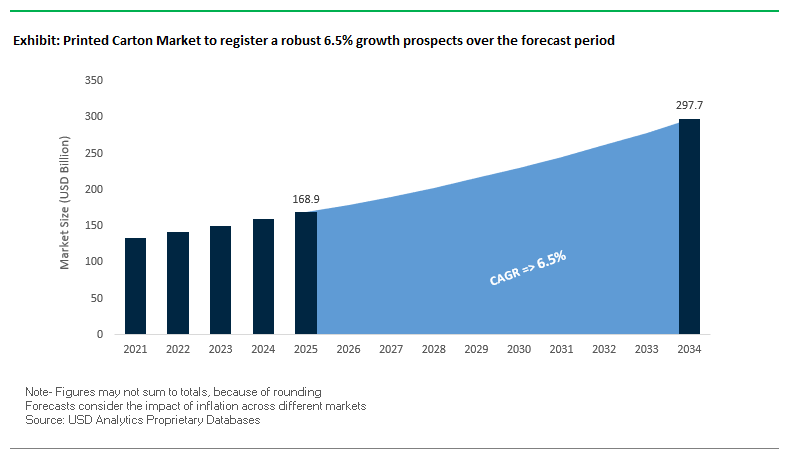
The Global Printed Carton Market is projected to reach $168.9 billion in 2025 and expand to $297.7 billion by 2034, growing at a CAGR of 6.5%. Printed cartons are increasingly becoming a cornerstone of modern packaging, balancing visual appeal, functionality, and sustainability. Folding carton paperboard remains the most dominant material, offering versatility, printability, and durability across industries such as food, beverages, pharmaceuticals, cosmetics, and e-commerce.
The industry is undergoing a rapid digital transformation, with the rise of digital printing enabling cost-effective short runs and personalized, localized packaging campaigns that enhance brand-consumer engagement. Simultaneously, the e-commerce boom has made the unboxing experience a crucial brand differentiator, pushing companies to invest in high-quality printed cartons that deliver both protection and premium aesthetics. Sustainability also stands as a defining factor, as fiber-based packaging solutions increasingly replace single-use plastics.
Key Insights for Industry Professionals
Folding carton paperboard dominates due to versatility, durability, and high-quality print surfaces.
Digital printing reshapes packaging with personalization, short-run flexibility, and reduced costs.
E-commerce fuels demand for innovative designs that enhance consumer “unboxing experiences.• Fiber-based packaging leads sustainability efforts, replacing billions of single-use plastic items.
Market Analysis: Innovation and Mergers Defining Strategic Growth
The printed carton market is advancing through a blend of sustainability-driven innovations, high-profile mergers, and capacity expansions. In August 2025, Smurfit WestRock, the newly merged entity of Smurfit Kappa and WestRock, reported strong Q2 results, demonstrating its enhanced ability to serve diverse markets, including printed cartons. In the same month, Graphic Packaging International secured four gold awards at the 2025 AmeriStar Awards, highlighting its leadership in design innovation.
Earlier, in July 2025, Graphic Packaging released its 2024 Impact Report, showcasing significant progress on sustainability by replacing nearly 1 billion plastic packages with paperboard. A few months prior, in May 2025, the company authorized a share repurchase plan, underlining investor confidence and its commitment to shareholder value creation.
The industry also witnessed significant consolidation. In January 2025, International Paper completed its $7.2 billion acquisition of DS Smith, creating a new global leader in sustainable fiber-based packaging with strong positions across North America and Europe. Meanwhile, Constantia Flexibles won two WorldStar Global Packaging Awards in January 2025 for its EcoPeelCover and EcoLamHighPlus solutions, reflecting the growing importance of recyclable and sustainable alternatives in printed cartons.
Earlier, in November 2024, DS Smith shareholders approved its planned merger with International Paper, strengthening the global fiber-based packaging ecosystem. Sustainability momentum was further emphasized by the U.S. Plastics Pact report in June 2024, which noted that the shift from green to clear PET bottles for brands like Sprite significantly improved the quality and availability of recycled PET for packaging markets.
Printed Carton Market: Transformative Trends and Growth Opportunities
Strategic Investment in Recyclable Material Sourcing and Infrastructure
The printed carton market is experiencing a structural shift as packaging companies and consumer goods giants make large-scale investments in recyclable material sourcing and recycling infrastructure. This movement is not limited to sustainability pledges; it is increasingly reflected in tangible capital commitments designed to secure long-term access to high-quality recycled fiber. Mondi’s €200 million investment in Italy to convert a mill into a recycled containerboard facility capable of producing 420,000 tons annually illustrates how vertically integrated strategies are reshaping the supply landscape. Policy drivers are equally critical: India’s draft Extended Producer Responsibility (EPR) Rules mandate progressive recycling targets that will reach 80% by 2029–30, while the U.S. EPA’s procurement guidelines for post-consumer recycled content are creating institutional demand for recycled folding cartons. These shifts are compelling brands to accelerate backward integration and invest in reliable recovery networks. The outcome is an ecosystem increasingly oriented toward a circular economy, where printed cartons are positioned as the sustainable alternative to virgin plastic-intensive formats.
Integration of Digital Printing for Mass Customization and Short Runs
Another transformative trend in the printed carton market is the rapid adoption of high-speed digital printing, which is redefining carton production from prototyping to mainstream manufacturing. Digital presses are now being used at scale for short and medium runs, enabling cost-effective customization without the expense of flexographic or offset printing plates. This agility has unlocked new opportunities for brands to launch limited editions, seasonal campaigns, or hyper-localized packaging strategies that would have been financially prohibitive under traditional methods. Coca-Cola’s digitally printed packaging campaign for a targeted stunt in Coffee County, Georgia, exemplifies how brands are leveraging the technology for real-time marketing activation. Hybrid models are also emerging, such as Yankee Candle’s dual approach of combining flexographic bulk printing with digital customization for headers, balancing cost-efficiency with promotional agility. As digital technology matures, its ability to reduce waste, streamline inventory, and enable versioning at speed is making it a central tool for brands seeking both sustainability and consumer relevance in a competitive market.
Expansion into Plastic-Free, Performance Barrier Coatings
A key opportunity for the printed carton market lies in developing plastic-free barrier coatings that expand the range of applications for recyclable paperboard. Traditional folding cartons often rely on plastic liners such as PE or EVOH to deliver grease, moisture, or oxygen resistance, which limits recyclability. Innovations in barrier technologies ranging from Papkot’s recyclable ceramic-based coatings to Notpla’s seaweed-derived solutions are revolutionizing this segment. These coatings not only provide strong performance against oil, moisture, and gas transmission but are also certified recyclable or compostable, thereby aligning with both regulatory frameworks and consumer expectations for eco-friendly packaging. Academic studies reinforce this momentum, pointing to cellulose, starch, and chitosan-based coatings that can extend food shelf life while maintaining paper recyclability. The expansion of recyclable barrier-coated cartons will enable paperboard packaging to penetrate product categories long dominated by plastics, including dairy, ready-to-eat meals, and greasy food products. This positions printed cartons as a direct competitor to plastic trays and wraps in segments where sustainability is becoming a core purchase driver.
Embedding Smart Packaging Technologies for Supply Chain and Consumer Engagement
Printed cartons are no longer passive packaging they are evolving into interactive platforms that enhance both supply chain transparency and consumer engagement. By embedding QR codes, NFC tags, and digital watermarks into print designs, cartons can deliver real-time information, authentication, and brand storytelling. For instance, NFC-enabled packaging like Malibu Rum’s smart bottles can be adapted for multipack cartons, allowing consumers to access recipes, competitions, or promotional campaigns with a single tap. From a supply chain perspective, digital watermarks trialed under the HolyGrail 2.0 initiative are proving effective in enabling material-specific sorting at recycling facilities, a breakthrough for the circular economy. Furthermore, serialization through QR codes or NFC provides a powerful anti-counterfeiting mechanism, ensuring consumers can authenticate high-value goods instantly. This combination of consumer engagement and enhanced traceability transforms printed cartons into value-added assets, enabling brands to differentiate themselves while contributing to system-wide improvements in recycling and product safety.
Competitive Landscape: Leaders Driving Sustainability and Print Innovation
The Global Printed Carton Industry is dominated by a mix of multinational leaders and regional specialists, all competing on sustainability, printing innovation, and value-added design solutions. Below are the top companies shaping the sector.
Smurfit WestRock: Leveraging Scale After Mega-Merger
Formed by the merger of Smurfit Kappa and WestRock in early 2025, Smurfit WestRock has emerged as a global powerhouse in paper-based packaging solutions. Its portfolio for printed cartons includes folding cartons and specialty containers enhanced with high-quality finishes. The company’s vertically integrated model from sustainable forestry to packaging design ensures circularity and quality control. Its focus remains on offering sustainable, visually appealing cartons to help brands achieve environmental and marketing goals.
Graphic Packaging International: Innovation Leader with Award-Winning Designs
Graphic Packaging International continues to reinforce its leadership in sustainable consumer packaging. The company’s 2024 Impact Report highlighted its milestone of replacing 1 billion plastic units with paperboard. Its Boardio™ and EnviroClip™ technologies are pioneering solutions reducing plastic dependency. The company also invests heavily in capacity expansion, with a new recycled paperboard mill in Waco, Texas, set to open in late 2025. Winning multiple 2025 AmeriStar Awards further demonstrates its dominance in innovative and sustainable printed carton design.
International Paper Company: Expanding Footprint with DS Smith Acquisition
International Paper is a leading producer of fiber-based packaging and paperboard for printed cartons. With the acquisition of DS Smith in January 2025, it solidified its position as a global leader in sustainable packaging across both North America and Europe. The company continues to invest in capacity expansion, including a $250 million mill conversion project to increase containerboard production. Its strategy is focused on sustainable innovation and long-term growth in high-performance printed cartons.
DS Smith Plc: Championing Closed-Loop Recycling in Printed Cartons
DS Smith has been a frontrunner in replacing plastics with fiber-based solutions and is known for its closed-loop recycling business model. Its printed cartons are manufactured from 100% recycled paper, aligning with its mission to “Redefine Packaging for a Changing World.” With the shareholder approval of its merger with International Paper in November 2024, DS Smith is now positioned to scale its sustainability-driven innovations globally. Its integrated recycling and packaging expertise makes it a key partner for brands transitioning toward greener solutions.
Mayr-Melnhof Karton AG: Focused Expansion in Pharma and Luxury Packaging
Mayr-Melnhof Karton AG (MM) is a global specialist in folding cartons and cartonboard, serving industries such as food, pharmaceuticals, and luxury goods. The company emphasizes sustainability and renewable resources, offering eco-friendly materials across its product lines. MM is actively expanding through acquisitions in Europe and Asia, strengthening its position in pharmaceutical secondary packaging and premium cartons. Its focus on innovation and high-quality board production ensures resilience and growth in competitive markets.
Printed Carton Market Share Insights
Offset Printing Dominates Market Share by Printing Technology in Printed Cartons
Offset printing holds the largest 48% share of the printed carton market, cementing its position as the industry’s standard for high-volume, high-quality production. Its dominance is explained by its ability to deliver superior color accuracy and consistency across massive print runs required by food, beverage, pharmaceutical, and consumer goods sectors. Unlike flexo or digital, offset combines speed, versatility across paper stocks, and cost efficiency for medium-to-very-long runs, making it indispensable in industries where brand colors and packaging uniformity directly impact consumer trust. The technology’s entrenchment is further reinforced by established global infrastructure and decades of converter investment, ensuring that offset will remain the backbone of carton printing even as digital technologies expand into niche and short-run applications.
Food & Beverages Drive Market Share by End-Use Industry in Printed Cartons
Food and beverages account for 40% of printed carton demand, underscoring the format’s unparalleled role in retail visibility and sustainability compliance. Cartons provide expansive billboard space for branding and mandatory labeling while delivering structural protection for cereals, frozen foods, dairy, and ready meals. The segment’s dominance is shaped by the replacement of plastic trays and clamshells with recyclable folding cartons, as well as rising demand for FSC-certified paperboard and water-based inks to align with consumer sustainability preferences. Global F&B brands, under pressure from EPR regulations and retailer sustainability scorecards, are dictating the innovation agenda for carton printing from lightweight paperboards to QR-enabled smart packaging. This ensures food and beverages will remain the cornerstone of printed carton industry revenues.
United States: Rising Sustainability and Digital Printing Transform the Printed Carton Market
The U.S. printed carton market is experiencing accelerated growth due to rising consumer and corporate demand for sustainable packaging solutions. Recyclable and compostable cartons are increasingly preferred across food, beverage, and FMCG sectors, driven by environmental awareness and regulatory pressures. Technological advancements, particularly digital printing technologies, are reshaping traditional folding carton production by enabling faster customization, reduced waste, and shorter lead times, making it the fastest-growing printing method in the industry.
Key applications are driving market expansion in high-end beauty, fashion, and luxury sectors, where packaging plays a critical role in brand perception and unboxing experiences. The food and beverage industry also contributes significantly, demanding functional, tamper-evident printed cartons. Corporate initiatives are further supporting growth, with companies like Graphic Packaging International and WestRock leading innovations in eco-friendly designs and sustainable carton solutions, catering to brands seeking high-quality, recyclable packaging.
Germany’s printed carton industry is shaped by stringent regulatory frameworks, including the EU Packaging and Packaging Waste Regulation (PPWR 2025), which mandates fully recyclable packaging and waste reduction targets. The country’s emphasis on a circular economy is reinforced by the Packaging Act (Verpackungsgesetz), which holds producers responsible for the entire lifecycle of packaging, incentivizing innovation in recyclability and sustainable design.
Technological advancements, including robotics-enabled systems, are enabling efficient short-run printing for promotional campaigns while controlling costs in consumer-driven markets. Regulatory updates favoring fiber-based packaging over plastics have further fueled the folding carton segment, particularly for pharmaceuticals and high-value consumer goods, positioning Germany as a leader in sustainable, recyclable printed carton solutions in Europe.
China: Government Policies and E-Commerce Growth Propel Printed Carton Market Expansion
China’s printed carton market is benefiting from government-driven dual carbon initiatives, targeting carbon peak and carbon neutrality, which are fostering the adoption of eco-friendly, recyclable packaging. Manufacturers are investing in automation, AI, and “5G plus industrial internet” technologies to improve production efficiency, optimize processes, and enable flexible manufacturing of printed cartons.
Sustainability is a key driver, with policies restricting non-degradable plastics and encouraging the use of paper-based packaging. The national carbon-credit scheme incentivizes manufacturers to increase recycled fiber content, further strengthening sustainable practices. Rapid e-commerce expansion has increased demand for intelligent printed cartons with QR codes for traceability and anti-counterfeiting measures, making China a dynamic market for innovative, eco-friendly printed carton solutions.
India: Regulatory Support and Technological Investments Boost Printed Carton Market
India’s printed carton industry is benefiting from the Make in India and Zero Effect Zero Defect missions, which promote domestic manufacturing and regulatory support for sustainable packaging solutions. National initiatives, such as the National Packaging Initiative, aim to reduce logistics costs while ensuring product safety and environmental sustainability, boosting demand for printed cartons.
Regulatory measures, including the Plastic Waste Management (Amendment) Rules and Food Safety and Standards Packaging Regulations, are creating a shift toward eco-friendly alternatives, further driving market growth. Corporate and government responses to GST rate cuts in September 2025 highlight the economic value of pre-printed cartons, especially in the FMCG sector. Rapid expansion in the Indian paper and packaging industry (22–25% annual growth) is fueling investments in high-speed printing and converting lines, ensuring that the printed carton market is well-positioned to meet rising domestic demand for sustainable and innovative packaging solutions.
Printed Carton Market Report Scope
Printed Carton Market
Parameter
Details
Market Size (2025)
$168.9 Billion
Market Size (2034)
$297.7 Billion
Market Growth Rate
6.5%
Segments
By Material Type (Paper Board, Corrugated Board, Kraft Board, Coated Paper, Liquid Board), By Printing Technology (Flexography Printing, Offset Printing, Digital Printing, Gravure Printing, Lithography Printing), By End-Use Industry (Food & Beverages, Pharmaceuticals & Healthcare, Cosmetics & Personal Care, Consumer Electronics, Homecare, Other Industries)
Study Period
2019- 2024 and 2025-2034
Units
Revenue (USD)
Qualitative Analysis
Porter’s Five Forces, SWOT Profile, Market Share, Scenario Forecasts, Market Ecosystem, Company Ranking, Market Dynamics, Industry Benchmarking
Companies
WestRock Company, Graphic Packaging International, Smurfit Kappa Group, DS Smith plc, International Paper, Mayr-Melnhof Karton AG, Mondi Group, Amcor plc, Sonoco Products Company, Huhtamaki Oyj, BillerudKorsnäs AB, TCPL Packaging Ltd., AR Packaging, Silgan Holdings Inc., Greif, Inc.
Countries
US, Canada, Mexico, Germany, France, Spain, Italy, UK, Russia, China, India, Japan, South Korea, Australia, South East Asia, Brazil, Argentina, Middle East, Africa
Printed Carton Market Segmentation
By Material Type
Paper Board
Corrugated Board
Kraft Board
Coated Paper
Liquid Board
By Printing Technology
Flexography Printing
Offset Printing
Digital Printing
Gravure Printing
Lithography Printing
By End-Use Industry
Food & Beverages
Pharmaceuticals & Healthcare
Cosmetics & Personal Care
Consumer Electronics
Homecare
Other Industries
Countries Analyzed
North America (US, Canada, Mexico)
Europe (Germany, UK, France, Spain, Italy, Russia, Rest of Europe)
Asia Pacific (China, India, Japan, South Korea, Australia, South East Asia, Rest of Asia)
South America (Brazil, Argentina, Rest of South America)
Middle East and Africa (Saudi Arabia, UAE, Rest of Middle East, South Africa, Egypt, Rest of Africa)
Top Companies in Printed Carton Market
WestRock Company
Graphic Packaging International
Smurfit Kappa Group
DS Smith plc
International Paper
Mayr-Melnhof Karton AG
Mondi Group
Amcor plc
Sonoco Products Company
Huhtamaki Oyj
BillerudKorsnäs AB
TCPL Packaging Ltd.
AR Packaging
Silgan Holdings Inc.
Greif, Inc.
* List Not Exhaustive
Methodology
USDAnalytics utilized a comprehensive research methodology to provide actionable insights into the global Printed Carton Market. Our approach integrated primary research, including interviews with packaging manufacturers, brand owners in food, beverage, pharmaceutical, cosmetics, and e-commerce sectors, alongside sustainability and production experts, with extensive secondary research from company reports, press releases, industry journals, and regulatory frameworks such as the EU Packaging and Packaging Waste Regulation (PPWR 2025) and Extended Producer Responsibility (EPR) rules. Market sizing and growth projections were calculated using historical trends, digital printing adoption, material innovation (folding carton paperboard, recycled fibers, and barrier coatings), and emerging smart packaging technologies. Segmentation analysis covered material types, printing technologies, and end-use industries, while qualitative insights focused on mergers and acquisitions, capacity expansions, sustainability initiatives, and innovations in digital printing and interactive packaging. Competitive benchmarking highlighted key players such as Smurfit WestRock, Graphic Packaging International, International Paper, DS Smith, and Mayr-Melnhof Karton, emphasizing their leadership in sustainable, high-performance, and consumer-centric printed carton solutions. This methodology ensures USDAnalytics delivers precise, forward-looking intelligence tailored for industry professionals seeking growth, innovation, and regulatory compliance insights.
Deliverables:
Comprehensive Market Research Report (PDF and Excel) with detailed tables, charts, and interactive visualizations.
Country-Specific Forecasts & Analysis.
Segment-Wise Revenue Forecasts (2025–2034).
Competitive Analysis, Benchmarking, and SWOT Profiles.
Recent Developments & Innovation Tracker.
Executive Summary & Analyst Commentary.
Post-Purchase Analyst Support for Client-Specific Questions and Custom Data Requirements.
2. Printed Carton Market Landscape & Outlook (2025–2034)
2.1. Introduction to Printed Carton Market
2.2. Market Valuation and Growth Projections (2025–2034)
2.3. Impact of Digital Printing and Mass Customization
2.4. Sustainability-Driven Packaging Transformation
2.5. E-Commerce Influence on Premium and Functional Cartons
3. Innovations Reshaping the Printed Carton Market
3.1. Trend: Digital Printing for Short Runs and Hyper-Localization
3.2. Trend: Smart Packaging Integration (QR Codes, NFC, Watermarks)
3.3. Opportunity: Plastic-Free Barrier Coatings for Recyclable Cartons
3.4. Opportunity: Investment in Recycled Fiber and Circular Economy Initiatives
4. Competitive Landscape and Strategic Initiatives
4.1. Mergers, Acquisitions, and Strategic Alliances
4.2. R&D and Material Innovation
4.3. Sustainability and Green Packaging Strategies
4.4. Market Expansion and Regional Focus
5. Market Share and Segmentation Insights: Printed Carton Market
5.1. By Material Type
5.1.1. Paper Board
5.1.2. Corrugated Board
5.1.3. Kraft Board
5.1.4. Coated Paper
5.1.5. Liquid Board
5.2. By Printing Technology
5.2.1. Flexography Printing
5.2.2. Offset Printing
5.2.3. Digital Printing
5.2.4. Gravure Printing
5.2.5. Lithography Printing
5.3. By End-Use Industry
5.3.1. Food & Beverages
5.3.2. Pharmaceuticals & Healthcare
5.3.3. Cosmetics & Personal Care
5.3.4. Consumer Electronics
5.3.5. Homecare
5.3.6. Other Industries
6. Country Analysis and Outlook of Printed Carton Market
6.1. United States
6.2. Canada
6.3. Mexico
6.4. Germany
6.5. France
6.6. Spain
6.7. Italy
6.8. UK
6.9. Russia
6.10. China
6.11. India
6.12. Japan
6.13. South Korea
6.14. Australia
6.15. South East Asia
6.16. Brazil
6.17. Argentina
6.18. Middle East
6.19. Africa
7. Printed Carton Market Size Outlook by Region (2025–2034)
7.1. North America Printed Carton Market Size Outlook to 2034
7.1.1. By Material Type
7.1.2. By Printing Technology
7.1.3. By End-Use Industry
7.2. Europe Printed Carton Market Size Outlook to 2034
7.2.1. By Material Type
7.2.2. By Printing Technology
7.2.3. By End-Use Industry
7.3. Asia Pacific Printed Carton Market Size Outlook to 2034
7.3.1. By Material Type
7.3.2. By Printing Technology
7.3.3. By End-Use Industry
7.4. South America Printed Carton Market Size Outlook to 2034
7.4.1. By Material Type
7.4.2. By Printing Technology
7.4.3. By End-Use Industry
7.5. Middle East and Africa Printed Carton Market Size Outlook to 2034
7.5.1. By Material Type
7.5.2. By Printing Technology
7.5.3. By End-Use Industry
8. Company Profiles: Leading Players in the Printed Carton Market
8.1. WestRock Company
8.2. Graphic Packaging International
8.3. Smurfit Kappa Group
8.4. DS Smith plc
8.5. International Paper
8.6. Mayr-Melnhof Karton AG
8.7. Mondi Group
8.8. Amcor plc
8.9. Sonoco Products Company
8.10. Huhtamaki Oyj
8.11. BillerudKorsnäs AB
8.12. TCPL Packaging Ltd.
8.13. AR Packaging
8.14. Silgan Holdings Inc.
8.15. Greif, Inc.
9. Methodology
9.1. Research Scope
9.2. Market Research Approach
9.3. Market Sizing and Forecasting Model
9.4. Research Coverage
9.5. Data Horizon
9.6. Deliverables
10. Appendix
10.1. Acronyms and Abbreviations
10.2. List of Tables
10.3. List of Figures
Printed Carton Market Segmentation
By Material Type
Paper Board
Corrugated Board
Kraft Board
Coated Paper
Liquid Board
By Printing Technology
Flexography Printing
Offset Printing
Digital Printing
Gravure Printing
Lithography Printing
By End-Use Industry
Food & Beverages
Pharmaceuticals & Healthcare
Cosmetics & Personal Care
Consumer Electronics
Homecare
Other Industries
Countries Analyzed
North America (US, Canada, Mexico)
Europe (Germany, UK, France, Spain, Italy, Russia, Rest of Europe)
Asia Pacific (China, India, Japan, South Korea, Australia, South East Asia, Rest of Asia)
South America (Brazil, Argentina, Rest of South America)
Middle East and Africa (Saudi Arabia, UAE, Rest of Middle East, South Africa, Egypt, Rest of Africa)
The market is fueled by rising demand for sustainable, recyclable packaging, driven by consumer preference and regulatory mandates. Digital printing, e-commerce growth, and the need for premium unboxing experiences also accelerate adoption, while industries like food, beverages, pharmaceuticals, and cosmetics increasingly prioritize eco-friendly cartons.
Digital printing enables cost-effective short runs, mass customization, and localized campaigns. It reduces lead times, minimizes material waste, and allows brands to quickly launch limited editions or seasonal packaging, enhancing consumer engagement while maintaining production efficiency and sustainability.
Advancements include recycled fiberboard, plastic-free barrier coatings, and compostable inks. Companies are replacing plastic liners with eco-friendly alternatives such as ceramic-based or seaweed-derived coatings, improving recyclability while maintaining moisture, grease, and oxygen resistance for sensitive products.
Printed cartons increasingly feature QR codes, NFC tags, and digital watermarks to enable real-time traceability, authentication, and consumer engagement. These technologies support supply chain transparency, anti-counterfeiting measures, and interactive brand experiences, adding value beyond traditional packaging.
Key companies include Smurfit WestRock, Graphic Packaging International, International Paper, DS Smith, and Mayr-Melnhof Karton. They focus on sustainable materials, digital and offset printing innovations, and consumer-centric designs, establishing leadership in high-quality, recyclable, and performance-oriented printed carton solutions.