Self-Heating Food Packaging Market Size, Overview, and Growth Outlook (2025–2034)
Self-Heating Food Packaging Market to Reach $103.5 Billion by 2034 Driven by On-the-Go Convenience and Military Demand
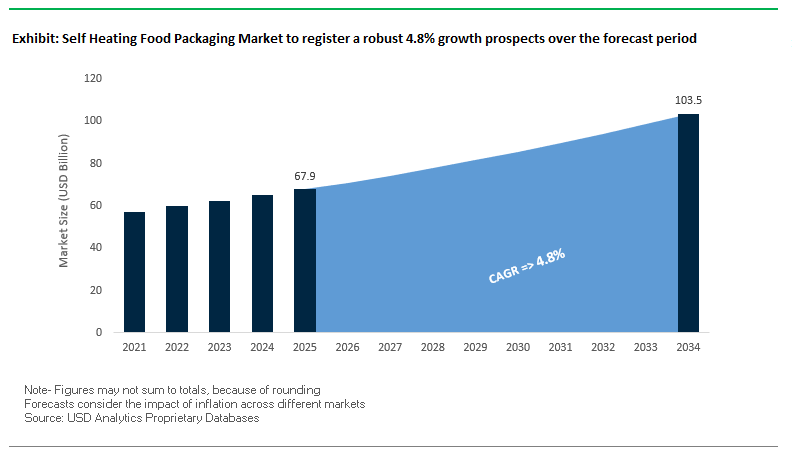
The global self-heating food packaging market is projected to grow from $67.9 billion in 2025 to $103.5 billion by 2034, at a CAGR of 4.8%. This growth is fueled by the increasing consumer preference for convenient, ready-to-eat meals, alongside strategic adoption in military and emergency applications. The market encompasses self-heating cans, pouches, and bowls, leveraging exothermic reactions to heat food and beverages without external sources.
Key Insights for Industry Professionals:
On-the-Go Meal Dominance: High demand for portable beverages and soups reflects changing consumer lifestyles, especially among urban professionals and travelers.
Military and Emergency Sector Influence: The U.S. military has purchased nearly 2 billion Flameless Ration Heaters (FRHs), showcasing critical applications in remote and combat zones.
Rising Popularity of Pouches: Lightweight, space-efficient pouches are gaining traction for emergency kits and outdoor activities.
Core Technology – Exothermic Reaction: Common reactions, such as quicklime with water, heat products to 40°C in 3 minutes, ensuring reliable and rapid heating.
Consumer Convenience Meets Safety: Packaging innovations prioritize safe, instant heating while maintaining food-grade compliance and portability.
This market is positioned at the intersection of convenience, portability, and safety, making it an essential segment for food, beverage, and packaging innovators.
Market Analysis: Strategic Acquisitions and Sustainable Innovations Are Reshaping the Self-Heating Packaging Landscape
The self-heating food packaging market has witnessed notable consolidation and innovation, reflecting a focus on enhancing product functionality, expanding global reach, and promoting sustainability. In August 2025, Constantia Flexibles completed its acquisition of Aluflexpack, strengthening its position in high-value segments benefiting from self-heating solutions. Similarly, July 2025 saw Amcor acquire Berry Global, creating a diversified packaging leader with capabilities in both flexible and rigid packaging.
Sustainability-focused innovations are driving growth alongside functional advancements. In June 2025, Mondi launched a sustainable sachet solution for the pet food industry, demonstrating its ability to integrate eco-friendly paper-based packaging without compromising functionality. Production capacity expansions continue to play a key role: in April 2025, Maanshan Hengxi invested in a new 20,000 sqm facility to meet growing demand, while Sonoco divested its Thermoformed and Flexibles Packaging business to TOPPAN Holdings for US$1.8 billion to streamline its focus on core operations.
Recent collaborations highlight technological integration and tailored solutions. January 2025, Vessl Inc. entered a development agreement with Tempra Technology Inc., allowing patented Vessl Technology to be adapted for self-heating applications, reflecting a growing trend of customized thermal solutions for beverages and meals. Additionally, Smurfit Kappa’s March 2025 launch of paper-based e-commerce packaging in Europe underscores the market’s emphasis on lightweight, protective, and easily assembled packaging solutions.
Self-Heating Food Packaging Market: Innovation Pathways Shaping Military and Commercial Demand
Strategic Adoption in Military and Emergency Response Rations
The self-heating food packaging market continues to be anchored by its deep integration into military rations and emergency response systems, where reliability and independence from infrastructure are critical. The U.S. Defense Logistics Agency (DLA) has consistently procured flameless ration heaters (FRH) as part of the Meal, Ready-to-Eat (MRE) program. A notable example is the August 7, 2025, $6.2 million contract awarded to Luxfer Magtech, Inc., underscoring the scale and consistency of defense-driven demand. These FRHs, which typically rely on magnesium-iron alloy and water reactions, are designed to heat rations to 140°F within 10–12 minutes, providing soldiers and emergency responders with safe, hot meals without the need for open flame or cooking appliances. This operational flexibility has made self-heating packaging indispensable in field deployments, disaster zones, and humanitarian missions. Defense agencies around the world remain the most stable customers, providing a baseline market demand that sustains R&D and production capabilities.
Scrutiny of Chemical Heating Components and Waste Streams
Despite proven effectiveness, the reliance on magnesium-based exothermic reactions has drawn scrutiny from regulators and sustainability advocates. While the byproduct, magnesium hydroxide is not classified as hazardous waste, concerns remain about the environmental footprint and flammable hydrogen gas emissions during the reaction. This scrutiny has accelerated research into safer and more eco-friendly heating mechanisms. Academic work, including a 2007 patent exploring calcium oxide and zeolite reactions, highlights early-stage alternatives that promise controlled heating with reduced safety risks. Today, material scientists are revisiting such approaches with modern technologies to design benign, low-emission heating elements that address disposal challenges without compromising performance. As sustainability becomes a stronger purchasing criterion in both consumer and defense markets, the push for cleaner chemistries will become a pivotal force shaping the sector’s long-term growth.
Development of Organic and Compostable Exothermic Reactions
A major opportunity lies in shifting from inorganic, metal-based reactions to organic and compostable self-heating systems. Research into bio-based compounds as heat sources has shown promising results, suggesting that a fully compostable heating element could soon reach commercialization. Such systems would allow the entire packaging—including the heating element—to be disposed of in a home compost bin, eliminating one of the biggest consumer objections around waste generation. This innovation directly appeals to eco-conscious outdoor enthusiasts, premium camping brands, and sustainability-driven consumer markets. Moreover, the ability to create heating mechanisms from upcycled waste materials or natural minerals could establish a closed-loop value chain, where packaging not only provides convenience but also minimizes post-use environmental impact. For companies operating in premium outdoor food, travel-ready meals, and sustainable packaging, this represents a high-margin growth avenue that goes well beyond traditional military applications.
Integration with E-Commerce and Direct-to-Consumer Meal Delivery
The rise of direct-to-consumer (DTC) meal services and e-commerce-driven food delivery is opening a significant new frontier for self-heating food packaging. Consumers increasingly seek ultimate convenience—hot meals anywhere, anytime—without reliance on microwaves or stoves. A September 2025 industry article on on-the-go food solutions highlights how brands are exploring self-heating meal kits and travel-ready solutions tailored for students, commuters, and outdoor consumers. Technological advancements are also pushing the category into smart packaging. A November 2024 announcement detailed the development of a solar-rechargeable heat battery with smartphone activation, demonstrating how self-heating systems are evolving into connected, tech-driven solutions. These innovations combine the ease of autonomous heating with data-enabled features, offering brands a way to differentiate in the competitive meal delivery space. With the convergence of on-demand food culture, outdoor lifestyle trends, and IoT integration, self-heating packaging is poised to transition from a military staple into a mainstream consumer convenience product.
Competitive Landscape: Top Players Are Leveraging Technology and Sustainability to Drive the Self-Heating Food Packaging Market
The global self-heating food packaging market is shaped by a select group of innovators who combine advanced thermal technology, material science, and scalable manufacturing to meet growing consumer and military demand.
Tempra Technology Inc.: Delivering Safe, Instant Thermal Solutions for Diverse Packaging Formats
Tempra Technology specializes in portable self-heating and self-chilling solutions for beverages and meals. In January 2025, it partnered with Vessl Inc. to enhance the efficiency and economics of self-heating packaging. Its technology is safe, instant, and compatible with cans, bowls, and pouches, offering a seamless solution for food and beverage manufacturers seeking portable thermal options.
HeatGenie, LLC: Revolutionizing Single-Use Beverages with Patented Self-Heating Technology
HeatGenie offers a patented solid-state self-heating solution for ready-to-drink beverages. The user-friendly system activates with a button press, heating contents in under two minutes. The company emphasizes food-safe, recyclable materials and safety-first design, while actively seeking partnerships with beverage brands to commercialize innovative thermal packaging solutions.
Luxfer Magtech powers the HeaterMeals brand, supplying nearly 2 billion Flameless Ration Heaters to the U.S. military. The company has global agreements across Canada, Europe, Israel, South & Central America, Australia, and Japan, showcasing the reliability and high-performance standards of its self-heating technology for military, emergency, and consumer markets.
The 42 Degrees Company: Offering Premium Self-Heating Beverage Experiences in Europe
The 42 Degrees Company focuses on self-heating coffee and beverage cans that reach 42°C (107.6°F) rapidly, providing a premium, convenient experience. Its products target outdoor enthusiasts and travelers, with strategic efforts to expand in Europe and North America through partnerships and product innovation.
HotCan, Ltd.: Enhancing Convenience and Safety for On-the-Go Self-Heating Meals
HotCan produces self-heating cans for beverages and food that require no external heating source. Its innovative designs focus on efficient, even heating via exothermic reactions, catering to outdoor, emergency, and everyday convenience applications. The company aims to expand its product range and distribution to reach a broader consumer base while maintaining safety and portability.
Cans Hold the Largest Market Share by Packaging Type in Self-Heating Food Packaging
Cans maintain a 40% share of the self-heating food packaging market, underscoring their dominance as the most reliable and structurally sound format. Their robust construction is vital for containing exothermic heating reactions safely while withstanding rough handling during military deployment, outdoor expeditions, or emergency relief logistics. Beyond durability, cans offer unmatched heat conductivity and long shelf life, making them the trusted solution for ready-to-eat meals in extreme conditions. While lighter alternatives like pouches and bowls are gaining ground in recreational markets, cans remain the backbone of large-scale deployment scenarios where safety, performance, and supply chain reliability outweigh packaging weight considerations.
Military & Defense Dominate Market Share by End-Use in Self-Heating Food Packaging
The military and defense sector accounts for 45% of demand, establishing itself as the core application for self-heating food packaging. Militaries worldwide rely on these solutions for MREs (Meals Ready-to-Eat), where the ability to deliver a hot, nutritious meal without external fuel or electricity is mission-critical. The segment drives innovation in heating element chemistry, packaging durability, and extended shelf life to meet extreme field conditions. While outdoor recreation and emergency relief represent strong growth segments, military procurement remains the volume and value anchor of the industry, with contracts often dictating design specifications and scale of production.
United States: Military Rations and Consumer Innovation Driving Market Expansion
The United States self-heating food packaging market is strongly influenced by demand from the defense and convenience food sectors. Military rations such as HeaterMeals utilize advanced heating chemistries to provide hot meals in remote conditions without the need for external heat sources, ensuring a steady demand base. The U.S. Environmental Protection Agency (EPA) supports innovations in self-heating packaging as part of its broader food waste reduction initiatives, highlighting the role of these solutions in extending shelf life and reducing spoilage.
The market is seeing a surge of R&D in heating mechanisms, with startups shifting toward controlled and safer chemistries such as calcium oxide micro-capsules, designed to provide a stable, consumer-safe heating experience. Pioneers like Tempra Technology continue to patent self-heating and self-chilling formats, while Ontech Operations’ self-heating beverage cans, including Wolfgang Puck gourmet lattes, showcase the transition of these solutions into mainstream retail. Overall, the U.S. is positioning itself as a hub for technology-driven packaging innovation with strong applications across military, retail, and ready-to-drink categories.
China: E-Commerce and “Lazy Economy” Fueling Self-Heating Instant Food Packaging
The China self-heating food packaging market is experiencing exponential growth, largely due to the popularity of self-heating hotpot and noodle kits from brands such as HaidiLao and Zihaiguo. These innovations have transformed the instant food sector, allowing restaurant-quality dishes to be packaged for home consumption and e-commerce distribution. The trend is amplified by China’s “Lazy Economy”, where consumers are increasingly prioritizing time-saving, convenience-oriented products and are willing to pay a premium for advanced packaging technologies.
Policy measures are reinforcing this growth trajectory. Under the 14th Five-Year Plan, the Chinese government is promoting eco-friendly and reusable packaging solutions, leading companies to invest in sustainable heating materials and recyclable container designs. With the rapid expansion of online retail and delivery platforms, self-heating packaging has become a strategic enabler for growth in the instant food category, particularly for young, urban consumers.
European Union: PPWR and Sustainable Materials Reshaping Self-Heating Formats
The European Union self-heating food packaging market is undergoing transformation under the Packaging and Packaging Waste Regulation (PPWR), effective February 2025, which sets strict reuse and recycled content requirements. For self-heating containers, this is pushing companies to adopt recyclable mono-material structures while ensuring safety in food-contact applications. In parallel, the Ecodesign for Sustainable Products Regulation (ESPR), effective mid-2024, introduces Digital Product Passports (DPPs), requiring companies to disclose material composition, recyclability, and compliance information.
With the upcoming PFAS ban in food-contact packaging by August 2026, manufacturers are innovating in non-toxic barrier technologies that can withstand the high temperatures generated in self-heating applications. Companies such as ScaldoPack are investing in advanced pouch spouting, filling, and capping systems to make production scalable, while in the UK, Heat Food & Drink has launched self-heating beverage cans for hot coffee and tea. This demonstrates a regional trend toward premiumization, regulatory compliance, and sustainability in packaging formats.
India: Defense and Ready-to-Eat Demand Boosting Self-Heating Packaging Growth
The India self-heating food packaging market is being driven by both regulatory reforms and growing consumer demand. The Plastic Waste Management (Amendment) Rules, 2024, which came into effect in April 2025, emphasize Extended Producer Responsibility (EPR), ensuring that packaging producers remain accountable for recycling and end-of-life management. This is particularly important for emerging self-heating solutions, where recyclability and disposal are key concerns.
Consumer demand for ready-to-eat and on-the-go meals is surging due to urbanization and lifestyle changes, while the Indian military and defense sectors remain consistent users of self-heating ration technologies. The Food Safety and Standards Authority of India (FSSAI) is also strengthening regulations for food-grade packaging materials, ensuring compliance with migration and safety testing. Together, these factors create a strong foundation for the expansion of innovative and regulatory-compliant self-heating packaging solutions in India.
Japan: Paper-Based Alternatives and Circular Economy Targets in Focus
The Japan self-heating food packaging market is being shaped by the government’s Plastic Resource Circulation Strategy, which requires all plastic packaging to be reusable or recyclable by 2025. Alongside, the Plastic Resource Circulation Promotion Law (2025) mandates redesign and reduction of 12 single-use plastics, incentivizing companies to explore sustainable materials for specialized packaging formats like self-heating containers.
Japanese packaging innovation is also venturing into paper-based materials with functional barriers. For example, Nippon Paper Industries’ SHIELDPLUS, a barrier-coated paper impermeable to oxygen and odors, offers a potential sustainable substrate for future self-heating applications. These innovations reflect Japan’s dual focus on circular economy goals and premium consumer packaging, ensuring that even high-tech formats like self-heating packaging align with national sustainability policies.
Brazil: Reverse Logistics and Waste Bans Shaping Market Dynamics
The Brazil self-heating food packaging market is regulated by the National Solid Waste Policy (PNRS), which emphasizes reuse, recycling, and sustainable disposal practices. A key turning point came with the enactment of Law No. 15,088 in January 2025, banning the import of solid waste, including plastics, to encourage domestic recycling and waste management.
While self-heating packaging adoption is still at a nascent stage, Brazil is witnessing increasing integration of plastic trays and flexible films with Modified Atmosphere Packaging (MAP) and vacuum technology, extending the shelf life of food and beverages. This infrastructure is expected to support the gradual adoption of self-heating solutions as the government promotes reverse logistics systems, making producers responsible for end-of-life recovery and recycling.
Self-Heating Food Packaging Market Report Scope
Self Heating Food Packaging Market
Parameter
Details
Market Size (2025)
$67.9 Billion
Market Size (2034)
$103.5 Billion
Market Growth Rate
4.8%
Segments
By Packaging Type (Cans, Pouches, Bottles, Containers, Bowls), By Application (Food, Beverage), By End-Use Industry (Military & Defense, Outdoor & Recreational, Food Service, Household & Consumer, Emergency Relief)
Study Period
2019- 2024 and 2025-2034
Units
Revenue (USD)
Qualitative Analysis
Porter’s Five Forces, SWOT Profile, Market Share, Scenario Forecasts, Market Ecosystem, Company Ranking, Market Dynamics, Industry Benchmarking
Companies
Tempra Technology, Luxfer Magtech Inc., HeatGen LLC, The 42 Degrees Company, Ontech Operations Inc., Heat Food & Drink Ltd, Scaldopack, Com-Pac International Inc., Crown Holdings Inc., LMK Thermosafe Ltd, Maanshan Hengxi Self-Heating Technology Development Co., Ltd., Hunan Jinhao New Material Technology Co., Ltd., Zhaoshangjia, QuicklimeX Technologies, Exothermix LLC
Countries
US, Canada, Mexico, Germany, France, Spain, Italy, UK, Russia, China, India, Japan, South Korea, Australia, South East Asia, Brazil, Argentina, Middle East, Africa
Self Heating Food Packaging Market Segmentation
By Packaging Type
Cans
Pouches
Bottles
Containers
Bowls
By Application
Food
Beverage
By End-Use Industry
Military & Defense
Outdoor & Recreational
Food Service
Household & Consumer
Emergency Relief
Countries Analyzed
North America (US, Canada, Mexico)
Europe (Germany, UK, France, Spain, Italy, Russia, Rest of Europe)
Asia Pacific (China, India, Japan, South Korea, Australia, South East Asia, Rest of Asia)
South America (Brazil, Argentina, Rest of South America)
Middle East and Africa (Saudi Arabia, UAE, Rest of Middle East, South Africa, Egypt, Rest of Africa)
Top Companies in Self Heating Food Packaging Market
Tempra Technology
Luxfer Magtech Inc.
HeatGen LLC
The 42 Degrees Company
Ontech Operations Inc.
Heat Food & Drink Ltd
Scaldopack
Com-Pac International Inc.
Crown Holdings Inc.
LMK Thermosafe Ltd
Maanshan Hengxi Self-Heating Technology Development Co., Ltd.
Hunan Jinhao New Material Technology Co., Ltd.
Zhaoshangjia
QuicklimeX Technologies
Exothermix LLC
* List Not Exhaustive
Methodology
USDAnalytics employs a robust and multi-dimensional research methodology to provide precise insights into the global self-heating food packaging market. Our approach integrates secondary research, including regulatory filings, sustainability reports, corporate press releases, industry publications, and patent databases, with primary research consisting of interviews with packaging engineers, military procurement specialists, food and beverage manufacturers, and material scientists. Market sizing and forecasts consider segmentation by packaging type (cans, pouches, bottles, containers, bowls), application (food, beverage), and end-use industry (military & defense, outdoor & recreational, food service, household & consumer, emergency relief), while accounting for regional dynamics in the U.S., EU, China, Japan, India, and Brazil. USDAnalytics evaluates key trends such as exothermic and compostable heating mechanisms, smart packaging integration, sustainability-driven materials, regulatory compliance with PPWR, EPR laws, and circular economy initiatives. Competitive analysis examines strategic acquisitions, capacity expansions, and technology partnerships by leading players like Tempra Technology, Luxfer Magtech, HeatGen LLC, and 42 Degrees Company, providing industry professionals with actionable intelligence on growth drivers, operational efficiency, and technological innovation shaping this rapidly evolving market.
Deliverables:
Comprehensive Market Research Report (PDF and Excel) with detailed tables, charts, and interactive visualizations.
Country-Specific Forecasts & Analysis.
Segment-Wise Revenue Forecasts (2025–2034).
Competitive Analysis, Benchmarking, and SWOT Profiles.
Recent Developments & Innovation Tracker.
Executive Summary & Analyst Commentary.
Post-Purchase Analyst Support for Client-Specific Questions and Custom Data Requirements.
Table of Contents: Self-Heating Food Packaging Market
1. Executive Summary
1.1. Market Highlights
1.2. Key Findings
1.3. Global Market Snapshot
2. Self-Heating Food Packaging Market Landscape & Outlook (2025–2034)
2.1. Introduction to Self-Heating Food Packaging Market
2.2. Market Valuation and Growth Projections (2025–2034)
2.3. Demand Dynamics: Convenience, Portability, and Safety
2.4. Role of Military and Emergency Applications in Market Expansion
2.5. Key Material and Chemical Advancements in Heating Mechanisms
2.6. Regulatory Environment and Compliance Challenges
2.7. Sustainability Trends and Circular Economy Integration
3. Innovations Reshaping the Self-Heating Food Packaging Market
3.1. Trend: Strategic Adoption in Military and Emergency Response Rations
3.2. Trend: Scrutiny of Chemical Heating Components and Waste Streams
3.3. Opportunity: Development of Organic and Compostable Exothermic Reactions
3.4. Opportunity: Integration with E-Commerce and Direct-to-Consumer Meal Delivery
4. Competitive Landscape and Strategic Initiatives
4.1. Mergers, Acquisitions and Strategic Alliances (Amcor–Berry Global, Constantia–Aluflexpack)
4.2. R&D and Material Innovation (Sustainable Sachets, Low-Emission Heating Systems)
4.3. Sustainability and Circular Economy Strategies
4.4. Market Expansion and Regional Focus (Europe, Asia-Pacific, North America)
5. Market Share and Segmentation Insights: Self-Heating Food Packaging Market
5.1. By Packaging Type
5.1.1. Cans
5.1.2. Pouches
5.1.3. Bottles
5.1.4. Containers
5.1.5. Bowls
5.2. By Application
5.2.1. Food
5.2.2. Beverage
5.3. By End-Use Industry
5.3.1. Military & Defense
5.3.2. Outdoor & Recreational
5.3.3. Food Service
5.3.4. Household & Consumer
5.3.5. Emergency Relief
6. Country Analysis and Outlook of Self-Heating Food Packaging Market
6.1. United States
6.2. Canada
6.3. Mexico
6.4. Germany
6.5. France
6.6. Spain
6.7. Italy
6.8. United Kingdom
6.9. Russia
6.10. China
6.11. India
6.12. Japan
6.13. South Korea
6.14. Australia
6.15. South East Asia
6.16. Brazil
6.17. Argentina
6.18. Middle East
6.19. Africa
7. Self-Heating Food Packaging Market Size Outlook by Region (2025–2034)
7.1. North America Self-Heating Food Packaging Market Size Outlook to 2034
7.1.1. By Packaging Type
7.1.2. By Application
7.1.3. By End-Use Industry
7.2. Europe Self-Heating Food Packaging Market Size Outlook to 2034
7.2.1. By Packaging Type
7.2.2. By Application
7.2.3. By End-Use Industry
7.3. Asia Pacific Self-Heating Food Packaging Market Size Outlook to 2034
7.3.1. By Packaging Type
7.3.2. By Application
7.3.3. By End-Use Industry
7.4. South America Self-Heating Food Packaging Market Size Outlook to 2034
7.4.1. By Packaging Type
7.4.2. By Application
7.4.3. By End-Use Industry
7.5. Middle East and Africa Self-Heating Food Packaging Market Size Outlook to 2034
7.5.1. By Packaging Type
7.5.2. By Application
7.5.3. By End-Use Industry
8. Company Profiles: Leading Players in the Self-Heating Food Packaging Market
8.1. Tempra Technology Inc.
8.2. Luxfer Magtech Inc.
8.3. HeatGen LLC
8.4. The 42 Degrees Company
8.5. Ontech Operations Inc.
8.6. Heat Food & Drink Ltd
8.7. ScaldoPack
8.8. Com-Pac International Inc.
8.9. Crown Holdings Inc.
8.10. LMK Thermosafe Ltd
8.11. Maanshan Hengxi Self-Heating Technology Development Co., Ltd.
8.12. Hunan Jinhao New Material Technology Co., Ltd.
8.13. Zhaoshangjia
8.14. QuicklimeX Technologies
8.15. Exothermix LLC
9. Methodology
9.1. Research Scope
9.2. Market Research Approach
9.3. Market Sizing and Forecasting Model
9.4. Research Coverage
9.5. Data Horizon
9.6. Deliverables
10. Appendix
10.1. Acronyms and Abbreviations
10.2. List of Tables
10.3. List of Figures
Self Heating Food Packaging Market Segmentation
By Packaging Type
Cans
Pouches
Bottles
Containers
Bowls
By Application
Food
Beverage
By End-Use Industry
Military & Defense
Outdoor & Recreational
Food Service
Household & Consumer
Emergency Relief
Countries Analyzed
North America (US, Canada, Mexico)
Europe (Germany, UK, France, Spain, Italy, Russia, Rest of Europe)
Asia Pacific (China, India, Japan, South Korea, Australia, South East Asia, Rest of Asia)
South America (Brazil, Argentina, Rest of South America)
Middle East and Africa (Saudi Arabia, UAE, Rest of Middle East, South Africa, Egypt, Rest of Africa)
The global market is expected to grow from USD 67.9 billion in 2025 to USD 103.5 billion by 2034, at a CAGR of 4.8%. Growth is driven by increasing demand for on-the-go meals, military ration adoption, emergency preparedness, and innovations in safe, sustainable heating technologies.
Cans hold the largest share at 40%, valued for structural integrity, safety during exothermic reactions, and long shelf life. Pouches, bowls, and containers are growing in recreational and e-commerce applications due to their lightweight and convenient design.
Eco-friendly initiatives, including organic and compostable heating elements, recyclable pouches, and mono-material structures, are increasingly adopted. Regulatory frameworks in the EU, Japan, India, and Brazil encourage reduced plastic usage, supporting circular economy principles without compromising safety or performance.
Innovations include magnesium- and calcium-based exothermic reactions, bio-based heating elements, solar-rechargeable heat batteries, and smart packaging integration with IoT connectivity. Digital and modular designs enable hyper-convenience, precision heating, and compatibility with meal kits and beverages.
Key players include Tempra Technology, Luxfer Magtech, HeatGen LLC, The 42 Degrees Company, Ontech Operations, and Scaldopack. These companies focus on advanced thermal technology, regulatory compliance, sustainable materials, and scalable production solutions for military, emergency, and consumer applications.