Sustainable ESD Packaging Market Size, Overview, and Growth Outlook (2025–2034)
Sustainable ESD Packaging Market Set to Reach $3.8 Billion by 2034 as Electronics Industries Push for Circular Economy Solutions
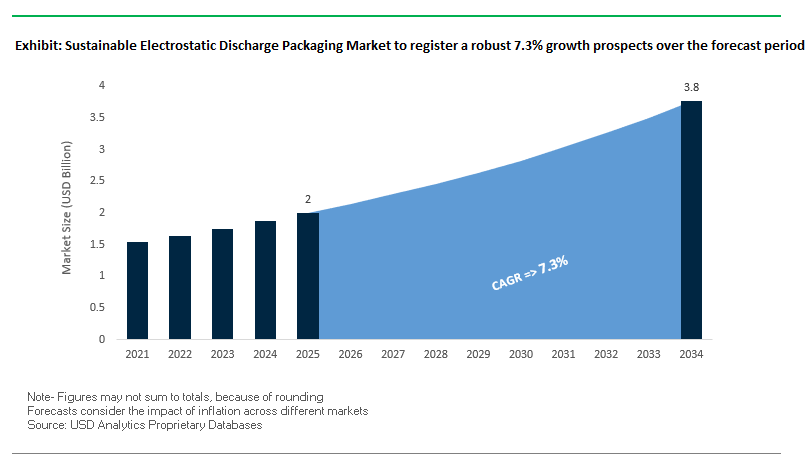
The global sustainable electrostatic discharge (ESD) packaging market is projected to grow from $2 billion in 2025 to $3.8 billion by 2034, reflecting a CAGR of 7.3%. This growth is driven by increasing demand from the electronics, automotive, and healthcare sectors for eco-friendly, recyclable, and reusable packaging solutions that protect sensitive components from static electricity while meeting environmental regulations. Companies are adopting innovative materials and smart packaging technologies to align with sustainability mandates and enhance supply chain efficiency.
Key Insights for Industry Professionals:
Government regulations and corporate sustainability mandates are accelerating adoption of green ESD packaging materials.
Bio-based polymers, conductive paperboard, and recycled foams are emerging as effective alternatives to petroleum-based plastics.
Closed-loop and reusable packaging systems are replacing single-use materials, reducing waste and costs.
Integration of RFID and IoT sensors enables real-time monitoring and enhanced traceability for high-value electronics.
Industry focus on circular economy and sustainable material innovation is becoming a competitive differentiator.
Sustainable ESD packaging solutions are now critical enablers for companies seeking to protect sensitive electronics while achieving environmental compliance and operational efficiency.
Market Analysis: Recent Innovations Highlight the Shift Towards Reusable, Smart, and Bio-Based ESD Packaging
The sustainable ESD packaging industry is witnessing rapid innovation with a strong focus on reusable materials, bio-based polymers, and integrated monitoring technologies. In April 2025, Good Natured Products, Inc. introduced advanced ESD protection for technology and pharmaceutical packaging with surface resistivity ranging from 10⁷ to 10¹⁰ ohms per square, highlighting enhanced performance combined with sustainability. LINDAL Group, also in April 2025, launched the FlipStraw dual spray actuator, improving functionality and minimizing waste, demonstrating cross-industry learning from aerosol and technical packaging sectors.
Corporate investments reflect the push for circular economy models. In February 2025, Ball Corporation invested in Meadow, a startup focusing on aluminum refills, signaling commitment to reusable and sustainable solutions. Earlier, in August 2024, Cortec Corporation launched EcoSonic ESD Paper, a recyclable alternative to plastic ESD bags, meeting ANSI/ESD and MIL-STD standards. Weber Verpackungen introduced the world’s first ESD paper bag in the same month, offering effective electrostatic protection for sensitive electronics with minimal environmental impact.
Sustainable ESD packaging adoption is further bolstered by manufacturing expansion and material research. Nefab Group opened a facility in Chihuahua, Mexico (June 2024) to meet growing demand for industrial ESD solutions, while studies in May 2024 demonstrated that incorporating 25% sugarcane bagasse fiber into biodegradable films improves tensile strength, elongation, and water vapor resistance. Strategic acquisitions, like Conductive Containers’ acquisition of Crestline Plastics in November 2023, enhance market capabilities and broaden sustainable ESD offerings.
Trends and Opportunities Driving the Sustainable Electrostatic Discharge (ESD) Packaging Market
Development of Carbon-Free, Intrinsically Dissipative Polymers
The market is moving beyond traditional carbon-black-based plastics, which can shed particles and contaminate delicate electronics. Instead, the industry is investing in inherently dissipative plastics (IDPs) made from advanced polymers like PETG and ACR that provide permanent, humidity-independent ESD protection. Unlike conventional carbon-loaded solutions, IDPs deliver clean static control without sloughing, chalking, or color limitations—critical advantages for sectors such as fiber optics, medical devices, and semiconductor packaging, where purity is paramount.
Research into all-polymeric compounds further enhances this shift. Studies published on ResearchGate highlight polymer systems that embed conductivity at the molecular level, allowing manufacturers to tailor resistivity levels without relying on additives that degrade over time. This next-generation approach provides permanent ESD safety and aligns with clean manufacturing standards such as ISO 14644 for cleanrooms. By eliminating particle contamination risks, these polymers reduce failure rates in sensitive electronic and medical applications, offering manufacturers a long-term cost and performance advantage in high-value industries.
Integration of PCR Content into ESD Formulations
The integration of post-consumer recycled (PCR) resins into ESD packaging formulations is a rising trend as companies respond to brand owner mandates and global sustainability regulations. Manufacturers such as Sinox Polymers now offer PCR-based ESD materials in HDPE and PP with tailored conductive additives, enabling applications like transport trays and blister packs while supporting closed-loop material systems.
However, this shift is not without challenges. Variability in PCR feedstocks—particularly in color, mechanical properties, and consistency—requires advanced testing and quality control. Studies note that uniform additive distribution and strict purity verification are essential to preserve anti-static performance and mechanical integrity. This is particularly relevant for packaging used in the semiconductor and automotive sectors, where reliability and ESD control cannot be compromised. The ability to integrate PCR while ensuring performance parity represents both a technical hurdle and a growth avenue, placing companies with strong R&D and testing protocols at the forefront of sustainable ESD packaging innovation.
Creation of Standardized Collection and Recycling Pathways
The specialized nature of ESD packaging means it often enters general waste streams, resulting in downcycling or landfilling of high-performance polymers. This presents a major opportunity to establish dedicated collection and recycling programs, designed specifically for ESD materials. Such systems could mirror existing take-back initiatives in electronics, enabling the recovery of engineered polymers with intrinsic dissipative properties.
Industry-wide collaboration and government policy will be critical to unlocking this pathway. For instance, the India Semiconductor Mission (ISM), backed by a $9.1 billion government investment, emphasizes sustainable domestic manufacturing of electronics and packaging. Embedding closed-loop recycling models at this stage ensures that high-value ESD packaging does not go to waste. By formalizing collection networks with semiconductor hubs, logistics providers, and waste management firms, manufacturers can secure secondary raw material streams, reduce reliance on virgin resources, and demonstrate compliance with global ESG standards.
Bio-Based and Compostable Solutions for Lower-Risk Applications
While high-value electronics require permanent ESD protection, less demanding applications open the door for bio-based and compostable alternatives. For example, BASF’s ecovio® bioplastic, a blend of PBAT and PLA, offers compostable performance for thermoformed trays and secondary packaging. These solutions reduce reliance on fossil-based plastics and align with customer goals for plastic-free logistics.
Academic research into thermoplastic starch (TPS) foams shows promise for creating biodegradable ESD-safe packaging for short-lifecycle and controlled-environment applications. Although humidity sensitivity remains a challenge, TPS-based foams meet mechanical strength and static protection requirements while offering a clean end-of-life profile. For logistics, wearables, and peripheral electronic devices with limited ESD exposure needs, bio-based packaging represents a cost-effective and environmentally responsible solution.
The ability to diversify between permanent, polymer-based solutions for high-value electronics and compostable packaging for low-risk use cases enables manufacturers to tap into both premium and mass-market segments, positioning them strongly in the evolving sustainable ESD packaging ecosystem.
Competitive Landscape: Leading Players Are Transforming ESD Packaging With Sustainable Materials, Smart Solutions, and Reusable Systems
The global sustainable ESD packaging market is driven by companies leveraging materials science, manufacturing expertise, and innovative design to deliver durable, eco-friendly solutions.
Desco Industries, Inc.: Pioneering Nanomaterial-Enhanced ESD Bags for Superior Protection
Desco Industries produces a broad range of ESD control products, including shielding and static-dissipative bags. The company has developed nanomaterial-based ESD bags, offering enhanced protection without increasing size or weight. Desco’s core strength is its vertically integrated model, materials expertise, and comprehensive ESD product range, while its strategic focus is on providing innovative, compliant solutions to accelerate customers’ product time-to-market.
Cortec Corporation: Driving Green ESD Packaging with EcoSonic Paper Solutions
Cortec Corporation specializes in corrosion protection and sustainable ESD products, including films, bags, and papers. In August 2024, the company launched EcoSonic ESD Paper, integrating static dissipation with corrosion protection. Cortec’s core strengths include material science expertise and vertical integration, with a strategic focus on sustainability and high-performance ESD protection across multiple industries.
Nefab Group: Expanding Global Footprint to Meet Growing Demand for Reusable and Sustainable ESD Packaging
Nefab Group provides industrial packaging and logistics solutions with a strong emphasis on sustainability. Its portfolio includes reusable ESD containers and customized trays. The opening of its Chihuahua, Mexico facility (June 2024) demonstrates responsiveness to demand growth. Nefab’s strategy focuses on “design for less” and recycled content solutions, supported by deep materials expertise and vertical integration.
Sealed Air Corporation: Integrating Circular Economy Principles Into High-Performance ESD Solutions
Sealed Air delivers static shielding bags, cushioning, and other ESD solutions. The company emphasizes recycle-ready and high-performance packaging, particularly for medical and electronics applications. Its core strengths are global manufacturing capabilities, material science expertise, and vertical integration, with a strategic focus on supporting the circular economy through R&D and innovative packaging technologies.
Conductive Containers, Inc.: Offering Durable, Reusable ESD Packaging to Reduce Waste Across Electronics Supply Chains
Conductive Containers specializes in reusable ESD totes, trays, and bins. The November 2023 acquisition of Crestline Plastics strengthened its market position in static control packaging. The company focuses on sustainable, high-quality, and compliant ESD solutions, with core strengths in materials expertise, vertical integration, and a comprehensive product portfolio supporting circular economy strategies.
Bags & Pouches Dominate Market Share by Product Type in Sustainable Electrostatic Discharge Packaging Industry
Bags and pouches, holding 40% of the sustainable electrostatic discharge (ESD) packaging market, lead as the most versatile and widely used format for safeguarding sensitive electronics during handling and transport. Their dominance is reinforced by their adaptability across semiconductors, printed circuit boards, and sub-assemblies, where static protection is mission-critical. The sustainability shift is reshaping this segment, with manufacturers investing in post-consumer recycled (PCR) content, mono-material designs for improved recyclability, and films that maintain conductivity without relying on metallized layers. Their relatively low cost, scalability, and ability to meet ESD standards while aligning with corporate ESG mandates position bags and pouches as the largest-volume solution in the market.
Semiconductors & Integrated Circuits Lead Market Share by Application in Sustainable Electrostatic Discharge Packaging Industry
Semiconductors and integrated circuits (ICs), with a 30% share, represent the most high-value application for sustainable ESD packaging, driven by the extreme vulnerability of advanced chips to static discharge. The enormous capital at risk in semiconductor fabs and distribution networks compels manufacturers to prioritize packaging that combines reliability, sterility, and recyclability. The push toward reusable trays and recyclable ESD-safe bags is most advanced here, as chipmakers face mounting ESG pressures and supply chain sustainability requirements. The sector’s sheer scale, combined with the sophistication of its protective needs, makes semiconductors the single most influential driver of innovation in sustainable ESD packaging.
United States: Innovation in Bio-Based and Reusable ESD Packaging Solutions
The United States sustainable ESD packaging market is being shaped by both regulatory pressure and technological innovation. The U.S. Environmental Protection Agency (EPA) has set a goal of achieving a 50% national recycling rate by 2030, encouraging electronics and packaging manufacturers to increase the use of recyclable and sustainable materials. The Association of Plastic Recyclers (APR) provides key guidance, leading to a shift toward mono-material constructions that improve end-of-life recovery for static-sensitive packaging.
A notable trend is the rise of reusable and returnable ESD trays and containers, especially within the electronics and semiconductor industries. These solutions help major manufacturers create closed-loop logistics chains, cutting costs while reducing waste. Companies are also innovating with bio-based materials, developing starch- and cellulose-derived ESD packaging, while academic institutions are contributing through research into biodegradable conductive foams. Funding from the U.S. Department of Defense and the National Science Foundation (NSF) supports R&D in wearable electronics and flexible devices, requiring advanced ESD protection. Alongside the e-commerce boom, which demands lightweight and protective packaging, these factors are driving the U.S. toward leadership in sustainable ESD packaging innovation.
European Union: Regulatory Frameworks Driving Circular ESD Packaging Systems
The European Union sustainable ESD packaging market is heavily influenced by strict regulations. The Packaging and Packaging Waste Regulation (PPWR), in force since February 2025, mandates minimum recycled content in all plastic packaging, including ESD formats, by 2030. Meanwhile, the Ecodesign for Sustainable Products Regulation (ESPR) emphasizes durability, reusability, and repairability, pushing companies toward refillable and reusable ESD systems that fit circular economy models.
Another major regulatory milestone is the introduction of the Digital Product Passport, which requires packaging to disclose details about its recyclability, material composition, and compliance. This improves traceability across supply chains and supports electronics manufacturers in demonstrating sustainability credentials. Companies are also investing in mono-material flexible ESD packaging that combines recyclability with effective anti-static protection. The EU’s comprehensive framework makes it one of the most advanced markets for sustainable ESD packaging compliance and innovation.
China: E-Commerce Growth and Government Support for Green ESD Packaging
The China sustainable ESD packaging market is being reshaped by government regulations and rising consumer expectations. Under the “14th Five-Year Plan”, new rules effective June 2025 mandate eco-friendly, reduced, and reusable packaging, especially within the fast-growing e-commerce and electronics sectors. These policies are critical since China’s electronics industry is one of the largest global users of ESD protection materials.
The government is also promoting remanufacturing industries with tax incentives for green technology adoption, while international bodies such as the Ellen MacArthur Foundation have urged China to strengthen recycling systems and create a high-quality recycled plastics market. At the same time, rising demand for high-end consumer electronics is driving adoption of advanced ESD packaging with superior barrier properties, anti-counterfeiting features, and security labeling. Together, these trends underline China’s role as both a major consumer and innovator in sustainable ESD packaging solutions.
India: EPR Regulations and Reverse Logistics Strengthening the Market
The India sustainable ESD packaging market is evolving under a regulation-driven model. The Plastic Waste Management (Amendment) Rules, 2024, effective April 2025, emphasize Extended Producer Responsibility (EPR), holding producers, importers, and brand owners accountable for the disposal and recycling of their ESD packaging. By July 2025, traceability through barcodes or QR codes becomes mandatory for all plastic packaging, improving transparency and accountability.
India’s growing e-commerce and retail boom is further accelerating demand for sustainable ESD packaging in electronics, consumer goods, and logistics. Government-backed reverse logistics initiatives require producers to manage the collection and recycling of post-consumer packaging, increasing investment in reusable and recyclable ESD systems. These combined pressures are pushing both domestic and multinational companies to prioritize eco-friendly and traceable ESD packaging solutions.
Japan: Circular Economy Laws and Transition to Compostable ESD Packaging
The Japan sustainable ESD packaging market is advancing under strong regulatory and industrial guidance. The Plastic Resource Circulation Strategy mandates that all plastic packaging be reusable or recyclable by 2025, pushing companies to replace conventional plastics with alternative and bio-based materials. Complementing this, the Plastic Resource Circulation Promotion Law (2025) mandates redesigns for 12 categories of single-use plastics, encouraging the shift to compostable and reusable ESD formats.
The Ministry of Health, Labor and Welfare (MHLW) further strengthens compliance with its positive list system for synthetic food containers and packaging, effective June 2025, ensuring only safe and certified materials are used. This framework directly impacts electronics and food-grade ESD packaging applications. Japan’s focus on circular economy practices and advanced material science places it at the forefront of next-generation sustainable ESD packaging innovation.
The Brazil sustainable ESD packaging market is advancing under the National Solid Waste Policy (PNRS), which emphasizes reuse, recycling, and waste reduction. A major milestone is Law No. 15,088, effective January 2025, which bans the import of plastic waste and rejects, ensuring greater reliance on domestically produced sustainable packaging materials.
Brazil is investing heavily in reverse logistics systems, holding producers responsible for the collection, recycling, and safe disposal of post-consumer packaging. This is particularly relevant for ESD packaging in electronics and industrial supply chains, where reusability and safety are critical. These initiatives, coupled with government-backed sustainability programs, are creating a strong foundation for the growth of recyclable and eco-friendly ESD packaging solutions in Brazil.
By Material (Plastics, Metals & Alloys, Paper & Paperboard, Conductive Foam, Composites), By Product Type (Bags & Pouches, Trays & Containers, Films & Sheets, Corrugated Boxes, Foams), By Additive Type (Carbon Black, Conductive Polymers, Metal Fillers, Anti-static Agents), By Application (Consumer Electronics, Automotive, Aerospace & Defense, Healthcare & Medical Devices, Industrial, Semiconductors & Integrated Circuits)
Study Period
2019- 2024 and 2025-2034
Units
Revenue (USD)
Qualitative Analysis
Porter’s Five Forces, SWOT Profile, Market Share, Scenario Forecasts, Market Ecosystem, Company Ranking, Market Dynamics, Industry Benchmarking
Companies
Smurfit Kappa Group, Desco Industries, Inc., Dow Inc., Pregis LLC, Teknis Limited, 3M Company, Henkel AG & Co. KGaA, Elcom (U.K.) Ltd., Nefab AB, Conductive Containers, Inc., Protektive Pak, GWP Group, Sealed Air Corporation, Botron Company Inc., Rogers Corporation
Countries
US, Canada, Mexico, Germany, France, Spain, Italy, UK, Russia, China, India, Japan, South Korea, Australia, South East Asia, Brazil, Argentina, Middle East, Africa
Europe (Germany, UK, France, Spain, Italy, Russia, Rest of Europe)
Asia Pacific (China, India, Japan, South Korea, Australia, South East Asia, Rest of Asia)
South America (Brazil, Argentina, Rest of South America)
Middle East and Africa (Saudi Arabia, UAE, Rest of Middle East, South Africa, Egypt, Rest of Africa)
Top Companies in Sustainable Electrostatic Discharge Packaging Market
Smurfit Kappa Group
Desco Industries, Inc.
Dow Inc.
Pregis LLC
Teknis Limited
3M Company
Henkel AG & Co. KGaA
Elcom (U.K.) Ltd.
Nefab AB
Conductive Containers, Inc.
Protektive Pak
GWP Group
Sealed Air Corporation
Botron Company Inc.
Rogers Corporation
* List Not Exhaustive
Methodology
USDAnalytics employs a comprehensive and integrated research methodology to deliver precise insights into the sustainable electrostatic discharge (ESD) packaging market. Our approach combines extensive primary research, including interviews with executives, R&D teams, and sustainability managers from leading companies such as Desco Industries, Cortec Corporation, and Nefab Group, with in-depth secondary research covering regulatory frameworks, corporate sustainability reports, patent databases, and technical publications. Market sizing, forecast, and CAGR calculations from 2025 to 2034 are derived through a bottom-up approach that triangulates production data, sales volumes, adoption rates of bio-based polymers, PCR materials, and reusable ESD solutions across key regions including the U.S., EU, China, India, Japan, and Brazil. USDAnalytics incorporates both qualitative and quantitative analysis to assess technological innovations, integration of carbon-free intrinsically dissipative polymers, and deployment of smart monitoring solutions like RFID-enabled packaging. Segmentation analyses by material, product type, additive type, and application are cross-verified with historical trends and market developments, ensuring actionable insights for industry professionals. This methodology ensures stakeholders gain a holistic, accurate, and forward-looking understanding of sustainable ESD packaging dynamics, opportunities, and challenges.
Deliverables:
Comprehensive Market Research Report (PDF and Excel) with detailed tables, charts, and interactive visualizations.
Country-Specific Forecasts & Analysis.
Segment-Wise Revenue Forecasts (2025–2034).
Competitive Analysis, Benchmarking, and SWOT Profiles.
Recent Developments & Innovation Tracker.
Executive Summary & Analyst Commentary.
Post-Purchase Analyst Support for Client-Specific Questions and Custom Data Requirements.
Table of Contents: Sustainable Electrostatic Discharge (ESD) Packaging Market
1. Executive Summary
1.1. Market Highlights
1.2. Key Findings
1.3. Global Market Snapshot
2. Sustainable ESD Packaging Market Landscape & Outlook (2025–2034)
2.1. Introduction to Sustainable ESD Packaging Market
2.2. Market Valuation and Growth Projections (2025–2034)
2.3. Drivers and Restraints Shaping Market Growth
2.4. Regulatory Frameworks Influencing Market Dynamics
2.5. Emerging Regional Opportunities
3. Innovations Reshaping the Sustainable ESD Packaging Market
3.1. Trend: Development of Carbon-Free, Intrinsically Dissipative Polymers
3.2. Trend: Integration of PCR Content into ESD Formulations
3.3. Opportunity: Creation of Standardized Collection and Recycling Pathways
3.4. Opportunity: Bio-Based and Compostable Solutions for Lower-Risk Applications
4. Competitive Landscape and Strategic Initiatives
4.1. Mergers, Acquisitions and Strategic Alliances
4.2. R&D and Material Innovation
4.3. Sustainability and Strategies
4.4. Market Expansion and Regional Focus
5. Market Share and Segmentation Insights: Sustainable ESD Packaging Market
5.1. By Material
5.1.1. Plastics
5.1.2. Metals & Alloys
5.1.3. Paper & Paperboard
5.1.4. Conductive Foam
5.1.5. Composites
5.2. By Product Type
5.2.1. Bags & Pouches
5.2.2. Trays & Containers
5.2.3. Films & Sheets
5.2.4. Corrugated Boxes
5.2.5. Foams
5.3. By Additive Type
5.3.1. Carbon Black
5.3.2. Conductive Polymers
5.3.3. Metal Fillers
5.3.4. Anti-static Agents
5.4. By Application
5.4.1. Consumer Electronics
5.4.2. Automotive
5.4.3. Aerospace & Defense
5.4.4. Healthcare & Medical Devices
5.4.5. Industrial
5.4.6. Semiconductors & Integrated Circuits
6. Country Analysis and Outlook of Sustainable ESD Packaging Market
6.1. United States
6.2. Canada
6.3. Mexico
6.4. Germany
6.5. France
6.6. Spain
6.7. Italy
6.8. UK
6.9. Russia
6.10. China
6.11. India
6.12. Japan
6.13. South Korea
6.14. Australia
6.15. South East Asia
6.16. Brazil
6.17. Argentina
6.18. Middle East
6.19. Africa
7. Sustainable ESD Packaging Market Size Outlook by Region (2025-2034)
7.1. North America Sustainable ESD Packaging Market Size Outlook to 2034
7.1.1. By Material
7.1.2. By Product Type
7.1.3. By Additive Type
7.1.4. By Application
7.2. Europe Sustainable ESD Packaging Market Size Outlook to 2034
7.2.1. By Material
7.2.2. By Product Type
7.2.3. By Additive Type
7.2.4. By Application
7.3. Asia Pacific Sustainable ESD Packaging Market Size Outlook to 2034
7.3.1. By Material
7.3.2. By Product Type
7.3.3. By Additive Type
7.3.4. By Application
7.4. South America Sustainable ESD Packaging Market Size Outlook to 2034
7.4.1. By Product
7.4.2. By Application
7.4.3. By Material
7.4.4. By Additive Type
7.5. Middle East and Africa Sustainable ESD Packaging Market Size Outlook to 2034
7.5.1. By Material
7.5.2. By Product Type
7.5.3. By Additive Type
7.5.4. By Application
8. Company Profiles: Leading Players in the Sustainable ESD Packaging Market
8.1. Smurfit Kappa Group
8.2. Desco Industries, Inc.
8.3. Dow Inc.
8.4. Pregis LLC
8.5. Teknis Limited
8.6. 3M Company
8.7. Henkel AG & Co. KGaA
8.8. Elcom (U.K.) Ltd.
8.9. Nefab AB
8.10. Conductive Containers, Inc.
8.11. Protektive Pak
8.12. GWP Group
8.13. Sealed Air Corporation
8.14. Botron Company Inc.
8.15. Rogers Corporation
9. Methodology
9.1. Research Scope
9.2. Market Research Approach
9.3. Market Sizing and Forecasting Model
9.4. Research Coverage
9.5. Data Horizon
9.6. Deliverables
10. Appendix
10.1. Acronyms and Abbreviations
10.2. List of Tables
10.3. List of Figures
The sustainable ESD packaging market is projected to grow from $2 billion in 2025 to $3.8 billion by 2034, achieving a CAGR of 7.3%. This growth is fueled by increasing demand for eco-friendly, recyclable, and reusable packaging solutions in electronics, healthcare, and automotive sectors.
Closed-loop and reusable ESD packaging solutions are reducing single-use waste, lowering operational costs, and enhancing supply chain sustainability. Industry initiatives and government-backed programs, such as the India Semiconductor Mission, promote collection, recycling, and circular economy adoption.
Bags and pouches lead, holding 40% of the market due to their versatility in protecting semiconductors, integrated circuits, and sensitive electronics. Trays, containers, films, and foams also play key roles, particularly in reusable and high-value applications where ESD protection and recyclability are critical.
Markets like the EU, U.S., China, Japan, India, and Brazil are guided by stringent policies on recycled content, circular economy, and extended producer responsibility (EPR). Regulations such as the EU PPWR, U.S. EPA recycling goals, and Japan’s Plastic Resource Circulation Strategy drive adoption of recyclable, reusable, and bio-based ESD packaging across electronics, industrial, and healthcare sectors.