Anti-Counterfeit Packaging Market Overview: Market Size, Growth, and Industry Insights
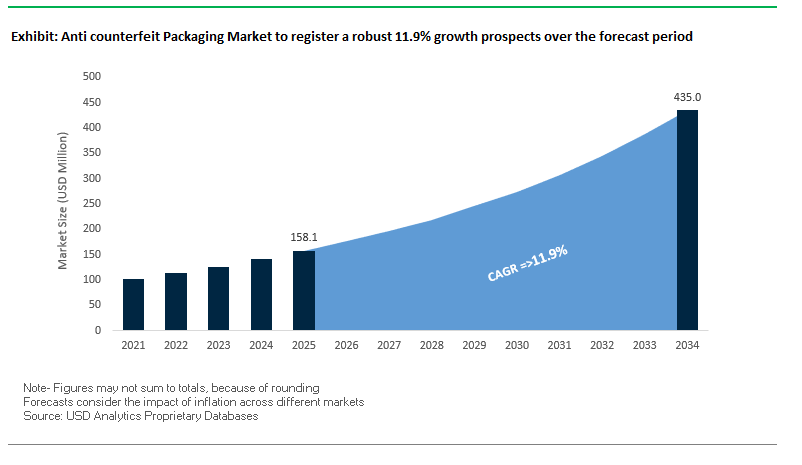
The Global Anti-Counterfeit Packaging Market is projected to reach $158.1 million in 2025 and expand to $434.9 million by 2034, advancing at an impressive CAGR of 11.9%. The demand for secure packaging solutions is accelerating as counterfeiting poses a significant challenge across industries, particularly pharmaceuticals, food, and consumer goods. According to the OECD, counterfeit and pirated goods were valued at over $460 billion in 2019, underlining the scale of the problem.
The pharmaceutical sector stands out as one of the most vulnerable, with counterfeit drugs threatening patient safety and regulatory compliance. To combat these risks, packaging is evolving beyond traditional overt (holograms, security labels) and covert (invisible inks, microtext) methods, moving toward digital authentication solutions such as QR codes, RFID tags, and NFC chips. These technologies enable real-time product verification, supply chain visibility, and consumer engagement.
Furthermore, governments worldwide are tightening regulations, mandating serialization, and implementing strict traceability requirements, creating a favorable policy environment for anti-counterfeit packaging. As industries increasingly prioritize consumer trust and regulatory adherence, the anti-counterfeit packaging industry is positioned for rapid adoption across diverse verticals.
Key Insights for Industry Professionals
Scale of Counterfeiting: Counterfeit goods exceed $460 billion in trade value, a persistent global issue.
Pharma Sector at Risk: Fake drugs highlight the urgency for robust anti-counterfeit packaging solutions.
Digital Authentication Growth: RFID, QR, and NFC technologies are reshaping brand protection strategies.
Government Policies as Drivers: Stronger regulations are accelerating the shift to secure packaging formats.
Market Analysis: Recent Industry Developments
The anti-counterfeit packaging industry is experiencing a wave of technological advancements and strategic alliances. In August 2025, Energous introduced its battery-free eSense tag, an IoT-driven authentication solution that enables wireless-powered package tracking and verification. In the same month, AlpVision revealed its solutions now protect more than 30 billion products annually, highlighting the scalability of digital authentication.
Pharmaceutical traceability remains a focal point. In July 2025, Antares Vision Group partnered with Sie Pharma to develop automated labeling systems for cylindrical pharma containers, strengthening serialization efforts. Meanwhile, global trade policies impacted packaging costs when the U.S. government doubled tariffs on imported aluminum and steel in July 2025, affecting inputs for holograms and security foils.
Strategic restructuring has also shaped the market. De La Rue sold its authentication division to Crane NXT, Co. in May 2025, enabling sharper focus on its core business, while SICPA partnered with UbiQD in April 2025 to pioneer quantum-dot-based inks for high-security labeling. Earlier, Authentix expanded in July 2024 through its acquisition of Nanotech Security Corp.’s authentication business, adding nano-optic and color-shifting technologies to its portfolio.
Pioneering Trends and Lucrative Opportunities Driving the Anti-Counterfeit Packaging Market
Strategic Integration of Digital Watermarks for Mass-Scale Item-Level Traceability
The anti-counterfeit packaging market is experiencing a paradigm shift with the adoption of digital watermark technologies, such as Digimarc and HolyGrail, which are imperceptible to the human eye yet scannable at high speeds. This innovation moves beyond traditional holograms and taggants, providing seamless security and enabling automated sorting of genuine products in recycling and fulfillment streams. Digimarc emphasizes that their digital watermark is ubiquitous and invisible, making it extremely difficult for counterfeiters to replicate. Moreover, initiatives like HolyGrail 2.0 demonstrate how digital watermarks facilitate high-purity sorting in material recovery facilities, allowing separation of food-grade and non-food-grade packaging and supporting a circular economy. Brands are also leveraging this technology to enhance consumer engagement, enabling product verification, origin tracking, and access to exclusive content via smartphone scanning, thus building trust while creating a direct, data-rich communication channel.
Mandated Serialization and Aggregation for Pharmaceutical Supply Chain Security
Government regulations are compelling the pharmaceutical industry to implement unit-level serialization (2D Data Matrix codes) and bundle/case-level aggregation as standard practice. The U.S. Drug Supply Chain Security Act (DSCSA) and the EU Falsified Medicines Directive (FMD) require unique identifiers on each unit of prescription drugs to enable electronic tracking from manufacturer to dispenser. Combining serialization with aggregation creates a tamper-proof timeline for products, allowing rapid identification and quarantine in case of counterfeit threats or recalls. Implementation demands significant investments in specialized hardware, vision inspection systems, data management software, and personnel training, representing a fundamental shift in supply chain operations. These measures not only ensure compliance but also bolster patient safety and brand integrity by preventing counterfeit circulation.
Development of Blockchain-Enabled Verification Platforms for Cross-Supply Chain Transparency
A key opportunity lies in developing interoperable blockchain platforms that enable all supply chain participants to verify product provenance and transaction history immutably. Blockchain provides an auditable, permanent, and shared ledger accessible to authorized stakeholders, reducing information silos and creating a trusted source of truth. The pharmaceutical industry is already piloting initiatives like MediLedger, involving major companies such as Pfizer, Genentech, and Amgen, to create decentralized verification networks. Scaling such platforms could revolutionize cross-supply chain transparency, enhance regulatory compliance, and provide consumers with verifiable product authenticity.
Adoption of Forensic and Molecular Taggants for High-Value, Brand-Protected Goods
Beyond digital codes, the market is exploring the integration of covert forensic taggants such as DNA-based markers, isotope ratios, and microtaggants into inks, substrates, and materials for ultra-high-value goods. These markers provide court-admissible evidence, with DNA-based taggants offering error frequencies of less than one in a trillion, ensuring unassailable authentication. Unlike visible holograms, these microscopic markers are invisible, embedded directly into products or packaging, making them exceptionally difficult to detect or replicate. Real-world applications include luxury goods, premium spirits, electronics, and aerospace components, where taggants verify provenance and prevent unauthorized use of counterfeit parts, reinforcing both brand protection and consumer safety.
Competitive Landscape: Leading Companies in Global Anti-Counterfeit Packaging
The anti-counterfeit packaging market is highly competitive, with players differentiating through advanced technologies, strategic acquisitions, and regulatory-focused solutions. Leaders are blending material sciences, digital platforms, and software analytics to provide multilayered protection against counterfeit goods.
SICPA Holding SA: Advancing Security with Quantum-Dot Inks
SICPA is a global leader in security inks and authentication solutions. In October 2024, it partnered with UbiQD to develop quantum-dot-based security inks, reinforcing its innovation edge. With its unlimitrust campus fostering trust-focused innovation, SICPA integrates material, digital, and data science expertise to deliver brand protection systems. Its core offerings blend security inks with digital traceability platforms, providing governments and brands with robust anti-counterfeit solutions.
Authentix, Inc.: Expanding with Nano-Optic Technologies
Authentix specializes in authentication services for governments and commercial brands. In July 2024, it acquired assets of Nanotech Security Corp., gaining access to advanced nano-optic and color-shifting technologies. Its strategic focus is on program management that ensures consumer trust and revenue protection, integrating real-time analytics into supply chains. Authentix’s strength lies in scalable, software-enabled security that seamlessly fits into client operations.
Avery Dennison Corporation: Driving RFID and Digital Identification
Avery Dennison is a global leader in labeling and security solutions. Its portfolio includes tamper-evident seals, holograms, and RFID/NFC-enabled labels that provide products with unique digital identities. By leveraging RFID and NFC technologies, Avery Dennison enhances brand protection, supply chain transparency, and consumer engagement. Its protective packaging range combines overt, covert, and forensic layers to deliver multi-level defense against counterfeiting.
3M Company: Enhancing Product Integrity with Security Labels and Tapes
3M offers diversified anti-counterfeit packaging solutions including security labels, tamper-evident tapes, and custom-printed adhesives. The company continues to innovate for industries such as electronics, food, and personal protective equipment. Its tamper-evident tapes reveal interference instantly, while custom-printed solutions add an additional layer of brand-specific security. With global reach and a reputation for innovation, 3M provides reliable, scalable anti-counterfeit technologies.
AlpVision SA: Scaling Invisible Digital Authentication
AlpVision leads in covert digital authentication with technologies like Cryptoglyph and Fingerprint, which create invisible digital signatures on packaging. These solutions can be verified instantly via smartphone applications, offering low-cost, high-security brand protection. In June 2025, AlpVision announced its technologies safeguard over 30 billion products annually, proving its global scale. Its expertise in digital signal processing makes it a frontrunner in invisible, easily integrated anti-counterfeit technologies.
Anti counterfeit Packaging Market Share Insights
Track-and-Trace Technologies Lead Market Share by Technology in Anti-Counterfeit Packaging
Track-and-trace solutions dominate with 60% of market share, driven by global regulatory mandates and the growing need for digital supply chain visibility. Serialization through QR codes, RFID, and barcoding not only prevents counterfeit infiltration but also enables downstream benefits such as recall efficiency, inventory optimization, and consumer engagement. This dominance is reinforced by its integration into pharmaceutical and healthcare supply chains, where compliance with DSCSA (US) and FMD (EU) is non-negotiable. Authentication technologies, representing the remaining share, play a complementary but critical role by providing physical or forensic verification. Features such as holograms, color-shift inks, and DNA tagging are vital for quick authenticity checks in industries where consumer trust and product integrity cannot be compromised. The interplay between digital traceability and physical authentication ensures a layered defense strategy against increasingly sophisticated counterfeiting practices.
Pharmaceuticals & Healthcare Continue to Drive Market Share by End-Use Industry in Anti-Counterfeit Packaging
Pharmaceuticals and healthcare remain the largest consumer of anti-counterfeit packaging, accounting for 45% of demand, propelled by strict global serialization requirements and the life-critical nature of medical products. This industry’s reliance on both track-and-trace and authentication technologies reflects the dual need for regulatory compliance and patient safety. Food and beverages represent the second major growth area, where brand protection for premium categories such as infant formula, spirits, and olive oil is paramount. Luxury goods leverage advanced packaging security to preserve exclusivity and combat profit erosion from counterfeits, while consumer electronics deploy anti-counterfeit features to ensure warranty validation and consumer safety. Cosmetics and personal care increasingly adopt these solutions to combat counterfeit products flooding e-commerce platforms, protecting both consumer health and brand trust. Automotive, though smaller in share, is strategically important, as counterfeit safety-critical components like airbags and ECUs pose direct risks to human life, making authentication technologies essential in this sector.
United States: FDA Regulations and Advanced Track-and-Trace Technologies Drive Anti-Counterfeit Packaging
The U.S. anti-counterfeit packaging market is significantly influenced by federal and state regulations, notably the FDA's Drug Supply Chain Security Act (DSCSA). This legislation mandates serialization and electronic traceability for prescription drugs, pushing pharmaceutical companies to adopt advanced track-and-trace solutions. Technological advancements are a key driver, with innovations like Avery Dennison’s AD Pure range of plastic-free inlays and the AD 2Metal Rock M781 RFID tag addressing both sustainability and complex tagging needs.
Corporate initiatives demonstrate a strong focus on safeguarding brand integrity, as seen with CCL Industries’ acquisition of eAgile Inc., enhancing RFID and NFC-based product authentication. The rapid growth of e-commerce has further amplified demand for anti-counterfeit solutions, leveraging QR codes and NFC tags to enable consumers to verify product authenticity easily. Key applications are concentrated in pharmaceuticals, consumer goods, electronics, and luxury products. Collaboration between technology providers and packaging companies to integrate covert, overt, and forensic features into unified solutions is emerging as a robust strategy against sophisticated counterfeiting threats.
Germany: EU Regulations and Precision Manufacturing Strengthen Anti-Counterfeit Solutions
Germany’s anti-counterfeit packaging market is shaped by the EU Falsified Medicines Directive, requiring unique identifiers and anti-tampering devices on all prescription medicines. This has driven widespread adoption of advanced serialization, tamper-evident solutions, and high-speed automated printing and labeling machinery. German manufacturers excel in precision engineering, developing technologies that accurately and efficiently apply complex security features such as holographic elements, security inks, and advanced printing techniques.
The EU Packaging and Packaging Waste Regulation (PPWR), effective February 2025, further impacts the market by promoting sustainable packaging design alongside anti-counterfeit measures. Key applications span the pharmaceutical, automotive, and luxury goods sectors, where product authenticity is critical due to high value. German companies are also investing in R&D for recyclable and eco-friendly anti-counterfeit solutions, integrating environmental sustainability with advanced security features to maintain compliance with EU environmental goals.
China: Dual Carbon Goals and E-Commerce Expansion Accelerate Anti-Counterfeit Packaging
China’s anti-counterfeit packaging market is being propelled by governmental initiatives such as the dual carbon goal and regulations promoting supply chain security. The June 2025 packaging regulation encourages the use of recycled materials while enabling product tracking through QR codes and barcodes, strengthening both sustainability and authentication efforts. Technological advancements, including AI and “5G plus industrial internet” integration, are optimizing production efficiency and flexible manufacturing capacity.
E-commerce growth is a major driver, increasing demand for consumer-friendly authentication solutions. The China Food and Drug Administration (CFDA) enforces strict serialization for pharmaceuticals, creating a robust market for track-and-trace technologies. Key applications are focused on pharmaceuticals and high-end cosmetics, which require secure, tamper-evident, and traceable packaging. Investments in infrastructure, including new manufacturing plants and production lines, are scaling to meet rising demand for secure and sustainable packaging solutions.
India: Make in India Initiative and Phygital Solutions Enhance Anti-Counterfeit Packaging
India’s anti-counterfeit packaging industry benefits from government initiatives such as “Make in India” and “Zero Effect Zero Defect,” supporting quality domestic production. The Authentication Solution Providers’ Association (ASPA) is collaborating with authorities to strengthen laws and promote advanced anti-counterfeiting technologies. The Plastic Waste Management (Amendment) Rules, 2025, mandate barcodes or QR codes on all plastic packaging, enhancing traceability and forming a foundation for anti-counterfeit solutions.
Technological adoption is accelerating, with AI, blockchain, and IoT-driven solutions gaining traction. Phygital solutions, combining overt features like holograms with digital authentication via QR codes, cater to both tech-savvy and less-connected consumers. Major demand comes from pharmaceuticals, food and beverage, and automotive sectors, driven by the growth of e-commerce and the expanding middle class. Industry collaboration and task forces are enforcing stricter penalties on counterfeit trade, strengthening market integrity.
Brazil: ANVISA Regulations and Strategic Investments Propel Anti-Counterfeit Packaging Market
Brazil’s anti-counterfeit packaging market is governed by ANVISA, which enforces stringent pharmaceutical packaging standards for drug safety and quality. Technological advancements, including robotics and AI, are enhancing efficiency and quality control across the production chain, from automated sorting to defect detection. Sustainability is becoming a critical focus, supported by laws banning imports of plastic waste, prompting innovation in eco-friendly security features.
Strategic investments are rising as Brazil emerges as a top-five global pharmaceutical market. Corporate initiatives by global players like Ball Corporation and SML Group provide high-quality anti-counterfeiting solutions to meet demand. Key applications are driven by pharmaceuticals, food, and beverage sectors, with tamper-evident seals, RFID tags, and security labels becoming essential to safeguard products in a growing and competitive market.
Japan: Smart Packaging and AI-Driven Innovations Redefine Anti-Counterfeit Solutions
Japan’s anti-counterfeit packaging market leverages advanced precision manufacturing and AI-driven design processes to enhance accuracy, efficiency, and product security. Regulatory updates by the Ministry of Health, Labour and Welfare (MHLW) in May 2025 revised food-contact packaging requirements, ensuring higher safety and compliance standards.
The market is shifting toward smart packaging, integrating sensors and digital tools to monitor product authenticity and supply chain integrity. Innovation focuses on high-dimensional stability, deformation resistance, and high-performance solutions suitable for pharmaceuticals and other sensitive products. Corporate collaborations, such as Toyo Aluminium K.K.’s merger of UACJ Foil Corporation and JIC Capital, strengthen manufacturing capabilities, optimize costs, and enhance technological integration. Japan’s aging population and increasing single-person households are further driving demand for pre-filled, easy-to-use, and secure packaging solutions.
Anti counterfeit Packaging Market Report Scope
Anti counterfeit Packaging Market
Parameter
Details
Market Size (2025)
$158.1 Million
Market Size (2034)
$434.9 Million
Market Growth Rate
11.9%
Segments
By Technology (Authentication, Track & Trace), By Material (Paper & Paperboard, Plastics, Glass, Metal), By End-Use Industry (Food & Beverages, Pharmaceuticals & Healthcare, Cosmetics & Personal Care, Automotive, Consumer Electronics, Luxury Goods), By Feature (Overt, Covert, Forensic, Digital)
Study Period
2019- 2024 and 2025-2034
Units
Revenue (USD)
Qualitative Analysis
Porter’s Five Forces, SWOT Profile, Market Share, Scenario Forecasts, Market Ecosystem, Company Ranking, Market Dynamics, Industry Benchmarking
Companies
Avery Dennison Corporation, CCL Industries Inc., 3M Company, DuPont de Nemours Inc., Zebra Technologies Corporation, SICPA Holding SA, SML Group, Applied DNA Sciences Inc., Authentix Inc., Impinj, Inc., Tracelink, Inc., AlpVision SA, Optel Group, Ardagh Group S.A., Crown Holdings Inc.
Countries
US, Canada, Mexico, Germany, France, Spain, Italy, UK, Russia, China, India, Japan, South Korea, Australia, South East Asia, Brazil, Argentina, Middle East, Africa
Anti counterfeit Packaging Market Segmentation
By Technology
Authentication
Track & Trace
By Material
Paper & Paperboard
Plastics
Glass
Metal
By End-Use Industry
Food & Beverages
Pharmaceuticals & Healthcare
Cosmetics & Personal Care
Automotive
Consumer Electronics
Luxury Goods
By Feature
Overt
Covert
Forensic
Digital
Countries Analyzed
North America (US, Canada, Mexico)
Europe (Germany, UK, France, Spain, Italy, Russia, Rest of Europe)
Asia Pacific (China, India, Japan, South Korea, Australia, South East Asia, Rest of Asia)
South America (Brazil, Argentina, Rest of South America)
Middle East and Africa (Saudi Arabia, UAE, Rest of Middle East, South Africa, Egypt, Rest of Africa)
Top Companies in Anti counterfeit Packaging Market
Avery Dennison Corporation
CCL Industries Inc.
3M Company
DuPont de Nemours Inc.
Zebra Technologies Corporation
SICPA Holding SA
SML Group
Applied DNA Sciences Inc.
Authentix Inc.
Impinj, Inc.
Tracelink, Inc.
AlpVision SA
Optel Group
Ardagh Group S.A.
Crown Holdings Inc.
* List Not Exhaustive
Methodology
USDAnalytics employs a robust and structured research methodology to provide in-depth insights into the global Anti-Counterfeit Packaging Market. Our approach integrates extensive primary research, including interviews with packaging engineers, compliance officers, supply chain managers, and R&D professionals across pharmaceuticals, food, consumer goods, and luxury sectors, with rigorous secondary research sourced from regulatory filings, company reports, industry journals, and trade publications. The study examines key market dimensions, including technology adoption (track-and-trace vs. authentication), material types (paperboard, plastics, glass, metal), end-use industries (pharmaceuticals, food & beverages, cosmetics, automotive, electronics, luxury goods), and packaging features (overt, covert, forensic, digital). USDAnalytics also evaluates emerging trends such as blockchain-enabled verification platforms, digital watermarks, molecular taggants, and smart packaging solutions integrating AI and IoT for enhanced supply chain transparency. Regional analyses cover critical markets including the U.S., Germany, China, India, Brazil, and Japan, factoring in regulatory frameworks, technological innovations, and sustainability initiatives. Competitive benchmarking incorporates leading players such as SICPA, Avery Dennison, Authentix, 3M, and AlpVision, highlighting strategic investments, technology adoption, and mergers & acquisitions. This methodology ensures a professional, actionable perspective on market dynamics, technology trends, and strategic opportunities, supporting informed decision-making for industry stakeholders.
Deliverables:
Comprehensive Market Research Report (PDF and Excel) with detailed tables, charts, and interactive visualizations.
Country-Specific Forecasts & Analysis.
Segment-Wise Revenue Forecasts (2025–2034).
Competitive Analysis, Benchmarking, and SWOT Profiles.
Recent Developments & Innovation Tracker.
Executive Summary & Analyst Commentary.
Post-Purchase Analyst Support for Client-Specific Questions and Custom Data Requirements.
Table of Contents: Global Anti-Counterfeit Packaging Market
1. Executive Summary
1.1. Market Highlights
1.2. Key Findings
1.3. Global Market Snapshot
2. Anti-Counterfeit Packaging Market Landscape & Outlook (2025–2034)
2.1. Introduction to Anti-Counterfeit Packaging Market
2.2. Market Valuation and Growth Projections (2025–2034)
2.3. Rising Threat of Counterfeiting Across Global Supply Chains
2.4. Evolution from Overt and Covert to Digital Authentication Solutions
2.5. Regulatory Initiatives and Serialization Mandates Driving Market Growth
3. Innovations Reshaping the Anti-Counterfeit Packaging Market
3.1. Trend: Strategic Integration of Digital Watermarks for Item-Level Traceability
3.2. Trend: Mandated Serialization and Aggregation in Pharmaceutical Supply Chains
3.3. Opportunity: Blockchain-Enabled Verification Platforms for Cross-Supply Chain Transparency
3.4. Opportunity: Adoption of Forensic and Molecular Taggants for High-Value Products
4. Competitive Landscape and Strategic Initiatives
4.1. Mergers, Acquisitions, and Strategic Alliances
4.2. R&D and Material Innovation
4.3. Sustainability and ESG Strategies
4.4. Market Expansion and Regional Focus
5. Market Share and Segmentation Insights: Anti-Counterfeit Packaging Market
5.1. By Technology
5.1.1. Authentication
5.1.2. Track & Trace
5.2. By Material
5.2.1. Paper & Paperboard
5.2.2. Plastics
5.2.3. Glass
5.2.4. Metal
5.3. By End-Use Industry
5.3.1. Food & Beverages
5.3.2. Pharmaceuticals & Healthcare
5.3.3. Cosmetics & Personal Care
5.3.4. Automotive
5.3.5. Consumer Electronics
5.3.6. Luxury Goods
5.4. By Feature
5.4.1. Overt
5.4.2. Covert
5.4.3. Forensic
5.4.4. Digital
6. Country Analysis and Outlook of Anti-Counterfeit Packaging Market
6.1. United States
6.2. Canada
6.3. Mexico
6.4. Germany
6.5. France
6.6. Spain
6.7. Italy
6.8. UK
6.9. Russia
6.10. China
6.11. India
6.12. Japan
6.13. South Korea
6.14. Australia
6.15. South East Asia
6.16. Brazil
6.17. Argentina
6.18. Middle East
6.19. Africa
7. Anti-Counterfeit Packaging Market Size Outlook by Region (2025–2034)
7.1. North America Anti-Counterfeit Packaging Market Size Outlook to 2034
7.1.1. By Technology
7.1.2. By Material
7.1.3. By End-Use Industry
7.1.4. By Feature
7.2. Europe Anti-Counterfeit Packaging Market Size Outlook to 2034
7.2.1. By Technology
7.2.2. By Material
7.2.3. By End-Use Industry
7.2.4. By Feature
7.3. Asia Pacific Anti-Counterfeit Packaging Market Size Outlook to 2034
7.3.1. By Technology
7.3.2. By Material
7.3.3. By End-Use Industry
7.3.4. By Feature
7.4. South America Anti-Counterfeit Packaging Market Size Outlook to 2034
7.4.1. By Technology
7.4.2. By Material
7.4.3. By End-Use Industry
7.4.4. By Feature
7.5. Middle East and Africa Anti-Counterfeit Packaging Market Size Outlook to 2034
7.5.1. By Technology
7.5.2. By Material
7.5.3. By End-Use Industry
7.5.4. By Feature
8. Company Profiles: Leading Players in the Anti-Counterfeit Packaging Market
8.1. Avery Dennison Corporation
8.2. CCL Industries Inc.
8.3. 3M Company
8.4. DuPont de Nemours Inc.
8.5. Zebra Technologies Corporation
8.6. SICPA Holding SA
8.7. SML Group
8.8. Applied DNA Sciences Inc.
8.9. Authentix Inc.
8.10. Impinj, Inc.
8.11. Tracelink, Inc.
8.12. AlpVision SA
8.13. Optel Group
8.14. Ardagh Group S.A.
8.15. Crown Holdings Inc.
9. Methodology
9.1. Research Scope
9.2. Market Research Approach
9.3. Market Sizing and Forecasting Model
9.4. Research Coverage
9.5. Data Horizon
9.6. Deliverables
10. Appendix
10.1. Acronyms and Abbreviations
10.2. List of Tables
10.3. List of Figures
Anti counterfeit Packaging Market Segmentation
By Technology
Authentication
Track & Trace
By Material
Paper & Paperboard
Plastics
Glass
Metal
By End-Use Industry
Food & Beverages
Pharmaceuticals & Healthcare
Cosmetics & Personal Care
Automotive
Consumer Electronics
Luxury Goods
By Feature
Overt
Covert
Forensic
Digital
Countries Analyzed
North America (US, Canada, Mexico)
Europe (Germany, UK, France, Spain, Italy, Russia, Rest of Europe)
Asia Pacific (China, India, Japan, South Korea, Australia, South East Asia, Rest of Asia)
South America (Brazil, Argentina, Rest of South America)
Middle East and Africa (Saudi Arabia, UAE, Rest of Middle East, South Africa, Egypt, Rest of Africa)
Track-and-trace solutions, including serialization via QR codes, RFID, and barcodes, dominate the market due to regulatory requirements and supply chain visibility needs. Authentication technologies like holograms, color-shifting inks, and molecular taggants complement digital systems, creating a multi-layered defense against counterfeiting.
Digital watermarks, such as Digimarc and HolyGrail, are imperceptible codes embedded in packaging, enabling high-speed scanning and automated sorting. They enhance brand protection, facilitate circular economy initiatives through high-purity recycling, and allow consumer engagement via smartphone verification.
Blockchain-enabled verification platforms provide a decentralized, immutable ledger for tracking product provenance across supply chains. By ensuring transparent, auditable records, blockchain reduces information silos, supports regulatory compliance, and offers consumers verifiable proof of authenticity.
Pharmaceuticals and healthcare lead demand due to patient safety and stringent serialization requirements. Other key sectors include food and beverages, luxury goods, consumer electronics, and automotive, where tamper-evident, secure, and traceable packaging is critical for consumer trust and regulatory compliance.
AI and IoT enable smart packaging with sensors, digital monitoring, and real-time verification. These technologies optimize supply chain efficiency, detect tampering, and improve product integrity, while supporting interactive consumer experiences and enabling faster authentication in e-commerce and retail environments.