Sustainability, Food Security, and Dairy Dominance Drive Aseptic Carton Packaging Market to USD 111.4 Billion by 2034
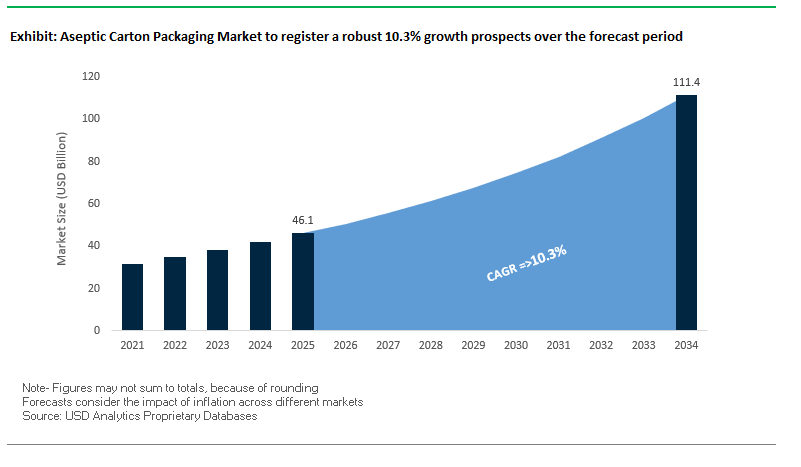
The global aseptic carton packaging market is valued at USD 46.1 billion in 2025 and is projected to reach USD 111.4 billion by 2034, expanding at a strong CAGR of 10.3%. Aseptic cartons have become indispensable in the food and beverage industry for their ability to extend shelf life without refrigeration, a capability that reduces supply chain energy usage while ensuring long-lasting convenience for consumers. Products such as milk, juices, soups, and plant-based beverages rely heavily on aseptic packaging to maintain nutrients, flavors, and freshness.
A critical industry trend is the dominance of dairy and juice applications, where aseptic cartons continue to lead thanks to their lightweight, durable, and nutrient-preserving properties. Equally important is the industry’s reliance on paperboard, a renewable material that aligns with sustainability mandates and consumer demand for eco-friendly solutions. Moreover, aseptic cartons are pivotal in reducing food waste, providing strong barriers against oxygen, light, and moisture to minimize spoilage a significant contribution given that nearly one-third of food globally is wasted each year.
Key Insights for Professionals
Shelf life extension without refrigeration enhances supply chain efficiency and consumer convenience.
Dairy and juice products remain the largest adopters of aseptic cartons due to nutrient preservation and durability.
Paperboard-based cartons strengthen the sustainability profile, aligning with eco-regulations and consumer demand.
Food waste reduction through barrier protection positions aseptic packaging as a critical contributor to global food security.
The aseptic carton packaging market is experiencing rapid developments, marked by expansion projects, sustainability milestones, and breakthrough product launches. In August 2025, SIG was recognized by the Association of Plastic Recyclers (APR) for its recycle-ready bag-in-box wine package, a critical step toward circularity. In the same month, Smurfit WestRock officially debuted in New York and London following its high-profile merger, consolidating capabilities in paper-based aseptic solutions.
Sustainability has been a key competitive frontier. In July 2025, Tetra Pak achieved the EcoVadis Platinum sustainability rating, reinforcing its leadership in climate and environmental performance. Earlier in June 2025, Elopak expanded its footprint with the launch of its first U.S. carton converting plant in Arkansas, enhancing its ability to serve North America. That same month, Tetra Pak opened its New Food Technology Development Centre in Sweden to support the fast-growing fermentation products market, showcasing its innovation pipeline.
Partnerships are also driving transformation. In May 2025, DS Smith combined with International Paper, creating a global leader in sustainable packaging with a stronger foothold in aseptic markets. Meanwhile, in April 2025, Tetra Pak and Lactalis unveiled an industry-first solution using certified recycled polymers from used beverage cartons. Similarly, Elopak’s 2024 annual report highlighted record revenues and its ambition to double revenue by 2030, while prioritizing “planet and profit.” These moves highlight how the aseptic carton industry is being reshaped by sustainability, expansion into new regions, and advanced technology adoption.
Transformative Trends Shaping the Aseptic Carton Packaging Market
Strategic Capacity Expansion and Investment in North American Production
One of the most transformative trends in the aseptic carton packaging market is the accelerated investment in North American production capacity. Global leaders are prioritizing onshoring aseptic carton manufacturing to meet rising regional demand while strengthening supply chain resilience. A leading player recently announced a significant capacity expansion at its Denton, Texas facility, designed to “strengthen the North American supply chain” and mitigate risks associated with cross-continental transport. This shift aligns with broader sustainability objectives localized production not only reduces dependence on imports but also cuts down on emissions tied to long-haul logistics. For example, a 2024 sustainability report from a top packaging firm revealed a 25% reduction in greenhouse gas emissions since 2019, with localized production playing a central role. Beyond carbon savings, North American production hubs allow packaging firms to respond more rapidly to consumer trends, ensuring faster lead times, optimized inventory management, and supply chains resilient to geopolitical or shipping disruptions. This localization strategy marks a structural shift in how companies balance sustainability with operational agility.
Accelerated Adoption of Plant-Based and Renewable Materials
The second major trend reshaping the aseptic carton packaging market is the accelerated transition toward plant-based and renewable materials. Driven by regulatory pressures, ESG goals, and consumer demand for sustainable packaging, manufacturers are shifting away from fossil-based polymers to fully renewable, bio-based materials without sacrificing product protection. A landmark innovation was recently introduced: the first-ever aseptic carton with a full barrier structure free of aluminum, developed in partnership with a major dairy producer. This achievement eliminates fossil-based inputs while maintaining product integrity, setting a new sustainability benchmark. Another company is scaling the use of bio-based polymers derived from renewable European wood, verified through ISCC PLUS certification under the mass balance approach, ensuring traceable renewable content. These advancements are not only reducing carbon footprints but also enhancing packaging circularity, making aseptic cartons an integral part of the global low-carbon materials shift. With consumer preference shifting toward eco-conscious packaging, the move toward renewable content is quickly becoming a defining competitive differentiator in the market.
Emerging Opportunities Driving Growth in the Aseptic Carton Packaging Industry
Integration of Digital Watermarks for Advanced Recycling
One of the most significant opportunities lies in the integration of digital watermarking technology into aseptic cartons, with initiatives like HolyGrail 2.0 showcasing its transformative potential. By embedding imperceptible digital watermarks onto packaging, waste management facilities can achieve high-precision sorting, addressing the long-standing challenge of separating complex multilayer cartons from mixed waste streams. Industrial trials have already demonstrated over 96% detection accuracy, highlighting the scalability of this solution. The impact extends beyond sorting efficiency by enabling clean separation of polyAlu (polyethylene-aluminum) components, digital watermarks create a higher-quality recyclate stream that was previously unachievable. According to the Ellen MacArthur Foundation, this innovation significantly increases the commercial value of recovered materials, incentivizing collection systems and strengthening the circular economy for aseptic cartons. Companies investing in digital watermarking not only align with global recycling targets but also position themselves as leaders in next-generation sustainable packaging infrastructure.
Penetration into New Liquid Food Categories Beyond Dairy and Juice
While dairy and juice remain the backbone of aseptic carton demand, untapped opportunities lie in expanding into new liquid food categories where shelf stability, sustainability, and convenience are key drivers. Plant-based beverages such as oat, soy, pea, and rice milk represent a fast-growing category, and aseptic cartons provide an ideal format to extend freshness without refrigeration, a fact highlighted by innovations from leaders like SIG and Tetra Pak. Beyond plant-based, aseptic cartons are emerging as a disruptive packaging format for wine and ready-to-drink (RTD) cocktails, offering a lightweight, oxidation-resistant, and unbreakable alternative to glass bottles. Industry studies underscore that the oxygen-free environment of aseptic cartons preserves wine quality and flavor for longer durations, catering to evolving consumer preferences for portability and sustainability. Additionally, the application of aseptic packaging in liquid eggs demonstrates strong potential to reduce food waste by extending shelf life up to four weeks under refrigeration, compared to much shorter durations in traditional packaging. This versatility across food and beverage categories positions aseptic cartons as a growth accelerator in markets beyond their traditional base, unlocking new revenue streams and diversifying applications in line with global consumption trends.
Market Leaders Focus on Sustainability, Innovation, and Expansion to Capture Aseptic Carton Growth
The competitive landscape of the aseptic carton packaging market is defined by a mix of established global leaders and newly consolidated players. Companies are differentiating themselves through sustainable materials, global expansion strategies, and advanced carton designs.
Tetra Pak International: Setting Global Standards in Sustainable Carton Packaging
Tetra Pak remains the market leader with its deep portfolio of aseptic cartons and filling systems. In April 2025, it partnered with a European dairy to launch packaging using certified recycled polymers, strengthening its leadership in circular economy solutions. Its Tetra Prisma Aseptic 300 Edge carton, co-launched with a European soft drinks brand, further showcases its innovation pipeline. With a global footprint and integrated processing-to-packaging expertise, Tetra Pak combines sustainability and performance to maintain its dominant market share.
SIG Combibloc: Driving Recyclability and Innovation in Wine and Food Packaging
SIG continues to expand its aseptic carton offering with a strong focus on recyclability. In August 2025, its recycle-ready bag-in-box for wine earned APR recognition, marking a milestone in circular innovation. Alongside product launches, the company announced a leadership change, signaling a renewed strategic direction. Its SIG Terra cartons, made largely from renewable materials, are central to its sustainability strategy, offering high barrier properties and extended shelf life.
Elopak ASA: Expanding North American Presence with New Converting Facility
Elopak has strengthened its global reach with the June 2025 opening of its first U.S. carton converting plant in Arkansas, ensuring proximity to key customers in North America. The company reported record revenues in 2024 and aims to double revenues by 2030 through sustainable innovations and regional expansions. Its flagship Pure-Pak brand emphasizes renewable paperboard and tethered cap solutions, reinforcing its “Repackaging tomorrow” vision.
Smurfit WestRock: Leveraging Scale and Global Presence Post-Merger
Following the August 2025 merger of Smurfit Kappa and WestRock, Smurfit WestRock has become a global powerhouse in paper-based packaging, with operations spanning 42 countries and 500+ facilities. Its scale and experience enable it to support aseptic packaging requirements for both bulk and consumer-facing applications. With a strategy centered on recyclability and innovation, Smurfit WestRock is positioned to capture significant growth in the aseptic packaging segment.
Aseptic Carton Packaging Market Share Insights
Standard Aseptic Cartons Dominate Market Share by Product Type in Aseptic Carton Packaging
Standard aseptic cartons command an overwhelming 65% share, establishing themselves as the default format for liquid food and beverage packaging. Their dominance is anchored in high-speed filling efficiencies, low material-to-product ratios, and the ability to deliver shelf-stable products without refrigeration. The iconic brick-shaped design maximizes space efficiency across logistics chains, enabling manufacturers to optimize freight costs and retailers to maximize shelf facings. This cost-effectiveness, combined with recyclability improvements and the integration of renewable paperboard, has made standard aseptic cartons the backbone of the liquid dairy, juice, and plant-based beverage supply chain. While cartons with straws hold a significant share due to strong demand for single-serve formats in children’s beverages, shaped cartons serve as the premium differentiation tool for brands seeking shelf impact. Bag-in-box, though niche, anchors the foodservice sector with efficiency in bulk dispensing, underscoring the multi-format versatility within aseptic carton packaging.
Food & Beverages Industry Holds Overwhelming Dominance in Aseptic Carton Packaging End-Use
The food and beverages industry accounts for more than 90% of aseptic carton packaging demand, making it the undisputed driver of this market. This dominance is tied directly to the sector’s reliance on aseptic technology to deliver shelf-stable milk, juices, soups, sauces, and plant-based beverages across global markets without refrigeration. By eliminating the cold chain dependency, aseptic cartons enable brand penetration in emerging economies while simultaneously supporting sustainability through reduced energy use. Pharmaceutical applications, though smaller, provide high-value opportunities in medical nutrition and enteral feeds, where sterility and dosage precision are critical. Cosmetics and personal care represent an emerging frontier, with aseptic packaging being positioned for preservative-free lotions, micellar water, and clean-label formulations. This sector, while nascent, highlights the broader diversification of aseptic packaging beyond food and beverages, opening new growth avenues.
United States: FDA Regulations and Technological Innovations Drive Aseptic Carton Packaging Growth
The U.S. aseptic carton packaging market is strongly influenced by FDA regulations, ensuring that food-contact materials are safe and contamination-free, providing a stable environment for innovation. Technological advancements are driving smart and active packaging solutions that enhance shelf stability for preservative-free products, extending the life of fresh beverages such as almond milk, soy milk, and juices without refrigeration. Corporate initiatives focus on convenience and sustainability, with companies investing in packaging solutions that meet growing consumer demand.
Rising consumption of plant-based and natural beverages is a key driver, fueling demand for aseptic cartons that maintain freshness and product quality. Sustainability is a priority, with companies developing recyclable and lightweight carton designs made from paperboard with minimal plastic and aluminum layers. Key applications span the beverage and pharmaceutical sectors, where aseptic cartons protect sensitive products, maintain sterility, and extend shelf life. These factors collectively position the U.S. as a leading market for advanced aseptic packaging solutions.
Germany: Circular Economy Leadership and Sustainable Aseptic Packaging Solutions
Germany’s aseptic carton packaging market is shaped by a stringent regulatory framework, including the EU Packaging and Packaging Waste Regulation (PPWR), mandating fully recyclable or reusable packaging by 2030. Germany’s Packaging Act (VerpackG) enforces producer responsibility across the packaging lifecycle, driving innovation in recyclable materials and efficient collection systems. Technological innovation includes next-generation substrates such as grass paper and high-strength recycled fibers, optimized for aseptic packaging applications.
Governmental mandates under PPWR encourage reusable and refillable carton solutions. The market’s key applications include long-life milk, juices, soups, and pharmaceuticals, where maintaining sterility and freshness is critical. Germany’s strong focus on R&D, particularly in medical technology, supports aseptic packaging innovation, with manufacturers investing over 9% of total revenue in product development. These initiatives strengthen Germany’s leadership in sustainable, high-performance aseptic carton packaging.
China: Government Policies and Domestic Innovation Propel Aseptic Packaging
China’s aseptic carton packaging market is driven by governmental sustainability goals, including the “dual carbon” policy and restrictions on non-degradable plastics, promoting paper-based alternatives. Technological advancements, such as AI and “5G plus industrial internet” integration, optimize production efficiency and flexible manufacturing capacity for aseptic cartons. Domestic substitution is a key trend, with companies like Shandong NewJF Technology Packaging acquiring stakes in established firms like Greatview Aseptic Packaging to boost local competitiveness.
Key applications include food and e-commerce sectors, where aseptic cartons extend shelf life and ensure product safety, particularly for liquid milk and packaged beverages. Regulatory reforms addressing over-packaging encourage efficient and sustainable design, while corporate investments in domestic production strengthen the local market and reduce dependence on imports, positioning China as a rapidly growing hub for innovative aseptic carton solutions.
India: Regulatory Support and Sustainable Packaging Drive Market Expansion
India’s aseptic carton packaging market benefits from the “Make in India” and “Zero Effect Zero Defect” initiatives, promoting quality domestic production and industrial investment. Regulatory oversight by FSSAI ensures compliance with food safety, migration limits, and labeling requirements, while mitigating misleading claims. Technological advancements include automated packaging systems and traceability solutions, such as QR codes, enhancing shelf life and consumer transparency.
Corporate investments, exemplified by Tetra Pak’s $11 million investment in Cuautitlán in 2025, strengthen India’s position in the aseptic packaging industry. Sustainability remains a focus, with growing interest in recyclable, biodegradable, and compostable materials. Key applications are concentrated in dairy, fruit-based beverages, and the broader food processing sector, which require secure and eco-friendly packaging solutions, driving India’s market growth and adoption of advanced aseptic carton technologies.
Brazil: Regulatory Reforms and Technological Advancements Foster Market Growth
Brazil’s aseptic carton packaging market is influenced by ANVISA’s regulatory framework, which took effect in September 2024 and strengthens pre-market controls for food packaging based on risk. Technological advancements, including robotics and AI, improve efficiency and quality control, enabling sophisticated operations like automated sorting and defect detection. The industry is also moving toward sustainable packaging solutions, integrating eco-friendly aseptic materials to align with environmental initiatives.
Strategic investments are driven by Brazil’s expanding pharmaceutical and food sectors, with aseptic cartons used extensively for milk, juices, and soy-based drinks. Regulatory support, including laws promoting domestic recycling and circular economy principles, encourages the adoption of recyclable materials in aseptic packaging. These combined factors enhance Brazil’s role as a key market for innovative, sustainable, and high-performance aseptic carton solutions.
Japan: Precision Manufacturing and Smart Packaging Transform the Aseptic Carton Market
Japan’s aseptic carton packaging market leverages advanced precision manufacturing and smart packaging technologies, with AI accelerating design processes and improving production accuracy. Regulatory updates from the Ministry of Health, Labour and Welfare (MHLW) in 2025 introduce a “positive list” for food-contact substances, ensuring compliance and safety. The market is shifting toward smart packaging, integrating sensors and digital tools to monitor product safety and shelf life.
Innovation focuses on specialized properties, including high dimensional stability and resistance to deformation for high-performance applications. Corporate collaborations, such as Toyo Seikan Group’s recyclable and lightweight packaging solutions, drive industry innovation, while academic research emphasizes biopolymers and natural agents for sustainable packaging. Key applications span food, beverages, and pharmaceuticals, where performance, compliance, and sustainability are critical, solidifying Japan’s leadership in next-generation aseptic carton packaging.
Aseptic Carton Packaging Market Report Scope
Aseptic Carton Packaging Market
Parameter
Details
Market Size (2025)
$46.1 Billion
Market Size (2034)
$111.4 Billion
Market Growth Rate
10.3%
Segments
By Product Type (Standard Cartons, Shaped Cartons, Bag-in-Box, Packs with Straws), By Material Type (Paperboard, Plastic, Aluminum), By Application (Beverages, Dairy Products, Food Products, Pharmaceuticals), By End-Use Industry (Food & Beverages, Pharmaceuticals, Cosmetics & Personal Care)
Study Period
2019- 2024 and 2025-2034
Units
Revenue (USD)
Qualitative Analysis
Porter’s Five Forces, SWOT Profile, Market Share, Scenario Forecasts, Market Ecosystem, Company Ranking, Market Dynamics, Industry Benchmarking
Companies
Tetra Pak, SIG Combibloc Group AG, Elopak ASA, Amcor plc, Mondi Group, Greatview Aseptic Packaging Co., Ltd., DS Smith Plc, Smurfit Kappa Group Plc, Nippon Paper Industries Co., Ltd., Huhtamäki Oyj, Sonoco Products Company, WestRock Company, Becton, Dickinson and Company, IPI Srl, Uflex Limited
Countries
US, Canada, Mexico, Germany, France, Spain, Italy, UK, Russia, China, India, Japan, South Korea, Australia, South East Asia, Brazil, Argentina, Middle East, Africamarket report scope
Aseptic Carton Packaging Market Segmentation
By Product Type
Standard Cartons
Shaped Cartons
Bag-in-Box
Packs with Straws
By Material Type
Paperboard
Plastic
Aluminum
By Application
Beverages
Dairy Products
Food Products
Pharmaceuticals
By End-Use Industry
Food & Beverages
Pharmaceuticals
Cosmetics & Personal Care
Countries Analyzed
North America (US, Canada, Mexico)
Europe (Germany, UK, France, Spain, Italy, Russia, Rest of Europe)
Asia Pacific (China, India, Japan, South Korea, Australia, South East Asia, Rest of Asia)
South America (Brazil, Argentina, Rest of South America)
Middle East and Africa (Saudi Arabia, UAE, Rest of Middle East, South Africa, Egypt, Rest of Africa)
Top Companies in Aseptic Carton Packaging Market
Tetra Pak
SIG Combibloc Group AG
Elopak ASA
Amcor plc
Mondi Group
Greatview Aseptic Packaging Co., Ltd.
DS Smith Plc
Smurfit Kappa Group Plc
Nippon Paper Industries Co., Ltd.
Huhtamäki Oyj
Sonoco Products Company
WestRock Company
Becton, Dickinson and Company
IPI Srl
Uflex Limited
* List Not Exhaustive
Methodology
USDAnalytics utilizes a robust and integrated research methodology to deliver comprehensive insights into the global aseptic carton packaging market. This approach combines primary research, including interviews with key stakeholders such as packaging manufacturers, food and beverage companies, dairy and juice producers, regulatory authorities, and technology innovators, with secondary research drawn from verified sources such as company reports, industry journals, patents, and regulatory guidelines including FDA, FSSAI, EU PPWR, and ANVISA standards. Market sizing and forecasting are performed using proprietary quantitative models that account for historical trends, macroeconomic variables, technological advancements, and evolving consumer preferences for sustainable, renewable, and bio-based packaging materials. The analysis evaluates competitive dynamics by profiling market leaders, assessing strategic expansions, mergers and acquisitions, and sustainability-driven innovations, including digital watermarking, circular economy integration, and smart aseptic solutions. Regional insights cover major markets such as the U.S., Germany, China, India, Brazil, and Japan, highlighting regulatory impacts, localized production, and sector-specific adoption in dairy, beverages, plant-based liquids, pharmaceuticals, and emerging consumer applications. By triangulating multiple data sources and leveraging USDAnalytics’ proprietary modeling, this methodology ensures accurate, actionable, and forward-looking insights to guide strategic decisions, investment planning, and innovation strategies for industry professionals.
Deliverables:
Comprehensive Market Research Report (PDF and Excel) with detailed tables, charts, and interactive visualizations.
Country-Specific Forecasts & Analysis.
Segment-Wise Revenue Forecasts (2025–2034).
Competitive Analysis, Benchmarking, and SWOT Profiles.
Recent Developments & Innovation Tracker.
Executive Summary & Analyst Commentary.
Post-Purchase Analyst Support for Client-Specific Questions and Custom Data Requirements.
Table of Contents: Aseptic Carton Packaging Market
2. Aseptic Carton Packaging Market Landscape & Outlook (2025–2034)
2.1. Introduction to Aseptic Carton Packaging Market
2.2. Market Valuation and Growth Projections (2025–2034)
2.3. Market Drivers and Growth Enablers
2.4. Regulatory and Policy Impact
2.5. Sustainability and Circular Economy Influence
3. Innovations Reshaping the Aseptic Carton Packaging Market
3.1. Trend: Strategic Capacity Expansion and Investment in North American Production
3.2. Trend: Accelerated Adoption of Plant-Based and Renewable Materials
3.3. Opportunity: Integration of Digital Watermarks for Advanced Recycling
3.4. Opportunity: Penetration into New Liquid Food Categories Beyond Dairy and Juice
4. Competitive Landscape and Strategic Initiatives
4.1. Mergers, Acquisitions and Strategic Alliances
4.2. R&D and Material Innovation
4.3. Sustainability and Strategies
4.4. Market Expansion and Regional Focus
5. Market Share and Segmentation Insights: Aseptic Carton Packaging Market
5.1. By Product Type
5.1.1. Standard Cartons
5.1.2. Shaped Cartons
5.1.3. Bag-in-Box
5.1.4. Packs with Straws
5.2. By Material Type
5.2.1. Paperboard
5.2.2. Plastic
5.2.3. Aluminum
5.3. By Application
5.3.1. Beverages
5.3.2. Dairy Products
5.3.3. Food Products
5.3.4. Pharmaceuticals
5.4. By End-Use Industry
5.4.1. Food & Beverages
5.4.2. Pharmaceuticals
5.4.3. Cosmetics & Personal Care
6. Country Analysis and Outlook of Aseptic Carton Packaging Market
6.1. United States
6.2. Canada
6.3. Mexico
6.4. Germany
6.5. France
6.6. Spain
6.7. Italy
6.8. UK
6.9. Russia
6.10. China
6.11. India
6.12. Japan
6.13. South Korea
6.14. Australia
6.15. South East Asia
6.16. Brazil
6.17. Argentina
6.18. Middle East
6.19. Africa
7. Aseptic Carton Packaging Market Size Outlook by Region (2025–2034)
7.1. North America Aseptic Carton Packaging Market Size Outlook to 2034
7.1.1. By Product Type
7.1.2. By Application
7.1.3. By End-Use Industry
7.2. Europe Aseptic Carton Packaging Market Size Outlook to 2034
7.2.1. By Product Type
7.2.2. By Material Type
7.2.3. By Application
7.2.4. By End-Use Industry
7.3. Asia Pacific Aseptic Carton Packaging Market Size Outlook to 2034
7.3.1. By Product Type
7.3.2. By Material Type
7.3.3. By Application
7.3.4. By End-Use Industry
7.4. South America Aseptic Carton Packaging Market Size Outlook to 2034
7.4.1. By Product Type
7.4.2. By Application
7.4.3. By End-Use Industry
7.5. Middle East and Africa Aseptic Carton Packaging Market Size Outlook to 2034
7.5.1. By Product Type
7.5.2. By Material Type
7.5.3. By Application
7.5.4. By End-Use Industry
8. Company Profiles: Leading Players in the Aseptic Carton Packaging Market
8.1. Tetra Pak International
8.2. SIG Combibloc Group AG
8.3. Elopak ASA
8.4. Amcor plc
8.5. Mondi Group
8.6. Greatview Aseptic Packaging Co., Ltd.
8.7. DS Smith Plc
8.8. Smurfit Kappa Group Plc
8.9. Nippon Paper Industries Co., Ltd.
8.10. Huhtamäki Oyj
8.11. Sonoco Products Company
8.12. WestRock Company
8.13. Becton, Dickinson and Company
8.14. IPI Srl
8.15. Uflex Limited
9. Methodology
9.1. Research Scope
9.2. Market Research Approach
9.3. Market Sizing and Forecasting Model
9.4. Research Coverage
9.5. Data Horizon
9.6. Deliverables
10. Appendix
10.1. Acronyms and Abbreviations
10.2. List of Tables
10.3. List of Figures
Aseptic Carton Packaging Market Segmentation
By Product Type
Standard Cartons
Shaped Cartons
Bag-in-Box
Packs with Straws
By Material Type
Paperboard
Plastic
Aluminum
By Application
Beverages
Dairy Products
Food Products
Pharmaceuticals
By End-Use Industry
Food & Beverages
Pharmaceuticals
Cosmetics & Personal Care
Countries Analyzed
North America (US, Canada, Mexico)
Europe (Germany, UK, France, Spain, Italy, Russia, Rest of Europe)
Asia Pacific (China, India, Japan, South Korea, Australia, South East Asia, Rest of Asia)
South America (Brazil, Argentina, Rest of South America)
Middle East and Africa (Saudi Arabia, UAE, Rest of Middle East, South Africa, Egypt, Rest of Africa)
The market is driven by the demand for shelf-stable products without refrigeration, sustainability mandates, and food waste reduction. Dairy, juice, and plant-based beverages rely heavily on aseptic cartons to preserve nutrients and flavors, while innovations in renewable materials and digital recycling technologies further fuel adoption.
Standard aseptic cartons hold the largest market share due to high-speed filling efficiency, cost-effectiveness, and shelf-stable performance. Other formats such as cartons with straws, shaped cartons, and bag-in-box serve niche markets, including single-serve beverages, premium packaging, and bulk foodservice applications.
Manufacturers are increasingly adopting renewable paperboard, bio-based polymers, and aluminum-free cartons, integrating circular economy principles. Innovations like digital watermarking enhance recycling precision, while partnerships with dairy and beverage brands ensure eco-friendly and high-performance packaging solutions.
Food and beverages dominate over 90% of demand, particularly dairy, juices, soups, and plant-based drinks. Pharmaceuticals utilize aseptic cartons for medical nutrition and enteral feeds, while cosmetics and personal care are emerging markets for preservative-free and clean-label formulations.
Smart packaging with sensors, AI-driven production, and digital watermarks for recycling are key innovations. Expansion into plant-based beverages, liquid eggs, wine, and RTD cocktails represents new growth avenues, while localized production and renewable material adoption align with sustainability and operational efficiency objectives.