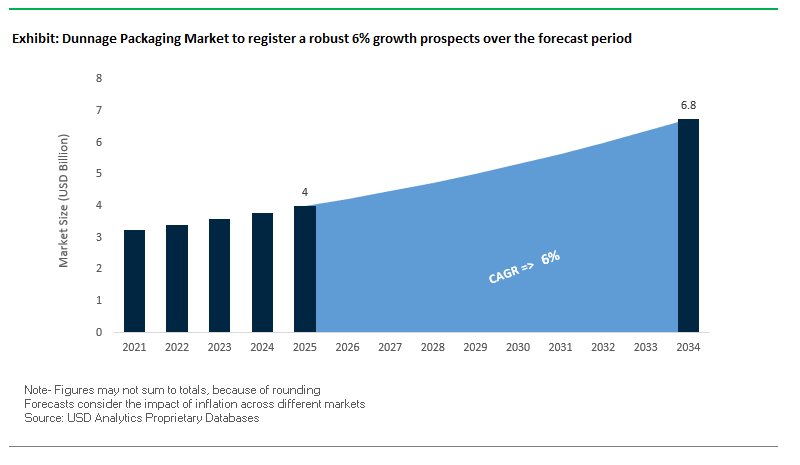
Dunnage Packaging Market Overview: Scaling from $4 Billion in 2025 to $6.8 Billion by 2034 at a 6% CAGR
The global dunnage packaging market is forecast to grow steadily, expanding from $4 billion in 2025 to $6.8 billion by 2034, representing a 6% CAGR. As a critical component of logistics, e-commerce, and industrial supply chains, dunnage packaging protects goods from damage during handling, storage, and transportation. For industry professionals, the key questions revolve around damage prevention ROI, reusability vs. disposability, sector-specific adoption (automotive, electronics, and e-commerce), and integration with automated fulfillment systems.
Key Insights for Decision-Makers
Damage Reduction as ROI Driver: Custom-engineered dunnage reduces costly product loss, replacements, and reverse logistics in high-value sectors.
Sustainability and Reusability: Durable, reusable solutions in plastics and fabrics support the circular economy, reducing single-use packaging waste.
Sector Leadership: Automotive and electronics lead adoption, with custom trays, molded inserts, and separators ensuring safe transit of delicate components.
E-Commerce Acceleration: High-speed fulfillment automation drives demand for air pillows, paper void-fill, and foam-in-place systems that can integrate seamlessly into packaging lines.
Market Analysis: Consolidation, Sustainability, and Automation Define the Landscape
The dunnage packaging industry is undergoing rapid transformation, influenced by consolidation, sustainability imperatives, and automation trends.
Maritime safety standards drive securement needs. In August 2025, industry publications emphasized new mandatory maritime safety measures, reinforcing the need for load-securing products like dunnage air bags and void-fill systems. With global shipping disruptions and container losses persisting, logistics players are investing in protective solutions to ensure compliance and minimize transit losses.
Paper-based leaders consolidate the market. In July 2025, the merger of Smurfit Kappa and WestRock created Smurfit WestRock, consolidating two giants in the paper-based packaging sector. This merger enhances the availability of corrugated dunnage, dividers, and inserts, offering eco-friendly protective options aligned with growing customer sustainability targets.
Eco-friendly innovations redefine protective systems. In May 2025, DS Smith introduced DryPack in North America to replace EPS foam. Similarly, in November 2024, Dart Container and PulPac unveiled dry-molded fiber solutions, demonstrating how alternative materials are reshaping protective packaging and potentially complementing traditional dunnage. Pregis’ September 2024 launch of EasyPack GeoTerra paper further emphasized the shift toward recyclable and curbside-friendly cushioning materials.
Portfolio expansions and automation gains. Berry Global’s February 2025 merger with Glatfelter highlights broader strategic consolidation across films and specialty materials, boosting supply capabilities for reusable and recyclable dunnage. Sealed Air and Pregis continue to pioneer automation-ready solutions, with void-sensing technology and on-demand systems optimized for high-volume e-commerce. Additionally, ITW Paslode’s October 2024 cordless coil nailer supports more efficient construction of wooden crates and bracing, demonstrating innovation in complementary dunnage applications.
Transit packaging gains ESG focus. By July 2024, Crown Holdings reported strong results in its Transit Packaging segment, underscoring the critical role of dunnage in protecting goods in motion. With SBTi validation of its net-zero targets, Crown reflects the industry’s dual priority: delivering damage protection while cutting carbon impact.
Dunnage Packaging Market: Trends and Opportunities Shaping the Future of Protective Solutions
Strategic Corporate Shift Towards In-house Automated Dunnage Production
The dunnage packaging market is being redefined by the rapid adoption of in-house automated dunnage production systems. Major manufacturers, e-commerce platforms, and fulfillment centers are moving away from pre-made protective materials toward custom-fit, on-demand dunnage created directly at the point of packing. This transition is driven by efficiency, cost control, and sustainability. For example, an e-commerce company’s May 2025 sustainability report revealed that deploying automated packaging machines across its European network reduced waste across millions of orders by generating right-sized packaging. Such automation reduces the reliance on generic void-fill, cuts material costs, and improves customer satisfaction by minimizing over-packaging.
Suppliers like Pregis are also marketing air and paper-based systems that eliminate unnecessary storage and labor costs, while ensuring packaging waste is significantly reduced. Beyond cost and sustainability, in-house dunnage production enhances supply chain resilience. Companies no longer depend on third-party suppliers for pre-made packaging, which has proven vital during peak demand surges or global disruptions. This trend highlights a growing industry preference for just-in-time packaging strategies that align with lean manufacturing principles and sustainability targets.
Regulatory and End-User Mandates Driving Adoption of Certified Recyclable Materials
The second major trend reshaping the market is the regulatory and corporate push for recyclable dunnage solutions. The European Union’s Packaging and Packaging Waste Regulation (PPWR), enforced in 2025, sets strict definitions for recyclability, effectively phasing out non-recyclable protective materials. Companies using dunnage now face financial and compliance pressures to adopt mono-material and paper-based alternatives. Parallel to this, corporate ESG goals are setting ambitious standards one global consumer goods company has committed to making 100% of its plastic packaging recyclable, reusable, or compostable by 2030, which is pushing suppliers to accelerate sustainable innovation.
Retailers are also acting as enforcers by mandating sustainable packaging use in their supply chains. For example, many have already directed suppliers to eliminate expanded polystyrene (EPS) foams in favor of curbside-recyclable paper-based dunnage. A reusable packaging firm in April 2024 launched eco-friendly dunnage products made from reprocessed plastics, aligning with these directives. Collectively, regulatory enforcement, corporate commitments, and retailer requirements are accelerating the transition to recyclable and circular dunnage systems, ensuring compliance while building brand equity with sustainability-conscious consumers.
Development and Scaling of High-Performance Bio-Based Foam Alternatives
The move away from petroleum-based foams such as EPS and PE has created an opportunity for bio-based foam alternatives that match traditional protective performance while aligning with sustainability goals. Manufacturers are commercializing biodegradable foam lines, including one product that demonstrated 94% degradation within four years in microbe-rich environments, offering a viable replacement for conventional EPS. At the frontier of innovation, mycelium-based dunnage grown from mushroom root structures is gaining momentum due to its renewable, lightweight, and home-compostable nature.
In addition, foams derived from corn, sugarcane, and agricultural byproducts provide sustainable sourcing advantages, appealing to companies targeting fossil fuel reduction and circular economy initiatives. These developments address one of the biggest market gaps: creating dunnage that delivers impact resistance and lightweight performance while also being environmentally benign. As adoption scales, bio-based foams are expected to disrupt protective packaging across electronics, appliances, and high-value consumer goods, where protective performance cannot be compromised.
Integration of Smart and Connected Dunnage for Supply Chain Visibility
The second opportunity lies in the integration of IoT-enabled sensors into dunnage, transforming it from a passive protective element into a data-rich enabler of supply chain visibility. Smart dunnage equipped with low-cost disposable sensors can track temperature, humidity, shock, and tilt during transit. In May 2024, a global logistics provider showcased how IoT-enabled packaging provided shipment-level visibility, reducing risks for high-value goods. This “digital twin” concept allows supply chain managers to monitor condition data in real time, ensuring proactive interventions when goods are exposed to shocks or adverse temperatures.
Beyond damage prevention, smart dunnage contributes to operational optimization. Data analytics can identify problem points in logistics networks such as hubs with high shock incidents enabling corrective action to reduce claims and improve efficiency. This transforms dunnage from a cost center into a strategic asset, not only protecting products but also optimizing supply chain decisions. As adoption grows, connected packaging technologies will unlock premium opportunities in industries like pharmaceuticals, electronics, and cold chain logistics, where both product safety and transparency are critical.
Competitive Landscape: Leaders Driving Innovation and Sustainability in Dunnage
The dunnage packaging market is shaped by paper giants, automation leaders, protective innovators, and diversified industrial manufacturers. Each is pursuing strategies around sustainability, automation, and customer-back innovation to stay competitive.
Smurfit WestRock Corrugated Dunnage Anchored in Paper Sustainability
Formed in July 2025, Smurfit WestRock combines two global leaders in corrugated and paper-based packaging. Its custom inserts, pads, and dividers serve the automotive, consumer goods, and e-commerce sectors. With control from forestry to final box, the company ensures quality and sustainability, offering optimized designs that reduce void fill and dimensional weight. Its focus on eco-friendly, high-performance corrugated solutions positions it as a front-runner in the sustainable dunnage market.
Sealed Air Corporation Automated and On-Demand Dunnage Solutions
Sealed Air dominates protective packaging with iconic products like Instapak® foam, Bubble Wrap® cushioning, and on-demand paper systems. The company leverages its strong brand reputation to deliver automation-ready void-fill solutions for high-volume e-commerce centers. Its automated void sensing systems reduce material waste while increasing throughput. The Jiffy® curbside-recyclable mailer further highlights its push toward eco-friendly protective packaging aligned with e-commerce growth.
Pregis LLC Expanding Sustainable and Smart Packaging Portfolios
Pregis offers AirSpeed® inflatable systems, Easypack® paper solutions, and foam-in-place protectives, all designed for automation integration. In September 2024, the company expanded its Easypack line with GeoTerra paper, a curbside-recyclable cushioning material. Pregis differentiates itself by coupling packaging materials with automation expertise, helping customers streamline operations while improving environmental performance. Its Purpose Awards initiative reinforces its brand as a sustainability-driven innovator.
Crown Holdings Inc. Transit Packaging Excellence with ESG Commitments
Crown Holdings’ Transit Packaging segment provides tailored in-transit protective solutions for high-volume and high-value goods. Its expertise extends across beverage, food, and personal care, making it a critical partner for global brands. In July 2024, Crown reported strong segment results while pursuing net-zero targets validated by SBTi, underscoring its dual focus on cargo protection and sustainability leadership. The company’s global footprint enhances its ability to serve multinational clients consistently.
ITW (Illinois Tool Works Inc.) Industrial Tools and Fasteners for Dunnage Construction
ITW delivers dunnage solutions through its diverse divisions, including Paslode, which provides tools and fasteners for constructing wooden crates and bracing. Its October 2024 cordless coil nailer improves safety and productivity in wooden dunnage assembly, reinforcing ITW’s customer-back innovation model. The company’s 80/20 business strategy prioritizes high-value solutions for core customers, ensuring customized, performance-driven protective systems across multiple industries.
Dunnage Packaging Market Share Insights
Dunnage Air Bags Dominate Market Share by Product Type
Dunnage air bags hold 35% of the dunnage packaging market share in 2025, making them the leading product type across logistics and freight applications. Their dominance is rooted in their ability to efficiently fill void spaces in containers, trucks, and railcars, preventing costly load shifts during transit. With global trade expanding and shipping distances growing longer, air bags have become the most cost-effective and performance-driven solution for securing mixed or heavy loads. Available in both disposable and reusable formats, they offer flexibility to shippers, with disposable types favored for one-way global shipments and reusables preferred in closed-loop supply chains. Their widespread adoption reflects not only cost savings and damage reduction but also their contribution to optimizing cargo density and logistics efficiency.
Inserts and dividers account for 25% of the dunnage packaging market in 2025, making them the second-largest product type. Their role is indispensable in industries where product-to-product contact must be avoided, such as electronics, glassware, and automotive parts. Customized to specific product geometries, they ensure precise separation and protection, reducing breakage rates and returns. This segment’s strong share is linked to the growing demand for high-value, fragile goods that require tailored packaging solutions. The automotive and consumer electronics industries, in particular, drive adoption, as they demand reliability and efficiency in protecting complex, high-cost components during global distribution.
Bags, Trays, Racks, and Emerging Materials Add to Market Diversity
Beyond the leading categories, bags including shrink films and inflatable cushions represent a versatile solution for securing and protecting products of varying shapes and sizes. Their demand is strongly tied to e-commerce and retail, where adaptability and scalability are crucial. Trays and racks hold a smaller but critical share, serving industries like automotive and aerospace that require structured support for heavy, irregularly shaped, or precision components. Meanwhile, other innovative products such as molded pulp, foam inserts, and custom-engineered designs are carving a niche by addressing sustainability goals and specialized protection needs. These emerging segments reflect ongoing innovation, particularly in environmentally friendly materials that align with regulatory and corporate sustainability mandates.
Automotive Industry Leads Dunnage Packaging Market Share by End-Use
The automotive industry accounts for 30% of the dunnage packaging market share in 2025, establishing itself as the single largest end-user. This dominance stems from the high value and sheer volume of automotive parts that need secure, damage-free transit, from engines and transmissions to delicate sensors and electronics. Reusability, durability, and precision fit are paramount in automotive supply chains, making customized dunnage solutions a core requirement. Electronics and electricals follow with a 25% share, anchored by the fragility and high value of devices and components that demand anti-static, shock-absorbing, and vibration-resistant packaging. Aerospace and defense represent a smaller but ultra-high-stakes niche, where performance and compliance outweigh cost, while food and beverages, healthcare, and consumer durables add steady volume demand. Notably, the growth of e-commerce in large consumer durables such as appliances and furniture is expanding the role of dunnage packaging as an enabler of safe, efficient last-mile delivery.
United States: Leading Automotive and E-commerce Logistics Drive Dunnage Packaging Demand
The U.S. dunnage packaging market is strongly driven by its expansive automotive industry and the growing e-commerce sector. Companies like Orbis Corporation and Myers Industries are at the forefront, offering customizable, reusable dunnage solutions designed to prevent damage to high-value components during transport. The market is increasingly focused on circular economy practices, with closed-loop systems that enable dunnage collection, recycling, and remanufacturing to maximize sustainability.
Technological integration is enhancing logistics efficiency, with smart dunnage solutions featuring RFID tags and sensors enabling real-time tracking and improved supply chain visibility. The surge in e-commerce and retail shipments is further boosting demand for lightweight and protective materials, including paper-based and foam inserts, which ensure product safety while optimizing shipping costs.
Germany: Industrial Excellence and Sustainable Innovations Strengthen Market Growth
Germany’s dunnage packaging market thrives on its high-value industrial and export economy, particularly in automotive and machinery sectors. The market demands custom-engineered dunnage to safeguard sensitive components during domestic and international transport. German companies are pioneering sustainable solutions, developing dunnage with high recycled content and emphasizing reusability, aligning with the European Green Deal and circular economy principles.
Advanced engineering and design software allow manufacturers to produce space-efficient, protective dunnage, reducing freight costs and carbon footprint. Compliance with strict EU regulations on load securement and packaging waste ensures product safety and environmental sustainability, giving manufacturers a competitive edge in both local and export markets.
China: Manufacturing Powerhouse Fuels High-Demand for Protective Dunnage
China’s dunnage packaging market is propelled by its position as a global manufacturing and export hub, serving the electronics, automotive, and consumer goods sectors. High-volume production demands protective packaging solutions, including corrugated plastic, foam inserts, and reusable dunnage for domestic distribution and international shipments.
Chinese manufacturers are leveraging advanced molding and fabrication technologies to deliver lightweight, cost-effective dunnage solutions. This focus on both protection and economic viability allows manufacturers to meet the needs of high-volume supply chains while addressing sustainability concerns with reusable and recyclable materials.
India: Industrialization and E-commerce Expansion Spur Market Growth
India’s dunnage packaging industry is witnessing rapid growth due to industrialization and the burgeoning e-commerce sector. The demand for protective packaging is increasing across automotive, electronics, and food and beverage industries, as goods transit across India’s expanding logistics network.
Government initiatives promoting sustainable packaging have encouraged the adoption of eco-friendly dunnage materials, including recycled paper, wood, and other renewable alternatives. Investments in local manufacturing facilities by both domestic and international players are helping meet this rising demand, providing high-quality, durable, and reusable dunnage solutions tailored to India’s diverse industrial needs.
Mexico: Nearshoring and Automotive Manufacturing Strengthen Dunnage Market
Mexico’s dunnage packaging market is closely tied to the North American automotive supply chain. The trend of nearshoring manufacturing from Asia has increased the need for specialized dunnage to protect auto parts during transport to the U.S. and Canada.
Companies like Nefab are expanding production facilities in Mexico to supply wood, plywood, and thermoformed dunnage solutions, enhancing local capabilities to meet the growing demand. The market emphasizes cost-effective, reliable, and reusable packaging solutions that support the logistics and automotive industries.
Japan: Precision and Reusability Drive High-Quality Dunnage Packaging
Japan’s dunnage packaging market is defined by precision and high-quality requirements, driven by the country’s electronics and automotive industries. Manufacturers focus on delivering dunnage that provides superior protection for delicate and high-value components, ensuring product integrity during transport.
Reusability and space-efficient designs are key trends, with innovative solutions that fold or nest when empty, minimizing return logistics costs. Japan’s emphasis on efficient manufacturing practices and sustainable packaging continues to drive innovation in eco-friendly and high-performance dunnage solutions.
Dunnage Packaging Market Report Scope
Dunnage Packaging Market
Parameter
Details
Market Size (2025)
$4 Billion
Market Size (2034)
$6.8 Billion
Market Growth Rate
6%
Segments
By Material Type (Corrugated Plastic, Molded Plastic, Foam, Fabric, Corrugated Paper, Wood, Other Materials), By Product Type (Inserts & Dividers, Trays, Racks, Bags, Dunnage Air Bags, Other Products), By End-Use Industry (Automotive, Electronics & Electricals, Aerospace & Defense, Food & Beverages, Healthcare, Consumer Durables, Other Industries)
Study Period
2019- 2024 and 2025-2034
Units
Revenue (USD)
Qualitative Analysis
Porter’s Five Forces, SWOT Profile, Market Share, Scenario Forecasts, Market Ecosystem, Company Ranking, Market Dynamics, Industry Benchmarking
Companies
Signode Industrial Group LLC, Myers Industries, Inc., Nefab Group, DS Smith Plc, ORBIS Corporation, Packaging Corporation of America, Reusable Transport Packaging, UFP Technologies, Inc., Rondo-Pak, LLC, GWP Group Ltd., Corplex, Amatech Inc., Sonoco Products Company, Shippers Products, Menasha Corporation
Countries
US, Canada, Mexico, Germany, France, Spain, Italy, UK, Russia, China, India, Japan, South Korea, Australia, South East Asia, Brazil, Argentina, Middle East, Africa
Dunnage Packaging Market Segmentation
By Material Type
Corrugated Plastic
Molded Plastic
Foam
Fabric
Corrugated Paper
Wood
Other Materials
By Product Type
Inserts & Dividers
Trays
Racks
Bags
Dunnage Air Bags
Other Products
By End-Use Industry
Automotive
Electronics & Electricals
Aerospace & Defense
Food & Beverages
Healthcare
Consumer Durables
Other Industries
Countries Analyzed
North America (US, Canada, Mexico)
Europe (Germany, UK, France, Spain, Italy, Russia, Rest of Europe)
Asia Pacific (China, India, Japan, South Korea, Australia, South East Asia, Rest of Asia)
South America (Brazil, Argentina, Rest of South America)
Middle East and Africa (Saudi Arabia, UAE, Rest of Middle East, South Africa, Egypt, Rest of Africa)
Top Companies in Dunnage Packaging Market
Signode Industrial Group LLC
Myers Industries, Inc.
Nefab Group
DS Smith Plc
ORBIS Corporation
Packaging Corporation of America
Reusable Transport Packaging
UFP Technologies, Inc.
Rondo-Pak, LLC
GWP Group Ltd.
Corplex
Amatech Inc.
Sonoco Products Company
Shippers Products
Menasha Corporation
* List Not Exhaustive
Research Coverage
This comprehensive report by USDAnalytics investigates the global dunnage packaging market, exploring breakthroughs in sustainable materials, automated production systems, and high-performance protective solutions. The analysis reviews historical trends from 2021 to 2024, examines recent developments in e-commerce, automotive, and electronics supply chains, and forecasts market growth from 2025 to 2034. The study highlights innovations such as bio-based foams, IoT-enabled smart dunnage, and AI-driven on-demand production, offering actionable insights for logistics managers, packaging engineers, and procurement professionals. This report also emphasizes the impact of regulatory mandates and ESG-driven adoption of recyclable materials, providing detailed evaluations of sector-specific ROI, damage prevention strategies, and cost optimization. With profiles and comparative analyses of over 15 leading companies, this report is an essential resource for industry stakeholders seeking to navigate competitive pressures, enhance operational efficiency, and implement sustainable packaging strategies in a global market projected to reach $6.8 billion by 2034.
Scope Highlights:
Segmentation: By Material Type (Corrugated Plastic, Molded Plastic, Foam, Fabric, Corrugated Paper, Wood, Other Materials), By Product Type (Inserts & Dividers, Trays, Racks, Bags, Dunnage Air Bags, Other Products), By End-Use Industry (Automotive, Electronics & Electricals, Aerospace & Defense, Food & Beverages, Healthcare, Consumer Durables, Other Industries)
Geographic Scope: Analysis spans 25+ countries across North America, Europe, Asia Pacific, Latin America, the Middle East & Africa.
Data Coverage: Historic data from 2021 to 2024 and forecast data from 2025 to 2034.
Company Profiles: Detailed analysis of 15+ leading players, including Signode Industrial Group LLC, Myers Industries, Inc., Nefab Group, DS Smith Plc, ORBIS Corporation, and others.
Methodology
The research methodology underpinning this report combines primary and secondary data collection, quantitative modeling, and qualitative industry insights to deliver a robust analysis of the dunnage packaging market. Primary research included interviews with supply chain executives, packaging engineers, and key decision-makers across major end-use industries. Secondary research incorporated company filings, trade journals, regulatory databases, and market publications to validate trends and competitive dynamics. Forecasting employed a combination of CAGR extrapolation, market-driver analysis, and scenario modeling, while segmentation insights were refined through comparative benchmarking of material types, product categories, and regional demand patterns. USDAnalytics applied an integrated approach to capture technological, regulatory, and sustainability-driven market shifts, ensuring actionable insights for strategy formulation and investment decisions.
Deliverables:
• Comprehensive Market Research Report (PDF and Excel) with detailed tables, charts, and interactive visualizations.
• Country-Specific Forecasts & Analysis.
• Segment-Wise Revenue Forecasts (2025–2034).
• Competitive Analysis, Benchmarking, and SWOT Profiles.
• Recent Developments & Innovation Tracker.
• Executive Summary & Analyst Commentary.
• Post-Purchase Analyst Support for Client-Specific Questions and Custom Data Requirements.
2. Dunnage Packaging Market Landscape & Outlook (2025–2034)
2.1. Introduction to Dunnage Packaging Market
2.2. Market Valuation and Growth Projections (2025–2034)
2.3. Market Dynamics: Drivers, Restraints, and Opportunities
2.4. Industry Transformation: Consolidation, Sustainability, and Automation
2.5. Regulatory and ESG Influences on Market Adoption
3. Innovations Reshaping the Dunnage Packaging Market
3.1. Trend: Strategic Corporate Shift Towards In-house Automated Dunnage Production
3.2. Trend: Regulatory and End-User Mandates Driving Recyclable Material Adoption
3.3. Opportunity: Development and Scaling of High-Performance Bio-Based Foam Alternatives
3.4. Opportunity: Integration of Smart and Connected Dunnage for Supply Chain Visibility
4. Competitive Landscape: Leaders Driving Innovation and Sustainability
4.1. Smurfit WestRock Corrugated Dunnage Anchored in Paper Sustainability
4.2. Sealed Air Corporation Automated and On-Demand Dunnage Solutions
4.3. Pregis LLC Expanding Sustainable and Smart Packaging Portfolios
4.4. Crown Holdings Inc. Transit Packaging Excellence with ESG Commitments
4.5. ITW (Illinois Tool Works Inc.) Industrial Tools and Fasteners for Dunnage Construction
5. Market Share and Segmentation Insights: Dunnage Packaging Market
5.1. By Material Type
5.1.1. Corrugated Plastic
5.1.2. Molded Plastic
5.1.3. Foam
5.1.4. Fabric
5.1.5. Corrugated Paper
5.1.6. Wood
5.1.7. Other Materials
5.2. By Product Type
5.2.1. Inserts & Dividers
5.2.2. Trays
5.2.3. Racks
5.2.4. Bags
5.2.5. Dunnage Air Bags
5.2.6. Other Products
5.3. By End-Use Industry
5.3.1. Automotive
5.3.2. Electronics & Electricals
5.3.3. Aerospace & Defense
5.3.4. Food & Beverages
5.3.5. Healthcare
5.3.6. Consumer Durables
5.3.7. Other Industries
6. Country Analysis and Outlook of Dunnage Packaging Market
6.1. United States
6.2. Canada
6.3. Mexico
6.4. Germany
6.5. France
6.6. Spain
6.7. Italy
6.8. UK
6.9. Russia
6.10. China
6.11. India
6.12. Japan
6.13. South Korea
6.14. Australia
6.15. South East Asia
6.16. Brazil
6.17. Argentina
6.18. Middle East
6.19. Africa
7. Dunnage Packaging Market Size Outlook by Region (2025–2034)
7.1. North America Dunnage Packaging Market Size Outlook to 2034
7.1.1. By Material Type
7.1.2. By Product Type
7.1.3. By End-Use Industry
7.2. Europe Dunnage Packaging Market Size Outlook to 2034
7.2.1. By Material Type
7.2.2. By Product Type
7.2.3. By End-Use Industry
7.3. Asia Pacific Dunnage Packaging Market Size Outlook to 2034
7.3.1. By Material Type
7.3.2. By Product Type
7.3.3. By End-Use Industry
7.4. South America Dunnage Packaging Market Size Outlook to 2034
7.4.1. By Material Type
7.4.2. By Product Type
7.4.3. By End-Use Industry
7.5. Middle East and Africa Dunnage Packaging Market Size Outlook to 2034
7.5.1. By Material Type
7.5.2. By Product Type
7.5.3. By End-Use Industry
8. Company Profiles: Leading Players in the Dunnage Packaging Market
8.1. Signode Industrial Group LLC
8.2. Myers Industries, Inc.
8.3. Nefab Group
8.4. DS Smith Plc
8.5. ORBIS Corporation
8.6. Packaging Corporation of America
8.7. Reusable Transport Packaging
8.8. UFP Technologies, Inc.
8.9. Rondo-Pak, LLC
8.10. GWP Group Ltd.
8.11. Corplex
8.12. Amatech Inc.
8.13. Sonoco Products Company
8.14. Shippers Products
8.15. Menasha Corporation
9. Methodology
9.1. Research Scope
9.2. Market Research Approach
9.3. Market Sizing and Forecasting Model
9.4. Research Coverage
9.5. Data Horizon
9.6. Deliverables
10. Appendix
10.1. Acronyms and Abbreviations
10.2. List of Tables
10.3. List of Figures
Dunnage Packaging Market Segmentation
By Material Type
Corrugated Plastic
Molded Plastic
Foam
Fabric
Corrugated Paper
Wood
Other Materials
By Product Type
Inserts & Dividers
Trays
Racks
Bags
Dunnage Air Bags
Other Products
By End-Use Industry
Automotive
Electronics & Electricals
Aerospace & Defense
Food & Beverages
Healthcare
Consumer Durables
Other Industries
Countries Analyzed
North America (US, Canada, Mexico)
Europe (Germany, UK, France, Spain, Italy, Russia, Rest of Europe)
Asia Pacific (China, India, Japan, South Korea, Australia, South East Asia, Rest of Asia)
South America (Brazil, Argentina, Rest of South America)
Middle East and Africa (Saudi Arabia, UAE, Rest of Middle East, South Africa, Egypt, Rest of Africa)
The market growth is propelled by increased e-commerce activity, the rising need for secure transportation of high-value goods, and adoption of sustainable and reusable dunnage materials. Automation and on-demand packaging systems also contribute to efficiency gains and cost reduction across supply chains.
Manufacturers are shifting toward recyclable paper, bio-based foams, and reusable plastics to comply with regulations and corporate ESG goals. These eco-friendly solutions reduce single-use packaging waste, support closed-loop logistics, and enhance brand reputation in environmentally conscious markets.
The automotive industry leads adoption due to high-value components and complex supply chains, followed by electronics, aerospace, and consumer durables. E-commerce fulfillment is also a major driver, requiring air pillows, foam-in-place, and paper void-fill solutions to ensure product safety.
IoT-enabled dunnage with sensors for shock, temperature, and humidity provides real-time shipment visibility. This reduces damage risk, enables proactive interventions, and generates predictive analytics for logistics optimization, particularly in sensitive sectors like pharmaceuticals and electronics.
On-demand, AI-driven packaging systems optimize bag size, tray dimensions, and inflation pressure for each shipment, minimizing material use and labor costs. Automated integration enhances throughput in high-volume e-commerce and industrial facilities while maintaining consistent protection and sustainability standards.
More Transit, E-commerce and Bulk Packaging Reports