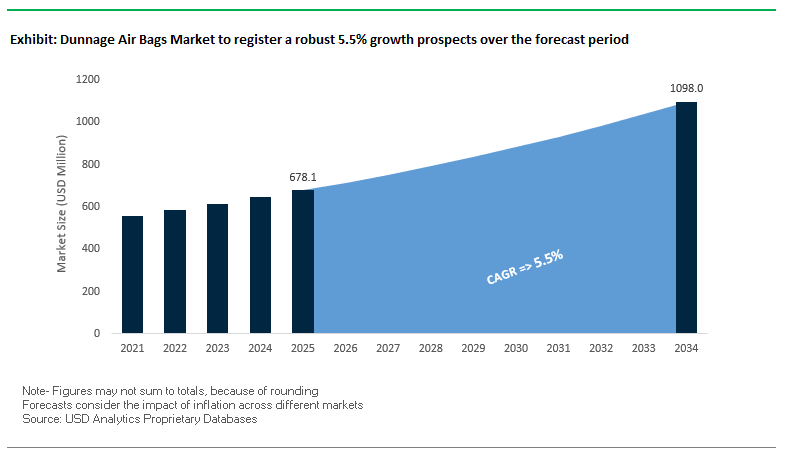
Dunnage Air Bags Market Overview: On-the-Move Load Securement Scaling to $1,097.9 Million by 2034 (CAGR 5.5%)
The global dunnage air bags market is forecast to grow from $678.1 million in 2025 to $1,097.9 million by 2034, registering a 5.5% CAGR. As a core element of transport packaging and cargo securement, dunnage bags prevent in-transit product damage across truck, rail, and ocean freight. For logistics leaders, packaging engineers, and procurement teams, the immediate questions are: Which poly-woven versus kraft paper platforms best balance cost, sustainability, and strength by lane? How can automation and integrated inflation shave minutes (and labor) off each load? And where should budgets land to cut damage claims while improving OTIF performance in global e-commerce and high-value shipments?
Executive insights for buyers and operators
Transport Mix Matters: Truck remains the largest user, with ocean shipping growing fastest as cross-border e-commerce and global trade expand.
Material Adoption Split: Poly-woven dunnage bags lead for strength/cycle life and cost-in-use; kraft paper bags gain share as an eco-friendly alternative in compliant lanes.
Damage Reduction ROI: Adoption is fueled by measurable drops in friction/impact/vibration damage lowering claims, rework, and returns.
Customization + Automation: Bag sizing by SKU/pallet pattern and automated inflation systems boost throughput, reduce labor, and standardize load quality.
Market Analysis: 2024–2025 Developments in Sustainability, Security, and Scale
The dunnage air bags landscape in 2025 reflects packaging’s broader pivot to sustainability, consolidation, and systems efficiency with direct implications for load securement strategies.
Sustainability and premium cargo protection intensify. In September 2025, Constantia Flexibles trailed low-carbon lidding within its Ecolutions suite at FACHPACK 2025 a category-adjacent signal that shippers increasingly mandate low-footprint packaging systems, including protective components such as dunnage. In August 2025, Orora’s acquisition of Saverglass underscored the growth of luxury spirits/cosmetics segments where secure transit and robust dunnage specifications are non-negotiable to protect high-value loads.
Maritime safety focus lifts securement rigor. Also in August 2025, a specialized publication highlighted new maritime safety requirements and projects, elevating scrutiny on containerized load restraint. Earlier incidents still resonate: by June 2025, industry data showed 576 containers lost at sea in 2024, with reroutes via the Cape of Good Hope amplifying sea states and risk. The result is renewed emphasis on validated dunnage specs, valve integrity, and placement SOPs for export lanes.
Paper powerhouses consolidate; sustainable systems spread. In July 2025, the Smurfit Kappa–WestRock merger created Smurfit WestRock, consolidating the paper ecosystem that underpins kraft-paper dunnage supply. In May 2025, DS Smith launched DryPack in North America to replace EPS another proof point that paper-based, recyclable protectives are scaling alongside dunnage in mixed protective systems. Upstream materials capacity also evolves: February 2025 saw Berry Global merge major nonwovens/films assets with Glatfelter, signaling ongoing films and specialty media integration that can influence poly-woven supply. And in November 2024, Dart + PulPac brought dry-molded fiber technology to North America an innovation pathway that could inform future fiber-based protectives adjacent to dunnage.
Trends and Opportunities Reshaping the Dunnage Air Bags Market
Strategic Shift Towards Sustainable and Recyclable Material Formulations
The dunnage air bags market is witnessing a decisive pivot from multi-layer film structures toward mono-material polyolefin constructions, a change driven by mounting sustainability mandates and global efforts to minimize plastic waste in logistics. Major logistics providers and brand owners have committed to 100% recyclable or reusable packaging by 2030, creating direct pressure on suppliers to develop recyclable mono-material solutions like polypropylene (PP) and polyethylene (PE). Advanced PE formulations are being commercialized with enhanced puncture resistance and air retention, allowing the production of thinner, lighter bags that retain the durability needed for heavy-duty cargo protection. This lightweighting strategy reduces virgin plastic consumption, lowers manufacturing costs, and shrinks the carbon footprint associated with shipping. At the same time, manufacturers are integrating post-consumer recycled (PCR) content into dunnage air bags, enabling a more circular economy and helping brands meet recycled content targets set by regulators and ESG frameworks.
Integration of Smart Features for Supply Chain Visibility and Damage Prevention
The role of dunnage bags is expanding from simple void-fill cushioning to becoming intelligent components of connected logistics ecosystems. The integration of IoT-enabled sensors, RFID, and QR codes allows companies to capture real-time data on shipments, enabling improved risk management and proactive interventions. Smart dunnage bags equipped with pressure, temperature, and humidity sensors provide continuous visibility into cargo conditions, a capability especially valuable for pharmaceuticals, food, and other sensitive goods. Logistics managers can receive instant alerts if there is a pressure drop, shock event, or environmental excursion, enabling them to reroute shipments or file insurance claims before extensive losses occur. Over time, the data collected from smart dunnage bags becomes a valuable resource for predictive analytics, allowing firms to pinpoint recurring issues at specific hubs or transit routes, optimize handling practices, and ultimately reduce damage-related costs across the supply chain.
Development of Bio-Based and Compostable Films for Sustainable Logistics
A significant white-space opportunity lies in the development of bio-based and industrially compostable dunnage bags, responding to a growing demand from industries where recyclability is not sufficient and landfill diversion is a corporate priority. Companies in organic food, retail, and premium consumer goods are actively seeking packaging solutions that align with their zero-waste goals. Materials such as polylactic acid (PLA) and next-generation polyhydroxyalkanoates (PHA) are being studied for their ability to provide both durability and reliable air retention, a prerequisite for logistics use. Although composting infrastructure remains limited in many regions, the commercialization of compostable dunnage bags represents a step toward building new biodegradable packaging supply chains. Academic research highlights PHA’s potential to degrade in diverse environments, including industrial composting, making it a viable long-term alternative. For manufacturers, this opportunity represents a chance to differentiate in a crowded market by providing eco-friendly packaging solutions that support both regulatory compliance and brand storytelling.
Advanced On-Demand Manufacturing and Sizing Algorithms
Another high-potential opportunity is the adoption of AI-driven on-demand manufacturing systems that optimize dunnage bag size, quantity, and inflation pressure based on shipment-specific variables. Instead of relying on standard sizes, logistics providers can use software-driven algorithms to calculate the precise bag dimensions required for a given container or pallet configuration. This ensures maximum load security while minimizing material use. AI-enabled systems also account for critical variables like cargo fragility, contact area, and optimal inflation pressure, which reduces the risks of under- or over-inflation. By combining these capabilities with on-demand digital manufacturing, companies can eliminate the inefficiencies of stocking multiple SKUs of standard-sized bags, significantly cutting inventory and material waste. This precision-driven approach supports both cost optimization and sustainability, while also meeting the increasingly complex demands of e-commerce and global freight logistics.
Competitive Landscape: Integrated Load-Securement Leaders and Specialized Providers
The competitive field spans end-to-end packaging platforms and cargo-securement specialists. Winning propositions combine AAR/rail compliance, valve tech and inflation speed, FSC/eco credentials, and application engineering that matches bag performance to route risk and pallet geometry.
Signode Industrial Group LLC Paper & Poly-Woven Dunnage with Fast-Inflation Valves
Signode offers a broad industrial packaging suite, including paper and poly-woven dunnage bags. Its paper range features the patented Striker™ valve (venturi-based) for fast, simple inflation, improving load-out takt times. With global footprint and a portfolio spanning strapping, films, tools, and dunnage, Signode enables integrated securement from stretch wrap to void fill. Sustainability credentials include 100% FSC paper construction and valve/foil components compliant with EU heavy-metal regulations, aligning with shipper ESG scorecards.
Cordstrap Engineered D-Connect Bags with Application Consulting
Cordstrap specializes in cargo securing systems and its D-Connect dunnage line spans five performance levels from light-duty stabilizers to heavy-duty for challenging loads. Differentiation comes from consultative sizing/level selection and faster inflation via optimized valve positioning (reported ~20% time savings). Cordstrap prioritizes regulatory compliance and port-control readiness, reducing detention risk and accelerating global throughput for shippers.
Shurtape Technologies, LLC End-of-Line Packaging Complements for Load Integrity
Though best known for adhesive tapes (Duck®, T-Rex®), Shurtape supports end-of-line packaging that pairs with dunnage to ensure outer-pack integrity. Investments such as the Pro Tapes & Specialties acquisition expanded pressure-sensitive manufacturing depth. At events like PACK EXPO, Shurtape showcases secure, sustainable tapes that maintain case closure critical to overall load performance when dunnage stabilizes the internal voids.
Cargo-Safe Global High-Pressure, Multi-Mode Dunnage Solutions
Cargo-Safe delivers paper and poly-woven dunnage bags rated up to ~5-ton working pressures, supported by airtight construction and dedicated inflator tools. Designed for road, rail, and sea, the range addresses light to heavy-duty applications. The company’s strength lies in durability, cost-effectiveness, and breadth of SKUs, enabling tailored programs for 3PLs and OEMs with varied lane risks.
AAR CORP. AAR-Verified Bags for Rail and Intermodal Safety
With roots in aviation services and deep ties to North American rail, AAR CORP. supplies AAR-verified dunnage bags for railcars, intermodal containers, and trucks. Certification assures compliance with stringent safety/performance standards vital for shippers prioritizing rail reliability. While AAR’s August 2025 acquisition of Aerostrat focused on aviation software, it underscores a broader strategy of technology-enabled, standards-driven logistics solutions that complement its securement offerings.
Dunnage Air Bags Market Share Insights
Disposable Dunnage Bags Dominate Market Share by Bag Type
Disposable dunnage bags account for 85% of the global dunnage air bags market in 2025, making them the clear standard across international and domestic supply chains. Their dominance stems from the one-way structure of most global trade flows, where retrieving, reinflating, and redistributing reusable bags is logistically unfeasible and cost-prohibitive. Shippers prioritize simplicity, reliability, and low upfront cost, making disposable dunnage bags the default choice for securing loads in containers, trucks, and railcars. Constructed primarily from kraft paper and polyethylene, these bags combine affordability with sufficient durability to handle a single transit cycle, ensuring goods arrive undamaged while keeping operational costs low. Reusable dunnage bags, by contrast, hold a smaller share but serve an important role in closed-loop logistics systems. Automotive supply chains and large-scale manufacturers with controlled return routes are prime users, as they can justify the higher upfront investment with repeated use. However, their adoption remains limited by fragmented global logistics networks, which favor disposable solutions over circular systems.
Overseas Containers Lead Market Share by Application
Overseas containers represent 65% of the global dunnage air bags market share in 2025, cementing their role as the industry’s most critical application. The high volume of international containerized trade spanning electronics, automotive parts, food products, and consumer goods creates immense demand for dunnage bags to prevent cargo shifting during long voyages. Exposure to ocean swells, crane lifts, and multimodal transfers means that even minor voids between pallets can translate into catastrophic product damage, making air bags a cost-effective insurance policy. Trucking applications form the second-largest share, particularly in less-than-truckload (LTL) shipments where pallets of varying sizes must be stabilized to ensure on-time, damage-free delivery. With the rapid expansion of e-commerce and regional distribution hubs, trucks are an increasingly important driver of dunnage bag demand. Railway applications, while smaller, remain strategically important for bulk and long-distance freight. Dunnage bags are used selectively in boxcars to stabilize sensitive or high-value goods, but intermodal containers already secured for sea or truck often limit their broader use in rail. Collectively, these applications highlight how dunnage air bags have become indispensable to modern freight security, reducing claims, protecting brands, and enhancing load efficiency across multimodal logistics.
United States: Leadership in Automotive and E-commerce Logistics Boosts Dunnage Air Bags Market
The U.S. dunnage air bags market is a global leader, driven by its expansive automotive and e-commerce logistics sectors. High-value automotive components require secure load protection, while the booming e-commerce ecosystem including companies like Amazon and FedEx relies heavily on dunnage air bags to safeguard shipments across complex road and rail networks. Manufacturers are responding with high-performance, recyclable air bags, increasingly made from multi-ply Kraft paper and woven polypropylene with recycled content, catering to sustainability-conscious customers.
Technological advancements are reshaping the market, with automated inflation systems and IoT-enabled monitoring enhancing operational efficiency and ensuring cargo integrity. The focus on reusable and eco-friendly solutions reflects a broader trend toward sustainable logistics packaging, combining cost-effectiveness with environmental responsibility. This makes the U.S. a hub for innovation in durable, high-quality dunnage air bag solutions.
Germany: Industrial Excellence and Regulatory Compliance Drive Market Growth
Germany’s dunnage air bags industry is fueled by the country’s high-value manufacturing and export economy, particularly in automotive, machinery, and industrial equipment sectors. The market is heavily influenced by strict EU load securing regulations, necessitating certified dunnage solutions that ensure product safety and compliance. This regulatory environment favors companies that can demonstrate both quality and reliability.
Sustainability is a core focus, with manufacturers producing reusable and recycled-material air bags in line with the European Green Deal and circular economy principles. The combination of high-performance products, regulatory compliance, and eco-friendly innovation positions Germany as a key market for advanced dunnage air bag solutions in Europe.
China: Manufacturing Powerhouse and Global Export Hub Strengthen Market Demand
China’s dunnage air bags market benefits from the country’s role as a global manufacturing and export hub, serving both domestic and international logistics needs. The products are essential for containerized cargo, sea freight, and rail transport, supporting the growing global trade network. Chinese manufacturers are investing in automation and advanced production technologies to enhance efficiency and reduce costs, producing high-performance air bags suitable for diverse cargo types.
The Belt and Road Initiative (BRI) has further expanded demand, as new rail and road corridors connecting China to Europe and Africa require secure and reliable load protection. China’s market combines high-volume production capacity, technological innovation, and export-oriented growth, making it a critical player in the global dunnage air bags landscape.
India: Rapid E-commerce and Industrialization Fuel Market Expansion
India’s dunnage air bags market is experiencing rapid growth, propelled by the expansion of the logistics, warehousing, and e-commerce sectors. Increasing industrialization in automotive and electronics manufacturing is driving demand for reliable packaging solutions to ensure safe transportation of goods. The government’s focus on infrastructure development, including highways and rail networks, enhances the efficiency and reach of freight transport, further boosting market potential.
Sustainability is shaping product innovation, with a growing preference for reusable and recyclable air bags that reduce waste and optimize costs. The combination of industrial growth, rising e-commerce activity, and eco-conscious trends is positioning India as a fast-growing market for high-quality dunnage air bag solutions.
Brazil: Agri-Business and E-commerce Expansion Enhance Market Opportunities
Brazil’s dunnage air bags market is driven by the country’s agricultural and automotive sectors, which require secure packaging for bulk goods and manufactured components destined for both domestic and export markets. The rise of e-commerce and logistics services in Latin America is creating additional demand for dunnage solutions that protect shipments from damage during transit.
Cost-effectiveness and adaptability are key market drivers, as dunnage air bags offer a flexible alternative to traditional wooden bracing. The Brazilian market is characterized by a focus on efficient, high-performance, and sustainable load securement solutions, making it a strategically important region in the global dunnage air bags industry.
Dunnage Air Bags Market Report Scope
Dunnage Air Bags Market
Parameter
Details
Market Size (2025)
$678.1 Million
Market Size (2034)
$1097.9 Million
Market Growth Rate
5.5%
Segments
By Material Type (Kraft Paper, Polywoven, Polyethylene, Vinyl), By Bag Type (Disposable Dunnage Bags, Reusable Dunnage Bags), By Load Capacity (Light Duty, Heavy Duty, Ultra-Heavy Duty), By Application (Trucks, Overseas Containers, Railways)
Study Period
2019- 2024 and 2025-2034
Units
Revenue (USD)
Qualitative Analysis
Porter’s Five Forces, SWOT Profile, Market Share, Scenario Forecasts, Market Ecosystem, Company Ranking, Market Dynamics, Industry Benchmarking
Companies
Cordstrap B.V., Signode Industrial Group LLC, Litco International Inc., Stopak India Pvt. Ltd., Cargo Tuff LLC, Atlanta Dunnage Services LLC, Green Label Packaging, Southern Bracing Systems Enterprises LLC, Shandong Xinyu Industrial Co., Ltd., Shippers Products, Wenzhou Lianhai Bag Company Ltd., Atmet Group Inc., Global-Pak Inc., Parimet Safepak (Shenzhen) Company Limited, Bates Cargo-Pak ApS
Countries
US, Canada, Mexico, Germany, France, Spain, Italy, UK, Russia, China, India, Japan, South Korea, Australia, South East Asia, Brazil, Argentina, Middle East, Africa
Dunnage Air Bags Market Segmentation
By Material Type
Kraft Paper
Polywoven
Polyethylene
Vinyl
By Bag Type
Disposable Dunnage Bags
Reusable Dunnage Bags
By Load Capacity
Light Duty
Heavy Duty
Ultra-Heavy Duty
By Application
Trucks
Overseas Containers
Railways
Countries Analyzed
North America (US, Canada, Mexico)
Europe (Germany, UK, France, Spain, Italy, Russia, Rest of Europe)
Asia Pacific (China, India, Japan, South Korea, Australia, South East Asia, Rest of Asia)
South America (Brazil, Argentina, Rest of South America)
Middle East and Africa (Saudi Arabia, UAE, Rest of Middle East, South Africa, Egypt, Rest of Africa)
Top Companies in Dunnage Air Bags Market
Cordstrap B.V.
Signode Industrial Group LLC
Litco International Inc.
Stopak India Pvt. Ltd.
Cargo Tuff LLC
Atlanta Dunnage Services LLC
Green Label Packaging
Southern Bracing Systems Enterprises LLC
Shandong Xinyu Industrial Co., Ltd.
Shippers Products
Wenzhou Lianhai Bag Company Ltd.
Atmet Group Inc.
Global-Pak Inc.
Parimet Safepak (Shenzhen) Company Limited
Bates Cargo-Pak ApS
* List Not Exhaustive
Research Coverage
This USDAnalytics report investigates the global dunnage air bags market, examining the latest breakthroughs in sustainable materials, automation, and smart logistics solutions. The analysis reviews market dynamics, competitive strategies, regulatory compliance, and technological innovations, highlighting how poly-woven, kraft paper, and bio-based air bags are transforming cargo securement. This report highlights trends in AI-driven sizing algorithms, IoT-enabled monitoring, and reusable/compostable solutions that enhance operational efficiency, reduce damage claims, and align with global ESG mandates. USDAnalytics provides a comprehensive assessment of the evolving logistics landscape, including material adoption, multimodal applications, and cost-optimization strategies. This report is an essential resource for logistics managers, procurement professionals, packaging engineers, and supply chain strategists seeking actionable insights, risk mitigation approaches, and sustainable packaging solutions. Historic data from 2021 to 2024 combined with forecasts to 2034 allow decision-makers to benchmark growth, identify high-value markets, and evaluate strategic partnerships, while detailed company profiles support competitive intelligence and innovation tracking.
Scope Highlights:
Segmentation: By Material Type (Kraft Paper, Polywoven, Polyethylene, Vinyl), By Bag Type (Disposable Dunnage Bags, Reusable Dunnage Bags), By Load Capacity (Light Duty, Heavy Duty, Ultra-Heavy Duty), By Application (Trucks, Overseas Containers, Railways)
Geographic Scope: Analysis spans 25+ countries across North America, Europe, Asia Pacific, Latin America, the Middle East & Africa.
Time Frame: Historic data from 2021 to 2024 and forecast data from 2025 to 2034.
Companies: Analysis and profiles of 15+ companies, including Cordstrap B.V., Signode Industrial Group LLC, Litco International Inc., Stopak India Pvt. Ltd., Cargo Tuff LLC, and Shippers Products.
Methodology
The research methodology combines primary interviews with logistics managers, packaging engineers, procurement executives, and industry experts, alongside secondary research from company filings, trade journals, and regulatory databases. USDAnalytics applied quantitative modeling, triangulating historical shipment volumes, material consumption, and application-specific adoption rates. Forecasts for 2025–2034 were generated using scenario analysis that incorporates regulatory developments, sustainability mandates, and emerging automation trends. Competitive benchmarking assessed company product portfolios, innovation pipelines, global supply capabilities, and ESG performance. The methodology ensures reliable insights for identifying growth opportunities, mitigating in-transit risk, and optimizing dunnage air bag strategies for multimodal transport across diverse industrial sectors.
Deliverables:
• Comprehensive Market Research Report (PDF and Excel) with detailed tables, charts, and interactive visualizations.
• Country-Specific Forecasts & Analysis.
• Segment-Wise Revenue Forecasts (2025–2034).
• Competitive Analysis, Benchmarking, and SWOT Profiles.
• Recent Developments & Innovation Tracker.
• Executive Summary & Analyst Commentary.
• Post-Purchase Analyst Support for Client-Specific Questions and Custom Data Requirements.
2. Dunnage Air Bags Market Landscape & Outlook (2025–2034)
2.1. Introduction to Dunnage Air Bags Market
2.2. Market Valuation and Growth Projections (2025–2034)
2.3. Regulatory and Safety Standards Impacting Load Securement
2.4. Material Adoption and Sustainability Trends
2.5. Automation, Customization, and Operational Efficiency
3. Innovations Reshaping the Dunnage Air Bags Market
3.1. Trend: Strategic Shift Towards Sustainable and Recyclable Material Formulations
3.2. Trend: Integration of Smart Features for Supply Chain Visibility and Damage Prevention
3.3. Opportunity: Development of Bio-Based and Compostable Films for Sustainable Logistics
3.4. Opportunity: Advanced On-Demand Manufacturing and Sizing Algorithms
4. Competitive Landscape and Key Players
4.1. Signode Industrial Group LLC Paper & Poly-Woven Dunnage with Fast-Inflation Valves
4.2. Cordstrap Engineered D-Connect Bags with Application Consulting
4.3. Shurtape Technologies, LLC End-of-Line Packaging Complements
4.4. Cargo-Safe Global High-Pressure, Multi-Mode Dunnage Solutions
4.5. AAR CORP. AAR-Verified Bags for Rail and Intermodal Safety
5. Market Share and Segmentation Insights: Dunnage Air Bags Market
5.1. By Material Type
5.1.1. Kraft Paper
5.1.2. Polywoven
5.1.3. Polyethylene
5.1.4. Vinyl
5.2. By Bag Type
5.2.1. Disposable Dunnage Bags
5.2.2. Reusable Dunnage Bags
5.3. By Load Capacity
5.3.1. Light Duty
5.3.2. Heavy Duty
5.3.3. Ultra-Heavy Duty
5.4. By Application
5.4.1. Trucks
5.4.2. Overseas Containers
5.4.3. Railways
6. Country Analysis and Outlook of Dunnage Air Bags Market
6.1. United States
6.2. Canada
6.3. Mexico
6.4. Germany
6.5. France
6.6. Spain
6.7. Italy
6.8. UK
6.9. Russia
6.10. China
6.11. India
6.12. Japan
6.13. South Korea
6.14. Australia
6.15. South East Asia
6.16. Brazil
6.17. Argentina
6.18. Middle East
6.19. Africa
7. Dunnage Air Bags Market Size Outlook by Region (2025–2034)
7.1. North America Dunnage Air Bags Market Size Outlook to 2034
7.1.1. By Material Type
7.1.2. By Bag Type
7.1.3. By Load Capacity
7.1.4. By Application
7.2. Europe Dunnage Air Bags Market Size Outlook to 2034
7.2.1. By Material Type
7.2.2. By Bag Type
7.2.3. By Load Capacity
7.3. Asia Pacific Dunnage Air Bags Market Size Outlook to 2034
7.3.1. By Material Type
7.3.2. By Bag Type
7.3.3. By Load Capacity
7.4. South America Dunnage Air Bags Market Size Outlook to 2034
7.4.1. By Material Type
7.4.2. By Bag Type
7.4.3. By Load Capacity
7.5. Middle East and Africa Dunnage Air Bags Market Size Outlook to 2034
7.5.1. By Material Type
7.5.2. By Bag Type
7.5.3. By Load Capacity
8. Company Profiles: Leading Players in the Dunnage Air Bags Market
8.1. Cordstrap B.V.
8.2. Signode Industrial Group LLC
8.3. Litco International Inc.
8.4. Stopak India Pvt. Ltd.
8.5. Cargo Tuff LLC
8.6. Atlanta Dunnage Services LLC
8.7. Green Label Packaging
8.8. Southern Bracing Systems Enterprises LLC
8.9. Shandong Xinyu Industrial Co., Ltd.
8.10. Shippers Products
8.11. Wenzhou Lianhai Bag Company Ltd.
8.12. Atmet Group Inc.
8.13. Global-Pak Inc.
8.14. Parimet Safepak (Shenzhen) Company Limited
8.15. Bates Cargo-Pak ApS
9. Methodology
9.1. Research Scope
9.2. Market Research Approach
9.3. Market Sizing and Forecasting Model
9.4. Research Coverage
9.5. Data Horizon
9.6. Deliverables
10. Appendix
10.1. Acronyms and Abbreviations
10.2. List of Tables
10.3. List of Figures
Dunnage Air Bags Market Segmentation
By Material Type
Kraft Paper
Polywoven
Polyethylene
Vinyl
By Bag Type
Disposable Dunnage Bags
Reusable Dunnage Bags
By Load Capacity
Light Duty
Heavy Duty
Ultra-Heavy Duty
By Application
Trucks
Overseas Containers
Railways
Countries Analyzed
North America (US, Canada, Mexico)
Europe (Germany, UK, France, Spain, Italy, Russia, Rest of Europe)
Asia Pacific (China, India, Japan, South Korea, Australia, South East Asia, Rest of Asia)
South America (Brazil, Argentina, Rest of South America)
Middle East and Africa (Saudi Arabia, UAE, Rest of Middle East, South Africa, Egypt, Rest of Africa)
Poly-woven and kraft paper dunnage bags dominate the market, balancing strength, cost, and sustainability. Poly-woven bags provide high puncture resistance and multi-use durability, while kraft paper offers a recyclable, eco-friendly alternative for compliant lanes.
Integration of IoT sensors, RFID, and QR codes allows real-time monitoring of pressure, temperature, and humidity. Smart bags alert logistics managers to anomalies, enabling proactive interventions and reducing damage claims across multimodal shipments.
Overseas containerized trade accounts for the largest application share, followed by trucking and rail. Industries like automotive, electronics, e-commerce, and food require secure, damage-free transport, making dunnage bags indispensable for these high-value goods.
Sustainable trends include mono-material polyolefin construction, bio-based films, reusable bags, and incorporation of post-consumer recycled content. These innovations reduce environmental impact, comply with ESG standards, and support circular economy initiatives in logistics.
The U.S. leads due to automotive and e-commerce logistics, Germany drives demand through regulatory compliance and industrial exports, China leverages high-volume manufacturing and BRI trade corridors, and India grows rapidly via industrialization and e-commerce expansion.
More Transit, E-commerce and Bulk Packaging Reports