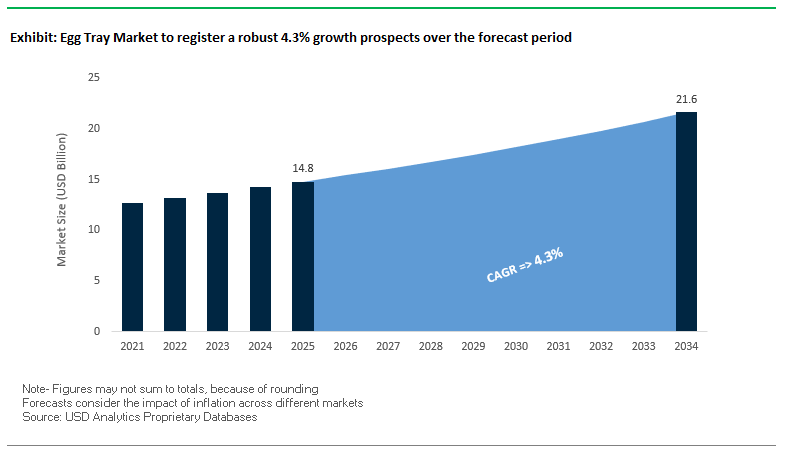
Market Overview: Egg Tray Market to Reach $21.6 Billion by 2034 at 4.3% CAGR
The global egg tray market is projected to expand from $14.8 billion in 2025 to $21.6 billion by 2034, registering a steady CAGR of 4.3%. Egg trays are indispensable in ensuring food safety, product protection, and efficient logistics, while simultaneously responding to growing sustainability mandates. The sector’s trajectory is shaped by molded fiber dominance, government-led sustainability policies, and technological integration into manufacturing. For buyers and industry professionals, the market offers significant opportunities in eco-friendly material innovation, logistics optimization, and automation-driven quality control.
Key Insights for Industry Stakeholders:
Molded fiber leadership: Trays made from 100% recycled pulp continue to dominate, offering cost-effective protection and compostable benefits.
Supply chain efficiency: Innovations in stackability, denesting, and dimensional stability reduce breakage during transit and maximize truck utilization.
Regulatory push: Europe and other regions are phasing out single-use plastics, accelerating adoption of biodegradable and recyclable trays.
Smart manufacturing: AI-driven visual inspection technologies are reducing defect rates from 3% to as low as 0.5%, boosting consistency in large-scale production.
Market Analysis: Strategic Acquisitions and Technological Innovation Driving Growth
The egg tray industry is undergoing rapid transformation through strategic acquisitions, certifications, and sustainable material breakthroughs. These developments reinforce its pivotal role in the global food packaging ecosystem.
In August 2025, Huhtamaki strengthened its North American molded fiber portfolio with the acquisition of Zellwin Farms, a move that significantly enhances its capacity and geographic presence. That same year, Hartmann partnered with Columbus Frischei (July 2025) to reintroduce brown eggs in Plus View packaging, a solution that combines molded fiber strength with transparent windows, meeting consumer demand for visibility.
Earlier, in April 2025, Pactiv Evergreen completed its acquisition by Novolex, consolidating two major food packaging companies into a dominant player in molded fiber and foam trays. Reinforcing its sustainability credentials, Pactiv Evergreen also earned FSC®-Recycled certification in January 2025 for its molded fiber trays and showcased its innovations at the IPPE Expo in Atlanta.
Restructuring has also shaped competition. Sonoco’s divestiture of its Thermoformed and Flexibles division in December 2024 redirected focus toward molded fiber packaging as part of its core growth strategy. Sustainability innovation is equally strong, with Palouse Fiber Packaging launching wheat-based trays in August 2024, introducing alternative fibers to replace plastics. Similarly, Innofibre’s July 2024 study validated the use of recycled beverage cartons in molded pulp trays, while Wegmans (April 2024) shifted from plastics to plant-based fiber trays, aligning retail packaging strategies with environmental mandates.
Trends and Opportunities Transforming the Egg Tray Market
Regulatory-Driven Shift from Plastic and Polystyrene to Molded Fiber
The egg tray market is undergoing a regulatory-driven transformation as plastic and expanded polystyrene (EPS) formats are phased out in favor of molded fiber packaging. The European Union’s Single-Use Plastics Directive (SUPD), which came into effect on July 3, 2021, has accelerated the decline of EPS packaging by setting stringent restrictions on hard-to-recycle materials. In the United States, by early 2025, 12 states had banned EPS food packaging, creating a major shift towards recyclable and compostable fiber-based alternatives. Industry leaders like Huhtamaki are capitalizing on this momentum, investing over $100 million in 2022 to expand molded fiber manufacturing in North America. The move is reinforced by consumer demand for plastic-free, biodegradable solutions, which positions molded fiber as the new global standard for sustainable egg trays.
Strategic Backward Integration by Major Producers to Secure Recycled Fiber Supply
A second key trend reshaping the egg tray market is backward integration into recycled fiber supply chains. With volatility in post-consumer waste paper (PCW) prices and increasing competition for raw materials, manufacturers are establishing their own recycling operations to ensure production stability and cost efficiency. By processing waste cardboard and paper into pulp in-house, producers reduce dependence on fluctuating commodity markets. In parallel, companies are exploring alternative renewable fibers such as sugarcane bagasse and bamboo, which offer similar mechanical properties to wood pulp while diversifying the supply base. This trend is also supported by Extended Producer Responsibility (EPR) schemes, which make producers financially accountable for end-of-life packaging. Vertical integration and sourcing diversification are therefore becoming critical strategies for securing raw material supply and maintaining competitiveness in the egg tray market.
Development of High-Performance, Wet-Strength Molded Fiber Trays
A major opportunity exists in creating moisture-resistant molded pulp egg trays that maintain their structural integrity in refrigerated and high-humidity environments. Traditional fiber trays often lose rigidity under these conditions, but advances in bio-based coatings and additives are providing effective solutions. Research demonstrates that natural water-based coatings can improve wet strength by over 30%, ensuring trays remain durable without relying on PFAS or plastic liners. Additionally, functional fiber engineering such as blending longer cellulose fibers into pulp enhances moisture resistance at the structural level. Industry innovation is already underway, with material science companies launching water-repellent, recyclable coatings that are both repulpable and compostable. These advancements are setting the stage for a new generation of high-performance molded fiber trays capable of competing with plastic while meeting global sustainability mandates.
Integration of Digital Watermarks for Enhanced Recycling and Traceability
The adoption of digital watermarking technologies presents a transformative opportunity for the egg tray market, enabling precision recycling and consumer engagement. The HolyGrail 2.0 Initiative, led by AIM – European Brands Association, has proven the effectiveness of invisible watermarks in semi-industrial trials, achieving 99% detection accuracy and over 93% purity in material sorting. This breakthrough allows recyclers to distinguish between packaging types that appear identical, creating higher-quality recycled streams and supporting circular economy objectives. Beyond recycling, watermarks also function as digital passports, enabling consumers to scan trays with smartphones for instant access to information on farm origin, certification, and safety standards. Some brands are exploring this for value-added consumer engagement, providing recipes, sustainability scores, or brand stories directly through packaging. This dual function of improving recycling efficiency and building brand transparency makes digital watermarking one of the most promising innovations in the egg tray market.
Competitive Landscape: Key Players Shaping the Global Egg Tray Industry
The competitive landscape features a mix of long-established molded fiber leaders, diversified packaging multinationals, and PET specialists driving innovation. Differentiation is built on sustainability, global footprint, and technology integration.
Hartmann A/S Leading Global Innovator in Molded Fiber Egg Trays
Hartmann is a world leader in molded fiber egg packaging, producing eco-friendly trays from recycled paper. With its acquisition of Dentaş in Romania, Hartmann strengthened its European presence. Its Plus View packaging introduces transparent windows to meet visibility demands, while its production technology platform supplies complete lines and tooling to other manufacturers, cementing its dual role as producer and enabler.
Huhtamaki Oyj Expanding Molded Fiber Capacity in North America
Huhtamaki is a global packaging leader with a focus on molded fiber cartons and egg flats. Its August 2025 acquisition of Zellwin Farms boosts U.S. molded fiber production. Operating in 36 countries, Huhtamaki offers localized service with global reliability, emphasizing acquisition-led growth to lead in renewable and recyclable molded fiber packaging.
Pactiv Evergreen Inc. FSC-Certified Solutions and Novolex Merger Synergies
Pactiv Evergreen offers molded fiber and foam trays, balancing cost efficiency with sustainability. In January 2025, it achieved FSC®-Recycled certification for its fiber cartons, underscoring environmental commitment. Its $6.7 billion merger with Novolex in April 2025 positions it as a major global supplier, leveraging diverse material expertise from fiber to recycled PET.
Ovotherm International Handels GmbH Transparent PET Egg Trays for Retail Merchandising
Ovotherm specializes in transparent rPET trays, providing superior visibility at retail shelves. Its trays are engineered for packing station efficiency while enhancing brand differentiation through visibility. By using recycled PET, Ovotherm ensures circularity, with trays that can be recycled multiple times without quality loss, making it a leader in retail-ready egg packaging.
Omni-Pac Group is a key European player in sustainable molded fiber packaging. Following its acquisition of MFP in the UK, it rebranded to Omni-Pac Group, reflecting its expanded footprint. With three automated facilities across France, Germany, and the UK, and exports to the Middle East, Africa, and the Americas, Omni-Pac annually recycles 100,000+ tons of paper and cardboard, giving waste a “second life” and reinforcing its circular economy positioning.
Egg Tray Market Share Insights
30-Egg Trays Lead Egg Tray Market Share by Product Type
By product type, 30-egg trays dominate the global egg tray market in 2025, as they are the industry standard for bulk handling, transportation, and wholesale distribution. Their popularity stems from cost efficiency, stackability, and the ability to reduce breakage during long-distance logistics, making them indispensable in both commercial farming and retail supply chains. 12-egg and 6-egg trays, while smaller in share, play a critical role in retail packaging where consumer convenience, portion control, and easy handling are priorities. The 18-egg tray segment captures a mid-range niche, appealing to households and regional markets with larger average consumption patterns. Other specialized capacities remain limited, typically serving local or customized retail needs. Overall, the dominance of 30-egg trays reflects the high-volume, efficiency-driven requirements of the poultry industry, while smaller formats highlight consumer-facing retail dynamics and the need for differentiated packaging across diverse markets.
Chicken Eggs Anchor Egg Tray Market Share by Application
By application, chicken eggs hold the overwhelming majority share of the egg tray market in 2025, reflecting their position as the most widely consumed poultry product globally. Chicken eggs dominate both retail and wholesale distribution, requiring trays that balance strength, ventilation, and cushioning to ensure safety during transport and storage. Duck eggs and quail eggs represent smaller but growing segments, supported by niche consumption in Asia-Pacific, the Middle East, and specialty gourmet markets where premium packaging formats enhance product visibility and value perception. Other poultry eggs, including goose and turkey, account for a minimal share but demonstrate the versatility of egg trays in meeting diverse egg-handling requirements. The dominance of chicken eggs underscores the mass-market nature of the industry, while the emerging growth of alternative poultry eggs highlights the importance of tray innovation to support niche markets and value-added segments.
United States: Automation and Sustainable Materials Driving Egg Tray Market Growth
The U.S. egg tray market is a leader in adopting advanced automation technologies, including computer vision systems for quality control and high-speed robotic stacking and palletizing systems. These innovations enhance production efficiency and reduce labor costs, meeting the increasing demand for large-scale egg distribution.
Sustainability is another major driver, with manufacturers shifting toward eco-friendly materials such as recycled paper fiber and post-consumer recycled (PCR) plastics. Companies are also developing durable and reusable designs, aligning with corporate sustainability goals. In addition, the growth of e-commerce and direct-to-consumer (D2C) sales is fueling demand for protective egg trays that can withstand shipping and handling, while state-level regulations on single-use plastics and packaging waste are encouraging further innovation in sustainable egg tray solutions.
Germany: Circular Economy and Green Technology Innovation Lead Europe
Germany’s egg tray industry is at the forefront of Europe’s circular economy, with a focus on molded fiber products made from 100% recycled paper. Innovations include the use of natural starch glue and mineral oil-free inks, ensuring that the entire tray is recyclable. Corrugated cardboard egg trays are gaining traction for their superior protection and stability, while also providing a valuable surface for custom printing and branding, a growing value-added application for egg producers.
German manufacturers are strategically investing in green technology, such as renewable energy-powered production lines and photovoltaic systems, to reduce their carbon footprint. This combination of sustainable materials, efficient design, and eco-friendly production practices positions Germany as a European leader in innovative and environmentally responsible egg tray solutions.
China: High-Volume Production and Regulatory Compliance Shape Market Dynamics
China serves as a global production and export hub for the egg tray industry, supplying both domestic and international markets. The market benefits from advanced pulp molding technology, enabling manufacturers to produce a wide range of trays, including egg and fruit trays, with a focus on versatility and scalability.
Government initiatives are shaping the industry, with new regulations on waste paper imports and domestic recycling infrastructure promoting the use of locally sourced recycled paper, which lowers production costs and supports environmental goals. China’s capacity for high-volume production combined with compliance with recycling and sustainability mandates ensures it remains a global leader in egg tray manufacturing.
India: Policy Support and Urbanization Propel Paper-Based Egg Tray Market
India’s egg tray market is rapidly expanding due to urbanization, growing retail chains, and e-commerce growth, which increases demand for hygienic and well-packaged eggs. The government’s ban on certain single-use plastics has accelerated the shift toward sustainable, paper-based trays, offering eco-friendly alternatives to plastic and foam.
Cost-effectiveness and local material sourcing are critical competitive advantages. Manufacturers are increasingly using molded pulp from locally available paper and waste materials, providing affordable solutions for domestic producers. These developments, coupled with rapid urbanization and organized retail expansion, are driving strong growth in India’s eco-conscious egg tray market.
The Brazilian egg tray market focuses on enhancing product durability, a necessity given the country’s vast geography and challenging transport conditions. Manufacturers are experimenting with fiber recipes from sugarcane, coconut shells, and other agro-based materials, producing humidity-resistant, stronger egg trays that significantly reduce breakage during long-distance transit.
Strategic investments are being made to expand production capacity, meeting the demands of Brazil’s growing poultry industry. This combination of innovative material use, durability, and production scaling positions Brazil as a regional leader in sustainable and reliable egg tray solutions.
Japan: Precision, Safety, and Dry Molded Fiber Technology Lead Market
Japan’s egg tray industry emphasizes product quality, safety, and precision, driven by cultural practices of consuming raw eggs. Advanced automation and inspection technologies detect even the slightest egg imperfections, ensuring high standards of safety and consumer protection.
Innovation in Dry Molded Fiber (DMF) technology is transforming the market. Companies like Nippon Molding have adopted PulPac Modula machines to produce fiber-based, resource-efficient trays, offering a cost-effective alternative to plastic. This aligns with Japan’s environmental goals, reducing plastic waste while maintaining premium quality and precision in egg packaging.
Egg Tray Market Report Scope
Egg Tray Market
Parameter
Details
Market Size (2025)
$14.8 Billion
Market Size (2034)
$21.6 Billion
Market Growth Rate
4.3%
Segments
By Material Type (Molded Fiber, Plastic, Polystyrene Foam, Other Materials), By Product Type (6-Egg Trays, 12-Egg Trays, 18-Egg Trays, 30-Egg Trays, Other Capacities), By Application (Chicken Eggs, Duck Eggs, Quail Eggs, Other Poultry Eggs)
Study Period
2019- 2024 and 2025-2034
Units
Revenue (USD)
Qualitative Analysis
Porter’s Five Forces, SWOT Profile, Market Share, Scenario Forecasts, Market Ecosystem, Company Ranking, Market Dynamics, Industry Benchmarking
Companies
Huhtamaki Oyj, Hartmann A/S, International Paper Company, Pactiv Evergreen Inc., DS Smith Plc, Tekni-Plex, Inc., Sonoco Products Company, MyPak Packaging, Rengo Co., Ltd., Sealed Air Corporation, Dispak, Ovotherm International Handels GmbH, Visy Industries, BillerudKorsnäs AB, Cascades, Inc.
Countries
US, Canada, Mexico, Germany, France, Spain, Italy, UK, Russia, China, India, Japan, South Korea, Australia, South East Asia, Brazil, Argentina, Middle East, Africa
Egg Tray Market Segmentation
By Material Type
Molded Fiber
Plastic
Polystyrene Foam
Other Materials
By Product Type
6-Egg Trays
12-Egg Trays
18-Egg Trays
30-Egg Trays
Other Capacities
By Application
Chicken Eggs
Duck Eggs
Quail Eggs
Other Poultry Eggs
Countries Analyzed
North America (US, Canada, Mexico)
Europe (Germany, UK, France, Spain, Italy, Russia, Rest of Europe)
Asia Pacific (China, India, Japan, South Korea, Australia, South East Asia, Rest of Asia)
South America (Brazil, Argentina, Rest of South America)
Middle East and Africa (Saudi Arabia, UAE, Rest of Middle East, South Africa, Egypt, Rest of Africa)
Top Companies in Egg Tray Market
Huhtamaki Oyj
Hartmann A/S
International Paper Company
Pactiv Evergreen Inc.
DS Smith Plc
Tekni-Plex, Inc.
Sonoco Products Company
MyPak Packaging
Rengo Co., Ltd.
Sealed Air Corporation
Dispak
Ovotherm International Handels GmbH
Visy Industries
BillerudKorsnäs AB
Cascades, Inc.
*List not Exhaustive
Research Coverage
This report investigates the global egg tray market, providing an in-depth examination of innovations, sustainability initiatives, and operational efficiencies that are redefining protective packaging in the poultry industry. USDAnalytics’ analysis reviews breakthroughs in molded fiber technologies, water-resistant coatings, AI-enabled quality inspection, and backward-integrated fiber supply chains, highlighting their impact on reducing breakage, improving logistics efficiency, and meeting regulatory and consumer sustainability expectations. This report is an essential resource for packaging engineers, production managers, sustainability officers, and supply chain executives seeking actionable insights on market dynamics, competitive strategies, and emerging technologies. It also highlights strategic mergers, acquisitions, and certifications that shape competitive positioning, while evaluating high-performance designs across retail, foodservice, and wholesale distribution. By combining historic data from 2021 to 2024 with forecasts through 2034, the study offers a comprehensive perspective on market expansion, material adoption, and regional growth opportunities. Furthermore, it analyzes portfolio innovations, circular economy initiatives, and automation integration across leading companies, enabling professionals to navigate the ongoing transition from plastic and polystyrene trays to recyclable, compostable, and digitally traceable molded fiber solutions.
Scope Highlights:
Segmentation: By Material Type (Molded Fiber, Plastic, Polystyrene Foam, Other Materials); By Product Type (6-Egg Trays, 12-Egg Trays, 18-Egg Trays, 30-Egg Trays, Other Capacities); By Application (Chicken Eggs, Duck Eggs, Quail Eggs, Other Poultry Eggs)
Geographic Scope: Analysis spans 25+ countries across North America, Europe, Asia Pacific, Latin America, the Middle East & Africa
Historical & Forecast Data: Historic data from 2021 to 2024 and forecast data from 2025 to 2034
Companies Covered: In-depth analysis and profiles of 15+ companies, including Huhtamaki Oyj, Hartmann A/S, International Paper Company, Pactiv Evergreen Inc., DS Smith Plc, Tekni-Plex, Inc., Sonoco Products Company, MyPak Packaging, Rengo Co., Ltd., Sealed Air Corporation, Dispak, Ovotherm International Handels GmbH, Visy Industries, BillerudKorsnäs AB, and Cascades, Inc.
Methodology
This research adopts a structured approach combining primary and secondary methods to provide accurate and actionable insights into the egg tray market. Primary research involved interviews with packaging engineers, production managers, sustainability officers, and logistics experts to validate technological trends, automation adoption, and material preferences. Secondary research utilized company reports, regulatory filings, patent databases, trade publications, and scientific literature to track developments in molded fiber technology, wet-strength coatings, digital watermarking, and supply chain optimization. Market sizing and forecasts were derived through a combination of top-down and bottom-up approaches, considering production capacities, consumption patterns, regulatory mandates, and sustainability adoption rates. Competitive benchmarking evaluates mergers, acquisitions, certifications, and material innovations, while regional analysis incorporates economic drivers, policy frameworks, and consumption trends. USDAnalytics ensures all data is cross-verified to deliver reliable insights for professionals aiming to align operations with evolving regulatory and consumer demands.
Deliverables:
• Comprehensive Market Research Report (PDF and Excel) with detailed tables, charts, and interactive visualizations.
• Country-Specific Forecasts & Analysis.
• Segment-Wise Revenue Forecasts (2025–2034).
• Competitive Analysis, Benchmarking, and SWOT Profiles.
• Recent Developments & Innovation Tracker.
• Executive Summary & Analyst Commentary.
• Post-Purchase Analyst Support for Client-Specific Questions and Custom Data Requirements.
2. Egg Tray Market Landscape & Outlook (2025–2034)
2.1. Introduction to Egg Tray Market
2.2. Market Valuation and Growth Projections (2025–2034)
2.3. Key Market Drivers and Restraints
2.4. Technological Advancements and Manufacturing Innovations
2.5. Sustainability and Regulatory Impact on Market Dynamics
3. Innovations Reshaping the Egg Tray Market
3.1. Trend: Regulatory-Driven Shift from Plastic and Polystyrene to Molded Fiber
3.2. Trend: Strategic Backward Integration by Major Producers to Secure Recycled Fiber Supply
3.3. Opportunity: Development of High-Performance, Wet-Strength Molded Fiber Trays
3.4. Opportunity: Integration of Digital Watermarks for Enhanced Recycling and Traceability
4. Competitive Landscape: Key Players Shaping the Global Egg Tray Industry
4.1. Hartmann A/S Leading Global Innovator in Molded Fiber Egg Trays
4.2. Huhtamaki Oyj Expanding Molded Fiber Capacity in North America
4.3. Pactiv Evergreen Inc. FSC-Certified Solutions and Novolex Merger Synergies
4.4. Ovotherm International Handels GmbH Transparent PET Egg Trays for Retail Merchandising
4.5. CDL Omni-Pac (Omni-Pac Group) Circular Economy Leader in Molded Fiber Packaging
5. Market Share and Segmentation Insights: Egg Tray Market
5.1. By Material Type
5.1.1. Molded Fiber
5.1.2. Plastic
5.1.3. Polystyrene Foam
5.1.4. Other Materials
5.2. By Product Type
5.2.1. 6-Egg Trays
5.2.2. 12-Egg Trays
5.2.3. 18-Egg Trays
5.2.4. 30-Egg Trays
5.2.5. Other Capacities
5.3. By Application
5.3.1. Chicken Eggs
5.3.2. Duck Eggs
5.3.3. Quail Eggs
5.3.4. Other Poultry Eggs
6. Country Analysis and Outlook of Egg Tray Market
6.1. United States
6.2. Canada
6.3. Mexico
6.4. Germany
6.5. France
6.6. Spain
6.7. Italy
6.8. UK
6.9. Russia
6.10. China
6.11. India
6.12. Japan
6.13. South Korea
6.14. Australia
6.15. South East Asia
6.16. Brazil
6.17. Argentina
6.18. Middle East
6.19. Africa
7. Egg Tray Market Size Outlook by Region (2025-2034)
7.1. North America Egg Tray Market Size Outlook to 2034
7.1.1. By Material Type
7.1.2. By Product Type
7.1.3. By Application
7.2. Europe Egg Tray Market Size Outlook to 2034
7.2.1. By Material Type
7.2.2. By Product Type
7.2.3. By Application
7.3. Asia Pacific Egg Tray Market Size Outlook to 2034
7.3.1. By Material Type
7.3.2. By Product Type
7.3.3. By Application
7.4. South America Egg Tray Market Size Outlook to 2034
7.4.1. By Material Type
7.4.2. By Product Type
7.4.3. By Application
7.5. Middle East and Africa Egg Tray Market Size Outlook to 2034
7.5.1. By Material Type
7.5.2. By Product Type
7.5.3. By Application
8. Company Profiles: Leading Players in the Egg Tray Market
8.1. Huhtamaki Oyj
8.2. Hartmann A/S
8.3. International Paper Company
8.4. Pactiv Evergreen Inc.
8.5. DS Smith Plc
8.6. Tekni-Plex, Inc.
8.7. Sonoco Products Company
8.8. MyPak Packaging
8.9. Rengo Co., Ltd.
8.10. Sealed Air Corporation
8.11. Dispak
8.12. Ovotherm International Handels GmbH
8.13. Visy Industries
8.14. BillerudKorsnäs AB
8.15. Cascades, Inc.
9. Methodology
9.1. Research Scope
9.2. Market Research Approach
9.3. Market Sizing and Forecasting Model
9.4. Research Coverage
9.5. Data Horizon
9.6. Deliverables
10. Appendix
10.1. Acronyms and Abbreviations
10.2. List of Tables
10.3. List of Figures
Egg Tray Market Segmentation
By Material Type
Molded Fiber
Plastic
Polystyrene Foam
Other Materials
By Product Type
6-Egg Trays
12-Egg Trays
18-Egg Trays
30-Egg Trays
Other Capacities
By Application
Chicken Eggs
Duck Eggs
Quail Eggs
Other Poultry Eggs
Countries Analyzed
North America (US, Canada, Mexico)
Europe (Germany, UK, France, Spain, Italy, Russia, Rest of Europe)
Asia Pacific (China, India, Japan, South Korea, Australia, South East Asia, Rest of Asia)
South America (Brazil, Argentina, Rest of South America)
Middle East and Africa (Saudi Arabia, UAE, Rest of Middle East, South Africa, Egypt, Rest of Africa)
Molded fiber trays dominate due to their cost-effectiveness, compostability, and structural integrity. Manufacturers are also exploring recycled paper, sugarcane bagasse, bamboo fibers, and rPET alternatives to meet sustainability and regulatory requirements.
High-speed robotic stacking, palletizing, and AI-powered visual inspection systems are being widely adopted, reducing defect rates from 3% to 0.5% and enhancing operational efficiency while supporting large-scale distribution and consistent quality.
30-egg trays dominate the market due to bulk handling efficiency and reduced breakage, while 6-egg and 12-egg trays cater to retail consumers seeking convenience, portion control, and easy handling. 18-egg trays serve mid-sized households and regional markets.
Bans on EPS and single-use plastics in Europe, the U.S., and other regions are accelerating adoption of recyclable and compostable fiber trays. Companies are investing in molded fiber production and bio-based coatings to comply with sustainability mandates.