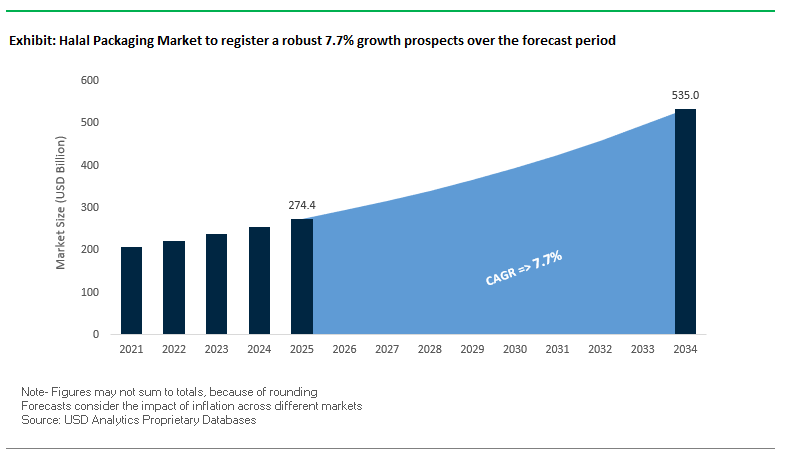
Market Overview: Halal Packaging Valued at $274.4 Billion in 2025; Poised to Reach $535 Billion by 2034
The Global Halal Packaging Market is valued at USD 274.4 billion in 2025 and is forecast to reach USD 535 billion by 2034, expanding at a strong CAGR of 7.7%. What began as a niche compliance need has become a mainstream, brand-differentiating strategy: halal-certified packaging now signals hygiene, quality assurance, and supply-chain integrity to Muslim and non-Muslim consumers alike. Procurement leaders and packaging R&D teams are prioritizing tamper-evidence, traceability, mono-material recyclability, and paper-based high-barrier solutions to meet Shariah compliance while advancing corporate sustainability.
Key Insights for industry Professionals
Certification as a growth lever: Halal certification spans materials and processes mitigating cross-contamination risk and elevating consumer trust across food, personal care, nutraceuticals, and pharma.
Supply-chain integrity: End-to-end segregation, tamper-evident features, and track-and-trace are central to preventing non-halal contact and counterfeit risk.
Sustainable halal solutions: Rising demand for biodegradable, recycled-content, and reusable formats aligns halal compliance with ESG goals.
Paper-based high-barrier formats: Brands are scaling recyclable paper with advanced barrier properties to replace multi-material laminates without compromising halal integrity.
E-commerce durability: Lightweight, mono-material structures that pass distribution stress tests lower damage, waste, and costs while maintaining halal assurance.
Market Analysis: Recent Developments Underscore Scale, Sustainability, and Integrity (2025)
Strategic investments and partnerships are reshaping halal packaging. In August 2025, Albéa acquired Amfora Packaging in Latin America bolstering regional supply for beauty and personal care lines where halal-compliant packaging demand is accelerating. Also in August 2025, Beta Glass reported a 63% H1 revenue surge, reflecting broader packaging momentum that spills over into halal end-markets. In July 2025, Huhtamaki earned its fifth consecutive EcoVadis Gold, reinforcing the market’s tilt toward third-party-verified sustainability a complement to halal integrity claims. The same month, Mondi partnered with Saga Nutrition to deliver sustainable pet-food packaging, signaling cross-category adoption of recyclable, halal-aligned materials and processes.
Performance, compliance, and logistics readiness are converging. In June 2025, Aptar Beauty extended ISTA-6 capabilities in Europe, strengthening e-commerce durability and product integrity both critical for halal-certified goods shipped through complex networks. In May 2025, Aptar was again named among TIME’s World’s Most Sustainable Companies, validating supplier selection criteria that weigh sustainability alongside halal compliance. Earlier, in March 2025, Constantia Flexibles and Aluflexpack AG joined forces to scale premium flexible innovations, and in January 2025 the Smurfit Kappa–WestRock merger created a paper-based heavyweight, deepening capacity for recyclable fiber solutions suited to halal specifications.
Emerging Trends and Strategic Opportunities Driving the Halal Packaging Market Growth
Strategic Integration of Digital Traceability and Blockchain for Certification Assurance
The Halal packaging market is experiencing a significant transformation as certification bodies and FMCG companies increasingly adopt digital traceability systems based on blockchain technology. This trend addresses rising consumer demand for verifiable proof of Halal compliance from source to shelf, reducing risks of fraud and cross-contamination. The American Halal Foundation (AHF) has implemented blockchain to create tamper-proof certification records, linking each product to a QR code that allows instant verification of the entire Halal journey. Academic studies highlight that blockchain mitigates supply chain complexity and preserves product integrity in Halal meat and processed food sectors. Consumer research in Indonesia shows that digitally traceable Halal products significantly enhance trust and influence purchase decisions, reflecting a strong market pull for transparent and blockchain-verified Halal packaging solutions.
Convergence of Halal with Ethical and Sustainable Packaging Values
Modern Halal packaging is evolving beyond religious compliance to incorporate universal ethical and sustainability values. Companies are increasingly adopting recyclable materials and eliminating animal-derived components, such as gelatin-based adhesives and animal fats in inks, aligning with the broader vegan and eco-conscious consumer movement. Packaging manufacturers report that high-quality, recyclable Halal-certified materials appeal not only to Muslim consumers but also to ethically-minded millennials who prioritize environmental impact. By integrating sustainable materials and practices, brands can simultaneously address regulatory compliance, Halal integrity, and growing market demand for eco-friendly packaging solutions.
Development of High-Barrier, Halal-Certified Biopolymers
A prominent opportunity lies in developing high-performance, bio-based polymers such as PHA and advanced PLA that meet Halal certification standards. These materials can replace conventional plastic trays and films in ready-to-eat Halal meals, offering both sustainability and strict religious compliance. Research into Halal-compliant biopolymers, including agar and pectin, provides a scientific basis for innovation in food packaging. Companies like NUREL are advancing water-biodegradable barrier polymers, demonstrating that bio-based materials can achieve the high-performance requirements essential for protecting Halal food products. This creates a significant market opening for suppliers of Halal-certified, sustainable packaging solutions in the fast-growing ready-to-eat and frozen Halal food sectors.
Specialized Aseptic Packaging Solutions for Halal Liquid Exports
The growth of Halal-certified pharmaceuticals, infant formula, and functional beverages for international markets is creating a niche opportunity for aseptic packaging solutions pre-certified as Halal. Lack of harmonized Halal certification across countries often delays product launches and increases compliance costs. Pre-certified aseptic cartons and bottles, such as those offered by Asepto with Halal India Certificate, simplify cross-border compliance, allowing brands to enter Muslim-majority markets efficiently. The expanding Halal pharmaceutical segment, which includes products containing gelatin and other sensitive ingredients, further underscores the demand for aseptic, Halal-certified packaging capable of maintaining sterility and integrity, positioning this as a high-value growth avenue within the Halal packaging market.
Competitive Landscape: Leaders Align Halal Compliance with Circular Design
A cohort of global players is integrating halal certification pathways with sustainable material science, system compatibility, and auditable supply chains.
Albéa Group Scaling halal-compliant beauty and personal care packaging
Albéa supplies tubes, jars, pumps, and dispensing systems for beauty/personal care segments with rising halal-certified demand. August 2025: acquisition of Amfora Packaging enhances Latin American reach for halal-compliant portfolios. Its EcoFusion Top (head-and-cap merged) reduces plastic use supporting sustainability within halal. Strategically, Albéa targets 100% recyclable cosmetic/oral-care tubes by 2025, maximizing PCR and material optimization. With 23 sites in 14 countries and ~8B tubes/year, Albéa offers global scale + local certification support for brands standardizing halal packaging.
AptarGroup, Inc. Dispensing systems engineered for recyclability and halal integrity
Aptar’s pumps, sprayers, and closures serve food, personal care, and pharma where halal-compliant packaging must balance contact, hygiene, and traceability. The Future Made Better platform prioritizes reduce–reuse–recycle with all-plastic/mono-material designs that simplify halal audits. June 2025: ISTA-6 expansion in Europe improves e-commerce robustness for halal SKUs; May 2025 recognition by TIME underscores credible ESG. Aptar’s breadth across material science and regulatory compatibility makes it a first-call partner for high-integrity dispensing.
Mondi Group Paper-based high-barrier innovation compatible with halal audits
Mondi’s FunctionalBarrier Paper portfolio delivers fiber-based, recyclable alternatives to plastic for foods and personal care aligning with halal packaging needs for segregation and clean materials. A material-neutral strategy tailors paper vs. recyclable plastics to performance specs, easing certification and end-of-life outcomes. Deep vertical integration from forestry to converting gives Mondi strong control over traceability and process hygiene, essential to halal compliance.
Huhtamaki Oyj Fiber systems and verified ESG for halal food packaging
Huhtamaki offers cups, containers, and films across food-on-the-go and retail. July 2025: EcoVadis Gold (five years running) validates operational sustainability that complements halal integrity requirements (hygiene, safety, segregation). Recent recyclable/compostable launches (e.g., ice-cream solutions; ProDairy™ low-plastic paper cups) reflect circular design without compromising food-contact standards. Global manufacturing and science-based climate targets reinforce its role in halal-ready, fiber-first programs.
Constantia Flexibles Group GmbH Premium flexibles with circular claims that support halal
Constantia provides pouches, bags, and laminates for food and pharma both high-growth halal categories. January 2025: WorldStar awards for EcoPeelCover and EcoLamHighPlus highlight its sustainable flexible credentials. March 2025: collaboration with Aluflexpack AG to scale innovation and premiumization key for halal-certified brands seeking tamper-evidence, barrier performance, and reduced footprint. Strategy centers on resource efficiency and recyclable structures, easing halal audit and LCA requirements.
Halal Packaging Market Share Insights
Bags and Pouches Lead Market Share by Product Type in the Halal Packaging Industry
Bags and pouches dominate the halal packaging industry with an estimated 35% share, reflecting their indispensable role in the meat, poultry, and processed food sectors. Flexible packaging formats are the default choice for halal-certified fresh and frozen proteins, where they provide oxygen and moisture barriers while preventing cross-contamination an essential requirement for maintaining halal integrity throughout the supply chain. Growth in halal-certified ready meals, frozen snacks, and convenience products has further cemented pouches as the most versatile format. Boxes and containers follow with about 30% share, serving dry goods such as cereals, dairy powders, and confectionery, where branding and structured protection are critical. Bottles and jars, while smaller in volume, represent a high-value segment for halal beverages, sauces, honey, and personal care products, where transparency and premium positioning enhance consumer trust. Wraps and films are the hidden backbone of halal logistics, ensuring tamper resistance and maintaining purity across transportation and storage. Other formats, such as aerosols, tubes, and aseptic packs, represent specialized but strategically important niches tied to product-specific needs.
Meat and Poultry Secure the Largest Market Share by End-Use Industry in the Halal Packaging Market
Meat and poultry dominate the halal packaging market with a commanding 40% share, reflecting both the volume of halal-certified protein consumption and the criticality of packaging in ensuring religious compliance. In this segment, packaging is not simply functional but forms an integral part of the halal certification chain, preventing contamination and ensuring traceability from slaughterhouse to consumer. Flexible pouches and vacuum-sealed bags are heavily relied upon to preserve freshness and meet halal integrity standards. Frozen and processed foods follow with about 25% share, driven by the rapid growth of halal-certified ready-to-eat meals and frozen convenience products tailored for urbanized Muslim populations. Dairy and confectionery packaging provides stable, everyday demand, with halal certification reinforcing consumer trust in items like milk, cheese, and chocolate. Pharmaceuticals, though smaller, are a high-value segment, where halal compliance is particularly sensitive due to the use of gelatin capsules and excipients, making inert and certified packaging a necessity. Cosmetics represent an aspirational growth frontier, as halal-certified bottles, jars, and tubes align with consumer demand for ethical and permissible beauty products, particularly in Southeast Asia and the Middle East.
Malaysia: Government Support and Technological Innovation Strengthen Halal Packaging Ecosystem
Malaysia has established itself as a global hub for halal packaging, driven by proactive government initiatives and robust regulatory frameworks. The Halal Development Corporation (HDC) actively collaborates with international organizations to standardize halal certification, including packaging requirements that ensure product integrity. The Department of Islamic Development (JAKIM) provides globally recognized certification, positioning Malaysia as a trusted hub for halal-compliant products.
Technological advancements play a pivotal role in enhancing transparency and traceability, with innovations like QR codes and blockchain allowing consumers to verify a product’s halal status and supply chain journey. Government incentives are fostering investments in new manufacturing facilities and innovation hubs focused on halal-compliant packaging solutions, particularly for exports. Key applications extend beyond food to pharmaceuticals, cosmetics, and personal care products, with a growing emphasis on eco-friendly, biodegradable, and compostable materials that comply with halal standards.
Indonesia: Regulatory Mandates and E-commerce Drive Halal Packaging Demand
Indonesia’s halal packaging market is anchored by strict regulatory frameworks, particularly the Halal Product Law of 2019, which mandates halal certification for all products entering the domestic market. The Halal Product Assurance Organizing Body (BPJPH) streamlines the certification process, boosting demand for compliant packaging solutions. This regulatory rigor ensures that packaging materials and manufacturing processes maintain the highest halal standards.
Technological advancements, including smart packaging with embedded sensors, enhance product safety and integrity, particularly for exports. The domestic halal supply chain is also expanding, supported by government initiatives encouraging local production and innovation. Key applications include packaged consumer food and beverages, along with growing cosmetics and personal care sectors. Additionally, Indonesia’s rapid e-commerce growth is driving demand for tamper-evident, durable packaging capable of withstanding online shipping challenges.
United Arab Emirates (UAE): Strategic Halal Trade Hub Boosts Packaging Innovation
The UAE is emerging as a strategic global hub for halal trade, supported by government-led initiatives from entities like the Dubai Islamic Economy Development Centre (DIEDC). A comprehensive halal ecosystem encompassing logistics, finance, and packaging is being actively promoted, facilitating both local production and re-exports. Regulatory leadership from the Emirates Authority for Standardization and Metrology (ESMA) has created unified national halal standards recognized internationally, simplifying certification and ensuring market consistency.
Companies in the UAE are investing heavily in advanced tracking systems and tamper-proof packaging technologies to guarantee product authenticity. The UAE’s robust tourism and hospitality sectors further drive demand for halal-certified packaged foods and personal care products. Corporate leaders like Al Islami Foods are setting benchmarks in quality and hygiene, demonstrating the critical role of premium and certified packaging in the region’s halal market.
Saudi Arabia: Government Initiatives and Digital Solutions Enhance Halal Packaging
Saudi Arabia is advancing its halal packaging sector through strong governmental vision and policy support. The Public Investment Fund (PIF) launched the Halal Products Development Company in 2022 to boost local innovation, enhance production efficiency, and promote global exports. The Saudi Food and Drug Authority (SFDA) enforces strict regulatory controls to prevent fraud and ensure product authenticity, covering packaging standards comprehensively.
Technological integration is a key focus, with digital solutions like QR code-based certifications enabling instant verification of halal status by consumers and authorities. The expansion of modern retail and e-commerce platforms is fueling demand for a broader range of certified packaging solutions, particularly for online delivery. Saudi Arabia’s significant investments in infrastructure and logistics reinforce its leadership in the global halal economy and create a strong market for certified, sustainable packaging materials.
India: Rising Muslim Population and Regulatory Support Drive Halal Packaging Growth
India’s halal packaging industry benefits from government initiatives like “Make in India” and “Zero Effect Zero Defect,” which encourage high-quality domestic production and regulatory compliance. The Quality Council of India (QCI) has implemented the India Conformity Assessment Scheme (i-CAS) to streamline halal certification, particularly for meat and related products for export. A growing Muslim population and heightened consumer awareness of halal principles are driving the adoption of compliant packaging solutions across regional markets.
Advanced packaging technologies are increasingly adopted to ensure compliance, utilizing materials and processes free from non-halal animal derivatives. Primary applications include halal food and beverages, cosmetics, and pharmaceuticals, with strong demand for secure and tamper-evident packaging. India’s expanding industrial infrastructure, combined with rising consumer awareness and disposable income, positions the country as a key market for halal-certified packaging in South Asia.
Japan: Tourism Growth and Sustainability Focus Propel Halal Packaging Market
Japan is experiencing a growing demand for halal packaging due to increasing Muslim tourists and residents. Companies are adopting halal-compliant packaging to meet this niche market’s requirements for quality, authenticity, and safety. Collaborations with international halal certifiers ensure compliance with global standards, enhancing Japan’s reputation in halal food and personal care markets.
Technological innovation is central to Japan’s halal packaging sector, with productivity-enhancing practices like “5S” and “Muda elimination” being implemented to reduce waste and defects. Sustainability is also a critical driver, as environmentally friendly halal-certified corrugated boxes and bio-based materials gain traction among eco-conscious consumers. The combination of technological advancement, tourism-driven demand, and sustainability focus is solidifying Japan’s position in the global halal packaging landscape.
Halal Packaging Market Report Scope
Halal Packaging Market
Parameter
Details
Market Size (2025)
$274.4 Billion
Market Size (2034)
$535 Billion
Market Growth Rate
7.7%
Segments
By Material (Plastic, Paper & Paperboard, Glass, Metal, Other Materials), By Product Type (Bags & Pouches, Boxes & Containers, Bottles & Jars, Wraps & Films, Other Product Types), By Application (Food & Beverages, Cosmetics & Personal Care, Pharmaceuticals & Health Supplements, Other Applications), By End-Use Industry (Meat & Poultry, Dairy & Confectionery, Frozen & Processed Foods, Cosmetics, Pharmaceuticals)
Study Period
2019- 2024 and 2025-2034
Units
Revenue (USD)
Qualitative Analysis
Porter’s Five Forces, SWOT Profile, Market Share, Scenario Forecasts, Market Ecosystem, Company Ranking, Market Dynamics, Industry Benchmarking
Companies
Amcor plc, Huhtamäki Oyj, Constantia Flexibles, Berry Global Group, Inc., International Paper, Tetra Pak, DS Smith Plc, Albéa S.A., Sonoco Products Company, Mondi Group, Mayr-Melnhof Karton AG, WestRock Company, Smurfit Kappa Group, Novolex, Evergreen Packaging
Countries
US, Canada, Mexico, Germany, France, Spain, Italy, UK, Russia, China, India, Japan, South Korea, Australia, South East Asia, Brazil, Argentina, Middle East, Africa
Halal Packaging Market Segmentation
By Material
Plastic
Paper & Paperboard
Glass
Metal
Other Materials
By Product Type
Bags & Pouches
Boxes & Containers
Bottles & Jars
Wraps & Films
Other Product Types
By Application
Food & Beverages
Cosmetics & Personal Care
Pharmaceuticals & Health Supplements
Other Applications
By End-Use Industry
Meat & Poultry
Dairy & Confectionery
Frozen & Processed Foods
Cosmetics
Pharmaceuticals
Countries Analyzed
North America (US, Canada, Mexico)
Europe (Germany, UK, France, Spain, Italy, Russia, Rest of Europe)
Asia Pacific (China, India, Japan, South Korea, Australia, South East Asia, Rest of Asia)
South America (Brazil, Argentina, Rest of South America)
Middle East and Africa (Saudi Arabia, UAE, Rest of Middle East, South Africa, Egypt, Rest of Africa)
Top Companies in Halal Packaging Market
Amcor plc
Huhtamäki Oyj
Constantia Flexibles
Berry Global Group, Inc.
International Paper
Tetra Pak
DS Smith Plc
Albéa S.A.
Sonoco Products Company
Mondi Group
Mayr-Melnhof Karton AG
WestRock Company
Smurfit Kappa Group
Novolex
Evergreen Packaging
* List Not Exhaustive
Methodology
USDAnalytics employs a rigorous, multi-faceted research methodology to deliver actionable insights into the Halal Packaging Market. Our approach combines primary and secondary research, analyzing corporate reports, regulatory publications, market filings, and verified industry databases to capture real-time trends in halal-certified packaging, sustainable materials, and supply-chain innovations. We conduct in-depth interviews with procurement leaders, packaging engineers, and R&D professionals across food, pharmaceuticals, and personal care sectors to validate market dynamics, adoption barriers, and growth drivers. Quantitative modeling integrates historical data, regional adoption rates, and projected regulatory impacts to forecast market size, growth, and segmentation by material, product type, application, and end-use industry. Advanced analytics are applied to track the integration of digital traceability, blockchain-based halal certification, and sustainable packaging innovations. All findings are synthesized to highlight competitive positioning, market share evolution, and emerging opportunities, enabling decision-makers to align product development, investment strategies, and compliance initiatives with global Halal Packaging trends.
Deliverables:
Comprehensive Market Research Report (PDF and Excel) with detailed tables, charts, and interactive visualizations.
Country-Specific Forecasts & Analysis.
Segment-Wise Revenue Forecasts (2025–2034).
Competitive Analysis, Benchmarking, and SWOT Profiles.
Recent Developments & Innovation Tracker.
Executive Summary & Analyst Commentary.
Post-Purchase Analyst Support for Client-Specific Questions and Custom Data Requirements.
2. Halal Packaging Market Landscape & Outlook (2025–2034)
2.1. Introduction to Halal Packaging Market
2.2. Market Valuation and Growth Projections (2025–2034)
2.3. Drivers: Hygiene, Supply-Chain Integrity, and Sustainability
2.4. Recent Developments and Strategic Investments
2.5. Challenges and Regulatory Landscape
3. Innovations Reshaping the Halal Packaging Market
3.1. Trend: Digital Traceability and Blockchain for Certification Assurance
3.2. Trend: Ethical and Sustainable Packaging Integration
3.3. Opportunity: Development of High-Barrier, Halal-Certified Biopolymers
3.4. Opportunity: Specialized Aseptic Packaging for Halal Liquid Exports
4. Competitive Landscape and Strategic Initiatives
4.1. Mergers, Acquisitions, and Strategic Alliances
4.2. R&D and Material Innovation
4.3. Sustainability and Circular Design Strategies
4.4. Market Expansion and Regional Focus
5. Market Share and Segmentation Insights: Halal Packaging Market
5.1. By Material
5.1.1. Plastic
5.1.2. Paper & Paperboard
5.1.3. Glass
5.1.4. Metal
5.1.5. Other Materials
5.2. By Product Type
5.2.1. Bags & Pouches
5.2.2. Boxes & Containers
5.2.3. Bottles & Jars
5.2.4. Wraps & Films
5.2.5. Other Product Types
5.3. By Application
5.3.1. Food & Beverages
5.3.2. Cosmetics & Personal Care
5.3.3. Pharmaceuticals & Health Supplements
5.3.4. Other Applications
5.4. By End-Use Industry
5.4.1. Meat & Poultry
5.4.2. Dairy & Confectionery
5.4.3. Frozen & Processed Foods
5.4.4. Cosmetics
5.4.5. Pharmaceuticals
6. Country Analysis and Outlook of Halal Packaging Market
6.1. United States
6.2. Canada
6.3. Mexico
6.4. Germany
6.5. France
6.6. Spain
6.7. Italy
6.8. UK
6.9. Russia
6.10. China
6.11. India
6.12. Japan
6.13. South Korea
6.14. Australia
6.15. South East Asia
6.16. Brazil
6.17. Argentina
6.18. Middle East
6.19. Africa
7. Halal Packaging Market Size Outlook by Region (2025–2034)
7.1. North America Market Size Outlook
7.1.1. By Material
7.1.2. By Product Type
7.1.3. By Application
7.1.4. By End-Use Industry
7.2. Europe Market Size Outlook
7.2.1. By Material
7.2.2. By Product Type
7.2.3. By Application
7.2.4. By End-Use Industry
7.3. Asia Pacific Market Size Outlook
7.3.1. By Material
7.3.2. By Product Type
7.3.3. By Application
7.3.4. By End-Use Industry
7.4. South America Market Size Outlook
7.4.1. By Material
7.4.2. By Product Type
7.4.3. By Application
7.4.4. By End-Use Industry
7.5. Middle East & Africa Market Size Outlook
7.5.1. By Material
7.5.2. By Product Type
7.5.3. By Application
7.5.4. By End-Use Industry
8. Company Profiles: Leading Players in the Halal Packaging Market
8.1. Amcor plc
8.2. Huhtamäki Oyj
8.3. Constantia Flexibles
8.4. Berry Global Group, Inc.
8.5. International Paper
8.6. Tetra Pak
8.7. DS Smith Plc
8.8. Albéa S.A.
8.9. Sonoco Products Company
8.10. Mondi Group
8.11. Mayr-Melnhof Karton AG
8.12. WestRock Company
8.13. Smurfit Kappa Group
8.14. Novolex
8.15. Evergreen Packaging
9. Methodology
9.1. Research Scope
9.2. Market Research Approach
9.3. Market Sizing and Forecasting Model
9.4. Research Coverage
9.5. Data Horizon
9.6. Deliverables
10. Appendix
10.1. Acronyms and Abbreviations
10.2. List of Tables
10.3. List of Figures
Halal Packaging Market Segmentation
By Material
Plastic
Paper & Paperboard
Glass
Metal
Other Materials
By Product Type
Bags & Pouches
Boxes & Containers
Bottles & Jars
Wraps & Films
Other Product Types
By Application
Food & Beverages
Cosmetics & Personal Care
Pharmaceuticals & Health Supplements
Other Applications
By End-Use Industry
Meat & Poultry
Dairy & Confectionery
Frozen & Processed Foods
Cosmetics
Pharmaceuticals
Countries Analyzed
North America (US, Canada, Mexico)
Europe (Germany, UK, France, Spain, Italy, Russia, Rest of Europe)
Asia Pacific (China, India, Japan, South Korea, Australia, South East Asia, Rest of Asia)
South America (Brazil, Argentina, Rest of South America)
Middle East and Africa (Saudi Arabia, UAE, Rest of Middle East, South Africa, Egypt, Rest of Africa)
The Halal Packaging Market is growing due to increasing demand for certified hygiene and quality assurance, integration of digital traceability and blockchain for supply-chain integrity, and the convergence of sustainability with halal compliance. Rising Muslim populations, e-commerce expansion, and regulatory mandates globally further accelerate adoption. Brands are leveraging tamper-evident, recyclable, and mono-material packaging to gain consumer trust and operational efficiency.
Paper-based high-barrier formats, mono-material plastics, and bio-based polymers like PLA and PHA are increasingly preferred. These materials allow recyclability, reduce cross-contamination risk, and comply with Shariah standards. Flexible pouches, recyclable boxes, and aseptic cartons also maintain product integrity while supporting sustainability goals, aligning halal compliance with ESG initiatives.
Blockchain-based traceability systems and QR code verification ensure every product’s halal compliance from source to shelf. These solutions reduce fraud, prevent cross-contamination, and build consumer trust. Brands implementing digital traceability can provide verifiable proof of certification, a critical differentiator in competitive halal food, pharma, and personal care markets.
Meat and poultry lead with around 40% market share, reflecting critical packaging requirements for halal compliance. Frozen and processed foods follow, supported by flexible, tamper-evident formats. Dairy, confectionery, cosmetics, and pharmaceuticals represent high-value segments where packaging integrity, traceability, and halal certification are essential to maintaining consumer trust and regulatory compliance.
Industry leaders are adopting recyclable, biodegradable, and reusable packaging while ensuring halal integrity. Paper-based high-barrier coatings replace multi-material laminates, and bio-based polymers reduce environmental impact. Sustainable packaging investments enhance ESG credentials, improve consumer perception, and meet regulatory mandates, making eco-friendly halal packaging a strategic differentiator in global markets.