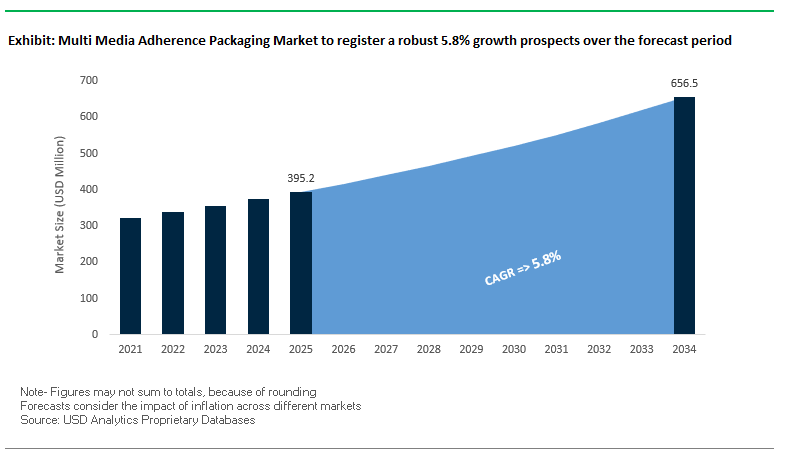
Multi-Media Adherence Packaging Market to Reach $656.4 Million by 2034 at 5.8% CAGR
The global multi-media adherence packaging market is projected to grow from $395.2 million in 2025 to $656.4 million by 2034, achieving a CAGR of 5.8%. The market expansion is driven by the rising need for improving patient compliance, integration of smart packaging technologies, and adoption of sustainable materials. Multi-med adherence packaging, including blister packs, pill organizers, and smart pillboxes, plays a pivotal role in reducing medication non-adherence, a major public health and economic challenge.
Dominance of blister packs: Blister packs are the preferred format due to their ease of use and ability to clearly organize medication by day and time.
Smart packaging integration: Digital reminders, sensors, and scannable codes enhance patient engagement and real-time adherence monitoring.
Material selection: Plastics such as Polyethylene (PE) and Polypropylene (PP) dominate due to their durability, cost-effectiveness, and versatility.
Sustainability trend: The industry is progressively adopting monomaterial and recyclable packaging, aligning with environmental goals.
Market Analysis: Recent Industry Developments Shaping Multi-Med Adherence Packaging
The multi-media adherence packaging industry is witnessing rapid evolution through technological innovations, strategic partnerships, and sustainability initiatives. In September 2025, a study highlighted the substitution of aluminum foil with lightweight metallized films, offering cost-effective and durable alternatives for interior trays and inserts. In July 2025, Aptar Pharma expanded its clinical trial capabilities through a strategic materials manufacturing acquisition, strengthening its capacity to develop advanced drug delivery and adherence packaging solutions. The ame month, Gerresheimer AG refocused its growth strategy by halting takeover discussions, emphasizing expansion in biologics systems and specialized packaging.
Sustainability-focused innovations have gained traction. In June 2025, Amcor and Cofigeo introduced a PP-based ready meal tray, highlighting a shift towards monomaterial, recyclable packaging, relevant to adherence solutions. In May 2025, Harpak launched the FM400 horizontal flow warp machine, high-speed automation equipment increasingly applied in pharmaceutical packaging to improve efficiency. Earlier, in March 2025, Constantia Flexibles acquired a majority stake in Aluflexpack, expanding its flexible packaging portfolio for the pharmaceutical and food sectors.
Other notable developments include Mondi and Proquimia in February 2025, launching a paper-based stand-up pouch for household products, illustrating broader industry trends towards eco-friendly materials. AptarGroup was also recognized by TIME in January 2025 as one of the World’s Most Sustainable Companies, signaling the growing importance of sustainable solutions across the adherence packaging industry.
Trends and Opportunities in the Multi-Media Adherence Packaging Market
Integration of NFC and QR Technology for Direct-to-Patient Data Capture
The multi-media adherence packaging market is rapidly evolving from traditional blister packs to smart, connected solutions that capture real-time dosing data. By embedding Near-Field Communication (NFC) chips and QR codes into packaging, pharmaceutical companies are enabling automatic recording of when a pill or dose is accessed. This creates a secure and verifiable stream of adherence data for patients, caregivers, and providers without requiring manual input.
A healthcare report highlights that NFC-enabled packages can link directly to patient apps, confirming dose intake through a simple smartphone tap. QR codes, meanwhile, are a low-cost solution that connects patients to instructional videos, reminders, and safety information, driving improved health literacy and adherence. Beyond engagement, these technologies are also central to supply chain security. By embedding encrypted NFC chips or serialized QR codes, manufacturers create a digital fingerprint for every unit, helping to prevent counterfeiting and ensuring product authenticity at the patient and distributor level.
This convergence of adherence monitoring, patient engagement, and security assurance is reshaping packaging from a passive container into an active digital health tool, strengthening its role in personalized care delivery.
Regulatory Push for Demonstrable Adherence Improvements in Clinical Trials
Global regulatory authorities, particularly the FDA and EMA, are intensifying their focus on objective adherence data in clinical research. Non-adherence remains one of the leading causes of trial failure and misleading efficacy results. Smart adherence packaging provides a superior alternative to self-reporting and pill counts by generating verifiable, tamper-proof adherence records.
A review on AI-based adherence tools shows that clinical trials using smart packaging recorded adherence improvements of 6.7% to 32.7%, directly enhancing the reliability of trial outcomes. This is particularly relevant for high-cost specialty therapies, where poor adherence can mask true drug efficacy and hinder regulatory approvals. Furthermore, adherence data from these systems is increasingly valuable for post-market surveillance and REMS (Risk Evaluation and Mitigation Strategies) programs mandated by the FDA.
With regulators demanding higher data integrity and payers requiring real-world evidence, smart multi-media adherence packaging is emerging as a critical enabler of both compliance and commercial success in the pharmaceutical industry.
Development of Integrated Platforms for Value-Based Contracting
The healthcare sector’s shift toward value-based care models is creating a major growth avenue for adherence packaging. In value-based contracts (VBCs), drug reimbursement is tied directly to patient outcomes and adherence levels. The challenge lies in generating accurate, real-world data to validate these agreements.
Smart multi-media adherence packaging addresses this by providing objective, real-time adherence data streams that can be directly shared with payers. For example, in outcomes-based contracts for specialty drugs, adherence packaging data can validate whether patients achieved the required compliance levels, ensuring manufacturers are reimbursed appropriately—or issuing rebates if adherence goals were not met.
This positions packaging as more than a cost center; it becomes a strategic data asset that facilitates risk-sharing arrangements, aligns incentives across stakeholders, and helps pharmaceutical companies differentiate themselves in negotiations with payers. As value-based contracting adoption accelerates globally, the role of adherence packaging in delivering trustworthy data will become increasingly critical.
AI-Powered Predictive Analytics for Proactive Intervention
The integration of AI and machine learning with adherence packaging marks the next phase of innovation in this market. Packaging equipped with NFC and QR technology generates large datasets on dosing times, missed doses, and consumption trends, which AI algorithms can analyze to identify at-risk patients.
Predictive models can flag patients likely to miss doses before non-adherence occurs, enabling healthcare teams to launch personalized interventions. This could include automated SMS reminders, app notifications, nurse follow-up calls, or tailored educational content delivered at precisely the right moment. Research on AI in healthcare confirms that such targeted interventions deliver significantly higher adherence improvements compared to blanket reminders.
Competitive Landscape of Global Multi-Media Adherence Packaging Market
The multi-media adherence packaging market is highly competitive, with leading players leveraging innovation, sustainability, and material science expertise to provide solutions that enhance patient compliance and healthcare outcomes. Companies focus on blister packs, pouches, and smart pillboxes that meet regulatory, environmental, and user-centric demands.
WestRock Company (now Smurfit Westrock): Innovating Child-Resistant and Senior-Friendly Adherence Packaging
WestRock, now Smurfit Westrock, offers the Shellpak® Renew system, a child-resistant and tear-resistant outer carton integrated with blister packs. The July 2025 merger with Smurfit Kappa strengthened its global presence, enabling a comprehensive portfolio of healthcare packaging. Shellpak® improves patient persistence for long-term medications, featuring recyclable cartons, integrated patient messaging, and compact 23% smaller Optilock™ designs for portability.
AptarGroup, Inc.: Enhancing Patient Outcomes Through Advanced Drug Delivery Packaging
Aptar is a global leader in drug delivery, dispensing, and adherence packaging. In July 2025, it expanded clinical trial capabilities via a strategic acquisition, boosting its ability to produce innovative adherence solutions. Aptar leverages design, science, and technology to improve patient adherence, with products including nasal sprays, inhalers, and smart blister packs, ensuring ease-of-use and regulatory compliance.
Amcor provides high-performance films and laminates for blister packs and pouches, engineered to offer superior moisture and oxygen barriers. In June 2025, Amcor partnered with Cofigeo to produce a PP-based monomaterial tray, reflecting a trend towards sustainable packaging in healthcare. Amcor’s offerings include all-PP recyclable pouches and trays, combining environmental sustainability with functional reliability for multi-med adherence.
Mondi Group: Pioneering High-Barrier and Sustainable Pharmaceutical Packaging
Mondi develops a broad range of films, laminates, and paper-based solutions tailored for the pharmaceutical and healthcare sectors. In September 2025, Mondi launched a 100% recyclable mono-material pouch with removable panels, emphasizing sustainability. Its portfolio includes high-barrier blister films and pouches, enabling secure, compliant, and eco-friendly adherence packaging for tablets, capsules, and liquid medications.
Constantia Flexibles: Advancing Flexible Packaging for Patient-Friendly Medication Systems
Constantia Flexibles specializes in films, foils, and laminates for blister packs, pouches, and sachets. In July 2025, it invested €6.5 million in Hosokawa Alpine MDO technology, enhancing production of high-performance films. Its solutions provide secure, user-friendly, and innovative adherence packaging, supporting patient compliance while meeting sustainability and pharmaceutical industry standards.
Multi Media Adherence Packaging Market Share Insights
Blister Packs Dominate Market Share by Packaging Type in the Multi-Dose Adherence Packaging Industry
Blister packs hold the leading 40% share in 2025, cementing their position as the gold standard for solid oral dose packaging due to their superior moisture, oxygen, and light barriers, as well as tamper-evidence features. Their wide acceptance in retail pharmacies and institutional healthcare makes them the backbone of adherence packaging globally. Pouches represent the fastest-growing segment at 25%, supported by the expansion of pharmacy-driven medication synchronization (MedSync) services that dispense multi-drug regimens in calendarized pouch rolls. Unit-dose packaging accounts for 15% share, particularly in hospitals and long-term care facilities, where dosing accuracy and safety protocols mandate single-dose solutions. Vials and bottles, with 12% share, remain entrenched in traditional dispensing but are gradually losing ground due to their lack of tamper-evidence and higher error risks. Strip packs (5%) and innovative digital formats (3%) contribute to niche but important applications, especially in emerging markets and clinical trials. Collectively, these formats illustrate the balance between patient safety, regulatory compliance, and innovation in adherence support systems.
Chronic Disease Management Holds the Largest Share by Application in the Multi-Dose Adherence Packaging Industry
Chronic disease management dominates the market with a commanding 55% share in 2025, reflecting the growing prevalence of conditions such as diabetes, hypertension, and cardiovascular disease that require daily, long-term medication adherence. Multi-dose blister packs and pharmacy-driven pouch systems are increasingly deployed to improve compliance and reduce costly hospitalizations. Geriatric care follows with 25% share, highlighting the vulnerability of aging populations to polypharmacy-related risks and the reliance on adherence packaging to minimize errors in both assisted living and independent households. Mental health management represents 10% share, where structured packaging formats help improve consistency of treatment for conditions like depression, anxiety, and schizophrenia, often reducing relapse rates. Pediatric care, with 5% share, addresses the unique challenges of safe and accurate dosing for children, while other applications (5%) include critical areas such as palliative care, HIV treatment, and organ transplant adherence, where compliance is directly tied to survival outcomes. Together, these applications demonstrate that adherence packaging is evolving from a value-add to a clinical necessity across healthcare ecosystems.
United States: FDA Regulations and Smart Packaging Innovations Fuel Market Growth
The United States multi-media adherence packaging market is heavily influenced by stringent FDA regulations, including the Fair Packaging and Labeling Act (FPLA) and Poison Prevention Packaging Act (PPPA). Recent initiatives emphasizing digital health and patient engagement are accelerating the adoption of smart packaging features that enhance medication compliance.
Technological advancements are central to market expansion, with companies integrating Near-Field Communication (NFC) and Radio-Frequency Identification (RFID) tags into multi-medication packaging to track dosages, provide reminders, and deliver patient education through connected apps. Robotics and automation in dispensing and filling complex adherence packages are further improving accuracy and operational efficiency. Corporate investments, such as WestRock’s expansion in Brazil and Aptar Pharma’s acquisition of Voluntis, highlight strategic moves to combine digital therapeutics with innovative packaging solutions. The market is particularly strong in chronic disease management, geriatric care, and multi-medication regimens, serving hospitals, pharmacies, and long-term care facilities seeking to reduce medication errors and improve patient outcomes.
Germany: Stringent EU Regulations and Advanced Automation Strengthen Market Position
Germany’s pharmaceutical packaging market is driven by the European Union’s rigorous regulations, emphasizing safety, quality, and traceability. Anti-counterfeiting measures and the need for serialized packaging have led to the growing adoption of smart and digital packaging solutions in multi-med adherence systems.
The country is a hub for pharmaceutical R&D, investing over €9.6 billion in 2022, fostering a robust ecosystem for innovation in drug development and packaging. Technological advancements include automated systems and advanced materials for handling complex adherence packaging. Investments such as SIRIO Pharma’s €16 million fully-automated packaging facility underscore Germany’s leadership in innovation. The market is particularly driven by geriatric care, where multi-media adherence packaging is crucial for managing complex medication schedules for an aging population across home care and institutional settings.
China: Government Support and AI Integration Accelerate Adoption
China’s multi-media adherence packaging market is supported by strong government initiatives aimed at enhancing pharmaceutical manufacturing and smart digital integration. The 2025–2030 Implementation Plan for Smart Digital Transformation of the Pharmaceutical Industry encourages the use of AI and digital technologies throughout the pharmaceutical value chain, including packaging.
Technological advancements include automation, AI-driven quality control, and smart regulatory platforms, improving both efficiency and drug traceability. The rapidly expanding healthcare sector, combined with rising chronic disease prevalence, is driving demand for multi-medication blister cards and unit-dose packs. While specific investment figures are limited, the overall trend of government backing and growing healthcare infrastructure indicates substantial capital flow into advanced adherence packaging solutions.
United Kingdom: Sustainability and Digital Health Innovations Propel Market Expansion
The UK multi-media adherence packaging market is shaped by pharmaceutical safety regulations and sustainability initiatives such as the Plastic Packaging Tax and Extended Producer Responsibility (EPR) scheme. These frameworks promote eco-friendly and recyclable packaging solutions, encouraging the adoption of innovative adherence packaging.
Technological advancements focus on next-generation extrusion, biodegradable films, and digital packaging technologies to enhance patient engagement. Corporate investments, exemplified by Berry Global Inc.’s advanced micro tray solution using bio-based polyethylene, align with the circular economy and have potential applications in adherence packaging. Key applications are centered on over-the-counter (OTC) and prescription medications, where visually appealing and customized packaging improves compliance and patient outcomes.
Japan: Regulatory Reforms and Advanced Packaging Solutions Enhance Patient Compliance
Japan’s multi-media adherence packaging market is influenced by amendments to the Pharmaceuticals and Medical Devices (PMD) Act, effective by May 2027, which mandate enhanced quality control, supply stability, and compliance standards. These regulations impact the production and design of multi-med adherence packaging.
Technological innovation in Japan focuses on high-quality, functional packaging with improved durability and visual properties, supporting both aesthetic and practical applications. Sustainability initiatives, including the government-led Industry-Government-Academia Consortium for recycled plastics, complement broader packaging advancements. Demand is driven by the aging population, which relies on adherence packaging solutions to ensure accurate medication administration and improve patient outcomes in both home and institutional care.
Multi Media Adherence Packaging Market Report Scope
Multi Media Adherence Packaging Market
Parameter
Details
Market Size (2025)
$395.2 Million
Market Size (2034)
$656.4 Million
Market Growth Rate
5.8%
Segments
By Packaging Type (Blister Packs, Vials & Bottles, Strip Packs, Unit-Dose Packaging, Pouches, Others), By Material (Plastic, Aluminum, Paper & Paperboard, Others), By Application (Chronic Disease Management, Geriatric Care, Pediatric Care, Mental Health Management, Others), By End-User (Pharmacies, Hospitals, Long-term Care Facilities, Home Healthcare)
Study Period
2019- 2024 and 2025-2034
Units
Revenue (USD)
Qualitative Analysis
Porter’s Five Forces, SWOT Profile, Market Share, Scenario Forecasts, Market Ecosystem, Company Ranking, Market Dynamics, Industry Benchmarking
US, Canada, Mexico, Germany, France, Spain, Italy, UK, Russia, China, India, Japan, South Korea, Australia, South East Asia, Brazil, Argentina, Middle East, Africa
Europe (Germany, UK, France, Spain, Italy, Russia, Rest of Europe)
Asia Pacific (China, India, Japan, South Korea, Australia, South East Asia, Rest of Asia)
South America (Brazil, Argentina, Rest of South America)
Middle East and Africa (Saudi Arabia, UAE, Rest of Middle East, South Africa, Egypt, Rest of Africa)
Top Companies in Multi-Media Adherence Packaging Market
WestRock Company
Amcor plc
Jones Healthcare Group
Cardinal Health Inc.
Omnicell, Inc.
AptarGroup, Inc.
Blisterpak, Inc.
Keystone Folding Box Co.
Medicine-On-Time, LLC
Synergy Medical
Sonoco Products Company
TCPL Packaging
SGD Pharma
Drug Package LLC
Manrex Ltd.
* List Not Exhaustive
Methodology
USDAnalytics employs a comprehensive, multi-layered research methodology to deliver precise insights into the global Multi-Media Adherence Packaging market. Our approach combines primary research—including structured interviews with pharmaceutical packaging specialists, R&D scientists, supply chain executives, and healthcare providers—with secondary research derived from regulatory filings, corporate reports, clinical studies, and industry publications. Market sizing and growth forecasting incorporate historical trends, CAGR projections, material adoption rates (plastics, aluminum, paperboard), and packaging type preferences (blister packs, unit-dose, pouches). We analyze technological innovations such as smart packaging with NFC/QR integration, AI-driven predictive adherence analytics, and eco-friendly materials adoption. Regulatory frameworks from the FDA, EMA, and other regional authorities, alongside sustainability mandates like the UK’s EPR scheme and Plastic Packaging Tax, are assessed for their impact on market dynamics. Competitive intelligence evaluates mergers, acquisitions, product launches, and sustainability initiatives by leading players such as WestRock, Amcor, AptarGroup, Mondi, and Constantia Flexibles, highlighting strategies that enhance patient compliance, streamline medication management, and support value-based healthcare models. This methodology ensures USDAnalytics provides actionable, data-driven insights for industry professionals, helping stakeholders optimize adherence packaging design, meet regulatory requirements, and leverage emerging growth opportunities.
Deliverables:
Comprehensive Market Research Report (PDF and Excel) with detailed tables, charts, and interactive visualizations.
Country-Specific Forecasts & Analysis.
Segment-Wise Revenue Forecasts (2025–2034).
Competitive Analysis, Benchmarking, and SWOT Profiles.
Recent Developments & Innovation Tracker.
Executive Summary & Analyst Commentary.
Post-Purchase Analyst Support for Client-Specific Questions and Custom Data Requirements.
Table of Contents: Multi-Media Adherence Packaging Market
1. Executive Summary
1.1. Market Highlights
1.2. Key Findings
1.3. Global Market Snapshot
2. Multi-Media Adherence Packaging Market Landscape & Outlook (2025–2034)
2.1. Introduction to Multi-Med Adherence Packaging Market
2.2. Market Valuation and Growth Projections (2025–2034)
2.3. Market Drivers and Challenges
2.4. Regulatory Landscape Overview
2.5. Sustainability and Environmental Impact
3. Innovations Reshaping the Multi-Media Adherence Packaging Market
3.1. Trend: Integration of NFC and QR Technology for Direct-to-Patient Data Capture
3.2. Trend: AI-Powered Predictive Analytics for Proactive Intervention
3.3. Opportunity: Regulatory Push for Demonstrable Adherence Improvements in Clinical Trials
3.4. Opportunity: Development of Integrated Platforms for Value-Based Contracting
4. Competitive Landscape and Strategic Initiatives
4.1. Mergers, Acquisitions and Strategic Alliances
4.2. R&D and Material Innovation
4.3. Sustainability and Strategies
4.4. Market Expansion and Regional Focus
5. Market Share and Segmentation Insights: Multi-Media Adherence Packaging Market
5.1. By Packaging Type
5.1.1. Blister Packs
5.1.2. Vials & Bottles
5.1.3. Strip Packs
5.1.4. Unit-Dose Packaging
5.1.5. Pouches
5.1.6. Others
5.2. By Material
5.2.1. Plastic
5.2.2. Aluminum
5.2.3. Paper & Paperboard
5.2.4. Others
5.3. By Application
5.3.1. Chronic Disease Management
5.3.2. Geriatric Care
5.3.3. Pediatric Care
5.3.4. Mental Health Management
5.3.5. Others
5.4. By End-User
5.4.1. Pharmacies
5.4.2. Hospitals
5.4.3. Long-term Care Facilities
5.4.4. Home Healthcare
6. Country Analysis and Outlook of Multi-Media Adherence Packaging Market
6.1. United States
6.2. Canada
6.3. Mexico
6.4. Germany
6.5. France
6.6. Spain
6.7. Italy
6.8. UK
6.9. Russia
6.10. China
6.11. India
6.12. Japan
6.13. South Korea
6.14. Australia
6.15. South East Asia
6.16. Brazil
6.17. Argentina
6.18. Middle East
6.19. Africa
7. Multi-Media Adherence Packaging Market Size Outlook by Region (2025–2034)
7.1. North America Market Size Outlook to 2034
7.1.1. By Packaging Type
7.1.2. By Material
7.1.3. By Application
7.1.4. By End-User
7.2. Europe Market Size Outlook to 2034
7.2.1. By Packaging Type
7.2.2. By Material
7.2.3. By Application
7.2.4. By End-User
7.3. Asia Pacific Market Size Outlook to 2034
7.3.1. By Packaging Type
7.3.2. By Material
7.3.3. By Application
7.3.4. By End-User
7.4. South America Market Size Outlook to 2034
7.4.1. By Packaging Type
7.4.2. By Material
7.4.3. By Application
7.4.4. By End-User
7.5. Middle East and Africa Market Size Outlook to 2034
7.5.1. By Packaging Type
7.5.2. By Material
7.5.3. By Application
7.5.4. By End-User
8. Company Profiles: Leading Players in the Multi-Media Adherence Packaging Market
8.1. WestRock Company
8.2. Amcor plc
8.3. Jones Healthcare Group
8.4. Cardinal Health Inc.
8.5. Omnicell, Inc.
8.6. AptarGroup, Inc.
8.7. Blisterpak, Inc.
8.8. Keystone Folding Box Co.
8.9. Medicine-On-Time, LLC
8.10. Synergy Medical
8.11. Sonoco Products Company
8.12. TCPL Packaging
8.13. SGD Pharma
8.14. Drug Package LLC
8.15. Manrex Ltd.
9. Methodology
9.1. Research Scope
9.2. Market Research Approach
9.3. Market Sizing and Forecasting Model
9.4. Research Coverage
9.5. Data Horizon
9.6. Deliverables
10. Appendix
10.1. Acronyms and Abbreviations
10.2. List of Tables
10.3. List of Figures
Growth is fueled by rising demand for improved patient compliance, the integration of smart packaging technologies, and adoption of sustainable materials. Blister packs, smart pillboxes, and digital adherence solutions help patients follow complex medication regimens while reducing missed or incorrect doses, enhancing healthcare outcomes globally.
Smart solutions embed NFC chips, QR codes, and sensors to capture real-time dosing data, deliver reminders, and link to patient apps. These technologies improve adherence, provide verifiable records for clinical trials, support supply chain security, and enable healthcare providers to monitor patient compliance remotely.
Regulatory frameworks from the FDA, EMA, and regional authorities demand improved safety, traceability, and objective adherence tracking. Policies such as the Poison Prevention Packaging Act and digital health guidelines incentivize manufacturers to implement compliant, patient-friendly, and tamper-proof packaging solutions.
Blister packs lead with a 40% share due to superior barriers, tamper evidence, and ease of organization by day and time. Pouches, unit-dose packaging, vials, bottles, and strip packs serve hospitals, pharmacies, and long-term care facilities, offering specialized solutions for chronic disease management, geriatric care, and mental health therapies.
Leading companies include WestRock, Amcor, AptarGroup, Mondi, and Constantia Flexibles. These players excel in sustainable monomaterial solutions, high-barrier films, smart digital packaging, and patient-centric designs that enhance compliance, improve operational efficiency, and support value-based healthcare initiatives.