Market Overview: Perfume and Fragrance Packaging Market to Reach $5.3 Billion by 2034, Driven by Luxury, Sustainability, and Innovation
The Global Perfume and Fragrance Packaging Market is a highly specialized sector that combines design, functionality, and brand storytelling. Packaging serves as a critical touchpoint for consumer experience, protecting delicate fragrances while communicating luxury, sustainability, and brand identity. With increasing consumer focus on eco-consciousness and premium experiences, packaging is evolving beyond protection to become an immersive sensory experience that enhances product appeal and loyalty.
Key Insights for industry professionals and buyers:
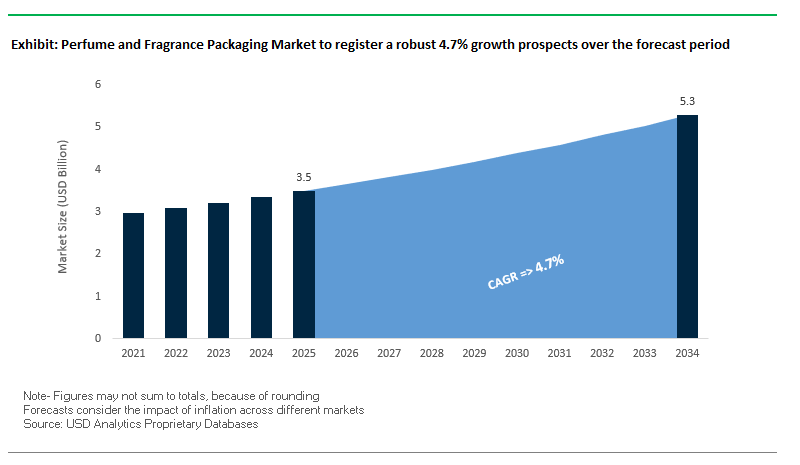
Market Expansion: Expected growth from $3.5 billion in 2025 to $5.3 billion by 2034 at a CAGR of 4.7%.
Luxury and Premiumization Trends: Investments in bespoke glass, crystal bottles, intricate closures, and asymmetric shapes to differentiate brands on retail shelves.
Sustainability Initiatives: Rising adoption of Post-Consumer Recycled (PCR) materials, recyclable plastics, and glass to meet environmental mandates.
Refillable and Reusable Formats: Innovative clean-refillable bottles and portable sprays are increasing consumer engagement and reducing waste.
Technological Integration: QR codes, NFC chips, and smart packaging features are enabling brand storytelling, product authentication, and enhanced consumer engagement.
Consumer-Centric Innovation: Focus on portability, convenience, and personalization to meet evolving lifestyle demands.
Brand Differentiation through Design: High-end decoration techniques and unique bottle aesthetics strengthen luxury positioning.
Market Analysis: Strategic Partnerships and Technological Innovations are Accelerating Growth in Perfume Packaging
The perfume and fragrance packaging industry is marked by rapid technological evolution, sustainability efforts, and global expansion. In August 2025, Albéa Group acquired Amfora Packaging to strengthen its footprint in Latin America and broaden its offerings in cosmetics and fragrance packaging. During the same month, Bormioli Luigi renewed its long-standing partnership with Maison Berger Paris, designing two new catalytic lamp collections for home fragrance, while also launching an asymmetrical, refillable bottle for a Ferragamo fragrance, demonstrating Italian craftsmanship and sustainability.
July 2025 was a notable month, with Albéa earning its sixth consecutive EcoVadis Gold Medal for CSR and sustainability performance. Aptar Beauty and Clarins also launched an eco-designed, patented double-chamber dispensing system for their “Double Serum,” reflecting an industry shift toward precision, customization, and eco-conscious designs.
Earlier in the year, June 2025, L’Oréal promoted consumer adoption of refillable formats, highlighting the broader movement toward sustainable packaging. In May 2025, Verescence showcased its “Made in America” bottles at LUXE PACK New York, emphasizing localized production and premium quality. April 2025 marked a key milestone as Pochet du Courval inaugurated its first 100% electric furnace, advancing decarbonization and luxury glass innovation. Additionally, January 2025, Aptar Beauty introduced the Nomad Refill, a 10ml purse spray designed for clean, rapid refills—an innovation catering to portable and sustainable fragrance solutions.
Trends and Opportunities Transforming the Perfume and Fragrance Packaging Market
Accelerated Adoption of Refillable and Reusable Packaging Systems
The perfume and fragrance packaging market is undergoing a structural shift as luxury brands embrace refillable and reusable formats to meet corporate ESG goals and consumer demand for sustainable solutions. Companies such as YSL Beauty are embedding refillable models into their core business strategies through initiatives like the “Change the rules, change the future” program. By encouraging consumers to buy 100ml refills instead of two new 50ml bottles, YSL highlights the tangible savings in glass, plastic, and paper materials, linking sustainability directly to material efficiency.
The move toward refills is also transforming business models, shifting from a one-time sale to recurring engagement. Molton Brown has pioneered in-store refill services that allow customers to bring back bottles for replenishment, cutting single-use packaging while deepening brand-consumer relationships. Simultaneously, consumer preferences are reinforcing this trend: a 2025 industry report confirmed that buyers increasingly prioritize biodegradable and recyclable packaging, making it a decisive factor in purchase decisions. The adoption of refillable and reusable systems is thus not only a regulatory and corporate necessity but also a direct response to evolving consumer values in the premium fragrance market.
Integration of Digital and Smart Features for Authentication and Engagement
Counterfeiting remains a significant challenge in the luxury fragrance sector, prompting brands to integrate digital and smart technologies into packaging. Advanced anti-counterfeit measures such as Quantum Base’s Q-ID optical tags, which use quantum materials embedded at the atomic level, provide unclonable authentication via a smartphone camera. This innovation ensures brand protection while enhancing consumer confidence.
In parallel, QR codes are being widely adopted to bridge physical packaging with digital ecosystems. Bastille Parfum, for example, uses serialized QR codes that allow consumers to trace ingredient sourcing, review sustainability credentials, and verify bottling dates. This transparency strengthens consumer trust and aligns with the growing demand for authenticity and traceability. Beyond information, brands are leveraging augmented reality (AR) to deliver immersive consumer experiences. By scanning packaging, customers can unlock tutorials, virtual try-ons, and storytelling, transforming unboxing into an interactive brand journey. These digital integrations elevate packaging from a protective medium to a powerful tool for engagement, trust-building, and competitive differentiation.
Development of High-Quality PCR Glass for Luxury Bottles
One of the most promising opportunities in perfume and fragrance packaging lies in the advancement of post-consumer recycled (PCR) glass for premium bottles. Historically, luxury brands resisted PCR due to concerns over clarity and aesthetics, but packaging leaders such as Gerresheimer have demonstrated the ability to manufacture high-clarity recycled glass that maintains luxury appeal. This is critical in an industry where visual elegance is inseparable from brand identity.
Brands are increasingly adopting PCR in new launches to meet their sustainability targets. Ralph Lauren Fragrances, for instance, introduced its Polo Earth vegan fragrance in a refillable bottle made with 20% PCR glass, showcasing how PCR is now viable for luxury applications. The environmental advantages are equally compelling: remelting cullet reduces energy consumption and lowers the carbon footprint compared to virgin glass production. As luxury brands face mounting pressure to decarbonize supply chains, high-quality PCR glass provides both a sustainability solution and a premium aesthetic, positioning it as a high-growth area in fragrance packaging.
Bio-Based and Marine-Degradable Materials for Secondary Packaging
Secondary packaging, such as inserts, clamshells, and outer cartons—represents another significant opportunity for sustainability in the fragrance industry. While primary glass bottles are often retained by consumers, secondary components are typically discarded, creating an urgent need for biodegradable solutions. Bio-based polymers such as PLA (polylactic acid) and PHA (polyhydroxyalkanoates) are emerging as strong candidates. These materials, sourced from agricultural waste, can deliver industrial compostability or even marine degradability, addressing end-of-life concerns.
Recent academic research confirms that thermoplastic starches (TPS) and PHAs can be engineered to meet the durability requirements of packaging while maintaining biodegradability in marine environments. This technological progress makes them suitable replacements for petroleum-based plastics in fragrance packaging inserts. By combining refillable glass bottles with bio-based, compostable secondary packaging, luxury brands can offer a full-lifecycle sustainability solution. This approach not only reduces environmental impact but also resonates strongly with eco-conscious consumers, making it a critical pathway for brands to align product design with circular economy principles.
Competitive Landscape: Key Market Players are Leading Innovation, Sustainability, and Premium Packaging in Perfume and Fragrance
The global perfume and fragrance packaging industry is highly competitive, driven by players specializing in high-quality materials, innovative designs, and sustainable production. Companies are leveraging their expertise in glassmaking, plastics, and multi-material systems to deliver packaging solutions that combine luxury appeal, functionality, and environmental consciousness.
AptarGroup, Inc.: Pioneering Refillable and Eco-Conscious Dispensing Systems for Fragrances
Aptar is renowned for innovative dispensing solutions, including pumps, caps, and airless systems. In January 2025, Aptar launched the Nomad Refill purse spray for easy, clean refills, aligning with growing consumer demand for portable and sustainable packaging. The company combines aesthetics with precision engineering and focuses on recyclable and recycled materials to enhance the consumer experience.
Stoelzle Glass Group: Driving Sustainability in High-End Glass Packaging through Recycled Materials
Stoelzle Glass specializes in luxury glass containers with in-house decoration capabilities. In 2025, the company introduced its PharmaCos line, featuring up to 73% recycled content in amber glass and 38% in flint glass. Innovations in water-based inner lacquering eliminate toxic materials while maintaining premium quality, positioning Stoelzle as a leader in sustainable luxury packaging.
Pochet du Courval (Groupe Pochet): Combining 400 Years of Craftsmanship with Sustainable Luxury Innovation
Pochet du Courval is a heritage French manufacturer of luxury glass packaging. In April 2025, it inaugurated its first 100% electric furnace to halve greenhouse gas emissions by 2033. The company specializes in intricate, custom bottle designs and advanced decoration, ensuring exceptional quality while advancing decarbonization goals.
Verescence: Global Luxury Glass Packaging Leader Driving Sustainability and Vertical Integration
Verescence provides a full suite of luxury glass bottles and jars with capabilities in manufacturing, decoration, and finishing. In March 2025, it was recognized on the CDP ‘A List’ for sustainability and invested in a hybrid furnace to reduce environmental impact. The company emphasizes bespoke designs for high-end fragrances and cosmetics, coupled with strong CSR and circular economy initiatives.
Bormioli Luigi S.p.A.: Innovating Refillable and Complex Luxury Glass Designs for Premium Brands
Bormioli Luigi is an Italian leader in high-end glass manufacturing. In August 2025, it launched an asymmetrical, refillable bottle for Ferragamo and renewed its partnership with Maison Berger Paris. The company excels in advanced decoration techniques and complex shapes, combining innovation with sustainability to serve premium fragrance and spirits markets.
Albéa Group: Expanding Latin American Presence and Leading Multi-Material Sustainable Packaging
Albéa provides packaging solutions for cosmetics, personal care, and fragrances, including pumps, bottles, and caps. In August 2025, it acquired Amfora Packaging to strengthen its Latin American footprint and earned its sixth consecutive EcoVadis Gold Medal in July 2025 for sustainability excellence. Albéa emphasizes recyclable, reusable, and recycled packaging solutions to meet consumer and environmental expectations.
France Perfume and Fragrance Packaging Market Strengthened by Circular Economy and Premium Materials
The France perfume and fragrance packaging market is being reshaped by regulatory reforms and sustainability initiatives. The French Parliament’s Law No. 2025-188, banning PFAS in cosmetics, textiles, and ski waxes by January 2026, is pushing brands to adopt fluorine-free coatings and alternative barrier materials. At the same time, the Anti-Waste Law for a Circular Economy (AGEC) mandates standardized French sorting symbols on perfume packaging, requiring brands to align with strict labeling compliance. These shifts are encouraging investment in refillable, reusable, and biodegradable solutions, reducing reliance on single-use formats.
France also remains the global epicenter of luxury fragrance packaging innovation. Events such as Luxe Pack Monaco showcase cutting-edge technologies like AI-driven design, digital twins, and augmented supply chain solutions. Local manufacturers are experimenting with recycled glass bottles, bio-sourced caps, and paper-based secondary packaging to meet rising consumer demand for premium yet eco-friendly fragrance experiences.
United States Perfume and Fragrance Packaging Market Fueled by Premiumization and Smart Technologies
The United States perfume packaging market is advancing with a strong focus on premiumization, sustainability, and smart packaging solutions. Leading players such as ProAmpac are incorporating laser perforation and intelligent shelf-life systems into packaging, while fragrance giants like IFF invest heavily in R&D hubs and mindful scent technologies. Consumer preferences are driving growth in custom-molded glass bottles, PCR-based materials, and lightweight shipping-ready formats, aligning with the rapid rise of fragrance e-commerce sales.
In addition, brands are integrating QR codes, NFC-enabled labels, and digital authentication technologies to enhance consumer engagement and verify product authenticity. Notably, startups like Osmo, backed by Google Ventures, are pioneering AI-powered digital olfaction, opening new opportunities for personalized fragrance experiences. These innovations, combined with a strong FDA regulatory framework and sustainability commitments, are pushing U.S. companies toward durable, eco-friendly, and interactive fragrance packaging.
China Perfume and Fragrance Packaging Market Accelerating with Luxury Branding and E-Commerce Demand
The China fragrance packaging market is growing rapidly, driven by a combination of e-commerce expansion, Gen Z and Millennial consumer demand, and rising investment in local luxury brands. A key milestone was Ushopal’s multi-million-dollar funding for Documents, a high-end domestic fragrance brand, signaling growing confidence in homegrown premium fragrance packaging.
China’s fragrance industry is focusing on luxury materials, travel-friendly packaging, and customized designs that appeal to younger demographics. Companies are expanding domestic manufacturing capacity, investing in high-quality finishes, embossing, and sustainable packaging formats to reduce imports and strengthen local supply chains. With online retail channels dominating distribution, packaging durability and aesthetic appeal are critical, positioning China as one of the fastest-growing markets for premium fragrance packaging solutions.
United Kingdom Perfume and Fragrance Packaging Market Influenced by EPR and Plastic-Free Initiatives
The United Kingdom perfume packaging market is strongly shaped by regulatory frameworks and consumer demand for sustainability. The Extended Producer Responsibility (EPR) system makes producers financially responsible for packaging waste, creating pressure to adopt recyclable and mono-material solutions. At the same time, the government’s plan to mandate flexible plastics collection by March 2027 is driving a transition to recyclable PET, FSC-certified paperboard, and aluminum packaging.
The British Beauty Council reports that 95% of cosmetic packaging ends up discarded, with only 9% recycled, highlighting the urgency of circular economy adoption. As a result, brands are embracing refillable packaging, reusable stations, and glue-free eco-designs. Consumer demand is shifting toward plastic-free luxury fragrance packaging, making the UK a leader in piloting sustainable yet premium perfume bottle and carton designs.
Italy Perfume and Fragrance Packaging Market Driven by Glassmaking Expertise and Luxury Craftsmanship
The Italy perfume packaging market thrives on its legacy of Made in Italy craftsmanship and high-end glass manufacturing expertise. Italian companies are producing custom-designed luxury bottles, blending traditional artistry with state-of-the-art manufacturing technologies. Companies such as Lumson are prioritizing flexibility and customization in primary packaging, while IMA Group specializes in automated filling, capping, and end-of-line machinery tailored for complex and premium fragrance formats.
Italian manufacturers are also responding to environmental pressures by adopting eco-friendly overwrapping materials, including compostable films and recyclable paper alternatives. With luxury fashion and fragrance brands deeply intertwined in Italy’s economy, the demand for innovative yet sustainable packaging is rapidly increasing, solidifying Italy’s position as a global leader in luxury fragrance packaging solutions.
India Perfume and Fragrance Packaging Market Growing with Premiumization and Eco-Regulations
The India fragrance packaging market is witnessing rapid growth fueled by rising middle-class incomes, premiumization, and stricter environmental policies. Domestic player Titan’s SKINN brand has expanded accessibility with its 24-seven fragrance line, targeting 2.5 million customers by FY 2025. Regulatory oversight by the Ministry of Environment, Forest and Climate Change on VOC emissions is pushing the industry toward eco-friendly and recyclable packaging formats.
E-commerce and digital marketing platforms are playing a crucial role in driving fragrance sales, creating demand for aesthetically appealing, protective packaging optimized for logistics. The surge in imports of natural essential oils (valued at nearly USD 255 million) is further encouraging organic fragrance packaging solutions that emphasize authenticity and sustainability. India’s perfume packaging market is therefore evolving at the intersection of affordability, premiumization, and eco-compliance.
Brazil Perfume and Fragrance Packaging Market Supported by ANVISA Regulations and E-Commerce Growth
The Brazil perfume and fragrance packaging market is strongly influenced by ANVISA’s regulatory framework, which classifies cosmetic products into Grade 1 and Grade 2 categories with varying packaging and registration requirements. Since 2014, São Paulo’s ban on animal testing and the acceptance of alternative safety methods have impacted ingredient sourcing and packaging compliance.
Brazil’s fragrance industry is experiencing a significant rise in e-commerce and small-sized perfume demand, particularly among urban consumers. With growing interest in personal care and cosmetic products, there is strong demand for aesthetically appealing and sustainable perfume packaging that meets both regulatory standards and consumer expectations. Companies are also experimenting with eco-friendly packaging designs, aligning with global sustainability goals while addressing Brazil’s growing domestic market for affordable and premium fragrances alike.
Perfume and Fragrance Packaging Market Report Scope
Perfume and Fragrance Packaging Market
Parameter
Details
Market Size (2025)
$3.5 Billion
Market Size (2034)
$5.3 Billion
Market Growth Rate
4.7%
Segments
By Material (Glass, Plastic, Metal, Paper & Paperboard, Others), By Product Type (Primary Packaging, Secondary Packaging, Components & Accessories), By Packaging Capacity (Less than 100 ml, 100–250 ml, 250–500 ml, Above 500 ml), By End-User (Women's Fragrances, Men's Fragrances, Unisex Fragrances)
Study Period
2019- 2024 and 2025-2034
Units
Revenue (USD)
Qualitative Analysis
Porter’s Five Forces, SWOT Profile, Market Share, Scenario Forecasts, Market Ecosystem, Company Ranking, Market Dynamics, Industry Benchmarking
Companies
Amcor plc, Mondi Group, AptarGroup, Inc., Gerresheimer AG, SGD S.A., Pochet du Courval, Verescence, Albéa, Quadpack, Shiseido Company, Limited, Virospack S.L.U., Lumson S.p.A., Bormioli Luigi SpA, The Estée Lauder Companies Inc., Coty Inc.
Countries
US, Canada, Mexico, Germany, France, Spain, Italy, UK, Russia, China, India, Japan, South Korea, Australia, South East Asia, Brazil, Argentina, Middle East, Africa
Perfume and Fragrance Packaging Market Segmentation
By Material
Glass
Plastic
Metal
Paper & Paperboard
Others
By Product Type
Primary Packaging
Secondary Packaging
Components & Accessories
By Packaging Capacity
Less than 100 ml
100–250 ml
250–500 ml
Above 500 ml
By End-User
Women's Fragrances
Men's Fragrances
Unisex Fragrances
Countries Analyzed
North America (US, Canada, Mexico)
Europe (Germany, UK, France, Spain, Italy, Russia, Rest of Europe)
Asia Pacific (China, India, Japan, South Korea, Australia, South East Asia, Rest of Asia)
South America (Brazil, Argentina, Rest of South America)
Middle East and Africa (Saudi Arabia, UAE, Rest of Middle East, South Africa, Egypt, Rest of Africa)
Top Companies in Perfume and Fragrance Packaging Market
Amcor plc
Mondi Group
AptarGroup, Inc.
Gerresheimer AG
SGD S.A.
Pochet du Courval
Verescence
Albéa
Quadpack
Shiseido Company, Limited
Virospack S.L.U.
Lumson S.p.A.
Bormioli Luigi SpA
The Estée Lauder Companies Inc.
Coty Inc.
* List Not Exhaustive
Methodology
USDAnalytics employs a comprehensive, multi-layered research methodology to analyze the global Perfume and Fragrance Packaging Market, combining both primary and secondary data sources to deliver accurate, actionable insights. The process begins with extensive primary research, including interviews and surveys with leading manufacturers, packaging designers, distributors, and key stakeholders across regions such as North America, Europe, Asia-Pacific, and Latin America. Secondary research is conducted through regulatory reports, company filings, press releases, industry journals, and trade publications to capture historical trends, competitive landscapes, and technological innovations. USDAnalytics integrates quantitative forecasting models with qualitative insights to project market size, CAGR, and regional dynamics, while analyzing sustainability trends, consumer behavior, and technological adoption, including refillable systems, PCR glass, and smart packaging. Advanced data validation, triangulation, and expert review ensure the findings are precise, enabling industry professionals to make informed strategic, investment, and operational decisions in a rapidly evolving luxury packaging market.
Deliverables:
Comprehensive Market Research Report (PDF and Excel) with detailed tables, charts, and interactive visualizations.
Country-Specific Forecasts & Analysis.
Segment-Wise Revenue Forecasts (2025–2034).
Competitive Analysis, Benchmarking, and SWOT Profiles.
Recent Developments & Innovation Tracker.
Executive Summary & Analyst Commentary.
Post-Purchase Analyst Support for Client-Specific Questions and Custom Data Requirements.
Table of Contents: Perfume and Fragrance Packaging Market
1. Executive Summary
1.1. Market Highlights
1.2. Key Findings
1.3. Global Market Snapshot
2. Perfume and Fragrance Packaging Market Landscape & Outlook (2025–2034)
2.1. Introduction to Perfume and Fragrance Packaging Market
2.2. Market Valuation and Growth Projections (2025–2034)
2.3. Market Drivers and Restraints
2.4. Regulatory Landscape and Compliance
2.5. Consumer Trends and Insights
3. Innovations Reshaping the Perfume and Fragrance Packaging Market
3.1. Trend: Accelerated Adoption of Refillable and Reusable Packaging Systems
3.2. Trend: Integration of Digital and Smart Features for Authentication and Engagement
3.3. Opportunity: Development of High-Quality PCR Glass for Luxury Bottles
3.4. Opportunity: Bio-Based and Marine-Degradable Materials for Secondary Packaging
4. Competitive Landscape and Strategic Initiatives
4.1. Mergers, Acquisitions and Strategic Alliances
4.2. R&D and Material Innovation
4.3. Sustainability and Strategies
4.4. Market Expansion and Regional Focus
5. Market Share and Segmentation Insights: Perfume and Fragrance Packaging Market
5.1. By Material
5.1.1. Glass
5.1.2. Plastic
5.1.3. Metal
5.1.4. Paper & Paperboard
5.1.5. Others
5.2. By Product Type
5.2.1. Primary Packaging
5.2.2. Secondary Packaging
5.2.3. Components & Accessories
5.3. By Packaging Capacity
5.3.1. Less than 100 ml
5.3.2. 100–250 ml
5.3.3. 250–500 ml
5.3.4. Above 500 ml
5.4. By End-User
5.4.1. Women's Fragrances
5.4.2. Men's Fragrances
5.4.3. Unisex Fragrances
6. Country Analysis and Outlook of Perfume and Fragrance Packaging Market
6.1. United States
6.2. Canada
6.3. Mexico
6.4. Germany
6.5. France
6.6. Spain
6.7. Italy
6.8. UK
6.9. Russia
6.10. China
6.11. India
6.12. Japan
6.13. South Korea
6.14. Australia
6.15. South East Asia
6.16. Brazil
6.17. Argentina
6.18. Middle East
6.19. Africa
7. Perfume and Fragrance Packaging Market Size Outlook by Region (2025–2034)
7.1. North America Perfume and Fragrance Packaging Market Size Outlook to 2034
7.1.1. By Material
7.1.2. By Product Type
7.1.3. By Packaging Capacity
7.1.4. By End-User
7.2. Europe Perfume and Fragrance Packaging Market Size Outlook to 2034
7.2.1. By Material
7.2.2. By Product Type
7.2.3. By Packaging Capacity
7.2.4. By End-User
7.3. Asia Pacific Perfume and Fragrance Packaging Market Size Outlook to 2034
7.3.1. By Material
7.3.2. By Product Type
7.3.3. By Packaging Capacity
7.3.4. By End-User
7.4. South America Perfume and Fragrance Packaging Market Size Outlook to 2034
7.4.1. By Material
7.4.2. By Product Type
7.4.3. By Packaging Capacity
7.4.4. By End-User
7.5. Middle East and Africa Perfume and Fragrance Packaging Market Size Outlook to 2034
7.5.1. By Material
7.5.2. By Product Type
7.5.3. By Packaging Capacity
7.5.4. By End-User
8. Company Profiles: Leading Players in the Perfume and Fragrance Packaging Market
8.1. Amcor plc
8.2. Mondi Group
8.3. AptarGroup, Inc.
8.4. Gerresheimer AG
8.5. SGD S.A.
8.6. Pochet du Courval
8.7. Verescence
8.8. Albéa
8.9. Quadpack
8.10. Shiseido Company, Limited
8.11. Virospack S.L.U.
8.12. Lumson S.p.A.
8.13. Bormioli Luigi SpA
8.14. The Estée Lauder Companies Inc.
8.15. Coty Inc.
9. Methodology
9.1. Research Scope
9.2. Market Research Approach
9.3. Market Sizing and Forecasting Model
9.4. Research Coverage
9.5. Data Horizon
9.6. Deliverables
10. Appendix
10.1. Acronyms and Abbreviations
10.2. List of Tables
10.3. List of Figures
Perfume and Fragrance Packaging Market Segmentation
By Material
Glass
Plastic
Metal
Paper & Paperboard
Others
By Product Type
Primary Packaging
Secondary Packaging
Components & Accessories
By Packaging Capacity
Less than 100 ml
100–250 ml
250–500 ml
Above 500 ml
By End-User
Women's Fragrances
Men's Fragrances
Unisex Fragrances
Countries Analyzed
North America (US, Canada, Mexico)
Europe (Germany, UK, France, Spain, Italy, Russia, Rest of Europe)
Asia Pacific (China, India, Japan, South Korea, Australia, South East Asia, Rest of Asia)
South America (Brazil, Argentina, Rest of South America)
Middle East and Africa (Saudi Arabia, UAE, Rest of Middle East, South Africa, Egypt, Rest of Africa)
The global Perfume and Fragrance Packaging Market is valued at approximately $3.5 billion in 2025 and is projected to reach $5.3 billion by 2034, reflecting significant growth driven by premiumization, sustainability initiatives, and technological innovations. Luxury and eco-conscious packaging trends continue to fuel this expansion globally.
The market is expected to grow at a CAGR of 4.7% during 2025–2034. This steady growth is supported by increasing consumer demand for refillable packaging, adoption of post-consumer recycled (PCR) glass, smart digital features, and brand differentiation through innovative design.
Glass remains the dominant material for primary packaging, often combined with PCR content to meet sustainability goals. Other materials include recyclable plastics, metals, and bio-based secondary packaging. Innovations include refillable bottles, multi-chamber dispensing systems, QR/NFC-enabled authentication, and biodegradable inserts, enhancing consumer engagement and brand loyalty.
Sustainability is a key growth driver, with brands adopting refillable bottles, reusable sprays, PCR glass, and bio-based secondary packaging. Initiatives such as circular economy integration, marine-degradable inserts, and eco-certified coatings are influencing both consumer purchasing behavior and regulatory compliance in regions like the EU, US, and UK.
High-growth regions include China, driven by e-commerce and luxury consumer demand; India, fueled by premiumization and eco-regulations; France and Italy, known for luxury craftsmanship and sustainable innovation; and the US, where smart packaging and refillable systems are accelerating adoption. Latin America and Brazil are also growing due to e-commerce expansion and regulatory compliance.