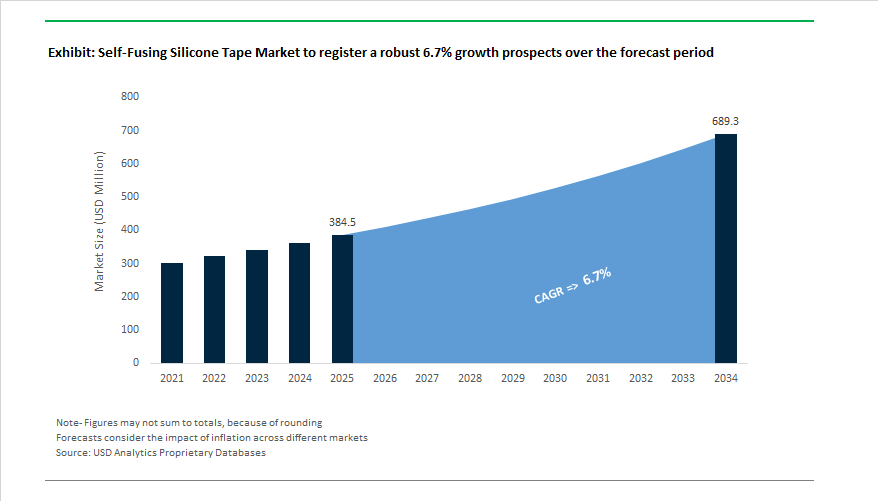
The Global Self-Fusing Silicone Tape Market is expected to grow from $384.5 million in 2025 to $689.2 million by 2034, registering a CAGR of 6.7%. Self-fusing silicone tapes—often called self-amalgamating tapes—play a vital role in electrical insulation, moisture protection, sealing, and repair applications across industrial, automotive, aerospace, and energy infrastructure sectors. Unlike traditional adhesive tapes, self-fusing silicone variants rely on molecular cohesion rather than adhesives, forming a seamless, durable, and weatherproof barrier ideal for extreme service environments.
The industry’s growth is driven primarily by electrical infrastructure modernization, automotive electrification, and the expansion of renewable energy systems, all of which require high-dielectric, heat-resistant, and halogen-free insulation materials. In the energy transmission sector, self-fusing silicone tapes are increasingly used for high-voltage splicing, providing dielectric strengths of up to 34 kV/mm, outperforming conventional PVC and butyl rubber tapes. Likewise, their superior resistance to UV exposure, ozone degradation, and thermal cycling makes them indispensable for outdoor electrical and communication installations.
In aerospace and defense, the demand for low-outgassing, flame-retardant, and vacuum-stable materials—meeting NASA ASTM E595 compliance—is expanding, as these tapes are integral in wire harnessing, hydraulic sealing, and insulation of critical components under fluctuating temperatures and vibration. Meanwhile, industrial MRO (Maintenance, Repair, and Operations) applications continue to fuel volume demand, especially for emergency field repairs of hydraulic lines, exhaust manifolds, and pressurized tubing where mechanical fastening is impractical.
The global self-fusing silicone tape industry is undergoing a technological evolution marked by material innovation, strategic mergers, and a surge in green energy and EV applications. In November 2025, a leading global adhesive producer unveiled a UV-resistant, flame-retardant silicone tape line tailored for photovoltaic (PV) cable management, ensuring long-term performance under solar radiation and extreme environmental exposure. This innovation reflects the market’s pivot toward renewable energy infrastructure, where durability and thermal stability are essential for long-term asset reliability.
In September 2025, a top industrial tapes manufacturer published an updated product guide emphasizing self-amalgamating silicone rubber solutions for the construction and building maintenance sector, supporting weatherproofing, sealing, and waterproof insulation in critical infrastructure. The same year, a Southeast Asian silicone polymer facility expansion (July 2025) by a major materials producer significantly boosted silicone compounding capacity, ensuring stable supply for high-volume insulation tape production—a critical move amid escalating demand from the electrical and automotive sectors.
Innovation in the EV space accelerated in June 2025, with a multinational specialty chemical firm introducing a high-elongation, lightweight silicone tape optimized for battery wire harnesses and compact electrical assemblies. The tape’s thin profile and flexibility cater to the space constraints of electric powertrain architectures, ensuring enhanced insulation and vibration resistance.
Research and policy shifts are reshaping product compliance. In February 2025, a research consortium demonstrated a self-healing silicone elastomer technology with potential applications in self-fusing tapes, capable of automatically repairing micro-punctures and extending cable longevity. Meanwhile, European utility operators (December 2024) updated safety specifications to mandate halogen-free, low-smoke, and non-toxic silicone tapes for underground metro systems and tunnels—a move expected to redefine the regional supply chain’s material requirements.
Additionally, acquisition-driven portfolio integration (April 2025) among major silicone solution providers is fostering the development of hybrid adhesive tapes, combining self-fusing technology with high-temperature-resistant silicones to meet emerging needs in industrial sealing, aerospace systems, and power electronics.
The industrial MRO segment remains resilient. In October 2024, a market leader introduced a high-temperature (up to 200°C) silicone-based self-amalgamating tape designed for hydraulic line sealing and exhaust insulation, reinforcing the material’s reputation as a multi-functional emergency repair tool across oil & gas, automotive, and manufacturing plants.
Market Trend 1: Rapid Adoption in Electric Vehicle Battery Pack Sealing and Component Protection
The transition toward electric mobility has significantly expanded the application scope of self-fusing silicone tapes, particularly within EV battery pack assembly and high-voltage component protection. As the operating voltages in next-generation electric vehicles rise beyond 800 volts, the need for high-dielectric, thermally stable, and vibration-resistant insulation materials becomes critical.
Modern self-fusing silicone tapes exhibit dielectric strength exceeding 400 volts per mil, ensuring reliable insulation for busbars, terminals, and wire harnesses in high-voltage systems. Their self-amalgamating nature eliminates gaps and voids, creating a continuous dielectric barrier capable of withstanding extreme electrical stress. In contrast to traditional heat-shrink tubing or liquid sealants, these tapes adapt to irregular geometries without the need for additional curing or heat application, thereby improving production efficiency and minimizing rework time in EV assembly lines.
In addition to insulation, thermal resilience up to 260°C (500°F) makes these tapes ideal for environments exposed to high operational heat or potential thermal runaway events within battery modules. Their elastomeric elongation (300%–450%) provides superior vibration damping and abrasion resistance, enhancing mechanical durability in high-frequency vibration zones such as motor control units and junction boxes. The industry’s pivot toward lightweight, high-voltage insulation materials positions self-fusing silicone tapes as a pivotal enabling component for EV reliability, safety, and long-term performance.
Market Trend 2: Shift Toward Platinum-Cure and Additive-Free Silicone Tapes for Sensitive and Clean Manufacturing Environments
In parallel with industrial electrification, the market is witnessing a pronounced shift from peroxide-cure to platinum-cure self-fusing silicone systems, driven by increasing regulatory scrutiny in semiconductor, medical, and food-grade manufacturing. Platinum-cure silicones are distinguished by their absence of volatile organic byproducts, offering unmatched purity, cleanliness, and compliance for cleanroom-grade sealing applications.
The platinum-catalyzed curing process ensures that no volatile acids or residual peroxides remain in the final material—unlike peroxide-cured alternatives that require costly post-curing cycles. The purity standard is vital for industries such as semiconductor wafer fabrication, where even trace siloxane outgassing can result in multi-million-dollar contamination events. Similarly, pharmaceutical and food processing facilities demand additive-free, non-leaching materials to prevent cross-contamination and product degradation.
Further, mechanical performance advantages such as higher tensile strength, elongation, and autoclave resistance give platinum-cure silicone tapes a clear technical edge in medical and biopharmaceutical sealing, where sterilization and mechanical endurance are critical. The resulting combination of chemical purity, durability, and biocompatibility positions platinum-cure tapes as the next frontier in clean manufacturing and medical-grade sealing systems.
Market Opportunity 1: Development of High-Thermal-Conductivity Silicone Tapes for Temporary Thermal Management in Electronics Manufacturing
The global surge in miniaturized, high-power electronic devices is creating a lucrative development path for thermally conductive self-fusing silicone tapes engineered as temporary thermal interface materials (TIMs). These advanced tapes offer a clean, residue-free alternative to traditional greases and pads used during electronic assembly, burn-in testing, and rework cycles.
Conventional silicone tapes exhibit a low thermal conductivity of around 0.2 W/mK, limiting their effectiveness in heat dissipation applications. However, filler-enhanced formulations integrating ceramic, aluminum oxide, or boron nitride particles can achieve conductivities between 1.0 and 3.0 W/mK, enabling efficient heat transfer while maintaining insulation and flexibility. Such materials allow manufacturers to safely conduct high-temperature testing of power modules, transistors, or integrated circuits without thermal overload.
A notable operational benefit is the elimination of cleanup and rework time associated with thermal grease. Clean peel-off tapes can streamline production workflows by up to 20% shorter testing cycles, improving throughput in electronics assembly lines. As the industry leans toward automation and zero-waste manufacturing, thermally conductive self-fusing silicone tapes are emerging as an essential bridge between thermal efficiency and process simplicity.
Market Opportunity 2: Engineering of Bio-Integrated Silicone Tapes for Wound Care and Wearable Medical Sensors
The medical sector represents a transformative growth frontier for bio-integrated self-fusing silicone tapes, leveraging their skin-friendly adhesion, conformability, and breathability to serve dual roles in advanced wound management and wearable device securement. Unlike acrylic adhesives, medical-grade silicone tapes ensure atraumatic removal and minimize the risk of Medical Adhesive-Related Skin Injuries (MARSI)—a critical requirement in geriatric, neonatal, and sensitive skin care.
Clinical studies published by the National Institutes of Health (NIH) confirm that silicone-based adhesives cause significantly lower epidermal trauma and protein removal during application cycles compared to standard medical tapes, preserving the skin’s protective barrier. Additionally, the incorporation of silicone gel sheeting (SGS) technology—clinically proven to reduce hypertrophic and keloid scars—presents an opportunity for dual-function medical tapes that combine securement and scar management capabilities.
In wearable health monitoring, repositionable silicone tapes offer the ideal solution for sensor fixation, IV line securement, and long-term patch adherence. Their ability to maintain adhesion after repeated reapplication supports the integration of biometric sensors, infusion sets, and ECG electrodes without compromising patient comfort. As wearable healthcare devices and home-based patient monitoring continue to expand, the development of bio-integrated, medical-grade self-fusing silicone tapes is poised to become a key enabler of the next generation of medical adhesives.
Competitive Landscape: Global Leaders Drive R&D, Material Purity, and Specialized Application Integration
The Global Self-Fusing Silicone Tape Market features a competitive ecosystem dominated by diversified materials conglomerates and specialized electrical insulation manufacturers. The market’s technological trajectory revolves around material engineering excellence, dielectric optimization, and sustainability integration.
3M Company remains the benchmark in material science-driven silicone technology, leveraging its proprietary formulations to deliver superior electrical insulation and sealing performance. Its flagship product, the Scotch® Self-Fusing Silicone Rubber Electrical Tape 70, offers a dielectric strength of 34 kV/mm, making it the industry standard for medium to high-voltage applications. The specialized triangular-profile 70HDT version ensures void-free, uniform wrapping, enhancing performance in complex splicing and cable terminations. 3M’s R&D focus extends into medical-grade silicone adhesives and advanced polymer backings, ensuring technological cross-pollination across diverse industrial domains including aerospace, healthcare, and renewable energy.
Chase Corporation is a recognized leader in protective materials and power cable technologies, offering a diverse range of self-fusing and binder tapes for energy transmission and control systems. Its products under the Chase & Sons® brand include halogen-free, low-smoke, zero-halogen (LSZH) film binders and moisture-resistant encapsulants that ensure reliability in harsh, corrosion-prone environments. The company’s recent expansion into plenum-rated and instrumentation cable insulation systems reflects a strong alignment with global fire-safety and environmental standards, consolidating its position as a trusted partner in the power and telecommunication sectors.
Scapa Group, operating under Mativ, continues to lead in rubber-based self-amalgamating solutions with its Scapa 75 Silicone Rubber Tape, which supports operational ranges from −45°C to +200°C. Its specialization in multiple rubber chemistries—Silicone, EPR, and Polyisobutylene (PIB)—enables precise tailoring of product properties for medium-voltage, MRO, and construction applications. In 2025, Scapa streamlined its distributor and end-user product selection through a comprehensive technical product guide, ensuring better accessibility and performance differentiation. Its EPR-based tapes maintain EDF Approval UTE C33-011, a key quality standard for European utility networks.
HellermannTyton stands out for its engineered cable protection systems, offering heat-shrink tubing, gel-filled protection sleeves, and self-fusing silicone tapes that ensure robust sealing across automotive, aerospace, and industrial power systems. Its focus on lightweight plastic component replacements aligns with global aerospace and EV lightweighting initiatives, enhancing system efficiency and design flexibility. The company’s product validation programs subject its materials to rigorous heat, vibration, and chemical exposure testing, ensuring long-term durability. High-temperature cable ties (up to 250°F) complement its silicone insulation products, enabling integrated wiring protection in engine compartments and control panels.
Nitto Denko Corporation excels in polymer synthesis and precision coating technologies, serving industries where thermal stability, low outgassing, and cleanroom compatibility are critical. Its silicone-based insulation and sealing tapes are trusted in semiconductor, automotive, and aerospace manufacturing environments. Nitto’s innovation focus lies in heat-resistant, anti-corrosive silicone materials, including thin-gauge films for high-voltage and high-temperature use. By leveraging its cross-sector expertise in optical films and advanced adhesives, Nitto ensures exceptional material consistency and performance, particularly for harsh electronic, cleanroom, and industrial applications.
Country Analysis: Emerging Innovations and Strategic Developments in the Global Self-Fusing Silicone Tape Industry
United States: Driving Next-Generation High-Performance Silicone Tape for Critical Infrastructure and EV Systems
The United States self-fusing silicone tape market remains a global innovation hub, supported by strong industrial safety regulations, defense-grade standards, and advanced materials engineering. The aerospace and defense sectors are key consumers, where U.S. manufacturers have introduced high-temperature, self-amalgamating silicone tapes specifically qualified under MIL-Spec requirements. The products are critical for electrical insulation, moisture-proof sealing, and wire harness bundling in both aircraft and naval systems, meeting the extreme durability and dielectric strength standards required for mission-critical performance.
In parallel, the U.S. Department of Energy’s Grid Modernization Initiative has intensified the use of UV- and arc-resistant silicone rubber electrical tapes for transmission and distribution system upgrades, emphasizing long-term insulation reliability under high-voltage stress. In the automotive sector, Tier-1 EV suppliers are integrating self-fusing silicone tapes for battery pack insulation, thermal management, and moisture shielding, helping improve safety and longevity of electric vehicles. 3M Company continues to lead in product innovation, launching its advanced Scotch™ Self-Fusing Silicone Tape with enhanced tracking and arc resistance properties for use in wind and solar installations.
The medical device sector is another growing area of influence, as innovations in medical-grade silicone adhesives inspire the development of non-adhesive, biocompatible self-fusing materials for flexible wound care and sensor protection. U.S. R&D alliances are also pioneering ultra-clean, high-purity silicone tapes designed for semiconductor packaging and cleanroom use, signaling the country’s expansion into the next-generation materials ecosystem driven by sustainability and digital integration.
China: Global Manufacturing Powerhouse for High-Volume Electrical and Industrial Silicone Tapes
China dominates global self-fusing silicone tape production, leveraging its massive manufacturing capacity, diversified raw material base, and aggressive infrastructure expansion. Government-led initiatives, particularly in renewable energy and 5G telecom, have spurred unprecedented demand for weatherproof, moisture-resistant silicone rubber sealing tapes. In solar farms and wind installations, weatherproof silicone tapes are essential for cable joint insulation and corrosion protection, while telecom operators utilize self-fusing silicone rubber tapes to protect fiber optic and coaxial connectors from environmental degradation.
With the government’s 5G and “New Infrastructure” program, localized production of silicone rubber insulation materials has surged, supported by state-of-the-art compounding and extrusion technologies. Domestic producers are expanding high-volume manufacturing for thin-gauge silicone tapes (0.25–0.75 mm) to cater to both industrial automation and consumer electronics markets. The electronics manufacturing industry relies heavily on thin, thermally stable self-fusing silicone tapes for component bonding, PCB protection, and cable harnessing in smartphones and IoT devices.
Moreover, as China enforces tighter environmental regulations on VOC emissions and hazardous materials, there is a visible transition toward eco-friendly silicone formulations. Manufacturers are increasingly developing solvent-free and recyclable silicone rubber compounds, ensuring compliance with global sustainability standards while preserving the cost advantages of mass production.
Japan: Technological Leadership in High-Precision Silicone Tape Engineering
Japan’s self-fusing silicone tape market is characterized by unmatched precision, material purity, and innovation in advanced elastomer science. Major companies such as Nitto Denko and Toray Industries, Inc. dominate through their deep expertise in polymer synthesis, thermal management materials, and miniaturized electronic applications. Japanese R&D continues to pioneer ultra-thin, precision-grade silicone tapes designed for microelectronics, sensors, and optical device assembly, where dimensional accuracy and insulation reliability are non-negotiable.
The automotive electrification trend is a key growth driver, with Japanese OEMs increasingly adopting high-reliability, self-amalgamating silicone tapes for battery terminals, high-voltage connectors, and hybrid powertrains. The tapes exhibit superior dielectric strength, thermal endurance, and flame resistance, making them indispensable in modern EV and hybrid platforms. Moreover, Japan’s stringent infrastructure maintenance programs utilize long-life silicone rubber repair tapes to extend the lifespan of power transmission, telecommunications, and marine equipment. Through continuous R&D in low-outgassing, tear-resistant silicone elastomers, Japan solidifies its global leadership in premium-grade silicone-based insulation solutions.
Germany: Sustainability and Precision Engineering at the Core of Silicone Tape Development
Germany represents a center of excellence in precision-engineered self-fusing silicone tapes, driven by the nation’s high industrial standards and sustainability commitments under EU policy frameworks. German manufacturers such as tesa SE are advancing the development of specialized, thermally stable self-amalgamating tapes for demanding industrial and OEM environments. The solutions offer exceptional adhesion, vibration damping, and environmental sealing, particularly for aerospace, automotive, and renewable energy systems.
The German automotive industry’s strict performance benchmarks continue to influence adhesive material innovation, leading to a surge in automotive-grade silicone tapes for wiring harness protection, vibration isolation, and engine compartment sealing. Meanwhile, EU regulatory frameworks such as REACH and the Green Deal are catalyzing a shift toward low-VOC, halogen-free, and recyclable silicone tape formulations. Germany’s extensive converting and customization expertise also supports precision-die-cut and tailor-made self-fusing tapes for industrial assembly lines, maintaining the country’s leadership in high-value, eco-compliant silicone adhesive technologies.
India: Infrastructure Expansion and Domestic Manufacturing Boosting Silicone Tape Demand
India’s self-fusing silicone tape market is expanding rapidly, propelled by its ambitious infrastructure modernization, energy grid upgrades, and industrial diversification. Government-led programs under the Power Grid Development Plan and National Smart Grid Mission are spurring large-scale adoption of high-voltage, self-amalgamating silicone electrical tapes for transmission, splicing, and substation cable applications. The products provide essential arc resistance, moisture sealing, and corrosion protection, critical for India’s challenging tropical conditions.
In the construction and plumbing sectors, demand for silicone rubber repair and waterproofing tapes has risen sharply due to urban infrastructure growth and rising awareness of preventive maintenance solutions. Local manufacturers, supported by ‘Make in India’ and PLI (Production Linked Incentive) schemes, are expanding domestic silicone compounding and extrusion capabilities to serve both industrial and consumer markets. India’s rise as a regional production hub is attracting partnerships with global players for technology transfer and localized manufacturing, ensuring long-term growth across both industrial sealing and electrical insulation categories.
United Kingdom: Advanced Engineering and Offshore Applications Strengthening Market Presence
The United Kingdom stands as a niche yet technologically advanced market within the global self-fusing silicone tape industry, catering primarily to offshore energy, defense, and aerospace sectors. British manufacturers supply high-grade, mil-spec silicone tapes certified for use in aviation, naval, and oil platform operations, where resilience to extreme temperatures, salt spray, and hydrocarbons is essential. The offshore wind energy expansion across the North Sea has further amplified the need for salt-resistant, self-amalgamating silicone tapes for cable joint protection, corrosion control, and waterproofing in marine environments.
In addition, the UK’s robust advanced converting ecosystem enables the production of customized, precision-cut silicone tapes for aerospace wiring harnesses and defense equipment assembly. Manufacturers are integrating digital monitoring and traceability systems into production workflows, ensuring compliance with defense-grade quality standards. The developments solidify the UK’s position as a leading European hub for high-performance, specialty silicone sealing technologies.
Self-Fusing Silicone Tape Market Report Scope
Self-Fusing Silicone Tape Market
Parameter
Details
Market Size (2025)
$384.5 Million
Market Size (2034)
$689.2 Million
Market Growth Rate
6.7%
Segments
By Thickness (Below 0.25mm, 0.26mm to 0.50mm, 0.51mm to 0.75mm, Above 0.75mm), By Product Form (Rectangular, Triangular, Sinusoidal/Profiled), By Function (Splicing, Insulating, Sealing, Repairing, Bundling/Harnessing, Corrosion Protection, UV Protection), By End-Use Industry (Electrical & Electronics, Plumbing & Water Supply, Automotive, Aerospace & Defense, Industrial, Building & Construction, Telecommunications, Home & DIY), By Resin (General-Purpose, High-Temperature, Fluorosilicone
Study Period
2019- 2024 and 2025-2034
Units
Revenue (USD)
Qualitative Analysis
Porter’s Five Forces, SWOT Profile, Market Share, Scenario Forecasts, Market Ecosystem, Company Ranking, Market Dynamics, Industry Benchmarking
Companies
3M Company, Nitto Denko Corporation, Rogers Corporation, tesa SE, Berry Global Inc., Scapa Group PLC (Mativ Holdings), Illinois Tool Works (ITW), Advance Tapes International Ltd., Shin-Etsu Polymer Co., Ltd., Lintec Corporation, Avery Dennison Corporation, Midsun Specialty Products, Shurtape Technologies, LLC, Dow Inc., DeWAL Industries Inc.
Countries
US, Canada, Mexico, Germany, France, Spain, Italy, UK, Russia, China, India, Japan, South Korea, Australia, South East Asia, Brazil, Argentina, Middle East, Africa
Europe (Germany, France, United Kingdom, Spain, Italy, Rest of Europe)
Asia Pacific (China, India, Japan, South Korea, Australia, Rest of APAC)
South and Central America (Brazil, Argentina, Rest of SCA)
Middle East and Africa (Saudi Arabia, UAE, South Africa, Rest of Middle East, Rest of Africa)
Top Companies in Self Fusing Silicone Tape Market
3M Company
Nitto Denko Corporation
Rogers Corporation
tesa SE
Berry Global Inc.
Scapa Group PLC (Mativ Holdings)
Illinois Tool Works (ITW)
Advance Tapes International Ltd.
Shin-Etsu Polymer Co., Ltd.
Lintec Corporation
Avery Dennison Corporation
Midsun Specialty Products
Shurtape Technologies, LLC
Dow Inc.
DeWAL Industries Inc.
*- List not Exhaustive
Research Coverage
Prepared by USDAnalytics, this report investigates the Global Self-Fusing Silicone Tape Market with a boardroom-ready narrative that links demand catalysts (grid modernization, EV platforms, aerospace wiring, and extreme-temperature maintenance) to material science breakthroughs in platinum-cure, low-smoke/halogen-free and high-dielectric silicone elastomers; our analysis reviews competitive moves, supply security, and specification shifts across electrical, industrial, and mobility use cases, and highlights how self-amalgamating tapes are displacing adhesive and heat-shrink methods in high-voltage splicing, moisture sealing, and vibration-exposed assemblies—this report is an essential resource for sourcing leaders, product managers, and engineering teams seeking defensible sizing, standards-aware benchmarking, and 2025–2034 opportunity mapping.
Scope Highlights
Segmentation:
By Type/Thickness: Below 0.25 mm; 0.26–0.50 mm; 0.51–0.75 mm; Above 0.75 mm.
By Product Form: Rectangular; Triangular; Sinusoidal/Profiled.
By End-Use Industry: Electrical & Electronics; Plumbing & Water Supply; Automotive; Aerospace & Defense; Industrial; Building & Construction; Telecommunications; Home & DIY.
By Resin: General-Purpose; High-Temperature; Fluorosilicone.
By Region: North America (United States, Canada, Mexico); Europe (Germany, France, United Kingdom, Spain, Italy, Rest of Europe); Asia Pacific (China, India, Japan, South Korea, Australia, Rest of APAC); South & Central America (Brazil, Argentina, Rest of SCA); Middle East & Africa (Saudi Arabia, UAE, South Africa, Rest of Middle East, Rest of Africa).
Geographic Scope: Analysis spans 25+ countries across North America, Europe, Asia Pacific, Latin America, the Middle East & Africa.
Timeframe: Historic data 2021–2024 and forecast data 2025–2034.
Companies Covered: Analysis / profiles of 15+ companies.
Deliverables
Comprehensive Market Research Report (PDF and Excel) with detailed tables, charts, and interactive visualizations.
Country-Specific Forecasts & Analysis.
Segment-Wise Revenue Forecasts (2025–2034).
Competitive Analysis, Benchmarking, and SWOT Profiles.
Recent Developments & Innovation Tracker.
Executive Summary & Analyst Commentary.
Post-Purchase Analyst Support for Client-Specific Questions and Custom Data Requirements.
Table of Contents: Self Fusing Silicone Tape Market
2. Self Fusing Silicone Tape Market Landscape & Outlook (2025–2034)
2.1. Introduction to the Self Fusing Silicone Tape Market
2.2. Market Valuation and Growth Projections (2025–2034)
2.3. Role of Self-Fusing Technology in Electrical Insulation and Sealing
2.4. Regulatory Standards, Safety Codes, and Compliance Landscape
2.5. Value Chain Analysis and Distribution Channel Overview
3. Innovations Reshaping the Self Fusing Silicone Tape Market
3.1. Trend: Adoption in High-Voltage EV Battery Packs and Power Electronics
3.2. Trend: Shift Toward Platinum-Cure and Additive-Free Silicone Systems
3.3. Opportunity: Thermally Conductive Silicone Tapes for Electronics Thermal Management
3.4. Opportunity: Bio-Integrated Silicone Tapes for Wound Care and Wearable Medical Devices
4. Competitive Landscape and Strategic Initiatives
4.1. Mergers, Acquisitions, and Portfolio Integration
4.2. R&D in High-Dielectric, Flame-Retardant, and Low-Outgassing Materials
4.3. Sustainability, Halogen-Free, and LSZH Product Strategies
4.4. Capacity Expansion and Renewable Energy Application Focus
5. Market Share and Segmentation Insights: Self Fusing Silicone Tape Market
5.1. By Type / Thickness
5.1.1. Below 0.25 mm
5.1.2. 0.26 mm to 0.50 mm
5.1.3. 0.51 mm to 0.75 mm
5.1.4. Above 0.75 mm
5.2. By Product Form
5.2.1. Rectangular
5.2.2. Triangular
5.2.3. Sinusoidal / Profiled
5.3. By Application Function
5.3.1. Splicing
5.3.2. Insulating
5.3.3. Sealing
5.3.4. Repairing
5.3.5. Bundling and Harnessing
5.3.6. Corrosion Protection
5.3.7. UV Protection
5.4. By End-Use Industry
5.4.1. Electrical and Electronics
5.4.2. Plumbing and Water Supply
5.4.3. Automotive
5.4.4. Aerospace and Defense
5.4.5. Industrial
5.4.6. Building and Construction
5.4.7. Telecommunications
5.4.8. Home and DIY
5.5. By Resin
5.5.1. General-Purpose Silicone
5.5.2. High-Temperature Silicone
5.5.3. Fluorosilicone
6. Country Analysis and Outlook of Self Fusing Silicone Tape Market
6.1. United States
6.2. Canada
6.3. Mexico
6.4. Germany
6.5. France
6.6. Spain
6.7. Italy
6.8. United Kingdom
6.9. Russia
6.10. China
6.11. India
6.12. Japan
6.13. South Korea
6.14. Australia
6.15. South East Asia
6.16. Brazil
6.17. Argentina
6.18. Middle East
6.19. Africa
7. Self Fusing Silicone Tape Market Size Outlook by Region (2025–2034)
7.1. North America Self Fusing Silicone Tape Market Size Outlook to 2034
7.1.1. By Type / Thickness
7.1.2. By Product Form
7.1.3. By Application Function
7.1.4. By End-Use Industry
7.2. Europe Self Fusing Silicone Tape Market Size Outlook to 2034
7.2.1. By Type / Thickness
7.2.2. By Product Form
7.2.3. By Application Function
7.2.4. By End-Use Industry
7.3. Asia Pacific Self Fusing Silicone Tape Market Size Outlook to 2034
7.3.1. By Type / Thickness
7.3.2. By Product Form
7.3.3. By Application Function
7.3.4. By End-Use Industry
7.4. South America Self Fusing Silicone Tape Market Size Outlook to 2034
7.4.1. By Type / Thickness
7.4.2. By Product Form
7.4.3. By Application Function
7.4.4. By End-Use Industry
7.5. Middle East and Africa Self Fusing Silicone Tape Market Size Outlook to 2034
7.5.1. By Type / Thickness
7.5.2. By Product Form
7.5.3. By Application Function
7.5.4. By End-Use Industry
8. Company Profiles: Leading Players in the Self Fusing Silicone Tape Market
8.1. 3M Company
8.2. Nitto Denko Corporation
8.3. Rogers Corporation
8.4. tesa SE
8.5. Berry Global Inc.
8.6. Scapa Group PLC (Mativ Holdings)
8.7. Illinois Tool Works Inc.
8.8. Advance Tapes International Ltd.
8.9. Shin-Etsu Polymer Co., Ltd.
8.10. Lintec Corporation
8.11. Avery Dennison Corporation
8.12. Midsun Specialty Products
8.13. Shurtape Technologies, LLC
8.14. Dow Inc.
8.15. DeWAL Industries Inc.
9. Methodology
9.1. Research Scope
9.2. Market Research Approach
9.3. Market Sizing and Forecasting Model
9.4. Research Coverage
9.5. Data Horizon
9.6. Deliverables
10. Appendix
10.1. Acronyms and Abbreviations
10.2. List of Tables
10.3. List of Figures
They deliver dielectric strength up to ~34 kV/mm and self-amalgamate into a void-free barrier that resists tracking and partial discharge. With −54°C to +180°C service, they tolerate thermal cycling on poles and substations. UV/ozone/weather resistance outperforms PVC and butyl in long outdoor exposures. LSOH formulations meet metro, tunnel, and utility safety rules.
EVs need compact, reworkable insulation around busbars, terminals, and harnesses without heat tools; tapes conform to tight geometries and fuse instantly. High elongation (≈300–450%) damps vibration near inverters and junction boxes. Thermal stability (often up to 200–260°C in specialty grades) adds protection around hot zones. Halogen-free chemistries aid battery safety compliance.
Platinum-cure systems avoid peroxide byproducts, reducing outgassing and particulates—critical for semiconductors, pharma, and food-grade plants. They offer higher purity, better autoclave resistance, and strong mechanicals for sterile lines. Lower VOCs support ISO cleanroom protocols and global ESG targets. The result is fewer contamination events and less post-cure processing.
Aerospace-grade tapes target low-outgassing per NASA ASTM E595 and flame/smoke limits, maintaining insulation under vibration and pressure changes. Triangular profiles help spiral wraps achieve uniform build with no voids. They protect wire bundles, hydraulics, and sensor leads from fluids and abrasion. Weight savings versus sleeves or heat-shrink supports fuel-efficient designs.
Thermally conductive, filler-enhanced tapes (≈1–3 W/m·K) can act as temporary TIMs for burn-in/rework, speeding electronics throughput. Medical uses include skin-friendly, repositionable tapes for sensors, lines, and scar-care hybrids. Self-healing elastomer research points to longer cable life in harsh MRO. Form factors (rectangular/triangular/sinusoidal) and thickness bands enable tailored sealing, repairing, bundling, and corrosion protection across industries.