Shrink and Stretch Sleeve Labels Market Size, Overview, and Growth Outlook (2025–2034)
Shrink and Stretch Sleeve Labels Market to Reach $28.4 Billion by 2034 Driven by Branding Innovation and Sustainability
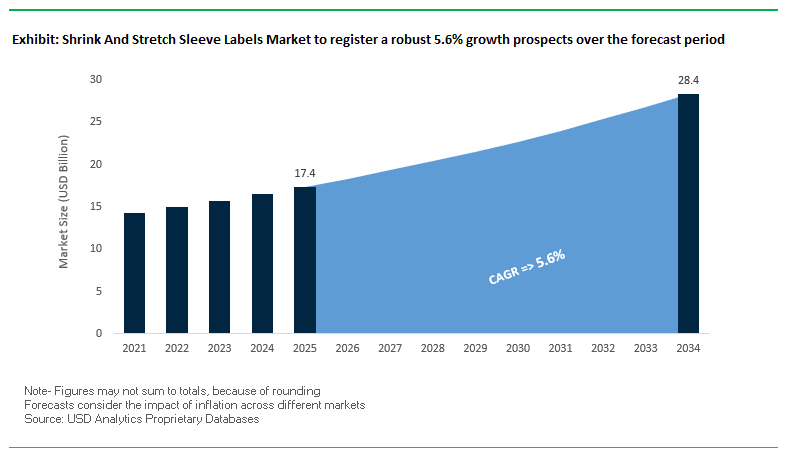
The global shrink and stretch sleeve labels market is projected to grow from $17.4 billion in 2025 to $28.4 billion by 2034, at a CAGR of 5.6%. This growth is driven by the rising demand for 360-degree product decoration, tamper-evident security, and environmentally-friendly materials in the beverage, food, and personal care industries. Shrink sleeve labels conform to containers when heated, while stretch sleeves rely on elasticity, providing a versatile and high-performance labeling solution for modern manufacturing.
Key Insights for Industry Professionals:
Maximizing Shelf Appeal: Full-body sleeves enable brands to utilize every inch of container surface for high-impact, vibrant designs.
Tamper-Evident and Security Integration: Hidden codes, holograms, and tamper-evident features enhance consumer trust and product safety.
Focus on Sustainability: Increasing adoption of recyclable PETG, PE, and PLA materials, with single-material stretch sleeves promoting eco-friendly packaging.
Digital Printing Advancements: Shorter production runs and faster changeovers allow brands to launch limited-edition or seasonal packaging cost-effectively.
Energy-Efficient Production: Modern sleeve technologies contribute to reduced energy consumption and operational efficiency.
This market combines innovation, brand storytelling, and sustainability, making it indispensable for brands aiming to differentiate on shelf and gain consumer loyalty.
Market Analysis: Recent Technological and Sustainable Developments Are Redefining the Sleeve Labels Industry
The shrink and stretch sleeve labels market has experienced significant technological advancements, sustainability initiatives, and strategic expansions. In August 2025, Klöckner Pentaplast won the German Packaging Award for its kp 100% Tray2Tray® innovation, highlighting its commitment to sustainable packaging solutions. The same month, FujiSeal expanded production capacity in Japan, addressing the increasing demand for eco-friendly shrink sleeves. Additionally, Aquapak Polymers revealed that 86% of FMCG brands are willing to pay more for sustainable packaging, emphasizing the growing importance of end-of-life recyclability.
Innovations are expanding across sectors: in July 2025, Mondi Group launched SolmixBag, a water-soluble bag for construction, improving usability and environmental outcomes. In May 2025, DOW introduced a lightweight shrink sleeve film aimed at reducing plastic usage for high-volume beverage packaging, demonstrating an industry-wide commitment to circular economy principles.
Collaborations and material advancements are shaping the market’s future. April 2024 saw Covestro develop high-performing waterborne UV resins for industrial coatings, while Henkel partnered with Celanese in November 2024 to produce water-based adhesives from captured CO2, increasing renewable content. Arkema achieved ISCC+ certification in March 2024, launching bio-attributed UV-LED-EB curable resins for advanced sleeve applications.
Shrink and Stretch Sleeve Labels Market: Innovations Driving Recyclability and Sustainability
Regulatory and Corporate Mandate for Full-Body PVC Elimination
The shrink and stretch sleeve labels market is undergoing a fundamental shift due to regulatory mandates and corporate sustainability goals. The EU Packaging and Packaging Waste Regulation (PPWR), which came into force in 2025, directly targets packaging formats that disrupt recycling streams. Full-body PVC shrink sleeves are among the most problematic, as their high density causes them to sink during the PET sink-float separation process, contaminating recycled PET and lowering output quality. This incompatibility has made PVC a material under strict regulatory scrutiny. As a result, brands operating in Europe and globally are accelerating their transition away from PVC to maintain compliance and safeguard their packaging supply chains.
Corporate sustainability commitments are reinforcing this trend. A 2024 environmental disclosure from a global consumer packaged goods (CPG) leader highlighted its roadmap to eliminate PVC from its packaging portfolio. This dual push—regulatory and corporate—has created a powerful alignment across stakeholders, ensuring that PVC phase-out is not a niche initiative but a mainstream requirement. The result is a fast-growing demand for recyclable alternatives that align with circular economy targets.
Adoption of Floatable and Easily Separable Label Solutions
To solve the recycling challenges posed by traditional sleeve labels, brands are rapidly adopting floatable polyolefin (PO) shrink sleeves. These labels are engineered with a density of less than 1.0 g/cm³, which allows them to float during recycling wash processes, enabling clean separation from heavier PET bottles that sink. This ensures a high-purity PET recyclate stream, preserving material value and closing the loop in beverage and personal care packaging.
Industry recognition has further legitimized these solutions. The Association of Plastic Recyclers (APR) has awarded certifications to multiple polyolefin-based sleeves for meeting stringent design-for-recyclability guidelines. Such third-party validations not only give brands confidence in their sustainability claims but also strengthen their compliance with voluntary and mandated recyclability frameworks. As a result, floatable and separable sleeve labels are becoming the default choice for companies seeking functional performance without compromising recyclability.
Development of Functional Bio-Based and Compostable Films
The end-of-life challenge of plastic shrink sleeves is creating a strong opportunity for bio-based and compostable alternatives. Polylactic acid (PLA), derived from renewable resources such as cornstarch and sugarcane, is one of the most promising materials. PLA-based shrink films are not only industrially compostable but also capable of delivering high optical clarity, printability, and shrink ratios that meet the needs of consumer-facing brands.
Recent product launches have shown that compostable films can perform on par with traditional plastics. For example, a new PLA shrink film grade announced in 2025 demonstrated excellent transparency and shrink performance while being 100% biodegradable. These solutions are particularly valuable in regions lacking robust recycling infrastructure, where compostability provides a more practical end-of-life pathway. This innovation space represents a convergence of sustainability and functionality, giving brands the ability to meet both regulatory and consumer expectations.
Integration of Digital Watermarking for Intelligent Packaging and Recycling
Another transformative opportunity lies in the integration of digital watermarking technologies on shrink and stretch sleeve labels. The HolyGrail 2.0 initiative, backed by over 130 companies across the packaging value chain, has proven the technical viability of digital watermarking at industrial scale. Trials in Germany showed that high-resolution cameras could reliably detect and decode these invisible codes with over 90% accuracy, enabling the precise sorting of packaging into food-grade and non-food-grade PET streams.
The potential of this technology extends beyond sorting. Digital watermarks can act as a “digital recycling passport”, embedding critical information about material composition, additives, and intended use. This creates unprecedented transparency in recycling systems, allowing for more efficient recovery of high-quality materials. For brands, it also provides a platform for enhanced consumer engagement, supply chain traceability, and credible circularity claims. The integration of watermarking positions shrink and stretch sleeve labels not just as packaging, but as data carriers in the circular economy.
Competitive Landscape: Key Players Are Driving Growth Through Innovation, Sustainability, and Advanced Labeling Technology
The global shrink and stretch sleeve labels market is dominated by leading companies that combine materials science, digital printing, and production efficiency to deliver high-performance, sustainable solutions.
Avery Dennison Corporation: Leveraging Innovation and Sustainability to Expand Sleeve Label Capabilities
Avery Dennison offers the Rapid-Roll® Shrink Film Portfolio, serving unit-dose detergents, agrochemicals, and personal care. The company focuses on innovation and sustainability, partnering with Velocys to advance CO2-derived e-SAF production. Avery Dennison’s vertically integrated model enables it to serve diverse regions efficiently while maintaining high-quality, compliant labeling solutions.
CCL Industries Inc.: Leading the Market with Recyclable Shrink and Stretch Sleeve Solutions
CCL Industries is the largest global label company, offering Triple S® Super Stretch Sleeves and shrink labels for beverages, food, and personal care. In February 2024, it launched recycling-friendly polyolefin sleeves compatible with PET flotation separation. Its vertical integration and deep material expertise allow efficient, sustainable solutions across global markets.
Fuji Seal International, Inc.: Expanding Capacity and Advancing Materials for Global Demand
Fuji Seal International provides shrink sleeves and pressure-sensitive labels for food, beverages, personal care, and pharmacy applications. In August 2025, it expanded production in Japan to meet rising sustainable packaging demand. The company invests in next-generation materials and technologies, positioning it as a leader in innovative and compliant labeling solutions.
Klöckner Pentaplast: Pioneering Sustainable Film Innovations in the Sleeve Labels Industry
Klöckner Pentaplast (kp) specializes in sustainable shrink films for food, beverages, and personal care. In July 2025, it won the German Packaging Award for kp 100% Tray2Tray®, highlighting innovations that improve sustainability and production efficiency. Its globally integrated operations provide consistent, high-quality packaging solutions.
Dow Inc.: Driving Lightweight and Circular Economy Solutions in Sleeve Labels
Dow Inc. produces DOWLEX™ and ELITE™ polyethylene resins for shrink and stretch sleeve applications. In May 2025, it introduced lightweight shrink films to reduce plastic usage in beverage packaging. Dow emphasizes material innovation, sustainability, and circular economy initiatives, enabling efficient solutions for food, beverage, and personal care sectors.
Shrink And Stretch Sleeve Labels Market Share Insights, 2025-2034
Shrink Sleeves Hold the Largest Share by Product Type in the Shrink and Stretch Sleeve Labels Industry
Shrink sleeves command 75% of the shrink and stretch sleeve label market, establishing themselves as the industry’s preferred solution for 360-degree decoration, tamper evidence, and complex container conformity. Their ability to tightly wrap around irregularly shaped bottles and provide full-body branding real estate is unmatched, making them indispensable for beverages, personal care, and healthcare packaging. Shrink sleeves also function as primary tamper-evident seals, a critical regulatory and safety requirement for pharmaceuticals and bottled consumables. While their recyclability challenges (particularly with PVC-based materials) remain a concern, the transition to PETG and polyolefin-based films compatible with recycling streams is accelerating adoption. Their dominance reflects a balance of high-impact shelf presence, safety functionality, and compatibility with lightweight packaging trends, making shrink sleeves the clear market leader.
Food & Beverages Drive the Largest Share by End-Use in the Shrink and Stretch Sleeve Labels Industry
The food and beverage sector leads with 55% of end-use demand, cementing its role as the most influential growth engine in the sleeve label market. Beverage brands—from bottled water to premium spirits—depend on shrink sleeves for billboard-style graphics, tamper-evident closures, and full-body coverage that ensure maximum visibility in crowded retail environments. In foods, ready-to-drink beverages, dairy products, sauces, and condiments benefit from sleeves’ ability to deliver vibrant, moisture-resistant branding on refrigerated and irregularly shaped containers. The dominance of this segment is further strengthened by rising competition in retail aisles, where packaging differentiation directly influences purchasing decisions. Moreover, the sector’s push toward recyclable packaging solutions is spurring innovation in PVC-free sleeves and floatable inks, ensuring that sleeves remain central to sustainable food and beverage branding strategies.
European Union: PPWR and Design Innovations Reshaping Label Sustainability
The European Union shrink and stretch sleeve labels market is being transformed by the Packaging and Packaging Waste Regulation (PPWR), which became effective in February 2025. This regulation requires all plastic components of packaging to include minimum recycled content by January 2030, pushing manufacturers toward mono-material shrink sleeve solutions that are compatible with PET bottle recycling. The Ecodesign for Sustainable Products Regulation (ESPR), effective mid-2024, further supports this transition by mandating the use of Digital Product Passports (DPPs), which provide transparency regarding recyclability and material composition.
A major trend in the EU is the rise of perforated shrink sleeves, enabling consumers to easily remove sleeves from bottles before disposal, significantly improving PET recovery rates. The upcoming PFAS ban in August 2026 is spurring innovations in adhesives and coatings for sleeve labels, with companies adopting safer and compliant chemistries. This regulatory landscape is encouraging brand owners to integrate circular design principles, while material suppliers focus on developing thinner, recyclable films without compromising print quality.
United States: EPR and Recyclability Targets Driving Market Transformation
The United States shrink and stretch sleeve labels market is heavily influenced by Extended Producer Responsibility (EPR) laws in seven states, with Maryland mandating that a Producer Responsibility Organization (PRO) must cover 90% of packaging waste management costs by 2030. Alongside, the U.S. Environmental Protection Agency’s (EPA) recycling target of 50% by 2030 is encouraging brands to use post-consumer recycled (PCR) plastics in labels. A prime example is Berry Global, which in April 2024 announced shrink sleeve production from PCR content.
Functional performance remains critical, with demand growing in logistics, food & beverage, and e-commerce where durable, scuff-resistant labels are essential for automated supply chains. Organizations such as the Association of Plastic Recyclers (APR) are issuing guidelines that promote washable inks and floatable shrink sleeves, ensuring PET bottles with labels meet recyclability requirements. The market is also witnessing growth in smart labels with QR/RFID features, providing tamper evidence and real-time traceability.
China: Luxury Packaging and E-Commerce Fueling Premium Label Demand
The China shrink and stretch sleeve labels market is benefitting from both policy reforms and consumer trends. Under the 14th Five-Year Plan, the NDRC and MEE are enforcing stricter plastic pollution controls, while new regulations effective June 1, 2025 require logistics and delivery companies to adopt eco-friendly, reduced, or reusable packaging, boosting demand for recyclable labels.
Consumer preferences are shifting toward high-end and luxury packaging, driving innovation in 3D platinum embossing, holographics, and gold foil stamping for premium stretch sleeves. At the same time, the explosive growth of e-commerce is accelerating the need for lightweight, flexible labels that can endure complex distribution networks. Chinese converters are focusing on advanced digital and gravure printing technologies, offering brand differentiation while aligning with regulatory mandates for eco-friendly packaging.
India: EPR and Traceability Rules Accelerating Market Adoption
The India shrink and stretch sleeve labels market is largely driven by the Plastic Waste Management (Amendment) Rules, 2024, which place heavy emphasis on Extended Producer Responsibility (EPR). Effective July 1, 2025, all plastic packaging must carry a barcode or QR code, enabling full traceability and accountability throughout the supply chain. Importantly, MSMEs are exempt from EPR obligations, shifting compliance responsibility to larger manufacturers and raw material suppliers.
Rising demand from e-commerce and organized retail sectors is fueling adoption of shrink and stretch sleeve labels due to their versatility, branding appeal, and tamper-evident features. While recyclability remains a concern, domestic brands are beginning to explore eco-friendly film substrates and water-based inks to comply with evolving sustainability norms. India’s price-sensitive yet brand-conscious consumer base makes shrink sleeve labels an attractive choice for FMCG, personal care, and food packaging.
The Japan shrink and stretch sleeve labels market is guided by the Plastic Resource Circulation Strategy, which mandates that all plastic packaging be reusable or recyclable by 2025. Complementing this, the Plastic Resource Circulation Promotion Law, effective the same year, requires the reduction or redesign of 12 single-use plastics, driving adoption of compostable and recyclable shrink sleeve alternatives.
Japanese companies are leading in bio-based material adoption, including bio-polypropylene (bio-PP) and paper-based hybrid labels with advanced barrier coatings. The strategy’s target to double renewable material use by 2030 has accelerated R&D into thinner films and innovative shrink label substrates that retain durability while lowering carbon impact. Coupled with Japan’s emphasis on waste sorting and recycling efficiency, the market is expected to set benchmarks for sustainable sleeve label production globally.
Brazil: PNRS and Reverse Logistics Strengthening Label Recovery Systems
The Brazil shrink and stretch sleeve labels market operates under the National Solid Waste Policy (PNRS), which emphasizes reuse, recycling, and reduction of packaging waste. A landmark development is Law No. 15,088 (January 2025), banning imports of solid waste—including plastics—to boost domestic recycling and material recovery systems.
The government is investing in reverse logistics systems, making producers responsible for post-consumer recovery and disposal of packaging materials, including labels. With the growth of food & beverage and retail sectors, the adoption of shrink and stretch sleeves is rising, especially for PET bottles, household goods, and consumer products. Local converters are aligning with regulations by adopting water-based adhesives and recyclable substrates, while multinational brands are expanding closed-loop recycling initiatives to enhance packaging circularity in Brazil.
Shrink And Stretch Sleeve Labels Market Report Scope
Shrink And Stretch Sleeve Labels Market
Parameter
Details
Market Size (2025)
$17.4 Billion
Market Size (2034)
$28.4 Billion
Market Growth Rate
5.6%
Segments
By Material (PETG, PVC, OPS, PE, PP), By Product Type (Shrink Sleeves, Stretch Sleeves), By End-Use Industry (Food & Beverages, Healthcare & Pharmaceuticals, Cosmetics & Personal Care, Home & Industrial Chemicals, Electronics & Appliances)
Study Period
2019- 2024 and 2025-2034
Units
Revenue (USD)
Qualitative Analysis
Porter’s Five Forces, SWOT Profile, Market Share, Scenario Forecasts, Market Ecosystem, Company Ranking, Market Dynamics, Industry Benchmarking
US, Canada, Mexico, Germany, France, Spain, Italy, UK, Russia, China, India, Japan, South Korea, Australia, South East Asia, Brazil, Argentina, Middle East, Africa
Shrink And Stretch Sleeve Labels Market Segmentation
By Material
PETG
PVC
OPS
PE
PP
By Product Type
Shrink Sleeves
Stretch Sleeves
By End-Use Industry
Food & Beverages
Healthcare & Pharmaceuticals
Cosmetics & Personal Care
Home & Industrial Chemicals
Electronics & Appliances
Countries Analyzed
North America (US, Canada, Mexico)
Europe (Germany, UK, France, Spain, Italy, Russia, Rest of Europe)
Asia Pacific (China, India, Japan, South Korea, Australia, South East Asia, Rest of Asia)
South America (Brazil, Argentina, Rest of South America)
Middle East and Africa (Saudi Arabia, UAE, Rest of Middle East, South Africa, Egypt, Rest of Africa)
Top Companies in Shrink And Stretch Sleeve Labels Market
CCL Industries Inc.
Amcor plc
Huhtamaki Oyj
Berry Global, Inc.
Fuji Seal International, Inc.
Sleeveco
Klöckner Pentaplast
Avery Dennison Corporation
Tekni-Plex, Inc.
D&L Packaging
WestRock Company
Multi-Color Corporation
Sonoco Products Company
Macfarlane Group PLC
Greiner Packaging International GmbH
* List Not Exhaustive
Methodology
USDAnalytics employs a comprehensive and multi-layered research methodology to provide accurate insights into the global shrink and stretch sleeve labels market. Our approach integrates secondary research, including regulatory filings, sustainability reports, corporate press releases, patent databases, and industry journals, with primary research conducted through interviews with packaging engineers, brand managers, material scientists, and sustainability consultants. Market sizing and forecasting are segmented by material type (PETG, PVC, OPS, PE, PP), product type (shrink sleeves, stretch sleeves), and end-use industries (food & beverages, healthcare & pharmaceuticals, cosmetics & personal care, home & industrial chemicals, electronics & appliances), while incorporating regional dynamics across the U.S., EU, China, Japan, India, and Brazil. USDAnalytics evaluates key market drivers such as full-body branding trends, tamper-evident and digital watermark technologies, sustainability mandates including PPWR and EPR laws, and innovations in compostable and floatable sleeve materials. Competitive analysis examines strategic expansions, capacity enhancements, and material and digital printing innovations by leading players like CCL Industries, Avery Dennison, Fuji Seal, and Klöckner Pentaplast, providing actionable intelligence for industry professionals to navigate technological, regulatory, and market evolution in this high-growth segment.
Deliverables:
Comprehensive Market Research Report (PDF and Excel) with detailed tables, charts, and interactive visualizations.
Country-Specific Forecasts & Analysis.
Segment-Wise Revenue Forecasts (2025–2034).
Competitive Analysis, Benchmarking, and SWOT Profiles.
Recent Developments & Innovation Tracker.
Executive Summary & Analyst Commentary.
Post-Purchase Analyst Support for Client-Specific Questions and Custom Data Requirements.
Table of Contents: Shrink and Stretch Sleeve Labels Market
1. Executive Summary
1.1. Market Highlights
1.2. Key Findings
1.3. Global Market Snapshot
2. Shrink and Stretch Sleeve Labels Market Landscape & Outlook (2025–2034)
2.1. Introduction to Shrink and Stretch Sleeve Labels Market
2.2. Market Valuation and Growth Projections (2025–2034)
2.3. Technological and Sustainable Developments
2.4. Regulatory Influences and Corporate Sustainability Commitments
2.5. Market Dynamics and Growth Drivers
3. Innovations Reshaping the Shrink and Stretch Sleeve Labels Market
3.1. Trend: Development of Floatable and Easily Separable Label Solutions
3.2. Trend: Functional Bio-Based and Compostable Films
3.3. Opportunity: Integration of Digital Watermarking for Intelligent Packaging and Recycling
3.4. Opportunity: Digital Printing Advancements and Energy-Efficient Production
4. Competitive Landscape and Strategic Initiatives
4.1. Mergers, Acquisitions and Strategic Alliances
4.2. R&D and Material Innovation
4.3. Sustainability and Strategies
4.4. Market Expansion and Regional Focus
5. Market Share and Segmentation Insights: Shrink and Stretch Sleeve Labels Market
5.1. By Material
5.1.1. PETG
5.1.2. PVC
5.1.3. OPS
5.1.4. PE
5.1.5. PP
5.2. By Product Type
5.2.1. Shrink Sleeves
5.2.2. Stretch Sleeves
5.3. By End-Use Industry
5.3.1. Food & Beverages
5.3.2. Healthcare & Pharmaceuticals
5.3.3. Cosmetics & Personal Care
5.3.4. Home & Industrial Chemicals
5.3.5. Electronics & Appliances
6. Country Analysis and Outlook of Shrink and Stretch Sleeve Labels Market
6.1. United States
6.2. Canada
6.3. Mexico
6.4. Germany
6.5. France
6.6. Spain
6.7. Italy
6.8. UK
6.9. Russia
6.10. China
6.11. India
6.12. Japan
6.13. South Korea
6.14. Australia
6.15. South East Asia
6.16. Brazil
6.17. Argentina
6.18. Middle East
6.19. Africa
7. Shrink and Stretch Sleeve Labels Market Size Outlook by Region (2025–2034)
7.1. North America Shrink and Stretch Sleeve Labels Market Size Outlook to 2034
7.1.1. By Material
7.1.2. By Product Type
7.1.3. By End-Use Industry
7.2. Europe Shrink and Stretch Sleeve Labels Market Size Outlook to 2034
7.2.1. By Material
7.2.2. By Product Type
7.2.3. By End-Use Industry
7.3. Asia Pacific Shrink and Stretch Sleeve Labels Market Size Outlook to 2034
7.3.1. By Material
7.3.2. By Product Type
7.3.3. By End-Use Industry
7.4. South America Shrink and Stretch Sleeve Labels Market Size Outlook to 2034
7.4.1. By Material
7.4.2. By Product Type
7.4.3. By End-Use Industry
7.5. Middle East and Africa Shrink and Stretch Sleeve Labels Market Size Outlook to 2034
7.5.1. By Material
7.5.2. By Product Type
7.5.3. By End-Use Industry
8. Company Profiles: Leading Players in the Shrink and Stretch Sleeve Labels Market
8.1. CCL Industries Inc.
8.2. Amcor plc
8.3. Huhtamaki Oyj
8.4. Berry Global, Inc.
8.5. Fuji Seal International, Inc.
8.6. Sleeveco
8.7. Klöckner Pentaplast
8.8. Avery Dennison Corporation
8.9. Tekni-Plex, Inc.
8.10. D&L Packaging
8.11. WestRock Company
8.12. Multi-Color Corporation
8.13. Sonoco Products Company
8.14. Macfarlane Group PLC
8.15. Greiner Packaging International GmbH
9. Methodology
9.1. Research Scope
9.2. Market Research Approach
9.3. Market Sizing and Forecasting Model
9.4. Research Coverage
9.5. Data Horizon
9.6. Deliverables
10. Appendix
10.1. Acronyms and Abbreviations
10.2. List of Tables
10.3. List of Figures
Shrink And Stretch Sleeve Labels Market Segmentation
By Material
PETG
PVC
OPS
PE
PP
By Product Type
Shrink Sleeves
Stretch Sleeves
By End-Use Industry
Food & Beverages
Healthcare & Pharmaceuticals
Cosmetics & Personal Care
Home & Industrial Chemicals
Electronics & Appliances
Countries Analyzed
North America (US, Canada, Mexico)
Europe (Germany, UK, France, Spain, Italy, Russia, Rest of Europe)
Asia Pacific (China, India, Japan, South Korea, Australia, South East Asia, Rest of Asia)
South America (Brazil, Argentina, Rest of South America)
Middle East and Africa (Saudi Arabia, UAE, Rest of Middle East, South Africa, Egypt, Rest of Africa)
The global market is expected to grow from USD 17.4 billion in 2025 to USD 28.4 billion by 2034, at a CAGR of 5.6%. Growth is fueled by demand for 360-degree branding, tamper-evident packaging, and adoption of recyclable, sustainable materials across food, beverage, and personal care industries.
Shrink sleeves hold the largest share at 75%, due to their ability to conform to complex container shapes, provide full-body decoration, and integrate tamper-evident features. Stretch sleeves are gaining adoption for flexible and eco-friendly applications but remain secondary in market share.
Regulatory mandates and corporate sustainability goals are driving the shift from PVC to recyclable PETG and polyolefin-based sleeves. Bio-based and compostable films, floatable sleeves, and water-based adhesives are increasingly adopted to enhance circularity and meet end-of-life recyclability standards.
Advancements include digital printing for short runs, water-soluble films, bio-based resins, and digital watermarking for intelligent packaging. These innovations improve brand storytelling, recyclability, traceability, and compliance with global regulations while supporting energy-efficient production.
Key players include CCL Industries, Avery Dennison, Fuji Seal International, Klöckner Pentaplast, and Dow Inc. These companies focus on combining material science, digital printing, and sustainable innovations to provide high-performance, compliant, and eco-friendly sleeve labeling solutions globally.