Temperature Controlled Packaging Solutions Market Size, Overview, and Growth Outlook (2025–2034)
Temperature Controlled Packaging Solutions Market Poised for Explosive Growth to $985.8 Billion by 2034 Amid Rising Pharmaceutical and Cold Chain Demands
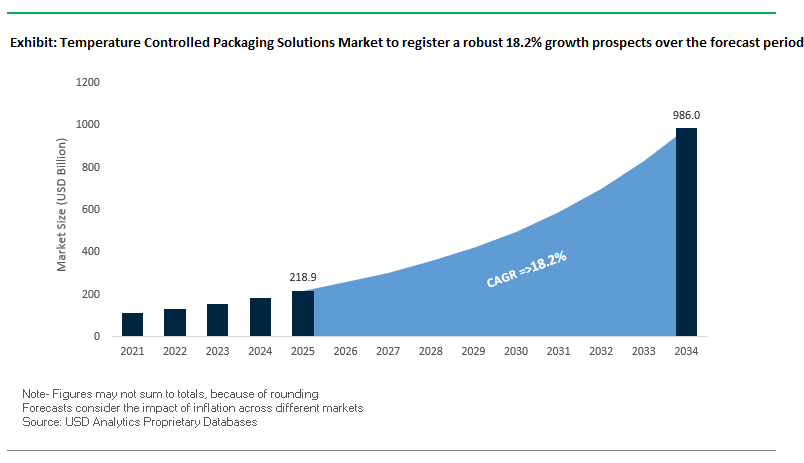
The global temperature controlled packaging solutions market is projected to grow from $218.9 billion in 2025 to $985.8 billion by 2034, representing a CAGR of 18.2%. The market is critical for the safe transport of sensitive goods, including pharmaceuticals, biologics, and perishable food products, across complex global supply chains.
Key Insights for logistics and life sciences professionals:
Stringent regulatory compliance from FDA, EMA, and other authorities is driving demand for precise temperature control throughout the cold chain.
Phase change materials (PCMs) are increasingly replacing traditional ice packs, offering more reliable temperature stability across controlled room, refrigerated, and deep-frozen ranges.
Integration of IoT sensors and data analytics allows real-time monitoring of temperature, humidity, and location, providing enhanced visibility and risk mitigation.
Sustainability trends are accelerating the adoption of reusable and modular packaging systems, reducing waste and cost across industries.
Growth is fueled by rising demand from pharmaceutical, biotech, food, and research sectors, emphasizing high-value, temperature-sensitive logistics solutions.
The market presents significant opportunities for innovative, technology-driven solutions that combine efficiency, compliance, and sustainability in the cold chain ecosystem.
Market Analysis: Advancements in Technology and Strategic Investments Are Shaping the Temperature Controlled Packaging Industry
The temperature controlled packaging solutions market is evolving rapidly with technological innovation and strategic partnerships leading the way. In August 2025, Cold Chain Technologies (CCT) expanded its Asia-Pacific presence with new hubs in Tokyo and Mumbai and strengthened distributor partnerships in China and Australia. Additionally, CCT partnered with E&I Cooperative Services to provide expedited cold chain solutions to colleges, universities, and research labs.
Capacity expansion and product diversification are key market drivers. In July 2025, Sonoco announced a $30 million investment to enhance its production capacity, including temperature-controlled packaging. The same month, academic research highlighted the use of advanced additives to improve mechanical and antimicrobial properties in sustainable packaging films, signaling a strong push towards environmentally friendly and high-performance solutions.
The market is also witnessing innovation in modular and reusable systems. In January 2025, DS Smith launched TailorTemp, a new solution targeting pharmaceutical logistics at Pharmapack Europe 2025. In December 2024, a private investment firm acquired a majority stake in Eutecma, a German developer of sustainable, modular, and reusable temperature-controlled packaging solutions. Earlier, in October 2024, PLUSS Advanced Technologies introduced the Celsure® XL Pallet Shipper and Celsure® VIP Multi-Use Parcel Shipper, showcasing advancements in multi-use and scalable packaging.
Trends and Opportunities in the Temperature Controlled Packaging Solutions Market
Proliferation of Data-Logging and Real-Time Condition Monitoring
The temperature-controlled packaging solutions market is undergoing a transformation with the rise of IoT-enabled real-time monitoring systems. Traditional manual data loggers are increasingly being replaced by connected sensors capable of recording temperature, humidity, light exposure, and geolocation every minute. For example, a leading cold chain provider has deployed IoT sensors that safeguard ultra-sensitive biologics, allowing immediate corrective action if a shipment drifts outside its safe range.
This capability is critical for compliance with Good Distribution Practices (GDP), which mandate continuous and auditable temperature control records. Instead of reacting after product spoilage, logistics teams are adopting proactive supply chain models with automated alerts that enable intervention mid-transit. Furthermore, the data-rich ecosystem created by these devices extends beyond compliance. Aggregated data across routes and carriers highlights systemic inefficiencies, enabling companies to optimize delivery pathways, identify “hotspot” risks, and refine packaging performance. This makes data-logging and monitoring technologies an operational asset as well as a compliance tool, reinforcing their role as a dominant trend in pharmaceutical and life sciences packaging.
Adoption of Sustainable and Reusable Passive Shipper Systems
Sustainability concerns are driving the transition away from single-use expanded polystyrene (EPS) coolers toward durable, reusable passive shippers. A leading pharma company has pledged to replace thousands of EPS boxes with reusable containers, each capable of substituting hundreds of single-use units throughout its lifecycle. This shift directly reduces landfill waste and cuts the carbon footprint of cold chain logistics.
While the upfront investment in reusable packaging can be higher, long-term savings come from reduced replacement costs and greater supply chain efficiency. Advanced insulation technologies such as Vacuum-Insulated Panels (VIPs), graphite composites, and polyurethane foams are enabling shippers to maintain precise temperature ranges across long-haul, multi-leg transport. In parallel, innovations in Phase Change Materials (PCMs) ensure thermal stability for categories ranging from ultra-cold biologics to ambient-sensitive medicines. These developments make reusable passive systems not only sustainable but also technically superior to many legacy single-use solutions.
Development of Phase Change Materials (PCMs) for Specific Therapeutic Temperature Ranges
The shift from dry ice to advanced Phase Change Materials (PCMs) represents a pivotal opportunity in the temperature-controlled packaging market. Dry ice, while widely used, presents challenges as a hazardous material, complicating handling, transportation, and regulatory compliance. Researchers are now engineering eutectic PCMs with melting points between -80°C and -60°C, designed specifically to match the requirements of cutting-edge therapies such as mRNA vaccines and cell therapies.
These PCMs deliver consistent ultra-low temperatures without external power, maintaining integrity for days and reducing the risk of spoilage from sublimation gaps that often occur with dry ice. By precisely absorbing or releasing thermal energy at a fixed point, PCMs create stable thermal environments critical for biologics and advanced therapies. Their scalability and safer logistics handling position them as a cornerstone of future cold chain innovations for high-value healthcare applications.
Integration with Last-Mile E-commerce Delivery Networks for Fresh Food
The pharmaceutical cold chain infrastructure, designed for regulatory-grade precision, is increasingly being repurposed for last-mile delivery of premium fresh food and groceries. Cold chain specialists are deploying pre-qualified packaging systems capable of maintaining safe temperature ranges for over 48 hours, ensuring that perishable goods like meat, seafood, and dairy reach consumers in pristine condition.
This approach directly addresses food waste, a major challenge in e-commerce grocery distribution. For instance, passive cold chain technologies used in India have demonstrated the ability to preserve frozen goods for up to 10 hours across multiple delivery stops, independent of vehicle refrigeration systems. By extending pharmaceutical-grade cold chain reliability into fresh food delivery networks, companies can reduce spoilage, lower costs, and scale premium e-commerce food distribution models. This creates a strong opportunity for cross-industry convergence, where pharmaceutical logistics expertise is applied to high-growth food retail channels.
Competitive Landscape: Leading Players Are Driving Innovation, Sustainability, and Global Expansion in Temperature Controlled Packaging Solutions
The temperature controlled packaging market is highly competitive, with key players focusing on material innovation, global reach, and sustainability to meet growing demand across pharmaceutical, biotech, and perishable goods sectors.
Sonoco ThermoSafe: Expanding Global Production to Enhance Sustainable Cold Chain Solutions
Sonoco ThermoSafe provides insulated containers, parcel shippers, and pallet shippers across a variety of temperature ranges. In July 2025, the company announced a $30 million capital investment to expand its production capacity. Its core strengths include global manufacturing and logistics networks, strong brand recognition, and a focus on sustainable, innovative packaging solutions for pharmaceuticals and fresh food products.
va-Q-tec AG: Delivering High-Performance Reusable Thermal Containers with Integrated Vacuum and PCM Technology
va-Q-tec specializes in reusable thermal containers using vacuum insulation panels (VIPs) and phase change materials (PCMs), maintaining precise temperatures for up to 10 days. In May 2022, the company reported a 25% revenue increase driven by its Services and Systems divisions, and is expanding in India and Brazil to serve the growing pharmaceutical sector. Its vertical integration and technology expertise provide scalable, high-performance cold chain solutions.
CCT offers insulated containers, gel packs, and phase change materials for diverse temperature ranges. In August 2025, CCT expanded its APAC operations with hubs in Tokyo and Mumbai and partnered with E&I Cooperative Services. Its global network and vertically integrated model allow efficient delivery of sustainable, reliable, and high-performance temperature-controlled solutions.
Pelican BioThermal: Setting Industry Standards with Reusable and Single-Use Thermal Packaging Solutions
Pelican BioThermal provides reusable and single-use containers, including the Crēdo line, designed for precise temperature maintenance over extended periods. Its innovation program focuses on lightweighting, continuous improvement, and new market solutions, while the company’s strong brand recognition and vertical integration support global distribution in life sciences and biotech sectors.
Inmark: Leading Sustainability Initiatives with Paper-Based Alternatives and Global Expansion
Inmark delivers insulated containers, gel packs, and phase change materials, emphasizing sustainability with Plastic Replacement initiatives. The company is expanding its international footprint to meet pharmaceutical cold chain demands, leveraging vertically integrated operations and a strong brand presence to provide high-quality, sustainable packaging and logistics solutions.
Temperature Controlled Packaging Solutions Market Share Insights, 2025-2034
Passive Thermal Packaging Dominates Product Type Share in Temperature Controlled Packaging Solutions Industry
Passive thermal packaging solutions command the largest share of the temperature-controlled packaging market, accounting for nearly 65% of total usage, largely due to their versatility, scalability, and cost-efficiency in single-use applications. These systems, typically designed with EPS or PUR insulation and enhanced with phase change materials (PCMs), are widely adopted for pharmaceutical, biotech, and food shipments that require reliable performance without the complexity of external power sources. Their ability to cover a broad range of temperature profiles (2–8°C, -20°C, and beyond) makes them the preferred choice for parcel shipments in global cold chain logistics. Pharmaceutical distribution, vaccine rollouts, and biologics transport especially rely on passive packaging as a validated, regulatory-compliant, and cost-controlled solution for last-mile and mid-mile shipping. While active systems continue to expand for long-duration and high-value payloads, passive thermal packaging’s lower capital intensity and strong sustainability credentials (lightweighting and recyclable insulation) ensure it remains the dominant product type in the industry.
Pharmaceuticals & Biologics Lead Application Share in Temperature Controlled Packaging Solutions Industry
Pharmaceuticals and biologics represent the largest application segment, holding 55% of the temperature-controlled packaging solutions market, driven by the uncompromising requirements of global drug distribution. The sector’s dominance is anchored in the transport of high-value products such as vaccines, oncology drugs, and insulin, where even minor deviations from prescribed temperature ranges can compromise product efficacy. Regulatory compliance under frameworks such as FDA 21 CFR Part 11 and WHO Good Distribution Practices (GDP) enforces stringent packaging validation, elevating demand for advanced passive solutions with multi-day thermal performance and active units for intercontinental shipments. This application continues to attract the most innovation investment, including integrated temperature loggers, IoT-enabled condition monitoring, and reusable cold chain packaging, to support traceability and sustainability in pharmaceutical logistics. The high financial value of biologics and the accelerating pipeline of cell and gene therapies further cement this segment as the key driver of industry revenue and technological advancement.
United States: Sustainability, IoT Monitoring, and Biometric Integration
The United States temperature-controlled packaging solutions market is strongly guided by the FDA’s cold chain compliance framework, which emphasizes Good Manufacturing Practices (GMP) and Good Distribution Practices (GDP) to protect the integrity of pharmaceuticals, biologics, and food products from manufacturer to end-user. This regulatory landscape has pushed companies to develop packaging systems with validated insulation, tamper-evident features, and longer duration hold times. At the same time, sustainability is becoming a core market driver, with leading suppliers investing in fiber-based insulated packaging, reusable shipping containers, and recycle-ready designs.
The market is also being reshaped by the rise of e-commerce, which requires lightweight yet durable packaging for frozen foods, ready-to-eat meals, and online pharmaceutical orders. IoT sensors, data loggers, and real-time monitoring systems are increasingly deployed, offering visibility into temperature, humidity, and location across the logistics chain. Furthermore, the adoption of biometric-enabled packaging solutions for high-value biologics and specialty medicines enhances supply chain security and combats counterfeiting. These innovations position the U.S. as one of the most advanced markets for intelligent, sustainable cold chain packaging.
European Union: Circular Economy Regulations and Cold Chain Compliance
The European Union temperature-controlled packaging solutions market is transitioning rapidly due to stringent sustainability and compliance regulations. The Packaging and Packaging Waste Regulation (PPWR), effective February 2025, mandates minimum recycled content thresholds in plastic packaging by 2030, directly influencing cold chain packaging materials. Additionally, the Ecodesign for Sustainable Products Regulation (ESPR) and the EU’s emphasis on refill and reuse systems are pushing manufacturers toward durable, repairable, and reusable insulated shipping solutions.
In parallel, the EU Medical Device Regulation (MDR, 2021) and GDP guidelines have reinforced stricter standards for sterile and temperature-controlled pharmaceutical logistics, requiring validated cold chain processes and clear documentation to prevent excursions. Companies are therefore investing in composite materials, energy-efficient insulation, and smart data tracking systems to align with compliance. Combined, these sustainability and pharmaceutical regulations are driving the EU market toward innovative, recyclable, and technology-driven cold chain packaging solutions.
China: Cold Chain Infrastructure Expansion and Smart Technology Adoption
The China temperature-controlled packaging solutions market is experiencing rapid growth under the government’s 14th Five-Year Plan, which prioritizes the development of a modern national cold chain logistics system. This includes substantial investments to reduce food waste, enhance food safety, and strengthen pharmaceutical distribution networks. The regulation effective June 1, 2025, requiring express delivery companies to adopt eco-friendly, reduced, and reusable packaging, is expected to significantly boost sustainable cold chain adoption across the e-commerce sector.
China is also a leader in integrating advanced technologies such as big data, artificial intelligence, and 5G-enabled monitoring systems into cold chain logistics. These systems improve traceability, efficiency, and predictive maintenance in temperature-sensitive deliveries. With government-backed tax incentives promoting green technology and remanufacturing, China’s market is evolving toward smart, sustainable, and highly automated temperature-controlled packaging solutions.
India: Policy-Driven Growth and Pharmaceutical Cold Chain Expansion
The India temperature-controlled packaging solutions market is being propelled by both government-led policies and private sector investment. The National Centre for Cold-chain Development (NCCD) is leading standardization and sustainability initiatives, while the Delhi Logistics and Warehousing Policy 2025 incentivizes cold chain operators with subsidies for green energy adoption, including solar-powered cold storage. Furthermore, regulatory frameworks are tightening, with the Plastic Waste Management Rules (2024) and the requirement from July 1, 2025, for barcode or QR-based traceability on all packaging, enhancing accountability and transparency.
The pharmaceutical sector is a particularly strong driver, with the CDSCO launching QR-coded pharmaceutical packaging in October 2024 for authenticity and anti-counterfeiting measures. With India being a global hub for generic medicines, these changes significantly increase demand for GDP-compliant pharmaceutical cold chain packaging. At the same time, the booming e-commerce sector and growing retail presence are accelerating adoption of temperature-controlled packaging for dairy, frozen foods, and beverages, making India one of the fastest-growing markets for sustainable cold chain packaging.
Japan: Energy-Efficient Cold Chain and Advanced Refrigeration Technologies
The Japan temperature-controlled packaging solutions market is undergoing a transformation shaped by plastic resource circulation policies and cutting-edge cold chain innovations. The Plastic Resource Circulation Strategy (2025) and the Plastic Resource Circulation Promotion Law mandate reductions in single-use plastic and encourage reusable or compostable alternatives, directly influencing packaging used for pharmaceuticals, diagnostics, and frozen foods.
Japan is also a leader in innovative cold chain technology, with companies integrating IoT-enabled temperature monitoring, energy-efficient refrigeration, and ice battery technology. These ice battery containers are gaining traction as they reduce reliance on diesel-powered generators, cutting CO₂ emissions while maintaining thermal stability for temperature-sensitive cargo. By combining sustainability mandates, advanced refrigeration systems, and IoT-driven monitoring, Japan is positioning itself as a pioneer in low-emission and high-performance temperature-controlled packaging.
Temperature Controlled Packaging Solutions Market Report Scope
Temperature Controlled Packaging Solutions Market
Parameter
Details
Market Size (2025)
$218.9 Billion
Market Size (2034)
$985.8 Billion
Market Growth Rate
18.2%
Segments
By Product Type (Passive Thermal Packaging, Active Thermal Packaging), By Material (Insulation Materials, Refrigerants, Outer Materials), By Application (Pharmaceuticals & Biologics, Food & Beverages, Chemicals, Clinical Trials, Life Sciences, Medical Devices), By End-Use Industry (Pharmaceutical & Healthcare, Food & Beverage, Logistics & Transportation, Chemicals)
Study Period
2019- 2024 and 2025-2034
Units
Revenue (USD)
Qualitative Analysis
Porter’s Five Forces, SWOT Profile, Market Share, Scenario Forecasts, Market Ecosystem, Company Ranking, Market Dynamics, Industry Benchmarking
Companies
Sonoco ThermoSafe (Sonoco Products Company), Cold Chain Technologies, LLC, Peli BioThermal, CSafe Global, Softbox Systems Ltd., Envirotainer AB, Cryopak, Va-Q-tec AG, Intelsius, Sofrigam SA, AmerisourceBergen, Tempack, Plasti-Fab, Inc., Air Sea Containers Ltd., Cryoport, Inc.
Countries
US, Canada, Mexico, Germany, France, Spain, Italy, UK, Russia, China, India, Japan, South Korea, Australia, South East Asia, Brazil, Argentina, Middle East, Africa
Temperature Controlled Packaging Solutions Market Segmentation
By Product Type
Passive Thermal Packaging
Active Thermal Packaging
By Material
Insulation Materials
Refrigerants
Outer Materials
By Application
Pharmaceuticals & Biologics
Food & Beverages
Chemicals
Clinical Trials
Life Sciences
Medical Devices
By End-Use Industry
Pharmaceutical & Healthcare
Food & Beverage
Logistics & Transportation
Chemicals
Countries Analyzed
North America (US, Canada, Mexico)
Europe (Germany, UK, France, Spain, Italy, Russia, Rest of Europe)
Asia Pacific (China, India, Japan, South Korea, Australia, South East Asia, Rest of Asia)
South America (Brazil, Argentina, Rest of South America)
Middle East and Africa (Saudi Arabia, UAE, Rest of Middle East, South Africa, Egypt, Rest of Africa)
Top Companies in Temperature Controlled Packaging Solutions Market
Sonoco ThermoSafe (Sonoco Products Company)
Cold Chain Technologies, LLC
Peli BioThermal
CSafe Global
Softbox Systems Ltd.
Envirotainer AB
Cryopak
Va-Q-tec AG
Intelsius
Sofrigam SA
AmerisourceBergen
Tempack
Plasti-Fab, Inc.
Air Sea Containers Ltd.
Cryoport, Inc.
* List Not Exhaustive
Methodology
USDAnalytics employs a comprehensive and rigorous research methodology to deliver precise, actionable insights into the global temperature-controlled packaging solutions market. Our approach combines primary research—through detailed interviews with cold chain logistics providers, pharmaceutical companies, and material technology experts—with extensive secondary research from corporate reports, regulatory publications, and trade journals. Quantitative modeling and market forecasting are applied to analyze historical trends, emerging technological innovations, sustainability initiatives, and regional dynamics across the United States, European Union, China, Japan, and India. USDAnalytics emphasizes technological adoption, including IoT-enabled monitoring, phase change materials (PCMs), and reusable thermal packaging, alongside regulatory compliance with FDA, EMA, GDP, and national standards. Country-specific policy drivers, e-commerce logistics trends, and pharmaceutical cold chain expansion are integrated to assess growth opportunities and challenges. All insights are validated via triangulation and expert consultation to ensure accuracy, reliability, and strategic relevance for supply chain managers, investors, and manufacturers seeking to capitalize on high-value temperature-sensitive logistics solutions.
Deliverables:
Comprehensive Market Research Report (PDF and Excel) with detailed tables, charts, and interactive visualizations.
Country-Specific Forecasts & Analysis.
Segment-Wise Revenue Forecasts (2025–2034).
Competitive Analysis, Benchmarking, and SWOT Profiles.
Recent Developments & Innovation Tracker.
Executive Summary & Analyst Commentary.
Post-Purchase Analyst Support for Client-Specific Questions and Custom Data Requirements.
Table of Contents: Temperature Controlled Packaging Solutions Market
1. Executive Summary
1.1. Market Highlights
1.2. Key Findings
1.3. Global Market Snapshot
2. Temperature Controlled Packaging Solutions Market Landscape & Outlook (2025–2034)
2.1. Introduction to Temperature Controlled Packaging Solutions Market
2.2. Market Valuation and Growth Projections (2025–2034)
2.3. Market Drivers and Restraints
2.4. Key Technological Trends
2.5. Regulatory and Policy Landscape
3. Innovations Reshaping the Temperature Controlled Packaging Solutions Market
3.1. Trend: Proliferation of Data-Logging and Real-Time Condition Monitoring
3.2. Trend: Adoption of Sustainable and Reusable Passive Shipper Systems
3.3. Opportunity: Development of Phase Change Materials (PCMs) for Specific Therapeutic Temperature Ranges
3.4. Opportunity: Integration with Last-Mile E-commerce Delivery Networks for Fresh Food
4. Competitive Landscape and Strategic Initiatives
4.1. Mergers, Acquisitions and Strategic Alliances
4.2. R&D and Material Innovation
4.3. Sustainability and Strategies
4.4. Market Expansion and Regional Focus
5. Market Share and Segmentation Insights: Temperature Controlled Packaging Solutions Market
5.1. By Product Type
5.1.1. Passive Thermal Packaging
5.1.2. Active Thermal Packaging
5.2. By Material
5.2.1. Insulation Materials
5.2.2. Refrigerants
5.2.3. Outer Materials
5.3. By Application
5.3.1. Pharmaceuticals & Biologics
5.3.2. Food & Beverages
5.3.3. Chemicals
5.3.4. Clinical Trials
5.3.5. Life Sciences
5.3.6. Medical Devices
5.4. By End-Use Industry
5.4.1. Pharmaceutical & Healthcare
5.4.2. Food & Beverage
5.4.3. Logistics & Transportation
5.4.4. Chemicals
6. Country Analysis and Outlook of Temperature Controlled Packaging Solutions Market
6.1. United States
6.2. Canada
6.3. Mexico
6.4. Germany
6.5. France
6.6. Spain
6.7. Italy
6.8. UK
6.9. Russia
6.10. China
6.11. India
6.12. Japan
6.13. South Korea
6.14. Australia
6.15. South East Asia
6.16. Brazil
6.17. Argentina
6.18. Middle East
6.19. Africa
7. Temperature Controlled Packaging Solutions Market Size Outlook by Region (2025–2034)
7.1. North America Market Size Outlook to 2034
7.1.1. By Product Type
7.1.2. By Application
7.1.3. By End-Use Industry
7.2. Europe Market Size Outlook to 2034
7.2.1. By Product Type
7.2.2. By Application
7.2.3. By End-Use Industry
7.3. Asia Pacific Market Size Outlook to 2034
7.3.1. By Product Type
7.3.2. By Application
7.3.3. By End-Use Industry
7.4. South America Market Size Outlook to 2034
7.4.1. By Product Type
7.4.2. By Application
7.4.3. By End-Use Industry
7.5. Middle East and Africa Market Size Outlook to 2034
7.5.1. By Product Type
7.5.2. By Application
7.5.3. By End-Use Industry
8. Company Profiles: Leading Players in the Temperature Controlled Packaging Solutions Market
8.1. Sonoco ThermoSafe (Sonoco Products Company)
8.2. Cold Chain Technologies, LLC
8.3. Peli BioThermal
8.4. CSafe Global
8.5. Softbox Systems Ltd.
8.6. Envirotainer AB
8.7. Cryopak
8.8. Va-Q-tec AG
8.9. Intelsius
8.10. Sofrigam SA
8.11. AmerisourceBergen
8.12. Tempack
8.13. Plasti-Fab, Inc.
8.14. Air Sea Containers Ltd.
8.15. Cryoport, Inc.
9. Methodology
9.1. Research Scope
9.2. Market Research Approach
9.3. Market Sizing and Forecasting Model
9.4. Research Coverage
9.5. Data Horizon
9.6. Deliverables
10. Appendix
10.1. Acronyms and Abbreviations
10.2. List of Tables
10.3. List of Figures
Temperature Controlled Packaging Solutions Market Segmentation
By Product Type
Passive Thermal Packaging
Active Thermal Packaging
By Material
Insulation Materials
Refrigerants
Outer Materials
By Application
Pharmaceuticals & Biologics
Food & Beverages
Chemicals
Clinical Trials
Life Sciences
Medical Devices
By End-Use Industry
Pharmaceutical & Healthcare
Food & Beverage
Logistics & Transportation
Chemicals
Countries Analyzed
North America (US, Canada, Mexico)
Europe (Germany, UK, France, Spain, Italy, Russia, Rest of Europe)
Asia Pacific (China, India, Japan, South Korea, Australia, South East Asia, Rest of Asia)
South America (Brazil, Argentina, Rest of South America)
Middle East and Africa (Saudi Arabia, UAE, Rest of Middle East, South Africa, Egypt, Rest of Africa)
The market is expected to expand from USD 218.9 billion in 2025 to USD 985.8 billion by 2034, growing at a CAGR of 18.2%. This growth is driven by rising demand from pharmaceuticals, biologics, perishable food, and biotechnology industries requiring precise temperature management throughout complex supply chains.
Passive thermal packaging accounts for nearly 65% of total usage due to its versatility, cost-efficiency, and reliability across temperature ranges from 2–8°C to -20°C. Active systems are growing for high-value, long-duration shipments, but passive packaging remains the preferred choice for pharmaceutical, biotech, and food logistics.
Innovations include IoT-enabled sensors for real-time monitoring, phase change materials (PCMs) for precise thermal control, vacuum-insulated panels (VIPs), and reusable modular designs. These technologies enhance regulatory compliance, reduce spoilage, and provide actionable supply chain data for optimization and risk mitigation.
Key growth regions include the U.S., EU, China, Japan, and India. The U.S. leverages federal support and IoT adoption, the EU emphasizes sustainability and circular economy regulations, China focuses on infrastructure expansion and smart technology, Japan advances energy-efficient cold chain systems, and India benefits from pharmaceutical-driven demand and government-led cold chain incentives.
Sustainability drives the adoption of reusable passive shippers, modular systems, recyclable insulation materials, and phase change materials with reduced environmental impact. Regulatory mandates like the EU PPWR, Japan’s Plastic Resource Circulation Law, and India’s Plastic Waste Management Rules are encouraging companies to integrate eco-friendly, circular solutions without compromising temperature stability or compliance.