Market Overview: Strategic Growth of the Contract Packaging Industry
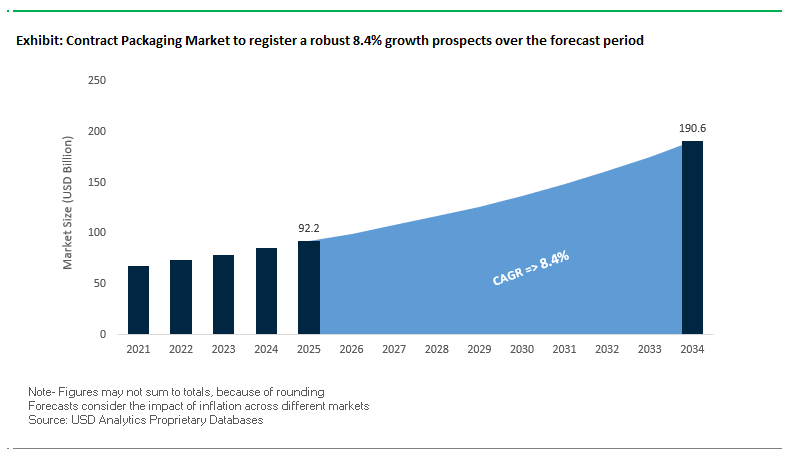
The Global Contract Packaging Market is projected to reach USD 92.2 billion in 2025 and is expected to grow significantly to USD 190.5 billion by 2034, expanding at a strong CAGR of 8.4%. Contract packaging, also known as co-packing, has evolved into a critical outsourcing solution for global brands seeking speed, scalability, and compliance in packaging operations. Beyond simple assembly, contract packagers deliver specialized services including regulatory expertise, serialization, sterilization, and smart packaging integration, enabling companies to focus on their core business while lowering operational costs by 7% to 9% on average.
Key demand is driven by customization and personalization, as brands increasingly launch limited-edition runs, seasonal promotions, and personalized products to connect with consumers. Additionally, e-commerce and direct-to-consumer business models are reshaping packaging requirements, with durability, visual appeal, and waste reduction emerging as central objectives. The pharmaceutical and cosmetics sectors, in particular, are leaning heavily on co-packers to navigate complex compliance landscapes, while consumer goods companies are turning to contract packaging for sustainable and smart packaging integration using QR codes, NFC tags, and recyclable substrates.
Key Insights for Industry Professionals:
Operational savings of 7–9% from outsourcing packaging.
Pharmaceuticals and cosmetics are leading adopters due to compliance complexity.
E-commerce boom drives demand for protective, recyclable, and visually appealing solutions.
Customization and smart packaging enhance brand engagement and shelf visibility.
Market Analysis: Recent Developments in the Contract Packaging Sector
The contract packaging industry is experiencing a wave of technological upgrades, sustainability commitments, and mergers & acquisitions in 2025. In August 2025, Kenco, a U.S.-based logistics provider, officially launched its Contract Packaging Division, creating a one-stop outsourcing hub for secondary packaging and supply chain management. This expansion reflects the growing convergence of logistics and packaging services.
In July 2025, a leading U.S. beverage company partnered with a co-packer to deploy an AI-driven robotic filling and bottling line, significantly improving efficiency and reducing labor dependency. The same month, industry reports highlighted surging M&A activity, with private equity firms entering the co-packing and specialty labeling segments to capture growth in consumer packaged goods. Also in July, International Paper completed strategic adjustments, consolidating its corrugated operations, reinforcing the importance of paper-based packaging in outsourced services.
In June 2025, Sanner inaugurated a new facility in North Carolina for injection-molded components tailored to pharmaceuticals and medical devices, strengthening specialized contract packaging services. In May 2025, a major FMCG brand partnered with its co-packer to launch smart corrugated packaging integrating QR codes and NFC tags for interactive consumer experiences.
Other innovations reflect sustainability priorities. In April 2025, co-packers adopted fit-to-product (FTP) automated technology in e-commerce, enabling custom-sized boxes to cut shipping costs and material waste. That same month, a cold chain solutions provider launched a curbside recyclable thermal packaging line, a milestone for temperature-sensitive products. In March 2025, the adoption of digital printing technologies emerged as a trend, enabling flexible short runs, seasonal promotions, and personalized labeling, giving brands greater agility in marketing.
Key Trends and Growth Opportunities Transforming the Contract Packaging Market
Strategic Capital Investment in Automated, High-Volume Facilities
A major trend in the contract packaging market is the significant capital investment in large-scale, highly automated facilities. Leading contract packagers are leveraging robotics, AI, and autonomous mobile robots (AMRs) to increase efficiency, handle complex SKU variations, and fill labor gaps. Industry reports highlight that automation can improve energy efficiency by 20-30% while reducing downtime and waste through optimized production scheduling. Companies are increasingly adopting modular automation platforms that integrate motion control, vision systems, sensing, and AI computation, enabling precise tasks such as bin-picking for variety pack assembly. This trend transforms contract packagers into strategic partners for brand owners, providing scalable, cost-effective, and technologically advanced packaging solutions. As brands demand agile supply chains and rapid response capabilities, automated facilities are becoming a critical differentiator in the global contract packaging market.
Integration of Advanced Track-and-Trace and Serialization Services
Another transformative trend is the integration of serialization and track-and-trace technologies within contract packaging operations. Regulatory mandates, such as the U.S. Drug Supply Chain Security Act (DSCSA) and the EU Falsified Medicines Directive (FMD), are compelling pharmaceutical companies to maintain unbroken, electronic chains of custody for all drug products. Contract packagers are responding by implementing sophisticated workflows that embed unique identifiers, anti-tampering devices, and centralized reporting systems. Beyond pharmaceuticals, these technologies are increasingly applied to high-value consumer goods for anti-counterfeiting and supply chain transparency. By providing a “digital fingerprint” for each product, contract packagers create a powerful value proposition for brand protection, helping clients mitigate gray market risks and enhance consumer trust. Partnerships with technology providers are essential to deliver comprehensive, compliant solutions, opening a significant growth avenue for the contract packaging market.
Capitalizing on the Clinical Trial and Personalized Medicine Boom
The rapid expansion of biologics, cell and gene therapies, and small-batch clinical trials represents a major growth opportunity for contract packagers with specialized capabilities. Personalized medicines require ultra-low volume packaging, cold chain logistics, and closed-loop systems to ensure patient safety and product integrity. Contract development and manufacturing organizations (CDMOs) are developing validated cryopreservation workflows, including regulatory-compliant labeling, storage, and full-chain-of-custody documentation. This creates a high-value, niche segment within the pharmaceutical contract packaging market, allowing brand owners to outsource specialized processes they lack in-house. The shift toward personalized therapies is reshaping the supply chain, emphasizing flexible, on-demand production models and driving deeper collaboration between pharmaceutical companies and contract packagers.
Offering Sustainability-as-a-Service to Brand Owners
Sustainability is emerging as a strategic opportunity for contract packagers. Increasing consumer and regulatory pressure for eco-friendly packaging has created demand for end-to-end sustainability solutions, including material sourcing, design-for-recycling, and end-of-life program management. Leading contract packagers are helping brands optimize packaging design, reduce material waste, and implement closed-loop systems. They are also investing in energy-efficient technologies and sourcing materials locally to reduce carbon emissions. Market studies indicate that 92% of consumers trust brands prioritizing sustainability, linking eco-conscious packaging initiatives to improved brand perception and financial performance. By offering comprehensive sustainability-as-a-service, contract packagers not only support brand compliance and environmental goals but also unlock a new revenue stream, reinforcing their role as strategic partners in the evolving global consumer packaging ecosystem.
Competitive Landscape: Leading Players in Global Contract Packaging Market
The contract packaging market features a mix of multinational co-packers, regional specialists, and sustainability-driven providers, each catering to diverse industries such as food & beverage, pharmaceuticals, cosmetics, and consumer goods.
Aaron Thomas Company offers scalable multi-format packaging solutions
Aaron Thomas is a versatile co-packer with expertise in blistering, shrink wrapping, bottling, and skin packaging. Its reputation lies in handling complex packaging formats across multiple industries, including food, cosmetics, and industrial goods. With an integrated service model combining packaging, fulfillment, and warehousing, Aaron Thomas enables clients to manage supply chains from a single point. Its strategic edge lies in rapid turnaround and scalability, helping brands respond quickly to market trends.
Co-Pack Solutions drives innovation with digital printing capabilities
Co-Pack Solutions is recognized for customized packaging formats and high-visibility shelf solutions. Its investments in digital printing technology enable short-run, high-quality packaging, ideal for seasonal promotions and new product trials. The company’s expertise in multipack assembly, custom box design, and secondary packaging positions it as a trusted partner for brands looking to elevate their packaging aesthetics. Its focus on innovation and compliance makes it a reliable choice for brand differentiation.
Unicep Packaging specializes in healthcare and personal care markets
Unicep is a niche player focusing on liquid and gel filling for sensitive sectors such as healthcare, dental, and personal care. With expertise in single-use tubes, pouches, and bottles, Unicep provides critical solutions for products requiring precision dosing and compliance. Its clean-room packaging capabilities and strict regulatory adherence ensure product integrity, making it a key partner for pharmaceutical and medical brands.
Assemblies Unlimited delivers nationwide co-packing and fulfillment
Assemblies Unlimited is known for its labor-intensive and complex projects, offering services such as blister packing, shrink wrapping, kitting, and retail display assembly. With a national network of facilities, the company provides end-to-end co-packing solutions, from product receiving to final distribution. Recently, it has expanded eco-friendly options, helping brands integrate sustainable materials into their packaging. Assemblies Unlimited’s scale and versatility make it an attractive option for diverse consumer products.
Green Packaging Asia leads sustainable co-packing in Asian markets
Green Packaging Asia focuses on eco-friendly contract packaging, leveraging biodegradable plastics, compostable pouches, and recycled board packaging. Its investments in R&D for barrier materials position it strongly in food and beverage packaging, where shelf-life preservation is critical. With a strategy built around sustainability leadership, the company enables brands in Asia and beyond to meet regulatory and consumer expectations for greener solutions.
Contract Packaging Market Share Insights
Primary Packaging Retains Top Market Share by Service Type in Contract Packaging
Across the broader contract packaging market, primary operations again lead (45%) because they concentrate regulatory risk, capital intensity, and throughput economics. Co-packers differentiate with validated fillers (aseptic/retort), in-line QA (weigh-check, metal/X-ray), late-stage customization, and digital track-and-trace all critical enablers for rapid SKU rotation and compliant global launches. Secondary packaging scales with omnichannel: shelf-ready trays, club packs, and DTC kitting designed for minimal waste and faster pick-pack. Tertiary services palletization, stretch-wrap, and unit load optimization remain a smaller share but are strategically bundled to deliver end-to-end cost and service KPIs.
Food & Beverages and Homecare & Personal Care Shape Market Share by End-Use in Contract Packaging
Food & beverages remains the largest end-use (40%) on throughput and compliance intensity, but homecare & personal care (25%) has become the brand-management core high SKU churn, frequent limited editions, and complex liquid/cream/aerosol handling that favor flexible, validated partners. Pharmaceuticals & medical, while smaller, commands premium pricing for sterile barrier systems, clinical kitting, and fully serialized lines. Electronics expands on protective engineered packs (anti-static films, custom foam, secure clamshells) tuned for e-commerce shock profiles. The end-use mix underscores why contract packaging capacity closest to demand hubs integrated with QA/RegOps and late-stage customization captures outsized value in consumer goods supply chains.
United States Contract Packaging Market Driven by EPR Regulations and Advanced Automation
The U.S. contract packaging market is heavily influenced by a fragmented state-level regulatory landscape, with Extended Producer Responsibility (EPR) bills shifting recycling and waste management costs to producers. This has prompted consumer goods companies to collaborate with co-packers that specialize in sustainable and recyclable materials. Technological advancements in automation and robotics are transforming operations, with companies upgrading secondary packaging lines to handle high-volume, high-mix production. For example, certain companies have reduced line labor by 85% through a $2 million automation investment while maintaining output efficiency.
Demand for contract packaging is particularly strong across the food and beverage, personal care, and e-commerce sectors. Direct-to-consumer (DTC) brands are driving the need for flexible, scalable packaging solutions, while co-packers are optimizing for omnichannel fulfillment with integrated protective, branded, and data-rich packaging. Sustainability remains a central focus, with clay- or plant-based grease-resistant papers and DOE-backed cellulose-based films gaining prominence. These innovations, combined with enhanced e-commerce optimization, help distributors minimize pick-pack errors and meet one-day delivery expectations, cementing the United States as a key growth market for advanced contract packaging solutions.
Germany Contract Packaging Market Accelerating Through Circular Economy Leadership and Industrie 4.0
Germany’s contract packaging industry operates under stringent regulations, including the Packaging Act (VerpackG) and the EU Packaging and Packaging Waste Regulation (PPWR), mandating full recyclability or reuse of packaging by 2030. The country’s well-established Extended Producer Responsibility (EPR) system and competitive market of Producer Responsibility Organizations (PROs) drive innovation in recycling and sorting, with modulated fees incentivizing recyclable packaging design. The German Supply Chain Act (LkSG) also requires companies to ensure ethical sourcing and environmental compliance across global supply chains, placing additional accountability on contract packagers.
Technological innovation is a core driver, with rising demand for machinery capable of processing sustainable materials, including bio-based composite films. Digital product passports, watermarks for transparency, and integration of cyber-physical systems through Germany’s Plattform Industrie 4.0 initiative are enhancing productivity and operational efficiency. Key applications are concentrated in the food and beverage, pharmaceutical, and retail sectors, where consumer demand for high-quality, artisanal, and visually appealing packaging is growing. Germany’s contract packaging market exemplifies the integration of sustainability, automation, and compliance-driven innovation.
China Contract Packaging Market Expanding Through Green Transformation and Domestic Production
China’s contract packaging market is being reshaped by government-driven sustainability initiatives, including the “dual carbon” goal and the 2024 Action Plan for Promoting Large-Scale Equipment Updates and Consumer Goods Replacement. Regulatory reforms addressing excessive packaging such as limits on layers, void ratios, and packaging costs have direct implications for contract packagers serving food and cosmetics sectors. The State Post Bureau also mandates express delivery companies to prioritize eco-friendly, reusable, and reduced packaging solutions.
Technological adoption is robust, with AI, automation, and “5G plus industrial internet” integration optimizing production efficiency and flexible manufacturing capacity. Domestic manufacturing is a key focus, reducing reliance on imported equipment while supporting high-quality, circular packaging solutions. Rapid growth in e-commerce, fresh food, and food delivery sectors is driving demand for contract packaging, and China is emerging as a global innovation hub with significant patent activity for new materials, high-performance films, and automated packaging methods.
Brazil Contract Packaging Market Growing on Regulatory Support and Major Investments
Brazil’s contract packaging market is benefiting from the National Solid Waste Policy and new laws banning single-use disposable items, with a 2030 deadline for fully compostable or recyclable packaging. Technological advancements, including robotics and AI, are enhancing quality control and efficiency, from automated sorting to defect detection. Biodegradable films, such as those developed from carboxymethyl cellulose (CMC) derived from sugarcane bagasse, highlight the country’s focus on sustainable materials.
Corporate investments are shaping market growth, exemplified by Smurfit Westrock’s R$840 million investment in expanding production in Santa Catarina to meet both domestic and international demand. Key applications include the food and beverage and cosmetics sectors, with the expanding food processing industry driving demand for technologically advanced packaging solutions. Governmental support through FINEP, such as Melhoramentos’ R$40 million investment in sustainable cellulose fiber packaging, reinforces the trajectory toward eco-friendly, high-performance contract packaging solutions in Brazil.
India Contract Packaging Market Strengthening Through Government Initiatives and Recycling Investments
India’s contract packaging sector is growing rapidly under government initiatives like Swachh Bharat Abhiyan and plastic waste management regulations, which include bans on certain single-use plastics and EPR rules mandating 30% recycled content in rigid plastics by 2025. Corporate investments exceeding INR 10,000 crore are expanding recycling infrastructure, providing contract packagers with a reliable supply of recycled materials. Companies such as Indorama Ventures, Dhunseri, and Varun Beverages are key contributors to scaling recycling capacity.
Technological adoption includes automated systems and innovative plastic-free laminate films suitable for paper and foil lamination, addressing efficiency and sustainability demands. Rapid growth in e-commerce, food and beverage, and pharmaceutical sectors is driving demand for flexible and cost-effective contract packaging solutions. Strategic partnerships, including the CIRCLE Alliance launched by Unilever, USAID, and EY with a USD 21 million commitment, further strengthen the adoption of circular packaging practices. The expanding food processing sector, especially for ready-to-drink beverages and processed foods, continues to create significant growth opportunities for contract packaging providers in India.
Contract Packaging Market Report Scope
Contract Packaging Market
Parameter
Details
Market Size (2025)
$92.2 Billion
Market Size (2034)
$190.5 Billion
Market Growth Rate
8.4%
Segments
By Service Type (Primary Packaging, Secondary Packaging, Tertiary Packaging), By End-Use Industry (Food & Beverages, Homecare & Personal Care, Pharmaceuticals & Medical, Electronics, Others), By Packaging Format (Flexible Packaging, Rigid Packaging)
Study Period
2019- 2024 and 2025-2034
Units
Revenue (USD)
Qualitative Analysis
Porter’s Five Forces, SWOT Profile, Market Share, Scenario Forecasts, Market Ecosystem, Company Ranking, Market Dynamics, Industry Benchmarking
Companies
Amcor plc, Mondi Group, Smurfit Kappa Group plc, Huhtamaki Oyj, Constantia Flexibles, Sonoco Products Company, DS Smith plc, WestRock Company, Sealed Air Corporation, Silgan Holdings Inc., Berry Global Group, Inc., Assemblies Unlimited Inc., Unicep Packaging, Kenco Logistics Services, Sanner GmbH
Countries
US, Canada, Mexico, Germany, France, Spain, Italy, UK, Russia, China, India, Japan, South Korea, Australia, South East Asia, Brazil, Argentina, Middle East, Africa
Contract Packaging Market Segmentation
By Service Type
Primary Packaging
Secondary Packaging
Tertiary Packaging
By End-Use Industry
Food & Beverages
Homecare & Personal Care
Pharmaceuticals & Medical
Electronics
Others
By Packaging Format
Flexible Packaging
Rigid Packaging
Countries Analyzed
North America (US, Canada, Mexico)
Europe (Germany, UK, France, Spain, Italy, Russia, Rest of Europe)
Asia Pacific (China, India, Japan, South Korea, Australia, South East Asia, Rest of Asia)
South America (Brazil, Argentina, Rest of South America)
Middle East and Africa (Saudi Arabia, UAE, Rest of Middle East, South Africa, Egypt, Rest of Africa)
Top Companies in Contract Packaging Market
Amcor plc
Mondi Group
Smurfit Kappa Group plc
Huhtamaki Oyj
Constantia Flexibles
Sonoco Products Company
DS Smith plc
WestRock Company
Sealed Air Corporation
Silgan Holdings Inc.
Berry Global Group, Inc.
Assemblies Unlimited Inc.
Unicep Packaging
Kenco Logistics Services
Sanner GmbH
* List Not Exhaustive
Methodology
The Contract Packaging Market analysis has been conducted by USDAnalytics using a rigorous, multi-layered methodology designed for industry professionals seeking actionable insights. Our approach integrates primary research, including interviews with leading contract packagers, brand owners, logistics providers, and regulatory authorities, to capture real-time perspectives on market dynamics, technological adoption, sustainability initiatives, and regional compliance requirements. Secondary research leveraged corporate filings, press releases, patent databases, government regulations, trade journals, and academic publications to validate market trends and emerging growth opportunities. Quantitative models were applied to forecast market size, growth, and segmentation by service type, end-use industry, and packaging format, while qualitative analysis focused on operational efficiencies, smart packaging integration, automation, and eco-friendly initiatives. USDAnalytics also evaluated mergers & acquisitions, capital investments in automated high-volume facilities, and innovations in serialization, track-and-trace, and sustainability-as-a-service, ensuring a holistic view of the global contract packaging landscape for strategic decision-making and investment planning.
Deliverables:
Comprehensive Market Research Report (PDF and Excel) with detailed tables, charts, and interactive visualizations.
Country-Specific Forecasts & Analysis.
Segment-Wise Revenue Forecasts (2025–2034).
Competitive Analysis, Benchmarking, and SWOT Profiles.
Recent Developments & Innovation Tracker.
Executive Summary & Analyst Commentary.
Post-Purchase Analyst Support for Client-Specific Questions and Custom Data Requirements.
2. Contract Packaging Market Landscape & Outlook (2025–2034)
2.1. Introduction to Contract Packaging Market
2.2. Market Valuation and Growth Projections (2025–2034)
2.3. Market Drivers: Operational Efficiency and E-Commerce Growth
2.4. Regulatory and Compliance Influence on Market Expansion
2.5. Key Recent Developments and Industry Milestones
3. Innovations Reshaping the Contract Packaging Market
3.1. Trend: Automation, Robotics, and High-Volume Facilities
3.2. Trend: Track-and-Trace, Serialization, and Smart Packaging
3.3. Opportunity: Personalized Medicine and Clinical Trial Packaging
3.4. Opportunity: Sustainability-as-a-Service and Eco-Friendly Solutions
4. Competitive Landscape and Strategic Initiatives
4.1. Mergers, Acquisitions, and Strategic Alliances
4.2. R&D and Material Innovation
4.3. Sustainability and Strategies
4.4. Market Expansion and Regional Focus
5. Market Share and Segmentation Insights: Contract Packaging Market
5.1. By Service Type
5.1.1. Primary Packaging
5.1.2. Secondary Packaging
5.1.3. Tertiary Packaging
5.2. By End-Use Industry
5.2.1. Food & Beverages
5.2.2. Homecare & Personal Care
5.2.3. Pharmaceuticals & Medical
5.2.4. Electronics
5.2.5. Others
5.3. By Packaging Format
5.3.1. Flexible Packaging
5.3.2. Rigid Packaging
6. Country Analysis and Outlook of Contract Packaging Market
6.1. United States
6.2. Canada
6.3. Mexico
6.4. Germany
6.5. France
6.6. Spain
6.7. Italy
6.8. UK
6.9. Russia
6.10. China
6.11. India
6.12. Japan
6.13. South Korea
6.14. Australia
6.15. South East Asia
6.16. Brazil
6.17. Argentina
6.18. Middle East
6.19. Africa
7. Contract Packaging Market Size Outlook by Region (2025–2034)
7.1. North America Contract Packaging Market Size Outlook to 2034
7.1.1. By Service Type
7.1.2. By End-Use Industry
7.1.3. By Packaging Format
7.2. Europe Contract Packaging Market Size Outlook to 2034
7.2.1. By Service Type
7.2.2. By End-Use Industry
7.2.3. By Packaging Format
7.3. Asia Pacific Contract Packaging Market Size Outlook to 2034
7.3.1. By Service Type
7.3.2. By End-Use Industry
7.3.3. By Packaging Format
7.4. South America Contract Packaging Market Size Outlook to 2034
7.4.1. By Service Type
7.4.2. By End-Use Industry
7.4.3. By Packaging Format
7.5. Middle East and Africa Contract Packaging Market Size Outlook to 2034
7.5.1. By Service Type
7.5.2. By End-Use Industry
7.5.3. By Packaging Format
8. Company Profiles: Leading Players in the Contract Packaging Market
8.1. Amcor plc
8.2. Mondi Group
8.3. Smurfit Kappa Group plc
8.4. Huhtamaki Oyj
8.5. Constantia Flexibles
8.6. Sonoco Products Company
8.7. DS Smith plc
8.8. WestRock Company
8.9. Sealed Air Corporation
8.10. Silgan Holdings Inc.
8.11. Berry Global Group, Inc.
8.12. Assemblies Unlimited Inc.
8.13. Unicep Packaging
8.14. Kenco Logistics Services
8.15. Sanner GmbH
9. Methodology
9.1. Research Scope
9.2. Market Research Approach
9.3. Market Sizing and Forecasting Model
9.4. Research Coverage
9.5. Data Horizon
9.6. Deliverables
10. Appendix
10.1. Acronyms and Abbreviations
10.2. List of Tables
10.3. List of Figures
Contract Packaging Market Segmentation
By Service Type
Primary Packaging
Secondary Packaging
Tertiary Packaging
By End-Use Industry
Food & Beverages
Homecare & Personal Care
Pharmaceuticals & Medical
Electronics
Others
By Packaging Format
Flexible Packaging
Rigid Packaging
Countries Analyzed
North America (US, Canada, Mexico)
Europe (Germany, UK, France, Spain, Italy, Russia, Rest of Europe)
Asia Pacific (China, India, Japan, South Korea, Australia, South East Asia, Rest of Asia)
South America (Brazil, Argentina, Rest of South America)
Middle East and Africa (Saudi Arabia, UAE, Rest of Middle East, South Africa, Egypt, Rest of Africa)
The market growth is driven by increasing outsourcing of packaging operations, demand for operational efficiency, regulatory compliance, and the rise of e-commerce. Specialized services such as serialization, smart packaging, and sustainable solutions further boost adoption across pharmaceuticals, cosmetics, and consumer goods.
Food & beverages lead the market due to high-volume production and compliance needs, followed by homecare and personal care products requiring complex packaging solutions. Pharmaceuticals and medical sectors, while smaller, command premium pricing for sterile, serialized, and cold chain-compliant packaging.
Robotics, AI, and autonomous mobile robots (AMRs) are improving efficiency, energy usage, and throughput, while digital printing and track-and-trace technologies enhance flexibility, customization, and compliance. Smart packaging integration enables consumer engagement and anti-counterfeiting measures.
Contract packagers offer end-to-end sustainability solutions, including recyclable materials, fit-to-product packaging, energy-efficient operations, and closed-loop programs. These initiatives reduce material waste, enhance brand reputation, and comply with regulations such as EPR mandates and circular economy policies.
The U.S., Germany, China, India, and Brazil are key innovation hubs. Drivers include regulatory support, automation investments, eco-friendly material adoption, and domestic production initiatives, with rapid growth fueled by e-commerce, pharmaceuticals, and consumer goods sectors.