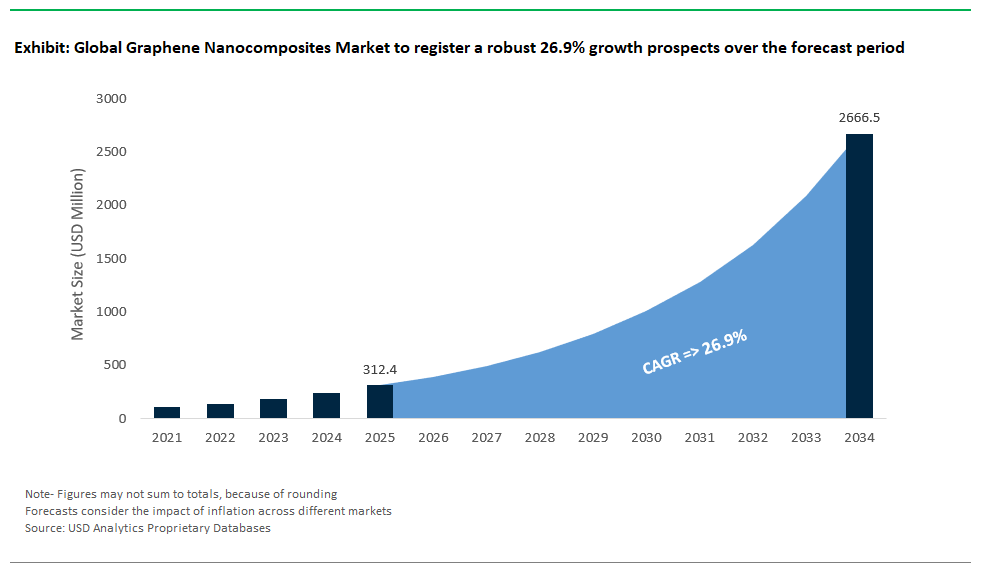
The graphene nanocomposites market is poised for substantial growth between 2025 and 2034, driven by accelerating demand across aerospace, automotive, electronics, energy storage, and advanced manufacturing sectors seeking lightweight, high-performance, and multifunctional materials. Market analysts project robust expansion at a CAGR of 26.9%, with the global market value expected to surpass USD 2666 million by 2034 from 312.4 million in 2025, fueled by graphene’s ability to transform mechanical, electrical, and thermal properties of composite materials.
With unique market intelligence from USDAnalytics, the 2025 release of the Graphene nanocomposites study presents a broad industry assessment and future projections, tracking trends in 21 countries and 14 major organizations- By Type (Graphene Oxide (GO), Graphene Nano Platelets (GNP), Others), By End-User (Electrical and Electronics, Medical, Automotive and Aerospace, Building and Construction, Packaging, Others)
This report delivers an in-depth analysis of the graphene nanocomposites market, providing insights into market size and growth forecasts, competitive landscapes, production economics, regulatory frameworks, and technological breakthroughs shaping the industry through 2034. Stakeholders across manufacturing, automotive, aerospace, and electronics industries will find essential intelligence to leverage graphene’s transformative potential in high-performance composite applications.
Graphene's Transformative Impact on Nanocomposites
Graphene is transforming nanocomposites by dramatically enhancing the mechanical, electrical, and thermal properties of polymers and engineered materials. Even at low loadings, graphene-infused composites double the strength of pure resins and boost fracture toughness by over 50%, enabling lighter, more durable parts for aerospace and defense while reducing weight by 10–15% compared to carbon fiber. Electrically, graphene nanocomposites offer tunable conductivities and raise thermal conductivity in polymers from 0.2 up to 50 W/m·K, allowing for superior thermal management in EV batteries and electronics. In aerospace, these materials improve EMI shielding and contribute to significant weight savings. The automotive industry uses graphene composites for faster heat dissipation in battery casings and reduced tire rolling resistance. Electronics benefit from ultra-flexible, conductive circuits for wearable devices. Innovations such as self-healing and 4D-printed graphene composites are opening up new frontiers for responsive, adaptive materials across multiple industries.
Market Analysis: Graphene Nanocomposites Industry Acceleration & Innovation
The graphene nanocomposites market has entered an exciting phase of commercial acceleration and technological innovation between 2023 and 2024. Once confined largely to laboratory exploration, graphene nanocomposites are now emerging as a powerful class of materials offering superior mechanical, thermal, and electrical properties across diverse industries such as automotive, aerospace, construction, electronics, and advanced manufacturing.
In the automotive and aerospace sectors, graphene nanocomposites are increasingly deployed to achieve critical lightweighting and safety objectives. In 2022, Lyten in the United States unveiled its LytR™ graphene-enhanced polymer composites, which have demonstrated significant weight reductions in various applications and are being explored for electric vehicle (EV) components. These new materials reportedly enable weight reductions of up to 20% compared to traditional polymers, offering significant benefits for vehicle efficiency, range, and emissions reduction. Companies like Haydale Graphene in the UK are actively developing graphene nanocomposites for aerospace interior components, aiming to enhance properties like flame resistance and reduce weight. These initiatives highlight graphene nanocomposites’ potential to meet stringent performance and regulatory standards in high-value mobility applications.
Construction & Infrastructure: Enhanced Durability & Sustainability
The construction and infrastructure sector has also embraced graphene nanocomposites as a route to enhanced durability and sustainability. In the construction sector, graphene-reinforced concrete solutions are being developed and deployed, with demonstrated capabilities of achieving significant increases in compressive strength, often around 30% or more, crucial for enhancing infrastructure resilience. Such advances are crucial for extending the lifespan of bridges, buildings, and infrastructure while potentially reducing material use and associated carbon footprints. Graphenstone in Spain has continued to expand its offerings of graphene-enhanced cement coatings in 2024, leveraging their established self-cleaning capabilities and improved durability. These coatings aim to maintain aesthetic surfaces while reducing maintenance costs and extending building life cycles, aligning well with green building trends and urban sustainability initiatives.
In electronics and thermal management, graphene nanocomposites have rapidly become a focal point for addressing thermal challenges posed by modern high-power electronic devices. Panasonic in Japan has continued to advance its carbon-based thermal interface materials, with developments in 2024 aimed at improving heat dissipation in electronics. Such materials help manage hotspots and maintain device stability in increasingly compact and powerful devices. Additionally, Companies like Sixonia Tech in Germany are developing and supplying graphene nanocomposites for advanced thermal management solutions, including potential applications like heat sinks for 5G telecommunications equipment, leveraging graphene’s excellent thermal conductivity to enable reliable operation in dense electronic environments. These applications underscore graphene nanocomposites’ vital role in enabling faster, cooler, and more efficient electronics, which is critical for next-generation technologies from data centers to mobile devices.
Research Breakthroughs Expanding Nanocomposite Capabilities
Recent research breakthroughs are accelerating the evolution of graphene nanocomposites, turning once-laboratory concepts into transformative solutions for real-world applications. Advances in self-healing materials, ultra-strong composites, and conductive plastics are opening new frontiers in performance and functionality. These innovations are driving graphene nanocomposites from niche research into large-scale commercial adoption across diverse industries.
MIT (US) developed self-healing graphene nanocomposites in 2024 for aerospace applications, enabling materials that can autonomously repair microcracks to enhance aircraft component longevity and safety.
The University of Manchester (UK) created ultra-strong graphene-polymer composites in 2023, achieving approximately double the tensile strength of conventional polymers and offering new possibilities for lightweight yet durable structural materials.
Fraunhofer Institute (Germany) engineered electrically conductive graphene-infused plastics in 2024, enabling flexible electronic components for wearables, flexible displays, and smart packaging, pushing graphene’s role into next-generation consumer electronics.
Competitive Landscape of the Graphene Nanocomposites Market
The graphene nanocomposites market is rapidly becoming a cornerstone of advanced materials innovation, as industries seek lighter, stronger, and more functional materials to enhance performance in automotive, aerospace, electronics, and construction applications. Graphene’s remarkable mechanical, thermal, and electrical properties make it an ideal additive for polymers, elastomers, concrete, and carbon fibers, driving intense competition among manufacturers striving to translate laboratory success into scalable industrial solutions. As sustainability goals intensify worldwide, graphene nanocomposites are also gaining attention for enabling longer-lasting products and reducing environmental footprints in sectors like transportation and infrastructure.
In North America, NanoXplore Inc. has solidified its position as a frontrunner with its GrapheneBlack® masterbatches. These are extensively used in thermoplastics for automotive parts, packaging, and conductive polymer composites for applications like EMI shielding in electronics. NanoXplore's production capacity has reached 4,000 metric tons per year, with an ambitious roadmap to scale to 20,000 tons per year by 2027, underscoring its significant influence in integrating graphene into high-volume industrial applications.
Regarding XG Sciences, it was acquired by Cabot Corporation in 2021. Cabot has integrated the xGnP® graphene nanoplatelet products into its broader portfolio of conductive additives. While XG Sciences as an independent entity no longer operates, Cabot continues to leverage these GNP technologies in polymer nanocomposites and battery materials, supplying customers, including those in the electric vehicle battery sector, who seek improved performance and thermal management.
Directa Plus: G+® Graphene Products for Elastomers & Textiles
Europe is home to several innovative players driving graphene nanocomposite adoption in niche and high-value markets. Italy’s Directa Plus focuses on its G+® graphene products for elastomer composites used in high-performance tires and conductive textiles for sportswear, notably through collaborations with partners like Versalis (Eni Group) and sports brands such as Colmar. These partnerships demonstrate successful commercialization of graphene into tangible consumer and industrial products.
In the UK, Haydale Graphene Industries leverages its HDPlas® functionalized graphene to enhance various composites. Their work includes applications in aerospace components, aiming for lightweight, high-strength parts suitable for sectors like drones, Formula 1, and commercial aircraft. Haydale's engagement with defense and aerospace primes, like their work with BAE Systems on advanced materials, underscores how graphene nanocomposites are penetrating mission-critical, performance-sensitive industries.
First Graphene (Australia): PureGRAPH® for Construction & Thermosets
Australia’s First Graphene has carved out a strong position in the construction sector, actively developing PureGRAPH®-enhanced concrete that aims to deliver greater strength, durability, and crack resistance. This directly addresses sustainability challenges in infrastructure by potentially reducing material consumption and extending lifespan. The company also targets thermoset composites for various industrial applications, including components for wind turbine blades and marine structures, reflecting graphene’s versatility across heavy industry.
The UK’s Versarien has been exploring a range of advanced graphene composites. This includes efforts in wear-resistant composites for applications like automotive brake pads and industrial machinery. Versarien has also been involved in the development of 3D-printed graphene filaments and exploring potential applications in advanced materials, including for biomedical uses like implants, showcasing a broad R&D scope.
Trend: High-Performance, Lightweight Structural Nanocomposites for Aerospace and Automotive
The Graphene Nanocomposites Industry is rapidly evolving, with graphene’s unique properties enabling breakthroughs in lightweight, high-performance materials for aerospace and automotive sectors. Companies and researchers are leveraging graphene to achieve significant mechanical gains, multifunctionality, and scalable manufacturing solutions. These developments are paving the way for next-generation mobility that combines strength, safety, and advanced features.
Graphene nanoplatelets and graphene oxide, when integrated into polymers like epoxy, PA, and PEEK, can boost tensile strength by 30–50%, fracture toughness by 80–120%, and fatigue resistance by up to fivefold, as demonstrated in R&D from NASA, Boeing, and other aerospace leaders exploring graphene-enhanced CFRPs for aircraft wings.
Multifunctional capabilities are emerging, such as Airbus developing graphene-doped wing skins with self-sensing technology to detect micro-cracks through electrical conductivity changes, enhancing safety and maintenance.
Automotive and EV industries are exploring graphene nanocomposites with thermal conductivities of 5–20 W/mK for battery housings, while innovations like GNP-infused 3D printing filaments (e.g., Blackleaf’s GNP-enhanced ABS) enable complex, high-strength components with superior design flexibility.
Opportunity: Sustainable Nanocomposites from Bio-Based Graphene and Recycled Polymers
A powerful trend is reshaping the Graphene Nanocomposites Market as sustainability and circular economy goals drive demand for eco-friendly materials. Bio-based graphene and recycled polymers are emerging as transformative solutions, enabling high-performance composites with significantly reduced environmental impacts. These advances are opening new commercial opportunities across manufacturing, mobility, and consumer goods.
Graphmatech (Sweden) is pioneering bio-based graphene production from forest byproducts and lignin, achieving an 80% lower CO₂ footprint and enabling fully bio-based nanocomposites like graphene-reinforced PLA for 3D printing, which offers double the stiffness of virgin PLA and industrial compostability.
Recycled polymers enhanced with as little as 0.5% graphene, such as rPET and rPP, are demonstrating the ability to recover significant portions of their original mechanical properties, supporting true closed-loop recycling for high-performance applications.
Global brands like Adidas are exploring graphene-reinforced recycled plastics for products like sneaker midsoles, illustrating the commercial viability and sustainability benefits of graphene nanocomposites in green manufacturing and consumer goods.
Graphene Oxide (GO): Leading Share & Dispersion Advantages
In 2025, graphene oxide (GO) commands the largest share of the nanocomposites market at 43.7%, owing to its cost-efficiency and superior dispersion in polymer matrices. This makes GO the preferred choice for applications requiring flexible circuits, EMI shielding, and multifunctional materials. Meanwhile, graphene nanoplatelets (GNPs) are on track for the fastest CAGR at 28.6%, fueled by their increasing use in high-strength, lightweight composites—especially within aerospace and automotive industries. Other types, including reduced graphene oxide and CVD graphene, occupy a smaller yet vital niche, addressing specialized needs in advanced engineering and electronics.
Electrical & Electronics Lead End-User Adoption, Medical Segment Shows Robust Momentum
The electrical and electronics sector represents the leading end-use market, accounting for 33.6% of demand in 2025. Graphene nanocomposites in this segment are primarily adopted for flexible printed circuits, conductive inks, and miniaturized device components, aligning with global trends in electronics miniaturization and performance. The automotive and aerospace industry follows closely, leveraging GNP-reinforced composites to advance lightweighting and structural integrity. Meanwhile, the medical segment is experiencing accelerated growth, as bio-compatible, antibacterial graphene composites find favor in implants, wound care, and next-gen medical devices.
China Leads Global Graphene Nanocomposites Industry with Aerospace and EV Breakthroughs
China continues to set the pace as the world’s largest producer of graphene nanocomposites, propelled by robust government investment and innovation hubs such as the Ningbo Graphene Innovation Center. Research at Tsinghua University has delivered ultra-strong graphene-polymer composites, now actively targeted for next-generation aerospace platforms like the C919 aircraft. Key markets include lightweight automotive parts and flexible electronics, sectors benefiting from ongoing public and private collaboration. In 2023, The Sixth Element launched graphene-reinforced nylon composites, setting new standards in strength and conductivity. Jiangsu Cnano Technology has rapidly expanded the production of conductive graphene nanocomposites for EV batteries, positioning China at the forefront of energy storage innovation. Notably, in 2024, COMAC began testing graphene composites in its next-gen commercial planes, reinforcing China’s dominance in aerospace, automotive, and electronic applications of graphene nanocomposites.
United States Expands Graphene Nanocomposites for Defense, Mobility, and Advanced Manufacturing
The United States is scaling the adoption of graphene nanocomposites across aerospace, defense, automotive, and sports industries. Federal support from NASA and the Department of Defense is accelerating R&D for spacecraft shielding, hypersonic vehicles, and next-generation military armor. MIT’s recent breakthrough in self-healing graphene-epoxy composites opens up possibilities for longer-lasting, more resilient materials. Major corporations like Boeing, SpaceX, GM, and Ford are exploring graphene nanocomposites for lighter and stronger components, with direct implications for energy efficiency and safety. Nanotech Energy’s 2023 commercialization of graphene-enhanced conductive plastics is spurring wider market adoption. XG Sciences (now Cabot Corp) is scaling up production for 3D printing applications, making advanced composites accessible for rapid prototyping and manufacturing. In 2024, Lockheed Martin is testing these advanced materials in hypersonic vehicles, keeping the U.S. at the frontier of high-performance graphene innovation.
South Korea Advances Graphene Nanocomposites in Flexible Electronics and Automotive Innovation
South Korea’s graphene nanocomposites market is fueled by a deep integration between industry and research institutes. KRICT’s development of graphene-enhanced carbon fiber composites is accelerating lightweighting in electric vehicles, while Samsung’s investments are ushering in flexible graphene nanocomposites for the booming foldable display segment. Automotive players like Hyundai and Kia are integrating these materials to improve safety, efficiency, and design flexibility. LG Chem’s 2023 launch of graphene-reinforced battery casings highlights a clear shift towards high-performance, thermally stable EV batteries. In 2024, KAIST announced graphene nanocomposites with triple the impact resistance of conventional materials, further expanding the nation’s leadership in advanced electronics, mobility, and materials science.
Germany Optimizes Graphene Nanocomposites for Lightweight Automotive and Renewable Energy
Germany remains at the forefront of engineering graphene nanocomposites for mobility, energy, and industry. The Fraunhofer Institute and BASF are driving research into thermoplastics and composites tailored for automotive, wind energy, and industrial machinery. BMW and Porsche are piloting graphene-enabled lightweight components, seeking to improve efficiency and lower emissions. SGL Carbon’s 2023 launch of graphene-carbon fiber hybrid composites illustrates how German companies are blending advanced materials for optimal strength and durability. In 2024, Mercedes-Benz began testing graphene nanocomposites for EV battery housings, marking a major step toward safer and lighter electric vehicles. Germany’s industrial rigor and sector integration continue to advance the application of graphene nanocomposites in key European supply chains.
United Kingdom Delivers High-Performance Graphene Nanocomposites for Sports, Aerospace, and Energy
The United Kingdom is leveraging its pioneering academic research to deliver high-performance graphene nanocomposites for diverse sectors. The University of Manchester leads innovations in sports and aerospace, while Haydale Graphene supplies functionalized graphene for industrial-scale composites. F1 racing teams like McLaren and aerospace giants such as Rolls-Royce are at the cutting edge of incorporating graphene for lighter, stronger, and more resilient materials. Versarien’s 2023 launch of graphene-enhanced bicycle frames demonstrates cross-over to consumer markets. Recent investments by BP into oil and gas pipeline nanocomposites further extend graphene’s reach into the energy sector. With an ecosystem bridging science, sports, and industry, the UK continues to turn laboratory innovation into real-world graphene solutions.
Japan Drives Graphene Nanocomposites in Construction, Automotive, and Electronics
Japan’s graphene nanocomposites sector is defined by its focus on safety, reliability, and industrial innovation. AIST’s development of earthquake-resistant graphene composites is pioneering new standards for infrastructure resilience. Toyota and other auto leaders are researching graphene-reinforced components for fuel cells and lightweight vehicles. In electronics, companies like Sony and Panasonic are targeting flexible, thermally-conductive composites for next-generation devices. Toray Industries’ 2023 introduction of graphene-enhanced carbon fiber materials is powering advances in both industrial and consumer applications. In 2024, Panasonic began testing graphene nanocomposites in heat-dissipating smartphone cases, emphasizing Japan’s focus on high-performance, multifunctional materials across automotive, electronics, and construction.
Canada Scales Graphene Nanocomposites for Automotive, Aerospace, and Infrastructure
Canada is aggressively scaling graphene nanocomposites production and application, targeting automotive, aerospace, and infrastructure markets. NanoXplore leads the sector, supplying EV battery manufacturers and infrastructure firms with advanced nanocomposite materials. The National Research Council (NRC) supports innovation in construction, particularly in graphene-enhanced concrete for bridges and highways. Grafoid’s 2023 commercialization of graphene-reinforced concrete brings improved durability and longevity to Canadian infrastructure. In 2024, Magna International is testing graphene nanocomposites for lightweight automotive components, aligning with the global drive for more efficient and sustainable transport solutions. With robust public-private collaboration and a focus on large-scale deployment, Canada is becoming a key supplier of graphene nanocomposites in North America.
Australia Expands Graphene Nanocomposites in Mining, Marine, and Renewable Energy
Australia’s graphene nanocomposites industry leverages its natural resource strengths and a focus on industrial durability. CSIRO’s research is propelling marine and mining applications, especially for corrosion-resistant and high-strength materials. The Graphene Manufacturing Group (GMG) is advancing conductive polymer composites for both energy and industrial markets. Sports tech is also a focus, with GMG’s 2023 launch of graphene-enhanced tennis rackets catering to performance-driven consumers. In 2024, the University of Queensland secured a patent for fire-resistant graphene nanocomposites, addressing both industrial safety and renewable energy applications like wind turbine blades. Australia’s approach balances advanced R&D, sector integration, and commercial rollouts across infrastructure, energy, and export markets.
Graphene Nanocomposites Market Report Scope
Graphene Nanocomposites Market
Parameter
Details
Market Size (2025)
$312.4 Million
Market Size (2034)
$2666 Million
Market Growth Rate
26.9%
Segments
By Type (Medical Grade, Food Grade), By Application (Athletes, Patient, Others), By Distribution Channel (Online, Offline)
Study Period
2019- 2024 and 2025-2034
Units
Revenue (USD)
Qualitative Analysis
Porter’s Five Forces, SWOT Profile, Market Share, Scenario Forecasts, Market Ecosystem, Company Ranking, Market Dynamics, Industry Benchmarking
US, Canada, Mexico, Germany, France, Spain, Italy, UK, Russia, China, India, Japan, South Korea, Australia, South East Asia, Brazil, Argentina, Middle East, Africa
Graphene Nanocomposites Market Segmentation
By Type
Graphene Oxide (GO)
Graphene Nano Platelets (GNP)
Others
By End-User
Electrical and Electronics
Medical
Automotive and Aerospace
Building and Construction
Packaging
Others
Countries Analyzed
North America (US, Canada, Mexico)
Europe (Germany, UK, France, Spain, Italy, Russia, Rest of Europe)
Asia Pacific (China, India, Japan, South Korea, Australia, South East Asia, Rest of Asia)
South America (Brazil, Argentina, Rest of South America)
Middle East and Africa (Saudi Arabia, UAE, Rest of Middle East, South Africa, Egypt, Rest of Africa)
Top Companies in Graphene Nanocomposites Market: Profiles & Strategies
Abalonyx AS
Applied Graphene Materials
Aztrong
Directa Plus S.p.A
Graphenea
GrapheneTech S.L.
Haydale Graphene Industries plc
NanoXplore Inc
Versarien plc
XG Sciences
* List Not Exhaustive
Methodology
This report on the Graphene Nanocomposites Market employs a robust, multi-stage research methodology designed to deliver accurate, actionable, and up-to-date intelligence. The process begins with extensive secondary research—analyzing peer-reviewed publications, government and industry reports, technical patents, company filings, and global trade data—to build a foundational understanding of market size, growth drivers, and competitive dynamics. Primary research supplements this foundation through interviews and surveys with senior executives at graphene nanocomposite producers, material scientists, R&D leaders, and procurement managers across end-user sectors including automotive, aerospace, electronics, construction, and packaging. The market is sized and forecasted using a hybrid of bottom-up and top-down modeling, cross-checked through iterative expert consultations and USDAnalytics’ proprietary data sets. All findings are triangulated to ensure accuracy, transparency, and relevance, enabling clients to make data-driven decisions in a fast-evolving landscape.
Research Coverage and Deliverables
Market Segmentation: By Type (Graphene Oxide (GO), Graphene Nanoplatelets (GNP)), By End-User (Electrical and Electronics, Medical, Automotive and Aerospace, Building and Construction, Packaging)
Geographic Coverage: Analysis of 21+ countries across North America, Europe, Asia-Pacific, South America, and the Middle East & Africa
Competitive Landscape: In-depth profiles of 14+ major organizations, including strategies, product innovations, production economics, and R&D pipelines
Technology & Innovation Insights: Assessment of material advances, functional performance (mechanical, thermal, electrical), sustainable sourcing, recycling, and next-generation manufacturing such as 3D printing and self-healing nanocomposites
Market Sizing & Forecasts (2025–2034): Revenue and volume projections by type, end-user, and region; CAGR analysis; opportunity mapping for emerging applications
Strategic Insights: Evaluation of regulatory trends, production cost analysis, supply chain developments, and the evolving landscape of sustainability in nanocomposites
Deliverables: Comprehensive PDF report, Excel data sheets, segment- and country-level visualizations, company and trend snapshots, and direct analyst support
6.2.1. Electrical and Electronics (Leading End-User Adoption)
6.2.2. Medical (Robust Momentum and Growth)
6.2.3. Automotive and Aerospace
6.2.4. Building and Construction
6.2.5. Packaging
6.2.6. Others
7. Country Analysis and Outlook of Graphene Nanocomposites Market, 2021- 2034
7.1. China: Leads Global Graphene Nanocomposites Industry with Aerospace and EV Breakthroughs
7.2. United States: Expands Graphene Nanocomposites for Defense, Mobility, and Advanced Manufacturing
7.3. South Korea: Advances Graphene Nanocomposites in Flexible Electronics and Automotive Innovation
7.4. Germany: Optimizes Graphene Nanocomposites for Lightweight Automotive and Renewable Energy
7.5. United Kingdom: Delivers High-Performance Graphene Nanocomposites for Sports, Aerospace, and Energy
7.6. Japan: Drives Graphene Nanocomposites in Construction, Automotive, and Electronics
7.7. Canada: Scales Graphene Nanocomposites for Automotive, Aerospace, and Infrastructure
7.8. Australia: Expands Graphene Nanocomposites in Mining, Marine, and Renewable Energy
7.9. Mexico: Growing adoption in automotive manufacturing and electronics assembly for lightweight and conductive materials.
7.10. France: Strong R&D and industrial applications in aerospace, defense, and automotive sectors.
7.11. Spain: Emerging applications in construction, energy, and sports equipment.
7.12. Italy: Focus on composites for automotive, industrial machinery, and consumer goods.
7.13. Russia: Increasing government support and industrial demand for high-strength, lightweight materials.
7.14. Rest of Europe: Analysis of other key European markets and their contribution to graphene nanocomposites growth.
7.15. India: Rapid growth in automotive, electronics, and construction, driven by domestic manufacturing initiatives.
7.16. South East Asia: Rising adoption in consumer electronics, automotive parts, and packaging.
7.17. Rest of Asia: Other significant Asian markets contributing to nanocomposites development and adoption.
7.18. Brazil: Growing demand from automotive, construction, and energy sectors for durable and lightweight materials.
7.19. Argentina: Developing applications in automotive, packaging, and industrial components.
7.20. Rest of South America: Overview of other South American countries and their evolving nanocomposites market.
7.21. Middle East and Africa: Increasing interest in aerospace, automotive, and construction applications, driven by industrial diversification.
8. Graphene Nanocomposites Market Size Outlook by Region (2025-2034)
8.1. North America Graphene Nanocomposites Market Size Outlook to 2034
8.1.1. By Type (Graphene Oxide (GO), Graphene Nano Platelets (GNP), Others)
8.1.2. By End-User (Electrical and Electronics, Medical, Automotive and Aerospace, Building and Construction, Packaging, Others)
8.2. Europe Graphene Nanocomposites Market Size Outlook to 2034
8.2.1. By Type (Graphene Oxide (GO), Graphene Nano Platelets (GNP), Others)
8.2.2. By End-User (Electrical and Electronics, Medical, Automotive and Aerospace, Building and Construction, Packaging, Others)
8.3. Asia Pacific Graphene Nanocomposites Market Size Outlook to 2034
8.3.1. By Type (Graphene Oxide (GO), Graphene Nano Platelets (GNP), Others)
8.3.2. By End-User (Electrical and Electronics, Medical, Automotive and Aerospace, Building and Construction, Packaging, Others)
8.4. South America Graphene Nanocomposites Market Size Outlook to 2034
8.4.1. By Type (Graphene Oxide (GO), Graphene Nano Platelets (GNP), Others)
8.4.2. By End-User (Electrical and Electronics, Medical, Automotive and Aerospace, Building and Construction, Packaging, Others)
8.5. Middle East and Africa Graphene Nanocomposites Market Size Outlook to 2034
8.5.1. By Type (Graphene Oxide (GO), Graphene Nano Platelets (GNP), Others)
8.5.2. By End-User (Electrical and Electronics, Medical, Automotive and Aerospace, Building and Construction, Packaging, Others)
9. Company Profiles: Leading Players in the Graphene Nanocomposites Market
9.1. Abalonyx AS
9.2. Applied Graphene Materials
9.3. Aztrong
9.4. Directa Plus S.p.A
9.5. Graphenea
9.6. GrapheneTech S.L.
9.7. Haydale Graphene Industries plc
9.8. NanoXplore Inc
9.9. Versarien plc
9.10. XG Sciences (now integrated with Cabot Corporation)
9.11. Additional Prominent Players (e.g., First Graphene, Lyten, The Sixth Element, Jiangsu Cnano Technology)
10. Methodology
10.1. Research Scope
10.1.1. Market Definition
10.1.2. Key Market Segments Covered
10.1.3. Geographic Coverage
10.1.4. Years Covered (Historical, Current, Forecast)
10.2. Market Research Approach
10.2.1. Primary Research
10.2.2. Secondary Research
10.2.3. Data Triangulation
10.3. Data Sources (Primary and Secondary)
10.3.1. Primary Data Sources (e.g., Interviews with Industry Experts, Manufacturers, Distributors, End-Users)
10.3.2. Secondary Data Sources (e.g., Company Annual Reports, Investor Presentations, Industry Journals, Government Publications, Databases, Industry Associations)
10.4. Market Estimation and Forecasting Model
10.4.1. Market Sizing Approaches
10.4.2. Forecasting Techniques (e.g., Regression Analysis, Time Series Analysis)
10.4.3. Assumptions for Market Modeling
10.5. Assumptions and Limitations
10.5.1. Key Assumptions Made During Research
10.5.2. Limitations of the Study
11. Appendix
11.1. Acronyms and Abbreviations
11.2. List of Tables
11.3. List of Figures
Graphene Nanocomposites Market Segmentation
By Type
Graphene Oxide (GO)
Graphene Nano Platelets (GNP)
Others
By End-User
Electrical and Electronics
Medical
Automotive and Aerospace
Building and Construction
Packaging
Others
Countries Analyzed
North America (US, Canada, Mexico)
Europe (Germany, UK, France, Spain, Italy, Russia, Rest of Europe)
Asia Pacific (China, India, Japan, South Korea, Australia, South East Asia, Rest of Asia)
South America (Brazil, Argentina, Rest of South America)
Middle East and Africa (Saudi Arabia, UAE, Rest of Middle East, South Africa, Egypt, Rest of Africa)
The global graphene nanocomposites market is forecast to expand at a CAGR of 26.9% between 2025 and 2034, with the market value expected to exceed USD 2,666 million by 2034, driven by accelerated adoption in aerospace, automotive, electronics, and sustainable manufacturing.
Primary end-user industries include electrical and electronics (flexible circuits, EMI shielding, thermal management), automotive and aerospace (lightweight, high-strength parts), medical (biocompatible devices, antibacterial materials), building and construction (high-durability concrete and coatings), and packaging (advanced barrier and sustainable materials).
The report segments the market by type (graphene oxide, graphene nanoplatelets, and others) and end-user (electronics, medical, automotive and aerospace, building and construction, packaging, and more), providing granular insights into each application’s market size and growth prospects.
The report covers advances such as self-healing composites, 4D-printed materials, bio-based graphene, recycled polymer integration, and smart structural nanocomposites with real-time monitoring—each accelerating the move from lab-scale innovation to industrial adoption.

.png)