Zero Waste Packaging Market Size, Overview, and Growth Outlook (2025–2034)
Zero Waste Packaging Market Set to More Than Double by 2034 Driven by Circular Economy and Sustainability Demands
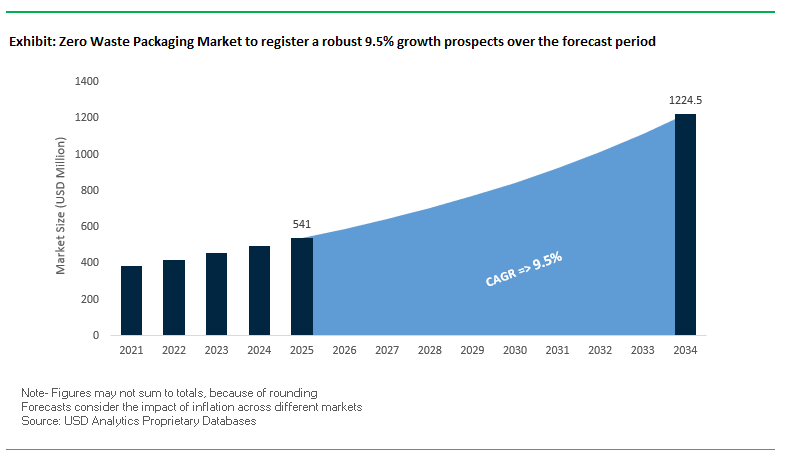
The global zero waste packaging market is projected to grow from $541 million in 2025 to $1,224.4 million by 2034, registering a CAGR of 9.5%. This market is fueled by the rising demand for sustainable, reusable, recyclable, and biodegradable packaging solutions that minimize environmental impact while enhancing brand reputation. The sector is particularly significant across food & beverage, cosmetics, and e-commerce industries, where consumer expectations for eco-friendly packaging are shaping purchasing decisions.
Key Insights for industry professionals and buyers:
Regulatory compliance: The EU Packaging and Packaging Waste Regulation (PPWR) and India’s Extended Producer Responsibility (EPR) are driving adoption of reusable and recyclable packaging solutions.
Innovation in materials: Use of alternative fibers (sugarcane bagasse, wheat straw) and bioplastics is creating high-performance eco-friendly packaging alternatives.
Circular economy adoption: Companies are increasingly implementing take-back programs and refill stations to promote closed-loop systems.
Consumer-driven sustainability: 86% of FMCG brands are willing to pay a premium for sustainable packaging that improves end-of-life outcomes.
Market growth enablers: Strong focus on environmental stewardship, operational efficiency, and competitive differentiation is accelerating market expansion.
Market Analysis: Recent Strategic Initiatives and Collaborations Are Transforming the Zero Waste Packaging Market
The zero waste packaging market is rapidly evolving due to strategic partnerships, technological innovations, and sustainable material adoption. In August 2025, Klöckner Pentaplast won the German Packaging Award for its kp 100% Tray2Tray® innovation, highlighting advanced materials development. In the same month, Aquapak Polymers Ltd released research showing that 86% of FMCG brands are willing to pay more for sustainable packaging, emphasizing the alignment of market innovation with brand and consumer priorities.
In May 2025, Chemco and Kandoi launched an INR 450-crore rPET JV, transforming PET waste into industrial packaging and generating over 2,500 jobs, demonstrating the potential of large-scale circular economy projects. In March 2025, a Danish-Indian collaboration initiated the 'From Beach to Big Bags' project, recycling ocean-bound and inland plastic waste into rPP big bags. The same month, Green Lab entered the U.S. market, offering 100% recycled paper bags and FSC-certified packaging, showcasing market globalization and sustainability adoption.
Earlier developments also highlight industry progress: In February 2025, Berry Global partnered with Mars to transition pantry jar packaging to 100% recycled plastic, eliminating over 1,300 metric tons of virgin plastic annually. In November 2024, Lactips and Walki Group signed a Joint Development Agreement for fully recyclable paper-based food packaging. Additionally, H.B. Fuller’s acquisition of Sanglier Limited in September 2024 enhanced adhesive capabilities in Europe, while Sainsbury's removal of plastic lids from hummus pots saved 50 million lids annually, emphasizing consumer-driven sustainability.
Trends and Opportunities in the Zero Waste Packaging Market
Corporate Adoption of Reusable and Refillable Packaging Systems
One of the most transformative trends in the zero waste packaging market is the large-scale corporate shift towards reusable and refillable models. Leading fast-moving consumer goods (FMCG) companies are setting ambitious targets to phase out single-use packaging. Coca-Cola has pledged that 25% of its beverages will be sold in refillable bottles by 2030, while PepsiCo has committed to doubling its refillable sales share from 10% to 20% over the same timeframe. These commitments are reshaping the consumer goods landscape and signaling long-term structural change.
To achieve these goals, companies are investing heavily in infrastructure and product design. For example, Unilever announced in 2024 a substantial boost in R&D investment to develop next-generation flexible materials and alternative packaging formats, alongside the rollout of refill stations in retail stores. The economic and environmental business case is also clear: the United Nations Environment Programme (UNEP) reported that transitioning just 20% of single-use packaging to reusable systems could unlock $10 billion in value creation while reducing global plastic leakage by more than 20% by 2040. This proves that reuse models not only support environmental goals but also lower long-term production and logistics costs.
Municipal and Regional Policy Mandating Circular Packaging Transitions
Another major trend is the accelerating role of governments in mandating zero waste packaging through regulations and Extended Producer Responsibility (EPR) schemes. For example, India’s Plastic Waste Management (Amendment) Rules, 2025, requires producers and brand owners to collect and sustainably manage their plastic packaging waste under EPR obligations. Such frameworks are pushing companies toward circular models by law rather than choice.
At the same time, bans and restrictions on single-use packaging are expanding worldwide. France has legislated a 10% share of reusable packaging by 2026, while U.S. cities such as Berkeley, California, now require retailers to apply fees on single-use packaging and incentivize lower costs for reusable alternatives. Deposit Return Schemes (DRS) are also proving highly effective. Backed by the European Union’s Single-Use Plastics Directive, many EU member states are legally mandating refillable beverage packaging supported by DRS to ensure high return and reuse rates. These legal mandates reinforce the transition to a truly circular packaging economy.
Development of Standardized, Interoperable Reusable Packaging Pools
One of the biggest opportunities in the zero waste packaging market lies in creating standardized, interoperable systems for reusable packaging. Moving away from brand-specific, proprietary containers toward shared pool systems enables scale and cost efficiency. For example, San Francisco mandates that 10% of beverages at city-sponsored events must be served in reusable cups, a system that is more practical when standardized containers can be circulated across multiple vendors.
The emerging “packaging as a service” model is being explored by industry collaborations where third-party operators manage container logistics, including washing, redistribution, and returns. Professional journals emphasize that such pooled systems reduce the logistical burden for individual brands and create a seamless consumer experience. Standardization not only lowers costs but also ensures each container achieves the necessary reuse cycles to become more cost-effective than single-use alternatives, unlocking large-scale circular packaging adoption.
Innovation in High-Barrier, Home-Compostable Flexible Films
Another high-potential opportunity is the development of home-compostable films with high-barrier properties. Traditional compostable packaging has struggled to meet the oxygen and moisture barrier requirements needed for products like savory snacks. However, in early 2025, TIPA launched a certified home-compostable metallized film for snacks and crisps that provides strong barrier protection without requiring an additional sealing layer, addressing a critical performance gap.
Certification plays a crucial role here. Films like TIPA’s meet EN 13432 standards for both industrial and home composting, offering assurance to brands and consumers on biodegradability and proper end-of-life management. Research is also advancing rapidly in sustainable materials science. For instance, blending poly(lactic acid) (PLA) with polycaprolactone (PCL) has been shown to enhance toughness and sealability—two critical properties for flexible packaging that need to be balanced with compostability. This innovation highlights how bio-polymer engineering can expand the scope of zero waste packaging into high-barrier and high-performance applications.
Competitive Landscape: Key Market Players Are Driving Innovation and Sustainability in Zero Waste Packaging Solutions
The zero waste packaging industry is shaped by companies leveraging materials science, innovative manufacturing, and sustainable design to meet global regulatory and consumer demands for eco-friendly solutions.
DS Smith PLC: Leading the Transition to Circular Economy Solutions in Corrugated Packaging
DS Smith specializes in recyclable and reusable corrugated solutions for e-commerce and retail applications. Its 'Now and Next' sustainability strategy aims to eliminate one billion pieces of problem plastics by 2025. The company’s core strengths include extensive materials expertise, integrated operations, and a strong sustainability focus, positioning it as a global leader in circular economy-driven packaging.
Mondi Group: Expanding Sustainable Packaging Innovations Across Construction and Industrial Applications
Mondi Group offers a diverse portfolio of sustainable packaging solutions for construction, automotive, and industrial sectors. In July 2025, it launched SolmixBag, a water-soluble bag for construction, and partnered with Velocys to advance CO2-derived e-SAF technology, demonstrating innovation in sustainable materials. Mondi’s strengths lie in brand recognition, materials expertise, and integrated global operations, enabling leadership in the paper and pulp industries.
Amcor PLC: Driving Innovation in Recyclable and Bio-Based Packaging for Global Brands
Amcor provides recyclable, reusable, and bio-based packaging for food, beverage, and healthcare sectors. Its 'Leading Packaging' strategy emphasizes sustainability and innovation, including partnerships to advance CO2-derived e-SAF production. Amcor’s strengths include global brand recognition, integrated operations, and expertise in responsible packaging solutions, supporting its market leadership.
Ball Corporation: Innovating Infinitely Recyclable Aluminum Packaging as Plastic Alternatives
Ball Corporation designs infinitely recyclable aluminum cans and bottles, serving as a sustainable alternative to traditional plastics in the beverage industry. Recent innovations include Ball Aerosol aluminum cans, reinforcing the company’s commitment to material innovation. Ball’s core strengths are expertise in sustainable materials, integrated manufacturing, and global reach, supporting its leadership in eco-friendly packaging.
Hindustan Tin Works Ltd.: Advancing Metal Packaging Solutions in the Indian Zero Waste Market
Hindustan Tin Works offers a range of metal packaging solutions, emphasizing circular economy principles. Its Innovations strategy focuses on new materials and TPO-free adhesive technologies to meet regulatory and market demands. Core strengths include materials expertise, integrated operations, and commitment to sustainable manufacturing, positioning the company as a key player in India’s zero-waste packaging market.
Zero Waste Packaging Market Share Insights, 2025-2034
Boxes & Containers Lead Market Share by Product Type in the Zero Waste Packaging Industry
Boxes and containers represent the largest share of the zero waste packaging industry, with approximately 30% of the market, due to their adaptability to reusable and refillable systems. From glass jars in retail bulk stores to durable polypropylene crates in logistics networks, this format exemplifies the reuse-first principle central to zero waste strategies. Their scalability in both consumer-facing and B2B applications, combined with durability over multiple life cycles, makes them indispensable to circular economy models. Bottles and jars also hold a significant share due to refill infrastructure, while bags, pouches, and films remain the focus of intense innovation in compostable and recyclable alternatives. The dominance of boxes and containers reflects the industry’s pivot toward formats that deliver functionality while radically reducing single-use waste streams.
Food & Beverages Dominate Market Share by End-Use in the Zero Waste Packaging Industry
Food and beverages account for nearly 40% of the zero waste packaging market, establishing themselves as the most urgent and transformative end-use sector. This dominance arises from the sector’s outsized contribution to single-use plastic waste and the mounting regulatory and consumer pressures to adopt compostable or reusable systems. Beverage refill models, compostable trays, mono-material pouches, and reusable meal containers are becoming central strategies to meet waste reduction targets. Investments are heavily concentrated here, as global brands and retailers attempt to balance product safety and shelf life with zero waste compliance. The food and beverage sector’s commanding position highlights how regulatory frameworks, consumer expectations, and sustainability-driven innovation converge to make it the epicenter of zero waste packaging adoption.
United States: EPR Laws and Growth of Refill & Reuse Systems
The United States zero waste packaging market is undergoing a significant transformation driven by the adoption of Extended Producer Responsibility (EPR) laws. By 2025, states such as Hawaii, Rhode Island, Maryland, and Washington joined Maine and others, bringing the total number of states with EPR frameworks to seven. These laws force producers and brands to take responsibility for the entire lifecycle of packaging, accelerating investment in recyclable and reusable formats. Maine, which pioneered EPR legislation, passed a “Fix It” bill in mid-2025 to ease multi-state compliance for producers, highlighting the need for national harmonization.
Innovation is another strong driver. In May 2025, Amazon introduced automated packaging machines in Europe that create custom-made cardboard boxes and paper bags, reducing excess material and shipping waste, a trend expected to influence U.S. adoption. Meanwhile, the EPA’s support for water-soluble packaging in hazardous chemical sectors remains an important regulatory lever. Companies like Loop are scaling refill and reuse systems by partnering with major consumer brands and retailers, meeting growing consumer demand for waste-free, reusable solutions in e-commerce and fast-moving consumer goods.
European Union: PPWR Targets and Horizon Europe Fuel Zero Waste Innovation
The European Union zero waste packaging market is heavily driven by the Packaging and Packaging Waste Regulation (PPWR), effective February 2025, which mandates a 15% per capita reduction in packaging waste by 2040 compared to 2018. The regulation bans items like miniature hotel toiletry bottles and plastic packaging for fresh produce, forcing industries to adopt compostable, reusable, or recyclable solutions. Additionally, Denmark’s EPR law, coming into force on October 1, 2025, sets a precedent for stricter accountability across member states.
The EU is investing heavily through Horizon Europe to advance bio-based and compostable materials, creating opportunities for innovation in next-generation films and coatings. Companies such as Mondi Group are actively developing water-soluble bags like SolmixBag, which dissolve in cement, offering a zero-waste solution for construction. Start-ups like Notpla are pioneering Ooho edible pods, already used in global events as plastic-free drink packaging. The EU’s strong circular economy framework and regulatory enforcement are positioning Europe as the global leader in zero waste packaging adoption.
China: 14th Five-Year Plan, Eco-Friendly Logistics, and the Reuse Revolution
The China zero waste packaging market is expanding rapidly under the government’s 14th Five-Year Plan, which enforces strict measures against plastic pollution. New regulations effective June 1, 2025, require express delivery companies—core players in China’s booming e-commerce industry—to adopt eco-friendly, reduced, and reusable packaging formats. This is accelerating demand for innovative pouches, films, and bulk delivery solutions.
The government is incentivizing companies through tax breaks for green technologies and promoting remanufacturing industries, creating a robust ecosystem for zero waste solutions. NGOs and businesses are also playing a critical role, with Pacific Environment’s “reuse revolution” program showcasing partnerships with restaurants and food platforms to replace disposable plastics with reusable delivery packaging. These efforts are helping China tackle both consumer waste and industrial supply chain inefficiencies, creating momentum for long-term market growth.
India: EPR, Plastic Ban, and Rise of Bagasse-Based Compostable Packaging
The India zero waste packaging market is shaped by regulatory pressure and rapid consumer adoption of eco-friendly alternatives. The Plastic Waste Management (Amendment) Rules, 2024, which took effect on April 1, 2025, mandate strict Extended Producer Responsibility (EPR) compliance. From July 1, 2025, all packaging must be traceable via barcodes or QR codes, ensuring accountability for post-consumer recycling and disposal.
India’s ban on single-use plastic items (2022) is creating a surge in demand for alternatives like water-soluble films, compostable packaging, and fiber-based solutions. Companies such as Ecoware are leading domestic innovation by producing 100% compostable packaging from bagasse, serving high-volume clients like Indian Railways and Delhi Metro Rail Corporation. This combination of government enforcement and private sector innovation positions India as one of the fastest-growing zero waste packaging markets globally.
Japan: Circular Economy Laws and Collaborative R&D Drive Market Growth
The Japan zero waste packaging market is being reshaped by the Plastic Resource Circulation Strategy, which mandates that all plastic packaging be reusable or recyclable by 2025. The Plastic Resource Circulation Promotion Law, also effective in 2025, requires companies to reduce or redesign 12 categories of single-use plastics, pushing innovation in compostable, reusable, and refillable formats.
Japanese companies are at the forefront of material science. For example, Kao Corporation’s launch of laundry detergent sticks wrapped in water-soluble film demonstrates practical zero waste solutions for consumer goods. Additionally, Toppan and Mitsubishi Chemical Group are developing a new material recycling process, targeting social implementation by 2027. With strong government-industry collaboration, Japan is fostering high-performance zero waste solutions that balance sustainability with consumer convenience.
Brazil: PNRS Policy, Anvisa’s Digital Leaflets, and Growth in Household Cleaning Packaging
The Brazil zero waste packaging market is advancing under the National Solid Waste Policy (PNRS), which sets strict guidelines on recycling, reuse, and reduction of packaging waste. This policy is a strong driver for companies to transition from conventional packaging to zero waste alternatives.
In July 2024, the Brazilian Health Regulatory Agency (Anvisa) published RDC 885, approving a pilot project for digital package leaflets. This includes QR code-enabled packaging, reducing paper waste while providing easy consumer access to information. Brazil’s packaging industry is also witnessing growth in unit-dose formats for household cleaning products, which cut down the need for bulky plastic containers. With these developments, Brazil is aligning public policy with consumer-driven sustainability trends, making it a growing hub for eco-innovative packaging solutions in Latin America.
Zero Waste Packaging Market Report Scope
Zero Waste Packaging Market
Parameter
Details
Market Size (2025)
$541 Million
Market Size (2034)
$1224.4 Million
Market Growth Rate
9.5%
Segments
By Material (Compostable Goods, Reusable Goods, Edible Goods), By Product Type (Bags & Pouches, Bottles & Jars, Boxes & Containers, Films & Wraps, Tapes & Adhesives, Pallets & Crates), By End-Use Industry (Food & Beverages, Cosmetics & Personal Care, Homecare & Cleaning, Healthcare & Pharmaceuticals, E-commerce, Industrial Goods), By Distribution Channel (Online Retail, Offline Retail, Direct-to-Consumer, Subscription Services)
Study Period
2019- 2024 and 2025-2034
Units
Revenue (USD)
Qualitative Analysis
Porter’s Five Forces, SWOT Profile, Market Share, Scenario Forecasts, Market Ecosystem, Company Ranking, Market Dynamics, Industry Benchmarking
US, Canada, Mexico, Germany, France, Spain, Italy, UK, Russia, China, India, Japan, South Korea, Australia, South East Asia, Brazil, Argentina, Middle East, Africa
Zero Waste Packaging Market Segmentation
By Material
Compostable Goods
Reusable Goods
Edible Goods
By Product Type
Bags & Pouches
Bottles & Jars
Boxes & Containers
Films & Wraps
Tapes & Adhesives
Pallets & Crates
By End-Use Industry
Food & Beverages
Cosmetics & Personal Care
Homecare & Cleaning
Healthcare & Pharmaceuticals
E-commerce
Industrial Goods
By Distribution Channel
Online Retail
Offline Retail
Direct-to-Consumer
Subscription Services
Countries Analyzed
North America (US, Canada, Mexico)
Europe (Germany, UK, France, Spain, Italy, Russia, Rest of Europe)
Asia Pacific (China, India, Japan, South Korea, Australia, South East Asia, Rest of Asia)
South America (Brazil, Argentina, Rest of South America)
Middle East and Africa (Saudi Arabia, UAE, Rest of Middle East, South Africa, Egypt, Rest of Africa)
Top Companies in Zero Waste Packaging Market
Mondi Group
Amcor plc
DS Smith Plc
Ball Corporation
Notpla
LOOP
The Coca-Cola Company
Loliware Inc.
PulpWork Inc.
Ecovative Design LLC
Ecoware
TIPA Corp.
Kuraray Co., Ltd.
Novamont S.p.A.
Arrow GreenTech Ltd.
* List Not Exhaustive
Methodology
USDAnalytics employs a comprehensive and data-driven research methodology to deliver actionable insights into the global zero waste packaging market. Our approach integrates primary research, including interviews with packaging manufacturers, FMCG brands, e-commerce operators, regulatory bodies, and sustainability experts, with extensive secondary research from company reports, government regulations, industry journals, and market databases. We analyze market dynamics such as the adoption of reusable, recyclable, and compostable packaging solutions, corporate circular economy initiatives, material innovations like bagasse and bioplastics, regulatory impacts including EPR mandates and PPWR legislation, and consumer-driven sustainability trends. Market segmentation is assessed by material type, product type, end-use industry, and distribution channel across key regions including the United States, European Union, China, India, Japan, and Brazil. USDAnalytics also evaluates strategic collaborations, technological advancements, and competitive positioning of major players, providing a holistic view of growth drivers, operational efficiency, sustainability trends, and investment opportunities shaping the zero waste packaging sector.
Comprehensive Market Research Report (PDF and Excel) with detailed tables, charts, and interactive visualizations.
Country-Specific Forecasts & Analysis.
Segment-Wise Revenue Forecasts (2025–2034).
Competitive Analysis, Benchmarking, and SWOT Profiles.
Recent Developments & Innovation Tracker.
Executive Summary & Analyst Commentary.
Post-Purchase Analyst Support for Client-Specific Questions and Custom Data Requirements.
Table of Contents: Zero Waste Packaging Market
1. Executive Summary
1.1. Market Highlights
1.2. Key Findings
1.3. Global Market Snapshot
2. Zero Waste Packaging Market Landscape & Outlook (2025–2034)
2.1. Introduction to Zero Waste Packaging Market
2.2. Market Valuation and Growth Projections (2025–2034)
2.3. Market Drivers and Restraints
2.4. Regulatory Frameworks and Impact on Market Growth
2.5. Market Challenges and Risk Analysis
3. Innovations Reshaping the Zero Waste Packaging Market
3.1. Trend: Corporate Adoption of Reusable and Refillable Packaging Systems
3.2. Trend: Municipal and Regional Policy Mandating Circular Packaging Transitions
3.3. Opportunity: Development of Standardized, Interoperable Reusable Packaging Pools
3.4. Opportunity: Innovation in High-Barrier, Home-Compostable Flexible Films
4. Competitive Landscape and Strategic Initiatives
4.1. Mergers, Acquisitions and Strategic Alliances
4.2. R&D and Material Innovation
4.3. Sustainability and Strategies
4.4. Market Expansion and Regional Focus
5. Market Share and Segmentation Insights: Zero Waste Packaging Market
5.1. By Material
5.1.1. Compostable Goods
5.1.2. Reusable Goods
5.1.3. Edible Goods
5.2. By Product Type
5.2.1. Bags & Pouches
5.2.2. Bottles & Jars
5.2.3. Boxes & Containers
5.2.4. Films & Wraps
5.2.5. Tapes & Adhesives
5.2.6. Pallets & Crates
5.3. By End-Use Industry
5.3.1. Food & Beverages
5.3.2. Cosmetics & Personal Care
5.3.3. Homecare & Cleaning
5.3.4. Healthcare & Pharmaceuticals
5.3.5. E-commerce
5.3.6. Industrial Goods
5.4. By Distribution Channel
5.4.1. Online Retail
5.4.2. Offline Retail
5.4.3. Direct-to-Consumer
5.4.4. Subscription Services
6. Country Analysis and Outlook of Zero Waste Packaging Market
6.1. United States
6.2. Canada
6.3. Mexico
6.4. Germany
6.5. France
6.6. Spain
6.7. Italy
6.8. UK
6.9. Russia
6.10. China
6.11. India
6.12. Japan
6.13. South Korea
6.14. Australia
6.15. South East Asia
6.16. Brazil
6.17. Argentina
6.18. Middle East
6.19. Africa
7. Zero Waste Packaging Market Size Outlook by Region (2025–2034)
7.1. North America Zero Waste Packaging Market Size Outlook to 2034
7.1.1. By Material
7.1.2. By Product Type
7.1.3. By End-Use Industry
7.2. Europe Zero Waste Packaging Market Size Outlook to 2034
7.2.1. By Material
7.2.2. By Product Type
7.2.3. By End-Use Industry
7.3. Asia Pacific Zero Waste Packaging Market Size Outlook to 2034
7.3.1. By Material
7.3.2. By Product Type
7.3.3. By End-Use Industry
7.4. South America Zero Waste Packaging Market Size Outlook to 2034
7.4.1. By Product Type
7.4.2. By Material
7.4.3. By End-Use Industry
7.5. Middle East and Africa Zero Waste Packaging Market Size Outlook to 2034
7.5.1. By Material
7.5.2. By Product Type
7.5.3. By End-Use Industry
8. Company Profiles: Leading Players in the Zero Waste Packaging Market
8.1. Mondi Group
8.2. Amcor plc
8.3. DS Smith Plc
8.4. Ball Corporation
8.5. Notpla
8.6. LOOP
8.7. The Coca-Cola Company
8.8. Loliware Inc.
8.9. PulpWork Inc.
8.10. Ecovative Design LLC
8.11. Ecoware
8.12. TIPA Corp.
8.13. Kuraray Co., Ltd.
8.14. Novamont S.p.A.
8.15. Arrow GreenTech Ltd.
9. Methodology
9.1. Research Scope
9.2. Market Research Approach
9.3. Market Sizing and Forecasting Model
9.4. Research Coverage
9.5. Data Horizon
9.6. Deliverables
10. Appendix
10.1. Acronyms and Abbreviations
10.2. List of Tables
10.3. List of Figures
Zero Waste Packaging Market Segmentation
By Material
Compostable Goods
Reusable Goods
Edible Goods
By Product Type
Bags & Pouches
Bottles & Jars
Boxes & Containers
Films & Wraps
Tapes & Adhesives
Pallets & Crates
By End-Use Industry
Food & Beverages
Cosmetics & Personal Care
Homecare & Cleaning
Healthcare & Pharmaceuticals
E-commerce
Industrial Goods
By Distribution Channel
Online Retail
Offline Retail
Direct-to-Consumer
Subscription Services
Countries Analyzed
North America (US, Canada, Mexico)
Europe (Germany, UK, France, Spain, Italy, Russia, Rest of Europe)
Asia Pacific (China, India, Japan, South Korea, Australia, South East Asia, Rest of Asia)
South America (Brazil, Argentina, Rest of South America)
Middle East and Africa (Saudi Arabia, UAE, Rest of Middle East, South Africa, Egypt, Rest of Africa)
The global zero waste packaging market is projected to grow from USD 541 million in 2025 to USD 1,224.4 million by 2034, representing a CAGR of 9.5%. Growth is driven by consumer demand for sustainable packaging, regulatory mandates, circular economy adoption, and the increasing use of biodegradable and reusable materials across industries like food & beverages, cosmetics, and e-commerce.
Boxes and containers hold the largest market share at approximately 30%, due to their adaptability for reusable and refillable systems. Bottles and jars also account for significant share, supported by deposit return schemes and refill infrastructure, while bags, pouches, and films are emerging as highly innovative segments with compostable and recyclable alternatives.
Regulations such as the EU’s Packaging and Packaging Waste Regulation (PPWR), India’s Extended Producer Responsibility (EPR) framework, and Japan’s Plastic Resource Circulation Strategy are accelerating market adoption. These policies mandate reduction, recycling, or reuse of packaging, encouraging companies to implement circular packaging solutions, invest in sustainable materials, and align with stringent environmental compliance requirements.
Corporate trends include the shift to reusable and refillable systems, standardization of packaging pools, and “packaging as a service” models. FMCG companies like Coca-Cola and PepsiCo are expanding refillable bottle programs, while innovations in home-compostable high-barrier films, multi-use containers, and standardized returnable systems are enabling operational efficiency and sustainability, creating both environmental and economic benefits.
The food & beverage sector dominates with nearly 40% market share due to strong regulatory pressure and consumer demand for sustainable packaging. Other high-growth industries include cosmetics, personal care, homecare, pharmaceuticals, and e-commerce, where zero waste packaging solutions enhance brand reputation, reduce environmental impact, and comply with evolving sustainability regulations.