
Regulation is moving PFAS substitution from a sustainability objective into a product-development, compliance and supply-chain priority. Commercial fluorine-free alternatives are gaining traction in packaging, textile finishing, firefighting foams, coatings and polymer processing, but performance parity and qualification requirements continue to slow conversion in high-specification applications.
Executive Takeaways
- PFAS substitution is becoming a portfolio-level issue rather than a phase-out of a few legacy substances. Europe's proposed broad restriction addresses more than 10,000 PFAS, while the EU Packaging and Packaging Waste Regulation (PPWR) has already introduced enforceable concentration limits for PFAS in food-contact packaging.
- Substitution readiness differs materially by function. Water and grease barriers in food packaging, water-repellent textile finishes and selected polymer processing aids already have commercial non-PFAS solutions. Oil repellency, extreme chemical resistance, dielectric performance and multi-property durability remain substantially harder to reproduce.
- Qualification can be as important as formulation. FAA research evaluated 49 fluorine-free firefighting foams through more than 750 fire tests, while 3M says PFAS-containing third-party inputs remain in some batteries, printed circuit boards, seals and gaskets because of technology constraints, standards and customer qualification requirements.
- Economics cannot be reduced to a universal “PFAS-free premium.” One documented molded-fiber conversion achieved its target performance at less than a 10% premium, while lifecycle evidence in protective coatings shows that a higher-cost fluoropolymer system can become economically favorable where superior durability reduces recoating.
Key Metrics Shaping the PFAS Substitution Transition
Table 1. Key Metrics Shaping the PFAS Substitution Transition
|
Metric |
Strategic significance |
|---|---|
|
10,000+ PFAS |
Approximate scope of the broad European restriction proposal, demonstrating the shift toward class-based regulation rather than substance-by-substance control. |
|
25 ppb / 250 ppb / 50 ppm |
EU PPWR limits applying from 12 August 2026 to individual targeted PFAS, the sum of targeted PFAS and PFAS including polymeric PFAS, respectively, in food-contact packaging. |
|
35 food-contact notifications |
PFAS-related FDA authorizations for grease-proofing substances determined no longer effective from January 2025. |
|
49 fluorine-free foams |
FAA research program evaluated 11 commercial products and 38 prototype formulations. |
|
750+ fire tests |
Scale of FAA testing illustrates the qualification burden associated with replacing AFFF in aircraft firefighting. |
|
AATCC 22 rating 100 / up to 30 washes |
Manufacturer-reported performance for a commercial fluorine-free textile water-repellent system. |
|
~$1.3 billion PFAS sales exposure |
Annual manufactured-PFAS sales disclosed by 3M when announcing its exit, with an estimated EBITDA margin of approximately 16%. |
PFAS Regulation Expands from Individual Chemicals to Product and Portfolio Exposure
The regulatory environment surrounding per- and polyfluoroalkyl substances is changing in both breadth and commercial consequence. Earlier interventions concentrated heavily on individual legacy compounds such as PFOA and PFOS. The emerging model increasingly combines class-based restriction proposals, product-specific concentration thresholds, reporting requirements and intentionally-added-PFAS prohibitions. For manufacturers, this changes PFAS from an environmental-compliance issue managed around selected substances into a portfolio-management problem spanning raw materials, processing aids, coatings, purchased components and downstream specifications.
Europe remains central to this shift. The universal restriction proposal developed by authorities from Denmark, Germany, the Netherlands, Norway and Sweden addresses more than 10,000 substances and was designed in part to prevent one regulated PFAS from simply being replaced by another. In March 2026, ECHA reported that its scientific committees support broad EU action with targeted derogations, reinforcing an important point for industry: the regulatory direction is toward substantial restriction, but substitution feasibility differs by application.
Food-contact packaging has already moved beyond proposal into enforceable product requirements. Since 12 August 2026, the EU PPWR prevents food-contact packaging from being placed on the market at or above specified PFAS concentrations: 25 ppb for an individual PFAS measured using targeted analysis, 250 ppb for the sum of targeted PFAS and 50 ppm for PFAS including polymeric PFAS. The thresholds create an immediate formulation and analytical challenge for coating suppliers, paper producers, molded-fiber manufacturers and converters.
The U.S. landscape is more fragmented but commercially significant. FDA confirmed that PFAS grease-proofing substances were no longer being sold for U.S. food-contact applications and subsequently determined that 35 related food-contact notifications were no longer effective. EPA's TSCA Section 8(a)(7) framework is also expanding information requirements around historical PFAS manufacture and imports, although EPA changed the reporting schedule in April 2026 so that the reporting period will begin 60 days after the effective date of a forthcoming rule revision.
State rules add another layer. Minnesota prohibited intentionally added PFAS in 11 product categories from January 2025, including cookware, cosmetics, fabric treatments, carpets, cleaning products and upholstered furniture. Washington restricts intentionally added PFAS in indoor leather and textile furniture from January 2026 and in apparel and accessories from January 2027.
EU food-contact packaging now faces PFAS limits as low as 25 ppb, with broader thresholds of 250 ppb and 50 ppm applying from August 2026.
Figure 1. PFAS Regulation Is Moving Closer to the Finished Product
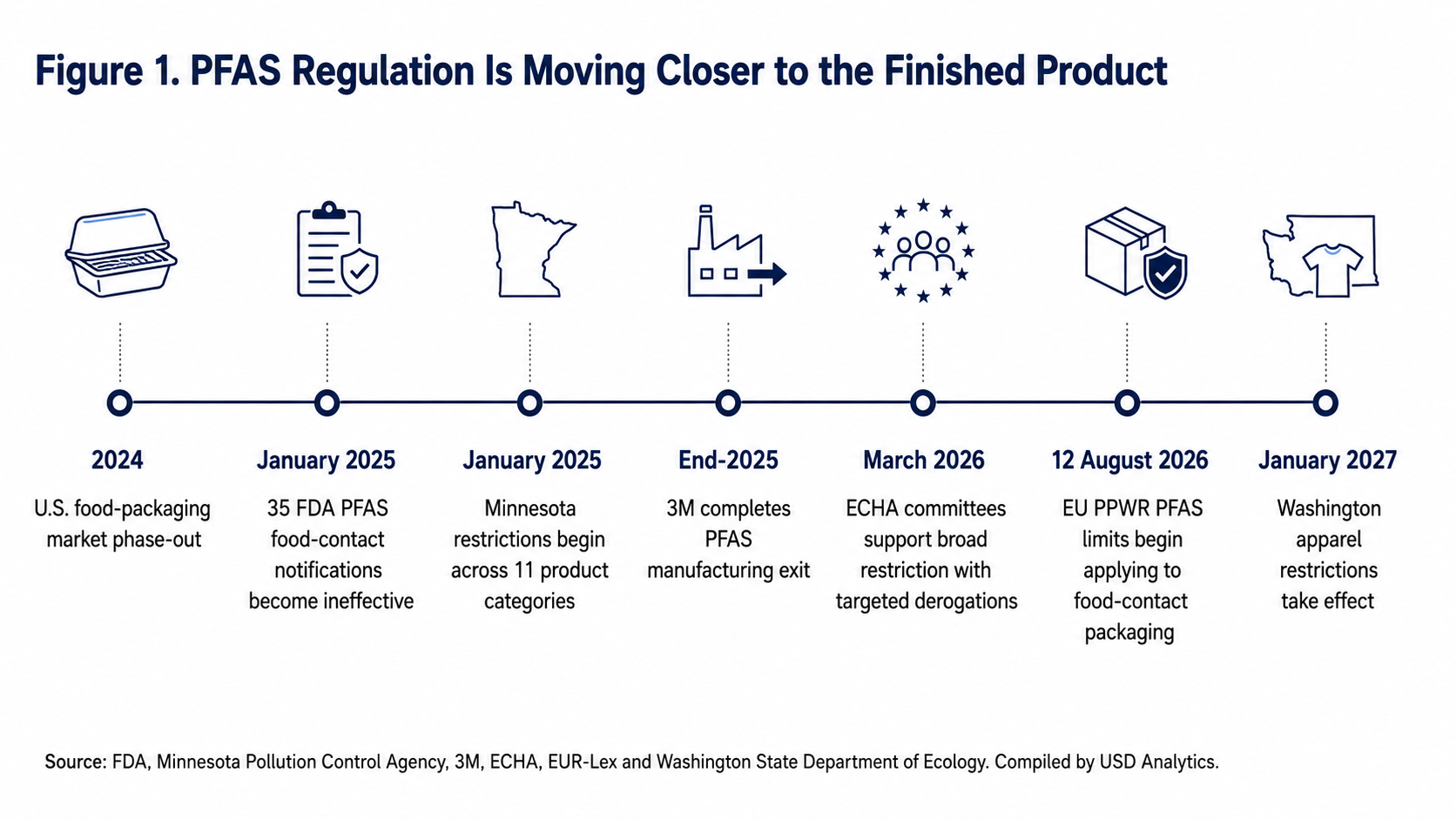
The recent regulatory architecture favors manufacturers that can identify PFAS at the formulation and component level rather than relying exclusively on finished-product testing. It also increases the commercial value of genuinely non-PFAS technology platforms that reduce the risk of another reformulation cycle if regulators extend controls across additional fluorinated substances.
Food Packaging Companies Accelerating Commercial Substitution amidst Regulatory Updates
Food-contact paper and molded fiber are emerging as key commercial proof points for PFAS substitution. Fluorinated treatments have historically been valuable because low treatment levels could provide resistance to water, fats and oils without the polymer-film structures used in many conventional packages. As regulatory requirements tighten, suppliers are recreating that barrier function through water-based polymers, waxes, dispersions and multilayer coating architectures.
The U.S. FDA states that manufacturers stopped selling PFAS-containing grease-proofing agents for food-contact use by early 2024, followed by withdrawal of 35 related authorizations in 2025. Europe's PPWR now places quantitative limits directly on food-contact packaging, further shifting procurement requirements toward documented non-PFAS systems.
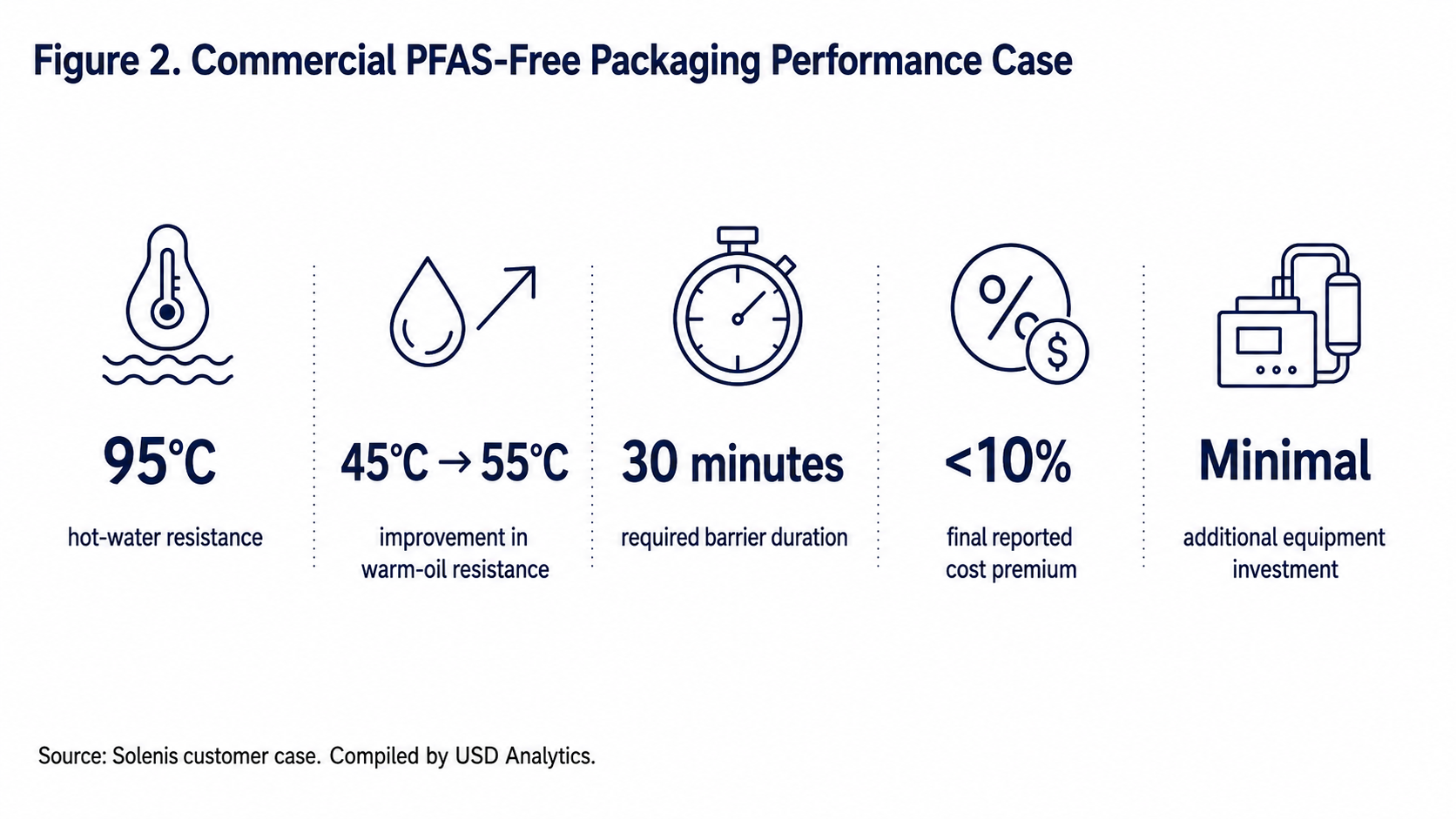
Commercial evidence indicates that the transition has progressed beyond laboratory feasibility. In a molded-fiber application documented by Solenis, a North American customer required a PFAS-free system able to resist 95°C hot water and 45°C warm oil for at least 30 minutes. The supplier's barrier program met the original requirement, while subsequent optimization increased warm-oil resistance to 55°C for 30 minutes. The final solution reportedly required minimal additional equipment investment and achieved the required performance at less than a 10% cost premium in that specific application.
A commercial PFAS-free molded-fiber barrier system achieved 95°C water resistance and 55°C oil resistance for 30 minutes at a reported cost premium below 10%.
Figure 2. Commercial PFAS-Free Packaging Performance Case
Textile Finishing Shows Where Water Repellency Is Solvable but Oleophobicity Remains Difficult
Textile chemistry is also rapidly distinguishing individual PFAS functions. Commercial fluorine-free durable water repellents can already deliver high levels of hydrophobic performance. RUDOLF reports a spray rating of 100 under AATCC 22 for one fluorine-free water-repellent system and laundering resistance of up to 30 cycles under DIN EN ISO 6330, subject to formulation and substrate conditions. Archroma is also expanding non-PFAS PHOBOTEX technologies; its CWR-SUP system combines durable water repellency with 53% sustainably sourced renewable feedstock.
RUDOLF distinguishes its fluorine-free technology for water-based stains from C6 fluorinated chemistry used where protection is required against oils, hazardous chemicals, blood and other very-low-surface-tension liquids. The supplier states that viable alternatives are still unavailable in a number of specialized workwear and protective applications.
Outdoor apparel whose principal requirement is rain resistance can transition faster than chemical-protective clothing, specialist PPE or industrial textiles requiring combined hydrophobic and oleophobic performance. The addressable opportunity therefore fragments into multiple formulation problems rather than one universal DWR replacement market.
Surface-Tension Performance Remains a Key Hurdle for Direct Chemical Replacement
The technical challenge becomes clearer when the underlying surface chemistry is quantified. PFAS-based surfactants can achieve very low surface tension at comparatively low use rates, supporting wetting, leveling, anti-blocking, oil repellency and dirt resistance in coatings. OECD's assessment of alternatives notes that non-fluorinated surfactants may need to be used at higher rates and may remain less effective for selected functions.
Chart 1. Lowest Surface Tension Reported in an OECD-Referenced Paint Study
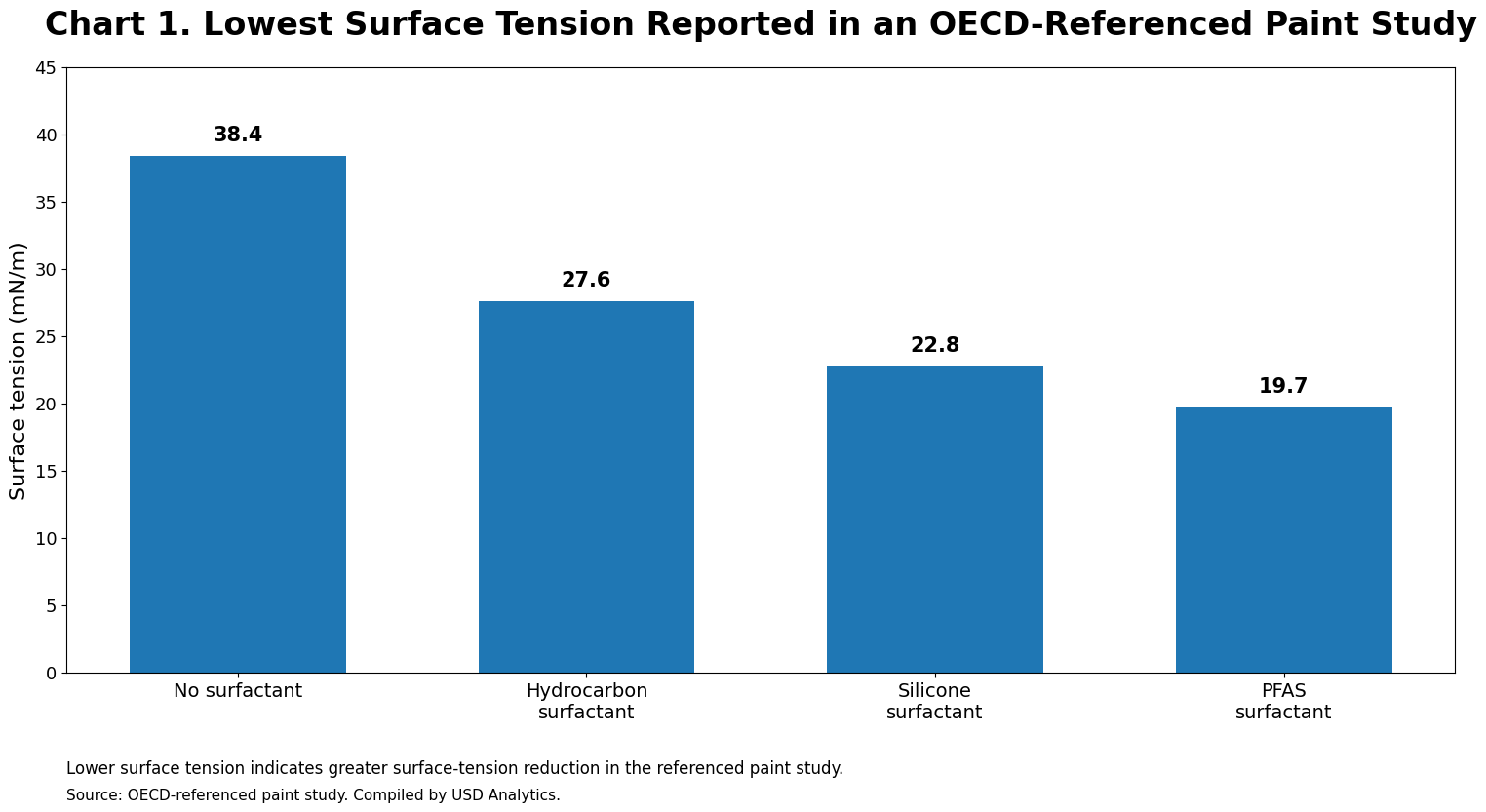
The approximately 3.1 mN/m difference between the silicone and PFAS examples may appear small numerically, but in applications dependent on wetting low-energy substrates it can materially influence leveling, coating uniformity and defect control. OECD concludes that the fluorosurfactant in the referenced study performed markedly better than the non-PFAS alternatives and reports stakeholder observations that higher alternative dosages do not always close the functional gap.
Accordingly, substitution programs increasingly redesign the formulation system rather than substitute molecule for molecule. Silicone and hydrocarbon surfactants, acrylics, polyurethanes, waxes, polyolefins and other polymer platforms can reproduce particular PFAS functions, but performance must be optimized around the substrate, application process and required end-use property.
Polymer Processing Aids Illustrate Function-Specific Replacement at Commercial Scale
Fluoropolymer-based polymer processing aids have historically been used to suppress melt fracture, improve extrusion stability and reduce surface defects. Instead of replicating every property of a fluoropolymer, developers are targeting specific processing outcomes.
Clariant launched AddWorks PPA 101 FG and AddWorks PPA 122 G in 2025 as commercially available PFAS-free polymer processing aids for polyolefin extrusion. The company reports improved extrusion efficiency, elimination of shark-skin defects and enhanced film surface smoothness without adversely affecting optical and mechanical properties, dyne level, sealability or coefficient of friction. AddWorks PPA 101 FG is supplied as a 100% active fine-grain composition, while the masterbatch-based 122 G is designed to operate at the same dosing level as conventional polymer-processing-aid masterbatches.
The launch follows a broader portfolio transition: Clariant reported that its additives business had completed the move to a fully PFAS-free additive portfolio by December 2023. This illustrates an emerging supplier strategy—remove PFAS at portfolio level while developing application-specific alternatives that minimize process disruption for converters.
Firefighting Foam Companies Facing Difficulties in Qualification over Reformulation
Aircraft firefighting provides one of the strongest examples of the gap between discovering an alternative and implementing it safely. Fluorine-free foams have moved through extensive research, formal performance specifications and qualified-product pathways rather than simple product substitution.
FAA research had evaluated 49 fluorine-free foams, comprising 11 commercial products and 38 prototypes, and conducted more than 750 fire tests across standard and modified scenarios. In January 2023, the U.S. Department of Defense issued a performance specification for synthetic fluorine-free foam. Products meeting the specification can be added to the DoD Qualified Products List, and FAA recognizes those qualified products as acceptable for meeting relevant Part 139 airport requirements. FAA continued issuing F3 transition and testing guidance in 2026.
FAA evaluated 49 fluorine-free firefighting foams through more than 750 fire tests, showing that PFAS substitution can require extensive qualification beyond reformulation.
Chart 2. FAA Fluorine-Free Foam Development Program
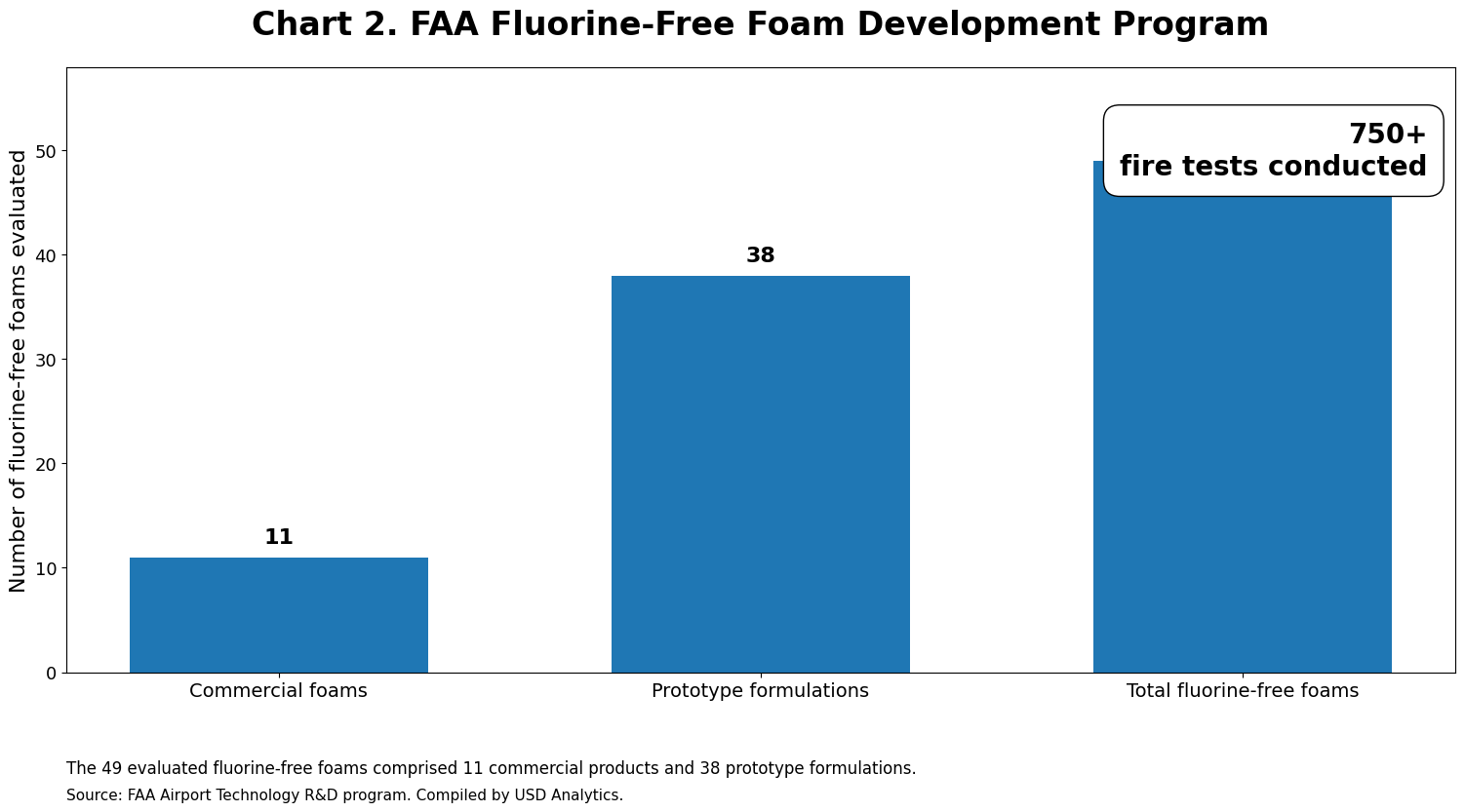
The numbers demonstrate the engineering intensity of substitution. Fire-extinguishing chemistry interacts with proportioning equipment, nozzles, fuel type, application density, vehicle configuration, cleaning procedures and residual AFFF contamination. FAA's transition program therefore addresses equipment rinsing, output testing and operating practices in addition to foam chemistry.
For chemical suppliers, Qualification support, equipment compatibility, field testing, decontamination protocols and operator training become part of the commercial proposition.
Semiconductors and Engineered Components Show Both the Limits and Possibilities of Substitution
BASF has reformulated its FOTOPUR R cleaning solutions for semiconductor manufacturing at 5 nm, 3 nm and 2 nm technology nodes. According to the company's 2025 Factbook, the new formulations deliver comparable performance without intentionally added PFAS, although trace PFAS may still occur as impurities. The example is significant because it shows that non-PFAS reformulation can penetrate extremely demanding semiconductor processes when development is tightly aligned with a defined application.
At the same time, 3M's experience illustrates the remaining constraints. The company completed its PFAS manufacturing exit at the end of 2025, but its June 2026 filing says PFAS-containing third-party inputs continue to be used in selected lithium-ion batteries, printed circuit boards, seals, gaskets and other products because of technological limitations, regulatory or industry standards and the need for customer certifications and approvals.
In high-specification markets, the substitute must pass application testing, process validation, reliability assessment, customer approval and sometimes regulatory recertification before commercial conversion can occur.
PFAS Substitution Maturity Varies by Application
Table 2. PFAS Substitution Maturity Across Key End-Use Applications
|
Application |
USD Analytics substitution assessment |
Evidence driving the assessment |
|---|---|---|
|
Food-contact paper and molded fiber |
Established / Scaling |
FDA phase-out, EU PPWR thresholds and documented commercial barrier systems indicate advanced substitution activity. |
|
Outdoor and apparel water repellency |
Scaling |
Commercial non-PFAS DWR technologies demonstrate strong water repellency and laundering durability. |
|
Protective textiles requiring oil/chemical repellency |
Technically constrained |
Supplier evidence identifies remaining difficulty protecting against oils, hazardous chemicals and other low-surface-tension liquids without fluorinated finishes. |
|
Aircraft firefighting foam |
Qualification-led / Scaling |
Qualified F3 pathway exists, but extensive testing and equipment-transition requirements illustrate implementation complexity. |
|
Polyolefin processing aids |
Commercializing |
Commercial PFAS-free products target melt fracture and film quality with limited change to conventional dosing practices. |
|
Advanced electronics and engineered components |
Application-specific / Qualification constrained |
BASF demonstrates successful substitution in selected semiconductor cleaning processes while 3M documents continuing PFAS dependence in other high-specification components. |
Source: USD Analytics assessment based on regulatory status, technical testing and manufacturer commercialization activity. The classifications indicate relative substitution maturity and are not market-share estimates.
The matrix reinforces a central feature of the transition: regulatory pressure and technical readiness do not move at the same speed. Applications with narrowly defined functions and established alternatives can convert quickly. Applications requiring several difficult properties simultaneously face longer development and qualification cycles.
Manufacturers Move from PFAS Phase-Out Announcements to Alternative-Chemistry Platforms
Table 3. Manufacturer Strategies Accelerating the Shift to PFAS-Free Chemistry
|
Manufacturer |
Verified transition activity |
Strategic signal |
|---|---|---|
|
3M |
Completed its PFAS manufacturing exit at end-2025; downstream third-party substitution continues in selected applications. |
Portfolio exits can precede complete supply-chain conversion. |
|
Clariant |
Completed a PFAS-free additive portfolio and commercialized PFAS-free PPAs for polyolefin extrusion. |
Function-specific alternatives can reduce converter disruption. |
|
Archroma |
Expanding non-PFAS textile repellents, including a system with 53% sustainably sourced renewable feedstock. |
PFAS removal is being combined with renewable-content differentiation. |
|
Solenis |
Commercial PFAS-free molded-fiber barrier chemistry has met documented hot-water and warm-oil requirements. |
Packaging alternatives are moving from qualification into commercial operation. |
|
BASF |
Reformulated semiconductor cleaning systems for 5 nm, 3 nm and 2 nm processes without intentionally added PFAS. |
High-performance substitution can succeed through process-specific development. |
|
Evonik |
Introduced PFAS-free specialty additives such as the 100%-active polyether-siloxane TEGO Foamex 8051 for waterborne coatings. |
Silicone chemistry is expanding as a function-specific alternative platform. |
The manufacturer evidence suggests that the market is moving through several strategic pathways simultaneously. Some producers are exiting fluorochemistry. Others are eliminating PFAS from existing additive portfolios, engineering replacements for narrowly defined functions or developing application platforms with customers. The commercially relevant unit of innovation is increasingly the performance function, not the PFAS molecule being removed.
The Economics of PFAS Substitution Depend on Total Cost of Use
Costs vary with chemistry, treatment level, processing requirements, equipment changes, qualification burden and product lifetime.
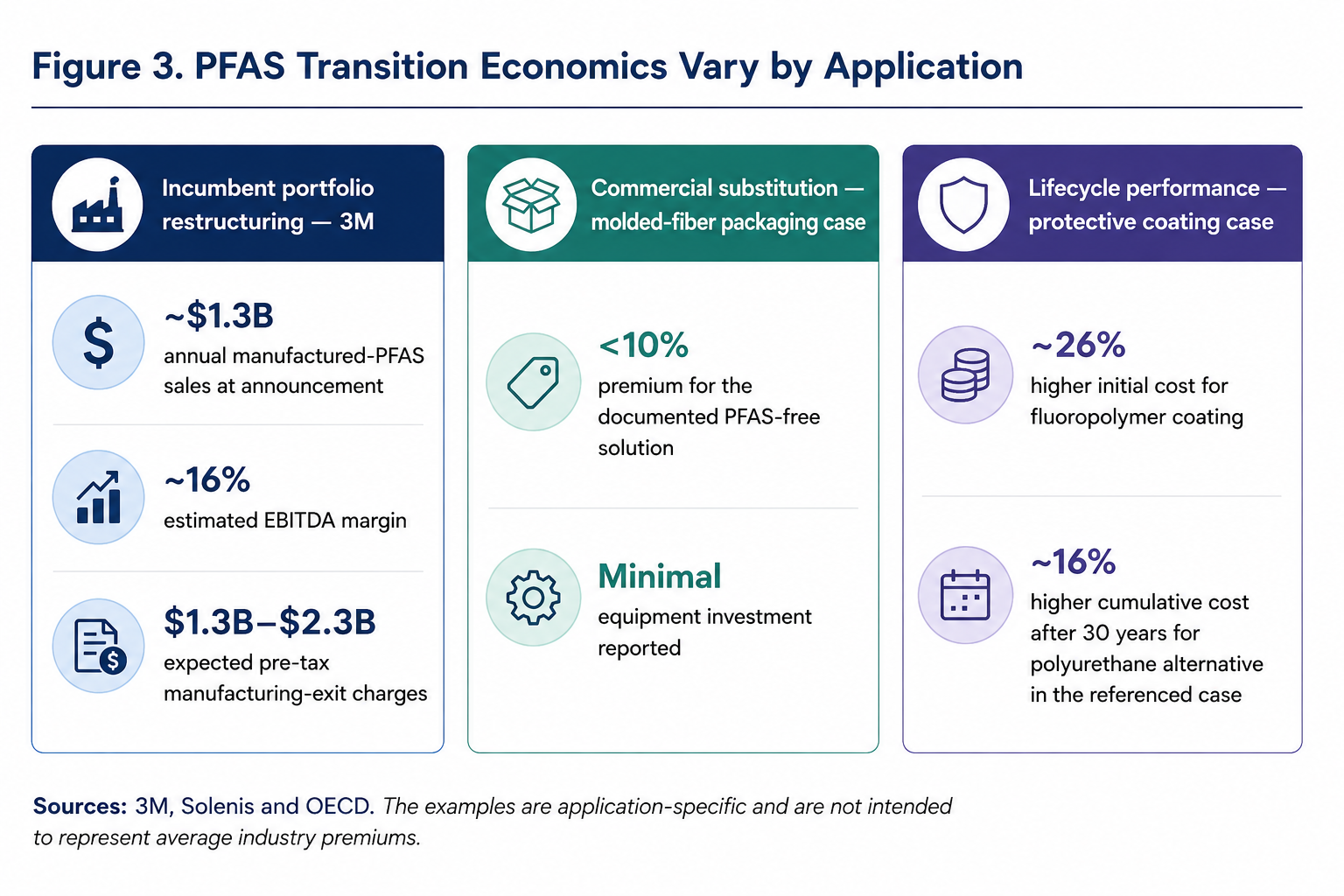
3M's manufacturing exit demonstrates the economics on the incumbent side. When the strategy was announced in 2022, the company disclosed approximately $1.3 billion in annual net sales from manufactured PFAS at an estimated 16% EBITDA margin, while expecting total pre-tax PFAS-manufacturing-exit charges of approximately $1.3 billion to $2.3 billion, with 70–80% expected to be non-cash. The company subsequently completed its manufacturing exit at the end of 2025.
The Solenis molded-fiber case achieved the specified PFAS-free performance for less than a 10% premium and required little additional equipment investment. Conversely, an older lifecycle case summarized by OECD found that a fluoropolymer bridge coating cost approximately 26% more per coating than polyurethane initially, but after 30 years the polyurethane system was estimated to cost 16% more cumulatively because faster degradation required more frequent recoating.
Figure 3. PFAS Transition Economics Vary by Application
Substitution is assessed using total cost of use: raw-material cost, dosage, line productivity, curing or drying energy, equipment modification, testing, qualification, service life and regulatory exposure. A higher-priced alternative can be commercially attractive if it reduces compliance risk or process cost; equally, removing a durable fluorinated material can increase lifecycle cost if the replacement requires more frequent maintenance.
Commercial Opportunity Is Moving Toward Application Engineering
The most attractive opportunities created by PFAS restrictions are emerging across multiple specialty-chemical value pools: barrier coatings for paper and molded fiber, durable water-repellent systems, polymer processing aids, silicone-based coating additives, firefighting formulations, alternative surfactants, analytical testing and customized high-performance polymers.
The differentiation threshold is also rising. Simply labeling a product PFAS-free will become less meaningful as compliance becomes a minimum market requirement. Suppliers will increasingly compete on whether their formulations preserve line speed, coating weight, wash durability, oil resistance, film optics, fire performance or device reliability while meeting evolving analytical and regulatory requirements.
Customer co-development is also becoming highly important. Qualification work performed before regulatory deadlines gives converters, OEMs and brand owners time to redesign processing conditions or product specifications where direct replacement cannot maintain the incumbent performance envelope. Suppliers with application laboratories and regulatory-science capabilities can capture more value than raw-material providers offering stand-alone replacement molecules.
Performance Gaps, Qualification and Regrettable Substitution Remain the Main Execution Risks
The first execution risk is functional underperformance. Water repellency can be reproduced more readily than simultaneous water and oil repellency; general coating wetting is easier than matching every fluorosurfactant function; and replacing a process chemical is materially different from replacing a fluoropolymer providing thermal, dielectric and chemical resistance simultaneously.
The second risk is qualification delay. FAA's extensive F3 testing and 3M's continuing use of certain third-party PFAS-containing components show that customer approvals, equipment compatibility and regulatory standards can become the binding constraint after alternative chemistry has been identified.
A third concern is regrettable substitution. The broad European proposal deliberately takes a group-based approach partly to avoid replacing one PFAS with another. For chemical manufacturers, this requires a broader screening framework in which persistence, hazard profile and likely future regulatory exposure are considered alongside immediate PFAS status and technical performance.
Finally, increasingly stringent product requirements raise the importance of analytical verification and supply-chain transparency. Compliance depends not only on intentionally added chemistry but also on impurities, processing aids and purchased components. BASF's description of its semiconductor formulations as having no intentionally added PFAS while potentially containing trace impurities demonstrates the level of precision that increasingly accompanies product claims.
Strategic Priorities for Chemical Manufacturers
Chemical producers aim to segment portfolios by substitution difficulty, distinguishing applications with commercially validated alternatives from those requiring fundamental material-system redesign. R&D is focused around the required function—wetting, grease resistance, water repellency, dielectric performance, melt processing or chemical durability.
The second priority is earlier downstream qualification. OEMs, converters and brand owners are being integrated into formulation development prior to regulatory deadlines. Testing under real substrates, production equipment and service conditions can expose performance gaps that laboratory screening alone will miss.
Third, manufacturers are integraring analytical verification and regulatory intelligence into product development. A credible PFAS-free proposition increasingly requires documented formulation control, supplier declarations, impurity management and suitable test methods.
Finally, economics should be communicated through total cost of use. Treatment dosage, energy, productivity, equipment compatibility, service life and avoided compliance exposure provide a better basis for customer decisions than additive price alone.
Strategic Outlook: PFAS Substitution Will Be a Segmented Industrial Transition
PFAS restrictions are accelerating one of the more complex formulation transitions facing specialty-chemical producers. The regulatory direction involves expanding product-level controls, advancing class-based restrictions and stringent requirements to understand where fluorinated substances enter products and supply chains.
The technical outcome will be less uniform. Food-contact packaging, outdoor textile water repellency, polymer processing aids and qualified firefighting foams are moving fluorine-free chemistry from R&D into commercial deployment. At the same time, protective textiles, selected coatings, batteries, electronics and engineered components continue to expose performance and qualification requirements that can lengthen substitution cycles.
For chemical manufacturers, competitive advantage will therefore shift toward companies able to combine formulation science, application engineering, regulatory intelligence, analytical verification and customer qualification. The strategic question is no longer simply whether PFAS can be removed. It is which functions can be replaced without compromising performance, how quickly downstream users can qualify the alternatives, and which suppliers can solve those problems before regulatory deadlines close the available transition window.
Related PFAS and Fluorine-Free Chemicals Research
Explore research covering PFAS-free packaging, fluoropolymer coatings, alternative surfactants, textile finishing chemicals, barrier technologies, and specialty chemicals supporting the transition toward fluorine-free formulations.
- PFAS Free Food Packaging Market
- Fluoropolymer Coating Additives Market
- Silicone Surfactants Market
- Water Based Barrier Coatings Market
- Textile Finishing Chemicals Market
- Semiconductor Chemical Market
Assess PFAS Substitution, Regulatory Exposure and Fluorine-Free Technology Opportunities
Access customized intelligence covering PFAS regulatory exposure, application-level substitution readiness, fluorine-free chemistries, technical performance gaps, reformulation requirements, supplier positioning, qualification pathways and emerging opportunities across specialty chemicals and end-use industries.
Discuss Your Research Requirement
Key Regulatory and Technical Authorities
- European Chemicals Agency (ECHA) — EU-wide PFAS restriction assessment, scientific committee opinions, sector-specific uses and proposed derogations.
- European Commission / EUR-Lex — legally binding requirements including PFAS concentration limits under the Packaging and Packaging Waste Regulation.
- U.S. Environmental Protection Agency (EPA) — TSCA PFAS reporting, CERCLA hazardous-substance requirements and broader federal PFAS risk-management actions.
- U.S. Food and Drug Administration (FDA) — PFAS use and authorization changes affecting food-contact packaging and grease-proofing applications.
- U.S. Federal Aviation Administration (FAA) — testing, qualification and transition guidance for fluorine-free firefighting foams in aviation applications.
- U.S. Department of Defense (DoD) — performance specifications and qualification requirements for fluorine-free firefighting foam.
- Minnesota Pollution Control Agency and Washington State Department of Ecology — state-level restrictions on intentionally added PFAS across consumer-product categories.
- OECD — technical assessment of PFAS functions, fluoropolymer applications, alternative chemistries and substitution-performance constraints.