
EU packaging rules are accelerating redesign across polymers, coatings, adhesives, inks and recycled-content systems. PPWR-driven recyclability, PFAS restrictions, EPR modulation and higher PCR requirements are shifting packaging innovation toward integrated, recycling-compatible material architectures and application-engineered specialty chemistry.
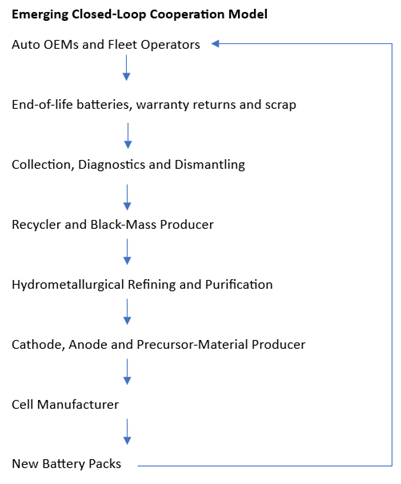
Battery recycling is moving beyond waste management and becoming a core instrument of industrial policy. Governments increasingly view end-of-life batteries, production scrap and black mass as strategic sources of lithium, nickel, cobalt, graphite, copper and manganese. Automakers, cell producers, chemical companies and recyclers are consequently building regional systems that connect battery collection, diagnostics, dismantling, material recovery, refining and battery-grade material production.
The commercial opportunity is substantial, but capacity expansion alone will not create a viable recycling industry. Feedstock availability, battery chemistry, collection networks, processing yields, material qualification, electricity and reagent costs, regulatory compliance and customer offtake will determine which projects become durable industrial assets.
Executive Takeaway
Battery deployment expanded far faster than end-of-life battery availability during the first half of the 2020s. The International Energy Agency estimates an approximately 15-year structural lag between rapid growth in battery demand and the emergence of comparable recycling feedstock. China currently hosts more than 85% of global battery-recycling capacity, while announced worldwide capacity for 2030 could equal seven times the available feedstock if all planned projects proceed.
This is shifting strategic attention from plant construction toward feedstock security, reverse logistics and downstream material qualification. Production scrap will remain a major near-term input, but end-of-life EV and energy-storage batteries are expected to become the largest feedstock source from 2035 onward. Recycling will therefore develop in two phases: an initial scrap-led market followed by a significantly larger end-of-life battery cycle.
Key Metrics Shaping the Battery-Recycling Strategy
|
Key metric |
Strategic significance |
|---|---|
|
~15 years |
Estimated lag between rapid battery deployment and comparable end-of-life battery availability |
|
More than 85% |
Share of global recycling capacity currently hosted by China |
|
7× |
Potential ratio of announced recycling capacity to available feedstock in 2030 |
|
80% lower |
Average greenhouse-gas emissions from recycled lithium, nickel and cobalt versus primary mined materials |
|
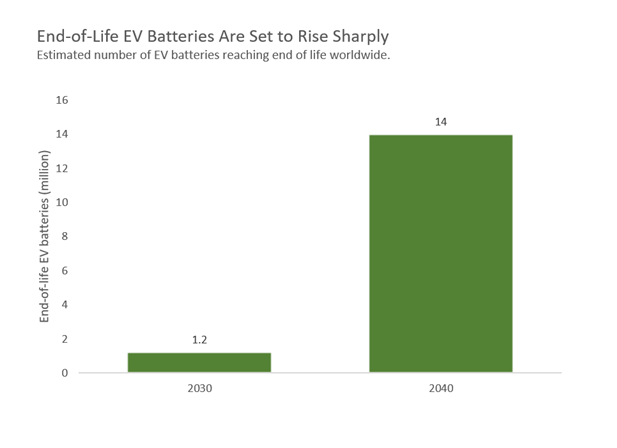
1.2 million to 14 million |
Estimated increase in EV batteries reaching end of life between 2030 and 2040 |
|
Up to $500 million |
US DOE funding opportunity announced for critical-material processing, battery manufacturing and recycling |
End-of-Life Batteries Become a Major Industrial Feedstock
The expected end-of-life battery wave is substantial. The IEA estimates that approximately 1.2 million EV batteries could reach retirement in 2030, rising to around 14 million in 2040. This expansion will create a larger regional material reservoir, but its commercial availability will depend on collection rates, second-life deployment, vehicle exports, ownership arrangements and battery condition.
Recycling Moves from Circularity Initiative to Industrial Policy
Recycling reduces dependence on geographically concentrated mining and refining capacity by retaining materials already present in domestic vehicle, electronics and energy-storage fleets. It also provides governments with a mechanism to support local battery manufacturing without relying entirely on new mineral extraction.
The EU Critical Raw Materials Act sets 2030 benchmarks for domestic capacity equivalent to at least 10% of annual consumption from extraction, 40% from processing and 25% from recycling. It also seeks to limit dependence on any one third country to no more than 65% of annual consumption for each strategic material at a relevant processing stage.
The United States is similarly supporting domestic processing and recycling. In March 2026, the Department of Energy announced a funding opportunity of up to $500 million covering critical-material processing, recovery from manufacturing scrap and end-of-life batteries, and domestic battery-material and component manufacturing.
A resilient battery supply chain now depends on collection rights, battery data, black-mass capacity, chemical separation, recycled-material certification and long-term offtake.
The Feedstock Timing Gap Is the Central Commercial Constraint
Lithium-ion battery deployment across EVs, stationary storage and other applications increased more than sixfold between 2020 and 2025. Most of those batteries remain in service and are unlikely to become available for recycling until the mid-2030s or later.
Manufacturing scrap therefore remains critical during the industry’s early development. The IEA estimates that production scrap will still account for approximately two-thirds of available battery-recycling feedstock in 2030. End-of-life EV and storage batteries are expected to become the largest source from 2035 onward and represent more than 90% of available feedstock by 2050.
The imbalance creates several strategic risks:
- Plants may operate below nameplate capacity before end-of-life volumes accelerate.
- Recyclers without automaker or cell-manufacturer contracts may struggle to secure feedstock.
- Competition for gigafactory scrap can increase acquisition costs.
- Black mass may flow toward regions offering lower processing costs or higher recovery value.
- Used EV exports can transfer future recycling feedstock from vehicle-selling countries to importing markets.
The IEA estimates that global announced recycling capacity in 2030 could be seven times available feedstock. By 2040, the position could reverse, with available feedstock exceeding currently announced capacity by approximately 60%.
Regulatory Pivots Transforming Battery Supply Chains
EU Batteries Regulation
The EU Batteries Regulation establishes requirements across battery design, due diligence, collection, material recovery, recycled content and digital traceability. The battery passport becomes mandatory from 18 February 2027 for covered EV, light-transport and industrial batteries. The European Commission’s Digital Product Passport Registry became operational in July 2026, giving companies a testing environment ahead of implementation.
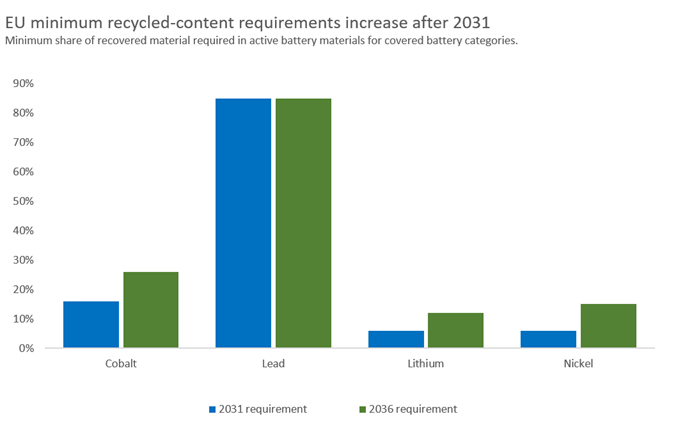
Minimum recycled-content requirements begin in August 2031 for covered batteries:
- 16% cobalt
- 85% lead
- 6% lithium
- 6% nickel
Requirements increase again in 2036 for cobalt, lithium and nickel.
EU minimum recycled-content requirements increase after 2031
Exhibit: Minimum share of recovered material required in active battery materials for covered battery categories-
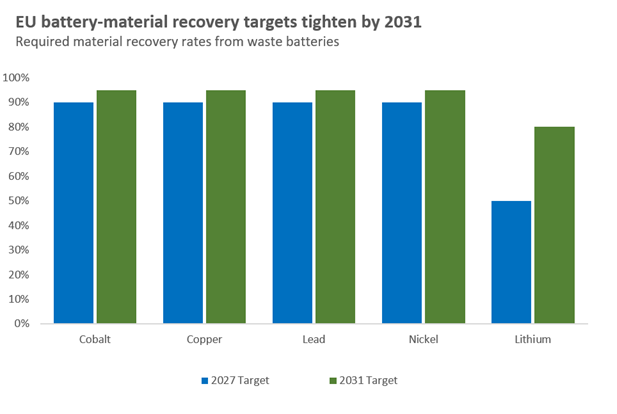
The EU framework also establishes material-recovery targets. By the end of 2027, recyclers must recover 90% of cobalt, copper, lead and nickel and 50% of lithium. By the end of 2031, those requirements increase to 95% for cobalt, copper, lead and nickel and 80% for lithium.
EU battery-material recovery targets tighten by 2031
Exhibit: Required material-recovery rates from waste batteries:
US Domestic Battery-Supply Policy
|
US policy lever |
Supply-chain relevance |
|---|---|
|
Section 45X advanced-manufacturing production credit |
Supports qualifying battery components, electrode active materials and applicable critical minerals produced in the United States |
|
Prohibited Foreign Entity restrictions |
Introduce ownership, material-assistance and supply-chain conditions affecting credit eligibility |
|
DOE critical-material funding |
Supports processing, recycling and battery-material manufacturing facilities |
|
RCRA and transport regulation |
Governs the handling, classification and movement of discarded batteries and certain recycling intermediates |
IRS guidance issued in 2026 confirms that Section 45X covers qualifying battery components and applicable critical minerals, while amended rules exclude eligible components containing specified material assistance from a prohibited foreign entity.
Black-Mass Classification and Cross-Border Movement
Black mass composition varies according to the battery chemistries entering the shredding process, the degree of preprocessing and the presence of electrolyte or other materials. The US EPA states that black mass is no longer a battery and is not universal waste; its regulatory status depends on its characteristics and management.
The EU updated battery-related waste codes in 2025, classifying several battery waste streams—including lithium-based black mass—as hazardous and strengthening controls under waste-shipment rules. The policy is intended partly to retain recoverable battery materials within the European recycling economy.
Regulatory Comparison
|
Dimension |
European Union |
United States |
|---|---|---|
|
Primary mechanism |
Binding lifecycle regulation |
Tax credits, funding and environmental regulation |
|
Digital traceability |
Mandatory battery passport from February 2027 |
No equivalent nationwide battery-passport mandate |
|
Recycled content |
Binding minimum requirements from 2031 |
Primarily encouraged through manufacturing and sourcing policy |
|
Material recovery |
Defined recovery-rate targets |
Varies by regulation, programme and jurisdiction |
|
Supply localization |
CRMA benchmarks and circularity rules |
Section 45X, PFE restrictions and DOE funding |
|
Black mass |
Hazardous waste codes and shipment controls |
RCRA classification depends on characteristics and management |
Critical-Mineral Economics: Primary Supply Versus Urban Mining
|
Dimension |
Primary mineral extraction and refining |
Secondary supply from battery recycling |
|---|---|---|
|
Resource basis |
Geological deposits, ore grades, brines and mining infrastructure |
Manufacturing scrap, end-of-life batteries and black mass |
|
Development profile |
Long permitting, infrastructure, mine development and commissioning cycles |
Potentially modular development, but still dependent on permitting, feedstock and offtake |
|
Environmental exposure |
Land disturbance, water requirements, beneficiation and refining emissions |
Lower average lifecycle emissions, but requires energy, chemicals and waste management |
|
Geopolitical exposure |
Concentrated mineral extraction and refining locations |
Can support regional supply, although recycling technology and capacity remain concentrated |
|
Main economic constraint |
Resource quality, capital intensity, commodity prices and permitting |
Feedstock availability, utilization, chemistry mix, logistics and recovered-product quality |
|
Commercial output |
Concentrates, refined metals and battery-grade compounds |
Black mass, metal salts, precursors and regenerated active materials |
On average, recycled lithium, nickel and cobalt generate approximately 80% fewer greenhouse-gas emissions than equivalent primary materials from mining. The IEA also estimates that stronger recycling could reduce the need for new mining activity by 25% to 40% for selected energy-transition minerals by 2050 under its Announced Pledges Scenario. Recycling nevertheless supplements rather than eliminates primary extraction because battery-material demand continues to expand.
Recycling-Technology Comparison
|
Technology |
Principal advantages |
Main limitations |
Best-fit conditions |
|---|---|---|---|
|
Pyrometallurgy |
Tolerates mixed or contaminated feedstock; established high-temperature processing |
High energy requirements; lithium and other materials may require additional recovery stages |
Mixed batteries, uncertain chemistry and integrated metallurgical operations |
|
Hydrometallurgy |
Potential for high recovery and refined metal salts; lower processing temperatures |
Reagent consumption, wastewater, impurity control and multistage purification |
Controlled black mass and production of battery-grade intermediates |
|
Direct recycling |
Preserves more of the active material’s engineered value; may reduce remanufacturing energy |
Requires chemistry identification, clean separation and extensive product requalification |
Consistent, chemistry-specific feedstock and integrated battery-material ecosystems |
Corporate Ecosystems and Closed-Loop Joint Ventures
BASF and TSR: Integrating Collection with Material Processing
BASF began commercial operation of its Schwarzheide black-mass plant in 2025. The facility can process up to 15,000 tonnes of end-of-life lithium-ion batteries and production scrap annually, equivalent to approximately 40,000 EV batteries according to BASF.
In 2026, BASF and TSR Group announced cooperation covering dismantling, discharging, black-mass production, metal-fraction recovery and battery logistics. The partnership adds collection and preprocessing capabilities to BASF’s broader European battery-material and recycling activities.
Redwood and General Motors: Managing the Full Battery Lifecycle
Redwood Materials and General Motors expanded their relationship in 2026 across production-scrap recycling, end-of-life EV battery management and second-life energy storage. Redwood reported receiving more than 28,000 tonnes of material from GM and Ultium Cells and having approximately 10,000 EV packs in its repurposing pipeline.
The companies also announced plans to deploy about 100 repurposed GM packs at a Michigan manufacturing site, providing 1.5 MW and 7.2 MWh of dispatchable energy. The arrangement demonstrates that diagnostic triage can extend battery value before final material recovery.
Glencore: Connecting Metals, Refining and Recycling
Glencore’s proposed Portovesme Critical Raw Materials Hub in Italy was selected as an EU Strategic Project in 2025. The project is intended to establish a European recycling value chain capable of recovering lithium, nickel and cobalt from battery material.
Glencore acquired Li-Cycle in August 2025 and integrated it into Glencore Battery Recycling, expanding its position across battery feedstock, processing and metal recovery.
Related Battery and Critical-Materials Research
Explore detailed research on battery recycling technologies, critical-material supply chains, anode materials, electrolytes, and specialized chemicals supporting the global battery value chain.
- Lithium-Ion Battery Recycling Market
- Strategic Mineral Materials Market
- Battery Anode Materials Market
- Battery Electrolyte Market
- Lithium Ion Battery Electrolyte Solvent Market
- Battery Additives Market
Assess Battery-Recycling Capacity, Technology and Regional Investment Opportunities
Access customized intelligence covering feedstock availability, recycling capacity, black-mass flows, processing technologies, battery chemistry exposure, recovery economics, company positioning, regulatory requirements and regional supply-chain opportunities.
Discuss Your Research Requirement | Explore Battery and Critical-Materials Research
Principal Government and Intergovernmental Sources
- European Union Batteries Regulation and official implementation guidance.
- European Critical Raw Materials Act.
- US Department of Energy critical-material processing and recycling funding.
- US Treasury and IRS Section 45X and Prohibited Foreign Entity guidance.
- US EPA lithium-ion battery recycling and black-mass guidance.
- International Energy Agency battery circularity and critical-minerals recycling analysis.