
Europe's Packaging and Packaging Waste Regulation is shifting packaging compliance from an end-of-life waste-management question toward a materials-design problem. Recyclability grades, higher recycled-content requirements, PFAS restrictions and future EPR fee modulation are forcing polymer, coating, adhesive and ink suppliers to engineer packaging as an integrated recycling-compatible system rather than optimize ...
Executive Takeaways
- PPWR has moved into implementation. Regulation (EU) 2025/40 applies from 12 August 2026 and replaces the previous Packaging and Packaging Waste Directive framework with a directly applicable EU regulation. From 2030, recyclability performance grades begin shaping market access, with Grade A at ≥95%, Grade B at ≥80% and Grade C at ≥70%; from 2038, Grade C packaging can no longer be placed on the market.
- Structural simplification is increasing formulation sophistication. Mono-PE, mono-PP and fiber-rich architectures can improve compatibility with established recycling streams, but barrier, sealing, adhesion, print and durability functions increasingly migrate into coatings, tie layers, adhesives and functional inks. Current CEFLEX and RecyClass guidance shows that relatively small amounts of EVOH, adhesives, coatings and ink can influence recycling compatibility.
- Recycled content creates a second materials challenge. PPWR requires recycled plastic content to rise from 10–35% across major packaging categories in 2030 to 25–65% by 2040, increasing the importance of formulations that can tolerate greater PCR variability while retaining processing, appearance, barrier and mechanical performance.
- Recyclability is becoming an economic and documentation variable. PPWR provides for EPR contributions to be modulated according to recyclability performance, while manufacturers must demonstrate compliance through technical documentation. Industry guidance is therefore pushing chemical suppliers toward recyclability evidence, conformity information and application testing alongside the material itself.
Key Metrics Reshaping Packaging Materials and Formulation
|
Packaging Metric |
Requirement / Technical Benchmark |
Evidence Type |
Strategic Significance |
|---|---|---|---|
|
PPWR application |
12 August 2026 |
EU regulation |
Moves packaging redesign into active implementation |
|
Recyclability Grade A |
≥95% |
EU regulation |
Rewards structures with very high recyclable content |
|
Recyclability Grade B |
≥80% |
EU regulation |
Becomes practical minimum for market access from 2038 |
|
Technical recyclability floor |
70% |
EU regulation |
Below this threshold packaging is technically non-recyclable |
|
Other plastic packaging recycled content |
35% in 2030 → 65% in 2040 |
EU regulation |
Increases demand for PCR-compatible polymer formulation |
|
Food-contact PFAS limits |
25 ppb / 250 ppb / 50 ppm |
EU regulation |
Adds substances-of-concern pressure to packaging chemistry |
|
EVOH in PE-film recycling |
Up to 5 wt% under specified conditions |
RecyClass guidance/testing |
Demonstrates narrow functional-barrier design windows |
|
Ink-use recommendation |
<5 wt% |
RecyClass guidance/testing |
Links ink chemistry directly to recyclate quality |
|
Commercial PE coffee-pack structure |
95% PE |
Manufacturer case |
Demonstrates structural simplification through polymer engineering |
|
Barrier-coating shelf-life case |
36 weeks |
Manufacturer/test case |
Shows coatings can replace selected structural barrier functions |
.
PPWR Moves Packaging Regulation From Waste Management Into Material Design
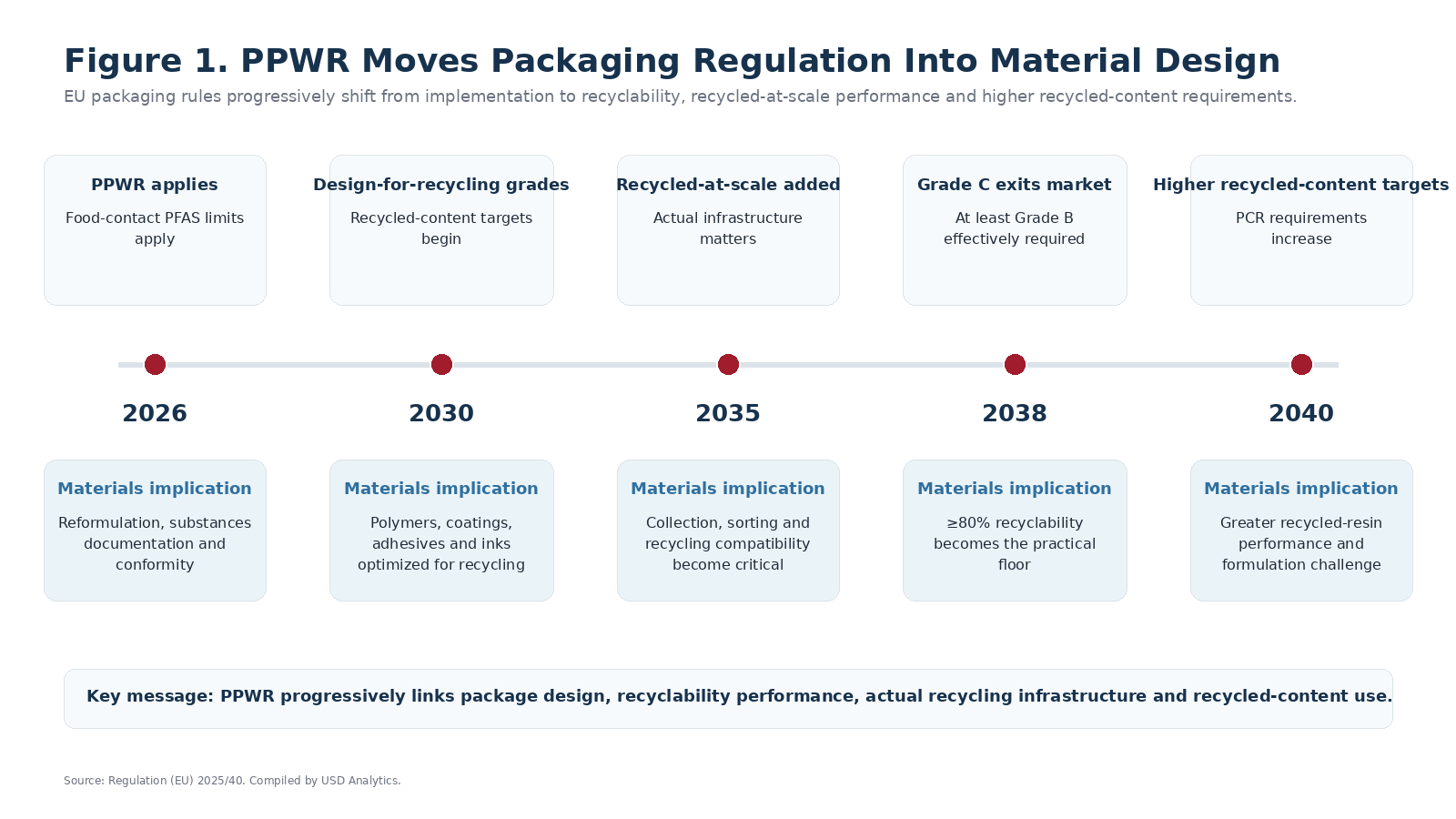
Regulation (EU) 2025/40 applies from 12 August 2026 and repeals the previous Directive 94/62/EC framework, subject to specified transitional provisions. Its strategic importance for chemical suppliers lies in how deeply it reaches into package composition: recyclability assessment is designed to consider the whole packaging unit, including integrated components, while Annex II identifies material composition, coatings, barriers, adhesives, inks, labels, additives and other components among the parameters relevant to design-for-recycling criteria.
From 2030, packaging recyclability will be classified through performance grades. Grade A corresponds to at least 95% recyclability by weight, Grade B to at least 80%, and Grade C to at least 70%. Packaging below 70% is technically non-recyclable. From 2035, a recycled-at-scale dimension is added so that theoretical compatibility with recycling is no longer sufficient: packaging must also be collected, sorted and recycled through installed infrastructure using processes proven in an operational environment. From 2038, Grade C packaging can no longer be placed on the market.
The regulation also adds chemical-composition pressure. The combined concentration of lead, cadmium, mercury and hexavalent chromium in packaging must not exceed 100 mg/kg. For food-contact packaging, PFAS restrictions applicable from 12 August 2026 establish thresholds of 25 ppb for an individual targeted PFAS, 250 ppb for the sum of targeted PFAS and 50 ppm for PFAS including polymeric PFAS. Total fluorine above 50 mg/kg triggers an additional evidence requirement to establish how much fluorine derives from PFAS versus non-PFAS sources.
By 2038, packaging that only achieves Grade C recyclability will no longer be permitted on the EU market—turning material compatibility from a sustainability preference into a market-access requirement.
Structural Simplification Moves Packaging Functionality Into Specialty Chemistry
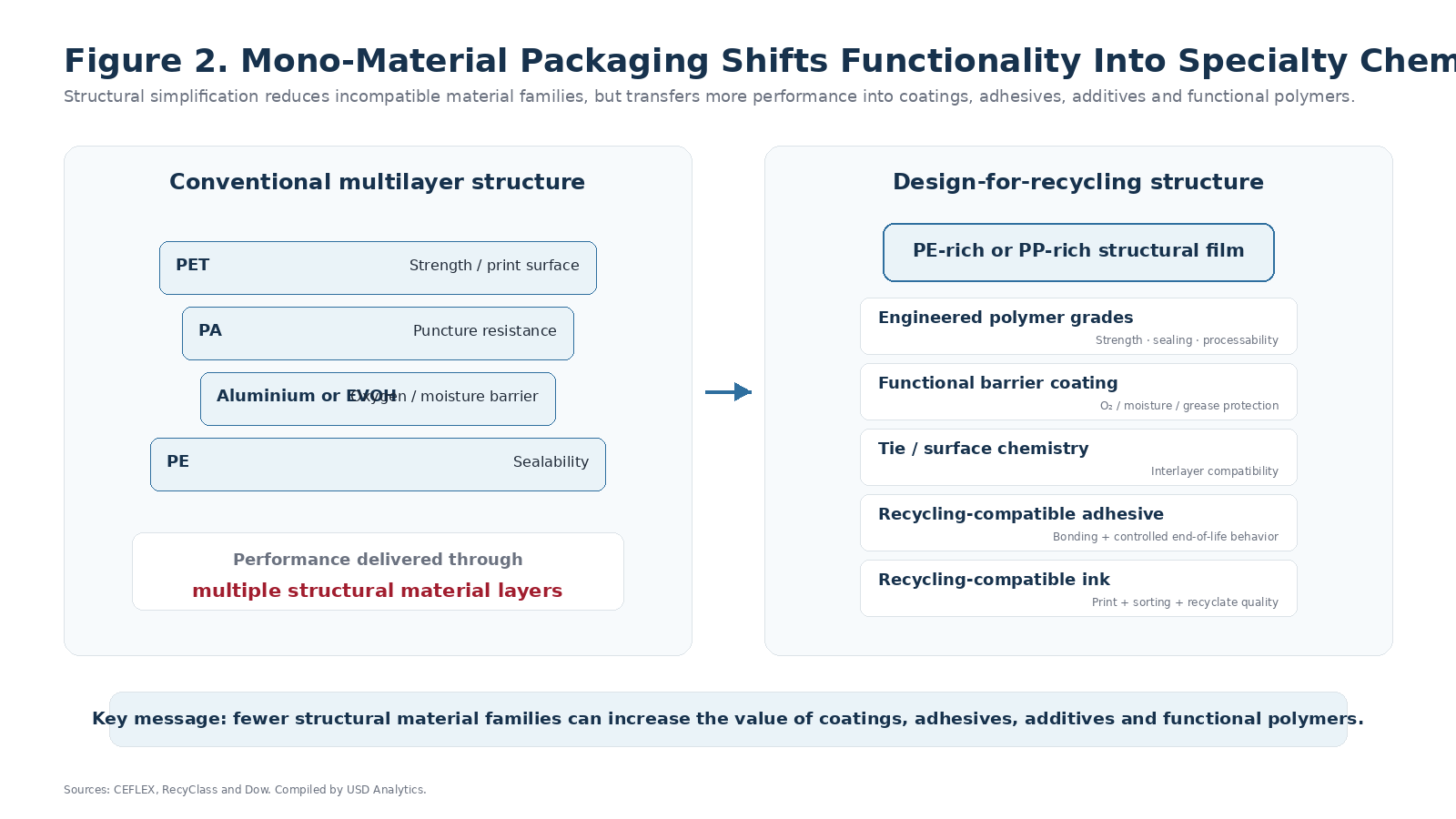
Conventional high-performance flexible packaging combines polymers or materials that each perform a specialized function: one layer contributes mechanical strength, another heat resistance, another oxygen or moisture barrier, and another sealability. This structure can create end-of-life challenges when materials cannot be effectively separated or processed in the same recycling stream. Current CEFLEX guidance consequently focuses on material selection together with barriers, coatings, adhesives, inks, metallisation and tie layers, based on testing of more than 600 packaging samples and 1,760 datapoints.
PE-rich and PP-rich structures reduce incompatible structural layers while transferring more functionality into sophisticated polymer grades, barrier coatings, tie resins, adhesives and print systems. Dow and Valgroup's coffee-packaging development provides a useful commercial example: the structure contains 95% polyethylene and is designed for the PE recycling chain, using high-performance polyethylene grades to deliver moisture and oxygen protection, strength and visual performance without the conventional combination of paper or metal layers.
Reducing material diversity can increase chemical complexity. A converter may eliminate a PET, aluminium or other barrier layer but require more advanced coatings, better surface chemistry, controlled adhesive loading, optimized sealing resins or inks that remain stable through polymer recycling. The design problem is therefore moving from selecting individually high-performing materials toward engineering a package whose individual functions remain effective without undermining the target recycling stream.
Barrier Coatings Become Critical as Packaging Structures Lose Functional Layers
Barrier coatings are positioned to capture one of the clearest value shifts created by design for recycling. Removing metallized, foil, PVDC or other functional layers from a structure does not remove the underlying requirement to protect oxygen-sensitive, moisture-sensitive, greasy or aromatic products. Instead, that performance increasingly has to come from thin coatings that are compatible with the base polymer or fiber recycling stream. This is pushing development across waterborne acrylics, PVOH-based systems, specialty dispersions and other functional barrier technologies.
Siegwerk provides an unusually useful application-level example. Its MDO-PE//PE coffee pouch used CIRKIT OxyBar BC 1582 oxygen-barrier coating and was compared with a PE pouch containing EVOH. Independent shelf-life work stored coffee for 36 weeks at 23°C and 50% relative humidity, with sensory testing after 12, 24 and 36 weeks. Siegwerk reported no statistically significant differences in ground-coffee odor, brewed-coffee odor or taste between the tested barrier-coated structure without EVOH and the reference structure. This is an application-specific manufacturer-backed test, not a universal claim that coated PE can replace EVOH across food packaging.
Fiber packaging is undergoing a parallel transition. UPM and BASF announced in May 2026 that they are combining UPM barrier papers with waterborne BASF Joncryl HPB barrier resins to develop recyclable fiber-based structures intended to replace selected mixed or PE-laminated packaging. UPM's papers have been certified against specified paper-recycling protocols, while BASF states that the Joncryl HPB line has not negatively affected paper recyclability in CEPI v2.0 testing; third-party assessment of the complete combined structure was still ongoing at the time of the announcement.
Dow provides another quantitative signal. Its RHOBARR 320 barrier dispersion can be applied at less than 8 µm and the company reports that coated paper structures can support up to 99% fiber recovery in its referenced recycling work. The result should remain identified as Dow-specific rather than treated as a general performance benchmark for dispersion coatings.
A mono-PE coffee pouch using a functional oxygen-barrier coating completed a 36-week shelf-life test without a statistically significant sensory difference versus the tested EVOH-containing reference structure.
Packaging Adhesives Shift From Bond Strength Alone to Recycling-Interface Performance
Adhesives illustrate why PPWR compliance cannot be reduced to choosing a nominally “recyclable” resin. Adhesives are necessary for package integrity, lamination, labeling, resealing and increasingly for functional barrier architectures, yet their behavior after disposal can affect separation, polymer purity or paper-fiber recovery. FEICA consequently argues that adhesives should be evaluated according to their actual interaction with the recycling process and the package as a whole rather than automatically classified as an incompatible plastic component.
Current commercial approvals show how precise these design windows can become. Four Sun Chemical solvent-free SunLam laminating adhesives received RecyClass approval for European flexible-PE recycling streams under defined conditions. Those conditions included PE-film density below 0.97 g/cm³ and adhesive loading of 2.3 wt% or less of total film weight, while other package components also had to comply with relevant design-for-recycling requirements. One approved adhesive incorporates gas-barrier functionality, demonstrating how adhesives themselves can begin to replace functions previously delivered by additional structural layers.
Label adhesives face a different end-of-life requirement: separation rather than persistence. Henkel's Technomelt EM 335 RE is designed for PET bottle labels and is reported to be removable by up to 98% during recycling, compared with conventional hot-melt adhesives that the company says typically dissolve only 12–30% in the referenced caustic washing process. The product can run at up to 40,000 bottle labels per hour and at processing temperatures of 110–140°C. These are product-specific manufacturer claims, but they illustrate how wash-off behavior and recyclate cleanliness are becoming measurable adhesive-performance parameters alongside bond strength and converting speed.
The commercial implication is significant: an adhesive can increasingly differentiate by what happens after it stops adhering. Wash-off, controlled debonding, low contaminant residue and compatibility with PE, PP, PET or fiber streams can become part of the specification, creating new formulation requirements for acrylic dispersions, polyurethane laminating systems, hot melts and debond-on-demand technologies.
Printing Inks Become a Sorting and Recyclate-Quality Variable
Printing inks are also moving beyond their conventional performance envelope of color, adhesion, drying, chemical resistance and printability. A recyclable package must first be correctly identified and sorted, and its inks must then survive—or be removed during—the recycling process without materially reducing recyclate quality. Current CEFLEX guidance explicitly includes near-infrared sorting, eddy-current sorting and metal detection alongside chemical compatibility considerations.
RecyClass testing provides particularly relevant evidence for flexible plastics. It assessed four new polyurethane-based ink technologies, one acrylic technology and a PVB-binder system as alternatives to nitrocellulose-based inks. The tested PU, acrylic and PVB approaches showed no adverse impact on resulting pellet or film quality in the stated recycling tests, while RecyClass recommends limiting ink use to below 5 wt%. That threshold is a RecyClass design recommendation—not a PPWR statutory limit.
Sun Chemical's July 2026 commercialization activity shows how this is translating into supplier strategy. Its SunUno SoliCycle solvent-based inks use PU chemistry as a nitrocellulose alternative and received RecyClass certification for flexible packaging. Sun Chemical combines these inks with RecyClass-certified SunLam adhesives, positioning the package not as separate ink and adhesive purchases but as an integrated recycling-compatible formulation system.
The emerging competitive specification for packaging inks can therefore be viewed in three layers: print performance, including adhesion, curing and color; sorting performance, including interaction with optical identification; and recycling performance, including heat stability, volatile generation, bleeding, deinking and effect on recyclate color or mechanical properties. This makes pigment, binder and additive selection increasingly relevant to the economics of the downstream recycling stream.
|
Component / Design Variable |
Current Guideline or Commercial Test Condition |
Interpretation |
|---|---|---|
|
EVOH in PE flexible film |
Up to 5 wt% under specified tie-layer conditions |
Functional barrier can remain compatible within controlled composition |
|
CEFLEX adhesives/coatings |
≤5 wt% in referenced guidance |
Functional chemistry must remain within stream-compatible loading windows |
|
SunLam adhesive approval |
≤2.3 wt% of total film weight |
Specific commercial adhesive approval demonstrates tighter formulation conditions |
|
RecyClass ink recommendation |
<5 wt% |
Ink content can influence polymer-recycling quality |
|
CEFLEX PA6 in PE |
≤35% with specified tie layers |
Compatibility depends on both polymer content and interface chemistry |
|
Henkel PET-label adhesive |
Up to 98% removable |
Separation behavior can become an adhesive performance metric |
Recycled-Content Mandates Shift Formulation Toward PCR Performance Engineering
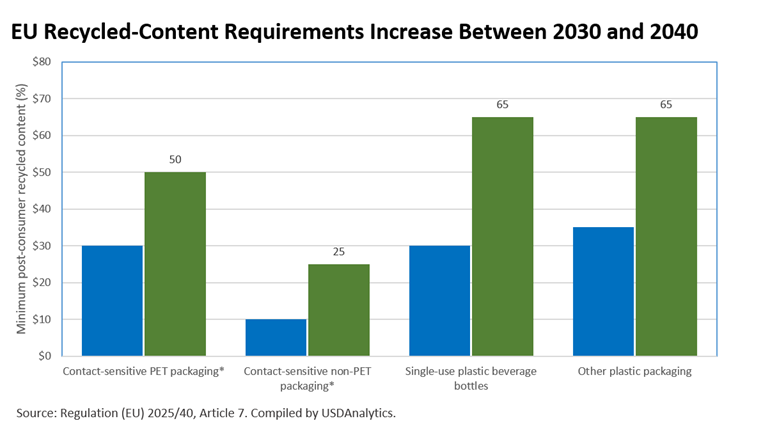
Design for recycling determines what happens to packaging after use; recycled-content rules change what must go into new packaging. Article 7 of PPWR requires post-consumer recycled plastic content from 2030 at 30% for contact-sensitive PET packaging, 10% for contact-sensitive non-PET packaging, 30% for single-use plastic beverage bottles and 35% for other plastic packaging, subject to the regulation's exemptions and conditions. By 2040, those figures rise to 50%, 25%, 65% and 65%, respectively.
These requirements introduce a fundamentally different formulation problem from designing a package made entirely from optimized virgin resin. Recycled polymers can vary in molecular-weight distribution, thermal history, color, contamination, odor and mechanical properties according to feedstock and processing history. Meeting higher PCR requirements is therefore likely to increase the importance of stabilization, compatibilization, odor control, color management, processing aids and tailored virgin/PCR blends where permitted. That represents a second specialty-chemicals opportunity created by PPWR, distinct from barrier and adhesive redesign. This is an analytical implication of the recycled-content requirements rather than a list of additives explicitly mandated by PPWR.
Circular-Plastics Supply Is Not Yet Expanding at the Pace Regulation Requires
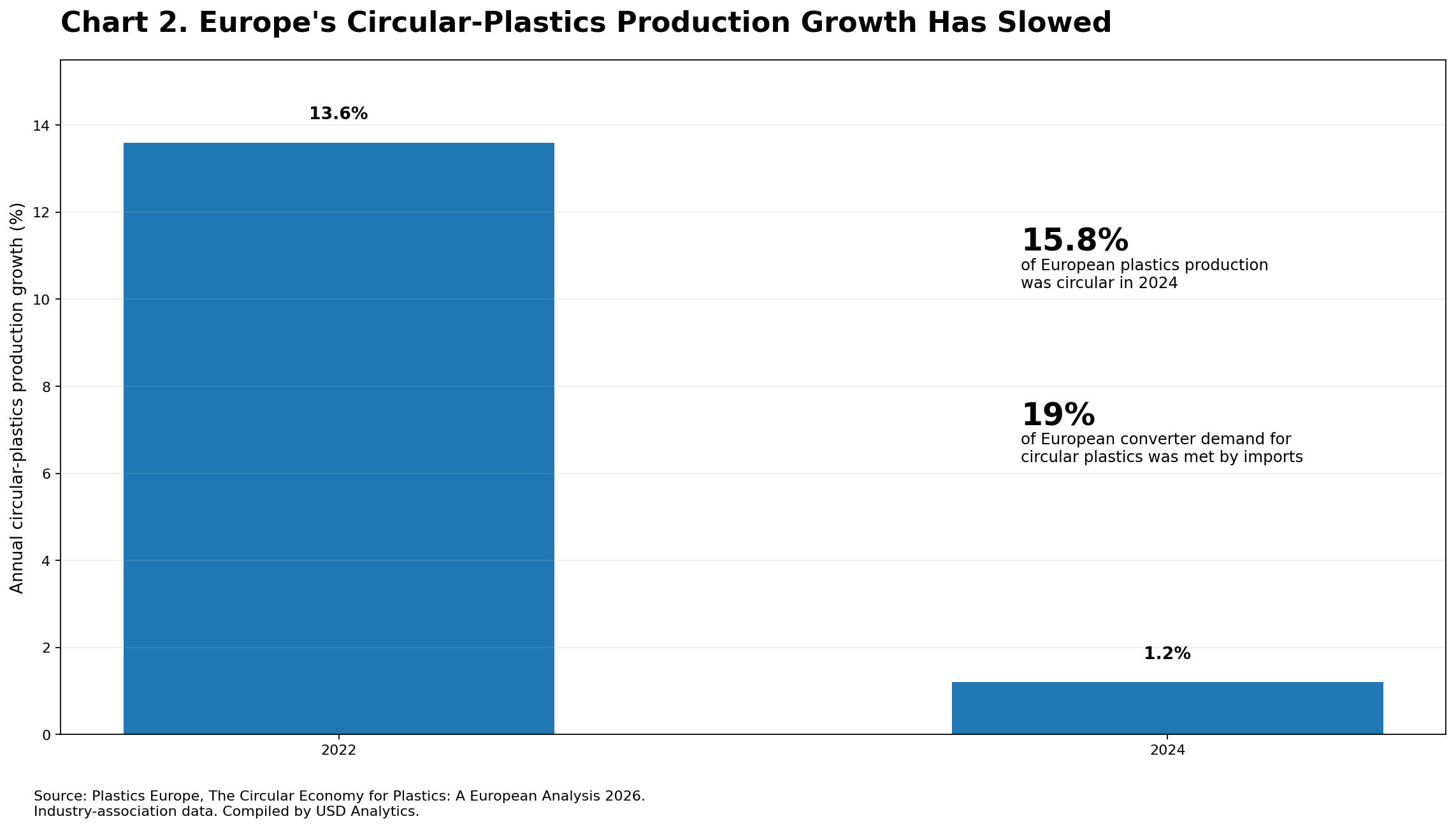
The recycled-content transition is occurring against a more difficult European supply backdrop. Plastics Europe reports that circular plastics represented 15.8% or 8.7 million tonnes of European plastics production in 2024, but annual growth in circular production slowed from 13.6% in 2022 to 1.2% in 2024. Circular-plastics demand growth at converters similarly fell from 16.2% to 4%. As an industry-association dataset, these figures should be treated as sector evidence rather than independent regulatory statistics.
The report also indicates that 19% of European converter demand for circular plastics was met through imports, while 12.4% of collected European plastic waste was recycled in other regions. Meanwhile, only 29.6% of collected plastic waste was recycled in 2024, with the remainder largely incinerated or landfilled. The tension is commercially important: PPWR is increasing regulatory pull for recycled material while Europe's circular resin-production growth has slowed sharply.
For polymer and additives suppliers, scarcity or variability in recycled feedstock can increase the value of formulations capable of accommodating broader PCR quality ranges. For converters and brand owners, it strengthens the case for designing structures that generate cleaner, higher-value recyclate because the quality of today's package waste increasingly affects tomorrow's feedstock availability.
Chart 2. Europe's Circular-Plastics Production Growth Has Slowed
Recyclability Performance Is Becoming an Economic Variable Through EPR Modulation
PPWR extends the materials-design issue into packaging economics through extended producer responsibility. The regulation explicitly identifies EPR fee modulation as an economic instrument capable of encouraging more easily recyclable packaging and requires harmonized criteria based on recyclability performance grades, while leaving actual fee amounts to the relevant schemes rather than establishing one EU-wide tariff.
This distinction is important. It would be misleading to publish a generic claim that a Grade A structure receives a fixed percentage discount or that Grade C packaging pays a universal EU penalty. What PPWR establishes is the mechanism: recyclability performance increasingly affects the producer's financial responsibility. That creates an economic pathway from chemical formulation to package recyclability and ultimately to total packaging cost.
The optimal material decision therefore cannot be evaluated solely through resin, adhesive or coating price per kilogram. A more realistic commercial assessment increasingly has to consider:
material cost + converting efficiency + package performance + product protection + recyclability grade + EPR exposure + PCR compatibility + qualification cost.
A higher-cost coating or adhesive can potentially create system-level value if it eliminates another structural layer, increases recyclability, preserves shelf life or improves secondary-material quality. Conversely, an apparently low-cost component can become expensive if it damages sortability or recyclate quality. This is an economic framework inferred from PPWR's design and EPR mechanisms rather than a statutory cost formula.
PPWR Turns Technical Documentation Into Part of the Materials Offering
The regulation also changes information flow across the packaging value chain. Compliance with recyclability requirements must be demonstrated through technical documentation, and manufacturers need information from material and component suppliers to support conformity. FEICA's June 2026 guidance specifically states that adhesive and sealant companies falling within the relevant PPWR manufacturer definition must conduct conformity assessment and prepare a Declaration of Conformity from the August 2026 application date, while clarifying roles and supply-chain information flows.
For chemical companies, this creates a less visible competitive dimension: regulatory evidence becomes part of product value. A supplier that can provide formulation information, substances documentation, recycling-test evidence, migration data where relevant, application guidance and confidentiality-compatible customer documentation may reduce the converter's compliance burden. FEICA explicitly emphasizes workable documentation, conformity requirements and case-by-case assessment for adhesives across plastics, paper and composite packaging.
EuPIA has made a comparable move for printing inks, publishing a dedicated PPWR customer information note in July 2026 ahead of the regulation's first application date. The emerging competitive model therefore extends beyond chemistry and price toward chemistry + application validation + recycling evidence + compliance support.
Mechanical Recycling Sets the Design Baseline, but Complex Waste Keeps Chemical Recycling Relevant
The direction of current design-for-recycling systems is clear: packaging should be compatible with established collection, sorting and material-recycling infrastructure wherever practical. PPWR's 2035 recycled-at-scale requirement reinforces that approach by demanding evidence that packaging is actually recycled through installed, proven processes—not only theoretically recyclable in laboratory conditions.
However, packaging functionality does not always permit immediate simplification into a clean mono-polymer stream. Multilayer structures, contaminated films and some mixed-material waste can remain difficult for mechanical recycling. Cefic consequently argues that PPWR sustainability criteria for recycling technologies should be technology-neutral so chemical recycling can complement mechanical processes for waste streams that cannot readily be handled mechanically. This is a chemical-industry policy position, not an EU determination that chemical recycling should replace mechanical recycling.
Economics remain a major constraint. A 2024 techno-economic study of pyrolysis for mixed engineering-plastics waste—not packaging waste calculated cost-covering minimum pyrolysis-oil sales prices ranging from €1,182 per tonne at 3,750 tonnes/year input capacity to €418 per tonne at 100,000 tonnes/year. The work found strong sensitivity to utilization, feedstock availability and output quality, demonstrating the scale economics of pyrolysis but not establishing a universal economic threshold for packaging recycling.
The implication for packaging designers is that chemical recycling should not be used as an excuse to ignore mechanical-recycling compatibility. Rather, the two pathways create a hierarchy of choices: simplify structures where performance permits; engineer coatings, adhesives and inks for established recycling streams; and retain complementary technologies for waste fractions whose functional complexity cannot yet be economically eliminated.
Manufacturer Activity Shows a Shift Toward Integrated Packaging-Material Systems
|
Company / Collaboration |
Verified Development |
Strategic Signal |
|---|---|---|
|
Dow + Valgroup |
95% PE coffee package designed for PE recycling |
Polymer architecture is replacing selected mixed-material functions |
|
Siegwerk + DG Press |
Mono-PE barrier-coated coffee pouch completed 36-week shelf-life testing against EVOH-containing reference |
Functional coatings can replace selected structural barrier layers |
|
UPM + BASF |
Recyclable barrier papers combined with waterborne Joncryl HPB coatings |
Fiber packaging increasingly relies on specialty barrier chemistry |
|
Sun Chemical |
RecyClass-approved solvent-free adhesives, including a gas-barrier adhesive |
Adhesives increasingly contribute both bonding and functional-barrier performance |
|
Sun Chemical |
PU-based NC-alternative inks combined with certified lamination adhesives |
Ink and adhesive are being commercialized as a recycling-compatible system |
|
Henkel |
PET-label hot melt reported removable by up to 98% in recycling |
End-of-life separation becomes an adhesive performance parameter |
|
Henkel Recyclab |
Industrial-style testing of paper, coatings and adhesives in recycling conditions |
Suppliers are adding package-level recycling validation capabilities |
Commercial Maturity Varies Across Packaging Formulation Pathways
The transition is likely to vary significantly across packaging applications. PE-rich and PP-rich structures are already commercially viable for a widening range of dry-food, household and selected flexible-packaging applications, while very demanding moisture, oxygen, aroma, retort, puncture or chemical-resistance requirements can still justify more complex material architectures. Current CEFLEX and RecyClass work itself illustrates this application dependency through conditional thresholds for EVOH, PA, coatings, adhesives and other components rather than treating all non-base-polymer materials as universally incompatible.
Fiber-based substitution follows a similar pattern. Thin dispersion barriers can improve repulpability compared with some laminate structures, but grease resistance, water resistance, sealing, food-contact performance and product shelf life must still be validated in the complete package. BASF and UPM's decision to continue third-party testing of their complete coated-paper structure demonstrates why ingredient-level recyclability cannot automatically be extrapolated to finished-packaging performance.
Strategic Priorities for Chemical Suppliers and Packaging Converters
Engineer the complete structure, not the individual chemistry
Material suppliers need to understand how polymers, coatings, adhesives, inks and labels interact during sorting and recycling. RecyClass and CEFLEX testing increasingly demonstrates that compatibility depends on material combinations and loading levels rather than one ingredient in isolation. Suppliers that can validate whole-package architectures should gain an advantage over companies selling only component-level performance.
Shift R&D toward multi-objective formulation
A barrier formulation can no longer be optimized only for OTR or moisture resistance; an adhesive cannot be judged only by peel strength; and an ink cannot be optimized only for color and printability. New formulations increasingly need to balance product protection, processability, material efficiency, recycling compatibility, PCR performance and regulatory compliance simultaneously. Current commercial developments from Siegwerk, Sun Chemical, BASF, UPM, Dow and Henkel illustrate this multi-objective approach.
Build PCR-performance capabilities before recycled-content demand peaks
The jump toward 50–65% recycled content in several plastic-packaging categories by 2040 will place increasing pressure on resin consistency and package aesthetics. Polymer suppliers, additive companies and compounders should therefore treat stabilization, compatibilization, odor management, color correction and process-window expansion as strategic platforms rather than secondary additives. The urgency is amplified by the current slowdown in European circular-plastics production growth.
Make regulatory documentation part of customer service
Converters and brand owners will need evidence to support technical documentation, declarations and future recyclability assessments. Suppliers that can provide structured composition information, substances evidence and recognized recyclability-test results can reduce customer qualification friction. FEICA's 2026 guidance shows this documentation burden already moving upstream into the adhesives supply chain.
Evaluate total packaging economics rather than material premium alone
PPWR's EPR modulation mechanism means materials should increasingly be assessed against the total economics of the finished package. A higher-priced barrier or adhesive can create value if it reduces package weight, removes an incompatible layer, protects shelf life, improves recyclability grade or generates cleaner recyclate. Conversely, a low-cost chemistry that compromises sorting or recycling can create downstream economic exposure.
Strategic Outlook: Packaging Simplification Will Increase the Value of Specialty Chemistry
PPWR is reshaping the packaging value chain in a way that appears paradoxical. The regulation encourages simpler, more recyclable packaging structures, but delivering the same shelf life, sealing performance, visual quality and manufacturing speed with fewer incompatible material layers requires more sophisticated chemistry at the remaining interfaces. Barrier coatings, engineered polymer grades, adhesives, inks, tie layers and additives therefore become more—not less—important as structural material diversity declines.
Recycled-content mandates reinforce the shift. From 2030 through 2040, packaging formulators will increasingly need to engineer structures not only to become recyclable but also to perform with higher proportions of recycled polymer. At the same time, Europe's circular plastics supply is not expanding at the pace implied by future regulatory demand, increasing the strategic importance of recyclate quality and feedstock efficiency.
The competitive advantage is therefore moving away from selling a polymer, coating, adhesive or ink solely on its individual performance. The higher-value proposition is becoming an application-engineered material platform supported by recyclability testing, converting knowledge, regulatory documentation and co-development with converters, recyclers and brand owners.
For chemical suppliers, PPWR should consequently be viewed not only as a compliance burden but as a reallocation of value within packaging materials. Chemistry that can remove a structural layer, increase PCR tolerance, improve separation, preserve recyclate quality or simplify compliance can capture strategic value even when the total package uses fewer materials.
Related Packaging Materials and Circular-Chemistry Research
Circular Packaging Market
Examines circular packaging systems focused on material recovery, recyclability, reuse and packaging designs intended to retain materials within closed-loop or circular value chains.
Sustainable Plastic Packaging Market
Examines sustainable plastic packaging formats and materials addressing recyclability, material efficiency, recycled-content integration and shifting environmental requirements across plastic packaging applications.
Flexible Plastic Packaging Market
Examines flexible plastic packaging formats relevant to PE- and PP-based structures, films, laminates and evolving material architectures used across consumer and industrial packaging applications.
Water Based Barrier Coatings Market
Examines water-based barrier coating technologies used to provide moisture, grease and other functional protection while reducing dependence on conventional laminated or less recycling-compatible barrier structures.
Flexible Packaging Adhesives Market
Examines adhesives used in flexible packaging structures, including laminating and bonding applications where adhesion performance increasingly intersects with recyclability and mono-material package design.
Laminating Adhesives Market
Examines adhesive systems used to bond multilayer substrates, including technologies relevant to flexible packaging conversion, solvent-free formulations and evolving recycling-compatible laminate structures.
Packaging Inks and Coatings Market
Examines inks and functional coatings used across packaging applications, directly aligning with PPWR-driven requirements around printing, barriers, recyclability, substrate compatibility and package performance.
Post Consumer Recycled Plastics Market
Examines plastics recovered from post-consumer waste and returned to material use, directly relevant to PPWR recycled-content mandates and growing demand for higher-performing PCR-based packaging formulations.
Assess Packaging Regulation, Formulation Risk and Circular-Materials Opportunities
Access customized intelligence covering PPWR exposure, design-for-recycling requirements, recycled-content impacts, mono-material packaging, barrier technologies, laminating adhesives, recycling-compatible inks, polymer additives, recyclate performance, supplier positioning and emerging circular-packaging opportunities.
Discuss Your Research Requirement | Packaging Materials
Key Government, Technical and Industry Authorities
European Commission / EUR-Lex — Regulation (EU) 2025/40, recyclability grades, recycled-content requirements, PFAS restrictions, technical documentation and extended producer responsibility.
European Commission Joint Research Centre — technical and economic assessment of recycling pathways and circular-material technologies.
RecyClass — design-for-recycling protocols, material-compatibility testing and certification across plastic-packaging recycling streams.
CEFLEX — flexible-packaging design, sortability and recyclability guidelines based on large-scale packaging testing.
FEICA — packaging-adhesive requirements, PPWR conformity guidance and adhesive behavior in recycling processes.
EuPIA — PPWR guidance for printing inks and technical evidence on ink behavior in plastic and fiber recycling.
Plastics Europe — European circular-plastics production, converter demand, recycling and trade indicators.
Cefic — chemical-industry analysis and policy positions on recycling technologies and circular-plastics regulation.