Market Overview: Sustainability and High-Performance Laminating Adhesives Drive Growth
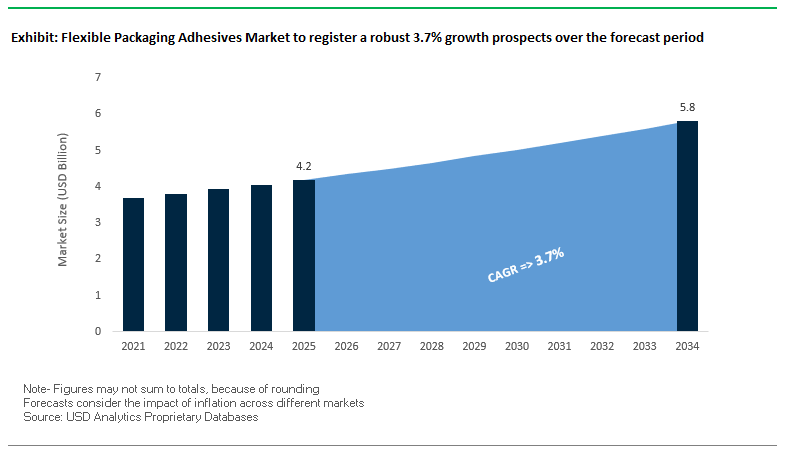
The Global Flexible Packaging Adhesives Market is projected to grow from USD 4.2 billion in 2025 to USD 5.8 billion by 2034, expanding at a CAGR of 3.7%. This market is an essential enabler of the flexible packaging industry, ensuring strong and durable bonding across diverse substrates such as films, foils, and papers. Flexible packaging adhesives are vital for creating lightweight, protective, and visually appealing packaging formats that dominate the food, beverage, personal care, and pharmaceutical sectors.
The industry is undergoing a major transformation driven by sustainability, regulatory compliance, and performance requirements. Global brands and converters are shifting toward water-based and solvent-free adhesives, reducing dependency on VOC-based solutions and aligning with stricter environmental standards. At the same time, laminating adhesives for retort pouches and barrier packaging remain a growth driver, as they provide food safety and longer shelf life for high-demand categories such as ready-to-eat meals and protein products.
Another critical area of innovation is compatibility with mono-material structures, which enable recyclability of flexible packaging. Adhesive suppliers are working closely with packaging converters to create recycle-ready solutions that maintain performance while simplifying end-of-life disposal. The rise of e-commerce packaging is also pushing demand for high-tack, fast-curing adhesives that can withstand shipping pressures, vibrations, and fluctuating humidity conditions.
Key Insights for Industry Professionals:
Market value to rise from USD 4.2B (2025) → USD 5.8B (2034), CAGR 3.7%.
Water-based and solvent-free adhesives gaining momentum due to VOC regulations.
Retort packaging adhesives critical for extending food shelf life and safety.
E-commerce growth driving demand for high-tack, fast-curing adhesive solutions.
Market Analysis: Recent Developments in the Flexible Packaging Adhesives Industry
The Flexible Packaging Adhesives Industry is highly dynamic, with innovation and consolidation shaping its competitive direction. Recent developments reflect a strong focus on sustainability, recyclable solutions, and strategic acquisitions.
In September 2025, Henkel Adhesive Technologies announced new recyclable and CO₂-reducing adhesive solutions at the FACHPACK 2025 event, reinforcing its leadership in sustainable innovation. Earlier in July 2025, Henkel launched Loctite Liofol LA 7837/LA 6265, a solvent-free adhesive designed for retort packaging applications, addressing food safety, recyclability, and performance needs simultaneously.
Also in July 2025, two significant mergers reshaped the packaging sector. The Amcor–Berry Global merger created a global packaging leader with increased strength in flexibles and laminations, while the Smurfit Kappa–WestRock merger consolidated the paper-based packaging sector, indirectly influencing adhesives demand for fiber-based flexible formats. Another report in the same month highlighted surging demand for laminating adhesives in the Asia Pacific region, fueled by food and beverage industry growth.
Earlier, in December 2024, Bostik (Arkema Group) finalized the acquisition of Dow’s flexible packaging adhesives business, expanding its global presence and product portfolio. In September 2024, Bostik, Dow, and Nordson launched Kizen™ LIME, a bio-based hot melt adhesive designed for recyclable FMCG paper and cardboard packaging, marking a strong move toward renewable ingredients.
Beyond product innovation, challenges remain. A report from March 2024 highlighted how rising raw material costs linked to petrochemical volatility reduced adhesive production capacity by about 6%, underscoring the importance of procurement optimization and supply chain resilience.
Transformative Trends and High-Value Opportunities Shaping the Global Flexible Packaging Adhesives Market
Rapid Adoption of Non-Isocyanate Polyurethane (NIPU) Adhesives
The flexible packaging adhesives market is witnessing a rapid adoption of non-isocyanate polyurethane (NIPU) adhesives, driven by stringent regulatory pressure on worker safety and chemical migration. NIPU adhesives eliminate toxic isocyanate monomers present in traditional PU adhesives, addressing workplace sensitization risks and potential migration into food products while maintaining high-performance standards for packaging applications. This trend is fueled by increasing regulatory requirements, particularly in the EU, targeting the migration of harmful substances like primary aromatic amines (PAAs). Leading manufacturers are investing heavily in NIPU technology, developing adhesives suitable for flexible food packaging applications that require heat resistance and compliance with stringent safety standards. Research into NIPUs derived from cyclic carbonates using CO₂ as a building block exemplifies eco-friendly innovation in this space, supporting both sustainability goals and product safety. The rise of NIPU adhesives represents a significant growth avenue, offering safer alternatives for workers, streamlining production, and aligning with global sustainability initiatives.
Development of Functional Adhesives for Mono-Material Packaging Structures
As the flexible packaging sector pivots to mono-material structures (such as all-PE or all-PP) to enhance recyclability, adhesive manufacturers are innovating functional adhesives that enhance overall package performance. These adhesives not only bond materials but also improve barrier properties against oxygen and moisture or serve as tie-layers between specific polyolefin grades, all while remaining compatible with recycling streams. Companies like Toppan are developing mono-material barrier packaging, while other global adhesives firms offer products approved by the RecyClass initiative, directly contributing to package recyclability. This trend is reshaping the value chain, requiring collaboration among raw material suppliers, adhesive manufacturers, and packaging converters to deliver seamless, recyclable solutions. Functional adhesives for mono-material structures provide a high-value growth opportunity, particularly in food and beverage packaging where regulatory and sustainability pressures are mounting.
Bio-Based Adhesives Sourced from Industrial Side Streams
A major opportunity in the flexible packaging adhesives market lies in bio-based adhesives derived from industrial side streams, such as agricultural waste or wood pulp byproducts. These adhesives reduce reliance on petroleum-based materials, improve lifecycle assessments, and align with corporate carbon reduction goals. Research has demonstrated that adhesives produced from lignin and other industrial waste streams can achieve high performance while maintaining sustainability. Companies are actively commercializing these solutions, offering eco-friendly, functional adhesives that appeal to environmentally conscious brands and consumers. The development of bio-based adhesives provides a significant growth avenue, positioning manufacturers at the forefront of sustainable innovation in flexible packaging.
Adhesives Designed for Advanced Recycling Compatibility
With the rise of chemical and advanced recycling technologies, there is an emerging need for adhesives that do not contaminate or poison catalysts used in pyrolysis or depolymerization processes. Adhesives engineered to break down cleanly or remain compatible with purification processes enable the circular economy for complex flexible packaging. Companies are developing solutions to ensure safe and effective recycling, addressing challenges posed by multi-material composites that cannot be processed via traditional mechanical recycling. This innovation represents a high-value growth opportunity, fostering collaboration between adhesive manufacturers, chemical recyclers, and waste management companies. By enabling fully recyclable flexible packaging, these adhesives support regulatory compliance, reduce landfill waste, and enhance overall sustainability throughout the supply chain.
Competitive Landscape: Innovation and Strategic Moves by Key Players
The Global Flexible Packaging Adhesives Market is defined by leading chemical and packaging companies leveraging material science, sustainability, and acquisitions to strengthen their competitive edge.
Henkel AG & Co. KGaA leads with solvent-free adhesive systems
Henkel remains a global leader in adhesive technologies, offering a wide range of polyurethane, water-based, and solvent-based laminating adhesives. In July 2025, it launched Loctite Liofol LA 7837/LA 6265, a solvent-free adhesive system for retort packaging. With initiatives like its Packaging RecycLab, Henkel is helping converters design recyclable solutions. Its strategy is centered on sustainability, VOC reduction, and customer-driven innovation.
H.B. Fuller is known for its Flextra® brand, offering solvent-free and solvent-based laminating adhesives approved by RecyClass for recyclability. The company is investing in compostable adhesives that fully decompose without leaving microplastics or toxins. By focusing on innovation and targeted acquisitions, H.B. Fuller is expanding its presence across packaging, electronics, and automotive markets, reinforcing its position as a global adhesive leader.
Arkema strengthens position with Bostik acquisition of Dow adhesives
Arkema Group, through Bostik, has enhanced its footprint in flexible packaging adhesives. The December 2024 acquisition of Dow’s laminating adhesives business expanded its technological portfolio and market reach. Its Kizen™ LIME bio-based hot melt adhesive, launched in partnership with Dow and Nordson, underscores Arkema’s commitment to renewable materials and recyclability. Arkema is focusing on solvent-free, APEO-free, and food-safe adhesives for sustainable growth.
The Dow Chemical Company develops polyolefin-based mono-material solutions
Dow leverages its materials science expertise to develop adhesive solutions enabling mono-material flexible packaging, critical for recycling. Its collaboration with Bostik and Nordson in September 2024 delivered a bio-based hot melt adhesive for FMCG packaging. Dow is also advancing polyolefin elastomers to improve recyclability. Its strategy emphasizes partnerships, innovation, and enabling the circular economy across the packaging value chain.
3M Company applies bonding expertise to flexible packaging
3M brings its materials science capabilities to specialized adhesive applications. While not a dominant laminating adhesives player, its pressure-sensitive adhesive films and transfer tapes serve critical roles in packaging and industrial bonding. 3M has also developed optically clear adhesives (OCAs) for electronics, demonstrating its versatility. The company’s focus lies in leveraging core technologies for sustainability, high-performance bonding, and cross-industry applications.
Food & Beverage Applications Dominate Market Share by Application in Flexible Packaging Adhesives
The food and beverage sector accounts for 65% of demand in the flexible packaging adhesives industry, highlighting its role as the primary growth driver. Adhesives here must ensure robust laminate bonding that can withstand moisture, oxygen, and aroma ingress, directly impacting product shelf life and food safety. From coffee and snacks to sauces and pet food, adhesives are the unseen backbone of packaging integrity. The segment is also leading sustainability innovation, with brand owners pushing for recyclable mono-material laminates that require advanced adhesive chemistries. As consumer packaged goods companies intensify their focus on lightweighting and eco-friendly formats, adhesives tailored for F&B packaging will remain dominant.
Polyethylene and Polypropylene Lead Market Share by Material in Flexible Packaging Adhesives
Polyethylene (PE) and Polypropylene (PP) together account for nearly two-thirds of material use in the flexible packaging adhesives market, reflecting their unmatched versatility, low cost, and compatibility with high-speed packaging lines. PE is the standard choice for sealing layers due to its excellent moisture barrier properties, while PP provides stiffness, heat resistance, and recyclability. Their dominance is reinforced by the industry’s strategic pivot toward mono-material PE and PP laminates, which enable circular economy compliance under EU and North American recycling mandates. While PET and PA play critical roles as high-barrier layers, the scale and adaptability of PE and PP ensure they remain the material leaders in adhesive-laminate systems.
United States Flexible Packaging Adhesives Market Accelerated by Low-VOC Innovations and Sustainability Trends
The U.S. flexible packaging adhesives technology market is navigating a fragmented regulatory landscape, with new EPA regulations targeting reductions in volatile organic compound (VOC) emissions. This shift has accelerated the adoption of water-based and other low-VOC adhesive technologies, driving innovation across the industry. Recent developments include solvent-free, aliphatic adhesive systems tailored for high-thermal stress applications, such as retort packaging. In September 2025, Advanced Flexible Packaging Solutions launched a new adhesive specifically for medical applications, offering superior bonding while maintaining biocompatibility.
Corporate investments are bolstering market growth, with Sonoco Products Co. committing $30 million to expand sustainable adhesive packaging production by 100 million units, focusing on flexible formats for the food industry. Key applications include food and beverage, pharmaceutical, and e-commerce sectors, driven by rising demand for lightweight, convenient packaging and tamper-evident seals. Sustainability remains central, with eco-friendly materials, bio-based polymers, and circular solutions—like Avery Dennison’s recyclable RFID labels—enhancing the environmental footprint of flexible packaging adhesives.
Germany Flexible Packaging Adhesives Market Shaped by Circular Economy Leadership and Regulatory Compliance
Germany’s flexible packaging adhesives market operates under strict European Union regulations, including the Packaging and Packaging Waste Regulation (PPWR), which mandates reduced packaging waste through reuse and recycling while phasing out chemicals such as PFAS. Technological innovations, such as machinery capable of handling sustainable materials and digital product passports, are enabling better material transparency and recycling efficiency.
Germany’s Extended Producer Responsibility (EPR) system encourages companies to design adhesives and packaging that are easier to recycle through modulated fees. Strategic partnerships between film producers and brand owners are fostering high-performance, customized flexible packaging solutions. Key applications include the food, beverage, and personal care sectors, where premium adhesives and high-barrier films enhance shelf life while meeting consumer expectations for sustainable, high-quality packaging.
China Flexible Packaging Adhesives Market Expanded by Green Policies and Domestic Manufacturing Initiatives
China’s flexible packaging adhesives market is strongly influenced by the government’s “dual carbon” goal and the March 2024 Action Plan for Large-Scale Equipment Updates and Consumer Goods Replacement, which promote recycling and sustainable materials adoption. Regulatory reforms, including the National Food Safety Standard for Adhesives in Food Contact Materials (GB 4806.15-2024), enforce strict migration limits to ensure food safety.
Technological advancements, including AI, 5G-enabled industrial internet integration, and automation, are improving production efficiency and flexible manufacturing capacity. A domestic focus on substituting imported technology is driving local production expansion. The market’s growth is fueled by rapid e-commerce, automotive, and electronics sectors, with high-volume demand for packaging and digital printing applications for high-end cosmetics and electronic product boxes.
India Flexible Packaging Adhesives Market Driven by Circular Economy Initiatives and Local Manufacturing Growth
India’s flexible packaging adhesives market is benefiting from government initiatives promoting a circular economy, including the Food Safety and Standards (Packaging) Regulations, 2018, which mandate food-grade material usage while prohibiting recycled plastics for food contact. Technological adoption is rising, with companies developing automated and solvent-free solutions. Brilliant Polymers achieved 72% solvent-free sales in 2025 and introduced five new solvent-free adhesive innovations for foil lamination and bulk packaging.
Corporate investments are strengthening market capacity, with UFlex operating over 100,000 TPA and investing in four R&D laboratories approved by the Ministry of Industries. Key applications include the food and beverage and personal care sectors, driven by growing e-commerce and the shift toward sustainable solutions. The “Make in India” initiative further encourages domestic production and technological development, reinforcing India’s role as a major player in flexible packaging adhesives.
Japan Flexible Packaging Adhesives Market Leading with Advanced High-Performance Films and Circularity Initiatives
Japan’s flexible packaging adhesives market leverages advanced precision manufacturing and sustainability-focused innovations. In September 2024, Toppan Inc., in collaboration with RM Tohcello Co. Ltd. and Mitsui Chemicals Inc., developed recycled BOPP film suitable for flexible packaging adhesives, exemplifying a push toward circularity. Regulatory guidance under the Plastic Resource Circulation Act (April 2022) promotes environmental design and reduces single-use plastics, targeting 2 million tonnes per year of bio-based plastics by 2030, influencing adhesives for these materials.
High-performance films with superior barrier properties, IoT-enabled tracking, and digital printing for sensor placement are transforming functionality in flexible packaging adhesives. Innovations such as easy-open tear notches and resealable closures cater to aging populations and single-person households, enhancing usability. Strategic mergers and acquisitions, like Sika AG’s acquisition of Hamatite from Yokohama Rubber Co., have strengthened market capabilities, particularly in automotive and construction segments, solidifying Japan’s position as a technology leader in flexible packaging adhesives.
Flexible Packaging Adhesives Market Report Scope
Flexible Packaging Adhesives Market
Parameter
Details
Market Size (2025)
$4.2 Billion
Market Size (2034)
$5.8 Billion
Market Growth Rate
3.7%
Segments
By Adhesive Technology (Solvent-Based, Water-Based, Hot-Melt, Solvent-less, Others), By Application (Food & Beverage Packaging, Pharmaceutical Packaging, Personal Care & Hygiene Packaging, Industrial Packaging, Others), By Material (Polyethylene, Polypropylene, PET, Polyamide, Others)
Study Period
2019- 2024 and 2025-2034
Units
Revenue (USD)
Qualitative Analysis
Porter’s Five Forces, SWOT Profile, Market Share, Scenario Forecasts, Market Ecosystem, Company Ranking, Market Dynamics, Industry Benchmarking
Companies
Henkel AG & Co. KGaA, H.B. Fuller Company, Dow Inc., Arkema S.A., 3M Company, Sika AG, DIC Corporation, Toyochem Co., Ltd., Bostik S.A., Ashland Inc., Dymax Corporation, Delo Industrial Adhesives, Mactac Americas, Jowat SE, Lord Corporation
Countries
US, Canada, Mexico, Germany, France, Spain, Italy, UK, Russia, China, India, Japan, South Korea, Australia, South East Asia, Brazil, Argentina, Middle East, Africa
Europe (Germany, UK, France, Spain, Italy, Russia, Rest of Europe)
Asia Pacific (China, India, Japan, South Korea, Australia, South East Asia, Rest of Asia)
South America (Brazil, Argentina, Rest of South America)
Middle East and Africa (Saudi Arabia, UAE, Rest of Middle East, South Africa, Egypt, Rest of Africa)
Top Companies in Flexible Packaging Adhesives Market
Henkel AG & Co. KGaA
H.B. Fuller Company
Dow Inc.
Arkema S.A.
3M Company
Sika AG
DIC Corporation
Toyochem Co., Ltd.
Bostik S.A.
Ashland Inc.
Dymax Corporation
Delo Industrial Adhesives
Mactac Americas
Jowat SE
Lord Corporation
* List Not Exhaustive
Methodology
USDAnalytics conducted an exhaustive, multi-faceted analysis of the Global Flexible Packaging Adhesives Market by integrating primary and secondary research, quantitative modeling, and qualitative insights. Our methodology included in-depth interviews with adhesive manufacturers, packaging converters, sustainability specialists, and regulatory experts, combined with analysis of corporate reports, trade journals, patent filings, and government regulations. We evaluated market growth across adhesive technologies, applications, and material types, focusing on trends such as water-based and solvent-free solutions, non-isocyanate polyurethane (NIPU) adhesives, bio-based formulations, and mono-material compatibility for recyclable packaging. The methodology also incorporated regional market dynamics, assessing regulatory frameworks like the EU’s VOC and EPR mandates, U.S. EPA guidelines, and China’s dual carbon policies, alongside strategic corporate activities, mergers, and technological innovations from leaders including Henkel, H.B. Fuller, Arkema, and Dow. By combining market sizing, growth forecasts, sustainability and compliance analysis, and innovation tracking, USDAnalytics delivers actionable insights for industry professionals seeking to optimize strategy, adopt advanced adhesive technologies, and align with evolving regulatory and sustainability trends in flexible packaging adhesives.
Deliverables:
Comprehensive Market Research Report (PDF and Excel) with detailed tables, charts, and interactive visualizations.
Country-Specific Forecasts & Analysis.
Segment-Wise Revenue Forecasts (2025–2034).
Competitive Analysis, Benchmarking, and SWOT Profiles.
Recent Developments & Innovation Tracker.
Executive Summary & Analyst Commentary.
Post-Purchase Analyst Support for Client-Specific Questions and Custom Data Requirements.
Table of Contents: Flexible Packaging Adhesives Market
1. Executive Summary
1.1. Market Highlights
1.2. Key Findings
1.3. Global Market Snapshot
2. Flexible Packaging Adhesives Market Landscape & Outlook (2025–2034)
2.1. Introduction to Flexible Packaging Adhesives Market
2.2. Market Valuation and Growth Projections (2025–2034)
2.3. Market Dynamics and Drivers
2.4. Challenges and Restraints
2.5. Regulatory and Compliance Overview
3. Innovations Reshaping the Flexible Packaging Adhesives Market
3.1. Trend: Rapid Adoption of Non-Isocyanate Polyurethane (NIPU) Adhesives
3.2. Trend: Development of Functional Adhesives for Mono-Material Packaging Structures
3.3. Opportunity: Bio-Based Adhesives Sourced from Industrial Side Streams
3.4. Opportunity: Adhesives Designed for Advanced Recycling Compatibility
4. Competitive Landscape and Strategic Initiatives
4.1. Mergers, Acquisitions and Strategic Alliances
4.2. R&D and Material Innovation
4.3. Sustainability and Strategies
4.4. Market Expansion and Regional Focus
5. Market Share and Segmentation Insights: Flexible Packaging Adhesives Market
5.1. By Adhesive Technology
5.1.1. Solvent-Based
5.1.2. Water-Based
5.1.3. Hot-Melt
5.1.4. Solvent-less
5.1.5. Others
5.2. By Application
5.2.1. Food & Beverage Packaging
5.2.2. Pharmaceutical Packaging
5.2.3. Personal Care & Hygiene Packaging
5.2.4. Industrial Packaging
5.2.5. Others
5.3. By Material
5.3.1. Polyethylene (PE)
5.3.2. Polypropylene (PP)
5.3.3. PET
5.3.4. Polyamide (PA)
5.3.5. Others
6. Country Analysis and Outlook of Flexible Packaging Adhesives Market
6.1. United States
6.2. Canada
6.3. Mexico
6.4. Germany
6.5. France
6.6. Spain
6.7. Italy
6.8. UK
6.9. Russia
6.10. China
6.11. India
6.12. Japan
6.13. South Korea
6.14. Australia
6.15. South East Asia
6.16. Brazil
6.17. Argentina
6.18. Middle East
6.19. Africa
7. Flexible Packaging Adhesives Market Size Outlook by Region (2025–2034)
7.1. North America Market Size Outlook to 2034
7.1.1. By Adhesive Technology
7.1.2. By Application
7.1.3. By Material
7.2. Europe Market Size Outlook to 2034
7.2.1. By Adhesive Technology
7.2.2. By Application
7.2.3. By Material
7.3. Asia Pacific Market Size Outlook to 2034
7.3.1. By Adhesive Technology
7.3.2. By Application
7.3.3. By Material
7.4. South America Market Size Outlook to 2034
7.4.1. By Adhesive Technology
7.4.2. By Application
7.4.3. By Material
7.5. Middle East and Africa Market Size Outlook to 2034
7.5.1. By Adhesive Technology
7.5.2. By Application
7.5.3. By Material
8. Company Profiles: Leading Players in the Flexible Packaging Adhesives Market
8.1. Henkel AG & Co. KGaA
8.2. H.B. Fuller Company
8.3. Dow Inc.
8.4. Arkema S.A.
8.5. 3M Company
8.6. Sika AG
8.7. DIC Corporation
8.8. Toyochem Co., Ltd.
8.9. Bostik S.A.
8.10. Ashland Inc.
8.11. Dymax Corporation
8.12. Delo Industrial Adhesives
8.13. Mactac Americas
8.14. Jowat SE
8.15. Lord Corporation
9. Methodology
9.1. Research Scope
9.2. Market Research Approach
9.3. Market Sizing and Forecasting Model
9.4. Research Coverage
9.5. Data Horizon
9.6. Deliverables
10. Appendix
10.1. Acronyms and Abbreviations
10.2. List of Tables
10.3. List of Figures
Flexible Packaging Adhesives Market Segmentation
By Adhesive Technology
Solvent-Based
Water-Based
Hot-Melt
Solvent-less
Others
By Application
Food & Beverage Packaging
Pharmaceutical Packaging
Personal Care & Hygiene Packaging
Industrial Packaging
Others
By Material
Polyethylene
Polypropylene
PET
Polyamide
Others
Countries Analyzed
North America (US, Canada, Mexico)
Europe (Germany, UK, France, Spain, Italy, Russia, Rest of Europe)
Asia Pacific (China, India, Japan, South Korea, Australia, South East Asia, Rest of Asia)
South America (Brazil, Argentina, Rest of South America)
Middle East and Africa (Saudi Arabia, UAE, Rest of Middle East, South Africa, Egypt, Rest of Africa)
Growth is fueled by rising demand for sustainable, recyclable, and bio-based adhesives, alongside the need for high-performance bonding in food, beverage, personal care, and pharmaceutical packaging. Mono-material compatibility and e-commerce-driven high-tack, fast-curing adhesives further accelerate market expansion.
Non-isocyanate polyurethane (NIPU) adhesives eliminate toxic isocyanates, reducing workplace hazards and chemical migration into food products. They provide heat resistance and high-performance bonding while supporting sustainability goals, regulatory compliance, and eco-friendly packaging initiatives.
Functional adhesives for mono-material structures enhance recyclability, improve barrier properties, and act as tie-layers between polyolefins. These adhesives enable fully recyclable laminates without compromising packaging integrity, offering critical solutions for food and beverage sustainability requirements.
Bio-based adhesives, derived from industrial side streams such as lignin or agricultural waste, reduce reliance on petroleum-based chemicals and lower carbon footprint. They maintain high bonding performance while supporting circular economy objectives and meeting growing brand and consumer demand for eco-friendly packaging.
The U.S. market emphasizes low-VOC, solvent-free solutions driven by EPA regulations, while Germany leads in circular economy compliance and high-performance adhesives. China focuses on domestic manufacturing with AI-driven production, and Japan prioritizes advanced films, IoT integration, and digital printing for functional, sustainable adhesive applications.