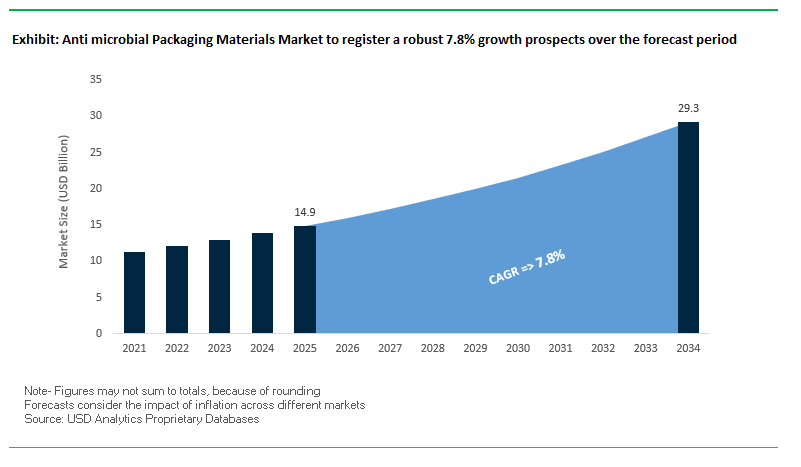
The Global Antimicrobial Packaging Materials Market is projected to grow from $14.9 billion in 2025 to $29.3 billion by 2034, registering a CAGR of 7.8%. Rising concerns over foodborne illnesses, healthcare-associated infections, and global food waste are fueling demand for packaging materials embedded with antimicrobial properties. These solutions extend the shelf life of perishables, enhance consumer safety, and align with growing sustainability goals.
In the food sector, antimicrobial packaging is being adopted to tackle the pressing challenge of food waste, which accounts for nearly one-third of global food production losses. Meanwhile, in healthcare, the technology is essential for sterile packaging of medical devices, drugs, and surgical instruments, reducing the risks of cross-contamination and infections.
Plastics dominate the market due to their barrier performance and versatility, but the focus is shifting toward bio-based and recyclable plastics enhanced with antimicrobial agents. At the same time, natural antimicrobial agents such as essential oils and plant extracts are becoming popular, driven by consumer preference for chemical-free and natural additives.
Key Insights for Industry Professionals
Food Safety Priority: Antimicrobial packaging reduces spoilage and contamination while extending shelf life.
Healthcare Reliance: Essential for sterile packaging of pharmaceuticals, devices, and surgical supplies.
Plastics Lead, but Greener Alternatives Emerge: Integration of antimicrobial properties into bio-based plastics is on the rise.
Natural Agents Gain Traction: Essential oils and plant-based extracts are increasingly replacing synthetic additives.
Market Analysis: Recent Industry Developments
The antimicrobial packaging industry has witnessed significant developments, reflecting the convergence of sustainability, healthcare innovation, and food safety. In August 2025, Constantia Flexibles invested over €100 million to upgrade its global production network, emphasizing high-performance packaging solutions for food and pharmaceuticals that could integrate antimicrobial agents. Similarly, in July 2025, Huhtamaki launched compostable and recyclable ice cream cups, strengthening its sustainable portfolio with potential for antimicrobial applications.
Material innovation is also driving momentum. Pregis, in May 2025, expanded blown film operations to add capacity for EVOH barrier films, enhancing antimicrobial integration for food packaging. Earlier in June 2024, Mondi and Saga Nutrition unveiled a sustainable pet food packaging solution, while Saica Group and Mondelez collaborated on recyclable paper multipacks for chocolates and confectionery. Both initiatives reflect rising demand for eco-friendly antimicrobial-ready materials.
Several key milestones highlight the technology’s evolution. Berry Global partnered with Pylote in March 2022 to develop eye-drop packaging with antimicrobial protection, leveraging mineral-based chemistry. COEXPAN introduced its COEXSHIELD antimicrobial tray in November 2021, offering antibacterial mono-material packaging. Likewise, Toppan Printing’s Virusweeper, launched in March 2021, incorporated antiviral and antibacterial films, underscoring the innovation potential in the sector.
Transformative Trends and Emerging Opportunities Shaping the Anti-Microbial Packaging Materials Market
Strategic Integration of Natural and Organic Antimicrobial Agents
The anti-microbial packaging materials market is witnessing a robust shift towards natural and organic antimicrobial agents, driven by growing consumer demand for “clean-label” products and increased regulatory scrutiny of synthetic additives. Material developers are embedding plant-derived compounds such as essential oils, bacteriocins, and chitosan directly into polymer matrices or as functional coatings. Nielsen surveys indicate that over 75% of global consumers are willing to pay a premium for clean-label products, highlighting strong market demand. Scientific research confirms that essential oils from oregano and thyme, when integrated into packaging films, significantly inhibit spoilage bacteria in meat, while chitosan effectively reduces microbial growth on fruits. Regulatory bodies, including the U.S. FDA and EFSA, support the use of approved natural preservatives like ε-poly-L-lysine and nisin, easing their adoption in active packaging systems designed for direct food contact. This trend enhances both product safety and shelf life while aligning with sustainability and consumer trust.
Development of Non-Migratory, Surface-Bound Antimicrobial Technologies
To address regulatory concerns and consumer preference for non-leaching solutions, the industry is innovating non-migratory, surface-bound antimicrobial technologies. Advanced R&D focuses on photocatalytic materials, such as titanium dioxide (TiO2), and covalently bonded antimicrobial agents to polymer surfaces. According to USDA research, ultraviolet light-initiated graft polymerization can permanently bond chelating agents to packaging films, preventing chemical migration into food. TiO2-based coatings generate reactive oxygen species upon light exposure, providing continuous, long-lasting antimicrobial activity without releasing chemicals into the product. These innovations offer regulatory compliance, enhanced safety, and a durable antimicrobial effect, positioning packaging manufacturers to meet evolving market expectations for safe, active packaging.
Application in Active Healthcare and Medical Device Packaging to Reduce HAIs
A significant market opportunity lies in healthcare and medical device packaging, focusing on reducing Hospital-Acquired Infections (HAIs) through antimicrobial surfaces. Academic studies emphasize that preventing microbial colonization and biofilm formation on sterile barrier packaging, IV bags, and device trays can inhibit pathogens like MRSA and Clostridium difficile. Companies such as Trinity Medical Devices are partnering with healthcare institutions to commercialize antimicrobial surfaces for critical touchpoints, including bed covers and privacy curtains. By integrating these materials, healthcare providers can enhance infection control protocols, demonstrating a compelling application for high-value, hospital-focused packaging solutions.
An emerging opportunity is the integration of antimicrobial functionality with end-of-life sustainability. Embedding natural antimicrobial agents into certified compostable polymers such as PLA, PBAT, or PHA can extend the shelf life of fresh food while minimizing persistent plastic waste. Research demonstrates that PLA/PBAT films containing ε-poly-L-lysine effectively inhibit Staphylococcus aureus growth and prolong banana shelf life. Addressing food waste is critical, as the UNEP estimates 1.3 billion tons of food are lost globally each year. Biodegradable antimicrobial packaging offers a dual advantage: enhancing food safety and supporting sustainability goals, creating a strong value proposition for brands targeting eco-conscious consumers.
Competitive Landscape: Leading Companies in Global Antimicrobial Packaging Materials
The antimicrobial packaging materials market is defined by a mix of chemical giants, packaging leaders, and material innovators. Their strategies center on sustainable innovation, bio-based integration, and expanding healthcare and food applications.
BASF SE: Advancing Fresh Produce Packaging with ChemCycling
BASF provides advanced antimicrobial additives and coatings for food and healthcare packaging. In 2022, it partnered with StePac to deliver contact-sensitive antimicrobial packaging for fresh produce using its ChemCycling technology. BASF focuses on high-performance solutions that are both sustainable and compliant with food safety standards. Its offerings include functional coatings and additives for paperboard and plastic packaging, making it a key innovator in the industry.
Berry Global Group, Inc.: Driving Plastic-Based Antimicrobial Solutions
Berry Global is a major player in plastic packaging, offering solutions tailored to food and healthcare markets. In 2022, it partnered with Pylote to create multi-dose eye-drop packaging with antimicrobial mineral protection. With over 265 global facilities, Berry Global leverages its extensive scale to deliver tailored antimicrobial packaging solutions. Its global presence and integrated business model make it a one-stop supplier for customers worldwide.
Mondi Group: Combining Sustainability with High-Barrier Innovation
Mondi is a leader in paper and flexible packaging solutions, driving innovation in sustainable antimicrobial-ready packaging. In 2022, it developed a mono-material PP barrier pack for Handl Tyrol’s bacon, highlighting its material-neutral approach. Mondi’s vertical integration from forest management to paper and packaging development ensures control over quality, sustainability, and innovation, making it a reliable partner for antimicrobial packaging development.
Amcor plc: Scaling Recycling and High-Barrier Packaging Solutions
Amcor is a global leader in flexible and rigid plastic packaging with a focus on high-barrier films and pouches. In August 2025, it upgraded its Heanor recycling facility in the UK to scale recyclate production for antimicrobial packaging. Amcor’s strategy targets sustainability, with commitments to make all packaging recyclable or reusable by 2025. Its flagship AmLite Recyclable product line provides lightweight, barrier packaging that aligns with antimicrobial innovation trends.
Anti microbial Packaging Materials Market Share Insights
Metallic Nanoparticles Dominate Market Share by Antimicrobial Agent
Metallic nanoparticles, particularly silver, zinc oxide, and copper, account for 35% of the antimicrobial packaging materials market, reflecting their broad-spectrum antimicrobial activity, high thermal and chemical stability, and long-lasting efficacy. Their integration into polymer films, coatings, and multilayer packaging structures has made them the benchmark solution for food, beverage, and healthcare applications where microbial resistance is non-negotiable. This dominance is reinforced by regulatory acceptance in multiple regions and ongoing research into nano-enabled packaging that prolongs shelf-life and ensures consumer safety. Organic acids follow with strong penetration in meat, seafood, and dairy packaging due to their cost efficiency and GRAS (Generally Recognized as Safe) status. Meanwhile, essential oils are accelerating as the leading natural alternative, tapping into consumer preference for plant-derived active packaging solutions. Though bacteriocins and enzymes remain niche, their precision antimicrobial activity positions them for premium, safety-critical applications.
Films Lead Market Share by Application in Antimicrobial Packaging
Films represent the largest application at 30%, cementing their role as the most versatile antimicrobial packaging solution. Widely used to wrap fresh produce, meat, and bakery products, films act as a frontline defense against microbial spoilage and foodborne pathogens. Their ability to incorporate antimicrobial agents either directly into the polymer matrix or as surface coatings makes them indispensable across high-volume food categories. Bags and pouches closely follow, propelled by the global boom in flexible packaging and consumer demand for lightweight, resealable, and portion-controlled formats. Trays and clamshells capture share in premium perishable segments like meat, seafood, and fresh produce, where antimicrobial coatings reduce shrink and waste in retail environments. Bottles and jars remain a smaller but critical application, particularly for dairy beverages and sauces prone to post-opening contamination. The growing regulatory and consumer focus on shelf-life extension and food waste reduction continues to push antimicrobial films and pouches into mainstream adoption.
United States: FDA and EPA Regulations Driving Innovation in Antimicrobial Packaging
The U.S. antimicrobial packaging materials market is shaped by stringent regulations from the Food and Drug Administration (FDA) and the Environmental Protection Agency (EPA). The FDA governs substances for direct food contact, while the EPA regulates antimicrobial additives, ensuring safety and compliance. Technological advancements are central to market growth, with innovations like active packaging that combines oxygen scavenging and moisture absorption, as exemplified by products from CSP Technologies.
Corporate initiatives highlight the focus on sustainable and safe solutions. In March 2022, Berry Global partnered with Pylote to develop multi-dose eye drop packaging that integrates high barrier and antimicrobial properties, enhancing protection against microbial infections. Rising consumer demand for food safety and extended shelf life drives adoption across food, pharmaceutical, and consumer goods sectors. Government programs such as the National Action Plan for Combating Antibiotic-Resistant Bacteria (CARB) also indirectly promote antimicrobial packaging solutions as preventive measures against pathogens. Key applications are concentrated in food and healthcare, where antimicrobial packaging ensures safety and extends product longevity.
Germany: Stringent EU Regulations and Sustainable Circular Economy Practices Boost Market Growth
Germany’s antimicrobial packaging materials market is governed by a stringent regulatory framework, including the EU Packaging and Packaging Waste Regulation (PPWR), effective February 2025. This regulation mandates fully recyclable or reusable packaging by 2030, encouraging innovations that integrate antimicrobial properties with sustainability. Germany's Packaging Act (VerpackG) reinforces producer responsibility, prompting the development of recyclable antimicrobial materials compatible with collection and recycling systems.
Technological innovation drives the adoption of next-generation substrates like grass paper and high-strength recycled fibers treated with antimicrobial coatings. Key applications are prominent in food and pharmaceuticals, with antimicrobial films and trays protecting against pathogens such as Listeria and Salmonella. A growing focus on natural ingredients in Europe is driving the use of plant extracts, essential oils, and organic acids in antimicrobial packaging, supporting clean-label trends while ensuring product safety and regulatory compliance.
China: Government Initiatives and Sustainable Innovations Propel Antimicrobial Packaging
China’s antimicrobial packaging materials market is influenced by governmental initiatives, including the dual carbon goal and the 2025–2027 Action Plan for High-Quality Development of the Aluminium Industry, which encourages green development and recycling practices. Technological advancements, including AI and “5G plus industrial internet” integration, optimize production efficiency and flexible manufacturing capacity for antimicrobial packaging.
Sustainability is a major focus, with policies restricting non-degradable plastics, driving demand for paper-based and eco-friendly antimicrobial alternatives. Academic research, such as the development of antibacterial paper from chitosan and nanocellulose at South China University of Technology, has demonstrated 99.9% bacteria inhibition while maintaining recyclability. Key applications are concentrated in the food and e-commerce sectors, where packaging solutions must extend shelf life and ensure product safety, aligning with the growth of the packaged food industry.
India: Make in India and Biodegradable Innovations Accelerate Antimicrobial Packaging Adoption
India’s antimicrobial packaging materials industry benefits from government initiatives like “Make in India” and “Zero Effect Zero Defect,” encouraging domestic production of high-quality packaging solutions. Regulatory oversight by FSSAI ensures safe food packaging, including specifications for materials, migration limits, and labeling requirements, with certain unsafe materials banned.
Technological advancements are driving innovation, with research on natural halloysite nanotubes enhancing shelf life, antimicrobial activity, and barrier properties in active food packaging. Infrastructure investments, including automated packaging systems and QR-code enabled traceability, further enhance efficiency. Biodegradable and compostable materials are a hotspot, exemplified by WOL3D’s protective packaging solutions and Nanosafe’s micro-copper embedded films, providing antimicrobial protection while addressing environmental sustainability. Key applications include food, pharmaceuticals, and consumer goods, where antimicrobial functionality is critical.
Brazil’s antimicrobial packaging materials market is influenced by the National Solid Waste Policy, promoting reusable and durable alternatives and encouraging eco-friendly innovations. A 2025 law banning solid waste imports has reinforced domestic sustainable practices. Technological advancements, including robotics and AI, have enhanced production efficiency, quality control, and defect detection across antimicrobial packaging lines.
Strategic investments in Brazil’s growing pharmaceutical and food sectors are fueling demand for sterile, safe, and sustainable antimicrobial packaging. The food and beverage sector, in particular, drives adoption, requiring tamper-evident seals, security labels, and antimicrobial films. Regulatory alignment, such as RDC No. 854 of April 2024, harmonizing metal packaging standards with Mercosur, ensures compliance while supporting the integration of antimicrobial solutions in food-contact materials.
Japan: Smart and AI-Enabled Antimicrobial Packaging Innovations Lead Market Transformation
Japan’s antimicrobial packaging materials market is characterized by precision manufacturing, advanced AI integration, and a focus on next-generation production. Regulatory updates by the Ministry of Health, Labour and Welfare (MHLW) in May 2025 revised food-contact packaging standards, further enhancing safety requirements.
The market is increasingly embracing smart packaging, integrating sensors and digital tools to monitor product safety and shelf life. Innovation focuses on high-dimensional stability, deformation resistance, and specialized functional properties, critical for pharmaceuticals and high-performance applications. Corporate collaborations, such as those by Toyo Seikan Group, and academic research on biopolymers and natural antimicrobial agents, are driving the development of recyclable, lightweight, and sustainable packaging solutions, ensuring both safety and environmental responsibility.
By Material Type (Plastics, Paper & Paperboard, Biopolymers, Metals), By Antimicrobial Agent (Organic Acids, Bacteriocins, Enzymes, Essential Oils, Metallic Nanoparticles, Others), By Technology (Active Release, Controlled Release), By End-Use Industry (Food & Beverages, Healthcare, Cosmetics & Personal Care, Consumer Goods), By Application (Trays, Bags & Pouches, Films, Clamshells, Bottles & Jars)
Study Period
2019- 2024 and 2025-2034
Units
Revenue (USD)
Qualitative Analysis
Porter’s Five Forces, SWOT Profile, Market Share, Scenario Forecasts, Market Ecosystem, Company Ranking, Market Dynamics, Industry Benchmarking
Companies
Amcor plc, Mondi Group, Berry Global Group, Inc., Smurfit Kappa Group, Huhtamäki Oyj, Sonoco Products Company, Dow Chemical Company, BASF SE, Microban International, Ltd., BioCote Limited, CCL Industries Inc., Sealed Air Corporation, WestRock Company, DuPont de Nemours, Inc., Toyo Seikan Group Holdings, Ltd.
Countries
US, Canada, Mexico, Germany, France, Spain, Italy, UK, Russia, China, India, Japan, South Korea, Australia, South East Asia, Brazil, Argentina, Middle East, Africa
Anti microbial Packaging Materials Market Segmentation
By Material Type
Plastics
Paper & Paperboard
Biopolymers
Metals
By Antimicrobial Agent
Organic Acids
Bacteriocins
Enzymes
Essential Oils
Metallic Nanoparticles
Others
By Technology
Active Release
Controlled Release
By End-Use Industry
Food & Beverages
Healthcare
Cosmetics & Personal Care
Consumer Goods
By Application
Trays
Bags & Pouches
Films
Clamshells
Bottles & Jars
Countries Analyzed
North America (US, Canada, Mexico)
Europe (Germany, UK, France, Spain, Italy, Russia, Rest of Europe)
Asia Pacific (China, India, Japan, South Korea, Australia, South East Asia, Rest of Asia)
South America (Brazil, Argentina, Rest of South America)
Middle East and Africa (Saudi Arabia, UAE, Rest of Middle East, South Africa, Egypt, Rest of Africa)
Top Companies in Anti microbial Packaging Materials Market
Amcor plc
Mondi Group
Berry Global Group, Inc.
Smurfit Kappa Group
Huhtamäki Oyj
Sonoco Products Company
Dow Chemical Company
BASF SE
Microban International, Ltd.
BioCote Limited
CCL Industries Inc.
Sealed Air Corporation
WestRock Company
DuPont de Nemours, Inc.
Toyo Seikan Group Holdings, Ltd.
* List Not Exhaustive
Methodology
USDAnalytics conducts its research on the Global Antimicrobial Packaging Materials Market using a robust multi-layered methodology that combines both primary and secondary data sources to ensure comprehensive and accurate market insights. Primary research involves detailed interviews with key stakeholders, including packaging manufacturers, material suppliers, healthcare providers, food industry experts, and regulatory bodies, to gain first-hand perspectives on market trends, technology adoption, and growth drivers. Secondary research draws from verified sources such as industry reports, company filings, patent databases, scientific publications, regulatory updates, and trade associations. Market sizing and forecasting leverage quantitative modeling, incorporating historical data, macroeconomic indicators, consumption trends, and industry-specific drivers, including innovations in natural and organic antimicrobial agents, biodegradable materials, and non-migratory technologies. USDAnalytics applies triangulation techniques to validate data accuracy, cross-referencing insights from multiple sources, ensuring that projections for market size, growth rates, and segmentation reflect real-world trends. Regional analysis includes an in-depth study of regulatory frameworks, sustainability initiatives, and technology adoption in key markets such as the U.S., Germany, China, India, Brazil, and Japan. The methodology also evaluates competitive dynamics by profiling leading players, examining strategic partnerships, product innovations, and regional expansions. By integrating scientific research, industry developments, and market intelligence, USDAnalytics delivers actionable insights for professionals seeking to understand growth opportunities, technological transformations, and emerging trends in antimicrobial packaging materials.
Deliverables:
Comprehensive Market Research Report (PDF and Excel) with detailed tables, charts, and interactive visualizations.
Country-Specific Forecasts & Analysis.
Segment-Wise Revenue Forecasts (2025–2034).
Competitive Analysis, Benchmarking, and SWOT Profiles.
Recent Developments & Innovation Tracker.
Executive Summary & Analyst Commentary.
Post-Purchase Analyst Support for Client-Specific Questions and Custom Data Requirements.
Table of Contents: Global Antimicrobial Packaging Materials Market
1. Executive Summary
1.1. Market Highlights
1.2. Key Findings
1.3. Global Market Snapshot
2. Antimicrobial Packaging Materials Market Landscape & Outlook (2025–2034)
2.1. Introduction to Antimicrobial Packaging Materials Market
2.2. Market Valuation and Growth Projections (2025–2034)
2.3. Rising Importance of Food Safety and Shelf-Life Extension
2.4. Integration of Antimicrobial Technology in Healthcare and Pharmaceutical Packaging
2.5. Shift Toward Sustainable and Bio-Based Antimicrobial Materials
3. Innovations Reshaping the Antimicrobial Packaging Materials Market
3.1. Trend: Strategic Integration of Natural and Organic Antimicrobial Agents
3.2. Trend: Development of Non-Migratory, Surface-Bound Antimicrobial Technologies
3.3. Opportunity: Application in Active Healthcare and Medical Device Packaging to Reduce HAIs
3.4. Opportunity: Development of Biodegradable Matrixes for Single-Use Fresh Food Packaging
4. Competitive Landscape and Strategic Initiatives
4.1. Mergers, Acquisitions, and Strategic Alliances
4.2. R&D and Material Innovation
4.3. Sustainability and ESG Strategies
4.4. Market Expansion and Regional Focus
5. Market Share and Segmentation Insights: Antimicrobial Packaging Materials Market
5.1. By Material Type
5.1.1. Plastics
5.1.2. Paper & Paperboard
5.1.3. Biopolymers
5.1.4. Metals
5.2. By Antimicrobial Agent
5.2.1. Organic Acids
5.2.2. Bacteriocins
5.2.3. Enzymes
5.2.4. Essential Oils
5.2.5. Metallic Nanoparticles
5.2.6. Others
5.3. By Technology
5.3.1. Active Release
5.3.2. Controlled Release
5.4. By End-Use Industry
5.4.1. Food & Beverages
5.4.2. Healthcare
5.4.3. Cosmetics & Personal Care
5.4.4. Consumer Goods
5.5. By Application
5.5.1. Trays
5.5.2. Bags & Pouches
5.5.3. Films
5.5.4. Clamshells
5.5.5. Bottles & Jars
6. Country Analysis and Outlook of Antimicrobial Packaging Materials Market
6.1. United States
6.2. Canada
6.3. Mexico
6.4. Germany
6.5. France
6.6. Spain
6.7. Italy
6.8. UK
6.9. Russia
6.10. China
6.11. India
6.12. Japan
6.13. South Korea
6.14. Australia
6.15. South East Asia
6.16. Brazil
6.17. Argentina
6.18. Middle East
6.19. Africa
7. Antimicrobial Packaging Materials Market Size Outlook by Region (2025–2034)
7.1. North America Antimicrobial Packaging Materials Market Size Outlook to 2034
7.1.1. By Material Type
7.1.2. By Antimicrobial Agent
7.1.3. By Technology
7.1.4. By End-Use Industry
7.2. Europe Antimicrobial Packaging Materials Market Size Outlook to 2034
7.2.1. By Material Type
7.2.2. By Antimicrobial Agent
7.2.3. By Technology
7.2.4. By End-Use Industry
7.3. Asia Pacific Antimicrobial Packaging Materials Market Size Outlook to 2034
7.3.1. By Material Type
7.3.2. By Antimicrobial Agent
7.3.3. By Technology
7.3.4. By End-Use Industry
7.4. South America Antimicrobial Packaging Materials Market Size Outlook to 2034
7.4.1. By Material Type
7.4.2. By Antimicrobial Agent
7.4.3. By Technology
7.4.4. By End-Use Industry
7.5. Middle East and Africa Antimicrobial Packaging Materials Market Size Outlook to 2034
7.5.1. By Material Type
7.5.2. By Antimicrobial Agent
7.5.3. By Technology
7.5.4. By End-Use Industry
8. Company Profiles: Leading Players in the Antimicrobial Packaging Materials Market
8.1. Amcor plc
8.2. Mondi Group
8.3. Berry Global Group, Inc.
8.4. Smurfit Kappa Group
8.5. Huhtamäki Oyj
8.6. Sonoco Products Company
8.7. Dow Chemical Company
8.8. BASF SE
8.9. Microban International, Ltd.
8.10. BioCote Limited
8.11. CCL Industries Inc.
8.12. Sealed Air Corporation
8.13. WestRock Company
8.14. DuPont de Nemours, Inc.
8.15. Toyo Seikan Group Holdings, Ltd.
9. Methodology
9.1. Research Scope
9.2. Market Research Approach
9.3. Market Sizing and Forecasting Model
9.4. Research Coverage
9.5. Data Horizon
9.6. Deliverables
10. Appendix
10.1. Acronyms and Abbreviations
10.2. List of Tables
10.3. List of Figures
Anti microbial Packaging Materials Market Segmentation
By Material Type
Plastics
Paper & Paperboard
Biopolymers
Metals
By Antimicrobial Agent
Organic Acids
Bacteriocins
Enzymes
Essential Oils
Metallic Nanoparticles
Others
By Technology
Active Release
Controlled Release
By End-Use Industry
Food & Beverages
Healthcare
Cosmetics & Personal Care
Consumer Goods
By Application
Trays
Bags & Pouches
Films
Clamshells
Bottles & Jars
Countries Analyzed
North America (US, Canada, Mexico)
Europe (Germany, UK, France, Spain, Italy, Russia, Rest of Europe)
Asia Pacific (China, India, Japan, South Korea, Australia, South East Asia, Rest of Asia)
South America (Brazil, Argentina, Rest of South America)
Middle East and Africa (Saudi Arabia, UAE, Rest of Middle East, South Africa, Egypt, Rest of Africa)
The market growth is fueled by rising concerns over foodborne illnesses, healthcare-associated infections, and global food waste. Demand for packaging materials with antimicrobial properties extends shelf life, ensures product safety, and supports sustainability goals. Innovation in natural antimicrobial agents and biodegradable materials also accelerates adoption across food and healthcare sectors.
Metallic nanoparticles, such as silver, zinc oxide, and copper, dominate the market due to their broad-spectrum activity, high stability, and long-lasting efficacy. Organic acids and essential oils are gaining traction as cost-effective and natural alternatives, appealing to clean-label and eco-conscious consumers. Emerging agents like bacteriocins target premium, safety-critical applications.
Recent innovations include non-migratory, surface-bound antimicrobial technologies, photocatalytic coatings like titanium dioxide, and active-release systems. These solutions prevent chemical migration into products, provide long-lasting antimicrobial effects, and meet stringent regulatory standards, ensuring safety and compliance in food, healthcare, and pharmaceutical packaging.
The U.S., Germany, China, India, Brazil, and Japan are key markets. The U.S. emphasizes FDA and EPA compliance, Germany focuses on EU circular economy regulations, China promotes sustainable production, India drives domestic innovation under Make in India, Brazil leverages circular economy policies, and Japan leads with AI-enabled and smart packaging technologies.
Opportunities include integrating natural and organic antimicrobial agents into biodegradable films, reducing hospital-acquired infections via medical device packaging, and combining sustainability with high-performance materials. Companies can capitalize on clean-label trends, food waste reduction, and eco-friendly innovations to capture premium market segments.