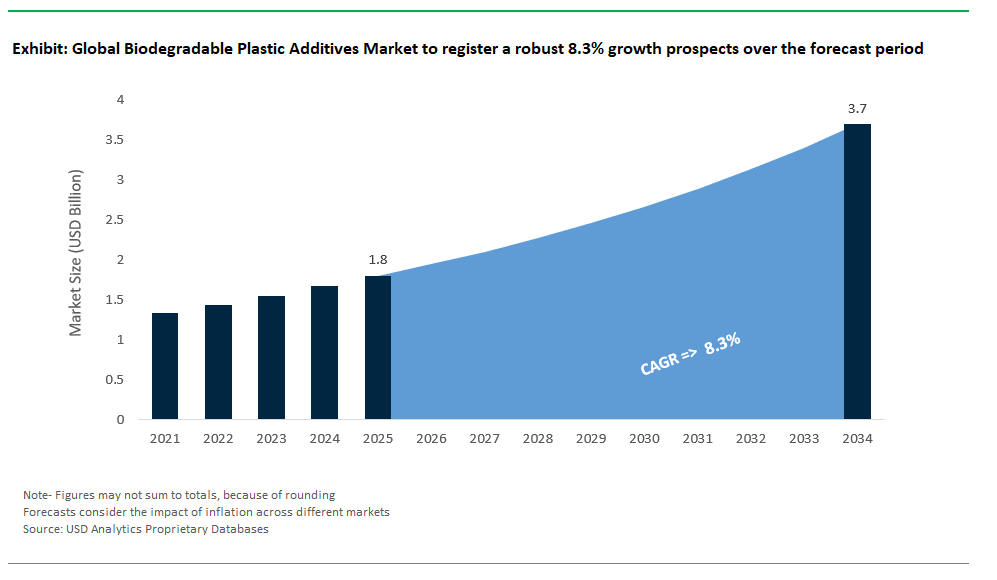
The Global Biodegradable Plastic Additives Market is set for steady expansion between 2025 and 2034, as industries increasingly demand sustainable solutions that enhance the properties and performance of biodegradable polymers. Market projections indicate that the sector will grow from USD 1.8 billion in 2025 to USD 3.7 billion by 2034, registering a healthy CAGR of 8.3%. This growth is driven by the pursuit of biodegradable materials that not only meet environmental standards but also deliver improved mechanical, thermal, and functional characteristics for diverse end-use applications.
This analysis delves into the strategic role of additives in extending the performance envelope of biodegradable plastics, examining how plasticizers improve flexibility, stabilizers enhance durability, and pro-degradants accelerate end-of-life decomposition under controlled conditions. It explores emerging bio-based aromatic and non-aromatic chemistries that are redefining additive functionality for polymers such as PLA, PHA, and starch-based plastics. The report also highlights innovations in flame retardants, antimicrobial solutions, and property modifiers tailored for high-performance applications in packaging, automotive, electronics, and healthcare sectors. With verified intelligence and actionable insights, this study equips polymer manufacturers, additive suppliers, converters, investors, and sustainability leaders with critical knowledge to navigate the evolving biodegradable plastics landscape and capture market opportunities through 2034.
The global market for biodegradable plastic additives is booming due to sustainability demands, regulations, and new technologies. These additives, from enzymes to plasticizers, are helping biodegradable plastics overcome past limitations in degradation, performance, and cost, moving them from niche to widespread use in packaging, agriculture, and more.
New additive innovations are boosting biodegradable plastic capabilities. For example, Clariant's flame retardants are enabling biodegradable materials for electronics, a challenging sector. Bio-Tec Environmental's EcoPure® G2 accelerates the breakdown of common plastics in landfills, vital for areas without composting. Also, advanced compounds like BASF's ecovio® are designed for rapid soil degradation in products like agricultural films, improving soil health and efficiency.
Growing production capacity shows the market is ready for large-scale adoption. Companies are investing in bio-based and non-toxic additives, such as plant-based plasticizers, which improve flexibility and processing. There's also increased output for additives used in agricultural films, balancing biodegradability with durability. This signifies a move towards environmentally responsive solutions for key industries.
Strategic Partnerships and Acquisitions Expand Technology Integration
Collaborations and acquisitions are integrating new additive technologies into plastic production. Starch-based additives like BioLogiQ’s NuPlastiQ® BioBlend are helping major resin producers enhance PE biodegradation. The focus is on incorporating bio-based components into mainstream products like flexible packaging and developing UV stabilizers that offer both biodegradability and material stability for outdoor applications.
Regulatory Drivers Accelerate Market Adoption
Global regulations are pushing the market forward. While the EU's Single-Use Plastics Directive bans certain problematic "degradable" plastics, it generally encourages truly biodegradable solutions. California's SB 54 mandates compostable packaging, driving demand for relevant additives. Similarly, India's CPCB guidelines for biodegradable plastics are shaping material development in emerging markets.
Technological Breakthroughs Enhance Degradability and Functional Control
Advanced science is creating smarter biodegradable additives. Research is exploring nano-cellulose enzyme carriers to boost marine biodegradation, tackling ocean pollution. "Smart" additives, like pH-responsive systems, are being developed to trigger degradation only when plastics enter specific environments. The aim is to create tailored solutions for precise environmental triggers in various applications.
Commercial Adoption Confirms Market Maturity
Widespread commercial use confirms these additives are ready for real-world application. Additives like Bio-Tec Environmental’s EcoPure® are being used in agricultural products to accelerate decomposition, replacing durable films. High-performance additives are also finding their way into regulated industries like medical packaging, meeting both safety and sustainability needs. Retailers are also adopting such solutions to address environmental concerns and consumer demand.
Market Dynamics – Biodegradable Plastic Additives Industry
Trend: Pro-Degradant Additives Transform Lifespan of Conventional Plastics in Landfills and Oceans
The global biodegradable plastic additives industry is transforming as pro-degradant additives become vital tools in addressing persistent plastic waste in landfills and oceans. Growing regulatory pressure to reduce plastic pollution and improve end-of-life solutions is driving rapid innovation in this field. Although the EU’s Single-Use Plastics Directive bans oxo-degradable plastics, global momentum for sustainable waste management is fueling interest in other additive technologies. Technological advances are enabling pro-degradant additives to speed up plastic breakdown significantly. For instance, some additives can reduce plastic degradation time under specific conditions, like those tested using ASTM D5511 for anaerobic biodegradation. Importantly, pro-degradant masterbatches add only a modest cost to plastic products, making them an affordable option for manufacturers seeking better environmental performance.
Investment and innovation in this space are surging, reflected in rising patent activity focused on sustainable plastic technologies, including enhanced degradation solutions. Major chemical companies are heavily investing in research and development to tackle the environmental challenges posed by traditional plastics. This wave of innovation signals a global push toward reducing plastic’s environmental footprint and improving waste management practices. As regulations tighten and sustainability becomes a top priority, pro-degradant additives are set to play a crucial role in shaping the future of sustainable plastics manufacturing worldwide.
Opportunity: Functional Additives Enhance Bioplastics’ Performance While Retaining Compostability
A significant growth opportunity in the biodegradable plastic additives market lies in developing functional additives tailored for bioplastics like PLA and PHA. These additives tackle crucial challenges related to durability, processing, and performance, helping bioplastics compete with traditional polymers. Demand is rising for additives such as plasticizers, nucleating agents, and antioxidants that boost bioplastics’ technical properties while maintaining sustainability. Breakthroughs like epoxidized vegetable oil plasticizers have greatly increased PLA’s flexibility, with studies showing elongation at break improving from single-digit percentages to several hundred percent, enabling new uses in flexible packaging and consumer products. Likewise, cellulose nanocrystal nucleating agents are speeding up PHA crystallization, shortening molding times, and enhancing production efficiency.
Importantly, these advanced additives are engineered to preserve full biodegradability and compostability. Certifications like OK COMPOST INDUSTRIAL rigorously evaluate whether materials and their additives meet compostability standards, ensuring high-performance bioplastics remain environmentally friendly at end-of-life. This balance between technical capability and eco-responsibility is crucial as industries look for materials that deliver both sustainability and robust functionality. Functional biodegradable plastic additives are emerging as key enablers in advancing the next generation of sustainable materials across diverse applications.
Competitive Landscape of the Global Biodegradable Plastic Additives Market
The global biodegradable plastic additives market is experiencing rapid growth in 2024, driven by regulatory mandates on plastic waste, surging demand for compostable and bio-based packaging, and the need for performance enhancements in bioplastics. From plasticizers and nucleating agents to colorants and flame retardants, biodegradable additives are critical to improving processability, durability, and functional properties in biopolymers like PLA, PHA, PBAT, and bio-based polyesters. Leading players are expanding their portfolios, entering strategic collaborations, and scaling production to meet rising global demand. The competitive landscape reflects a dynamic industry bridging the gap between sustainability and high-performance plastic manufacturing.
BASF SE: Leading with Innovations in Biodegradable Additives
BASF SE (Germany) BASF SE remains a global leader in biodegradable additives with significant innovations. Its ecovio® brand is a finished compound that is certified compostable worldwide and has a variable bio-based content, combining BASF's compostable polymer ecoflex® with polylactic acid (PLA) and other additives. ecovio® products are designed to be as high-performing and strong in use as conventional plastics. BASF offers various ecovio® grades that meet international and national standards and regulations for industrial composting, and its ecovio® grades for extrusion coating show excellent barrier properties and temperature stability for food packaging. BASF is at the forefront of driving sustainable solutions for both rigid and flexible biodegradable plastics.
Clariant: Expanding Footprint with Unique Additive Solutions
Clariant (Switzerland) Clariant continues to expand its footprint in biodegradable plastic additives with unique solutions targeting electronics and packaging sectors. At K 2019, Clariant launched new "Terra" designated additives solutions, including the Exolit® OP Terra range, which comprises renewable-based halogen-free flame retardants. These are the first halogen-free flame retardants based on renewable sources and are designed not to interfere with the recycling process, achieving a UL 94 V-0 rating with stable flame retardancy even after multiple recycling processes. Their application areas include electronic and electrical equipment and automotive components. Information regarding. As a supplier to major bioplastics producers, Clariant plays a key role in the global bioplastics value chain.
Dow Chemical: Innovating Bio-Based Plasticizers and Functional Additives
Dow Chemical (US) Dow Chemical is innovating in bio-based plasticizers and functional additives to enhance the performance of biodegradable polymers. Dow's sustainability science includes Ecolibrium™, a brand pillar for products that contain some percentage of materials derived from biomass, indicating their commitment to bio-based solutions. Dow offers a range of plastics additives, including processing aids and impact modifiers, which enhance the durability and processability of various plastics, including those for packaging and electronics.
Sukano: Recognized Supplier of Masterbatches for Bioplastics
Sukano (Switzerland) Sukano is a recognized supplier of masterbatches for bioplastics, addressing critical processing and property challenges in biodegradable polymers. Sukano offers a range of masterbatches for PLA, including those designed to enhance properties like heat resistance, crystallization, and barrier performance. Sukano's expertise in tailor-made masterbatch solutions for biopolymers is well-established, making it a trusted partner for converters and bioplastics producers globally.
Avient: Advancing Biodegradable Plastic Additives with Colorants and Compatibility Systems
Avient (US) Avient is advancing biodegradable plastic additives through innovative colorants and compatibility systems. Avient offers OnColor™ Bio color concentrates, which are specially designed to perform well with bioplastics such as PLA, PHA, PHBV, PBS, PBAT, and special blends. These colorants are formulated not to compromise the organic recyclability of the resins they enhance and have received OK compost HOME certification from TÜV AUSTRIA. Avient also provides Cesa™ Bio Additives, which can add properties like antistatic and UV protection to products built from biodegradable resins.
Lanxess: Leading Producer of Specialty Plasticizers
Lanxess (Germany) Lanxess is a leading producer of specialty chemicals, including a diverse portfolio of plasticizers. The company offers plasticizer solutions that cater to sensitive applications, with several products developed from bio-based sources. Lanxess places strong emphasis on sustainability, integrating bio-based alternatives and environmentally friendly products into its portfolio to support environmental protection initiatives.
Emery Oleochemicals: Expanding Role with Bio-Based Additive Solutions
Emery Oleochemicals (Malaysia) Emery Oleochemicals is expanding its role in biodegradable plastic additives with bio-based solutions derived from renewable feedstocks. Their Green Polymer Additives (GPA) business offers a product portfolio including lubricants, plasticizers, viscosity depressants, antistatic and antifogging agents, and release agents, all made from sustainable materials. At Vinyltec 2024 (October 22-24, 2024), Emery Oleochemicals showcased its LOXIOL® sustainable additives, including LOXIOL® G 24, a 100% bio-based carbon content lubricant, and bio-based antifogging agents. Emery Oleochemicals' continuous development and showcasing of bio-based polymer additives highlight its pivotal role in the global shift toward sustainable materials.
By Additive Type: Plasticizers Dominate, Degradation Accelerators Deliver Highest Growth
In 2025, plasticizers hold a 28.7% market share in the biodegradable plastic additives segment, reflecting their indispensable role in enhancing flexibility for packaging, bags, and films made from bioplastics. These additives ensure bioplastic products meet performance requirements while maintaining compostability. Degradation accelerators (pro-degradants) represent the fastest-growing segment with a CAGR of 9.1%, as global regulations tighten and demand rises for solutions that speed up plastic breakdown in landfill and compost environments. Antimicrobial agents are also gaining momentum, with expanding applications in food packaging and medical devices to support product safety and shelf life.
By Application: Plasticizers Lead Adoption, Flame Retardants and Antimicrobials Expand Rapidly
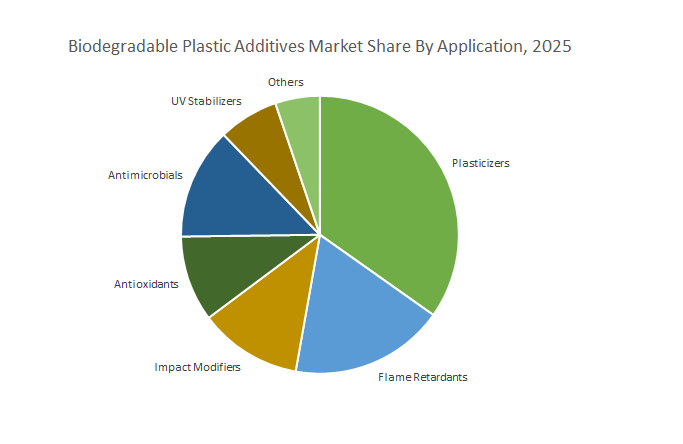
Plasticizers remain the dominant application area, accounting for 34.6% of additive use in 2025. Their widespread adoption in flexible bioplastic products, such as bags, wraps, and films, underscores the ongoing shift from rigid plastics to compostable and user-friendly alternatives. Flame retardants are the next largest and among the fastest-growing applications, supporting the rise of bioplastics in Agriculture, electronics, automotive, and construction sectors, where fire safety standards are stringent. Antimicrobial additives are also surging in use, especially for food packaging and healthcare applications, as brand owners look to extend shelf life and improve hygiene.
Germany Driving Technological Innovation in Biodegradable Plastic Additives
Germany has firmly established itself as the technology and innovation leader in the biodegradable plastic additives industry. German companies are pioneering advanced additive solutions that significantly improve the properties of biodegradable polymers. BASF’s Ecovio® processing aids continue to enhance compatibility between PLA and PBAT blends, resulting in more uniform films and molded products for packaging and industrial uses. As of 2025, BASF is actively promoting its Ecovio® range for circularity solutions, including its use in compostable coatings for food packaging and plant clips for greenhouses, highlighting its functional advantages like food-contact approval and barrier properties. Clariant has introduced BioAdimide®, a hydrolysis stabilizer that improves the lifespan and durability of biopolymers, especially under humid or high-temperature conditions, a crucial breakthrough for applications such as compostable packaging and agricultural films. Notably, Fraunhofer UMSICHT has developed enzyme-triggered degradation additives, offering precise control over biodegradability, making products adaptable for specific end-of-life environments. Research on enzyme-triggered degradation of cellulose acetate by embedded enzymes, with results published as recently as February and June 2025, indicates ongoing advancements in this area, aligning with Fraunhofer's innovative work. The regulatory landscape is also supportive: the EU’s REACH regulation continues to evolve, supporting sustainable chemistry innovations. The European Chemicals Agency (ECHA) continues to update the REACH Candidate List in 2025, and there's an ongoing focus on the safe use of chemicals in workplaces and the development of new regulatory lists, which influence the approval and use of various additives. Germany’s robust R&D ecosystem positions it as a pivotal player shaping the future of biodegradable plastic additives.
United States Emerging as the Fastest-Growing Market for Biodegradable Plastic Additives
The United States is witnessing significant momentum as a rapidly growing market for biodegradable plastic additives, driven by sustainability initiatives and strong policy support. Leading players like ADM are producing BioSolutions, soy-based plasticizers that improve flexibility and processing in biodegradable films and molded products. ADM continues to focus on biosolutions as a growth opportunity in 2025, aligning with the increasing demand for sustainable ingredients and products across various sectors. PolyOne’s OnCap™ BIO series has introduced nucleating agents specifically designed for PLA, improving clarity, mechanical strength, and thermal resistance. Avient (formerly PolyOne) continues to offer a broad range of sustainable formulations and additive solutions in 2025, including those that enhance the performance of various polymers. Key market drivers include the USDA BioPreferred Program, which certifies bio-based additives and helps manufacturers secure green credentials, as well as California’s SB 54 legislation, mandating compostable packaging solutions and indirectly boosting demand for performance-enhancing additives in biodegradable plastics. The USDA BioPreferred Program continues to certify bio-based products, including additives, with ongoing audits to ensure compliance. California's SB 54 aims to reduce plastic pollution and implement an Extended Producer Responsibility (EPR) program, with significant regulatory updates in May 2025 regarding single-use packaging and plastic food service ware, which will further drive demand for compostable solutions and related additives. With ongoing investment and regulatory incentives, the U.S. is rapidly positioning itself as a key hub for innovative biodegradable plastic additives, offering solutions tailored to diverse industries from packaging to consumer goods.
Japan Innovating High-Performance Specialty Additives for Biodegradable Plastics
Japan continues to excel in producing high-performance specialty additives for biodegradable plastics, focusing on advanced functionality and precision applications. Mitsubishi Chemical’s BioPBS™ modifiers enhance the heat resistance and processability of biodegradable polymers, crucial for applications like food packaging and automotive components. Mitsubishi Chemical Group continues to report on its business activities in 2025, including the adoption of their bio-based engineering plastic DURABIO for 3D-printed stools at Expo 2025, indicating their ongoing advancements in bio-based materials and potential for additive integration. Adeka has developed the ADK STAB FP-2000 series, UV stabilizers designed specifically for PHA, extending the service life of biodegradable materials exposed to sunlight, a significant challenge for outdoor applications and packaging. Adeka's ADK STAB FP-2000 series includes halogen-free flame retardants and has received the UL verified mark, showcasing their commitment to high-performance chemical products, including additives. Major industry players such as Toyota are integrating these bio-based additives into automotive bioplastics to create sustainable and high-performance vehicle parts. Toyota Kirloskar Motor's Environment Month 2025 initiatives highlight their broader commitment to environmental stewardship, promoting circular economy solutions, and reducing resource consumption, which includes exploring sustainable materials for vehicle parts. Supported by rigorous R&D and Japan’s culture of precision engineering, the nation remains at the forefront of biodegradable additive technologies that meet both technical performance and environmental standards.
China Leading Global Production of Biodegradable Plastic Additives
China has emerged as a major global production hub for biodegradable plastic additives, fueled by significant domestic investments and rapid scaling of manufacturing capacity. Companies like Kingfa are producing degradation accelerators that expedite the breakdown of biodegradable plastics under environmental conditions, aligning with China’s aggressive sustainability targets. Kingfa Science & Technology (India) reported a significant rise in net profit for the quarter ended March 2025, indicating the company's strong financial performance in the broader specialty chemicals and plastics sector. Meanwhile, Sinopec has launched new facilities to increase its capacity for bio-based plasticizers, a move that underscores the country’s commitment to both volume and technological advancement. The global bioplasticizers market is projected to reach US$2.8 billion by 2025, driven by increasing demand for eco-friendly alternatives, with North America currently dominating the market, but China's growing production capabilities are influencing global supply. The Chinese government’s strategic initiatives, including environmental mandates and subsidies for sustainable materials, ensure that the nation remains pivotal in global supply chains for biodegradable plastic additives. With the dual goals of environmental stewardship and cost-effective production, China is expected to maintain its leadership in scaling sustainable additive solutions worldwide.
Netherlands: Focusing on Circular Economy Solutions in Biodegradable Plastic Additives
The Netherlands is playing a crucial role in advancing biodegradable plastic additives through its strong focus on circular economy principles and bio-based chemistry. Companies like Avantium are pioneering FDCA-based performance enhancers, which improve the mechanical and barrier properties of biodegradable plastics, making them suitable for demanding applications such as food packaging and flexible films. The global market for 2,5-Furandicarboxylic Acid (FDCA) is projected to reach US$794.0 million by 2030, with PEF (produced from FDCA) boasting superior barrier properties and biodegradability compared to PET, positioning Avantium as a key player in sustainable packaging solutions. Corbion, a leader in bio-ingredients, offers PURALACT® lactic acid-based modifiers that enhance clarity, impact resistance, and processability of PLA and other biodegradable polymers. Corbion's "Advance 2025" strategy focuses on aligning its business portfolio with global market trends, including sustainability, and its lactic acid production for the PLA market remains a key component, supporting innovative, safe, and sustainable polymers. The Dutch government and EU regulatory bodies are backing these efforts through the EU Circular Economy Action Plan, encouraging further R&D investments and commercial deployment of bio-based additives. The Circular Bio-based Europe Joint Undertaking (CBE JU) announced its 2025 funding priorities, including €13.5 million for Safe and Sustainable by Design (SSbD) bio-based polymers/copolymers, and €6 million for bio-based and biodegradable delivery systems for fertilizing products to reduce microplastics pollution, indicating strong EU-level support for such initiatives. The Netherlands’ integrated approach, combining technological innovation, policy support, and industry commitment, is positioning it as a leader in sustainable healthcare solutions.
By Additive Type (Plasticizers, Property Stabilizers, Property Modifiers/Extenders, Flame Retardants, Antimicrobial Agents, Degradation Accelerators/Pro-degradants, Others), By Application (Plasticizers, Flame Retardants, Impact Modifiers, Antioxidants, Antimicrobials, UV Stabilizers, Others), By Polymer Type (PLA (Polylactic Acid), PHA (Polyhydroxyalkanoates), Starch-based Plastics, PBAT (Polybutylene Adipate Terephthalate), PBS (Polybutylene Succinate), PCL (Polycaprolactone), Others)
Study Period
2019- 2024 and 2025-2034
Units
Revenue (USD)
Qualitative Analysis
Porter’s Five Forces, SWOT Profile, Market Share, Scenario Forecasts, Market Ecosystem, Company Ranking, Market Dynamics, Industry Benchmarking
Companies
BASF SE (Germany), Evonik Industries AG (Germany), Clariant AG (Switzerland), Cargill, Inc. (U.S.), DIC Corporation (Japan), ADEKA Corporation (Japan), Croda International Plc (UK), Stora Enso (Finland), UPM-Kymmene Oyj (Finland), Borregaard AS (Norway), Corbion N.V. (Netherlands), Avient Corporation (U.S.), Emery Oleochemicals (Malaysia), Greenchemicals S.r.l. (Italy), Dow Inc. (U.S.), LANXESS AG (Germany), Solvay S.A. (Belgium), Polymateria Ltd. (UK), BioSphere Plastic (U.S.), Green Dot Bioplastics (U.S.), Bio-Tec Environmental, LLC (U.S.), ENSO Plastics (U.S.), Itaconix Plc (U.S.), Polyone Corporation (U.S.), and Others.
Countries
US, Canada, Mexico, Germany, France, Spain, Italy, UK, Russia, China, India, Japan, South Korea, Australia, South East Asia, Brazil, Argentina, Middle East, Africa
Europe (Germany, UK, France, Spain, Italy, Russia, Rest of Europe)
Asia Pacific (China, India, Japan, South Korea, Australia, South East Asia, Rest of Asia)
South America (Brazil, Argentina, Rest of South America)
Middle East and Africa (Saudi Arabia, UAE, Rest of Middle East, South Africa, Egypt, Rest of Africa)
Top Companies in Biodegradable Plastic Additives Market
BASF SE (Germany)
Evonik Industries AG (Germany)
Clariant AG (Switzerland)
Cargill, Inc. (US)
DIC Corporation (Japan)
ADEKA Corporation (Japan)
Croda International Plc (UK)
Stora Enso (Finland)
UPM-Kymmene Oyj (Finland)
Borregaard AS (Norway)
Corbion N.V. (Netherlands)
Avient Corporation (US)
Emery Oleochemicals (Malaysia)
Greenchemicals S.r.l. (Italy)
Dow Inc. (US)
LANXESS AG (Germany)
Solvay S.A. (Belgium)
Polymateria Ltd. (UK)
BioSphere Plastic (US)
Green Dot Bioplastics (US)
Bio-Tec Environmental, LLC (US)
ENSO Plastics (US)
Itaconix Plc (US)
Polyone Corporation (US) (now part of Avient Corporation)
* List Not Exhaustive
Methodology:
The research methodology for the Global Biodegradable Plastic Additives Market integrates rigorous primary research involving interviews with leading additive manufacturers, biopolymer producers, industry experts, and sustainability specialists to capture firsthand insights on technological advancements, market trends, and evolving regulatory impacts. These findings are validated and supplemented by extensive secondary research using authoritative sources, including corporate annual reports, patent databases, regulatory publications (e.g., EU REACH, California SB 54), scientific journals, trade association data, and relevant market intelligence reports. A multi-layered triangulation process ensures high accuracy of market sizing, growth forecasts, and segment-level analysis. This robust approach underpins market projections extending through 2034 and delivers reliable intelligence for decision-makers navigating the biodegradable plastic additives landscape.
Research Coverage:
Geographic Scope: Analysis spans 25+ countries across North America, Europe, Asia Pacific, South America, and the Middle East & Africa.
Competitive Landscape: Strategic profiles and analysis of over 20 leading companies operating in biodegradable plastic additives and sustainable materials innovations.
Trends & Disruptions: Detailed assessment of emerging additive technologies, bio-based chemistries, regulatory changes, circular economy impacts, and innovation pipelines across industries.
Industry Dynamics: Examination of market drivers, restraints, technological progress, evolving customer requirements, investment patterns, and global regulatory developments shaping the biodegradable plastic additives market.
Historic data from 2021 to 2024 and forecast data from 2025 to 2034.
Deliverables:
Full Market Research Report (PDF, Excel) featuring extensive data tables, charts, and interactive visualizations.
Country-Level Forecasts & Analysis.
Segment-wise Revenue Projections (2025–2034).
Competitive Benchmarking & SWOT Analysis.
Recent Developments & News Tracker.
Executive Summary & Analyst Insights.
Post-Purchase Analyst Support for Client-Specific Questions and Custom Data Requirements.
The global biodegradable plastic additives market is forecast to grow from USD 1.8 billion in 2025 to USD 3.7 billion by 2034, registering a healthy CAGR of 8.3% as demand accelerates for sustainable materials with enhanced performance capabilities.
Biodegradable plastic additives are essential in improving flexibility, strength, flame resistance, antimicrobial properties, and UV stability of biopolymers like PLA, PHA, PBAT, and starch-based plastics. Applications span packaging, agriculture films, electronics, automotive, and medical devices.
Degradation accelerators (pro-degradants) are the fastest-growing segment, driven by regulations and the need to shorten the lifespan of plastics in landfill or composting conditions. Meanwhile, functional additives like nucleating agents and bio-based plasticizers are rapidly expanding to improve the processability and durability of bioplastics.
Manufacturers are investing in biodegradable additives to improve the performance of bioplastics, comply with strict sustainability regulations, and offer high-quality alternatives to conventional plastics. These additives help balance eco-friendliness with demanding mechanical and processing requirements for diverse end-use industries.
Global regulations such as the EU’s Single-Use Plastics Directive and California’s SB 54 are major drivers for biodegradable plastic additives. They set strict standards for compostability, restrict certain “degradable” plastics, and push industries to adopt additives that ensure plastics meet environmental performance and certification criteria like OK Compost and EN13432.