Healthcare and Laboratory Labels Market Overview: Traceability, Patient Identification and Environmental Durability Drive Specialized Label Demand
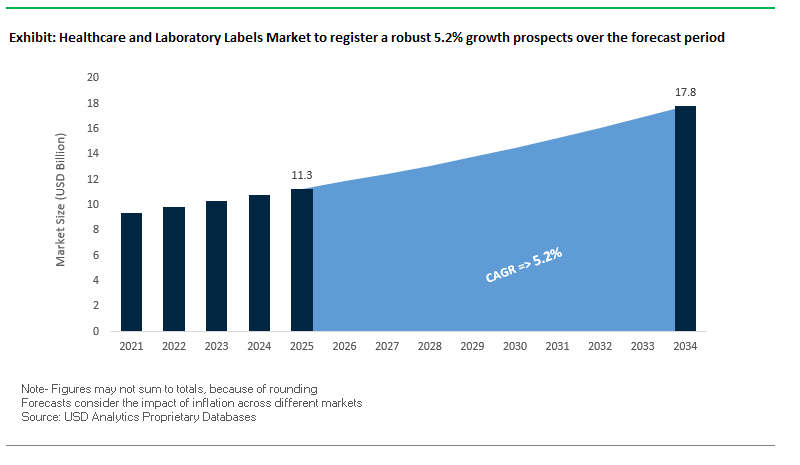
The global Healthcare and Laboratory Labels Market is valued at USD 11.3 billion in 2025 and is projected to reach USD 17.8 billion by 2034, expanding at a CAGR of 5.2%. Healthcare and laboratory labels provide identification, traceability, regulatory information and workflow data across pharmaceuticals, hospitals, diagnostic laboratories, blood banks, research facilities and medical-device supply chains. Applications include patient identification labels, specimen labels, blood-bag labels, pharmaceutical and nutraceutical labels, laboratory labels, asset and inventory labels, and specialty labels for vials, syringes, tubes, slides, plates and diagnostic containers.
Unlike conventional product labels, healthcare labels can encounter demanding combinations of tight container radii, sterilization, refrigeration, ultra-low-temperature storage, liquid nitrogen, solvents, moisture, abrasion and repeated handling. Label performance consequently depends on the interaction among facestock, adhesive, coating, printing technology, barcode quality, container substrate and environmental exposure. 3M, for example, offers healthcare label materials engineered for small-diameter vials, plastics, pharmaceutical packaging and sterilization environments, while Brady Corporation supplies laboratory materials designed for cryogenic temperatures down to –196°C.
Digital identification is expanding the functional role of labels. Conventional linear and 2D barcodes remain central to patient, specimen and device identification, while RFID and NFC technologies increasingly support unit-level medication tracking, inventory management, authentication, tamper indication and connected pharmaceutical packaging.
Recent Healthcare and Laboratory Label Developments and Manufacturer Strategies
Avery Dennison Integrates RFID into Prefillable Syringe Identification
In January 2025, Avery Dennison and BD announced an RFID-enabled digital-identification solution for prefillable syringe packaging. The BD iDFill system integrates an RFID tag into the syringe's rigid needle shield, assigning a unique digital identity without changing the fundamental syringe-barrel design. The system is intended to support unit-level identification, authentication and traceability through the syringe lifecycle. The development illustrates how smart identification is moving closer to individual drug-delivery containers rather than remaining limited to cartons and shipping units.
Avery Dennison further expanded healthcare RFID capabilities in March 2026 through a new portfolio of inlays engineered to withstand major sterilization processes. AD Minidose U9 Steri, AD Accessory U9 Steri and AD Shelter Steri were tested on substrates including polypropylene syringes and glass vials and are designed to retain RFID functionality through autoclave and ethylene oxide sterilization.
Schreiner MediPharm and HERMA Address High-Speed RFID Labeling on Vials
In May 2026, Schreiner MediPharm and HERMA introduced an integrated RFID vial-labeling solution combining mechanically protected RFID labels with pharmaceutical labeling equipment. Small-radius containers such as vials and syringes create particular challenges because bending and high-speed application can mechanically stress the RFID chip and antenna. The companies designed the system to protect chip functionality while maintaining precise application at pharmaceutical production speeds.
The development demonstrates an increasingly important purchasing criterion in healthcare labeling: digital functionality must remain compatible with the physical realities of pharmaceutical packaging lines. RFID performance alone is insufficient if the inlay cannot tolerate converting, dispensing, container curvature and line-speed stresses.
Digital Display Labels Address Changing Clinical-Trial Information
In May 2025, Schreiner MediPharm introduced a Digital Display Label for investigational medicines used in clinical trials. The reusable electronic label can update information such as protocol data, patient-group information and expiration dates without conventional physical relabeling and can be attached to packaging ranging from blister wallets and kit boxes to bottles and vials.
CCL Clinical is pursuing a related architecture through battery-free e-paper clinical smart labels incorporating HF-RFID technology for remote expiry-date updates. These developments reflect the unusually dynamic data requirements associated with investigational medicinal products, where stability extensions, country-specific information and protocol changes can occur after packaging has been produced.
Smart Pharmaceutical Labels Extend into Authentication and Hospital Medication Management
In 2025, Schreiner MediPharm expanded NFC-based authentication labels for pharmaceutical pens and autoinjectors. The labels combine encrypted digital authentication with irreversible first-opening indication and smartphone-based verification.
RFID labels are also gaining a role inside hospitals. Schreiner MediPharm's integration with Bluesight's KitCheck platform enables hospital pharmacies to identify individual injectable products and capture information including batch numbers, expiration dates and container status. Bluesight's network was reported by Schreiner to cover more than 900 North American hospitals and more than 325 million registered injectable doses.
UPM Expands Advanced Label-Material Capacity
UPM Raflatac was renamed UPM Adhesive Materials in June 2025, while UPM Raflatac continues as a product brand within its label-material portfolio. The company subsequently announced investments in advanced label-material capacity in North Carolina and new coating and filmic capabilities at Johor Bahru, Malaysia. Pharmaceutical applications are among the higher-value end uses addressed by its advanced label-material production.
Healthcare and Laboratory Labeling Regulatory and Technical Framework
Patient and Specimen Identification Require Controlled Label Content and Placement
Patient and specimen identification is a distinct healthcare labeling discipline because errors can propagate directly into diagnostic workflows. CLSI PRE01—Patient and Laboratory Specimen Identification Processes addresses patient registration, specimen identification, collection, labeling, transport and handling across laboratory workflows. It also covers electronic patient-identification systems and harmonization of identification processes for blood and non-blood specimens.
CLSI AUTO12 provides additional specifications for specimen-label content, format, barcode placement, fonts and orientation on specimen tubes. This is commercially relevant to label manufacturers and printer suppliers because specimen-label performance depends not only on adhesive durability but also on available print space, barcode readability and consistent label positioning.
U.S. Medical Device Labels Integrate UDI in Human-Readable and Machine-Readable Forms
FDA UDI Basics — Unique Device Identification System requires applicable medical-device labels and packages to bear a unique device identifier, subject to defined exceptions and alternatives. FDA states that the UDI must be provided in an easily readable plain-text form and in a machine-readable automatic identification and data capture format. Device information is also submitted to the Global Unique Device Identification Database.
This creates demand for durable barcodes, 2D codes and other machine-readable identifiers capable of remaining legible across the expected device lifecycle. Labels used on reusable or sterilized devices can face additional material requirements because the identification layer may encounter cleaning, disinfection, sterilization or repeated handling.
EUDAMED Makes UDI/Device Registration a Current European Labeling Issue
The EU Medical Device Regulation and In Vitro Diagnostic Medical Device Regulation establish a UDI-based identification system for medical devices and IVDs. A major implementation milestone occurred on May 28, 2026, when the first four EUDAMED modules—including UDI/Device registration—became mandatory following the European Commission's functionality decision and transition period.
The framework strengthens the role of machine-readable product identification across European medical-device markets and increases the importance of accurate variable-data printing and durable identification throughout device distribution and use.
ISBT 128 Standardizes Identification of Blood and Other Medical Products of Human Origin
Blood and cellular-therapy labeling has a separate identification framework. ISBT 128, administered by ICCBBA, provides standardized terminology, coding and labeling for medical products of human origin including blood, cellular-therapy products, tissues, human milk and organs. ICCBBA — ISBT 128 Standard Technical Specification
FDA issued final guidance in April 2024 recognizing Version 4.0.0 of the United States Industry Consensus Standard for Uniform Labeling of Blood and Blood Components Using ISBT 128 as acceptable for use by manufacturers subject to applicable U.S. requirements. This gives blood-bag labels a regulatory and technical identity that differs materially from conventional pharmaceutical, specimen or laboratory labels.
Healthcare and Laboratory Labels Market Trends, Technologies and Application Developments
Patient and Specimen Identification Drive Point-of-Collection Barcode Labeling
Hospitals and laboratories increasingly connect label generation directly with patient and test-order verification. A typical bedside workflow can involve scanning the patient's identification, matching that identity electronically to the laboratory order, printing a specimen label at the collection point and applying it immediately to the tube or container. Zebra Technologies describes a digital bedside workflow in which patient identification is verified by barcode and matched to the test order before specimen labeling.
This architecture increases demand for compact mobile and desktop printers, direct thermal and thermal transfer media, scanner-compatible barcodes and materials that adhere reliably to specimen tubes. The commercial requirement extends beyond print speed: the label must provide sufficient space and orientation for patient identifiers, accession data and machine-readable information while remaining readable during transport, centrifugation, refrigeration and automated laboratory processing. CLSI PRE01 and AUTO12 reinforce the importance of identification accuracy, placement and barcode formatting in these workflows.
Cryogenic, Deep-Freeze and Chemical Exposure Define Laboratory Label Materials
Laboratory labels can encounter substantially harsher environments than conventional healthcare labels. Biobanks, molecular diagnostics, research laboratories and cell-based research may store samples at –80°C or in liquid nitrogen, while labels can also encounter ethanol, isopropanol, xylene, DMSO, acids, bleach, autoclaving and repeated freeze-thaw cycles.
These conditions increase demand for polyester and other engineered films, aggressive low-temperature adhesives and thermal-transfer printing systems capable of retaining barcode and text readability. Brady Corporation's FreezerBondz products, for example, are designed for laboratory surfaces including vials and tubes and can withstand liquid nitrogen storage at –196°C, while self-laminating laboratory materials add a protective film over printed information.
Material performance can also depend on when the label is applied. Adhesion to a clean room-temperature tube differs from adhesion to an already frozen or frost-affected container, increasing the importance of application-specific adhesive systems.
Small Vials, Tubes and Syringes Increase Adhesive and Barcode-Readability Requirements
Healthcare labels are frequently applied to surfaces with diameters far smaller than conventional bottles or packages. Cryovials, blood-collection tubes, PCR tubes, ampoules, cartridges, prefilled syringes and small pharmaceutical vials create tight radii that can generate label lifting or edge flagging if facestock stiffness and adhesive performance are poorly matched.
3M specifically identifies small-diameter vials and single-unit-dose packaging applications as uses for its healthcare label materials and offers adhesive systems intended to resist flagging on glass and low-surface-energy plastics.
Smaller containers also limit available area for human-readable information and barcodes. This increases the value of high-resolution variable-data printing, thin conformable facestocks and carefully controlled barcode dimensions. Smart labels add another constraint because RFID antenna and chip structures must tolerate bending and automated application without degrading read performance. The 2026 Schreiner MediPharm/HERMA vial-labeling development directly addresses these combined mechanical and production-line requirements.
RFID and NFC Expand Labels from Identification Media into Digital Healthcare Assets
RFID and NFC are extending labels beyond static information. RFID can support bulk reading, unit-level medication identification, automated inventory, device tracking and hospital kit management, while NFC adds short-range smartphone interaction for authentication, patient information and digital tamper indication.
At Pharmapack 2025, Avery Dennison demonstrated an RFID architecture integrated with a prefillable syringe needle shield, creating a digital identity at individual syringe level. In hospital medication management, Schreiner MediPharm integrates RFID labels with Bluesight KitCheck to identify injectable products, expiration dates and inventory status.
RFID integration is simultaneously becoming more demanding technically. Healthcare applications can expose tags to sterilization, tight container curvature and high-speed labeling. Avery Dennison's March 2026 sterilization-resistant inlay portfolio and Schreiner MediPharm's robust RFID vial labels demonstrate how materials, antenna design, chip protection and label-converting technology are increasingly developed as one system.
Blood Bag and Cellular-Therapy Labels Require Standardized Machine-Readable Identification
Blood bags and cellular-therapy products create a specialized labeling market because the label must connect donor or product identification with product description, collection information, expiration and other required data while supporting machine-readable traceability.
ISBT 128 provides standardized data structures and terminology across medical products of human origin. The framework spans blood and blood components, cellular therapies, tissues, organs and other defined products, supporting interoperable identification across collection, processing, storage, distribution and clinical use.
Label materials must also tolerate refrigeration, freezing, plastic blood-bag substrates and handling throughout the product lifecycle without compromising machine-readable information. 3M's healthcare labeling portfolio includes applications for blood and infusion bags, while specialized converters compete on adhesive compatibility, barcode print quality and durability.
The growth of cell-based therapies can further increase performance requirements because certain products move through deep-frozen or cryogenic environments while maintaining chain-of-identity information.
Medical Device and IVD Labeling Expands UDI and Machine-Readable Data Requirements
UDI regulations are increasing the functional value of durable labels used across medical device packaging and IVD applications. In the U.S., applicable devices generally require UDI information on labels and packages in human-readable and automatic-identification/data-capture formats. The EU similarly uses UDI under the MDR and IVDR, with mandatory EUDAMED UDI/Device module use beginning in May 2026.
The resulting label requirements extend across paper, polymer and durable-film constructions depending on the device. In vitro diagnostics packaging for disposable tests can require high-throughput variable-data labeling, while reusable devices and instruments can require materials capable of withstanding disinfection or sterilization.
RFID is adding another identification layer for selected devices and surgical instruments. Avery Dennison's 2026 sterilization-resistant RFID portfolio targets hospitals, medical-device manufacturing and central sterile supply environments, demonstrating how UDI-oriented identification and digital asset tracking can increasingly coexist within the same labeling system.
Clinical Trials Drive Multilingual, Variable-Data and Digitally Updateable Labels
Clinical-trial labeling differs from commercial pharmaceutical labeling because information can change as studies progress. Investigational medicinal products can require randomization data, protocol identifiers, multilingual content, blinding, batch information and expiry dates across multiple countries and study sites.
Conventional booklet and multi-panel labels remain important where substantial multilingual content must fit onto small containers. CCL Clinical supplies conventional, booklet and e-clinical label systems across vials, syringes, bottles and other investigational formats.
Digital technologies are adding a more dynamic layer. CCL's battery-free e-paper/RFID system can update expiration information remotely, while Schreiner MediPharm's Digital Display Label can electronically change protocol or expiry information without conventional relabeling.
These developments are particularly relevant where new stability data extend drug expiry during an active trial, creating demand for labeling architectures that can accommodate changing data while preserving traceability and study blinding.
Healthcare and Laboratory Labels Market Share Insights
Thermal Transfer Technology Leads with 48% Market Share
Thermal transfer printing accounts for 48% of the Healthcare and Laboratory Labels Market by technology in 2025. Thermal transfer uses a heated printhead to transfer ink from a ribbon to the label surface, producing durable text and machine-readable codes across paper and filmic materials.
Its position is supported by applications where printed information must survive refrigeration, freezing, chemicals, abrasion, sterilization or extended storage. Thermal-transfer systems are particularly relevant to cryogenic laboratory labels, specimen identification, asset labels and pharmaceutical variable-data applications.
Direct thermal printing remains important in shorter-lifecycle workflows such as certain point-of-care and specimen-labeling applications because it eliminates the ribbon. Laser and inkjet technologies address other variable-data and high-resolution requirements depending on label construction, print environment and application duration.
Pharmaceutical and Nutraceutical Labels Account for 30% of Application Demand
Labels used across pharmaceutical packaging and nutraceutical products represent 30% of market demand in 2025, making them the largest application segment. Demand spans prescription medicines, OTC products, biologics, injectable containers and other pharmaceutical formats requiring product identification, lot and expiry information, variable data, security functions and machine-readable codes.
Patient-identification and specimen labels form another substantial application group driven by hospital and diagnostic workflows, while laboratory labels serve sample management across research, biotechnology and clinical testing. Blood-bag labels are smaller in volume but technically specialized because of machine-readable identification and product-specific standards. Asset and inventory labels increasingly intersect with RFID and barcode systems as healthcare facilities digitize equipment and pharmaceutical inventory management.
Regional and Country Analysis of the Healthcare and Laboratory Labels Market
United States: UDI, Specimen Identification and Smart Medication Tracking Support Advanced Label Demand
The United States combines a large pharmaceutical industry with extensive hospital, diagnostic laboratory, medical-device and clinical-trial activity. Healthcare label demand spans bedside specimen labeling, laboratory sample identification, blood products, pharmaceutical labels, device UDI and RFID-enabled hospital inventory applications.
FDA's UDI system provides a regulatory foundation for machine-readable medical-device identification, while FDA recognition of the updated ISBT 128 blood-labeling standard supports standardized blood-component identification.
U.S.-based technology suppliers are also advancing smart labeling. Avery Dennison's healthcare RFID developments encompass prefillable syringes, sterilization-compatible tags and medical-device identification, while Zebra, Brady and Honeywell participate through printers, barcode media, scanners and laboratory workflow technologies.
Germany and Wider Europe: UDI Implementation and Pharmaceutical Labeling Support Specialized Demand
Europe combines pharmaceutical manufacturing, medical-device production, clinical research and sophisticated laboratory infrastructure. The mandatory use of EUDAMED's UDI/Device module from May 28, 2026 increases the current relevance of standardized medical-device identification across the region.
Germany is also an important center for specialty healthcare labeling through companies including Schreiner Group and labeling-equipment suppliers such as HERMA. Their 2026 integrated RFID vial-labeling system illustrates demand for labels capable of combining digital identification with high-speed pharmaceutical production.
European pharmaceutical and diagnostic markets also sustain demand for multilingual labels, clinical-trial booklets, tamper-evident constructions and durable identifiers for devices and laboratory samples.
United Kingdom: Clinical Research and Laboratory Workflows Support Variable-Data Labeling
The United Kingdom's pharmaceutical, biotechnology and clinical-research ecosystem generates demand for investigational-product labels, laboratory specimen identification and healthcare variable-data printing. International clinical trials can require booklet constructions and multi-language data even when packaging operations originate from a single location.
The market also benefits from growing use of digital trial-management tools, which increases interaction between physical labels, clinical supply databases and electronic identification. Cryogenic labeling remains particularly relevant across biotechnology research, biobanking and advanced-therapy development where samples can move through deep-frozen storage.
China: Pharmaceutical, Diagnostic and Medical-Device Manufacturing Support High-Volume Label Demand
China's large pharmaceutical, medical-device and diagnostics manufacturing base creates diverse demand for pressure-sensitive label materials, barcode and variable-data systems, pharmaceutical vial and bottle labels, specimen labels and device identification.
The market spans high-volume conventional labels as well as higher-value filmic, durable and digitally enabled constructions. Multinational material suppliers and local converters compete on production scale, adhesive performance, digital printing and supply reliability. Expansion of biologics, laboratory automation and medical-device production is increasing the relevance of high-resolution machine-readable identification in addition to conventional printed healthcare labels.
India: Local RFID Manufacturing Adds Capacity for Digital Identification
India's pharmaceutical manufacturing, diagnostics, hospital and medical-device sectors support growing demand for labels ranging from conventional pharmaceutical identification to specimen labels and RFID-enabled tracking systems.
In April 2025, Avery Dennison opened its first India-based RFID inlay and label production facility in Pune. The facility localizes UHF, HF and NFC-related capabilities within a market where the company identifies pharmaceuticals among important RFID application sectors.
India's large pharmaceutical export base additionally generates demand for serialized and variable-data labels, multilingual pharmaceutical labeling and durable identification systems compatible with international supply chains.
Japan: High-Quality Healthcare Manufacturing Supports Durable and Automated Labeling
Japan's pharmaceutical, diagnostics and medical-device industries create demand for high-quality identification materials and automated label application. Healthcare labels serve drug containers, laboratory samples, hospital assets, diagnostics and medical devices, with differentiation based on print accuracy, material consistency and compatibility with automated workflows.
Domestic companies including SATO Holdings and LINTEC Corporation participate across automatic identification, label printing and pressure-sensitive materials, while global suppliers compete in pharmaceutical and medical-device applications. The country's highly automated manufacturing environment supports continued use of barcode, variable-data and smart identification technologies.
Competitive Landscape: Specialty Materials, Healthcare Converting and Digital Identification Define Competition
The Healthcare and Laboratory Labels Market includes pressure-sensitive material suppliers, specialist healthcare label converters, pharmaceutical printers, barcode and printer manufacturers, and RFID/NFC technology providers. Avery Dennison Corporation participates across label materials and digital identification, including RFID-enabled pharmaceutical and medical-device applications. CCL Industries Inc. provides pharmaceutical and clinical label converting, multi-ply labels, cryogenic solutions and smart packaging; Checkpoint Systems should no longer be treated as an independent competitor because CCL completed its acquisition in 2016. 3M Company competes through healthcare-grade facestocks and adhesive systems for pharmaceutical, vial, blood-bag, sterilization and durable-label applications. Brady Corporation has a strong laboratory-identification position across cryogenic, chemical-resistant and specimen-label materials, while Schreiner Group GmbH & Co. KG specializes in pharmaceutical security, RFID/NFC, clinical-trial and multifunctional healthcare labels.
Printing and automatic-identification companies including Zebra Technologies Corporation, Honeywell International Inc. and SATO Holdings Corporation compete through barcode printers, scanners, mobile labeling and healthcare workflow systems rather than primarily through upstream pressure-sensitive material production. LINTEC Corporation and UPM Adhesive Materials, formerly the UPM Raflatac business area, compete in labelstocks, films and adhesive materials used by converters across pharmaceutical and other demanding applications. R.R. Donnelley & Sons Company (RRD) remains relevant through commercial and specialty print capabilities. Competition across this group centers on print accuracy, barcode quality, chemical and temperature resistance, small-radius adhesion, variable-data capacity, automation compatibility, supply reliability and integration with hospital or laboratory information workflows. UPM formally renamed the Raflatac business area in June 2025 while retaining UPM Raflatac as a product brand.
Healthcare and Laboratory Labels Market Report Scope
Healthcare and Laboratory Labels Market
Parameter
Details
Market Size (2025)
$11.3 Billion
Market Size (2034)
$17.8 Billion
Market Growth Rate
5.2%
Segments
By Material Type (Paper, Vinyl, Polyolefin, Polyester, Nylon, Other Materials), By Technology (Thermal Transfer, Direct Thermal, Laser, Inkjet), By Application (Patient Identification Labels, Specimen Labels, Blood Bag Labels, Pharmaceutical & Nutraceutical Labels, Laboratory Labels, Asset & Inventory Labels, Other Applications), By End-Use (Hospitals & Clinics, Laboratories, Blood Banks, Research & Diagnostic Centers, Pharmaceutical Companies)
Study Period
2020- 2025 and 2026-2034
Units
Revenue (USD)
Qualitative Analysis
Porter’s Five Forces, SWOT Profile, Market Share, Scenario Forecasts, Market Ecosystem, Company Ranking, Market Dynamics, Industry Benchmarking
Companies
Avery Dennison Corporation, CCL Industries Inc., 3M Company, Honeywell International Inc., Brady Corporation, Zebra Technologies Corporation, Lintec Corporation, UPM Raflatac Oyj, Schreiner Group GmbH & Co. KG, SATO Holdings Corporation, WS Packaging Group, Inc., Checkpoint Systems, Inc., R.R. Donnelley & Sons Company (RRD), L.N. International Co., Ltd., Technicote Inc.
Countries
US, Canada, Mexico, Germany, France, Spain, Italy, UK, Russia, China, India, Japan, South Korea, Australia, South East Asia, Brazil, Argentina, Middle East, Africa
Healthcare and Laboratory Labels Market Segmentation
By Material Type
Paper
Vinyl
Polyolefin
Polyester
Nylon
Other Materials
By Technology
Thermal Transfer
Direct Thermal
Laser
Inkjet
By Application
Patient Identification Labels
Specimen Labels
Blood Bag Labels
Pharmaceutical & Nutraceutical Labels
Laboratory Labels
Asset & Inventory Labels
Other Applications
By End-Use
Hospitals & Clinics
Laboratories
Blood Banks
Research & Diagnostic Centers
Pharmaceutical Companies
Countries Analyzed
North America (US, Canada, Mexico)
Europe (Germany, UK, France, Spain, Italy, Russia, Rest of Europe)
Asia Pacific (China, India, Japan, South Korea, Australia, South East Asia, Rest of Asia)
South America (Brazil, Argentina, Rest of South America)
Middle East and Africa (Saudi Arabia, UAE, Rest of Middle East, South Africa, Egypt, Rest of Africa)
Top Companies in Healthcare and Laboratory Labels Market
Avery Dennison Corporation
CCL Industries Inc.
3M Company
Honeywell International Inc.
Brady Corporation
Zebra Technologies Corporation
Lintec Corporation
UPM Raflatac Oyj
Schreiner Group GmbH & Co. KG
SATO Holdings Corporation
WS Packaging Group, Inc.
Checkpoint Systems, Inc.
R.R. Donnelley & Sons Company (RRD)
L.N. International Co., Ltd.
Technicote Inc.
*List not Exhaustive
Research Coverage
The Healthcare and Laboratory Labels Market report examines pressure-sensitive, thermal, digital and specialty identification labels used across hospitals, laboratories, blood banks, research and diagnostic centers, pharmaceutical companies and medical-device environments. Coverage includes patient-identification labels, specimen labels, pharmaceutical and nutraceutical labels, blood-bag labels, cryogenic laboratory labels, device-identification labels, clinical-trial labels and asset or inventory labels.
Technical analysis covers paper and filmic facestocks, pressure-sensitive adhesives, small-diameter container labeling, cryogenic and deep-freeze performance, solvent and chemical resistance, sterilization compatibility, barcode readability, variable-data printing, thermal transfer and direct thermal technologies, RFID, NFC and digital-display labeling.
The report also evaluates healthcare-specific identification frameworks including patient and specimen identification standards, U.S. medical-device UDI, EU MDR/IVDR UDI and EUDAMED implementation, and ISBT 128 for medical products of human origin. Manufacturer activity, capacity developments, digital-label technology, clinical-trial requirements and competitive positioning are assessed alongside country and regional market conditions.
Scope Highlights:
Segmentation: By Material Type (Paper, Vinyl, Polyolefin, Polyester, Nylon, Other Materials), By Technology (Thermal Transfer, Direct Thermal, Laser, Inkjet), By Application (Patient Identification Labels, Specimen Labels, Blood Bag Labels, Pharmaceutical & Nutraceutical Labels, Laboratory Labels, Asset & Inventory Labels, Other Applications), By End-Use (Hospitals & Clinics, Laboratories, Blood Banks, Research & Diagnostic Centers, Pharmaceutical Companies)
Geographic Scope: Analysis spans 25+ countries across North America, Europe, Asia Pacific, Latin America, the Middle East & Africa
Companies Covered: Profiles and analysis of 15+ companies including Avery Dennison, CCL Industries, 3M, Honeywell, Brady Corporation, Zebra Technologies, Lintec, UPM Raflatac, Schreiner Group, SATO Holdings, and others
Methodology
USDAnalytics applies primary and secondary research to evaluate the Healthcare and Laboratory Labels Market. Primary research incorporates interactions with label-material suppliers, label converters, pharmaceutical and medical-device companies, laboratories, healthcare facilities, printing-equipment suppliers, automatic-identification providers and other industry participants.
Secondary research includes company annual reports, investor disclosures, official manufacturer literature, regulatory agencies, healthcare standards organizations, government publications, product documentation, transaction announcements and relevant technical sources. Market sizing evaluates label demand by material, printing technology, application, end use and geography and is cross-checked against company activity, healthcare infrastructure, pharmaceutical and medical-device production, laboratory workflows and digital-identification adoption.
Historical analysis covers 2019–2024, with forecasts from 2025 through 2034. Technical analysis includes thermal-transfer and direct-thermal printing, cryogenic labeling, variable-data systems, RFID/NFC, barcode identification, adhesives, durable facestocks, clinical-trial labels and healthcare-specific traceability systems.
Deliverables
Comprehensive Healthcare and Laboratory Labels Market Research Report
Market Size and Forecasts, 2025–2034
Material, Technology, Application and End-Use Analysis
Country and Regional Market Analysis
Market Share and Competitive Analysis
Company Profiles and Industry Benchmarking
Regulatory and Technology Analysis
Recent Developments and Innovation Tracking
Tables, Charts and Supporting Market Data
Analyst Support for Report-Specific Data Questions
Table of Contents: Healthcare and Laboratory Labels Market
2. Healthcare and Laboratory Labels Market Landscape & Outlook (2025–2034)
2.1. Introduction to Healthcare and Laboratory Labels Market
2.2. Market Valuation and Growth Projections (2025–2034)
2.3. Regulatory Compliance and Industry Standards
2.4. Market Drivers and Restraints
2.5. Emerging Opportunities in Smart and Sustainable Labels
3. Innovations Reshaping the Healthcare and Laboratory Labels Market
3.1. Trend: Strategic Expansion of Production Capacity for High-Performance Materials
3.2. Trend: Integration of Digital Technology for Track-and-Trace and Patient Safety
3.3. Opportunity: Capitalizing on the Rapid Growth of At-Home Diagnostic Tests
3.4. Opportunity: Development of Sustainable Label Solutions for Life Sciences
4. Competitive Landscape and Strategic Initiatives
4.1. Mergers, Acquisitions and Strategic Alliances
4.2. R&D and Material Innovation
4.3. Sustainability and Strategies
4.4. Market Expansion and Regional Focus
5. Market Share and Segmentation Insights: Healthcare and Laboratory Labels Market
5.1. By Material Type
5.1.1. Paper
5.1.2. Vinyl
5.1.3. Polyolefin
5.1.4. Polyester
5.1.5. Nylon
5.1.6. Other Materials
5.2. By Technology
5.2.1. Thermal Transfer
5.2.2. Direct Thermal
5.2.3. Laser
5.2.4. Inkjet
5.3. By Application
5.3.1. Patient Identification Labels
5.3.2. Specimen Labels
5.3.3. Blood Bag Labels
5.3.4. Pharmaceutical & Nutraceutical Labels
5.3.5. Laboratory Labels
5.3.6. Asset & Inventory Labels
5.3.7. Other Applications
5.4. By End-Use
5.4.1. Hospitals & Clinics
5.4.2. Laboratories
5.4.3. Blood Banks
5.4.4. Research & Diagnostic Centers
5.4.5. Pharmaceutical Companies
6. Country Analysis and Outlook of Healthcare and Laboratory Labels Market
6.1. United States
6.2. Canada
6.3. Mexico
6.4. Germany
6.5. France
6.6. Spain
6.7. Italy
6.8. UK
6.9. Russia
6.10. China
6.11. India
6.12. Japan
6.13. South Korea
6.14. Australia
6.15. South East Asia
6.16. Brazil
6.17. Argentina
6.18. Middle East
6.19. Africa
7. Healthcare and Laboratory Labels Market Size Outlook by Region (2025–2034)
7.1. North America Market Size Outlook to 2034
7.1.1. By Material Type
7.1.2. By Technology
7.1.3. By Application
7.1.4. By End-Use
7.2. Europe Market Size Outlook to 2034
7.2.1. By Material Type
7.2.2. By Technology
7.2.3. By Application
7.3. Asia Pacific Market Size Outlook to 2034
7.3.1. By Material Type
7.3.2. By Technology
7.3.3. By Application
7.4. South America Market Size Outlook to 2034
7.4.1. By Material Type
7.4.2. By Technology
7.4.3. By Application
7.5. Middle East and Africa Market Size Outlook to 2034
7.5.1. By Material Type
7.5.2. By Technology
7.5.3. By Application
8. Company Profiles: Leading Players in the Healthcare and Laboratory Labels Market
8.1. Avery Dennison Corporation
8.2. CCL Industries Inc.
8.3. 3M Company
8.4. Honeywell International Inc.
8.5. Brady Corporation
8.6. Zebra Technologies Corporation
8.7. Lintec Corporation
8.8. UPM Raflatac Oyj
8.9. Schreiner Group GmbH & Co. KG
8.10. SATO Holdings Corporation
8.11. WS Packaging Group, Inc.
8.12. Checkpoint Systems, Inc.
8.13. R.R. Donnelley & Sons Company (RRD)
8.14. L.N. International Co., Ltd.
8.15. Technicote Inc.
9. Methodology
9.1. Research Scope
9.2. Market Research Approach
9.3. Market Sizing and Forecasting Model
9.4. Research Coverage
9.5. Data Horizon
9.6. Deliverables
10. Appendix
10.1. Acronyms and Abbreviations
10.2. List of Tables
10.3. List of Figures
Healthcare and Laboratory Labels Market Segmentation
By Material Type
Paper
Vinyl
Polyolefin
Polyester
Nylon
Other Materials
By Technology
Thermal Transfer
Direct Thermal
Laser
Inkjet
By Application
Patient Identification Labels
Specimen Labels
Blood Bag Labels
Pharmaceutical & Nutraceutical Labels
Laboratory Labels
Asset & Inventory Labels
Other Applications
By End-Use
Hospitals & Clinics
Laboratories
Blood Banks
Research & Diagnostic Centers
Pharmaceutical Companies
Countries Analyzed
North America (US, Canada, Mexico)
Europe (Germany, UK, France, Spain, Italy, Russia, Rest of Europe)
Asia Pacific (China, India, Japan, South Korea, Australia, South East Asia, Rest of Asia)
South America (Brazil, Argentina, Rest of South America)
Middle East and Africa (Saudi Arabia, UAE, Rest of Middle East, South Africa, Egypt, Rest of Africa)
The global Healthcare and Laboratory Labels Market is valued at USD 11.3 billion in 2025 and is projected to reach USD 17.8 billion by 2034, expanding at a 5.2% CAGR between 2025 and 2034.
Thermal transfer leads with 48% market share in 2025. Its position is supported by applications requiring durable printed information across laboratory, pharmaceutical, cryogenic and chemical-exposure environments.
RFID can provide unit-level identification, inventory visibility and automated reading of medicines or devices, while NFC enables short-range smartphone interaction for authentication, tamper indication and digital information. Current pharmaceutical applications include prefillable syringes, injectable medication inventory, vials, pens and autoinjectors.
Clinical-trial information can change as protocols and stability data evolve. Electronic-display, e-paper and RFID-enabled labels can update information such as expiration dates without conventional physical relabeling. Conventional booklet labels remain important for multi-language and high-information-density studies.