Micro-Perforated Food Packaging Market Overview: Size, CAGR, and Industry Insights
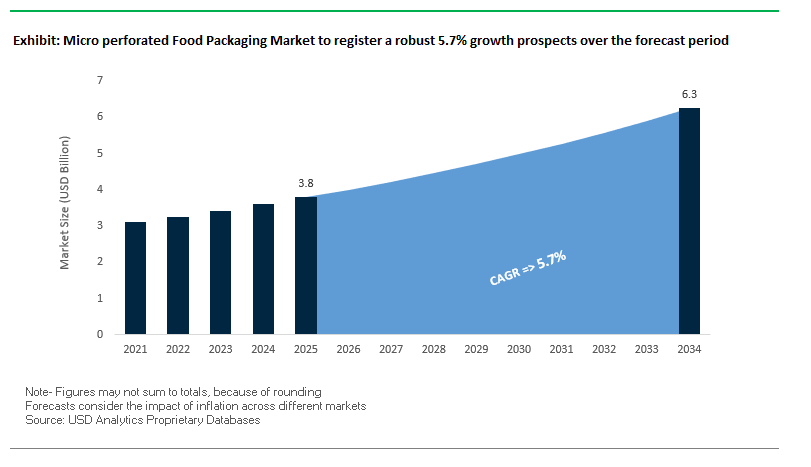
The global Micro-Perforated Food Packaging Market is projected to grow from $3.8 billion in 2025 to $6.3 billion by 2034, reflecting a CAGR of 5.7%. This growth is driven by the rising demand for fresh, minimally processed foods, the need for extended shelf life, and the adoption of sustainable packaging technologies. Micro-perforated packaging allows for controlled gas exchange, maintaining optimal humidity levels for fruits, vegetables, and ready-to-eat meals, while reducing food spoilage during storage and transportation.
Key Insights for Industry Professionals:
Extended shelf life: Micro-perforated packaging ensures freshness preservation through precise moisture and gas regulation.
Rising fresh produce consumption: Increasing consumer preference for healthy, minimally processed foods is a key driver.
Technological advancements: Laser micro-perforation technology enables precise hole sizes, customizable for different food respiration rates.
Convenience solutions: Self-venting packaging for microwaveable food meets consumer demand for ready-to-eat meals.
Sustainability trends: Adoption of eco-friendly, recyclable materials enhances environmental footprint while maintaining product quality.
The micro-perforated food packaging industry has witnessed significant technological innovations and strategic initiatives recently. In August 2025, studies highlighted that the Asia-Pacific region is poised for rapid growth due to its robust manufacturing sector and expanding food and beverage industry, driving demand for advanced packaging solutions.
By July 2025, reports indicated that established converters are investing in wider, faster coating lines to enhance scale and reduce costs, while innovators focused on recycling-ready structures, reinforcing sustainability. In May 2025, Mondi launched a new €400 million paper machine at its Štětí mill, strengthening its sustainable paper-based packaging portfolio, including micro-perforated products for fresh produce. Earlier, in March 2025, Mondi reported strong results for its flexible packaging segment, which includes metallized and micro-perforated films, highlighting growing adoption across food applications.
Notable product innovations include the February 2025 launch by Mondi and Proquimia of a paper-based stand-up pouch for dishwashing tabs, demonstrating the application of micro-perforation technology for functional and sustainable packaging. Strategic acquisitions such as Sonoco Products Company's purchase of Eviosys in November 2024 further expanded capabilities in metal and aerosol packaging, indirectly benefiting micro-perforated offerings. A major early innovation was the January 2024 development by PerfoTec, introducing a laser micro-perforated bag system extending the shelf life of spinach (21 days) and bananas (3 weeks), underscoring the market's focus on food preservation and technological excellence.
Transformative Trends and Strategic Opportunities in the Micro Perforated Food Packaging Market
Precision Perforation for Extended Shelf-Life of Respiring Produce
The micro perforated food packaging market is being reshaped by the demand for precision-engineered films that extend the shelf life of fresh produce. Unlike generic perforation, today’s innovation focuses on customizing hole size, density, and pattern for individual fruits and vegetables, creating a modified atmosphere that balances O₂ (3–5%) and CO₂ (5–10%) to slow down respiration and spoilage.
Food waste is a major global concern, with the FAO estimating 1.3 billion metric tons wasted annually. Micro-perforated films address this by delaying microbial growth, retaining moisture, and protecting nutritional and visual quality. For instance, a technical supplier documented that produce packaged with specific MAP (Modified Atmosphere Packaging) films maintained moisture loss rates below 1% over 18 days, ensuring fresher appearance, weight retention, and consumer appeal.
Laser precision technologies are now replacing mechanical methods, offering greater reliability and uniformity in perforation. For fresh-cut vegetables, this means extending marketable shelf life while aligning with retailer demands for reduced shrinkage and sustainability. Precision perforation is thus emerging as a key enabler in reducing food waste across the global fresh produce supply chain.
Integration of Perforation with Sustainable and Mono-Material Films
Sustainability mandates are driving a convergence between micro-perforation functionality and recyclable mono-material films. Traditionally, multilayer flexible packaging presented recycling challenges, but the adoption of polyolefin-based mono-material structures (PE and PP) is changing the paradigm. These films are fully compatible with recycling streams, but applying perforations without compromising barrier performance requires advanced laser-based technology.
The HolyGrail 2.0 initiative, a pan-European collaboration, is validating the use of digital watermarks for precision sorting of micro-perforated packaging into high-purity recycling streams. This supports the EU Packaging and Packaging Waste Regulation (PPWR) targets, which require all packaging to be recyclable by 2030.
Meanwhile, corporate commitments from leading retailers and FMCG brands, pledging 100% recyclable or compostable packaging by 2030 are accelerating investments in recyclable perforated films. This dual innovation ensures that micro-perforated packaging not only extends shelf life but also contributes to closed-loop sustainability models.
Development of Perforated Active and Intelligent Packaging
The next frontier lies in combining micro-perforation with active and intelligent packaging technologies. Future-ready films will integrate moisture absorbers, oxygen scavengers, and ethylene absorbers alongside perforation to create a dynamic protective environment tailored to each product.
Active packaging innovations have shown that oxygen scavengers extend leafy green freshness, while integrated ethylene absorbers slow climacteric fruit ripening, reducing waste and ensuring peak condition at the point of sale. Intelligent packaging takes this further by embedding time-temperature indicators (TTIs) or color-changing oxygen sensors, alerting consumers if the package atmosphere has been compromised.
This combination of active shelf-life extension with real-time spoilage indicators gives consumers greater confidence, while providing retailers and suppliers with tools to reduce shrinkage. Micro-perforated films enhanced with intelligent features are positioned to become a premium solution in high-value produce and ready-to-eat packaging markets.
Precision Perforation for Controlled Ripening and Ethylene Management
A breakthrough opportunity for the market is the use of precision perforation not just for preservation but for controlled ripening of climacteric fruits such as bananas, avocados, and mangoes. These fruits release ethylene gas post-harvest, which accelerates ripening and often leads to retail-level spoilage.
By precisely regulating gas permeability, packaging can either slow or accelerate ripening to align with logistics. The USDA highlights that high CO₂ levels can inhibit ethylene action, delaying ripening, while customized O₂/CO₂ ratios can create a “just-in-time” ripening effect for retailers.
This ability to control ripening on demand gives distributors and retailers unprecedented flexibility, reducing losses in transit and on the shelf. Controlled-ripening micro-perforated films represent a powerful opportunity to optimize supply chains, enhance consumer satisfaction, and significantly cut waste in the global fruit industry.
Competitive Landscape: Leading Companies in the Global Micro-Perforated Food Packaging Industry
The global micro-perforated food packaging market is led by companies that combine advanced material science, sustainability, and precision engineering. These players are recognized for providing freshness-preserving, convenience-oriented, and eco-friendly packaging solutions, serving the fresh produce, bakery, and perishable food industries worldwide.
Amcor plc: Driving Fresh Produce Innovation with Micro-Perforated Films
Amcor is a global leader in flexible and rigid packaging solutions, offering micro-perforated products for fresh produce, bakery items, and other perishables. Its P-Plus Films are engineered with precise perforations, optimizing respiration rates and extending refrigerated shelf life. In July 2025, Amcor upgraded its Heanor, UK recycling facility, reinforcing its sustainability commitment. Amcor’s strategy emphasizes recyclable packaging, lightweighting, and material innovation, supported by a full suite of design, manufacturing, and logistics services.
Mondi Group: Advancing Sustainable Micro-Perforated Paper Packaging
Mondi is a global leader in packaging and paper, offering micro-perforated papers for fresh and processed foods. In August 2025, Mondi ramped up production of its FunctionalBarrier Paper Ultimate, providing ultra-high oxygen and water vapor barriers. The company focuses on value-accretive, sustainable growth, co-innovating with clients to develop fiber and high-end sustainable packaging products. Mondi’s portfolio includes stand-up pouches and functional barrier papers, micro-perforated for specific applications like coffee sticks and muesli bars.
Sealed Air Corporation: Extending Shelf Life with Precision Micro-Perforation
Sealed Air specializes in protective and food packaging, with micro-perforated solutions designed to reduce food waste and extend shelf life. Leveraging materials science expertise, Sealed Air addresses critical global resource challenges while enhancing supply chain efficiency. Its strategic expansions into Western Europe (1970s) and the Far East (late 1970s) have established a strong global footprint, enabling localized, sustainable packaging solutions.
Uflex Ltd.: Innovating Oxygen Barrier Films for Fresh Foods
Uflex is a major Indian multinational and global flexible packaging leader. The company offers micro-perforated metallized and flexible films for food, pharmaceutical, and industrial applications. Its F-ETB-M Film, a metallized, easy-tear BOPET product, delivers superior oxygen barrier properties for items like biscuits and mouth fresheners. Uflex invests heavily in R&D, sustainable technologies, and global manufacturing expansion to meet rising market demand.
Bemis Company, Inc. (part of Amcor): Legacy in Flexible Food Packaging
Bemis, acquired by Amcor in June 2019, was a global manufacturer of flexible packaging products, including self-venting cook-in-bags and retort packaging. Its expertise in polymer chemistry, film extrusion, and printing enabled high-performance packaging solutions. Nearly two-thirds of its products were used in the food industry, while the remainder supported medical, pharmaceutical, and agribusiness applications, reinforcing Amcor’s micro-perforated packaging capabilities.
Fresh Fruits & Vegetables Dominate Market Share by Application in the Micro-Perforated Food Packaging Industry
Fresh fruits and vegetables account for 65% of the micro-perforated food packaging market, making this segment the undisputed leader. The dominance comes from the unique respiration management needs of fresh produce, where laser-drilled micro-holes in packaging films regulate oxygen and carbon dioxide exchange to slow spoilage and extend shelf-life. For example, mushrooms require highly specific perforation patterns to prevent discoloration, while leafy greens rely on controlled permeability to maintain freshness without condensation buildup. The segment’s leadership is reinforced by global retail demand for reduced food waste, year-round availability of produce, and stricter supermarket requirements for consistent shelf performance. With urban consumers increasingly purchasing packaged fresh produce over loose alternatives, the fresh fruits and vegetables application secures its position as the core revenue driver in this industry.
Food Manufacturers Lead Market Share by End-User in the Micro-Perforated Food Packaging Industry
Food manufacturers represent 45% of demand for micro-perforated food packaging, establishing themselves as the primary specifiers and users of the technology. Their leadership is tied to the integration of micro-perforation directly into high-speed packaging lines for products like salad kits, fresh-cut fruits, and baked goods. Manufacturers rely on tailored perforation designs to ensure product safety, extend shelf-life, and preserve texture, which directly impacts brand reputation and retail acceptance. This segment’s dominance is also reinforced by its close alignment with private-label supermarket requirements and regulatory standards for packaging that minimizes food waste. As consumer expectations shift toward freshness and convenience, food manufacturers continue to drive adoption of advanced micro-perforation systems that balance barrier protection with breathability, making them the central force behind the market’s expansion.
United States: Precision Laser Perforation Driving Fresh Food Shelf-Life Extension
The U.S. micro perforated food packaging market is highly shaped by regulatory frameworks, particularly the Food Safety Modernization Act (FSMA), along with enforcement from the USDA, FDA, and EPA. One of the strongest regulatory drivers is the national push to reduce food loss and waste, where micro-perforated films are being positioned as critical packaging technologies that extend the shelf life of fresh produce. State-level initiatives further strengthen the emphasis on sustainable, recyclable, and food-safe materials, ensuring the industry remains highly compliance-driven.
On the technology front, the U.S. is a frontrunner in precision laser perforation systems, which allow manufacturers to design product-specific perforation patterns that match the respiration needs of fruits, vegetables, and bakery products. These systems use computer-aided design (CAD) to deliver consistency and efficiency, minimizing waste while enhancing freshness. Corporate investment is also robust—Sealed Air’s Cryovac division and Amcor plc are spearheading innovations in meat, poultry, and bakery packaging with high-performance micro-perforated films. With strong adoption across fresh produce, bakery, and ready-to-eat meals, coupled with rising e-commerce grocery and meal delivery services, the U.S. stands as one of the most advanced and influential markets globally.
Germany: Circular Economy and Modified Atmosphere Packaging Boost Market Growth
Germany’s micro perforated food packaging industry is underpinned by the European Union’s Packaging and Packaging Waste Regulation (PPWR), implemented in January 2025. These stringent regulations prioritize recyclability and sustainable materials, compelling manufacturers to align with circular economy principles. German producers are therefore leading in the development of eco-friendly micro-perforated films designed for high recyclability and compatibility with closed-loop systems.
Technological innovation is a hallmark of Germany’s market, with a strong emphasis on advanced film-coating and printing technologies as well as recycled content integration. A major trend is the use of modified atmosphere packaging (MAP) combined with micro-perforations, particularly in berries and leafy greens, to extend freshness and reduce waste. Germany’s leadership in recycling infrastructure further accelerates adoption, with retailers like Lidl integrating micro-perforated solutions in fresh produce and dairy categories. This combination of regulation, technology, and circular economy leadership makes Germany a benchmark market for sustainable micro-perforated food packaging in Europe.
China: Government Reforms and AI-Driven Manufacturing Fuel Expansion
China’s micro perforated food packaging market is being rapidly advanced through strong governmental initiatives that support the high-end manufacturing sector. Policies emphasize accelerating standards for new technologies, simplifying approval processes, and aligning with dual-carbon sustainability targets. These measures are shaping a packaging landscape focused on energy efficiency, lower emissions, and compliance with global benchmarks.
Regulatory reforms are equally impactful, with updates to GB 4806.1 Food Contact Materials Standards, ensuring stricter safety and quality compliance for packaging used in food applications. At the industrial level, Chinese manufacturers are investing heavily in automation and artificial intelligence (AI) to enhance quality control and streamline large-scale production. Demand is particularly strong due to rising urbanization, disposable income growth, and the surge in supermarkets and e-commerce grocery platforms. Applications in fresh fruits, vegetables, and ready-to-eat meals are expanding quickly, making China a high-growth market with increasing dominance in Asia-Pacific.
United Kingdom: Biodegradable Films and Retail Innovation Redefine Market Standards
The UK micro perforated food packaging industry is shaped by government policies aligned with EU plastic waste and single-use plastics regulations, driving rapid innovation in biodegradable and compostable films. Local manufacturers are heavily focused on developing plant-based micro-perforated packaging made from renewable materials such as corn starch and sugarcane, positioning the UK as a leader in green packaging solutions.
Corporate investments are also notable—Coveris has invested heavily in upgrading its manufacturing capabilities to deliver eco-friendly and high-performance perforated packaging. Technological progress is directed toward new-generation extrusion and pre-stretch assets to meet industrial and agricultural needs, while retail adoption is rapidly growing. Supermarkets like Tesco are embracing micro-perforated packaging to enhance the freshness of bakery and produce items, reduce food waste, and respond to consumer preferences for sustainability. The UK is thus balancing innovation with strong retail-driven adoption, reinforcing its role as a dynamic and eco-conscious market in Europe.
India: Government Incentives and Recycling Investments Power Market Transformation
India’s micro perforated food packaging market is experiencing robust growth, fueled by government-led programs such as Make in India and the Production Linked Incentive (PLI) scheme, which encourage domestic manufacturing and investment in the packaging sector. The government’s broader push for a circular economy aligns closely with innovations in recyclable and sustainable materials. Moreover, regulatory measures from the Central Pollution Control Board (CPCB), including mandatory Extended Producer’s Responsibility (EPR) registration for plastic packaging, are reshaping industry compliance standards.
The technological landscape is evolving rapidly, with companies like Uflex Ltd. launching barrier-coated paper-based micro-perforated packaging for single-serve food and beverage sachets, helping reduce plastic use. The sector is also seeing significant corporate investments in R&D and new manufacturing plants. Notably, the Huhtamaki Foundation’s CloseTheLoop initiative, with a ₹10 crore (US$1.18 million) investment in recycling facilities, is reinforcing India’s transition toward sustainable packaging. Rising demand from e-commerce, pharmaceuticals, and consumer foods further amplifies India’s role as a fast-emerging hub for micro perforated food packaging in Asia.
US, Canada, Mexico, Germany, France, Spain, Italy, UK, Russia, China, India, Japan, South Korea, Australia, South East Asia, Brazil, Argentina, Middle East, Africa
Europe (Germany, UK, France, Spain, Italy, Russia, Rest of Europe)
Asia Pacific (China, India, Japan, South Korea, Australia, South East Asia, Rest of Asia)
South America (Brazil, Argentina, Rest of South America)
Middle East and Africa (Saudi Arabia, UAE, Rest of Middle East, South Africa, Egypt, Rest of Africa)
Top Companies in Micro perforated Food Packaging Market
Amcor plc
Sealed Air
Constantia Flexibles
Uflex Limited
Huhtamaki
Mondi Group
Bolloré
Coveris
A·ROO Company
Specialty Polyfilms
Prism Pak, Inc.
Greendot Biopak Pvt. Ltd.
Crystal Vision Packaging
KM Packaging Services Ltd.
PerfoTec
* List Not Exhaustive
Methodology
USDAnalytics employs a comprehensive research methodology to provide industry professionals with actionable insights on the global Micro-Perforated Food Packaging Market. Our approach integrates primary research through interviews with packaging engineers, food manufacturers, supply chain experts, and retail stakeholders, alongside secondary research from company filings, regulatory reports, patent literature, and scientific publications. We analyze key market drivers such as precision micro-perforation for fresh produce, integration with sustainable and mono-material films, active and intelligent packaging technologies, and controlled ripening solutions. Advanced forecasting models are used to assess regional trends, regulatory impacts, technological adoption, and competitive dynamics across the U.S., Europe, China, India, and the UK. Additionally, USDAnalytics evaluates strategic initiatives, including corporate mergers, R&D investments, and production scale expansions, while examining material performance, barrier properties, and environmental compliance. This methodology ensures a robust, data-driven understanding of market growth, emerging opportunities, and technological innovation in micro-perforated food packaging, providing professionals with actionable insights for strategic planning and investment decisions.
Deliverables:
Comprehensive Market Research Report (PDF and Excel) with detailed tables, charts, and interactive visualizations.
Country-Specific Forecasts & Analysis.
Segment-Wise Revenue Forecasts (2025–2034).
Competitive Analysis, Benchmarking, and SWOT Profiles.
Recent Developments & Innovation Tracker.
Executive Summary & Analyst Commentary.
Post-Purchase Analyst Support for Client-Specific Questions and Custom Data Requirements.
Table of Contents: Micro-Perforated Food Packaging Market
1. Executive Summary
1.1. Market Highlights
1.2. Key Findings
1.3. Global Market Snapshot
2. Micro-Perforated Food Packaging Market Landscape & Outlook (2025–2034)
2.1. Introduction to Micro-Perforated Food Packaging Market
2.2. Market Valuation and Growth Projections (2025–2034)
2.3. Market Drivers and Trends
2.4. Recent Developments
2.5. Regulatory and Sustainability Overview
3. Innovations Reshaping the Micro-Perforated Food Packaging Market
3.1. Trend: Precision Perforation for Extended Shelf-Life of Respiring Produce
3.2. Trend: Integration of Perforation with Sustainable and Mono-Material Films
3.3. Opportunity: Development of Perforated Active and Intelligent Packaging
3.4. Opportunity: Precision Perforation for Controlled Ripening and Ethylene Management
4. Competitive Landscape and Strategic Initiatives
4.1. Mergers, Acquisitions and Strategic Alliances
4.2. R&D and Material Innovation
4.3. Sustainability and Strategies
4.4. Market Expansion and Regional Focus
5. Market Share and Segmentation Insights: Micro-Perforated Food Packaging Market
5.1. By Material
5.1.1. PE
5.1.2. PP
5.1.3. PET
5.1.4. Others
5.2. By Application
5.2.1. Fresh Fruits & Vegetables
5.2.2. Bakery & Confectionery
5.2.3. Ready-to-Eat Food
5.2.4. Others
5.3. By End-User
5.3.1. Food Manufacturers
5.3.2. Supermarkets & Retailers
5.3.3. Agricultural Producers
5.3.4. Food Service Providers
5.4. By Perforation Technology
5.4.1. Laser Perforation
5.4.2. Needle Perforation
5.4.3. Mechanical Perforation
6. Country Analysis and Outlook of Micro-Perforated Food Packaging Market
6.1. United States
6.2. Canada
6.3. Mexico
6.4. Germany
6.5. France
6.6. Spain
6.7. Italy
6.8. UK
6.9. Russia
6.10. China
6.11. India
6.12. Japan
6.13. South Korea
6.14. Australia
6.15. South East Asia
6.16. Brazil
6.17. Argentina
6.18. Middle East
6.19. Africa
7. Micro-Perforated Food Packaging Market Size Outlook by Region (2025-2034)
7.1. North America Market Size Outlook to 2034
7.1.1. By Material
7.1.2. By Application
7.1.3. By End-User
7.1.4. By Perforation Technology
7.2. Europe Market Size Outlook to 2034
7.2.1. By Material
7.2.2. By Application
7.2.3. By End-User
7.2.4. By Perforation Technology
7.3. Asia Pacific Market Size Outlook to 2034
7.3.1. By Material
7.3.2. By Application
7.3.3. By End-User
7.3.4. By Perforation Technology
7.4. South America Market Size Outlook to 2034
7.4.1. By Material
7.4.2. By Application
7.4.3. By End-User
7.4.4. By Perforation Technology
7.5. Middle East and Africa Market Size Outlook to 2034
7.5.1. By Material
7.5.2. By Application
7.5.3. By End-User
7.5.4. By Perforation Technology
8. Company Profiles: Leading Players in the Micro-Perforated Food Packaging Market
8.1. Amcor plc
8.2. Sealed Air
8.3. Constantia Flexibles
8.4. Uflex Limited
8.5. Huhtamaki
8.6. Mondi Group
8.7. Bolloré
8.8. Coveris
8.9. A·ROO Company
8.10. Specialty Polyfilms
8.11. Prism Pak, Inc.
8.12. Greendot Biopak Pvt. Ltd.
8.13. Crystal Vision Packaging
8.14. KM Packaging Services Ltd.
8.15. PerfoTec
9. Methodology
9.1. Research Scope
9.2. Market Research Approach
9.3. Market Sizing and Forecasting Model
9.4. Research Coverage
9.5. Data Horizon
9.6. Deliverables
10. Appendix
10.1. Acronyms and Abbreviations
10.2. List of Tables
10.3. List of Figures
Micro-perforated packaging extends the shelf life of fruits and vegetables by enabling controlled gas exchange and humidity regulation. It slows respiration, reduces microbial growth, and preserves nutritional quality, freshness, and visual appeal, making it essential for retailers and food manufacturers.
Laser perforation allows precise control over hole size, density, and pattern, tailored to each product’s respiration needs. This ensures consistent freshness, reduces food waste, and supports high-speed packaging lines for fresh-cut fruits, leafy greens, and ready-to-eat meals.
Sustainable films, including recyclable mono-material PE and PP or paper-based options, allow for eco-friendly micro-perforation without compromising barrier performance. Adoption of these materials helps meet regulatory mandates, corporate ESG goals, and consumer demand for environmentally responsible packaging.
Active and intelligent packaging combines micro-perforation with oxygen scavengers, ethylene absorbers, and time-temperature indicators. This integration extends shelf life, enables controlled ripening, and provides real-time spoilage alerts, enhancing supply chain efficiency and consumer confidence.
The U.S. leads in precision laser perforation and regulatory compliance; Germany drives circular economy initiatives and modified atmosphere packaging; China advances AI-driven production; India benefits from government incentives and recycling programs; the UK focuses on biodegradable films and retail-driven innovation, collectively shaping global market trends.