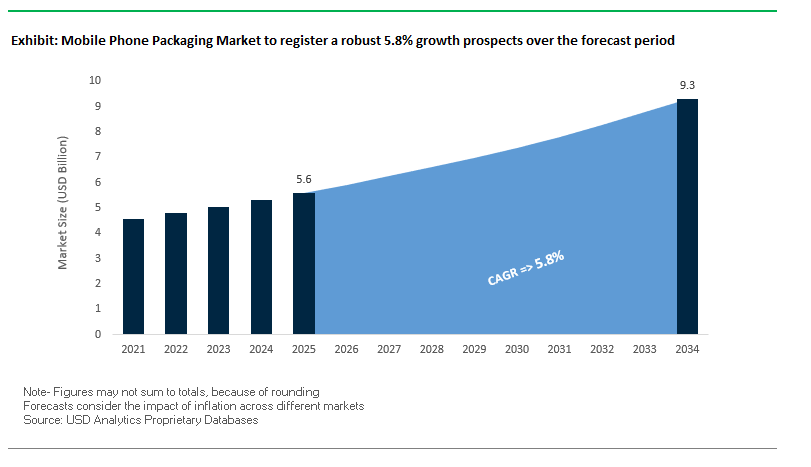
Mobile Phone Packaging Market Growth Forecast: $5.6 Billion in 2025 to $9.3 Billion by 2034 at 5.8% CAGR
The global mobile phone packaging market is projected to grow from $5.6 billion in 2025 to $9.3 billion by 2034, exhibiting a CAGR of 5.8%. Growth is primarily driven by sustainability initiatives, the premiumization of unboxing experiences, and e-commerce protective packaging innovations. Packaging manufacturers are increasingly adopting eco-friendly materials, interactive technologies, and lightweight composites to meet consumer and regulatory demands.
Key Insights for Industry Stakeholders
Elimination of single-use plastics: Companies like Samsung aim to remove plastics from mobile packaging entirely by 2025, reflecting a broader trend toward sustainable packaging solutions.
Luxury and consumer engagement: Innovative designs using magnetic closures, pull-tabs, and premium finishes enhance the unboxing experience, driving brand differentiation.
E-commerce resilience: Packaging must be durable, lightweight, and shock-resistant, supporting safe delivery in global online retail channels.
Smart technology integration: QR codes and NFC tags are increasingly embedded into packaging, enabling product verification, consumer interaction, and enhanced brand loyalty.
Material innovation and lightweighting: Adoption of metallized films, composite inserts, and biodegradable materials is reshaping mobile packaging to improve efficiency and environmental performance.
Market Analysis: Material Innovations Driving Mobile Phone Packaging
Recent developments highlight significant material, sustainability, and technology trends shaping the global mobile phone packaging landscape. In August 2025, the rapid substitution of aluminum foil with lightweight metallized films demonstrated cost-effective, durable alternatives for interior trays and inserts, potentially enhancing packaging protection for high-value devices. Simultaneously, a liquid-metal printing process enabling ultra-thin indium tin oxide (ITO) films may influence how devices are secured inside packaging while improving flexibility and transparency.
July 2025 marked a critical consolidation event with WestRock and Smurfit Kappa merging to form Smurfit WestRock, strengthening their capacity to serve global mobile phone packaging demands. Sustainability remains a priority, as recyclable plastics show 34% adoption, and biodegradable materials reach 28%, particularly appealing to environmentally conscious consumers. By June 2025, copper adoption in metallic films surged, driven by high-power battery packs and 5G device requirements, highlighting the intersection of packaging with emerging electronics technology.
Earlier innovations include April 2025 studies emphasizing the rising demand for protective and sustainable packaging that prolongs product shelf life, and February 2025 launches of paper-based stand-up pouches by Mondi and Proquimia, demonstrating the potential of paper alternatives for electronics packaging. In February 2024, companies such as Corplex, Packeta, and Slovak Telekom successfully implemented reusable e-commerce boxes featuring QR-based product tracking, proving the feasibility of circular economy packaging solutions.
Trends and Opportunities Transforming the Mobile Phone Packaging Market
Elimination of Plastic and Shift to Fiber-Based Monomaterial Structures
The mobile phone packaging market is undergoing a decisive shift away from plastic laminates and inserts toward 100% fiber-based monomaterial systems, driven by Extended Producer Responsibility (EPR) regulations, corporate sustainability goals, and circular economy principles. Major OEMs are leading this transition. Google announced in August 2024 that all Pixel hardware packaging is now 100% plastic-free, using stretchable paper and molded pulp from recycled newspapers. Apple has also accelerated its transformation, with the iPhone 15 Pro series reaching 99% fiber-based packaging, ahead of its 2025 target. Samsung has followed suit, cutting plastic in its Galaxy smartphone packaging from 51% in 2017 to just 4% in 2024, and committing to complete elimination by 2025.
The EU Packaging and Packaging Waste Regulation (PPWR), approved in late 2024, has intensified this momentum by enforcing mandatory recyclability and recycled content targets. These regulations are compelling brands to adopt simplified monomaterial packaging to ensure clean recovery streams. The combination of regulatory pressure, corporate commitments, and consumer demand for sustainable packaging positions fiber-based designs as the dominant trend in the next phase of the mobile phone packaging industry.
Supply Chain-Led Packaging Miniaturization and Logistics Optimization
Another powerful trend shaping the mobile phone packaging market is packaging miniaturization, which directly contributes to lower Scope 3 emissions, optimized logistics, and reduced material usage. OEMs are redesigning boxes to be smaller and lighter, while maintaining protective performance. Apple’s redesign of the iPhone 16 Pro and Pro Max packaging resulted in a 6% reduction in box volume, translating into a 3% drop in transportation-related carbon emissions by allowing more units per pallet.
This shift is not new—Apple’s packaging strategy as far back as the iPhone 7 reduced plastic by 84% compared to the iPhone 6s, using compact fiber-based trays. Google’s sustainability reports similarly highlight packaging optimization as a critical tool to lower its device supply chain footprint, even when overall product emissions fluctuate. By combining smaller box sizes, reduced weight, and fiber-based inserts, manufacturers achieve both economic efficiency and sustainability alignment, making miniaturization a long-term packaging trend across the mobile phone industry.
Integration of Digital Watermarking for Enhanced Recycling and Consumer Engagement
The integration of digital watermarking technologies—pioneered through the HolyGrail 2.0 initiative—presents a transformative opportunity for mobile phone packaging. These nearly invisible codes, printed directly on fiber-based mobile phone boxes, can be detected by high-resolution scanners in recycling facilities, enabling high-purity paper stream sorting and significantly improving recyclability outcomes.
Beyond recycling, digital watermarks open new avenues for interactive consumer engagement. By scanning the code with a smartphone, users can access digital manuals, sustainability credentials, warranty information, or exclusive multimedia content. Brands can leverage this to enhance the unboxing experience, personalize communication, and strengthen customer loyalty. This dual function—closing recycling loops and building digital engagement platforms—positions digital watermarking as one of the most impactful near-term opportunities in mobile phone packaging.
Development of Protective Bio-Based and Molded Fiber Cushioning
The global phase-out of plastic foams (EPS inserts) has created a critical opening for bio-based cushioning solutions that combine product protection with compostability. Companies are investing in molded pulp made from sugarcane bagasse, bamboo, and recycled newspaper, as well as mycelium-based composites, to provide sustainable alternatives to plastic trays and holders. Samsung has already replaced many plastic accessory trays with recycled pulp molds, ensuring comparable strength with reduced environmental impact.
Bio-based cushioning not only aligns with corporate zero-plastic goals but also diverts agricultural waste streams from landfills, creating renewable raw materials for packaging. Research on agricultural waste utilization demonstrates the dual benefit of reducing reliance on virgin resources while providing consumers with home-compostable inserts. As circular economy frameworks expand, protective bio-based cushioning will play a pivotal role in ensuring mobile phone packaging achieves both sustainability and product protection targets.
Competitive Landscape of Global Mobile Phone Packaging: Leading Innovators
The mobile phone packaging industry is increasingly shaped by sustainability-driven innovation, e-commerce resilience, and premium design capabilities. Market leaders differentiate through advanced materials, smart packaging technologies, and strategic mergers.
Amcor plc: Championing Recyclable and High-Performance Packaging
Amcor is a global leader in flexible and rigid packaging, providing folding cartons, rigid boxes, and flexible films for mobile phones and accessories. In July 2025, Amcor upgraded its Heanor, UK recycling facility to strengthen high-performance recycling capabilities in Europe. The company focuses on sustainability, lightweighting, and material innovation, aiming for all packaging to be recyclable or reusable by 2025. Its products are used in primary mobile phone packaging and protective accessory packaging, balancing durability with premium presentation.
Sonoco Products Company: Sustainable Paperboard and Molded Fiber Expertise
Sonoco specializes in paperboard and molded fiber packaging critical for mobile phone boxes and custom-fit inserts. In November 2024, the acquisition of Eviosys enhanced its global footprint and capabilities in innovative packaging solutions. Sonoco focuses on lightweight, recyclable materials and serves as a key supplier for brands requiring durable, environmentally responsible packaging for smartphones and accessories.
Smurfit WestRock: Merging Scale with Eco-Friendly Paper-Based Packaging
Following the July 2025 merger of WestRock and Smurfit Kappa, Smurfit WestRock offers an extensive portfolio of folding cartons and corrugated containers for mobile phones. The merger enhances global supply capabilities, while its strategy emphasizes recycled and renewable materials to reduce environmental footprint. The company provides premium-quality packaging for retail display and secure e-commerce delivery.
Mondi delivers innovative paper and flexible packaging solutions for mobile phones, combining sustainability with aesthetic appeal. In May 2025, the company commissioned a €400 million paper machine at its Štětí mill, expanding production of high-quality, recyclable materials. Mondi’s offerings include fiber-based pouches and functional barrier papers, supporting both premium unboxing experiences and environmental goals.
Pragati Pack specializes in high-end, consumer-facing packaging, including rigid boxes and folding cartons for mobile phones and tablets. Its core strength is in producing highly customized packaging that enhances brand image and the unboxing experience, leveraging advanced printing and finishing technologies. Pragati Pack emphasizes sustainability, quality, and innovation, making it a preferred partner for global electronics brands seeking differentiated packaging solutions.
Mobile Phone Packaging Market Share Insights
Folding Cartons Retain the Largest Market Share by Packaging Type in the Mobile Phone Packaging Industry
Folding cartons dominate the mobile phone packaging market with 45% share in 2025, owing to their unmatched balance of cost-efficiency, sustainability, and brand presentation. They are the go-to solution for mid-range and budget smartphones, as well as accessories, because they ship flat, reduce logistics costs, and support high-speed automated filling. Their printability enables vibrant branding, regulatory labeling, and anti-counterfeiting features, which are critical in a fiercely competitive smartphone market. While rigid boxes remain indispensable for premium flagships and flexible films are rapidly expanding in accessory packaging, folding cartons maintain leadership by addressing the industry’s need for high-volume, eco-friendly, and versatile packaging. Insert trays and thermoformed blisters serve more specialized roles, but their shares remain secondary compared to cartons, which have become the backbone of smartphone packaging strategies worldwide.
Smartphones Drive the Largest Market Share by Application in the Mobile Phone Packaging Industry
Smartphones account for 65% of the application share in 2025, making them the single largest consumer of packaging in this industry. This dominance is driven by the enormous global shipment volumes of smartphones, which demand both premium packaging for flagships and cost-effective folding cartons for mass-market models. Packaging here is not merely protective but a core part of brand strategy, with unboxing experiences shaping consumer perception and loyalty. Accessories, while commanding a strong 25% share, rely more on flexible, lightweight formats, particularly as e-commerce accelerates. Refurbished phones are a fast-growing application, leaning heavily on sustainable, no-frills recycled cartons to align with the circular economy. Feature phones continue to shrink into a niche, relying on the lowest-cost blisters. Collectively, smartphones remain the centerpiece of packaging innovation, sustainability adaptation, and supply chain efficiency in this market.
United States: EPR Laws and Smart Packaging Technologies Reshape Consumer Experiences
The United States mobile phone packaging market is rapidly adapting to Extended Producer Responsibility (EPR) laws, with California’s SB 54 standing out as a landmark regulation. By requiring producers to fund end-of-life packaging management, this regulation is accelerating the transition toward recyclable, plastic-free, and sustainable phone boxes. Leading companies are also exploring smart packaging technologies that integrate NFC tags and QR codes to provide augmented reality experiences, product authentication, and real-time supply chain traceability. A notable example is Google’s Pixel 8 series, launched in late 2024 with 100% plastic-free packaging, reflecting a broader industry trend toward sustainability. With premium and mid-tier smartphones both demanding unique unboxing experiences, features such as magnetic closures, embossed logos, and sustainable rigid boxes are becoming mainstream. The U.S. market is also witnessing investments in localized production facilities to reduce exposure to global trade disruptions while capitalizing on high consumer expectations for innovative and eco-friendly mobile phone packaging.
Germany: EU Packaging Regulations and Circular Economy Leadership Drive Innovation
Germany is at the forefront of the European Union’s Packaging and Packaging Waste Regulation (PPWR), which came into effect in January 2025. This framework prioritizes recyclability and recycled content, putting pressure on packaging manufacturers to replace plastics with fiber-based alternatives and recycled paperboard. German companies, recognized globally for their strength in material science, are investing in high-performance, lightweight packaging solutions that balance durability with sustainability. With one of the world’s most advanced recycling infrastructures, Germany also leads the adoption of mono-material and circular packaging designs for smartphones. Corporate investments in R&D are creating next-generation packaging with advanced adhesive formulations and protective designs, ensuring compliance with EU mandates while serving the premium smartphone packaging market. This makes Germany a role model for the integration of circular economy principles in mobile phone packaging.
China: Domestic Innovation and Automation Fuel High-Volume Smartphone Packaging
China’s mobile phone packaging market is benefiting from strong government support for high-end manufacturing. Fast-tracked approval processes and new standards for packaging technologies are fostering rapid innovation. Domestic producers are leading in automation and digital printing, enabling cost-efficient, on-demand, and highly customized mobile phone packaging that caters to the branding needs of both global giants and local smartphone companies. Multinational brands are also expanding production facilities in China to shorten supply chains, boosting demand for local packaging suppliers. With China’s rapidly growing consumer electronics industry, the demand for premium packaging that combines aesthetics, durability, and sustainability is surging. The increasing use of digital printing and smart customization is ensuring that Chinese mobile phone packaging can deliver both functionality and visual appeal, particularly in the competitive premium smartphone market.
India: Make in India and PLI Scheme Boost Domestic Mobile Phone Packaging Manufacturing
India is emerging as a major hub for mobile phone packaging production, strongly driven by the government’s Make in India initiative and the Production Linked Incentive (PLI) scheme. In 2024, India inaugurated its first tempered glass manufacturing facility for mobile devices, expanding the local ecosystem of phone packaging and components. The Central Pollution Control Board’s (CPCB) EPR regulations on plastic packaging are also reshaping the industry by encouraging manufacturers to invest in sustainable alternatives and register compliance for imports. The Indian market is experiencing rapid adoption of advanced packaging solutions to meet the demands of its booming e-commerce and smartphone industries, with a focus on lightweight, durable, and visually appealing designs. Major investments, such as Samsung’s world’s largest mobile phone factory in India, reinforce the country’s role in both domestic and export-oriented smartphone packaging. As branding becomes critical for online sales, demand is accelerating for cost-effective yet high-quality unboxing experiences across the Indian mobile phone packaging sector.
United Kingdom: Premium Smartphone Packaging Strengthened by Sustainability Initiatives
The United Kingdom mobile phone packaging market is strongly influenced by the Smart Sustainable Plastic Packaging (SSPP) challenge, which funds over 70 innovation projects to drive the development of eco-friendly alternatives to single-use plastics. The UK is aligning with the EU’s plastic waste reduction goals while promoting biodegradable films and bio-based materials. Local companies are focusing on advanced extrusion technologies and innovative film solutions to improve packaging sustainability. Recent corporate moves, such as Berry Global’s 2025 launch of bio-based polyethylene packaging, reflect the broader commitment to the circular economy. The UK market is particularly strong in the premium mobile phone and accessories segment, where unboxing experience is seen as part of brand identity. Brands are increasingly investing in luxury rigid boxes, high-quality finishing, and custom branding elements to appeal to premium consumers while maintaining eco-friendly practices.
Japan: Precision Manufacturing and Premium Graphics Strengthen Mobile Phone Packaging
Japan’s mobile phone packaging industry is driven by its precision manufacturing expertise, with companies such as Toppan and Dai Nippon Printing setting high standards in sustainable and high-performance packaging solutions. Regulatory oversight from the Pharmaceuticals and Medical Devices Agency (PMDA) enforces strict safety and quality measures, indirectly influencing the wider packaging supply chain. Japanese packaging firms are focusing on thin-walled, high-finish packaging designs that meet the growing demand for premium unboxing experiences across smartphones, cosmetics, and electronics. Innovations include advanced paper-based alternatives and multifunctional packaging with enhanced optical properties, durability, and aesthetic appeal. With a national focus on reducing plastics and ensuring sustainable design, Japan is becoming a leader in premium, eco-friendly mobile phone packaging that balances elegance, functionality, and sustainability.
Mobile Phone Packaging Market Report Scope
Mobile Phone Packaging Market
Parameter
Details
Market Size (2025)
$5.6 Billion
Market Size (2034)
$9.3 Billion
Market Growth Rate
5.8%
Segments
By Packaging Type (Rigid Boxes, Folding Cartons, Flexible Films, Insert Trays, Thermoformed Blisters), By Material (Paper & Paperboard, Plastic, Molded Fiber, Others), By Application (Smartphones, Feature Phones, Refurbished Phones, Accessories), By End-User (Mobile Phone Manufacturers, Accessory Manufacturers, E-commerce Platforms, Retailers)
Study Period
2019- 2024 and 2025-2034
Units
Revenue (USD)
Qualitative Analysis
Porter’s Five Forces, SWOT Profile, Market Share, Scenario Forecasts, Market Ecosystem, Company Ranking, Market Dynamics, Industry Benchmarking
Companies
International Paper Company, WestRock Company, Berry Global Inc., Amcor Plc, Smurfit Kappa Group, Mondi Group, DS Smith, Sealed Air Corporation, Sonoco Products Company, Pragati Pack (India) Pvt. Ltd., Graphic Packaging Holding Company, Huhtamaki Oyj, AR Packaging Group AB, Crown Holdings, Inc., Avery Dennison Corporation
Countries
US, Canada, Mexico, Germany, France, Spain, Italy, UK, Russia, China, India, Japan, South Korea, Australia, South East Asia, Brazil, Argentina, Middle East, Africa
Mobile Phone Packaging Market Segmentation
By Packaging Type
Rigid Boxes
Folding Cartons
Flexible Films
Insert Trays
Thermoformed Blisters
By Material
Paper & Paperboard
Plastic
Molded Fiber
Others
By Application
Smartphones
Feature Phones
Refurbished Phones
Accessories
By End-User
Mobile Phone Manufacturers
Accessory Manufacturers
E-commerce Platforms
Retailers
Countries Analyzed
North America (US, Canada, Mexico)
Europe (Germany, UK, France, Spain, Italy, Russia, Rest of Europe)
Asia Pacific (China, India, Japan, South Korea, Australia, South East Asia, Rest of Asia)
South America (Brazil, Argentina, Rest of South America)
Middle East and Africa (Saudi Arabia, UAE, Rest of Middle East, South Africa, Egypt, Rest of Africa)
Top Companies in Mobile Phone Packaging Market
International Paper Company
WestRock Company
Berry Global Inc.
Amcor Plc
Smurfit Kappa Group
Mondi Group
DS Smith
Sealed Air Corporation
Sonoco Products Company
Pragati Pack (India) Pvt. Ltd.
Graphic Packaging Holding Company
Huhtamaki Oyj
AR Packaging Group AB
Crown Holdings, Inc.
Avery Dennison Corporation
* List Not Exhaustive
Methodology
USDAnalytics employs a robust and systematic methodology to deliver accurate insights into the global Mobile Phone Packaging Market. Our approach integrates primary research, including interviews with packaging engineers, supply chain specialists, mobile device OEMs, and sustainability consultants, alongside secondary research sourced from corporate reports, regulatory filings, patent databases, scientific publications, and trade journals. We analyze key market drivers such as the shift to fiber-based monomaterial packaging, eco-friendly cushioning materials, e-commerce protective solutions, and smart technology integration like NFC and QR codes. Quantitative analysis incorporates historical data, market sizing, CAGR forecasts, and regional adoption trends across North America, Europe, and Asia-Pacific. Competitive intelligence evaluates innovations, mergers, and sustainability initiatives by leading players such as Amcor, Smurfit WestRock, Mondi, Sonoco, and Pragati Pack, highlighting premium unboxing experiences, digital engagement, and material optimization. This methodology ensures that USDAnalytics provides industry professionals with actionable, data-driven insights to support strategic planning, sustainability adoption, and supply chain optimization in the evolving mobile phone packaging sector.
Deliverables:
Comprehensive Market Research Report (PDF and Excel) with detailed tables, charts, and interactive visualizations.
Country-Specific Forecasts & Analysis.
Segment-Wise Revenue Forecasts (2025–2034).
Competitive Analysis, Benchmarking, and SWOT Profiles.
Recent Developments & Innovation Tracker.
Executive Summary & Analyst Commentary.
Post-Purchase Analyst Support for Client-Specific Questions and Custom Data Requirements.
Table of Contents: Mobile Phone Packaging Market
1. Executive Summary
1.1. Market Highlights
1.2. Key Findings
1.3. Global Market Snapshot
2. Mobile Phone Packaging Market Landscape & Outlook (2025–2034)
2.1. Introduction to Mobile Phone Packaging Market
2.2. Market Valuation and Growth Projections (2025–2034)
2.3. Drivers: Sustainability Initiatives, Premiumization, E-commerce Packaging
2.4. Challenges and Restraints
2.5. Future Outlook and Market Opportunities
3. Innovations Reshaping the Mobile Phone Packaging Market
3.1. Trend: Shift to Fiber-Based Monomaterial Structures
3.2. Trend: Packaging Miniaturization and Logistics Optimization
3.3. Opportunity: Digital Watermarking for Recycling and Consumer Engagement
3.4. Opportunity: Protective Bio-Based and Molded Fiber Cushioning
4. Competitive Landscape and Strategic Initiatives
4.1. Mergers, Acquisitions and Strategic Alliances
4.2. R&D and Material Innovation
4.3. Sustainability and Strategies
4.4. Market Expansion and Regional Focus
5. Market Share and Segmentation Insights: Mobile Phone Packaging Market
5.1. By Packaging Type
5.1.1. Rigid Boxes
5.1.2. Folding Cartons
5.1.3. Flexible Films
5.1.4. Insert Trays
5.1.5. Thermoformed Blisters
5.2. By Material
5.2.1. Paper & Paperboard
5.2.2. Plastic
5.2.3. Molded Fiber
5.2.4. Others
5.3. By Application
5.3.1. Smartphones
5.3.2. Feature Phones
5.3.3. Refurbished Phones
5.3.4. Accessories
5.4. By End-User
5.4.1. Mobile Phone Manufacturers
5.4.2. Accessory Manufacturers
5.4.3. E-commerce Platforms
5.4.4. Retailers
6. Country Analysis and Outlook of Mobile Phone Packaging Market
6.1. United States
6.2. Canada
6.3. Mexico
6.4. Germany
6.5. France
6.6. Spain
6.7. Italy
6.8. UK
6.9. Russia
6.10. China
6.11. India
6.12. Japan
6.13. South Korea
6.14. Australia
6.15. South East Asia
6.16. Brazil
6.17. Argentina
6.18. Middle East
6.19. Africa
7. Mobile Phone Packaging Market Size Outlook by Region (2025-2034)
7.1. North America Mobile Phone Packaging Market Size Outlook to 2034
7.1.1. By Packaging Type
7.1.2. By Material
7.1.3. By Application
7.1.4. By End-User
7.2. Europe Mobile Phone Packaging Market Size Outlook to 2034
7.2.1. By Packaging Type
7.2.2. By Material
7.2.3. By Application
7.2.4. By End-User
7.3. Asia Pacific Mobile Phone Packaging Market Size Outlook to 2034
7.3.1. By Packaging Type
7.3.2. By Material
7.3.3. By Application
7.3.4. By End-User
7.4. South America Mobile Phone Packaging Market Size Outlook to 2034
7.4.1. By Packaging Type
7.4.2. By Material
7.4.3. By Application
7.4.4. By End-User
7.5. Middle East and Africa Mobile Phone Packaging Market Size Outlook to 2034
7.5.1. By Packaging Type
7.5.2. By Material
7.5.3. By Application
7.5.4. By End-User
8. Company Profiles: Leading Players in the Mobile Phone Packaging Market
8.1. International Paper Company
8.2. WestRock Company
8.3. Berry Global Inc.
8.4. Amcor Plc
8.5. Smurfit Kappa Group
8.6. Mondi Group
8.7. DS Smith
8.8. Sealed Air Corporation
8.9. Sonoco Products Company
8.10. Pragati Pack (India) Pvt. Ltd.
8.11. Graphic Packaging Holding Company
8.12. Huhtamaki Oyj
8.13. AR Packaging Group AB
8.14. Crown Holdings, Inc.
8.15. Avery Dennison Corporation
9. Methodology
9.1. Research Scope
9.2. Market Research Approach
9.3. Market Sizing and Forecasting Model
9.4. Research Coverage
9.5. Data Horizon
9.6. Deliverables
10. Appendix
10.1. Acronyms and Abbreviations
10.2. List of Tables
10.3. List of Figures
Mobile Phone Packaging Market Segmentation
By Packaging Type
Rigid Boxes
Folding Cartons
Flexible Films
Insert Trays
Thermoformed Blisters
By Material
Paper & Paperboard
Plastic
Molded Fiber
Others
By Application
Smartphones
Feature Phones
Refurbished Phones
Accessories
By End-User
Mobile Phone Manufacturers
Accessory Manufacturers
E-commerce Platforms
Retailers
Countries Analyzed
North America (US, Canada, Mexico)
Europe (Germany, UK, France, Spain, Italy, Russia, Rest of Europe)
Asia Pacific (China, India, Japan, South Korea, Australia, South East Asia, Rest of Asia)
South America (Brazil, Argentina, Rest of South America)
Middle East and Africa (Saudi Arabia, UAE, Rest of Middle East, South Africa, Egypt, Rest of Africa)
The market is moving toward 100% fiber-based monomaterial packaging, eliminating plastics in compliance with EPR regulations and corporate sustainability goals. Companies like Google, Apple, and Samsung are adopting molded pulp, recycled paper, and bio-based inserts to reduce environmental impact while maintaining protective performance.
Smaller, lighter boxes reduce transportation emissions, optimize logistics, and lower material usage. Apple’s iPhone 16 Pro redesign achieved a 6% volume reduction, translating to lower carbon footprint and higher pallet efficiency, showing the dual benefits of cost savings and sustainability.
Integration of NFC tags, QR codes, and digital watermarking enables product authentication, interactive unboxing experiences, and recycling traceability. These technologies enhance consumer engagement, strengthen brand loyalty, and facilitate high-purity material recovery in circular economy frameworks.
Folding cartons lead with 45% market share due to cost-efficiency, sustainability, and branding versatility. Rigid boxes remain essential for premium smartphones, while flexible films, insert trays, and thermoformed blisters serve specialized accessory and protective packaging needs.
The U.S. focuses on smart packaging and EPR compliance, Germany excels in circular economy integration, China drives high-volume automated production, India benefits from Make in India and PLI incentives, the UK emphasizes premium eco-friendly packaging, and Japan leads in precision, high-finish sustainable solutions.