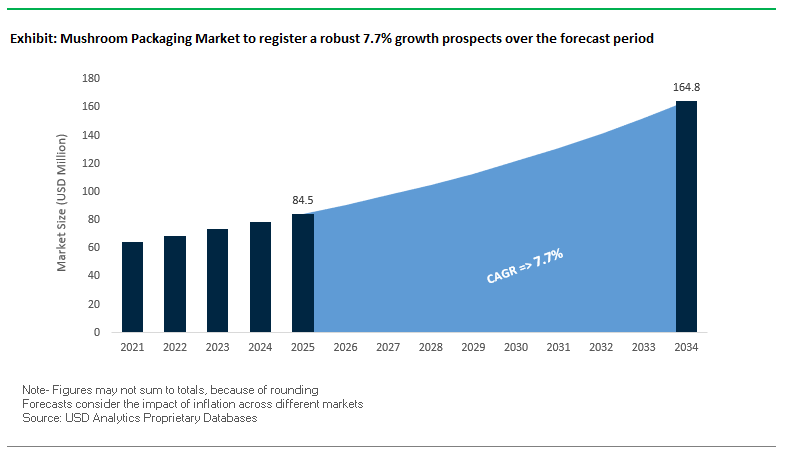
Market Overview: Mushroom Packaging Market Valued at $84.5 Million in 2025, Forecast to Reach $164.7 Million by 2034
The Global Mushroom Packaging Market is expected to grow from $84.5 million in 2025 to $164.7 million by 2034, expanding at an impressive CAGR of 7.7%. Mushroom packaging, derived from mycelium and agricultural waste, is a breakthrough in home-compostable and biodegradable packaging. Unlike petroleum-based plastics such as Styrofoam, it decomposes naturally within weeks, leaving no harmful residues.
A major application of mushroom packaging is as a sustainable alternative to expanded polystyrene (EPS), often used for shipping and dunnage. By adopting mushroom-based solutions, companies reduce reliance on single-use plastics, avoid regulatory penalties like plastic taxes, and strengthen their brand image in sustainability-conscious markets. Beyond protective packaging, its moldable versatility has led to use cases across electronics, food and beverages, automotive, and furniture sectors, making it a competitive green material for multiple industries.
Corporate adoption further underscores its relevance. Dell, IKEA, and Adidas are among multinational leaders integrating mushroom packaging into their supply chains, signaling strong corporate momentum toward eco-friendly practices. This aligns with consumer demand for sustainable products and reflects broader industry efforts to meet ESG commitments and sustainability targets.
Key Insights for Industry Professionals
Eco-friendly compostability: Fully home-compostable and biodegradable, decomposes in weeks.
EPS replacement: Emerging as the leading sustainable alternative to Styrofoam.
Versatile applications: Expanding across electronics, food, automotive, and furniture.
Corporate adoption: Dell, IKEA, Adidas among global brands driving large-scale use.
Market Analysis: Recent Developments Highlight Sustainability, Scaling, and Innovation
The mushroom packaging industry has gained momentum through research breakthroughs, funding initiatives, and new commercial launches that demonstrate scalability and market readiness.
In May 2025, Czech-based Myco introduced a 100% plastic-free biodegradable EPS alternative, leveraging mycelium and organic waste. This innovation was designed to compete directly on both protective performance and cost, addressing one of the main barriers to wider adoption. Earlier in June 2024, Magical Mushroom Company (MMC) raised $3 million in funding to expand its industrial-scale production, underscoring investor confidence in plant-based packaging alternatives.
Collaborations and new material science approaches are also accelerating adoption. In August 2024, Ecovative partnered with AGI Denim to convert post-consumer denim waste into sustainable design material, showcasing mushroom technology’s versatility. Similarly, in July 2024, researchers at the University of Washington developed a 3D-printed compostable packaging material combining coffee grounds, spores, and mycelium, reinforcing the scientific community’s role in scaling biodegradable solutions.
Awareness of the environmental urgency also contributes to market growth. A World Economic Forum report in October 2024 highlighted that Styrofoam takes 50 years to degrade, compared to 20 years for plastic shopping bags, emphasizing mushroom packaging’s role as a necessary substitute. Earlier, in August 2025, Smurfit WestRock’s strong performance after its merger signaled a consolidated packaging sector where sustainability-driven solutions like mushroom-based designs are becoming critical.
Emerging Trends and Opportunities Transforming the Mushroom Packaging Market
Mushroom Packaging Market Driven by Corporate Adoption and Advanced Biofabrication
The mushroom packaging market is entering a critical growth phase as leading corporations adopt mycelium-based materials at scale and biofabrication research unlocks new structural and performance capabilities. Partnerships with Fortune 500 companies, advancements in water-resistant and moldable forms, and the alignment with circular economy principles are positioning mycelium packaging as a high-potential alternative to expanded polystyrene (EPS) and petroleum-based foams. At the same time, opportunities are opening in agricultural waste supply chains and compostability infrastructure, which will determine the scalability and long-term impact of the market.
Strategic Partnerships with Major Corporations for Sustainable Cushioning Applications
The mushroom packaging market is being propelled by long-term supply agreements between mycelium technology providers and multinational corporations, particularly in the electronics and furniture sectors. Companies like Dell have deployed mushroom-based materials to ship servers, highlighting the material’s ability to replace EPS foam while meeting performance and durability requirements. Similarly, IKEA’s sustainability strategy includes a full transition to renewable and recyclable materials, with mushroom packaging serving as a cornerstone for eliminating fossil-fuel-based foams. The environmental benefits are substantial: mycelium packaging is grown from agricultural waste, requires minimal energy and water inputs, and is fully biodegradable within weeks, aligning with stringent corporate responsibility goals. A study on mycelium composites confirms their high-impact resistance and lightweight cushioning properties, making them ideal for fragile, high-value goods. These partnerships demonstrate that mushroom packaging is no longer experimental it is becoming a commercially viable solution for global supply chains.
Advancements in Biofabrication for Durable, Moldable Forms Beyond Loose-Fill
Research and development efforts are moving mushroom packaging beyond basic loose-fill into engineered structural forms with enhanced water resistance, moldability, and functional performance. Scientists are reinforcing mycelium with natural fibers such as pineapple leaf or hemp to create moisture-resistant composites, expanding its suitability for food, cosmetics, and electronics packaging. At the industrial scale, the Fraunhofer Institute in Germany has pioneered a roll-to-roll cultivation process, enabling consistent mass production of mycelium sheets for high-volume applications. Luxury brands are also leveraging mycelium’s natural aesthetics and sustainability narrative by using it for premium packaging in spirits and cosmetics, where consumer expectations for both performance and storytelling are high. These advancements are redefining mushroom packaging from a niche alternative to a versatile, high-value material category.
Development of High-Volume Agricultural Waste Supply Chains
Scaling mushroom packaging production requires formalized, reliable supply chains for agricultural residues such as hemp hurd, cotton gin trash, sawdust, and rice straw. Currently treated as waste and often burned, these substrates can instead serve as feedstock for mycelium growth, transforming an environmental liability into a revenue-generating commodity. Government reports, including those from India, highlight the potential of rice straw and coconut coir for bio-composite production, signaling opportunities for partnerships between mycelium packaging producers and farming communities. Establishing these supply chains will reduce raw material costs, generate new farmer income streams, and reinforce the circular economy by turning waste into value. For packaging manufacturers, this represents not just a cost advantage but also a powerful sustainability narrative for global brands.
Creation of Standardized Compostability and End-of-Life Infrastructure
For mushroom packaging to scale globally, end-of-life management must be standardized through compostability certifications and commercial waste partnerships. Mycelium packaging has already proven its home-compostable credentials, with Ecovative receiving certifications showing complete breakdown within 45 days in domestic compost bins. However, large-scale adoption requires integration into commercial composting networks, supported by waste management companies and retailers. Certification bodies such as the Biodegradable Products Institute (BPI) are central to creating consumer trust and regulatory clarity. Clear labeling and consumer education will also ensure proper disposal, bridging the gap between innovation and behavior. By creating universal compostability pathways, the industry can establish mushroom packaging as a truly scalable alternative to plastic foams across electronics, foodservice, and retail packaging markets.
Emerging Trends and Opportunities in the Microwave Packaging Market
Material Transition from PFAS-Coated Papers to Next-Generation Barriers
The microwave packaging market is undergoing a critical transformation as regulators, packaging converters, and brand owners accelerate the transition away from PFAS-coated papers. This shift is being driven by mounting regulatory pressure, particularly in the U.S., where the FDA has already finalized the voluntary phase-out of PFAS-based grease-proofing substances for food-contact packaging. The absence of legacy chemistries has created strong momentum for PFAS-free barrier solutions, compelling companies to re-engineer their material portfolios. Ahlstrom and Stora Enso are spearheading this trend, promoting dispersion barrier coatings and sustainable fiber-based alternatives that combine grease resistance with recyclability. Beyond compliance, this transition reflects a broader consumer-driven demand for safe, environmentally responsible microwaveable packaging, with brands embedding PFAS-free commitments into their global sustainability strategies. As food manufacturers race to meet consumer expectations while maintaining performance in microwave applications, investment in next-generation materials is emerging as both a regulatory necessity and a competitive differentiator.
Proliferation of Dual-Ovenable, Molded Fiber Trays in Premium Frozen Meals
The premium frozen meals segment is rapidly redefining microwave packaging innovation with the adoption of dual-ovenable molded fiber trays. Replacing non-recyclable black CPET trays, these trays are produced from renewable fibers such as bamboo and sugarcane, offering recyclability and a premium aesthetic that resonates with environmentally conscious consumers. Food brands are strategically leveraging these trays not only for their oven safety (up to 400°F) and freezer durability but also for their seamless integration into existing packaging machinery. Companies like Oliver Packaging are optimizing trays for compatibility, minimizing disruption in manufacturing lines while enabling a swift transition from plastics to fiber-based solutions. In addition to functional advantages, the natural look of fiber trays enhances brand storytelling, signaling sustainability and premium positioning in retail aisles. As consumer preference for eco-friendly frozen food packaging strengthens, dual-ovenable fiber trays are becoming a benchmark for innovation and differentiation in the microwave packaging market.
Development of Peelable Susceptors for Browning and Crisping
A major opportunity for the microwave packaging market lies in advancing susceptor technologies that address long-standing limitations in food crisping and browning. Traditional microwave cooking struggles with products like pizza, pies, and burritos that require a crisp crust. Integrated peelable susceptors offer a breakthrough by converting microwave energy into controlled radiant heat, ensuring optimal texture and flavor. Recent patents highlight the potential of disposable crisping layers that can be removed post-cooking, enhancing convenience and food safety. This advancement not only raises the quality of microwaveable meals but also broadens the portfolio of food categories that can be adapted to microwaves. With innovations in metallized films and ceramic-based susceptors, packaging developers are creating high-efficiency solutions that balance heat generation, recyclability, and food integrity. The expansion of susceptor applications is poised to elevate consumer satisfaction and accelerate adoption in ready-to-eat and frozen convenience segments.
Integration of Steam-Release and Active Venting Systems for Consistent Cooking
Another promising opportunity comes from the integration of steam-release and active venting technologies in microwave packaging, aimed at addressing challenges of sogginess and uneven heating. Excessive steam buildup in sealed trays often compromises product texture and quality. By incorporating one-way steam valves and intelligent venting systems, packaging can regulate pressure release during critical cooking phases, delivering consistency across product lines. Companies deploying methods like Micvac’s patented valve technology are setting new standards, combining safety, performance, and user experience. For consumers, features such as audible steam-release cues provide added convenience and reassurance. Research institutions are further developing tailored venting systems for specific food types, from vegetables to full meals, ensuring optimal cooking outcomes while retaining nutritional integrity. As ready-to-eat and frozen meal producers intensify their focus on premiumization, these smart venting innovations represent a powerful tool to improve food safety, consumer trust, and brand competitiveness.
Competitive Landscape: Key Companies Driving the Mushroom Packaging Industry
The mushroom packaging market is shaped by a mix of startups pioneering mycelium innovation and global packaging leaders adopting bio-based alternatives. Companies are leveraging research, scaling initiatives, and partnerships to replace petroleum-based foams with compostable solutions.
Ecovative Design LLC: Pioneering Mycelium Technology with Scalable Applications
Ecovative is a market leader in mycelium-based solutions, with its flagship Mushroom® Packaging serving as a compostable alternative to Styrofoam. Its MycoComposite™ technology, combining hemp and mycelium, produces durable and lightweight protective packaging. Beyond packaging, the company is expanding into food and fashion applications, using its AirMycelium technology to replace plastic foams and even leather. In August 2024, Ecovative partnered with AGI Denim to turn waste denim into sustainable material, showcasing scalability and innovation.
Magical Mushroom Company: Industrial-Scale Production in Europe
MMC is Europe’s first industrial-scale mushroom packaging producer, known for providing biodegradable EPS alternatives to brands in electronics, furniture, and consumer goods. Its ability to produce at scale positions it strongly against cost barriers to adoption. In June 2024, MMC secured $3 million in funding to expand production capacity and meet growing demand. The company’s client list includes premium brands like Tom Dixon and BA Kitchens, which use mushroom packaging for protective dunnage and to reinforce eco-friendly brand messaging.
Sealed Air Corporation: Expanding Sustainable Portfolio Beyond Plastic
Although not a pure-play mycelium company, Sealed Air is a global leader in protective packaging that has made significant strides in plant-based and recycled materials. In 2024, it invested $24 million in expanding production of Plantic™ plant-based resins. Sealed Air’s strategy includes making all packaging recyclable or reusable by 2025. Its global distribution and design expertise allow it to integrate mushroom-based or similar bio-alternatives into mainstream applications, accelerating industry adoption.
MycoWorks: Redefining Luxury Materials with Mycelium
MycoWorks specializes in Fine Mycelium™ technology, primarily for fashion and luxury applications, but its Reishi™ leather alternative demonstrates the scalability of mycelium into premium packaging. Collaborations with Hermès and designer Nick Fouquet highlight its ability to serve the high-end segment. While not yet focused on dunnage, MycoWorks’ technology could create luxury-grade mushroom packaging for jewelry, electronics, and cosmetics, blending sustainability with premium aesthetics.
Mushroom Packaging Market Share Insights
Consumer Goods Dominate Market Share by Application in Mushroom Packaging
Consumer goods hold the largest share of mushroom packaging, representing 30% of total applications. This dominance reflects the strategic use of mycelium-based packaging by eco-conscious brands to differentiate themselves in crowded retail markets. Direct-to-consumer apparel, lifestyle, and luxury brands have embraced mushroom packaging for cushioning and void fill, prioritizing sustainability storytelling and ESG alignment over cost parity with EPS foams. For these companies, mushroom packaging is not just a protective medium but a branding tool that signals environmental responsibility and resonates with premium consumers. The segment’s growth underscores how marketing value and brand positioning can outweigh price in packaging adoption, particularly when sustainability credentials are increasingly a prerequisite for consumer loyalty.
Commercial End-Users Secure Market Share Leadership in Mushroom Packaging
The mushroom packaging industry is overwhelmingly commercial in nature, with 95% of demand tied to B2B applications. Companies such as furniture manufacturers, wine producers, and luxury goods brands are driving adoption by integrating custom-grown mycelium structures into their packaging supply chains. This dominance is explained by the industrial production model: mushroom packaging requires specialized design and molding at scale, making it inherently incompatible with household-level use. Commercial end-users also justify the premium cost by leveraging its sustainability benefits for brand equity and its custom-molded protection to reduce product damage rates. The segment’s near-total share confirms that mushroom packaging is not a commodity packaging format but a bespoke solution tailored to corporate sustainability strategies and industrial logistics needs.
United States: Mycelium-Based Packaging Gains Momentum Amid Rising Sustainability Trends
The U.S. mushroom packaging market is being driven by eco-conscious consumer preferences and corporate sustainability initiatives. There is increasing demand for biodegradable cushioning materials and alternatives to traditional plastics and foams in electronics, luxury goods, and consumer products. Technological advancements in mycelium cultivation and biofabrication are enabling companies like Ecovative Design to produce more durable, water-resistant, and scalable mushroom-based packaging. A notable collaboration in June 2024 with The Rootist introduced compostable, mycelium-based trays for haircare products, reflecting the growing market adoption of eco-friendly packaging innovations.
Sustainability initiatives are a key market driver, with companies like MycoWorks investing in full-scale production facilities for Fine Mycelium™ materials, targeting luxury goods and leather alternatives. Early adopters like Dell highlight corporate commitment to sustainable packaging, using mushroom-based solutions in electronics shipping. Academic and industry research and development, including platforms like AirMycelium™, are supporting the market by producing pure mycelium-based foams and hides, which cater to a circular economy and the rising demand for biodegradable packaging materials in the United States.
Germany: Regulatory Framework and Circular Economy Strengthen Mycelium Packaging
Germany’s mushroom packaging industry is strongly shaped by the EU Packaging and Packaging Waste Regulation (PPWR 2025), which mandates fully recyclable packaging by 2030 and sets reuse and refill targets. This regulatory landscape creates high demand for eco-friendly, sustainable packaging materials and drives innovation in biodegradable solutions. German manufacturers are increasingly integrating mushroom-based packaging into their supply chains, reflecting the country’s leadership in the circular economy.
Technological innovation is central to Germany’s market growth. Companies like Magical Mushroom Company (MMC) are scaling the production of mushroom-based biodegradable packaging, combining environmental sustainability with functional performance. This approach aligns with consumer demand for recyclable and biodegradable packaging solutions while enabling manufacturers to meet national and EU sustainability targets. Germany’s focus on regulatory compliance, innovation, and sustainability positions it as a leading hub for mycelium-based packaging in Europe.
China: Governmental Policies and Mushroom Production Drive Sustainable Packaging Adoption
China’s mushroom packaging market benefits from the country’s leadership in both mushroom production and sustainable initiatives. Government policies targeting carbon peak and carbon neutrality are driving a shift toward eco-friendly, reduced, and reusable materials in packaging. Technological advancements, such as automation, AI, and 5G industrial internet integration, are enhancing production efficiency and enabling scalable adoption of mycelium-based materials.
China’s position as the world’s largest producer and consumer of mushrooms provides a robust supply of raw materials, supporting mycelium-based packaging innovations. Policies restricting non-degradable plastics have accelerated the market’s growth, encouraging the use of mushroom by-products for packaging applications. With strong domestic supply, supportive government initiatives, and rapid adoption of sustainable manufacturing technologies, China is emerging as a major hub for biodegradable mushroom packaging solutions.
India: Startups and Research Innovations Fuel Mycelium Packaging Growth
India’s mushroom packaging market is being shaped by government initiatives like Make in India and Zero Effect Zero Defect, which promote domestic production and sustainable industrial practices. Academic research is playing a key role, with institutions such as IIT Madras developing lab-scale mycelium-based packaging materials using agricultural waste, demonstrating local innovation to reduce plastic pollution.
The market is also witnessing the rise of startups, including Roha.bio, which are focusing on mycelium-based packaging and construction materials. These companies aim to offer Indian-made alternatives to polystyrene foam, catering to both industrial and consumer demands. The Plastic Waste Management (Amendment) Rules are further driving demand for eco-friendly packaging solutions, highlighting India’s growing focus on sustainability, innovation, and circular economy practices in the mycelium packaging sector.
Mushroom Packaging Market Report Scope
Mushroom Packaging Market
Parameter
Details
Market Size (2025)
$84.5 Million
Market Size (2034)
$164.7 Million
Market Growth Rate
7.7%
Segments
By Material Type (Pure Mycelium-based Packaging, Composite Mushroom Packaging), By Application (Electronics, Automotive, Furniture, Wine & Glassware, Consumer Goods, Other Applications), By End-User (Commercial, Household), By Distribution Channel (Direct Sales, Online Retail, Retail Stores)
Study Period
2019- 2024 and 2025-2034
Units
Revenue (USD)
Qualitative Analysis
Porter’s Five Forces, SWOT Profile, Market Share, Scenario Forecasts, Market Ecosystem, Company Ranking, Market Dynamics, Industry Benchmarking
Companies
Ecovative Design, MycoWorks, The Magical Mushroom Company, Grow.bio, Stanhope-Seta Ltd., Merck Forest & Farmland Center, Mushroom Packaging, MycoLogic LLC, Dell Technologies (as a prominent end-user), Sealed Air Corporation, BillerudKorsnäs AB, Smurfit Kappa Group, DS Smith plc, Mondi Group
Countries
US, Canada, Mexico, Germany, France, Spain, Italy, UK, Russia, China, India, Japan, South Korea, Australia, South East Asia, Brazil, Argentina, Middle East, Africa
Mushroom Packaging Market Segmentation
By Material Type
Pure Mycelium-based Packaging
Composite Mushroom Packaging
By Application
Electronics
Automotive
Furniture
Wine & Glassware
Consumer Goods
Other Applications
By End-User
Commercial
Household
By Distribution Channel
Direct Sales
Online Retail
Retail Stores
Countries Analyzed
North America (US, Canada, Mexico)
Europe (Germany, UK, France, Spain, Italy, Russia, Rest of Europe)
Asia Pacific (China, India, Japan, South Korea, Australia, South East Asia, Rest of Asia)
South America (Brazil, Argentina, Rest of South America)
Middle East and Africa (Saudi Arabia, UAE, Rest of Middle East, South Africa, Egypt, Rest of Africa)
Top Companies in Mushroom Packaging Market
Ecovative Design
MycoWorks
The Magical Mushroom Company
Grow.bio
Stanhope-Seta Ltd.
Merck Forest & Farmland Center
Mushroom Packaging
MycoLogic LLC
Dell Technologies (as a prominent end-user)
Sealed Air Corporation
BillerudKorsnäs AB
Smurfit Kappa Group
DS Smith plc
Mondi Group
* List Not Exhaustive
Methodology
USDAnalytics employed a rigorous and multi-faceted research methodology to deliver an in-depth analysis of the global Mushroom Packaging Market. This methodology combined primary research, including interviews with packaging manufacturers, biofabrication experts, sustainability officers, and corporate procurement teams, with secondary research comprising company reports, press releases, regulatory filings, academic publications, and industry news. Market sizing and forecasting were derived from historical trends, adoption rates of mycelium-based packaging, agricultural waste availability, and corporate sustainability initiatives. Segmentation analysis considered material types, applications across electronics, automotive, furniture, wine, and consumer goods, end-user categories, and distribution channels. Qualitative insights focused on technological advancements in biofabrication, moldable structural forms, water-resistant composites, and scalable industrial production. Competitive landscape evaluation included strategic partnerships, corporate adoption trends, and funding initiatives. USDAnalytics also incorporated regulatory frameworks, circular economy adoption, and sustainability-driven innovations to present a comprehensive outlook, providing actionable intelligence for industry professionals, investors, and corporate decision-makers aiming to capitalize on the growing demand for eco-friendly, compostable packaging solutions.
Deliverables:
Comprehensive Market Research Report (PDF and Excel) with detailed tables, charts, and interactive visualizations.
Country-Specific Forecasts & Analysis.
Segment-Wise Revenue Forecasts (2025–2034).
Competitive Analysis, Benchmarking, and SWOT Profiles.
Recent Developments & Innovation Tracker.
Executive Summary & Analyst Commentary.
Post-Purchase Analyst Support for Client-Specific Questions and Custom Data Requirements.
Table of Contents: Mushroom Packaging Market
1. Executive Summary
1.1. Market Highlights
1.2. Key Findings
1.3. Global Market Snapshot
2. Mushroom Packaging Market Landscape & Outlook (2025–2034)
2.1. Introduction to Mushroom Packaging Market
2.2. Market Valuation and Growth Projections (2025–2034)
2.3. Transition from Petroleum-Based Foams to Mycelium Packaging
2.4. Corporate Adoption and ESG-Driven Packaging Shifts
2.5. Regulatory Influence and Circular Economy Integration
2.6. Role of Biofabrication and Agricultural Waste Utilization
2.7. Challenges in Scalability and Cost Competitiveness
3. Innovations Reshaping the Mushroom Packaging Market
3.1. Trend: Corporate Integration by Dell, IKEA, and Adidas
3.2. Trend: Expansion of 3D-Printed and Moldable Mycelium Structures
3.3. Opportunity: Development of Agricultural Waste Supply Chains
3.4. Opportunity: Standardization of Compostability and End-of-Life Systems
4. Competitive Landscape and Strategic Initiatives
4.1. Mergers, Acquisitions and Strategic Alliances
4.2. R&D and Material Innovation
4.3. Sustainability and Strategies
4.4. Market Expansion and Regional Focus
5. Market Share and Segmentation Insights: Mushroom Packaging Market
5.1. By Material Type
5.1.1. Pure Mycelium-Based Packaging
5.1.2. Composite Mushroom Packaging
5.2. By Application
5.2.1. Electronics
5.2.2. Automotive
5.2.3. Furniture
5.2.4. Wine & Glassware
5.2.5. Consumer Goods
5.2.6. Other Applications
5.3. By End-User
5.3.1. Commercial
5.3.2. Household
5.4. By Distribution Channel
5.4.1. Direct Sales
5.4.2. Online Retail
5.4.3. Retail Stores
6. Country Analysis and Outlook of Mushroom Packaging Market
6.1. United States
6.2. Canada
6.3. Mexico
6.4. Germany
6.5. France
6.6. Spain
6.7. Italy
6.8. UK
6.9. Russia
6.10. China
6.11. India
6.12. Japan
6.13. South Korea
6.14. Australia
6.15. South East Asia
6.16. Brazil
6.17. Argentina
6.18. Middle East
6.19. Africa
7. Mushroom Packaging Market Size Outlook by Region (2025–2034)
7.1. North America Mushroom Packaging Market Size Outlook to 2034
7.1.1. By Material Type
7.1.2. By Application
7.1.3. By End-User
7.1.4. By Distribution Channel
7.2. Europe Mushroom Packaging Market Size Outlook to 2034
7.2.1. By Material Type
7.2.2. By Application
7.2.3. By End-User
7.2.4. By Distribution Channel
7.3. Asia Pacific Mushroom Packaging Market Size Outlook to 2034
7.3.1. By Material Type
7.3.2. By Application
7.3.3. By End-User
7.3.4. By Distribution Channel
7.4. South America Mushroom Packaging Market Size Outlook to 2034
7.4.1. By Material Type
7.4.2. By Application
7.4.3. By End-User
7.4.4. By Distribution Channel
7.5. Middle East and Africa Mushroom Packaging Market Size Outlook to 2034
7.5.1. By Material Type
7.5.2. By Application
7.5.3. By End-User
7.5.4. By Distribution Channel
8. Company Profiles: Leading Players in the Mushroom Packaging Market
8.1. Ecovative Design LLC
8.2. Magical Mushroom Company (MMC)
8.3. MycoWorks
8.4. Grow.bio
8.5. Stanhope-Seta Ltd.
8.6. Merck Forest & Farmland Center
8.7. Mushroom Packaging (Ecovative subsidiary)
8.8. MycoLogic LLC
8.9. Dell Technologies (as a prominent end-user)
8.10. Sealed Air Corporation
8.11. BillerudKorsnäs AB
8.12. Smurfit Kappa Group
8.13. DS Smith plc
8.14. Mondi Group
8.15. Other Emerging Regional Innovators
9. Methodology
9.1. Research Scope
9.2. Market Research Approach
9.3. Market Sizing and Forecasting Model
9.4. Research Coverage
9.5. Data Horizon
9.6. Deliverables
10. Appendix
10.1. Acronyms and Abbreviations
10.2. List of Tables
10.3. List of Figures
Mushroom Packaging Market Segmentation
By Material Type
Pure Mycelium-based Packaging
Composite Mushroom Packaging
By Application
Electronics
Automotive
Furniture
Wine & Glassware
Consumer Goods
Other Applications
By End-User
Commercial
Household
By Distribution Channel
Direct Sales
Online Retail
Retail Stores
Countries Analyzed
North America (US, Canada, Mexico)
Europe (Germany, UK, France, Spain, Italy, Russia, Rest of Europe)
Asia Pacific (China, India, Japan, South Korea, Australia, South East Asia, Rest of Asia)
South America (Brazil, Argentina, Rest of South America)
Middle East and Africa (Saudi Arabia, UAE, Rest of Middle East, South Africa, Egypt, Rest of Africa)
The market is fueled by the need for sustainable alternatives to EPS and petroleum-based foams, corporate ESG initiatives, and regulatory pressures to reduce plastic waste. Companies like Dell, IKEA, and Adidas adopting mushroom packaging demonstrate its industrial viability and growing commercial acceptance.
Mushroom packaging is widely used in electronics, furniture, automotive, wine & glassware, and consumer goods. Its moldable, lightweight, and impact-resistant properties allow it to replace Styrofoam for protective dunnage, cushioning, and premium packaging solutions.
Advances in biofabrication, 3D printing, and reinforced mycelium composites are enabling water-resistant, moldable, and scalable packaging. Research partnerships and roll-to-roll cultivation processes are expanding industrial production while maintaining biodegradability and performance.
Mushroom packaging is fully biodegradable, home-compostable, and produced from agricultural waste, turning by-products into value-added materials. It reduces reliance on plastics, lowers energy and water consumption, and aligns with circular economy principles, enhancing corporate sustainability credentials.
Key players include Ecovative Design, Magical Mushroom Company (MMC), MycoWorks, Grow.bio, and Sealed Air Corporation. These companies focus on industrial-scale production, moldable designs, and corporate partnerships, enabling widespread adoption across electronics, consumer goods, and luxury packaging sectors.