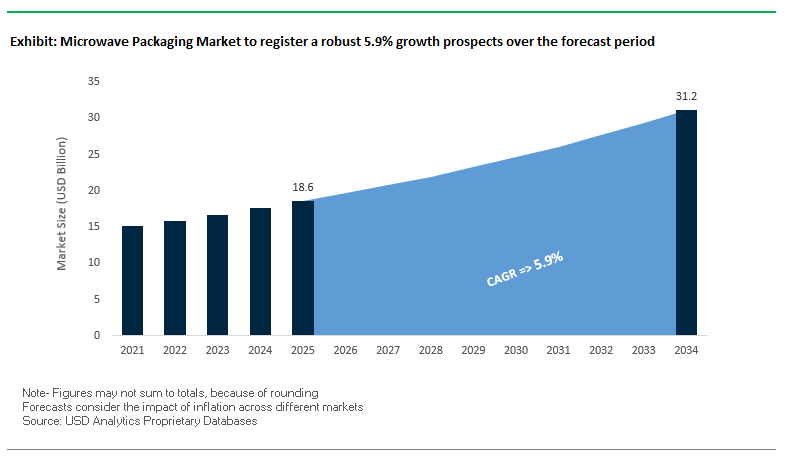
Market Overview: Microwave Packaging Market to Reach $31.2 Billion by 2034, Driven by Convenience and Sustainability
The Global Microwave Packaging Market is valued at $18.6 billion in 2025 and projected to grow to $31.2 billion by 2034, registering a CAGR of 5.9%. Growth is underpinned by rising consumer demand for ready-to-eat meals, on-the-go food formats, and sustainable alternatives to plastics. Plastic currently dominates the market due to its excellent moisture and vapor barrier properties, essential for preserving freshness and shelf life of microwavable meals. However, paper-based packaging is steadily gaining traction as an eco-friendly alternative, driven by regulatory bans on single-use plastics and shifting consumer preferences.
The largest end-user segment is ready-to-eat meals, reflecting demand from single-person households, dual-income families, and urban populations seeking quick, convenient solutions. This consumer shift has fueled innovation in packaging formats that are easy to store, microwave, and dispose of. At the same time, packaging producers are prioritizing sustainable material innovations, aligning with both brand ESG commitments and consumer willingness to pay more for eco-friendly solutions.
Key Insights for Industry Professionals
Plastic dominates: Barrier protection against moisture and vapor remains a decisive factor.
Paper-based alternatives rising: Sustainable trays and cartons increasingly replace traditional plastics.
Ready-to-eat meals drive demand: The strongest adoption comes from fast-moving, convenience-driven lifestyles.
Convenience-led growth: Stackable, dual-ovenable, and recyclable packaging formats are seeing rapid adoption.
Market Analysis: Industry Developments Highlight Consolidation and Sustainability Efforts
The microwave packaging market is undergoing a period of rapid transformation, with strategic mergers, sustainability reports, and new innovations reshaping competitive dynamics.
In August 2025, Smurfit WestRock reported strong Q2 results following the Smurfit Kappa–WestRock merger earlier that year, emphasizing its enhanced ability to scale sustainable paperboard microwaveable packaging solutions. Around the same time, O-I Glass announced in July 2025 that it would halt development of its MAGMA glass-making platform, pivoting toward a “Best at Both” strategy that emphasizes operational efficiency and premium output. In June 2025, Crown Holdings expanded its Brazil beverage can plant with a new high-speed production line, indirectly boosting material supply for the food and beverage packaging ecosystem.
Sustainability reporting is playing a critical role. Sonoco, in May 2025, released its 2024 Corporate Sustainability Report highlighting measurable progress toward reducing plastic dependency. The following month, in April 2025, Sonoco divested its thermoformed and flexibles packaging business to TOPPAN Holdings to streamline its portfolio and sharpen focus on sustainable microwaveable packaging. Earlier, in October 2024, Sonoco also completed its acquisition of Eviosys, strengthening its position in the global food can and aerosol packaging markets.
Mergers are consolidating industry leadership. The Smurfit Kappa–WestRock merger in February 2025 and International Paper’s acquisition of DS Smith in January 2025 created two paper-based packaging giants with significant microwave packaging portfolios. These moves position them to deliver sustainable, fiber-based alternatives to plastics at global scale, redefining competition in microwave packaging.
Emerging Trends and Opportunities in the Microwave Packaging Market
Material Transition from PFAS-Coated Papers to Alternative Grease & Moisture Barriers
The industry is rapidly shifting away from PFAS-coated food-contact papers due to both regulatory pressure and consumer health awareness. The U.S. FDA’s completion of the voluntary PFAS phase-out has been a defining moment, compelling converters and food brands to accelerate adoption of alternative barrier technologies. Ahlstrom and Stora Enso are among the leaders, pioneering PFAS-free solutions such as dispersion barrier coatings that provide grease and moisture resistance while maintaining recyclability. These PFAS-free coatings are also aligned with global brand commitments to eliminate toxic chemistries and reinforce sustainability credentials. For brands, adopting PFAS-free microwave packaging not only ensures compliance but also strengthens consumer trust in food safety.
Proliferation of Dual-Ovenable, Molded Fiber Trays for Premium Frozen Meals
The shift from CPET plastic trays to molded fiber trays marks a major sustainability milestone for the frozen food industry. Molded fiber trays, crafted from renewable raw materials like sugarcane bagasse and bamboo, are fully curbside recyclable and dual-ovenable, withstanding temperatures up to 400°F. Their compatibility with existing filling and sealing equipment has made adoption seamless, reducing operational disruption for manufacturers. Companies such as Oliver Packaging are driving this innovation by ensuring that these trays are drop-in replacements, enabling frozen meal brands to highlight their eco-conscious value proposition. Beyond functionality, molded fiber trays also offer a natural, premium look that resonates with consumers seeking healthier, more environmentally friendly food packaging.
Development of Integrated, Peelable Susceptors for Improved Browning and Crisping
One of the most compelling opportunities lies in innovating susceptor technology to address a long-standing microwave cooking limitation: lack of browning and crisping. Peelable susceptors represent a breakthrough, offering disposable crisping elements that can be easily removed post-cooking. This innovation expands the microwave packaging segment to food categories traditionally reliant on ovens, such as frozen pizzas, burritos, and pies. Advancements in metallized film and ceramic-based susceptors are improving heating efficiency, creating a balance between convenience and food quality. For packaging manufacturers, susceptor integration presents a new avenue to partner with brands seeking to elevate microwave meal quality to restaurant-style standards.
Integration of Steam-Release and Active Venting Technologies for Optimal Cooking
Active venting systems and one-way steam valves are emerging as high-value differentiators in microwave packaging. By automatically releasing steam at precise temperatures, these technologies prevent sogginess, ensure uniform heating, and enhance food safety. The Micvac system, with its audible whistling valve, demonstrates how venting can double as both a safety feature and a consumer convenience indicator. Academic research also highlights how venting solutions can be product-specific ensuring, for example, that vegetables retain both texture and nutritional value. As demand for convenient yet high-quality ready meals grows, packaging companies investing in venting technologies will capture greater market share by improving the overall cooking experience.
Competitive Landscape: Key Companies Driving the Microwave Packaging Market
The microwave packaging industry is shaped by portfolio restructuring, sustainability commitments, and innovations in paperboard and rigid containers. Leading companies are focused on balancing performance, convenience, and eco-friendliness to meet evolving consumer expectations.
Sonoco Products Company: Driving Sustainability Through Portfolio Reshaping
Sonoco is a global leader in packaging with strong offerings in paperboard microwaveable canisters and trays. In April 2025, it sold its thermoformed and flexibles unit to TOPPAN Holdings while acquiring Eviosys in October 2024, strengthening its global leadership in metal and rigid packaging. Its EnviroSense™ line of paper containers, made with recycled and recyclable materials, is a cornerstone of its sustainable microwave packaging portfolio.
Anchor Packaging LLC: Innovating with Crisp Food Technologies®
Anchor Packaging specializes in rigid food containers for foodservice and retail. Its proprietary Crisp Food Technologies® containers maintain fried food crispiness for up to 30 minutes, addressing the critical quality challenge for delivery and takeout meals. Its product line spans over 450 items, including Anchorware® Reusables, lightweight polypropylene containers that are microwave-safe and designed for reuse. Anchor’s focus is aligned with the EPA’s Reduce, Re-Use, Recycle framework, reinforcing its sustainability goals.
WestRock, now part of Smurfit WestRock after the February 2025 merger, is a major player in paperboard microwave packaging. Its MicroCook™ paperboard is dual-ovenable, recyclable, and durable, making it a sustainable alternative to plastics. With vertical integration from forestry to finished products, WestRock delivers fiber-based microwave containers that align with the circular economy while helping brands reduce environmental impact.
Graphic Packaging provides folding cartons and fiber-based solutions for microwavable foods. In August 2025, it launched a child-resistant paperboard pod package, showcasing leadership in combining safety and sustainability. Its proprietary Boardio™ and EnviroClip™ solutions help brands transition away from plastics. Guided by Vision 2030, the company is targeting lower greenhouse gas emissions, increased renewable energy use, and recyclable packaging across its product portfolio.
Huhtamaki is a global packaging leader offering flexible and molded fiber packaging for ready-to-eat meals. In July 2025, it launched a recyclable, compostable ice cream cup, underlining its push to reduce plastics. Its microwave-ready food containers and lids are designed for hygiene, safety, and sustainability. Huhtamaki also announced a U.S. expansion in early 2025 with a new line of fiber-based egg cartons made from 100% recycled materials, further strengthening its eco-friendly portfolio.
Microwave Packaging Market Share Insights
Trays Secure Market Share Leadership by Product Type in Microwave Packaging
Trays account for 35% of microwave packaging demand, positioning themselves as the most versatile format for multi-component frozen and ready-to-eat meals. Their structural rigidity enables separation of proteins, starches, and sauces, while withstanding thermal cycling from freezing to microwaving without warping. Historically dominated by CPET, trays are now at the center of the industry’s sustainability push, with dual-ovenable paperboard and bio-coated alternatives being trialed to reduce reliance on plastics. For brand owners and retailers, trays provide both functionality and branding real estate, while consumers favor their convenience and reliability. Their dominance illustrates the balance between food safety, heating performance, and sustainability, making them the innovation frontier of microwave packaging.
Ready-to-Eat Meals Dominate Market Share by Application in Microwave Packaging
Ready-to-eat meals represent the largest application segment, holding 40% of microwave packaging demand, driven by the global appetite for convenience and time-saving food solutions. Packaging here is not a passive vessel but an active cooking system vented films, compartmentalized trays, and susceptor layers are engineered to ensure even heating of diverse ingredients. Growth is accelerated by demographic shifts, including urbanization, dual-income households, and demand for healthier premium meals that can be prepared quickly without sacrificing taste or texture. This segment also sets the pace for sustainability innovation, as brands seek recyclable and compostable packaging options without compromising microwave performance. The dominance of ready-to-eat meals underscores how packaging has evolved into a critical enabler of consumer convenience and brand differentiation in the frozen and chilled food supply chain.
United States: Convenience and Sustainability Driving Microwave Packaging Innovation
The U.S. microwave packaging market is experiencing strong growth due to the rising demand for ready-to-eat meals and convenience-driven food solutions. Changing lifestyles and fast-paced urban living are fueling the need for functional and appealing microwaveable containers that preserve food quality while offering ease of use. Technological advancements, such as susceptor films for browning and crisping and self-venting films that release steam automatically, are enhancing the cooking experience and driving product differentiation in the market.
Sustainability is also a key driver. Major brands are redesigning packaging to be easily recyclable or incorporate post-consumer recycled (PCR) materials, reducing dependence on virgin plastics. Corporate initiatives are shaping the industry, with companies like Mars Food & Nutrition expanding their microwave-ready meal lines across the U.S. and Canada in July 2024. Strict regulatory oversight under the Federal Food, Drug and Cosmetic Act (FDCA) and the Food Contact Notification (FCN) system ensures that chemical substances used in packaging meet FDA safety standards, promoting consumer confidence and driving innovation in safe and eco-friendly microwave packaging solutions.
Germany: Circular Economy and Consumer Convenience Boost Microwave Packaging Demand
Germany’s microwave packaging industry is guided by the EU Packaging and Packaging Waste Regulation (PPWR 2025), which mandates fully recyclable packaging and sets targets for reuse and refill by 2030. This regulatory framework is creating a strong market for eco-friendly and highly recyclable microwave packaging solutions. Germany’s focus on a circular economy encourages manufacturers to incorporate a high percentage of recycled content while developing packaging that meets consumer expectations for sustainability.
Technological innovation is a key market driver. Companies like LoeschPack are advancing flexible and efficient packaging machinery, with applications extending to microwaveable food and confectionery items. Rising consumer demand for freshly prepared meals and convenience further propels market growth, driving the development of innovative, sustainable, and convenient microwave packaging that aligns with environmental standards and urban lifestyle needs.
China: Urbanization and Green Initiatives Fuel Growth in Microwave Packaging
China’s microwave packaging market is benefiting from the government’s dual carbon strategy, promoting eco-friendly, reduced, and reusable materials across the food and packaging sectors. Regulatory initiatives aimed at reducing non-degradable plastics are driving the adoption of sustainable microwave packaging solutions. Technological advancements, including automation, AI, and the integration of 5G industrial internet, are enhancing production efficiency and enabling scalable adoption of advanced packaging materials.
Urbanization and evolving lifestyles are significantly boosting demand for ready-to-eat meals, which, in turn, fuels the need for high-quality microwave packaging. Government campaigns promoting healthier food options are encouraging the development of packaging that ensures food safety, quality, and convenience. Combined with a strong focus on sustainability, these trends position China as a rapidly expanding market for microwaveable food packaging innovations.
United Kingdom: Convenience and Sustainability Shaping Microwave Packaging Trends
The UK microwave packaging market is driven by the growth of the ready-meal sector, with consumers demanding packaging that combines convenience and quality. Regulatory oversight by the Food Standards Agency (FSA) ensures that packaging provides clear preparation instructions, particularly for microwave use, ensuring safety and proper food handling.
Sustainability goals are reshaping the market, with initiatives like the Plastic Packaging Tax encouraging higher use of recycled materials. Food manufacturers and major supermarkets are setting corporate sustainability targets, focusing on mono-material solutions to simplify recycling. This has led to innovations in microwaveable packaging that is both eco-friendly and consumer-friendly, aligning with broader trends in convenience, sustainability, and regulatory compliance across the UK market.
Microwave Packaging Market Report Scope
Microwave Packaging Market
Parameter
Details
Market Size (2025)
$18.6 Billion
Market Size (2034)
$31.2 Billion
Market Growth Rate
5.9%
Segments
By Material Type (Paper & Paperboard, Plastic, Metal, Other Materials), By Product Type (Trays, Boxes, Pouches, Bags, Cups & Bowls, Other Types), By Application (Ready-to-Eat Meals, Frozen Foods, Shelf-Stable Meals, Other Applications)
Study Period
2019- 2024 and 2025-2034
Units
Revenue (USD)
Qualitative Analysis
Porter’s Five Forces, SWOT Profile, Market Share, Scenario Forecasts, Market Ecosystem, Company Ranking, Market Dynamics, Industry Benchmarking
US, Canada, Mexico, Germany, France, Spain, Italy, UK, Russia, China, India, Japan, South Korea, Australia, South East Asia, Brazil, Argentina, Middle East, Africa
Microwave Packaging Market Segmentation
By Material Type
Paper & Paperboard
Plastic
Metal
Other Materials
By Product Type
Trays
Boxes
Pouches
Bags
Cups & Bowls
Other Types
By Application
Ready-to-Eat Meals
Frozen Foods
Shelf-Stable Meals
Other Applications
Countries Analyzed
North America (US, Canada, Mexico)
Europe (Germany, UK, France, Spain, Italy, Russia, Rest of Europe)
Asia Pacific (China, India, Japan, South Korea, Australia, South East Asia, Rest of Asia)
South America (Brazil, Argentina, Rest of South America)
Middle East and Africa (Saudi Arabia, UAE, Rest of Middle East, South Africa, Egypt, Rest of Africa)
Top Companies in Microwave Packaging Market
Amcor plc
Mondi Group
Graphic Packaging Holding Company
WestRock Company
Smurfit Kappa Group
DS Smith plc
Sonoco Products Company
Huhtamaki Oyj
Constantia Flexibles
International Paper
BillerudKorsnäs AB
TCPL Packaging Ltd.
Sealed Air Corporation
Crown Holdings, Inc.
Avery Dennison Corporation
* List Not Exhaustive
Methodology
USDAnalytics applied a comprehensive research methodology to deliver an accurate and actionable analysis of the global Microwave Packaging Market. Our approach combined primary research, including interviews with packaging manufacturers, foodservice executives, sustainability officers, and regulatory specialists, with extensive secondary research drawn from company reports, press releases, industry journals, academic publications, and government regulations. Market sizing and forecasting were calculated using historical growth trends, adoption rates of dual-ovenable and eco-friendly packaging, consumer behavior data, and corporate sustainability initiatives. Segmentation analysis covered material types such as paper, plastic, and metal; product types including trays, boxes, pouches, and cups; applications across ready-to-eat meals, frozen foods, and shelf-stable meals; and distribution channels. Qualitative insights focused on innovations such as peelable susceptors, venting systems, molded fiber trays, and PFAS-free barriers. Competitive analysis incorporated strategic mergers, acquisitions, and portfolio expansions, highlighting leaders such as WestRock, Sonoco, Huhtamaki, and Smurfit Kappa in driving sustainable and high-performance microwave packaging solutions. This methodology ensures USDAnalytics provides industry professionals with precise, forward-looking insights to guide investment, production, and sustainability strategies.
Deliverables:
Comprehensive Market Research Report (PDF and Excel) with detailed tables, charts, and interactive visualizations.
Country-Specific Forecasts & Analysis.
Segment-Wise Revenue Forecasts (2025–2034).
Competitive Analysis, Benchmarking, and SWOT Profiles.
Recent Developments & Innovation Tracker.
Executive Summary & Analyst Commentary.
Post-Purchase Analyst Support for Client-Specific Questions and Custom Data Requirements.
2. Microwave Packaging Market Landscape & Outlook (2025–2034)
2.1. Introduction to Microwave Packaging Market
2.2. Market Valuation and Growth Projections (2025–2034)
2.3. Market Drivers and Restraints
2.4. Regulatory Landscape and Compliance Overview
2.5. Technological Advancements in Microwave Packaging
3. Innovations Reshaping the Microwave Packaging Market
3.1. Trend: Transition from PFAS-Coated Papers to Alternative Barriers
3.2. Trend: Dual-Ovenable Molded Fiber Trays for Premium Frozen Meals
3.3. Opportunity: Integrated Peelable Susceptors for Browning and Crisping
3.4. Opportunity: Steam-Release and Active Venting Technologies
4. Competitive Landscape and Strategic Initiatives
4.1. Mergers, Acquisitions and Strategic Alliances
4.2. R&D and Material Innovation
4.3. Sustainability and Corporate Strategies
4.4. Market Expansion and Regional Focus
5. Market Share and Segmentation Insights: Microwave Packaging Market
5.1. By Material Type
5.1.1. Paper & Paperboard
5.1.2. Plastic
5.1.3. Metal
5.1.4. Other Materials
5.2. By Product Type
5.2.1. Trays
5.2.2. Boxes
5.2.3. Pouches
5.2.4. Bags
5.2.5. Cups & Bowls
5.2.6. Other Types
5.3. By Application
5.3.1. Ready-to-Eat Meals
5.3.2. Frozen Foods
5.3.3. Shelf-Stable Meals
5.3.4. Other Applications
6. Country Analysis and Outlook of Microwave Packaging Market
6.1. United States
6.2. Canada
6.3. Mexico
6.4. Germany
6.5. France
6.6. Spain
6.7. Italy
6.8. United Kingdom
6.9. Russia
6.10. China
6.11. India
6.12. Japan
6.13. South Korea
6.14. Australia
6.15. South East Asia
6.16. Brazil
6.17. Argentina
6.18. Middle East
6.19. Africa
7. Microwave Packaging Market Size Outlook by Region (2025–2034)
7.1. North America Microwave Packaging Market Size Outlook to 2034
7.1.1. By Material Type
7.1.2. By Product Type
7.1.3. By Application
7.2. Europe Microwave Packaging Market Size Outlook to 2034
7.2.1. By Material Type
7.2.2. By Product Type
7.2.3. By Application
7.3. Asia Pacific Microwave Packaging Market Size Outlook to 2034
7.3.1. By Material Type
7.3.2. By Product Type
7.3.3. By Application
7.4. South America Microwave Packaging Market Size Outlook to 2034
7.4.1. By Material Type
7.4.2. By Product Type
7.4.3. By Application
7.5. Middle East and Africa Microwave Packaging Market Size Outlook to 2034
7.5.1. By Material Type
7.5.2. By Product Type
7.5.3. By Application
8. Company Profiles: Leading Players in the Microwave Packaging Market
8.1. Amcor plc
8.2. Mondi Group
8.3. Graphic Packaging Holding Company
8.4. WestRock Company
8.5. Smurfit Kappa Group
8.6. DS Smith plc
8.7. Sonoco Products Company
8.8. Huhtamaki Oyj
8.9. Constantia Flexibles
8.10. International Paper
8.11. BillerudKorsnäs AB
8.12. TCPL Packaging Ltd.
8.13. Sealed Air Corporation
8.14. Crown Holdings, Inc.
8.15. Avery Dennison Corporation
9. Methodology
9.1. Research Scope
9.2. Market Research Approach
9.3. Market Sizing and Forecasting Model
9.4. Research Coverage
9.5. Data Horizon
9.6. Deliverables
10. Appendix
10.1. Acronyms and Abbreviations
10.2. List of Tables
10.3. List of Figures
Microwave Packaging Market Segmentation
By Material Type
Paper & Paperboard
Plastic
Metal
Other Materials
By Product Type
Trays
Boxes
Pouches
Bags
Cups & Bowls
Other Types
By Application
Ready-to-Eat Meals
Frozen Foods
Shelf-Stable Meals
Other Applications
Countries Analyzed
North America (US, Canada, Mexico)
Europe (Germany, UK, France, Spain, Italy, Russia, Rest of Europe)
Asia Pacific (China, India, Japan, South Korea, Australia, South East Asia, Rest of Asia)
South America (Brazil, Argentina, Rest of South America)
Middle East and Africa (Saudi Arabia, UAE, Rest of Middle East, South Africa, Egypt, Rest of Africa)
The market is propelled by rising demand for ready-to-eat meals, convenience-driven lifestyles, and sustainability regulations. Adoption of dual-ovenable fiber trays, PFAS-free coatings, and venting technologies enhances consumer appeal while supporting brand ESG commitments and reducing plastic reliance.
Paper-based and molded fiber trays made from renewable materials like sugarcane bagasse and bamboo are replacing traditional plastics. These eco-friendly alternatives are recyclable, dual-ovenable, and compatible with existing production lines, allowing manufacturers to meet consumer expectations without operational disruption.
Peelable susceptors, metallized films, and ceramic-based layers enable browning and crisping, overcoming traditional microwave limitations. Active venting and steam-release systems ensure even heating, maintain texture, and enhance food safety, creating restaurant-quality convenience for ready-to-eat meals.
Key market leaders include Sonoco Products, WestRock, Huhtamaki Oyj, Smurfit Kappa Group, and Graphic Packaging. These companies are expanding sustainable fiber-based solutions, dual-ovenable trays, and PFAS-free materials, combining eco-friendliness with high performance across global supply chains.
Microwave packaging innovations adhere to FDA, FSA, and EU PPWR standards, incorporating recyclable, compostable, and PFAS-free materials. By reducing single-use plastics and promoting circular economy principles, packaging solutions enable brands to meet environmental targets while enhancing consumer trust.