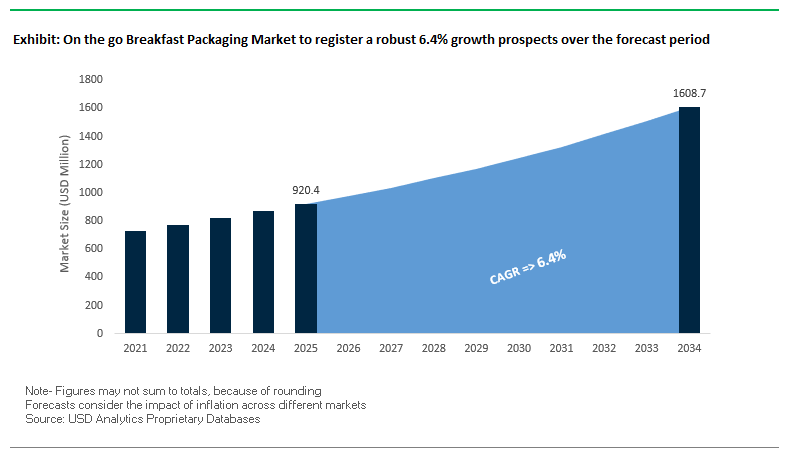
On-the-go Breakfast Packaging Market Expected to Reach $1.61 Billion by 2034 at 6.4% CAGR
The global on-the-go breakfast packaging market is projected to grow from $920.4 million in 2025 to $1,608.6 million by 2034, registering a CAGR of 6.4%. This growth reflects the increasing demand for convenient, portable, and mess-free packaging solutions that align with the modern consumer’s busy lifestyle. The market spans a variety of products, including cereal cups, breakfast bars, yogurt, smoothies, and heat-and-eat sandwiches, highlighting the industry’s commitment to ease-of-use, freshness, and innovation.
Key Insights for Industry Professionals:
Convenience-driven growth: Single-serve and ready-to-eat breakfast options address time-constrained consumers, supporting faster adoption of on-the-go formats.
Sustainability adoption: Shift toward paper-based, mono-material, and recyclable packaging reduces environmental impact and supports corporate sustainability goals.
Enhanced product freshness: Barrier films, hermetic seals, and modified atmosphere packaging (MAP) extend shelf life and maintain product appeal.
Smart packaging integration: Use of QR codes and digital features provides nutritional information, recipes, and interactive experiences, increasing brand engagement.
Health-conscious alignment: Packaging innovations support the growing trend of healthy and functional breakfasts, meeting consumer expectations for nutrition and safety.
Market Analysis: Recent Developments Highlighting Sustainability and Smart Packaging Innovations
The on-the-go breakfast packaging industry is evolving rapidly with strategic initiatives aimed at sustainability, technology integration, and convenience. In August 2025, DNP showcased mono-material, recyclable solutions for medical and pharmaceutical packaging, reflecting broader industry trends toward environmentally friendly materials applicable to breakfast packaging. In July 2025, a market report emphasized smart packaging adoption, including QR codes and RFID tracing, enabling product traceability and consumer engagement.
In May 2025, ProAmpac introduced FiberCool, a patent-pending curbside insulated bag that improves insulation while reducing material waste, targeting e-commerce and home delivery breakfast solutions. In April 2025, Nestlé launched Nescafé Espresso Concentrate production in Malaysia, meeting demand for ready-to-drink and cold coffee on-the-go. Amcor made significant sustainability strides in February 2025 with the AmFiber Performance Paper stand-up pouch, reducing carbon footprint by 73%, while its November 2024 acquisition of Berry Global strengthened leadership in breakfast food packaging.
Earlier in the market timeline, Belgian Boys unveiled Breakfast All Day boxes and Pancakes & Go cups in September 2024, enhancing portability and convenience. Huhtamaki, in July 2024, introduced recyclable and compostable packaging, and industry reports in June 2024 highlighted a surge in mono-material adoption for better recyclability and reduced environmental impact.
Trends and Opportunities Defining the On-the-Go Breakfast Packaging Market
Rapid Expansion of Fiber-Based and Molded Pulp Solutions for Hot Food Applications
The on-the-go breakfast packaging market is witnessing a decisive shift away from plastics toward fiber-based and molded pulp solutions, particularly for hot food applications like wraps, sandwiches, and hash browns. Quick Service Restaurant (QSR) giants are under increasing pressure to align with consumer preferences for paper-based packaging and deliver on ambitious sustainability commitments. McDonald’s, for example, has pledged that by the end of 2025, 100% of its primary guest packaging will be sourced from renewable, recycled, or certified materials, making fiber-based breakfast solutions a core part of its strategy. Real-world deployments reinforce this transition: in France, McDonald’s rolled out fiber-based cold beverage lids, cutting 1,200 metric tons of plastic annually. Parallel to this, molded pulp packaging—derived from recycled paper or sugarcane bagasse—is being engineered for superior durability and heat resistance, meeting QSR demands from preparation to delivery. This trend highlights a broad, industry-wide acceleration toward bio-based, circular packaging formats capable of meeting both performance and sustainability requirements.
Integration of Advanced Grease and Moisture Barriers Without PFAS
The elimination of PFAS (per- and polyfluoroalkyl substances) from food packaging is catalyzing material science innovations in barrier coatings for greasy and moist breakfast items. Regulatory changes are forcing rapid adoption—by January 1, 2025, bans on intentionally added PFAS in foodware took effect in Minnesota, Oregon, and Rhode Island, with additional states following suit. Packaging manufacturers are responding with PFAS-free, bio-based coatings, such as starch-based and vegetable oil-derived biowax barriers, engineered for compostability and recyclability. These coatings have demonstrated the ability to match, and in some cases exceed, the grease- and oil-resistance of PFAS-based systems, making them a viable alternative for items like burrito wraps, muffin liners, and butter packets. By combining compliance with functionality, these innovations ensure that packaging maintains high performance while aligning with stricter environmental standards. This evolution positions PFAS-free coatings as a core enabler of next-generation breakfast packaging.
Development of Integrated, Leak-Proof Packaging for Yogurt and Parfaits
A significant innovation gap exists in designing integrated, single-component leak-proof containers for yogurt, parfaits, and overnight oats. The current market standard relies on multi-component packaging—typically involving a plastic cup, film seal, external lid, and a separate spoon—leading to higher material usage and consumer inconvenience. Developing a compact, compostable solution with an embedded spoon would streamline design, reduce packaging waste, and improve user experience for busy consumers seeking breakfast on-the-go. The opportunity extends beyond functionality to branding: companies adopting such designs could position themselves as leaders in eco-friendly convenience packaging, catering to both sustainability-conscious and time-strapped consumers. For QSRs, retailers, and dairy companies, leak-proof, all-in-one containers represent a breakthrough solution to balance operational efficiency with environmental responsibility.
Smart Packaging for Dynamic Freshness Indication and Personalization
The fusion of digital technology and breakfast packaging creates a major opportunity to reduce food waste and increase consumer engagement. Traditional static “best before” dates are being challenged by smart freshness indicators, which dynamically track spoilage biomarkers such as volatile organic compounds. Color-changing labels that shift from green to red provide a clear, real-time signal when food is no longer fresh, an innovation particularly suited for perishable items like fruit cups, boiled eggs, and sandwiches. At the same time, smart QR codes elevate consumer experience by offering tailored data. For example, scanning a code on a fruit cup could reveal a freshness-adjusted “best by” date based on its cold chain journey, alongside personalized nutrition tips and recipes. By combining sustainability, safety, and personalization, smart packaging can build stronger consumer trust while enabling brands to differentiate in a competitive on-the-go breakfast market.
Competitive Landscape of Global On-the-go Breakfast Packaging Market
The on-the-go breakfast packaging industry is highly competitive, driven by companies that leverage advanced materials, design innovation, and sustainability expertise to cater to modern consumer needs. Key players are focusing on high-performance, recyclable, and smart packaging solutions that enhance convenience, extend shelf life, and reduce environmental impact.
Tetra Pak Provides Integrated Aseptic Packaging for Portable Breakfast Products
Tetra Pak is a leader in food processing and aseptic carton packaging, offering complete systems that ensure safety, quality, and shelf life without refrigeration. Its Tetra Prisma® Aseptic package is specifically designed for on-the-go consumption, with an ergonomic octagonal shape. Key offerings include Tetra Top® and Tetra Classic® Aseptic cartons for milk, yogurt, and smoothies, featuring plant-based caps and straws. The company’s strategic focus emphasizes a low-carbon circular economy using renewable and responsibly sourced materials.
Huhtamaki Oyj Leads with Recyclable and Compostable On-the-go Packaging
Huhtamaki is a global provider of flexible and rigid on-the-go packaging, with a strong emphasis on sustainable material innovation. In July 2025, the company introduced recyclable and compostable solutions, earning an EcoVadis gold medal for sustainability. Offerings include paper cups, lids, flexible pouches, and the ProDairy single-coated paper cup for yogurt, reducing plastic content below 10%. Huhtamaki aims to be the first choice for sustainable packaging solutions, focusing on reducing food waste and environmental impact.
ProAmpac Focuses on Innovative High-Performance Flexible Packaging
ProAmpac excels in flexible packaging for on-the-go breakfast items, offering microwavable wraps, pouches with handles, and carton board sandwich wedges. In May 2025, it launched FiberCool, a patent-pending insulated bag for home delivery and e-commerce. The company emphasizes high-barrier films for extended shelf life, targeting quick-service restaurants and retail applications. ProAmpac’s strategy centers on recyclable and sustainable solutions compatible with existing production machinery.
SIG Combibloc Expands Aseptic Solutions for On-the-go Liquid Breakfast Products
SIG Combibloc provides aseptic carton packaging and filling machines, enabling a variety of liquid and semi-liquid breakfast items. Following the 2024 acquisition of Scholle IPN, SIG expanded into bag-in-box and spouted pouch packaging, strengthening its on-the-go liquid food segment. Key products include SIG SafeBloc and SIG Stelo cartons, designed for convenience and long shelf life without refrigeration. SIG’s Terra portfolio emphasizes environmental sustainability and circular economy principles.
DS Smith Plc Drives Sustainable Paper-Based Packaging Alternatives
DS Smith specializes in corrugated and collapsible packaging, providing sustainable alternatives for on-the-go breakfast products. In 2024, the company achieved a 2% like-for-like box volume growth and surpassed its goal to replace over one billion pieces of plastic packaging with fiber-based solutions by 2025. Offerings include corrugated boxes and insulated liners for e-commerce and home delivery. DS Smith focuses on high-performance recyclable packaging, supporting a circular economy and reduced environmental impact.
On the go Breakfast Packaging Market Share Insights
RTD Beverages Lead Market Share by Product Type in the On-the-Go Breakfast Packaging Industry
Ready-to-Drink (RTD) beverages dominate the on-the-go breakfast packaging market with a 30% share in 2025, reflecting their unrivaled portability, convenience, and alignment with busy consumer lifestyles. PET bottles and aluminum cans are the packaging backbone, with lightweighting and recycled PET adoption critical to meeting sustainability targets set by global beverage giants. Sports caps, resealable closures, and ergonomic bottle designs have elevated functionality for commuters and active consumers. Yogurt and smoothies hold a strong 25% share, where innovation centers on drinkable pouch formats and spill-proof bottles, enabling single-handed consumption while also communicating health benefits such as probiotics through premium printing and clear packaging. Breakfast bars account for 20%, where flexible plastic films and paperboard cartons dominate, but the accelerated shift towards recyclable paper-based wrappers with bio-coatings underscores the industry’s response to sustainability demands. Ready-to-Eat (RTE) meals, representing 15%, depend on dual-ovenable trays and compartmentalized packs that maintain freshness and allow microwave re-heating, making packaging part of the product’s core functionality. Breakfast cereals, while smaller at 10%, are rapidly evolving into portion-controlled cups and single-serve bowls, with rigid plastic and molded pulp formats balancing portability with structural integrity. Collectively, the category highlights how packaging is being redesigned not only for convenience but also to serve as a functional enabler of product freshness, portability, and sustainability compliance.
Food Manufacturers Drive Market Share by End-User in the On-the-Go Breakfast Packaging Industry
Food manufacturers command 60% of end-user share in 2025, reflecting their pivotal role as the primary decision-makers in packaging design, procurement, and innovation. Leading global brands such as Kellogg’s, Chobani, and Starbucks leverage packaging as a strategic tool for brand differentiation, retail visibility, and consumer trust, while simultaneously aligning with corporate ESG commitments through recyclable and compostable solutions. Retailers follow with 25% share, driven by private-label programs across supermarkets and convenience chains, where cost-effectiveness and shelf impact are balanced with mandatory sustainability requirements in chillers and grab-and-go aisles. Food service providers contribute 10%, where coffee shops and quick-service restaurants are undergoing a historic packaging transition from plastic to paper-based compostable wraps, cups, and bags to reinforce their sustainability credentials and customer experience. Consumers, although a small 5% share, represent a growing niche for reusable containers, portion packs, and refillable pouches, signaling a counter-trend driven by household cost savings and sustainability-conscious behavior. The clear insight is that manufacturers and retailers are the engines of innovation, while food service and consumers reinforce sustainability-driven diversification in packaging demand.
United States: E-Commerce and Sustainability Drive Smart On-the-Go Breakfast Packaging
The United States on-the-go breakfast packaging market is navigating a complex landscape of state-level regulations, including Extended Producer Responsibility (EPR) laws like California’s SB 54, which incentivize the use of recyclable, reusable, and post-consumer recycled (PCR) materials. These regulations are fostering innovation in eco-friendly single-serve cups, pouches, and portable breakfast containers.
Technological advancements focus on sustainable and smart packaging solutions, including compostable and recyclable materials for breakfast bars, smoothies, and ready-to-eat meals. Digital printing technologies allow for high-quality, customizable designs, improving brand visibility and consumer engagement. Corporate initiatives, such as Belgian Boys’ launch of Breakfast All Day boxes and Pancakes & Go cups in September 2024, emphasize mess-free, portable, and convenient packaging. Key applications include the e-commerce sector and vending machine distribution, with high demand for healthy snacks, fortified smoothies, and portable breakfast solutions requiring packaging that maintains freshness and extends shelf life.
Germany: Stringent Regulations and Circular Economy Principles Foster Advanced Packaging
Germany’s on-the-go breakfast packaging market operates under the EU Packaging and Packaging Waste Regulation (PPWR) effective early 2025, mandating high recyclability and recycled content. Mono-material designs and returnable systems are strongly favored, while Germany’s deposit-return system further influences packaging choices.
Technological innovations include lightweight, ultra-thin, and recyclable films and containers, particularly for yogurt and smoothie products. Corporate investments are driving sustainable solutions, such as Amcor plc’s 2024 launch of recyclable flexible packaging for breakfast bars and ready-to-eat meals, aligning with both FDA and EU regulations. Key applications include energy drinks and soft beverages in cans, with the “craze for cans” reflecting consumer preference for convenient, recyclable packaging in the on-the-go breakfast segment.
China: Government Dual-Carbon Targets and E-Commerce Boost Sustainable Packaging Adoption
China’s on-the-go breakfast packaging market is supported by government initiatives targeting carbon peaking by 2030 and neutrality by 2060, which encourage the adoption of eco-friendly, circular economy-aligned packaging across all food sectors. These policies are pushing sustainable packaging innovation in breakfast bars, pouches, and ready-to-eat meals.
Technological advancements include automation, AI, and smart regulatory platforms to enhance production efficiency, quality control, and food safety. Corporate investments such as Amcor’s Huizhou facility with intelligent operations systems demonstrate the focus on high-quality, sustainable packaging. Key applications are driven by China’s booming e-commerce sector and rapidly growing consumer goods market, facilitating wider accessibility of on-the-go breakfast options and increasing demand for premium, visually appealing packaging.
India: Government Initiatives and Circular Economy Drive Convenience Packaging Growth
India’s on-the-go breakfast packaging market is fueled by Make in India and Production Linked Incentive (PLI) schemes, which promote domestic manufacturing and sustainable, recyclable packaging solutions. The government is also fostering a circular economy, supporting the adoption of infinitely recyclable materials in the food packaging sector.
Technological advancements are evident with brands like On The Run, which leverage e-commerce platforms to expand availability of energy bars, healthy bites, and portable breakfast items. Corporate investments, including the Huhtamaki Foundation’s “CloseTheLoop” initiative, support post-consumer plastic recycling and sustainability. Key applications include juices, sports drinks, and RTD teas and coffees, where packaging plays a pivotal role in brand presentation, product protection, and consumer convenience in the growing on-the-go breakfast segment.
Japan: Eco-Friendly Innovations and Advanced Materials Lead the Market
Japan’s on-the-go breakfast packaging market is guided by new food container regulations effective June 1, 2025, introducing a “positive list” for synthetic materials. This encourages the use of approved, paper-based materials with safe coatings, driving innovation in eco-friendly packaging.
Technological advancements focus on high-quality, functional, and environmentally friendly packaging. Innovations such as Nippon Paper Industries’ SHIELDPLUS® paper-based barrier material protect oxygen-sensitive foods and maintain flavor integrity. Sustainability initiatives like Suntory Group’s 2R+B strategy, aiming for 100% sustainable PET bottles globally by 2030, influence packaging practices across breakfast and beverage sectors. Key applications include ready-to-drink tea, coffee, and mineral water, with demand for lightweight, durable, and visually appealing packaging reflecting Japan’s emphasis on quality, convenience, and eco-conscious consumption.
On the go Breakfast Packaging Market Report Scope
On the go Breakfast Packaging Market
Parameter
Details
Market Size (2025)
$920.4 Million
Market Size (2034)
$1608.6 Million
Market Growth Rate
6.4%
Segments
By Material (Plastic, Paper & Paperboard, Metal, Glass), By Product Type (Breakfast Bars, Yogurt & Smoothies, Breakfast Cereals, RTD Beverages, RTE Meals), By Packaging Format (Flexible Packaging, Rigid Packaging), By End-User (Food Manufacturers, Retailers, Food Service Providers, Consumers)
Study Period
2019- 2024 and 2025-2034
Units
Revenue (USD)
Qualitative Analysis
Porter’s Five Forces, SWOT Profile, Market Share, Scenario Forecasts, Market Ecosystem, Company Ranking, Market Dynamics, Industry Benchmarking
Companies
Amcor plc, Berry Global Inc., Huhtamaki Oyj, WestRock Company, DS Smith Plc, Sonoco Products Company, Mondi Group, Tetra Pak International S.A., Graphic Packaging International, LLC, International Paper Company, Pactiv Evergreen Inc., Ball Corporation, Crown Holdings, Inc., Silgan Holdings Inc., Greiner Packaging International GmbH
Countries
US, Canada, Mexico, Germany, France, Spain, Italy, UK, Russia, China, India, Japan, South Korea, Australia, South East Asia, Brazil, Argentina, Middle East, Africa
On the go Breakfast Packaging Market Segmentation
By Material
Plastic
Paper & Paperboard
Metal
Glass
By Product Type
Breakfast Bars
Yogurt & Smoothies
Breakfast Cereals
RTD Beverages
RTE Meals
By Packaging Format
Flexible Packaging
Rigid Packaging
By End-User
Food Manufacturers
Retailers
Food Service Providers
Consumers
Countries Analyzed
North America (US, Canada, Mexico)
Europe (Germany, UK, France, Spain, Italy, Russia, Rest of Europe)
Asia Pacific (China, India, Japan, South Korea, Australia, South East Asia, Rest of Asia)
South America (Brazil, Argentina, Rest of South America)
Middle East and Africa (Saudi Arabia, UAE, Rest of Middle East, South Africa, Egypt, Rest of Africa)
Top Companies in On the go Breakfast Packaging Market
Amcor plc
Berry Global Inc.
Huhtamaki Oyj
WestRock Company
DS Smith Plc
Sonoco Products Company
Mondi Group
Tetra Pak International S.A.
Graphic Packaging International, LLC
International Paper Company
Pactiv Evergreen Inc.
Ball Corporation
Crown Holdings, Inc.
Silgan Holdings Inc.
Greiner Packaging International GmbH
* List Not Exhaustive
Methodology
USDAnalytics employs a comprehensive, data-driven methodology to deliver actionable insights into the global on-the-go breakfast packaging market. Our approach integrates primary research, including interviews with packaging engineers, food technologists, sustainability experts, and supply chain managers, with secondary research sourced from corporate reports, patent filings, industry journals, and regulatory guidelines. Market sizing and forecasts are based on historical trends, consumer adoption of convenience-focused formats, and the increasing demand for sustainable materials such as mono-material, fiber-based, molded pulp, and recyclable plastics. USDAnalytics evaluates technological innovations, including smart packaging features like QR codes, RFID-enabled tracking, dynamic freshness indicators, and leak-proof containers, while factoring in regional regulatory frameworks such as the EU Packaging and Packaging Waste Regulation (PPWR), U.S. Extended Producer Responsibility laws, and Japan’s positive list for food container materials. Competitive analysis focuses on strategic initiatives, mergers, and product innovations by leading players including Amcor plc, Huhtamaki Oyj, ProAmpac, Tetra Pak, DS Smith, and SIG Combibloc, highlighting their high-performance, eco-friendly, and digitally enabled packaging solutions. This methodology ensures USDAnalytics provides professional-grade insights for manufacturers, retailers, and food service providers aiming to optimize convenience, sustainability, and consumer engagement in on-the-go breakfast packaging.
Deliverables:
Comprehensive Market Research Report (PDF and Excel) with detailed tables, charts, and interactive visualizations.
Country-Specific Forecasts & Analysis.
Segment-Wise Revenue Forecasts (2025–2034).
Competitive Analysis, Benchmarking, and SWOT Profiles.
Recent Developments & Innovation Tracker.
Executive Summary & Analyst Commentary.
Post-Purchase Analyst Support for Client-Specific Questions and Custom Data Requirements.
Table of Contents: On-the-Go Breakfast Packaging Market
1. Executive Summary
1.1. Market Highlights
1.2. Key Findings
1.3. Global Market Snapshot
2. On-the-Go Breakfast Packaging Market Landscape & Outlook (2025–2034)
2.1. Introduction to On-the-Go Breakfast Packaging Market
2.2. Market Valuation and Growth Projections (2025–2034)
2.3. Recent Developments Highlighting Sustainability and Smart Packaging Innovations
2.4. Market Drivers and Restraints
2.5. Consumer Trends and Adoption Patterns
3. Innovations Reshaping the On-the-Go Breakfast Packaging Market
3.1. Trend: Rapid Expansion of Fiber-Based and Molded Pulp Solutions for Hot Food Applications
3.2. Trend: Integration of Advanced Grease and Moisture Barriers Without PFAS
3.3. Opportunity: Development of Integrated, Leak-Proof Packaging for Yogurt and Parfaits
3.4. Opportunity: Smart Packaging for Dynamic Freshness Indication and Personalization
4. Competitive Landscape and Strategic Initiatives
4.1. Mergers, Acquisitions and Strategic Alliances
4.2. R&D and Material Innovation
4.3. Sustainability and Strategies
4.4. Market Expansion and Regional Focus
5. Market Share and Segmentation Insights: On-the-Go Breakfast Packaging Market
5.1. By Material
5.1.1. Plastic
5.1.2. Paper & Paperboard
5.1.3. Metal
5.1.4. Glass
5.2. By Product Type
5.2.1. Breakfast Bars
5.2.2. Yogurt & Smoothies
5.2.3. Breakfast Cereals
5.2.4. RTD Beverages
5.2.5. RTE Meals
5.3. By Packaging Format
5.3.1. Flexible Packaging
5.3.2. Rigid Packaging
5.4. By End-User
5.4.1. Food Manufacturers
5.4.2. Retailers
5.4.3. Food Service Providers
5.4.4. Consumers
6. Country Analysis and Outlook of On-the-Go Breakfast Packaging Market
6.1. United States
6.2. Canada
6.3. Mexico
6.4. Germany
6.5. France
6.6. Spain
6.7. Italy
6.8. UK
6.9. Russia
6.10. China
6.11. India
6.12. Japan
6.13. South Korea
6.14. Australia
6.15. South East Asia
6.16. Brazil
6.17. Argentina
6.18. Middle East
6.19. Africa
7. On-the-Go Breakfast Packaging Market Size Outlook by Region (2025–2034)
7.1. North America Market Size Outlook to 2034
7.1.1. By Material
7.1.2. By Product Type
7.1.3. By Packaging Format
7.1.4. By End-User
7.2. Europe Market Size Outlook to 2034
7.2.1. By Material
7.2.2. By Product Type
7.2.3. By Packaging Format
7.2.4. By End-User
7.3. Asia Pacific Market Size Outlook to 2034
7.3.1. By Material
7.3.2. By Product Type
7.3.3. By Packaging Format
7.3.4. By End-User
7.4. South America Market Size Outlook to 2034
7.4.1. By Product Type
7.4.2. By Packaging Format
7.4.3. By End-User
7.4.4. By Material
7.5. Middle East and Africa Market Size Outlook to 2034
7.5.1. By Material
7.5.2. By Product Type
7.5.3. By Packaging Format
7.5.4. By End-User
8. Company Profiles: Leading Players in the On-the-Go Breakfast Packaging Market
8.1. Amcor plc
8.2. Berry Global Inc.
8.3. Huhtamaki Oyj
8.4. WestRock Company
8.5. DS Smith Plc
8.6. Sonoco Products Company
8.7. Mondi Group
8.8. Tetra Pak International S.A.
8.9. Graphic Packaging International, LLC
8.10. International Paper Company
8.11. Pactiv Evergreen Inc.
8.12. Ball Corporation
8.13. Crown Holdings, Inc.
8.14. Silgan Holdings Inc.
8.15. Greiner Packaging International GmbH
9. Methodology
9.1. Research Scope
9.2. Market Research Approach
9.3. Market Sizing and Forecasting Model
9.4. Research Coverage
9.5. Data Horizon
9.6. Deliverables
10. Appendix
10.1. Acronyms and Abbreviations
10.2. List of Tables
10.3. List of Figures
On the go Breakfast Packaging Market Segmentation
By Material
Plastic
Paper & Paperboard
Metal
Glass
By Product Type
Breakfast Bars
Yogurt & Smoothies
Breakfast Cereals
RTD Beverages
RTE Meals
By Packaging Format
Flexible Packaging
Rigid Packaging
By End-User
Food Manufacturers
Retailers
Food Service Providers
Consumers
Countries Analyzed
North America (US, Canada, Mexico)
Europe (Germany, UK, France, Spain, Italy, Russia, Rest of Europe)
Asia Pacific (China, India, Japan, South Korea, Australia, South East Asia, Rest of Asia)
South America (Brazil, Argentina, Rest of South America)
Middle East and Africa (Saudi Arabia, UAE, Rest of Middle East, South Africa, Egypt, Rest of Africa)
The market is fueled by increasing consumer demand for convenient, portable, and mess-free breakfast options. Growth is supported by innovations in single-serve formats, smart packaging, sustainable materials, and high-barrier solutions that preserve freshness and nutritional quality for busy lifestyles.
Manufacturers are transitioning from plastics to fiber-based, mono-material, and molded pulp packaging. PFAS-free coatings, recyclable films, and compostable materials are reducing environmental impact, aligning with corporate ESG goals and regulatory mandates across major markets like the EU, U.S., and Japan.
Developments include leak-proof yogurt and parfait containers, microwavable trays for ready-to-eat meals, insulated bags for e-commerce, and ergonomic packaging for RTD beverages. Smart features such as QR codes and freshness indicators enhance user experience while supporting product traceability and personalization.
RTD beverages hold the largest market share, followed by yogurt and smoothies, breakfast bars, ready-to-eat meals, and portion-controlled cereal cups. Flexible pouches, rigid cups, cartons, molded pulp trays, and aseptic packaging dominate, designed for portability, extended shelf life, and eco-conscious performance.
Leading companies include Amcor plc, Huhtamaki Oyj, ProAmpac, Tetra Pak, DS Smith, and SIG Combibloc. They focus on sustainable materials, smart and high-barrier packaging, and innovative designs that enhance convenience, reduce environmental impact, and improve consumer engagement across global markets.