Smart Water Treatment Chemicals and Dosing Solutions Market Overview: Growth Analysis and Forecast
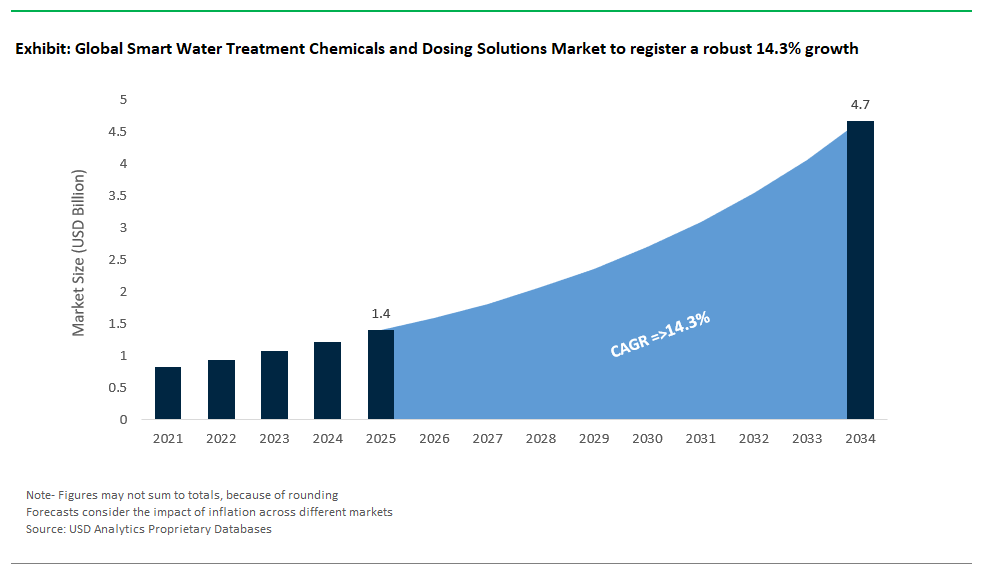
The smart water treatment chemicals and dosing solutions market is valued at $1.4 billion in 2025 and projected to reach $4.7 billion by 2034, registering a strong CAGR of 14.3%. The market represents the convergence of water treatment chemistry with advanced analytics, embedded sensing, and real-time process control an evolution driven by rising demands for cost efficiency, compliance, and operational transparency. No longer constrained to fixed-setpoint dosing, today’s chemical treatment programs are increasingly governed by adaptive control systems that integrate sensor feedback, AI algorithms, and dynamic performance benchmarks.
Machine learning models, for instance, have shown the capability to reduce coagulant consumption by 15–25% while maintaining stringent turbidity targets below 0.3 NTU, as demonstrated in recent trials. This not only delivers material savings but also reduces sludge volume and downstream polymer dependency.
Corrosion inhibition is likewise benefiting from digitization: electrochemical noise sensors enable real-time corrosion rate tracking, allowing inhibitor dosing to be continuously adjusted to maintain rates below the critical threshold of 0.1 mm/year, in line with AMPP standards and best practices for critical applications, which often recommend corrosion rates below this threshold for long-term asset integrity.
These gains in precision hinge on the growing reliability and autonomy of IoT sensor platforms. Residual chlorine sensors with high accuracy and auto-calibration routines are enabling continuous feedback loops in disinfection control, while high-sensitivity phosphate analyzers support fine-tuned nutrient dosing strategies.
These technologies are being rapidly adopted in municipal and industrial systems alike, particularly in facilities seeking to minimize chemical overfeed, optimize regulatory margins, or participate in ESG reporting frameworks. As digital water programs mature, the competitive advantage lies not merely in deploying sensors or smart pumps but in delivering fully integrated chemical-dosing ecosystems bundled with advanced analytics dashboards, anomaly detection, and cloud-based control. Vendors that offer predictive insights, dose-to-target algorithms, and interoperable sensor suites are increasingly becoming strategic partners to utilities and manufacturers navigating the transition from manual to intelligent treatment paradigms.
AI-Driven Efficiency and Modular Solutions Shape the Future of Smart Water Treatment Chemicals and Dosing Systems
Market Trend: AI-Powered Predictive Dosing Revolutionizes Water Treatment Efficiency and Compliance
The Smart Water Treatment Chemicals and Dosing Solutions Market is experiencing a fundamental transformation as artificial intelligence becomes the new operational backbone for chemical dosing. Moving beyond traditional flow-paced or fixed-ratio dosing, today’s systems leverage real-time sensors, SCADA integration, and predictive algorithms to continuously fine-tune dosing rates based on dynamic influent characteristics, weather events, and historical system behavior. Flagship solutions like Evoqua’s AI Dosing Controller and Suez are setting the industry benchmark reporting up to 30% fewer overdosing incidents and a 20% drop in chemical usage, especially in load-variable industrial effluents and seasonal municipal flows. These platforms not only reduce operating costs but also serve as a frontline defense against tightening environmental regulations. With predictive dosing, plants can avoid permit violations preemptively by dynamically adjusting polymer, biocide, or antiscalant concentrations based on live influent loads and forecasted stress events. Integration ease is another accelerant: modern systems are SCADA-compatible and IIoT-ready, allowing seamless deployment without overhauling existing infrastructure. The result is a chemical program that’s not only smarter but also safer, more sustainable, and increasingly automated supporting a shift from reactive to anticipatory water quality management. As utilities and industries pursue ESG metrics and digital twin integration, AI-based chemical dosing is quickly becoming the operational standard rather than a premium upgrade.
Market Opportunity: Decentralized and Modular Water Systems Drive Demand for Intelligent, Plug-and-Play Dosing Platforms
The surge in decentralized and point-of-use water treatment systems is creating a high-margin growth zone for intelligent, containerized dosing solutions particularly in sectors and geographies where centralized infrastructure is inadequate, inflexible, or under regulatory strain. Industries such as food & beverage, pharma, mining, and microelectronics are deploying modular wastewater and reuse systems that demand precision chemical dosing without constant operator oversight. Enter smart, pre-engineered dosing skids, which combine IoT-based telemetry with cloud analytics to enable remote chemical control, fault prediction, and consumables management. These units are often deployed in remote industrial parks or Tier-2 cities with minimal trained manpower but stringent sustainability and discharge targets. According to Global Water Intelligence (2024), investment in decentralized water treatment systems is growing at over 12% annually, with chemical dosing platforms representing a critical enabler of this growth. Unlike conventional systems, these skids cut commissioning times by 40%, reduce chemical overdosing risks, and support subscription-based service models generating steady aftermarket revenue through cloud dashboards and predictive maintenance alerts. Furthermore, they serve emerging markets exceptionally well: regions like Southeast Asia, Sub-Saharan Africa, and Latin America, which lack centralized wastewater networks but face escalating climate-driven water stress, are leapfrogging to modular smart water tech. With regulatory bodies increasingly favoring data-logged, auditable chemical control, smart dosing units offer not just compliance. The next wave of market leaders will be those offering chemical-agnostic, drop-in dosing intelligence tailored for a decentralized future.
Smart Water Treatment Chemicals and Dosing Solutions Market Competitive Landscape
The market for smart water treatment chemicals and dosing solutions is evolving quickly. This change is driven by sensor integration, AI-based dosing optimization, and partnerships with end-user industries. The competitive scene features global companies that use their own cloud platforms, embedded analytics, and specialized chemical-dosing equipment to address the needs of industrial and municipal water treatment systems.
Integrated IoT Platforms and Real-Time Control- A key trend among top vendors is combining dosing technology with IoT-enabled cloud platforms. Ecolab’s 3D TRASAR™ and Smart Dosing™ ecosystem leads the way with over 60,000 global deployments, using real-time analytics to automatically adjust chemical feed in cooling towers, boilers, and membrane systems. Similarly, Veolia’s Hubgrade™ platform and Dolphin™ skids use digital twin models and embedded sensors to fine-tune chemical use, with more than 1,000 installations in complex industrial sites like refineries and power plants. After acquiring Evoqua, Xylem has become the most diverse player in sensor-dosing integration. They utilize their Vue™ platform along with legacy technologies like BioMag® and IQ SensorNet to serve municipal and industrial segments in North America.
AI-Powered Chemical Optimization and Predictive Dosing- More companies are adopting artificial intelligence and machine learning for predictive maintenance and precise chemical usage. Solenis’ SOLARIS™ platform manages over $1 billion in annual chemical costs by optimizing treatment regimens in the power and paper sectors. Kurita's KP-8000 dosing controllers, supported by the Kurita Brain AI platform, allow adaptive learning for ultrapure water dosing in semiconductor fabs resulting in chemical use reductions of up to 30%. Kemira’s Kemconnect™ and AI-based raw water coagulant prediction tools highlight this shift by improving dosing efficiency in municipal and pulp & paper applications.
Sector-Specific Strengths and Application Customization- Companies are customizing their dosing technologies to meet specific industry needs. BASF’s Smart Chemistry Program uses SensoGuard™ sensors to enhance RO system performance, targeting petrochemical and process liquid (PoL) industries with early detection of scaling and fouling. Grundfos and ProMinent are leading manufacturers of dosing pumps focused on hygienic dosing and industrial safety. They are certified to standards like ISO 15883 and UL/FM for critical applications, including pharma, food & beverage, and hazardous areas. Seko specializes in automated clean-in-place (CIP) dosing for the pharmaceutical and F&B sectors, maintaining regulatory compliance through 3A and EHEDG certifications.
Emerging Market Innovators and Cost-Optimized Deployments- In India and other cost-sensitive areas, smaller players are gaining traction through local manufacturing and integration. Dosimix Technologies and Dynamic Equipments offer robust, PLC-based dosing skids designed for SMEs in textiles, electroplating, and pharma often incorporating local IoT platforms or renewable energy sources like solar for remote dosing. While these firms may lack global reach, they excel in service responsiveness and price-performance balance, especially in South Asia and Middle East export markets.
Recent Innovation Priorities and Future Outlook- Across the industry, companies are investing in smart chemical packaging, such as RFID-tagged containers by BASF, and cybersecurity for dosing infrastructure like ProMinent’s IEC 62443 compliance. They are also integrating their systems with building or water management systems, as seen with Grundfos iSolutions and Seko Cloud. With stricter regulatory compliance and clearer sustainability targets, the market is likely to divide further. One path will focus on high-precision, AI-guided treatment for critical infrastructure, while the other will emphasize modular, scalable dosing systems for decentralized and emerging-market users.
Smart Water Treatment Chemicals and Dosing Solutions Market– Segmentation Insights (2025–2034)
By Application: Cooling Water Treatment Leads While Desalination Grows Fastest
Cooling water treatment holds the largest share in the smart water treatment chemicals and dosing solutions market, accounting for approximately 28.4% of total demand in 2025. This dominance stems from the extensive deployment of industrial cooling towers across sectors such as power generation, petrochemicals, and manufacturing where automated dosing systems ensure optimal control of scale, corrosion, and biofouling. Smart dosing platforms powered by real-time sensors and AI algorithms are reducing chemical consumption and extending equipment life by precisely adjusting chemical feed rates based on process conditions. In contrast, desalination is the fastest-growing application segment, projected to expand at a 15.2% CAGR through 2034. This growth is driven by the rapid adoption of reverse osmosis (RO) and nanofiltration (NF) systems in water-scarce regions and the rising integration of AI-driven platforms for predictive antiscalant and biocide dosing. Wastewater treatment is also experiencing strong growth, with smart nutrient dosing and biological process optimization supporting a 13% CAGR as municipalities and industries embrace precision control for regulatory compliance and cost savings. Boiler water, process water, and raw water treatment continue to integrate digital dosing to enhance efficiency and reduce manual intervention, particularly in decentralized and remote facilities.
By End-User Industry: Industrial Segment Dominates While Municipal Sector Sees Accelerated Adoption
The industrial sector dominates the smart water treatment chemicals and dosing solutions market, contributing approximately 58.7% of total market share in 2025. Industries such as power, oil & gas, chemicals, and food processing are leveraging predictive dosing platforms to enhance reliability, minimize unplanned shutdowns, and achieve up to 30% savings in chemical usage. Real-time monitoring, digital twins, and edge analytics are increasingly integrated into smart skids and cloud-connected control systems, allowing proactive water chemistry management even across complex, multi-site operations. The municipal segment is growing steadily, with a projected CAGR of 14.9% as public utilities deploy IoT-enabled platforms for remote monitoring of disinfectant residuals, nutrient levels, and pH control. Automated systems are proving vital in managing variable influent loads and optimizing disinfection processes under tightening regulatory limits. The commercial sector including hospitals, data centers, and large office complexes accounts for a smaller share but is adopting compact smart dosing units to manage water quality in HVAC systems, cooling towers, and building-wide recirculation systems. As digital transformation accelerates across water-intensive industries, smart chemical dosing solutions are becoming a cornerstone of next-generation water management strategies.
United States: Federal Investments and AI-Driven Smart Dosing Solutions Accelerate Adoption
The U.S. is a global leader in smart water treatment chemicals and dosing solutions, with growth driven by federal funding and innovation in digital technologies. The Infrastructure Investment and Jobs Act (IIJA) has allocated over $50 billion for water infrastructure upgrades, a portion of which is earmarked for smart water technologies like IoT-enabled dosing systems, automated chemical management, and advanced metering infrastructure (AMI). These solutions help utilities optimize chemical usage, reduce costs, and enhance compliance with strict discharge standards.
AI and machine learning are transforming U.S. water utilities by enabling real-time analysis of sensor data to predict chemical demand, detect leaks, and prevent failures. Companies are also integrating digital twins and predictive modeling for proactive maintenance and precision dosing of scale inhibitors and disinfectants. Private firms are introducing automated chemical dosing systems and radar-based wastewater monitoring that minimize overflows and ensure operational resilience. With growing interest in asset optimization, sustainability, and energy efficiency, the U.S. market remains a hub for cutting-edge smart water solutions.
China: Policy-Driven Expansion and IoT Integration in Water Infrastructure
China’s market for smart water treatment chemicals and dosing technologies is rapidly expanding, driven by aggressive national initiatives such as the Water Ten Plan and over RMB 26 billion in government funding for pollution control in 2024. These programs are accelerating the integration of IoT-enabled sensors, AI-driven dosing platforms, and real-time quality monitoring systems in municipal and industrial water projects.
Urban centers like Shanghai and the Greater Bay Area are deploying advanced smart pipeline systems to optimize chemical dosing, reduce water losses, and meet stringent nutrient and pollutant removal standards. Chinese manufacturers are developing localized smart dosing solutions for desalination, municipal water, and industrial sectors, enabling cost-efficient compliance with new discharge norms. The market is also witnessing a surge in decentralized IoT water treatment systems for rural areas, aligning with the country’s sustainability and digital transformation goals.
Germany: Sustainability Goals Drive Intelligent Chemical Dosing and Automation
Germany is setting benchmarks in digital water treatment technologies, combining strict regulatory compliance with cutting-edge smart solutions. The German Water Resources Act (WHG) and EU Water Framework Directive mandate high water quality standards, prompting utilities and industries to adopt smart chemical dosing platforms integrated with AI and IoT for real-time optimization.
Leading German companies are pioneering eco-friendly coagulants and flocculants integrated with automated dosing systems, minimizing sludge production and improving treatment efficiency. These technologies are widely used in wastewater recycling and reuse projects, supporting Germany’s commitment to a circular economy. Real-time monitoring, predictive analytics for corrosion and scale control, and energy-efficient dosing have become standard practices in industrial facilities, particularly in chemical, food & beverage, and automotive sectors, reinforcing Germany’s position as a global innovation hub.
India: Smart Water Solutions Gain Momentum Through National Missions
India’s smart water treatment chemicals and dosing market is expanding rapidly, fueled by initiatives such as the Jal Jeevan Mission and the Smart Cities Mission. These programs are deploying IoT-enabled real-time monitoring systems for water quality and pressure across rural and urban networks. Municipalities and industrial users are adopting AI-driven chemical dosing platforms to optimize treatment, reduce wastage, and ensure compliance with regulatory standards.
Startups and established firms are focusing on low-cost smart dosing systems for small-scale water treatment plants, addressing the needs of industries like textiles, pharmaceuticals, and power generation. The JJM-IMIS digital platform further supports data-driven decision-making for rural water supply systems. With growing concerns over water scarcity and operational inefficiencies, India is emerging as a high-growth market for IoT-driven dosing technologies integrated with advanced water treatment chemicals.
Japan: Automation and Predictive Analytics Define the Smart Water Landscape
Japan’s water sector is leveraging digital technology and automation to counter challenges like aging infrastructure and workforce shortages. The Ministry of Land, Infrastructure, Transport and Tourism (MLIT) has introduced a Catalogue of Digital Technology in Water and Sewerage Systems, listing over 100 advanced solutions such as wireless smart meters, predictive maintenance tools, and AI-driven dosing systems.
Utilities are increasingly adopting automated chemical dosing platforms combined with smart sensors to maintain water quality in municipal and industrial systems. The Tokyo Metropolitan Waterworks Bureau’s Environmental Five-Year Plan (2025–2029) prioritizes decarbonization and resilience, driving investment in smart chemical dosing technologies for wastewater reuse and energy optimization. Japan’s leadership in advanced sensor technology ensures precise dosing of corrosion inhibitors, scale control agents, and disinfectants, cementing its position as a key innovator in the smart water treatment sector.
Brazil: Legal Framework Spurs Private Investment in Digital Water Treatment
Brazil’s New Sanitation Legal Framework (Law No. 14,026/2020) mandates universal access to water and wastewater treatment by 2033, creating enormous opportunities for smart chemical dosing solutions. Utilities and private operators are deploying digital water management systems that integrate IoT sensors, remote monitoring, and AI-based dosing to improve efficiency and reduce operating costs.
Projects such as water reclamation stations for industrial reuse are increasingly incorporating smart dosing platforms to maintain stringent water quality standards. The mining and oil & gas sectors are also adopting digital dosing systems for produced water treatment, highlighting Brazil’s growing demand for chemical optimization technologies in industrial processes.
United Kingdom: £104 Billion Investment Plan Accelerates Smart Chemical Dosing Adoption
The UK water industry is entering a new era of digital transformation under Water UK’s £104 billion investment plan (2025–2030), which includes widespread deployment of smart water meters and automated dosing technologies. These systems help utilities reduce water leakage, optimize chemical usage, and comply with stricter pollution control measures under the Environment Act 2021.
Real-time data analytics and AI-based predictive systems are becoming central to storm overflow management and nutrient removal optimization, ensuring compliance with evolving environmental targets. Companies are investing in smart chlorination and coagulant dosing systems to reduce chemical waste and improve energy efficiency, aligning with the UK’s sustainability and net-zero goals.
South Korea: ICT Integration and AI-Powered Water Management
South Korea is at the forefront of smart water management through large-scale adoption of ICT-enabled chemical dosing systems and AI-based optimization platforms. Projects like the Seosan Smart Water Management initiative showcase the use of smart meters, real-time data collection, and predictive analytics to reduce leakage and improve water quality.
The Framework Act on Water Management promotes integrated monitoring of water quantity, quality, and ecosystems, driving utilities to implement smart dosing solutions for disinfection, corrosion control, and wastewater recycling. South Korea is also investing in desalination and water reuse projects, where automated chemical dosing and digital monitoring systems are essential for operational efficiency and sustainability.
Smart Water Treatment Chemicals and Dosing Solutions Market Report Scope
Smart Water Treatment Chemicals and Dosing Solutions Market
Parameter
Details
Market Size (2025)
$1.4 Billion
Market Size (2034)
$4.7 Billion
Market Growth Rate
14.3%
Segments
By Component (Smart Water Treatment Chemicals, Smart Dosing Solutions/Systems), By Application (Raw Water Treatment, Boiler Water Treatment, Cooling Water Treatment, Wastewater Treatment, Desalination (RO/NF Systems), Process Water Treatment), By End-User Industry (Industrial, Municipal, Commercial), By Level of Automation/Intelligence (Basic Automated Dosing, Sensor-Feedback Dosing, Advanced/Predictive Dosing
Study Period
2019- 2024 and 2025-2034
Units
Revenue (USD)
Qualitative Analysis
Porter’s Five Forces, SWOT Profile, Market Share, Scenario Forecasts, Market Ecosystem, Company Ranking, Market Dynamics, Industry Benchmarking
Companies
Ecolab Inc. (U.S.), Veolia Water Technologies (France), Xylem Inc. (U.S.), BASF SE (Germany), Kemira Oyj (Finland), Solenis LLC (U.S.), Kurita Water Industries Ltd. (Japan), Grundfos Holding A/S (Denmark), ProMinent GmbH (Germany), Seko S.p.A. (Italy), Dosimix Technologies (India), Dynamic Equipments Pvt. Ltd. (India),
Countries
US, Canada, Mexico, Germany, France, Spain, Italy, UK, Russia, China, India, Japan, South Korea, Australia, South East Asia, Brazil, Argentina, Middle East, Africa
Smart Water Treatment Chemicals and Dosing Solutions Market Segmentation
By Component
Smart Water Treatment Chemicals
Smart Dosing Solutions/Systems
Automated Dosing Pumps
Control Systems
Sensors and Analyzers (Real-time Monitoring)
Connectivity and Communication
Software and Analytics
Ancillary Equipment
By Application
Raw Water Treatment
Boiler Water Treatment
Cooling Water Treatment
Wastewater Treatment
Desalination (RO/NF Systems)
Process Water Treatment
By End-User Industry
Industrial
Power Generation
Oil and Gas
Chemical and Petrochemical
Food and Beverage
Pharmaceutical
Pulp and Paper
Mining and Metallurgy
Textile
Electronics and Semiconductors
Other Manufacturing Industries
Municipal
Drinking Water Treatment Plants
Municipal Wastewater Treatment Plants
Commercial
By Level of Automation/Intelligence
Basic Automated Dosing
Sensor-Feedback Dosing
Advanced/Predictive Dosing
Countries Analyzed
North America (US, Canada, Mexico)
Europe (Germany, UK, France, Spain, Italy, Russia, Rest of Europe)
Asia Pacific (China, India, Japan, South Korea, Australia, South East Asia, Rest of Asia)
South America (Brazil, Argentina, Rest of South America)
Middle East and Africa (Saudi Arabia, UAE, Rest of Middle East, South Africa, Egypt, Rest of Africa)
Top Companies in Smart Water Treatment Chemicals and Dosing Solutions Market
Ecolab Inc. (U.S.)
Veolia Water Technologies (France)
Xylem Inc. (U.S.)
BASF SE (Germany)
Kemira Oyj (Finland)
Solenis LLC (U.S.)
Kurita Water Industries Ltd. (Japan)
Grundfos Holding A/S (Denmark)
ProMinent GmbH (Germany)
SekS.p.A. (Italy)
Dosimix Technologies (India)
Dynamic Equipments Pvt. Ltd. (India)
* List Not Exhaustive
Research Coverage
This report investigates the Smart Water Treatment Chemicals and Dosing Solutions Market, offering a comprehensive analysis of digital dosing technologies, AI-powered predictive control, and IoT-integrated water treatment solutions. USDAnalytics highlights market breakthroughs in real-time monitoring systems, cloud-based platforms, and modular dosing units, addressing the growing demand for energy efficiency, compliance, and sustainability. The analysis reviews market trends across industrial, municipal, and commercial sectors, providing actionable insights for stakeholders in AI-driven chemical dosing and smart water infrastructure. This report is an essential resource for industry leaders, utilities, and technology providers navigating the transition to intelligent water management systems.
Scope Highlights:
Segmentation:
By Component: Smart Water Treatment Chemicals; Smart Dosing Solutions/Systems (Automated Dosing Pumps, Control Systems, Sensors and Analyzers, Connectivity and Communication, Software and Analytics, Ancillary Equipment)
By Application: Raw Water Treatment, Boiler Water Treatment, Cooling Water Treatment, Wastewater Treatment, Desalination (RO/NF Systems), Process Water Treatment
By End-User Industry: Industrial (Power Generation, Oil and Gas, Chemical and Petrochemical, Food and Beverage, Pharmaceutical, Pulp and Paper, Mining and Metallurgy, Textile, Electronics and Semiconductors, Other Manufacturing Industries); Municipal (Drinking Water Treatment Plants, Municipal Wastewater Treatment Plants); Commercial
By Level of Automation/Intelligence: Basic Automated Dosing, Sensor-Feedback Dosing, Advanced/Predictive Dosing
Geographic Scope: Analysis spans 25+ countries across North America, Europe, Asia Pacific, Latin America, and the Middle East & Africa.
Data Coverage: Historic data from 2021 to 2024 and forecast data from 2025 to 2034.
USDAnalytics employs a robust methodology combining primary research through interviews with water utility managers, chemical dosing experts, and IoT solution providers, complemented by secondary sources including regulatory databases, industry reports, and trade journals. Forecasts leverage top-down and bottom-up models validated through data triangulation and sensitivity analysis. The methodology incorporates macroeconomic indicators, digital transformation trends, AI adoption rates, and CAPEX/OPEX optimization benchmarks to deliver accurate projections for 2025–2034.
Deliverables
Complete Market Research Report (PDF, Excel): data tables, market charts, and visual insights.
Country-Level Forecasts & Analysis
Segment-wise Revenue Projections (2025–2034)
Competitive Benchmarking & SWOT Analysis
Recent Developments & News Tracker
Executive summary and key takeaway slides for boardroom presentations
Post-Purchase Analyst Support for Client-Specific Questions and Custom Data Requirements
Table of Content: Smart Water Treatment Chemicals and Dosing Solutions Market
1. Executive Summary
1.1. Market Highlights
1.2. Key Findings
1.3. Global Market Snapshot
2. Smart Water Treatment Chemicals and Dosing Solutions Market Outlook (2025–2034)
2.1. Introduction to Smart Chemicals and Dosing Solutions
2.2. Market Valuation and Growth Projections (2025–2034)
2.2.1. Current Market Size (2025): $1.4 Billion
2.2.2. Forecasted Market Size and CAGR (2034): $4.7 Billion at 14.3% CAGR
2.3. Technology Convergence: Analytics, Sensing, and Control
Smart water treatment chemicals and dosing solutions combine advanced sensors, AI algorithms, and real-time process controls to automate and optimize chemical dosing in water treatment. This improves efficiency, reduces chemical overuse, and ensures compliance with water quality standards.
AI-driven dosing platforms use real-time sensor data and predictive analytics to automatically adjust chemical feed rates. This minimizes overdosing, prevents permit violations, and adapts dosing to fluctuating influent quality, delivering cost savings and improved environmental outcomes.
Decentralized and modular smart dosing systems offer plug-and-play installation, remote monitoring, and automated control—ideal for small-scale or remote sites. They reduce labor needs, cut commissioning time by up to 40%, and support sustainable water management in regions lacking centralized infrastructure.
Industrial sectors such as power, oil & gas, food & beverage, and manufacturing are leading adopters, using smart dosing to enhance reliability, cut chemical usage, and meet regulatory requirements. Municipal utilities are also accelerating adoption to optimize public water systems and wastewater plants.
Major growth drivers include U.S. federal funding, China’s Water Ten Plan, Germany’s digitalization push, and the UK’s £104 billion water investment. Emerging markets in India, Brazil, and South Korea are rapidly scaling up adoption through national missions, IoT integration, and regulatory mandates.

.png)