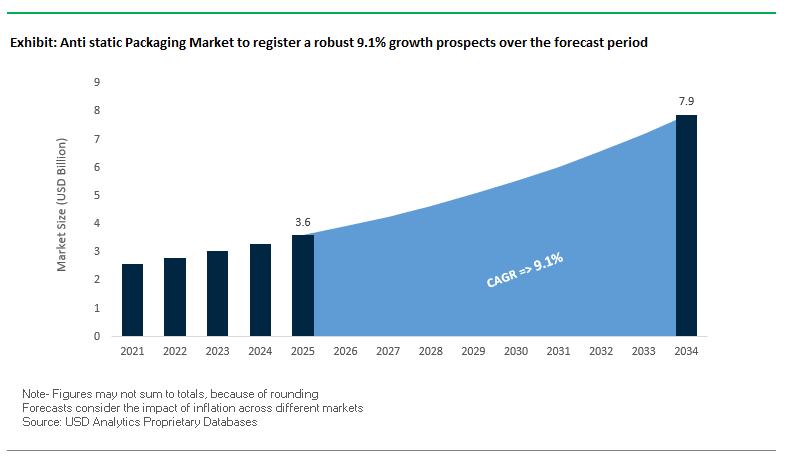
Rising E-commerce and ESD Risks Propel the Anti-static Packaging Market to USD 7.9 Billion by 2034
The global anti-static packaging market is valued at USD 3.6 billion in 2025 and is projected to expand to USD 7.9 billion by 2034, advancing at a strong CAGR of 9.1%. This growth is underpinned by the essential role anti-static packaging plays in mitigating electrostatic discharge (ESD) risks for sensitive electronic components. Even static shocks of a few volts imperceptible to humans can cause irreversible damage to microchips and integrated circuits, leading to costly product failures.
The rapid rise of e-commerce logistics is another major driver, as safe transport of delicate consumer electronics such as smartphones, tablets, and laptops requires robust anti-static protection. Moreover, the industry is witnessing a decisive shift toward sustainable packaging materials, with biodegradable and recyclable anti-static films gaining momentum as companies respond to regulatory pressures and environmentally conscious consumers. The integration of smart packaging technologies, such as embedded IoT sensors for static monitoring and product tracking, further highlights how the market is evolving toward innovation and value-added solutions.
Key Insights for Professionals
Electronics vulnerability to ESD is driving packaging adoption across consumer and industrial applications.
E-commerce boom is fueling demand for lightweight yet highly protective anti-static packaging.
Sustainability trends are reshaping material preferences, with biodegradable plastics and compostable films gaining share.
IoT-enabled smart packaging with static detection and real-time monitoring is creating new growth opportunities.
Strategic Mergers, Sustainable Innovations, and IoT Integration Redefine the Anti-static Packaging Industry
The anti-static packaging market is undergoing rapid structural change through investments, product launches, and consolidations. In August 2025, Constantia Flexibles committed over €100 million to expand its global production network, with implications for sectors like pharmaceuticals and food packaging that often require anti-static solutions. That same month, Energous introduced its eSense tag, a battery-free IoT authentication platform designed for packaging integrity, demonstrating how anti-static formats are being enhanced with wireless smart technologies.
M&A activity is consolidating the industry into fewer but more powerful players. In June 2025, the merger of Smurfit Kappa and WestRock formed Smurfit WestRock, a giant in paper-based and specialty packaging with extended anti-static capabilities. Similarly, in April 2025, DS Smith joined forces with International Paper, expanding its global reach and creating synergies in sustainable electronics packaging. Other key moves include De La Rue’s divestiture of its Authentication division to Crane NXT (May 2025), strengthening focus on brand protection technologies, while Cortec Corporation’s EcoSonic VpCI-125 HP ESD Film (November 2022) exemplifies the trend toward multifunctional, corrosion-resistant static protection.
Transformative Trends and Growth Opportunities in the Anti-Static Packaging Market
Strategic Shift Towards Permanent, Carbon-Free Static Dissipative Polymers
A major transformation is underway as manufacturers phase out conventional carbon-black and amine-coated ESD materials in favor of permanent, carbon-free static-dissipative polymers. These advanced materials, such as polycarbonate (PC) and polyethylene terephthalate (PET) blended with inherently dissipative polymers, eliminate the contamination risks caused by carbon black sloughing a critical concern in semiconductor cleanrooms and high-precision electronics assembly lines.
Unlike migrating coatings that rely on ambient humidity, permanent dissipative polymers offer consistent performance across all environments by forming a continuous conductive network within the polymer matrix. This reliability is crucial for global electronics supply chains operating across multiple climate zones. Companies like Arkema and Cargill are leading innovation by developing IDPs (Inherently Dissipative Polymers) that can be adapted for extrusion, injection molding, and thermoforming. These solutions ensure uniform surface resistivity and long-term stability, making them the preferred option for sensitive applications such as chip packaging, hard disk drives, and aerospace electronics.
Integration of Smart, Connected Features into ESD-Safe Packaging
The next wave of anti-static packaging innovation lies in embedding IoT, RFID, and NFC technologies into ESD-safe materials. By integrating RFID tags, manufacturers enable bulk scanning of sensitive components without direct line of sight, improving warehouse efficiency and reducing manual errors. Smart packaging also strengthens security, with sensors designed to detect tampering and unauthorized movements.
In addition, NFC-enabled sensors allow real-time monitoring of environmental parameters like humidity and temperature critical factors for semiconductor wafers and microprocessors. Smart authentication systems are further mitigating counterfeiting risks by linking unique digital identities to each package. With these advancements, anti-static packaging is evolving into an intelligent ecosystem that enhances both supply chain visibility and product integrity.
Development of High-Performance, Sustainable ESD Materials from Recycled Content
The growing emphasis on ESG compliance and circular economy principles creates a significant opportunity to integrate post-consumer recycled (PCR) content into ESD packaging without compromising on performance. While traditional recycled materials often struggle to meet the purity and conductivity requirements for sensitive electronics, new material formulations and hybrid systems are overcoming these challenges.
One promising approach involves pairing recyclable corrugated cartons with anti-static liners, foams, or trays made from ESD-safe recycled polymers. This design allows the bulk of the packaging to re-enter conventional recycling streams while ensuring electrostatic protection for internal components. With consumer electronics brands pledging aggressive carbon reduction and waste minimization targets, suppliers who develop high-performance recycled-content ESD packaging will secure long-term partnerships and strengthen market positioning.
Standardization of ESD Packaging for the Automotive Lithium-Ion Battery Supply Chain
The rapid growth of electric vehicles (EVs) is creating a high-value opportunity for standardized ESD packaging systems tailored for lithium-ion batteries. Electrostatic discharge poses significant risks to battery management systems (BMS) and electronic modules, requiring packaging that meets both ESD and stringent safety certifications like UN 38.3.
Packaging companies are responding with durable, reusable bulk containers, thermoformed dunnage, and metal racks specifically designed for battery cells and modules. These solutions not only ensure electrostatic protection but also withstand the rigors of global transport. Reusability is particularly attractive, as it reduces logistics costs and aligns with the sustainability strategies of EV manufacturers. With the EV supply chain scaling at unprecedented speed, suppliers offering standardized, certified, and reusable ESD packaging stand to capture a rapidly expanding market niche.
Competitive Landscape: Leading Companies in the Anti-static Packaging Market
The anti-static packaging industry is characterized by a mix of global leaders and niche innovators, all focusing on sustainability, innovation, and protective performance. Companies are strengthening their positions through mergers, acquisitions, and continuous product development.
Following the June 2025 merger of Smurfit Kappa and WestRock, Smurfit WestRock has emerged as a global leader in sustainable paper-based packaging. The company operates in more than 42 countries with over 500 converting facilities, offering specialized anti-static papers and corrugated boxes. Its TechniPaper Anti Electrostatic product line addresses ESD challenges in electronics packaging. With sustainability as its core strategy, the company leverages recyclable content and innovative designs to meet customer goals in electronics and industrial packaging.
Sealed Air Corporation: Protective Packaging with Static Control Solutions
Sealed Air, rebranded as SEE in 2023, remains a dominant force in protective and specialty packaging. Its portfolio includes anti-static Bubble Wrap cushioning and Instapak foam systems that combine shock absorption with static dissipative features. Sealed Air’s strategic emphasis on sustainable and innovative packaging enables brands to enhance supply chain efficiency and product safety. Its global reach and R&D expertise provide it with a strong advantage in delivering premium protective solutions for sensitive electronics and high-value goods.
Pregis LLC: Driving Sustainable Innovation in Anti-static Packaging
Pregis has established itself as a leading provider of protective solutions, with anti-static air cushioning, void-fill, and foam systems in its portfolio. Its AirSpeed Renew line demonstrates the company’s commitment to sustainability, incorporating at least 30% recycled or renewable material while maintaining recyclability. Pregis focuses on helping customers reduce shipping costs, minimize product damage, and achieve sustainability objectives, positioning it as a reliable partner in both electronics and healthcare packaging.
DS Smith plc: Circular Economy-driven Anti-static Packaging Provider
In April 2025, DS Smith merged with International Paper, enhancing its global capabilities and reinforcing its sustainability leadership. Known for its commitment to “Redefining Packaging for a Changing World,” DS Smith offers anti-static corrugated packaging and protective solutions designed for electronics and industrial applications. With its integrated model spanning paper production, recycling, and packaging design DS Smith combines innovation with circular economy principles, strengthening its competitive position in the anti-static packaging space.
Anti static Packaging Market Share Insights
Bags & Pouches Dominate Market Share by Product Type in Anti-Static Packaging
Bags and pouches command 45% of the anti-static packaging industry, highlighting their unmatched scalability, low unit cost, and adaptability for protecting sensitive electronic components from electrostatic discharge (ESD). They are indispensable for semiconductors, printed circuit boards (PCBs), and integrated circuits (ICs), ensuring safe storage and shipment through conductive or static-dissipative material structures. Their dominance is reinforced by the exponential growth in global electronics manufacturing and the parallel rise of e-commerce distribution of sensitive electronic parts. Trays and containers hold the next largest share, offering rigid protection for high-value or irregularly shaped components, while films, wraps, foams, and boxes serve specialized roles. Together, these categories provide a multi-layered defense system, but bags and pouches remain the industry standard due to their cost-efficiency and universal usability across the electronics supply chain.
Electronics & Semiconductors Continue to Drive Market Share by End-Use Industry in Anti-Static Packaging
Electronics and semiconductors represent nearly 65% of total demand, cementing their position as the central driver of anti-static packaging. The extreme vulnerability of chips, microprocessors, and PCBs to ESD failures often invisible but catastrophic makes protective packaging non-negotiable for global electronics supply chains. The scale of demand is immense, fueled by growth in consumer electronics, 5G infrastructure, cloud data centers, and IoT devices. Automotive applications follow with 15% of share, reflecting the surge in electronic integration across vehicles, from ADAS systems to EV battery management. Healthcare, aerospace, and defense collectively represent smaller but critical niches, where ultra-high reliability packaging is required for diagnostic equipment, avionics, and mission-critical electronics. As automation, robotics, and smart manufacturing expand across industrial and telecom sectors, anti-static packaging is transitioning from a specialized safeguard to a core enabler of next-generation technological ecosystems.
United States: Regulatory Compliance and Advanced Materials Driving Anti-Static Packaging Growth
The U.S. anti-static packaging market is strongly influenced by federal and state regulations, particularly the increasing adoption of electrostatic discharge (ESD) standards across electronics, aerospace, and high-tech industries. The proliferation of miniaturized, ESD-sensitive components has created a surge in demand for robust protective packaging solutions. Technological advancements are driving the development of advanced polymers with enhanced dissipative properties and conductive fillers, as well as innovative conductive foams tailored for applications such as electric vehicle battery components.
Corporate initiatives reflect a strong focus on product protection and sustainability. In February 2023, Freudenberg Performance Materials introduced Evolon® ESD, a recycled polyester technical packaging textile designed for surface protection of automotive and electronic components. The rapid growth of e-commerce further accelerates demand for secure anti-static packaging to safeguard electronic devices during shipping and storage. Sustainability initiatives, including biodegradable plastics, recyclable materials, and compostable solutions, are also gaining traction to align with environmental regulations and consumer preferences. Key applications are concentrated in electronics and automotive sectors, where innovation and high-performance packaging are critical to prevent ESD-related damage.
China: Government Policies and E-Commerce Expansion Fuel Anti-Static Packaging Demand
China’s anti-static packaging market is driven by governmental initiatives such as the “dual carbon” goal, which promotes green industrial transformation and the reduction of non-degradable plastics. These policies have spurred demand for sustainable anti-static packaging solutions, including paper-based alternatives with protective ESD properties. Technological advancements, including AI and “5G plus industrial internet,” are optimizing production efficiency and flexible manufacturing capacity, enabling the mass production of precision anti-static materials.
The rapid expansion of e-commerce in China is a major driver for anti-static packaging, as it necessitates solutions capable of protecting a wide range of sensitive electronics and components. Regulatory standards, including GB 23350-2021, limit excessive packaging, further influencing the design of efficient, protective materials. Key applications are found in the electronics and automotive sectors, particularly with the proliferation of miniaturized, ESD-sensitive components in electric vehicles and consumer electronics. Significant investments in new production lines and infrastructure are being made to meet rising demand, ensuring secure, high-quality packaging for both domestic and international markets.
Germany: Precision Manufacturing and Sustainability Lead Anti-Static Packaging Innovation
Germany’s anti-static packaging market operates under stringent regulations, including the EU Packaging and Packaging Waste Regulation (PPWR), which promotes sustainable packaging design. The DIN 61340 standard for electrostatic protection serves as a critical reference for manufacturers, ensuring compliance across electronics and high-tech sectors. German companies leverage their leadership in precision engineering to develop high-speed, high-precision machinery for producing anti-static packaging with superior protection and accuracy.
Technological innovation is a central trend, with companies introducing advanced conductive foams, ESD additives, and complex security materials. Key applications are concentrated in the automotive, electronics, and medical device sectors, where high-value products require reliable anti-static protection. Sustainability is a key focus, with firms investing in recyclable and eco-friendly materials to meet EU environmental goals. Collaboration with the ESD Association of Germany ensures continual evolution of practical recommendations and standards, supporting the development of next-generation anti-static solutions.
Japan: Smart Technologies and Eco-Friendly Materials Power Anti-Static Packaging Market
Japan’s anti-static packaging market is characterized by advanced manufacturing precision and the integration of AI to accelerate design and production processes. Regulatory emphasis on technological innovation and supply chain security, particularly in electronics and semiconductor industries, drives the adoption of cutting-edge anti-static materials. Companies are focusing on next-generation anti-static fibers and films with enhanced ESD protection, ensuring the safe handling of miniaturized and high-performance devices.
Corporate collaborations, such as those by Ibiden Co., Ltd. and Nitto Denko Corporation, are advancing the development of specialized materials for semiconductor and electronics packaging. The market is further supported by the rapid growth of the electronics, semiconductor, and electric vehicle sectors, as well as the expansion of 5G technology. Sustainability remains a priority, with eco-friendly and recyclable ESD materials increasingly adopted to align with environmental consciousness. Key applications are concentrated in electronics, semiconductors, and automotive sectors, emphasizing high-performance, safe, and environmentally responsible packaging solutions.
Anti-static Packaging Market Report Scope
Anti static Packaging Market
Parameter
Details
Market Size (2025)
$3.6 Billion
Market Size (2034)
$7.9 Billion
Market Growth Rate
9.1%
Segments
By Material Type (Plastics, Metals, Paper & Paperboard, Biopolymers, Others), By Product Type (Bags & Pouches, Trays & Containers, Films & Wraps, Foams, Boxes), By Functionality (Anti-static, Conductive, Static Dissipative, Static Shielding), By End-Use Industry (Electronics & Semiconductors, Automotive, Healthcare, Aerospace & Defense, Others)
Study Period
2019- 2024 and 2025-2034
Units
Revenue (USD)
Qualitative Analysis
Porter’s Five Forces, SWOT Profile, Market Share, Scenario Forecasts, Market Ecosystem, Company Ranking, Market Dynamics, Industry Benchmarking
Companies
Sealed Air Corporation, Amcor plc, 3M Company, Berry Global Group, Inc., DS Smith Plc, Teknis Limited, Mondi Group, Smurfit Kappa Group, Avery Dennison Corporation, WestRock Company, CCL Industries Inc., Nitto Denko Corporation, Sonoco Products Company, Ibiden Co., Ltd., Nefab AB
Countries
US, Canada, Mexico, Germany, France, Spain, Italy, UK, Russia, China, India, Japan, South Korea, Australia, South East Asia, Brazil, Argentina, Middle East, Africa
Anti static Packaging Market Segmentation
By Material Type
Plastics
Metals
Paper & Paperboard
Biopolymers
Others
By Product Type
Bags & Pouches
Trays & Containers
Films & Wraps
Foams
Boxes
By Functionality
Anti-static
Conductive
Static Dissipative
Static Shielding
By End-Use Industry
Electronics & Semiconductors
Automotive
Healthcare
Aerospace & Defense
Others
Countries Analyzed
North America (US, Canada, Mexico)
Europe (Germany, UK, France, Spain, Italy, Russia, Rest of Europe)
Asia Pacific (China, India, Japan, South Korea, Australia, South East Asia, Rest of Asia)
South America (Brazil, Argentina, Rest of South America)
Middle East and Africa (Saudi Arabia, UAE, Rest of Middle East, South Africa, Egypt, Rest of Africa)
Top Companies in Anti static Packaging Market
Sealed Air Corporation
Amcor plc
3M Company
Berry Global Group, Inc.
DS Smith Plc
Teknis Limited
Mondi Group
Smurfit Kappa Group
Avery Dennison Corporation
WestRock Company
CCL Industries Inc.
Nitto Denko Corporation
Sonoco Products Company
Ibiden Co., Ltd.
Nefab AB
* List Not Exhaustive
Methodology
USDAnalytics conducts a comprehensive analysis of the Global Anti-Static Packaging Market using a robust research methodology that combines both primary and secondary data sources to provide accurate, actionable insights for industry professionals. Primary research involves detailed interviews with packaging manufacturers, electronics and semiconductor industry experts, supply chain stakeholders, and regulatory authorities to gather firsthand insights on ESD trends, technological adoption, and market growth drivers. Secondary research incorporates verified sources, including company reports, patent filings, regulatory updates, scientific publications, industry associations, and trade data. Market sizing and forecasts are generated using quantitative modeling that integrates historical market trends, macroeconomic indicators, technological innovations such as inherently dissipative polymers and IoT-enabled ESD solutions, and adoption rates across key regions including the U.S., China, Germany, and Japan. Triangulation techniques are applied to validate the data, ensuring consistency and reliability across multiple sources. The study further examines competitive dynamics by profiling leading players, analyzing mergers and acquisitions, innovations in sustainable materials, and strategic expansions. By combining technological, regulatory, and market intelligence, USDAnalytics delivers a detailed and professional overview of current trends, emerging opportunities, and future projections in anti-static packaging, catering to professionals seeking strategic guidance in electronics, automotive, healthcare, and high-value industrial applications.
Deliverables:
Comprehensive Market Research Report (PDF and Excel) with detailed tables, charts, and interactive visualizations.
Country-Specific Forecasts & Analysis.
Segment-Wise Revenue Forecasts (2025–2034).
Competitive Analysis, Benchmarking, and SWOT Profiles.
Recent Developments & Innovation Tracker.
Executive Summary & Analyst Commentary.
Post-Purchase Analyst Support for Client-Specific Questions and Custom Data Requirements.
2. Anti-Static Packaging Market Landscape & Outlook (2025–2034)
2.1. Introduction to Anti-Static Packaging Market
2.2. Market Valuation and Growth Projections (2025–2034)
2.3. Drivers: ESD Risks and E-Commerce Growth
2.4. Sustainability and Regulatory Influences
2.5. Technological Innovations and Smart Packaging
3. Innovations Reshaping the Anti-Static Packaging Market
3.1. Trend: Permanent, Carbon-Free Static Dissipative Polymers
3.2. Trend: Integration of Smart, Connected Features into ESD-Safe Packaging
3.3. Opportunity: Development of High-Performance, Sustainable ESD Materials from Recycled Content
3.4. Opportunity: Standardization of ESD Packaging for Automotive Lithium-Ion Battery Supply Chain
4. Competitive Landscape and Strategic Initiatives
4.1. Mergers, Acquisitions and Strategic Alliances
4.2. R&D and Material Innovation
4.3. Sustainability and Strategies
4.4. Market Expansion and Regional Focus
5. Market Share and Segmentation Insights: Anti-Static Packaging Market
5.1. By Material Type
5.1.1. Plastics
5.1.2. Metals
5.1.3. Paper & Paperboard
5.1.4. Biopolymers
5.1.5. Others
5.2. By Product Type
5.2.1. Bags & Pouches
5.2.2. Trays & Containers
5.2.3. Films & Wraps
5.2.4. Foams
5.2.5. Boxes
5.3. By Functionality
5.3.1. Anti-static
5.3.2. Conductive
5.3.3. Static Dissipative
5.3.4. Static Shielding
5.4. By End-Use Industry
5.4.1. Electronics & Semiconductors
5.4.2. Automotive
5.4.3. Healthcare
5.4.4. Aerospace & Defense
5.4.5. Others
6. Country Analysis and Outlook of Anti-Static Packaging Market
6.1. United States
6.2. Canada
6.3. Mexico
6.4. Germany
6.5. France
6.6. Spain
6.7. Italy
6.8. UK
6.9. Russia
6.10. China
6.11. India
6.12. Japan
6.13. South Korea
6.14. Australia
6.15. South East Asia
6.16. Brazil
6.17. Argentina
6.18. Middle East
6.19. Africa
7. Anti-Static Packaging Market Size Outlook by Region (2025-2034)
7.1. North America Market Size Outlook to 2034
7.1.1. By Material Type
7.1.2. By Product Type
7.1.3. By Functionality
7.1.4. By End-Use Industry
7.2. Europe Market Size Outlook to 2034
7.2.1. By Material Type
7.2.2. By Product Type
7.2.3. By Functionality
7.2.4. By End-Use Industry
7.3. Asia Pacific Market Size Outlook to 2034
7.3.1. By Material Type
7.3.2. By Product Type
7.3.3. By Functionality
7.3.4. By End-Use Industry
7.4. South America Market Size Outlook to 2034
7.4.1. By Product Type
7.4.2. By Material Type
7.4.3. By Functionality
7.4.4. By End-Use Industry
7.5. Middle East and Africa Market Size Outlook to 2034
7.5.1. By Material Type
7.5.2. By Product Type
7.5.3. By Functionality
7.5.4. By End-Use Industry
8. Company Profiles: Leading Players in the Anti-Static Packaging Market
8.1. Sealed Air Corporation
8.2. Amcor plc
8.3. 3M Company
8.4. Berry Global Group, Inc.
8.5. DS Smith plc
8.6. Teknis Limited
8.7. Mondi Group
8.8. Smurfit Kappa Group
8.9. Avery Dennison Corporation
8.10. WestRock Company
8.11. CCL Industries Inc.
8.12. Nitto Denko Corporation
8.13. Sonoco Products Company
8.14. Ibiden Co., Ltd.
8.15. Nefab AB
9. Methodology
9.1. Research Scope
9.2. Market Research Approach
9.3. Market Sizing and Forecasting Model
9.4. Research Coverage
9.5. Data Horizon
9.6. Deliverables
10. Appendix
10.1. Acronyms and Abbreviations
10.2. List of Tables
10.3. List of Figures
Anti static Packaging Market Segmentation
By Material Type
Plastics
Metals
Paper & Paperboard
Biopolymers
Others
By Product Type
Bags & Pouches
Trays & Containers
Films & Wraps
Foams
Boxes
By Functionality
Anti-static
Conductive
Static Dissipative
Static Shielding
By End-Use Industry
Electronics & Semiconductors
Automotive
Healthcare
Aerospace & Defense
Others
Countries Analyzed
North America (US, Canada, Mexico)
Europe (Germany, UK, France, Spain, Italy, Russia, Rest of Europe)
Asia Pacific (China, India, Japan, South Korea, Australia, South East Asia, Rest of Asia)
South America (Brazil, Argentina, Rest of South America)
Middle East and Africa (Saudi Arabia, UAE, Rest of Middle East, South Africa, Egypt, Rest of Africa)
The market is primarily driven by the increasing vulnerability of electronics to electrostatic discharge (ESD), rapid e-commerce growth, and demand for sustainable packaging. Advanced polymers, smart packaging technologies, and regulatory compliance in regions like the U.S. and EU also contribute to strong adoption across electronics, automotive, and semiconductor sectors.
Plastics, metals, paper & paperboard, and biopolymers dominate due to their ability to provide conductive or dissipative properties. Permanent carbon-free dissipative polymers like PET and PC blends ensure consistent ESD protection, while recycled-content materials support sustainability without compromising performance.
IoT, NFC, and RFID-enabled packaging allows real-time monitoring of static, temperature, and humidity, improving supply chain visibility and security. Smart anti-static solutions also enable bulk scanning, tamper detection, and authentication of sensitive electronic components, enhancing efficiency and reducing product damage.
Electronics and semiconductors account for the largest share, driven by the need to protect chips, PCBs, and microprocessors. Automotive, healthcare, aerospace, and defense are also key users, where high-value components require reliable ESD protection for safe handling, transport, and storage.
Opportunities include developing sustainable ESD materials from recycled content, integrating permanent dissipative polymers for consistent protection, and standardizing reusable packaging for lithium-ion batteries in EVs. Smart packaging integration with IoT sensors and eco-friendly innovations offer additional growth potential for global supply chains.