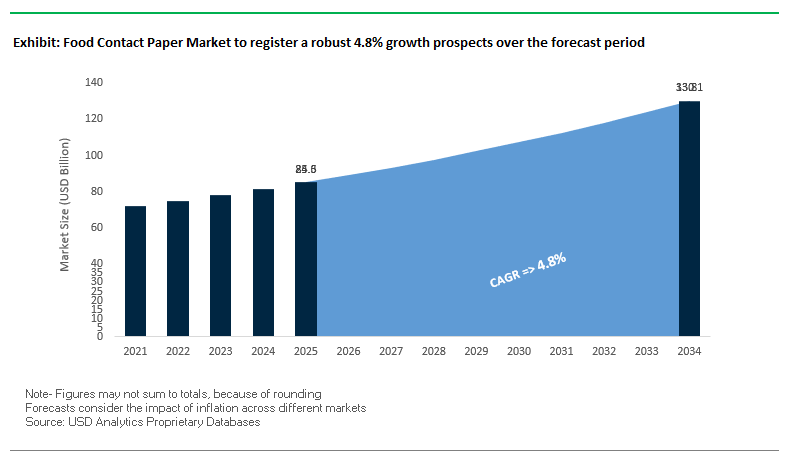
Market Overview: Global Food Contact Paper Market Valued at $85.3 Billion in 2025
The global food contact paper market is projected to grow from $85.3 billion in 2025 to $130.1 billion by 2034, expanding at a CAGR of 4.8%. This growth trajectory is strongly tied to the global shift toward sustainable, PFAS-free, and compostable packaging solutions as governments tighten regulations and consumers demand eco-friendly alternatives. For industry professionals and buyers, food contact paper has become more than a safety material it is now central to brand positioning, regulatory compliance, and circular economy initiatives.
The market is defined by innovations in barrier properties, advancements in biodegradability, and integration of digital technologies that connect packaging with consumer engagement platforms. These drivers are making food contact paper a preferred alternative to plastics and aluminum in applications ranging from quick-service restaurants to frozen meals.
Key Insights for Professionals:
PFAS-Free Formulations: Rapid elimination of PFAS in coatings is shaping product innovation.
Rapid Biodegradability: Compostable food contact paper is driving adoption in foodservice and retail.
Advanced Barrier Properties: Oil, grease, oxygen, and moisture resistance open new application areas.
Digital Integration: QR-coded packaging enhances traceability and consumer interaction.
Market Analysis: Strategic Developments Reshaping the Food Contact Paper Industry
The global food contact paper industry has witnessed a series of transformative developments over the past year, marking significant progress in sustainable material science, mergers, and production capacity expansion.
In August 2025, Mondi scaled up its FunctionalBarrier Paper Ultimate, a recyclable high-barrier packaging solution addressing surging demand for sustainable alternatives. In the same month, International Paper finalized its $9.9 billion acquisition of DS Smith, a landmark deal that consolidated capabilities and expanded its footprint in sustainable packaging solutions. Meanwhile, Huhtamaki’s July 2025 launch of recyclable and compostable ice cream packaging reinforced its role as a leader in fiber-based innovation.
On the manufacturing front, Sappi’s $500 million investment in a new advanced paper machine at its Somerset Mill in July 2025 underlines the capital intensity and long-term confidence in food packaging demand. Earlier in the year, Billerud’s April 2025 launch of a formable fiber-based material showcased the industry’s push to displace plastic. Mondi’s collaboration with Proquimia in February 2025 to launch paper-based pouches further highlights how barrier technologies are driving diversification.
Complementing these, Ahlstrom’s December 2024 introduction of PFAS-free filtration media and its November 2024 industry award demonstrate the growing recognition of sustainability-focused innovations. Together, these developments reflect how the industry is aligning with global sustainability goals and consumer expectations, ensuring both regulatory compliance and competitive advantage.
Trends and Opportunities Defining the Food Contact Paper Market
Regulatory Bans on PFAS Driving Intensive Material Re-Formulation
The food contact paper market is undergoing a rapid transformation as global regulators impose strict bans on PFAS (per- and polyfluoroalkyl substances), historically used for oil and grease resistance in food packaging. In the United States, multiple states including California, Washington, New York, Connecticut, and Minnesota implemented legislation between 2023 and 2024 that prohibits the sale and use of PFAS in food packaging. These state-level bans have created a national compliance challenge, compelling manufacturers to phase out PFAS entirely, rather than risk fragmented product portfolios.
The European Union has reinforced this momentum with the Packaging and Packaging Waste Regulation (PPWR), effective February 2025, which enforces a complete ban on PFAS in food contact paper from August 12, 2026. This measure sets a uniform regulatory standard across the EU, accelerating the shift to safer alternatives. Anticipating these bans, the U.S. FDA announced in 2024 that manufacturers voluntarily agreed to phase out PFAS grease-proof coatings, highlighting the industry’s proactive stance in aligning with regulatory direction. These moves are not only compliance-driven but also essential for protecting consumer trust, making PFAS-free food contact paper a non-negotiable market standard by 2026.
Brand Commitments to Plastic-Free Packaging Accelerating Adoption
Corporate sustainability pledges are a powerful catalyst for the food contact paper market, with major brands pivoting from plastic-heavy formats to plastic-free, recyclable, and compostable paper packaging. Amazon, in 2025, announced that 99.7% of its mixed-material padded mailers were replaced with recyclable paper mailers, while JDE Peet’s committed to paper pouches for instant coffee and Nissin Foods shifted Cup Noodles packaging to 40% recycled paper cups. These high-volume transitions are setting benchmarks across the sector.
The beverage industry is pushing boundaries with pioneering paper bottles. Partnerships between PepsiCo, Carlsberg, Pulpex, and Paboco aim to develop molded fiber bottles as scalable alternatives to plastic and glass. While still pre-commercial, these projects signal how brand commitments are reshaping the competitive landscape. Consumer behavior reinforces this trajectory 2024 research showed that demand for 100% biodegradable packaging and recognition of “green certifications” were key differentiators in purchasing decisions. With this alignment of corporate strategy, regulation, and consumer demand, plastic-free food contact paper is emerging as a mainstream growth driver across FMCG and foodservice industries.
Development and Commercialization of High-Performance Bio-Based Barriers
The simultaneous phase-out of PFAS and reduction of plastic usage presents a significant opportunity to scale bio-based barrier technologies that maintain oil, grease, and moisture resistance while remaining recyclable or compostable. Innovators such as Solenis are leading commercialization efforts with water-based and bio-wax coatings, including TopScreen™ and EarthGuard™, positioned as drop-in PFAS and polyethylene film replacements. These coatings are repulpable, compostable, and recyclable, ensuring end-of-life compatibility with existing infrastructure.
Research into next-generation bio-materials highlights the potential of cellulose nanocrystals and chitosan to enhance oxygen and vapor barrier performance without compromising recyclability. Further, Smart Planet Technologies has introduced EarthCoating-Bio, a PLA-mineral blend designed to be processed like clay fillers in recycling mills, ensuring compatibility with established recovery systems. These material science breakthroughs illustrate how bio-based barriers not only mitigate compliance risks but also enable companies to achieve differentiated ESG performance and long-term competitiveness.
“Design for Recycling” as a Key Product Differentiator
As adoption of food contact paper accelerates, end-of-life management is emerging as a core differentiator. Designing paper-based packaging for recycling compatibility ensures that environmental benefits extend beyond marketing claims. Industry standards, such as the Confederation of European Paper Industries (CEPI) recyclability guidelines, emphasize monomaterial designs and the use of easily separable adhesives and coatings.
Investment is also ramping up across recycling infrastructure. Reports from European recycling mills show upgrades to advanced pulping and screening systems that can recover fibers from light-coated food contact paper, avoiding landfill losses. Simultaneously, regulatory frameworks like the EU’s PPWR mandate harmonized material labeling, providing consumers with clear disposal instructions and improving recycling yields. Brands that integrate “design for recycling” into their products through simplified structures, clear labeling, and validated compatibility with municipal systems can command a premium market position as sustainability leaders, while also aligning with regulatory expectations and circular economy goals.
Competitive Landscape: Leading Innovators Driving Market Transformation
The food contact paper market is characterized by multinational leaders and regional innovators competing on sustainability, material science, and supply chain integration. Companies are focusing on PFAS-free coatings, recyclable and compostable formats, and strategic acquisitions to strengthen their market positions.
Mondi: Driving Growth with FunctionalBarrier and MAP2030 Commitments
Mondi stands out as a pioneer in high-barrier food contact paper solutions. Its FunctionalBarrier Paper Ultimate exemplifies recyclable innovation, while the Ad/Vantage Smooth Brown Semi Extensible paper extends versatility in packaging. Under its MAP2030 strategy, Mondi emphasizes “sustainable by design” packaging, ensuring recyclability and bio-based sourcing. Its vertically integrated model from forests to finished paper gives it control over quality and reliability, reinforcing its leadership in sustainable paper packaging.
Billerud: Innovating with FibreForm® and Plastic Alternatives
Billerud’s strength lies in its specialty kraft papers and innovative FibreForm® material, designed to replace plastic in specific food applications. Its North American shift toward packaging materials underscores strategic adaptation to market demand. The company’s focus on 100% primary fibers ensures durability and food safety, while new heat-sealable and vacuum metallizable papers broaden its high-performance portfolio.
Ahlstrom: Expanding PFAS-Free and Compostable Solutions
Ahlstrom is at the forefront of PFAS-free and compostable innovations, offering solutions for food packaging, cooking, and baking. The company’s acquisition of Stevens Point operations strengthened its specialty portfolio, while recognition for its PawPrint® Pet Food Packaging demonstrates leadership in sustainability. With portfolios like Genuine Vegetable Parchment and Cristal™ transparent paper, Ahlstrom is extending fiber-based applications into markets traditionally dominated by plastics.
Huhtamaki: Leading in Recyclable and Compostable Foodservice Packaging
Huhtamaki focuses on protecting food, people, and the planet by developing recyclable and compostable foodservice packaging. Its innovative ice cream packaging launched in July 2025, alongside fiber-based egg cartons made from 100% recycled material, highlight its material innovation. With a strong global footprint, Huhtamaki delivers solutions for takeaway, single-use, and consumer packaging, aligning with evolving sustainability mandates.
Smurfit Kappa Group: Strengthening Position with WestRock Merger
Smurfit Kappa is recognized for its corrugated food contact products such as pizza pads and cushion liners. The company’s pending merger with WestRock is set to create a global leader in sustainable paper-based packaging. Known for smart and sustainable design, Smurfit Kappa emphasizes food safety compliance and recyclability, making it a strong competitor in consumer and direct food contact applications.
Food Contact Paper Market Share Insights
Food Service Paper Leads Market Share by Product Type in Food Contact Paper
In 2025, food service paper dominates the food contact paper market with a 40% share, reflecting the direct impact of global bans on single-use plastics and the shift toward compostable and recyclable alternatives. Paper cups, plates, and bags are now the cornerstone of regulatory-driven substitution, particularly in quick service restaurants (QSRs), cafés, and retail food outlets. The segment’s strength lies in its scalability and adaptability, as manufacturers integrate biopolymer or PLA linings to enhance functionality without fully sacrificing recyclability. Barrier paper at 25% emerges as the fastest-growing segment, supported by technological advancements that deliver grease- and moisture-resistance without plastic. Meanwhile, food wraps continue to dominate QSR packaging, offering a natural, low-cost solution that resonates with eco-conscious consumers, while liners, trays, and niche specialty papers maintain stable demand in bakery, ready-meal, and processing applications. Overall, the segmentation underscores how food service paper drives volume under regulatory pressure, barrier paper anchors high-value innovation, and wraps reinforce the QSR growth engine.
Quick Service Restaurants Dominate Market Share by Application in Food Contact Paper
By application, quick service restaurants account for 35% of the food contact paper market in 2025, making them the undisputed volume driver. Their mass consumption of cups, wraps, and carry bags reflects both regulatory compliance and consumer expectation for plastic-free dining experiences. Global fast-food giants have become trendsetters in mandating sustainable food service packaging, pushing suppliers toward recyclable and compostable innovations at scale. Bakery and confectionery follow with 25%, driven by their reliance on grease-resistant barrier papers to preserve the quality of oily pastries, breads, and sweets while also leveraging unbleached kraft paper for artisanal branding. Ready-to-eat meals are fueling demand for paperboard trays and sleeves in supermarkets and meal delivery services, while meat, poultry, and produce categories are adopting absorbent liners and breathable paper wraps as plastic replacements. Collectively, the application mix shows how QSRs set the standard for high-volume adoption, bakeries demand performance-driven grease barriers, and RTE meals drive hybrid packaging innovation.
United States: PFAS-Free Innovation and Sustainable Packaging for E-Commerce Growth
The U.S. food contact paper market is undergoing a major transformation driven by state-level bans on intentionally added per- and polyfluoroalkyl substances (PFAS). This regulatory push is compelling manufacturers to develop alternative barrier coatings that provide moisture and grease resistance without using fluorochemicals. Companies like Twin Rivers Paper are expanding their PFAS-free product portfolios to meet this demand. In parallel, innovation in paper-based barrier technologies is reshaping the market, moving beyond traditional wax coatings to advanced functional barrier papers capable of withstanding high temperatures, particularly for takeout and foodservice applications. The booming e-commerce and food delivery sectors are further driving demand for durable, insulated, and eco-friendly packaging solutions, including corrugated boxes and paperboard containers. Additionally, consumer preference for sustainable and recyclable packaging is encouraging brands to adopt mono-material paper alternatives over plastic-laminated options, ensuring recyclability and alignment with eco-conscious market trends.
Germany: Pioneering Circular Economy and Advanced Paper-Based Barrier Solutions
Germany’s food contact paper market is at the forefront of Europe’s circular economy initiatives, shaped by high recycling rates and stringent regulations such as the German Packaging Act (VerpackG) and the EU Packaging and Packaging Waste Regulation (PPWR). The market is focused on developing paper packaging with advanced barrier properties to replace multi-material plastic films. Mondi’s partnership with packaging machinery firms to create recyclable paper solutions for dry foods exemplifies this trend. Academic and industry collaboration is strong, with studies like those from the University of Bonn revealing consumer trust in paper packaging’s eco-image while highlighting practical concerns, which are influencing product design. Further, the market is emphasizing advanced functionality, developing paper-based trays and cups for sensitive foods through initiatives funded by the European Institute of Innovation and Technology (EIT), reflecting Germany’s commitment to sustainable, high-performance packaging solutions.
China: National Standards and Massive Production Driving Market Expansion
China’s food contact paper market is benefiting from modernized regulations, including GB 4806.8-2022, which define clear safety and testing requirements for food-contact paper and paperboard. The government’s push for sustainability, via plastic bans and enhanced waste management regulations, is encouraging manufacturers to increase R&D investment and improve product quality. China is a global leader in production capacity for food contact paper, serving both domestic demand and international exports. Rapid growth in the food service and ready-to-eat sectors, combined with urbanization, is creating strong demand for convenient, safe, and attractively packaged food products, positioning China as a key player in the global food contact paper industry.
India: Regulatory Standards and E-Commerce Expansion Fueling Market Growth
India’s food contact paper industry is guided by comprehensive regulations from the Food Safety and Standards Authority of India (FSSAI), ensuring that all paper or board materials in contact with food are food-grade and contaminant-free. The “Make in India” initiative and liberal FDI policies in the food processing sector are attracting global players and driving local manufacturing. The market is increasingly focusing on the use of recycled materials, though FSSAI regulations prohibit recycled newsprint to maintain food safety standards. Rapid expansion of modern retail and e-commerce platforms is creating strong demand for lightweight, durable, and protective packaging solutions, encouraging innovation in food contact paper products tailored to India’s growing domestic market.
Brazil: Forest Resources and Sustainable Barrier Innovations Strengthen Market Position
Brazil’s food contact paper market leverages its abundant and responsibly managed forestry resources, supporting paper and paperboard production. Major players like Suzano, Klabin, and Bracell are investing heavily to expand capacity. Regulatory focus from the Brazilian Health Regulatory Agency (Anvisa) on authorized substances for food contact materials ensures product safety and compliance. The market is also embracing innovation in barrier coatings, developing recyclable and sustainable paper packaging solutions to reduce environmental impact. Brazil’s combination of natural resources, strong regulations, and sustainability initiatives positions it as a prominent player in the global food contact paper sector.
Japan: Premium Quality, Functional Innovation, and Circular Economy Leadership
Japan’s food contact paper market emphasizes high-quality, aesthetic, and functional packaging designs, with brands prioritizing premium materials and decorative printing techniques. Companies like the Ajinomoto Group are innovating with paper-plastic composite bags that offer comparable durability and moisture resistance to traditional plastics. Japan is actively promoting circular economy practices, including plastic waste reduction and recycling initiatives, which drives demand for paper-based packaging solutions. This focus on high functionality, premium quality, and environmental responsibility defines Japan’s leadership in innovative food contact paper solutions.
Food Contact Paper Market Report Scope
Food Contact Paper Market
Parameter
Details
Market Size (2025)
$85.3 Billion
Market Size (2034)
$130.1 Billion
Market Growth Rate
4.8%
Segments
By Product Type (Food Service Paper, Food Wraps, Barrier Paper, Liners & Trays, Other Products), By Material (Virgin Paper, Recycled Paper), By Application (Quick Service Restaurants, Bakery & Confectionery, Meat, Fish & Poultry, Fruits & Vegetables, Ready-to-Eat Meals, Other Applications), By Barrier Type (Grease-Resistant, Moisture-Resistant, Oxygen-Resistant)
Study Period
2019- 2024 and 2025-2034
Units
Revenue (USD)
Qualitative Analysis
Porter’s Five Forces, SWOT Profile, Market Share, Scenario Forecasts, Market Ecosystem, Company Ranking, Market Dynamics, Industry Benchmarking
Companies
International Paper Company, Mondi Group, WestRock Company, DS Smith Plc, Smurfit Kappa Group plc, Huhtamaki Oyj, Graphic Packaging Holding Company, Sonoco Products Company, Rengo Co., Ltd., Twin Rivers Paper Company, Nippon Paper Industries Co., Ltd., Amcor plc, Domtar Corporation, BillerudKorsnäs AB, Klabin S.A.
Countries
US, Canada, Mexico, Germany, France, Spain, Italy, UK, Russia, China, India, Japan, South Korea, Australia, South East Asia, Brazil, Argentina, Middle East, Africa
Food Contact Paper Market Segmentation
By Product Type
Food Service Paper
Food Wraps
Barrier Paper
Liners & Trays
Other Products
By Material
Virgin Paper
Recycled Paper
By Application
Quick Service Restaurants
Bakery & Confectionery
Meat
Fish & Poultry
Fruits & Vegetables
Ready-to-Eat Meals
Other Applications
By Barrier Type
Grease-Resistant
Moisture-Resistant
Oxygen-Resistant
Countries Analyzed
North America (US, Canada, Mexico)
Europe (Germany, UK, France, Spain, Italy, Russia, Rest of Europe)
Asia Pacific (China, India, Japan, South Korea, Australia, South East Asia, Rest of Asia)
South America (Brazil, Argentina, Rest of South America)
Middle East and Africa (Saudi Arabia, UAE, Rest of Middle East, South Africa, Egypt, Rest of Africa)
Top Companies in Food Contact Paper Market
International Paper Company
Mondi Group
WestRock Company
DS Smith Plc
Smurfit Kappa Group plc
Huhtamaki Oyj
Graphic Packaging Holding Company
Sonoco Products Company
Rengo Co., Ltd.
Twin Rivers Paper Company
Nippon Paper Industries Co., Ltd.
Amcor plc
Domtar Corporation
BillerudKorsnäs AB
Klabin S.A.
*List not Exhaustive
Research Coverage
This USDAnalytics report investigates the global Food Contact Paper Market, analyzing key drivers such as PFAS-free formulations, rapid biodegradability, and advanced barrier technologies that are reshaping the industry. The analysis reviews breakthrough innovations in bio-based coatings, compostable papers, and digital integration for traceability and consumer engagement, while highlighting sustainability commitments, regulatory compliance, and circular economy initiatives. The report highlights strategic developments including capacity expansion, mergers, and product diversification by global leaders, providing insights into evolving market dynamics, emerging applications, and competitive positioning. This report is an essential resource for manufacturers, brand owners, investors, and packaging professionals seeking actionable intelligence to guide decisions in the 2025–2034 market landscape, connecting historical performance from 2021–2024 with forward-looking projections.
Scope Highlights
Segmentation: By Product Type (Food Service Paper, Food Wraps, Barrier Paper, Liners & Trays, Other Products), By Material (Virgin Paper, Recycled Paper), By Application (Quick Service Restaurants, Bakery & Confectionery, Meat, Fish & Poultry, Fruits & Vegetables, Ready-to-Eat Meals, Other Applications), By Barrier Type (Grease-Resistant, Moisture-Resistant, Oxygen-Resistant)
Geographic Scope: Analysis spans 25+ countries across North America, Europe, Asia Pacific, Latin America, the Middle East & Africa.
Historic and Forecast Data: Historic data from 2021 to 2024 and forecast data from 2025 to 2034.
Companies: Analysis/profiles of 15+ leading companies including International Paper, Mondi, WestRock, DS Smith, Smurfit Kappa, Huhtamaki, Graphic Packaging, Sonoco, Twin Rivers Paper, and others.
Methodology
USDAnalytics employs a rigorous research methodology combining primary and secondary data to ensure accurate, actionable insights. Primary research includes interviews with industry stakeholders such as manufacturers, foodservice providers, coating technology experts, and sustainability consultants to capture firsthand insights on innovation, regulatory compliance, and market adoption. Secondary research involves a detailed review of company reports, financial statements, patent filings, regulatory guidelines, and trade publications to validate trends and benchmark competitive performance. Market sizing and forecasts are derived using both bottom-up and top-down approaches, integrating production capacity, consumption patterns, and application-specific adoption. Triangulation, scenario modeling, and competitive benchmarking are applied to provide a reliable outlook, bridging historical data (2021–2024) with projections (2025–2034) to inform strategic planning in the Food Contact Paper Market.
Deliverables:
Comprehensive Market Research Report (PDF and Excel) with detailed tables, charts, and interactive visualizations.
Country-Specific Forecasts & Analysis.
Segment-Wise Revenue Forecasts (2025–2034).
Competitive Analysis, Benchmarking, and SWOT Profiles.
Recent Developments & Innovation Tracker.
Executive Summary & Analyst Commentary.
Post-Purchase Analyst Support for Client-Specific Questions and Custom Data Requirements.
2. Food Contact Paper Market Landscape & Outlook (2025–2034)
2.1. Introduction to Food Contact Paper Market
2.2. Market Valuation and Growth Projections (2025–2034)
2.3. Market Drivers and Opportunities
2.4. Regulatory Environment and Compliance
2.5. Sustainability and Circular Economy Initiatives
3. Innovations Reshaping the Food Contact Paper Market
3.1. Trend: PFAS-Free Formulations Driving Product Innovation
3.2. Trend: Rapid Biodegradability and Compostable Packaging
3.3. Opportunity: Advanced Barrier Properties for Oil, Grease, Moisture, and Oxygen Resistance
3.4. Opportunity: Digital Integration and “Design for Recycling”
4. Competitive Landscape and Strategic Initiatives
4.1. Mergers, Acquisitions and Strategic Alliances (e.g., International Paper & DS Smith, Smurfit Kappa & WestRock)
4.2. R&D and Material Innovation (Bio-Based Coatings, High-Performance Paper)
4.3. Sustainability and Corporate Strategies (MAP2030, ESG Commitments)
4.4. Market Expansion and Regional Focus
5. Market Share and Segmentation Insights: Food Contact Paper Market
5.1. By Product Type
5.1.1. Food Service Paper
5.1.2. Food Wraps
5.1.3. Barrier Paper
5.1.4. Liners & Trays
5.1.5. Other Products
5.2. By Material
5.2.1. Virgin Paper
5.2.2. Recycled Paper
5.3. By Application
5.3.1. Quick Service Restaurants
5.3.2. Bakery & Confectionery
5.3.3. Meat
5.3.4. Fish & Poultry
5.3.5. Fruits & Vegetables
5.3.6. Ready-to-Eat Meals
5.3.7. Other Applications
5.4. By Barrier Type
5.4.1. Grease-Resistant
5.4.2. Moisture-Resistant
5.4.3. Oxygen-Resistant
6. Country Analysis and Outlook of Food Contact Paper Market
6.1. United States
6.2. Canada
6.3. Mexico
6.4. Germany
6.5. France
6.6. Spain
6.7. Italy
6.8. UK
6.9. Russia
6.10. China
6.11. India
6.12. Japan
6.13. South Korea
6.14. Australia
6.15. South East Asia
6.16. Brazil
6.17. Argentina
6.18. Middle East
6.19. Africa
7. Food Contact Paper Market Size Outlook by Region (2025–2034)
7.1. North America Food Contact Paper Market Size Outlook to 2034
7.1.1. By Product Type
7.1.2. By Material
7.1.3. By Application
7.2. Europe Food Contact Paper Market Size Outlook to 2034
7.2.1. By Product Type
7.2.2. By Material
7.2.3. By Application
7.3. Asia Pacific Food Contact Paper Market Size Outlook to 2034
7.3.1. By Product Type
7.3.2. By Material
7.3.3. By Application
7.4. South America Food Contact Paper Market Size Outlook to 2034
7.4.1. By Product Type
7.4.2. By Material
7.4.3. By Application
7.5. Middle East and Africa Food Contact Paper Market Size Outlook to 2034
7.5.1. By Product Type
7.5.2. By Material
7.5.3. By Application
8. Company Profiles: Leading Players in the Food Contact Paper Market
8.1. International Paper Company
8.2. Mondi Group
8.3. WestRock Company
8.4. DS Smith Plc
8.5. Smurfit Kappa Group plc
8.6. Huhtamaki Oyj
8.7. Graphic Packaging Holding Company
8.8. Sonoco Products Company
8.9. Rengo Co., Ltd.
8.10. Twin Rivers Paper Company
8.11. Nippon Paper Industries Co., Ltd.
8.12. Amcor plc
8.13. Domtar Corporation
8.14. BillerudKorsnäs AB
8.15. Klabin S.A.
9. Methodology
9.1. Research Scope
9.2. Market Research Approach
9.3. Market Sizing and Forecasting Model
9.4. Research Coverage
9.5. Data Horizon
9.6. Deliverables
10. Appendix
10.1. Acronyms and Abbreviations
10.2. List of Tables
10.3. List of Figures
Food Contact Paper Market Segmentation
By Product Type
Food Service Paper
Food Wraps
Barrier Paper
Liners & Trays
Other Products
By Material
Virgin Paper
Recycled Paper
By Application
Quick Service Restaurants
Bakery & Confectionery
Meat
Fish & Poultry
Fruits & Vegetables
Ready-to-Eat Meals
Other Applications
By Barrier Type
Grease-Resistant
Moisture-Resistant
Oxygen-Resistant
Countries Analyzed
North America (US, Canada, Mexico)
Europe (Germany, UK, France, Spain, Italy, Russia, Rest of Europe)
Asia Pacific (China, India, Japan, South Korea, Australia, South East Asia, Rest of Asia)
South America (Brazil, Argentina, Rest of South America)
Middle East and Africa (Saudi Arabia, UAE, Rest of Middle East, South Africa, Egypt, Rest of Africa)
The market is fueled by regulatory bans on PFAS, increasing consumer preference for biodegradable and compostable packaging, and the adoption of high-performance barrier papers. Corporate sustainability commitments and circular economy initiatives further accelerate demand across foodservice, retail, and ready-to-eat applications.
Food service paper leads with a 40% share, driven by cups, plates, and bags for quick service restaurants and retail outlets. Barrier papers are the fastest-growing segment due to grease-, moisture-, and oxygen-resistant innovations, while food wraps and trays continue to support bakery, ready-to-eat, and specialty packaging applications.
PFAS-free and bio-based coatings provide effective grease, oil, and moisture resistance while being recyclable or compostable. Companies like Solenis and Smart Planet Technologies are commercializing water-based and PLA-mineral coatings, enabling compliance with global regulations while supporting sustainable brand positioning.
The U.S. emphasizes PFAS-free solutions and e-commerce-ready packaging, Germany pioneers circular economy and high-barrier papers, China drives massive production and regulatory compliance, India grows through FSSAI standards and modern retail expansion, Brazil leverages forest resources and sustainable barriers, and Japan focuses on premium, functional, and recyclable paper solutions.
Leading companies include International Paper, Mondi, WestRock, DS Smith, Smurfit Kappa, Huhtamaki, and Billerud. They focus on recyclable and compostable solutions, innovative barrier technologies, and strategic acquisitions, strengthening market leadership while meeting sustainability and regulatory goals globally.