Market Overview: Sustainability and Convenience Shaping the Fruit Juice Packaging Market
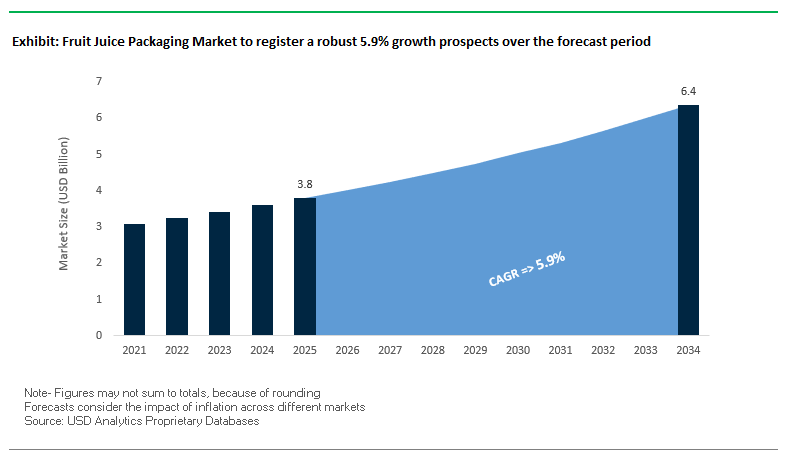
The Global Fruit Juice Packaging Market is projected to grow from USD 3.8 billion in 2025 to USD 6.4 billion by 2034, registering a steady CAGR of 5.9%. This industry plays a vital role in preserving the nutritional value, flavor, and shelf life of fruit juices while addressing rising consumer demand for convenient, portable, and sustainable packaging formats. As the beverage industry evolves, fruit juice packaging has become central to brand differentiation, regulatory compliance, and sustainability goals.
The market is witnessing a strong shift toward eco-friendly solutions, with brands adopting bio-based cartons, recycled PET bottles, and compostable pouches. Demand for advanced barrier coatings and multi-layer films is increasing, enabling extended shelf life without chemical preservatives. Convenience continues to drive growth, with single-serve juice boxes, pouches, and PET bottles becoming popular in the on-the-go consumer lifestyle segment. Furthermore, the integration of smart packaging technologies such as QR codes, NFC tags, and time-temperature indicators is reshaping consumer engagement, providing traceability and boosting confidence in product freshness.
Key Insights for Industry Professionals:
Market Value: USD 3.8B (2025) → USD 6.4B (2034).
Growth Rate: CAGR of 5.9% driven by sustainability and premiumization.
Innovation Drivers: Adoption of fiber-based caps, recyclable cartons, and eco-friendly pouches.
Consumer Demand: Rising need for on-the-go single-serve juice packs.
Technology Shift: Smart packaging with track-and-trace features enhancing transparency.
Market Analysis: Recent Developments in Fruit Juice Packaging Industry
The Global Fruit Juice Packaging Industry has seen significant strategic expansions, product innovations, and consolidation efforts over the last two years, highlighting the sector’s rapid transformation.
In July 2025, Amcor and Berry Global Group finalized their all-stock merger, creating a packaging giant with enhanced capabilities in flexibles and rigid containers for fruit juices. Around the same time, Fiat (June 2025) pioneered an automotive initiative by using recycled beverage carton materials in car production, underscoring the extended value of post-consumer juice packaging waste.
Elopak has been highly active in 2025, launching its Natural White Board in May 2025, which reduces greenhouse gas emissions by 14% compared to its traditional boards. The same month, Elopak opened its first U.S. carton converting plant in Arkansas, a strategic move to expand its footprint in North America. Earlier in March 2025, Elopak invested in Blue Ocean Closures AB, developing fiber-based caps that complement its Pure-Pak® cartons.
Consolidation has also reshaped the industry. International Paper and DS Smith shareholders approved their merger in October 2024, forming a major player in corrugated and paper-based fruit juice packaging. Meanwhile, Elopak’s “Repackaging tomorrow” strategy, announced in September 2024, set ambitious goals to double revenue by 2030 through sustainability and innovation.
Emerging Trends and Strategic Opportunities in the Fruit Juice Packaging Market
Accelerated Adoption of rPET and Monomaterial Barrier Solutions
A decisive trend in the fruit juice packaging market is the industry-wide pivot toward 100% recycled PET (rPET) bottles and recyclable monomaterial pouch solutions. Driven by stringent EU mandates, U.S. state-level recycled content laws, and voluntary brand commitments, juice manufacturers are embedding sustainability at the core of packaging strategy. Major players are scaling rPET adoption to reduce virgin plastic use while ensuring compatibility with existing recycling infrastructure.
The challenge lies in maintaining oxygen and light barrier performance without using non-recyclable additives like EVOH or polyamide (PA). To overcome this, converters are engineering advanced monomaterial barrier layers in PE or PP that retain product shelf life while remaining fully recyclable. This transition not only addresses regulatory compliance but also appeals to eco-conscious consumers who increasingly seek products packaged in recycled or recyclable materials. For brands, rPET and monomaterial adoption is becoming a competitive differentiator, signaling authenticity in sustainability pledges while enabling compliance with future circular economy policies.
Integration of Digital Printing for Hyper-Personalization and Limited Editions
Juice packaging is also being reimagined as a dynamic marketing tool through digital printing technology. In an industry crowded with private labels and premium health-focused products, differentiation is critical. Digital printing allows brands to execute short-run campaigns with hyper-personalized designs, localized labels, and limited-edition promotions without incurring high tooling or lead-time costs.
This flexibility is enabling juice brands to tap into cultural moments, seasonal launches, or influencer collaborations with speed and precision. By printing variable data such as QR codes or personalized graphics, brands can boost consumer engagement, drive loyalty, and create exclusivity. The trend not only enhances shelf appeal but also improves supply chain agility, as production runs can be adapted quickly to match shifting consumer preferences. For premium and functional juice categories, packaging-as-marketing is emerging as a high-value strategy to capture attention in saturated retail and e-commerce channels.
Development of Aseptic Paper-Based Bottles
A major innovation opportunity lies in the commercialization of aseptic paper-based juice bottles that combine renewable fiber with thin plastic or biopolymer barriers. This format leverages the sustainable image of paper while delivering the functional benefits of aseptic packaging extended shelf life at ambient temperatures without refrigeration or preservatives.
Paper-based aseptic bottles are particularly appealing in markets where consumers associate paper with eco-friendliness and where regulatory frameworks are driving reduction in plastic dependency. With scalable R&D, these bottles could replace traditional PET formats for ambient juice segments, offering a lower-carbon, more circular end-of-life profile. As consumer pressure mounts for plastic-free alternatives, paper-based aseptic bottles represent a high-margin growth segment that aligns with both sustainability narratives and evolving retail demands.
Smart Labels for Enhanced Traceability and Consumer Engagement
Beyond sustainability and aesthetics, packaging is becoming an interactive platform through the integration of smart labels. By embedding QR codes, NFC tags, or blockchain-enabled identifiers, juice brands can offer consumers transparency into fruit origin, processing methods, and supply chain practices. This level of traceability builds trust, particularly in the premium and organic juice segments where authenticity and provenance are critical selling points.
Smart labels also open up avenues for digital engagement, loyalty rewards, and personalized nutrition guidance. For instance, NFC-enabled packaging can link directly to immersive brand experiences, while blockchain-backed platforms can showcase certified sourcing. This transforms fruit juice packaging from a static container into a consumer engagement tool, strengthening brand loyalty and aligning with global trends toward digital transparency in food and beverages.
Competitive Landscape: Leading Players Driving Fruit Juice Packaging Innovation
The Fruit Juice Packaging Market is dominated by a mix of carton leaders, flexible packaging innovators, and paper-based solution providers. These companies are investing heavily in sustainability, automation, and smart packaging to strengthen their competitive edge.
Tetra Pak pioneers aseptic cartons for fruit juice packaging
Tetra Pak remains the global leader in aseptic carton technology, enabling long shelf life without refrigeration. In July 2025, it received the EcoVadis Platinum Medal for sustainability and partnered with Fiat to integrate recycled beverage cartons into car production. Recent innovations include the Tetra Stelo Aseptic package for Minute Maid and the rollout of certified recycled polymers in India. Tetra Pak continues to focus on renewable materials and circular economy packaging.
SIG Combibloc advances with aluminum-free and low-carbon packaging
SIG Combibloc is known for its high-speed filling systems and sustainable carton solutions. Its SIG Terra Alu-free packs increase renewable content to 82% by eliminating aluminum layers. In parallel, its SIG Neo filling machine cuts per-pack carbon emissions by 25%, offering efficiency and sustainability. The company’s “For better” strategy prioritizes safe, sustainable, and affordable fruit juice packaging worldwide.
Elopak AS expands footprint with Pure-Pak® innovations
Elopak continues to strengthen its Pure-Pak® gable-top cartons made from renewable and recyclable materials. In May 2025, it launched its Natural White Board, reducing emissions by 14%, and opened its first U.S. converting plant, accelerating North American expansion. With its investment in Blue Ocean Closures (March 2025), Elopak is also developing fiber-based caps for next-gen sustainable packaging. Its “Repackaging tomorrow” strategy aims to double revenue by 2030.
Smurfit Kappa integrates Bag-in-Box® and Pouch-Up® solutions
Smurfit Kappa is a global leader in paper-based and bag-in-box packaging for fruit juices. Its Bag-in-Box® and Pouch-Up® solutions utilize high-barrier films to extend shelf life by up to 12 months. Lightweight and unbreakable, these solutions reduce carbon footprint compared to PET bottles. Smurfit Kappa also supports customers with ShelfSmart retail optimization services, reinforcing its focus on premium, eco-friendly juice packaging.
Amcor plc strengthens position through Berry Global merger
Amcor leverages its broad global network and innovation capabilities in both rigid and flexible juice packaging. In July 2025, its merger with Berry Global Group expanded its portfolio, adding capabilities in sustainable flexible films and rigid containers. Key offerings include AmLite Recyclable, a metal-free, high-barrier flexible film designed for polyolefin recycling. Amcor’s 2025 recyclability goal drives its focus on lightweight and circular packaging solutions.
Fruit Juice Packaging Market Share Insights
Bottles Lead Market Share by Packaging Type in Fruit Juice Packaging
Bottles command the largest share of the fruit juice packaging market at 45% in 2025, primarily driven by the widespread adoption of PET bottles for single-serve and premium chilled juices. Their resealability, portability, and crystal-clear visibility cater directly to modern consumer demand for convenience and on-the-go consumption. The growth of health-oriented juice categories, such as cold-pressed juices, further reinforces bottle dominance due to their ability to convey premium branding. Cartons, with 30% share, remain a critical packaging format for long-life juices, benefiting from aseptic technology that protects contents from oxygen and light without refrigeration, making them indispensable for family-size and shelf-stable products. Pouches continue to grow rapidly, especially in children’s juice drinks and squeezable formats, as they combine portability with lighter material use and reduced logistics costs. Meanwhile, cans are experiencing a niche revival in premium segments, especially functional and cold-pressed juices, as they offer full recyclability, rapid chilling, and strong protection from light exposure. Together, these dynamics reflect how bottles dominate through versatility, cartons secure shelf-stability, pouches drive innovation, and cans reemerge in niche premium segments.
Juices & Juice Drinks Dominate Market Share by End-Use in Fruit Juice Packaging
The juices and juice drinks segment accounts for 60% of the fruit juice packaging market in 2025, underscoring its role as the volume engine of global demand. This category spans 100% juices to diluted juice drinks, consumed daily across demographics and distributed through chilled, ambient, and online channels. Its massive scale makes it the key driver of packaging innovation and volume. Nectars, with their thicker consistency and fruit pulp content, tend to favor bottles or cartons with wider openings for easy pouring, while juice concentrates require robust packaging such as composite tubes, bag-in-box systems, or freeze-stable containers to handle distribution and dilution. Beyond these, high-value emerging segments like functional juice shots, wellness tonics, and cold-pressed super-premium juices are reshaping packaging strategies. These products lean toward glass bottles, sleek aluminum cans, or unique smaller formats that emphasize premium branding and sustainability. This segmentation highlights how mainstream juice products secure the bulk of packaging demand, while niche segments drive high-margin innovation in materials and formats.
United States Fruit Juice Packaging Market Driven by HACCP Compliance and Sustainable Packaging Innovations
The U.S. fruit juice packaging market is strongly shaped by a fragmented regulatory landscape, with the FDA’s Juice Hazard Analysis Critical Control Point (HACCP) regulations ensuring product safety through mandatory implementation of HACCP systems. These regulations compel juice processors to adopt stringent safety measures, influencing packaging design and material selection. Technological advancements, such as smart packaging with temperature sensors, QR codes, and aseptic packaging that extends shelf life without refrigeration, are increasingly adopted to enhance product protection and consumer convenience.
Corporate investments are focusing on sustainability, highlighted by Amcor’s planned acquisition of Berry Global Group, which represents a strategic consolidation to accelerate investment in eco-friendly packaging solutions. Key applications are concentrated in e-commerce and on-the-go segments, where lightweight, resealable pouches and single-serve bottles are gaining traction. Manufacturers are prioritizing biodegradable and compostable materials derived from mushrooms, seaweed, and recycled content, addressing the rising consumer demand for environmentally responsible fruit juice packaging solutions.
Germany Fruit Juice Packaging Market Strengthened by Circular Economy Leadership and Clean Label Trends
Germany’s fruit juice packaging market operates under the EU Packaging and Packaging Waste Regulation (PPWR), effective February 2025, which mandates fully recyclable or reusable packaging by 2030 with strict guidelines on recycled content. The Packaging Act (VerpackG) incentivizes the design of recyclable packaging and drives innovation in carton-based solutions, reusable glass bottles, and refillable systems, reinforcing Germany’s leadership in the circular economy.
Technological innovation is evident in corporate initiatives such as Coca-Cola’s acquisition of a German refillable bottling system to meet environmental standards. Key applications focus on health-conscious consumers demanding single-serving packs, cold-pressed juices, and transparent “clean label” products. Quality, transparency, and sustainability are central to brand strategies, driving the adoption of packaging solutions that minimize waste while enhancing consumer trust and product appeal.
China Fruit Juice Packaging Market Expands with Governmental Green Initiatives and Automation
China’s fruit juice packaging market is benefiting from the government’s “dual carbon” strategy, promoting recycling and sustainable materials. The March 2024 Action Plan for Equipment Updates and Consumer Goods Replacement, along with the GB/T 31268 standard limiting excessive packaging, is directly impacting juice packaging, especially for e-commerce sales.
Technological advancements, including AI, automation, and the integration of 5G plus industrial internet, are enhancing production efficiency and flexible capacity. Corporate investments, such as Coca-Cola China’s RMB 1 billion investment in a new orange juice processing plant, reflect a push to meet domestic demand. Rapid growth in e-commerce and ready-to-drink (RTD) beverages is driving the market for convenient, premium, and high-performance fruit juice packaging solutions.
India Fruit Juice Packaging Market Boosted by Circular Economy Policies and Rising Domestic Demand
India’s fruit juice packaging market is supported by government initiatives promoting a circular economy and FSSAI regulations addressing labeling accuracy, such as the removal of misleading “100% fruit juice” claims. The adoption of automated high-speed packaging lines is increasing, with Dabur India’s collaboration with Ball Corporation to launch fully recyclable aluminum cans demonstrating innovation in sustainable packaging with extended shelf life.
Corporate investments are expanding production capabilities under the Make in India initiative. Key applications are concentrated in the growing food and beverage sector, fueled by e-commerce expansion and demand for sustainable, high-performance packaging. The domestic food processing industry, projected to reach $535 billion by FY26, is a major driver of growth for fruit juice packaging in India, creating significant opportunities for local manufacturers and innovative packaging solutions.
Japan Fruit Juice Packaging Market Focused on Recycled Films and IoT-Enabled High-Performance Packaging
Japan’s fruit juice packaging industry is leveraging advanced precision manufacturing and sustainable materials. In September 2024, Toppan Inc., in collaboration with RM Tohcello Co. Ltd. and Mitsui Chemicals Inc., developed a recycled BOPP film ready for mass production. Regulatory guidance from the Plastic Resource Circulation Act encourages the use of sustainable materials, pushing companies to develop eco-friendly packaging solutions.
Corporate expansions, including Coca-Cola Bottlers Japan Inc.’s increased PET bottle production, respond to rising domestic demand. High-performance films with superior barrier properties and IoT-enabled tracking are becoming standard. Innovation in functionality, such as easy-open tear notches and resealable closures, addresses the needs of aging populations and single-person households. Japan’s integration of sustainability and technology positions it as a leader in Asia-Pacific fruit juice packaging.
Brazil Fruit Juice Packaging Market Advancing with Sustainable Materials and Premium Packaging Solutions
Brazil’s fruit juice packaging market is driven by sustainable waste management practices, with the National Solid Waste Policy amended in January 2025 to encourage domestic recycling and circular economy initiatives. Technological advancements, including robotics and AI for automated label selection and defect detection, are improving efficiency and quality control.
The market is shifting toward premium digital and flexible packaging solutions that extend shelf life while maintaining product freshness. Sustainability is a key focus, exemplified by initiatives like iFood partnering with XPRIZE to fund flexible, biodegradable packaging solutions. Product trends show an increasing preference for not-from-concentrate (NFC) juices, which now represent nearly 50% of Brazilian exports, highlighting consumer demand for premium and high-quality juice offerings.
Fruit Juice Packaging Market Report Scope
Fruit Juice Packaging Market
Parameter
Details
Market Size (2025)
$3.8 Billion
Market Size (2034)
$6.4 Billion
Market Growth Rate
5.9%
Segments
By Packaging Material (Glass, Plastic, Metal, Paperboard), By Packaging Type (Cartons, Bottles, Pouches, Cans), By End-Use (Juices, Nectars, Juice Concentrates, Juice Drinks), By Application (Supermarkets & Hypermarkets, Convenience Stores, E-commerce, On-the-Go Consumption)
Study Period
2019- 2024 and 2025-2034
Units
Revenue (USD)
Qualitative Analysis
Porter’s Five Forces, SWOT Profile, Market Share, Scenario Forecasts, Market Ecosystem, Company Ranking, Market Dynamics, Industry Benchmarking
Companies
Amcor plc, Mondi Group, Huhtamaki Oyj, Ball Corporation, International Paper Company, Sonoco Products Company, Sealed Air Corporation, WestRock Company, DS Smith Plc, ProAmpac, Pactiv Evergreen Inc., Tetra Pak International S.A., UFlex Ltd., Constantia Flexibles Group, Smurfit Kappa Group
Countries
US, Canada, Mexico, Germany, France, Spain, Italy, UK, Russia, China, India, Japan, South Korea, Australia, South East Asia, Brazil, Argentina, Middle East, Africa
Fruit Juice Packaging Market Segmentation
By Packaging Material
Glass
Plastic
Metal
Paperboard
By Packaging Type
Cartons
Bottles
Pouches
Cans
By End-Use
Juices
Nectars
Juice Concentrates
Juice Drinks
By Application
Supermarkets & Hypermarkets
Convenience Stores
E-commerce
On-the-Go Consumption
Countries Analyzed
North America (US, Canada, Mexico)
Europe (Germany, UK, France, Spain, Italy, Russia, Rest of Europe)
Asia Pacific (China, India, Japan, South Korea, Australia, South East Asia, Rest of Asia)
South America (Brazil, Argentina, Rest of South America)
Middle East and Africa (Saudi Arabia, UAE, Rest of Middle East, South Africa, Egypt, Rest of Africa)
Top Companies in Fruit Juice Packaging Market
Amcor plc
Mondi Group
Huhtamaki Oyj
Ball Corporation
International Paper Company
Sonoco Products Company
Sealed Air Corporation
WestRock Company
DS Smith Plc
ProAmpac
Pactiv Evergreen Inc.
Tetra Pak International S.A.
UFlex Ltd.
Constantia Flexibles Group
Smurfit Kappa Group
* List Not Exhaustive
Methodology
USDAnalytics employed a rigorous and multi-faceted research methodology to analyze the Global Fruit Juice Packaging Market, combining both primary and secondary research. Our primary research involved in-depth interviews and surveys with key stakeholders, including juice manufacturers, packaging converters, retailers, and regulatory authorities, providing firsthand insights into emerging trends, sustainability initiatives, and technology adoption. Secondary research included a detailed review of company reports, press releases, industry journals, patent filings, and government publications to identify market drivers, competitive strategies, and regulatory developments. Market sizing, forecasts, and growth projections were determined using historical data, trend analysis, and econometric modeling, with particular emphasis on sustainability trends, smart packaging innovations, and consumer demand for convenience and premium formats. Regional market dynamics across the United States, Germany, China, India, Japan, and Brazil were assessed to provide actionable insights, while competitive landscape analysis highlighted strategic moves, mergers, and innovations from leading players such as Tetra Pak, Amcor, Elopak, SIG Combibloc, and Smurfit Kappa. This integrated approach ensures industry professionals receive a data-driven, practical, and forward-looking understanding of the fruit juice packaging market.
Deliverables:
Comprehensive Market Research Report (PDF and Excel) with detailed tables, charts, and interactive visualizations.
Country-Specific Forecasts & Analysis.
Segment-Wise Revenue Forecasts (2025–2034).
Competitive Analysis, Benchmarking, and SWOT Profiles.
Recent Developments & Innovation Tracker.
Executive Summary & Analyst Commentary.
Post-Purchase Analyst Support for Client-Specific Questions and Custom Data Requirements.
Table of Contents: Fruit Juice Packaging Market
1. Executive Summary
1.1. Market Highlights
1.2. Key Findings
1.3. Global Market Snapshot
2. Fruit Juice Packaging Market Landscape & Outlook (2025–2034)
2.1. Introduction to Fruit Juice Packaging Market
2.2. Market Valuation and Growth Projections (2025–2034)
2.3. Market Drivers: Sustainability & Convenience
2.4. Regulatory Impact on Packaging
2.5. Market Dynamics and Consumer Preferences
3. Innovations Reshaping the Fruit Juice Packaging Market
3.1. Trend: Accelerated Adoption of rPET and Monomaterial Barrier Solutions
3.2. Trend: Integration of Digital Printing for Hyper-Personalization
3.3. Opportunity: Development of Aseptic Paper-Based Bottles
3.4. Opportunity: Smart Labels for Enhanced Traceability and Consumer Engagement
4. Competitive Landscape and Strategic Initiatives
4.1. Mergers, Acquisitions and Strategic Alliances
4.2. R&D and Material Innovation
4.3. Sustainability and Strategies
4.4. Market Expansion and Regional Focus
5. Market Share and Segmentation Insights: Fruit Juice Packaging Market
5.1. By Packaging Material
5.1.1. Glass
5.1.2. Plastic
5.1.3. Metal
5.1.4. Paperboard
5.2. By Packaging Type
5.2.1. Cartons
5.2.2. Bottles
5.2.3. Pouches
5.2.4. Cans
5.3. By End-Use
5.3.1. Juices
5.3.2. Nectars
5.3.3. Juice Concentrates
5.3.4. Juice Drinks
5.4. By Application
5.4.1. Supermarkets & Hypermarkets
5.4.2. Convenience Stores
5.4.3. E-commerce
5.4.4. On-the-Go Consumption
6. Country Analysis and Outlook of Fruit Juice Packaging Market
6.1. United States
6.2. Canada
6.3. Mexico
6.4. Germany
6.5. France
6.6. Spain
6.7. Italy
6.8. UK
6.9. Russia
6.10. China
6.11. India
6.12. Japan
6.13. South Korea
6.14. Australia
6.15. South East Asia
6.16. Brazil
6.17. Argentina
6.18. Middle East
6.19. Africa
7. Fruit Juice Packaging Market Size Outlook by Region (2025-2034)
7.1. North America Market Size Outlook to 2034
7.1.1. By Packaging Material
7.1.2. By Packaging Type
7.1.3. By End-Use
7.1.4. By Application
7.2. Europe Market Size Outlook to 2034
7.2.1. By Packaging Material
7.2.2. By Packaging Type
7.2.3. By End-Use
7.2.4. By Application
7.3. Asia Pacific Market Size Outlook to 2034
7.3.1. By Packaging Material
7.3.2. By Packaging Type
7.3.3. By End-Use
7.3.4. By Application
7.4. South America Market Size Outlook to 2034
7.4.1. By Packaging Material
7.4.2. By Packaging Type
7.4.3. By End-Use
7.4.4. By Application
7.5. Middle East and Africa Market Size Outlook to 2034
7.5.1. By Packaging Material
7.5.2. By Packaging Type
7.5.3. By End-Use
7.5.4. By Application
8. Company Profiles: Leading Players in the Fruit Juice Packaging Market
8.1. Amcor plc
8.2. Mondi Group
8.3. Huhtamaki Oyj
8.4. Ball Corporation
8.5. International Paper Company
8.6. Sonoco Products Company
8.7. Sealed Air Corporation
8.8. WestRock Company
8.9. DS Smith Plc
8.10. ProAmpac
8.11. Pactiv Evergreen Inc.
8.12. Tetra Pak International S.A.
8.13. UFlex Ltd.
8.14. Constantia Flexibles Group
8.15. Smurfit Kappa Group
9. Methodology
9.1. Research Scope
9.2. Market Research Approach
9.3. Market Sizing and Forecasting Model
9.4. Research Coverage
9.5. Data Horizon
9.6. Deliverables
10. Appendix
10.1. Acronyms and Abbreviations
10.2. List of Tables
10.3. List of Figures
Fruit Juice Packaging Market Segmentation
By Packaging Material
Glass
Plastic
Metal
Paperboard
By Packaging Type
Cartons
Bottles
Pouches
Cans
By End-Use
Juices
Nectars
Juice Concentrates
Juice Drinks
By Application
Supermarkets & Hypermarkets
Convenience Stores
E-commerce
On-the-Go Consumption
Countries Analyzed
North America (US, Canada, Mexico)
Europe (Germany, UK, France, Spain, Italy, Russia, Rest of Europe)
Asia Pacific (China, India, Japan, South Korea, Australia, South East Asia, Rest of Asia)
South America (Brazil, Argentina, Rest of South America)
Middle East and Africa (Saudi Arabia, UAE, Rest of Middle East, South Africa, Egypt, Rest of Africa)
The Global Fruit Juice Packaging Market is expected to grow from USD 3.8 billion in 2025 to USD 6.4 billion by 2034, registering a steady CAGR of 5.9%. Growth is driven by sustainability initiatives, premiumization, and increasing consumer demand for convenient, on-the-go packaging formats.
Recycled PET (rPET) bottles and monomaterial pouches are increasingly adopted to meet regulatory requirements and consumer expectations for eco-friendly solutions. These formats maintain barrier performance while ensuring recyclability, enabling brands to reduce plastic waste and demonstrate authentic sustainability commitments.
Aseptic paper-based bottles combine renewable fiber with thin biopolymer barriers, allowing ambient storage without refrigeration. This format preserves juice freshness and nutritional quality while supporting circular economy goals and reducing reliance on traditional PET packaging.
Digital printing enables hyper-personalized designs, limited editions, and short-run campaigns with variable data like QR codes or NFC tags. This approach boosts consumer engagement, drives loyalty, and allows brands to quickly adapt to seasonal trends or cultural events, enhancing shelf appeal and market differentiation.
Smart labels with QR codes, NFC tags, or blockchain integration provide transparency on sourcing, processing, and freshness. These technologies strengthen brand trust, particularly for premium and organic juices, while offering interactive experiences, digital engagement, and proof of authenticity in the supply chain.