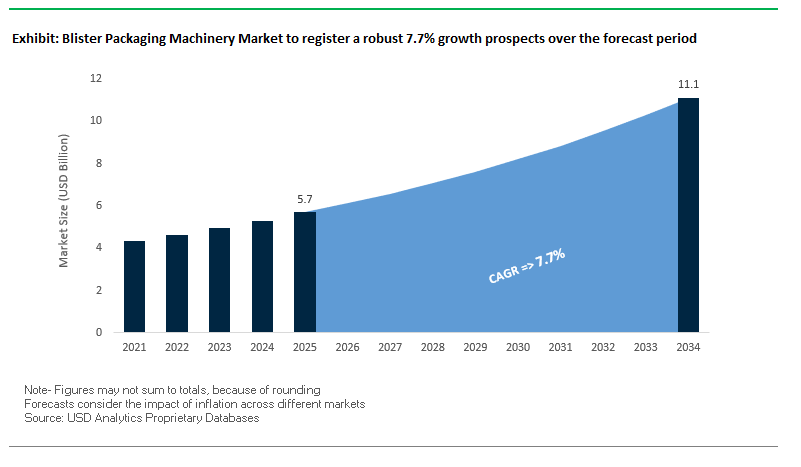
The global blister packaging machinery market is projected to grow from USD 5.7 billion in 2025 to USD 11.1 billion by 2034, advancing at a robust CAGR of 7.7%. The industry’s growth is fueled by rising pharmaceutical demand, the integration of automation technologies, and regulatory emphasis on secure and recyclable packaging solutions. Modern machinery achieves speeds of up to 300 blister packs per minute, far surpassing manual production lines that averaged 40–60 packs.
Key growth drivers include the tamper-evident sealing advantage critical for pharmaceuticals, rising adoption of Alu-Alu high-barrier materials for moisture and oxygen protection, and deployment of AI-powered vision systems for real-time defect detection. These advancements position blister packaging machinery as a central technology in healthcare compliance, sustainability, and mass production efficiency.
Recent developments underscore how policy shifts and high-speed machinery innovations are transforming the blister packaging machinery market. In August 2025, Smurfit WestRock, formed after the Smurfit Kappa–WestRock merger, highlighted a push toward sustainable paper-based packaging integrated with blister formats for consumer goods. Around the same time, the EU’s revised Packaging and Packaging Waste Regulation (PPWR) tightened recyclability requirements, compelling machinery makers to develop systems that can process mono-material films and recyclable substrates.
In May 2025, Marchesini Group showcased the INTEGRA 320 blister line in Mexico, achieving speeds of 720 blisters per minute, a breakthrough for pharmaceutical and cosmetic sectors. Similarly, IMA Group’s TILE-X technology won the Biotech Innovation Award at Interphex NY in April 2025, recognizing its aseptic blistering capability for biotech products. Pharmaworks, in March 2025, launched the FR1 Robotic Feeder, enabling flexibility in feeding irregular product shapes into blister lines.
Emerging regulations are also reshaping equipment requirements. In February 2025, India’s new Plastic Waste Management Rules mandated QR coding and serialization on plastic packaging, driving demand for blister machinery with integrated coding systems. Other highlights include IMA’s sustainable GIANT5-A96 blister line (Oct 2024), Jornen Machinery’s Alu-PVC-Alu thermoforming unit (Aug 2024), and collaborations like IMA–LIVEO on sustainable pharma packs.
Transformative Trends and High-Impact Opportunities Shaping the Blister Packaging Machinery Market
Integration of Industry 4.0 and IoT for Predictive Maintenance and OEE Optimization
A key trend in the blister packaging machinery market is the adoption of Industry 4.0 technologies and IoT-enabled smart sensors. Manufacturers are embedding connectivity and real-time monitoring capabilities into new machines to optimize Overall Equipment Effectiveness (OEE) and enable predictive maintenance. This shift allows pharmaceutical companies to anticipate failures, prevent costly unplanned downtime, and maximize production efficiency. Major players such as Uhlmann Pac-Systeme and ACG are investing heavily in digital solutions, including remote diagnostics and supervisory control systems. Case studies from European manufacturing sectors demonstrate that Industrial IoT solutions can substantially enhance production line performance. Given the high financial impact of unplanned downtime ranging from thousands to tens of thousands of dollars per hour the integration of smart sensors and data analytics offers a strong ROI and positions equipment suppliers as key enablers of modern, data-driven pharmaceutical manufacturing.
Development of Modular and Changeover-Optimized Machinery for Flexible Manufacturing
Another prominent trend is the design of modular blister packaging machinery with rapid changeover capabilities, addressing the rise of smaller batch sizes and personalized medicine. Servo-driven components, automated format part exchange, and recipe-driven control systems minimize downtime and enable fast transitions between production runs. Companies like ELMACH have introduced modular systems with tool-less, slide-in changeover tooling and user-friendly interfaces, supporting efficient production of multiple product types. Early adopters such as Elos Medtech highlight the operational benefits of quick changeovers, especially in sectors requiring high-frequency, small-volume batches. This trend enhances manufacturing agility, allowing pharmaceutical companies to respond swiftly to market demand and expand into new therapeutic areas without significant investment in additional equipment.
Retrofitting and Upgrading Legacy Machinery with Smart Sensor Kits
A high-potential market opportunity lies in retrofitting existing blister packaging machinery with IoT-enabled sensors and software upgrades. Many pharmaceutical facilities operate mechanically sound machines lacking modern data collection capabilities. Retrofitting these systems provides predictive maintenance and operational insights at a fraction of the cost of a new machine. IoT-enabled retrofit kits capture parameters such as vibration, temperature, and pressure, enabling proactive maintenance and performance optimization. By democratizing Industry 4.0 access, these solutions allow small- and mid-sized manufacturers to enhance efficiency, reduce waste, and extend the lifecycle of legacy equipment. This opportunity offers a dual benefit: revenue growth for OEMs and third-party providers and enhanced operational productivity for pharmaceutical companies.
Machinery Adaptation for High-Viscosity and Biologic Drug Delivery Systems
The surge in biologics, vaccines, and high-viscosity drugs is driving demand for specialized blister packaging machinery capable of handling non-standard primary containers, including pre-filled syringes, vials, and gels. This trend requires gentle handling systems, advanced vision inspection for biologics, and new sealing technologies to maintain product integrity. Manufacturers like Uhlmann have developed machines tailored for these applications, featuring precise handling and defect detection capabilities. By addressing the unique requirements of complex therapies, equipment providers can tap into a high-value, growing market segment. This adaptation not only positions manufacturers as critical partners in the biologics sector but also diversifies their product portfolio beyond traditional solid-dose packaging.
Competitive Landscape: Leading Players in Blister Packaging Machinery Market
The competitive landscape features pharma machinery specialists and diversified packaging giants, each innovating in speed, sustainability, and integration.
Uhlmann Group Prioritizes Digitalization and Mono-Material Packaging
Uhlmann offers blister machines, cartoners, and end-of-line systems, with its BLU 200 and BEC series supporting mono-PP packaging for pharma. The group invests 6.7% of revenues in R&D, focusing on AI-driven predictive maintenance and sustainability. Through acquisitions like KOCH Pac-Systeme and Cremer Speciaalmachines, Uhlmann has built a global system provider ecosystem.
IMA Group Wins Awards for Sustainable Blister Packaging Lines
IMA manufactures a wide portfolio of blister machines, cartoners, and aseptic systems. Its GIANT5-A96 line and TILE-X technology earned recognition in 2025 for sustainable and biotech blister applications. With divisions like IMA Pharma and IMA MED-TECH, the company provides integrated solutions across the value chain, leveraging its global R&D network.
Marchesini Group Expands Global Reach with INTEGRA High-Speed Systems
Marchesini specializes in pharma and cosmetic packaging, with its INTEGRA 320 offering high-speed blister and cartoning integration. Showcased in Mexico and Japan (2025), it represents the company’s commitment to efficiency and flexibility. Marchesini is expanding its global footprint while continuously investing in fully integrated, modular systems.
Romaco Group Strengthens Sustainable Pharma Packaging Portfolio
Romaco supplies blister lines, cartoners, and turnkey packaging systems. Its Noack Unity 600 blister machine delivers carbon-neutral operations, aligning with industry sustainability goals. The company’s new Bologna plant (2021) has expanded production capacity, supporting a strategy focused on sustainable and digitalized solutions for pharmaceuticals.
Syntegon Technology Rebrands with a Focus on Sustainability and Traceability
Formerly Bosch Packaging, Syntegon is now a standalone brand emphasizing smart, sustainable blister lines. Its systems are widely used for pharmaceuticals, medical devices, and food packaging, with strong focus on serialization and regulatory compliance. Since its 2020 rebrand, Syntegon has expanded service flexibility and global partnerships, differentiating through traceability and intelligent automation.
Blister Packaging Machinery Market Share Insights
Pharmaceutical Packaging Drives the Largest Market Share by Application in Blister Packaging Machinery
Pharmaceuticals account for 58% of blister packaging machinery demand, solidifying their position as the industry’s structural core. The segment’s dominance is rooted in the regulatory necessity of blister packs as the global standard for unit-dose solid oral dosages, including tablets and capsules. Blister packaging ensures moisture and oxygen protection, tamper evidence, and dosing compliance requirements that are non-negotiable in regulated markets. Machinery demand is further intensified by the need to incorporate serialization, track-and-trace, and anti-counterfeit features into packaging lines, making pharmaceutical companies the primary specifiers of blister equipment worldwide. With drug production volumes rising globally, particularly in generics and biologics, this segment continues to anchor machinery sales with compliance-driven, high-volume demand.
Medium-Speed Equipment Leads Market Share by Product Type in Blister Packaging Machinery
Medium-speed blister packaging machinery, with an output of 200–600 blisters per minute, holds 45% of the market, highlighting its role as the operational sweet spot. These machines offer the best balance between flexibility, throughput, and cost-efficiency, making them the workhorse choice for mid-sized pharmaceutical companies, contract manufacturing organizations, and diversified consumer goods producers. Their ability to handle multiple SKUs with quick changeovers makes them indispensable in a market where product variety and regulatory demands are rising. While high-speed systems dominate blockbuster drug production, the broad adoption of medium-speed machinery reflects its versatility and strong ROI, ensuring it remains the most commercially attractive segment across both pharma and consumer applications.
United States Blister Packaging Machinery Market Driven by FDA Regulations and Automation Investments
The U.S. blister packaging machinery market is heavily influenced by stringent federal and state regulations. Key regulations such as the Poison Prevention Packaging Act of 1970 require child-resistant packaging for many over-the-counter (OTC) drugs, while FDA mandates on tamper-evident packaging drive widespread adoption of blister packs. These regulations not only ensure patient safety but also create continuous demand for technologically advanced machinery capable of producing compliant packaging.
Corporate investments are accelerating innovation. In October 2024, Pharmaworks introduced its FR1 Robotic Feeder for handling diverse drug delivery devices like autoinjectors and prefilled syringes, alongside the TF1e Blister Machine compatible with sustainable and recyclable films. Technological advancements, including high-speed automation and vision inspection systems, enable real-time defect detection, improving product quality and operational efficiency. The market primarily serves the pharmaceutical and consumer goods sectors, covering unit-dose packaging for tablets, capsules, and soft gels, as well as protective packaging for small electronics and batteries. Government initiatives, such as the EPA’s “National Strategy to Prevent Plastic Pollution,” further encourage the integration of bio-based materials, pushing machinery manufacturers to innovate sustainably.
Germany Blister Packaging Machinery Market Strengthened by EU PPWR and Industry 4.0 Initiatives
Germany’s blister packaging machinery industry is shaped by a stringent regulatory framework, including the EU Packaging and Packaging Waste Regulation (PPWR) effective February 2025. The legislation mandates fully recyclable or reusable packaging by 2030, directly influencing the machinery and materials used in the industry. Germany’s Packaging Act (VerpackG) reinforces producer responsibility, emphasizing compatibility with recycling streams and circular economy principles.
Technological innovation is a key growth driver, with companies developing machinery to handle sustainable materials like high-barrier paper-based films. Government-led Industry 4.0 initiatives, including Plattform Industrie 4.0, promote integration of IoT, cloud computing, and cyber-physical systems into manufacturing, enabling smart, interconnected blister packaging machines. Germany’s strong R&D ecosystem further supports the development of high-performance and sustainable machinery, aligning with both regulatory mandates and circular economy goals.
China Blister Packaging Machinery Market Expands with Dual Carbon Goals and Smart Manufacturing
China’s blister packaging machinery market is influenced by the government’s dual carbon initiative, aiming to reduce plastic pollution and promote bio-based materials. Regulatory reforms under SAMR, including updates to GB standards, ensure that blister packaging machinery meets global safety and consumer protection requirements.
Technological advancements such as AI integration and “5G plus industrial internet” are optimizing production efficiency and flexible manufacturing for pharmaceutical and consumer goods packaging. The domestic push to replace imported machinery supports capacity expansion, addressing rising demand driven by the booming pharmaceutical and e-commerce sectors. Efficient and cost-effective machinery for tamper-evident, unit-dose packaging is particularly crucial for an aging population and expanding healthcare needs. China’s strong patent activity also highlights its growing contribution to innovation in blister packaging machinery.
India Blister Packaging Machinery Market Supported by Export-Oriented Upgrades and Sustainability Initiatives
India’s blister packaging machinery market is being shaped by government initiatives like “Make in India” and “Zero Effect Zero Defect,” promoting high-quality domestic production. The CSIR-led National Mission on Sustainable Packaging Solutions supports the development of eco-friendly materials and recycling methods, while regulations under MoEFCC, FSSAI, and the Plastic Waste Management (PWM) Rules provide clear frameworks for biodegradable and compostable materials.
Technological adoption is increasing, with companies investing in automated systems and advanced machinery to meet international standards. In August 2025, Nice Prints installed a Bobst Visionfold 80 A2 with Accubraille for compliance with European Braille embossing requirements. Corporate investments are also growing, exemplified by Siegwerk’s INR 350 crore strategic investment in 2025 to expand innovation, manufacturing, and sustainability capabilities. Key applications include the expanding pharmaceutical sector, particularly generic drugs, as well as the food processing sector, where safety and quality are driving demand for advanced blister packaging machinery.
Blister Packaging Machinery Market Report Scope
Blister Packaging Machinery Market
Parameter
Details
Market Size (2025)
$5.7 Billion
Market Size (2034)
$11.1 Billion
Market Growth Rate
7.7%
Segments
By Technology (Thermoforming, Cold Forming), By Application (Pharmaceutical Packaging, Medical Device Packaging, Consumer Goods Packaging, Food Packaging, Electronics Packaging), By Product Type (Low-speed Machinery, Medium-speed Machinery, High-speed Machinery), By Operation (Automatic, Semi-Automatic), By End-Use Industry (Pharmaceutical, Medical & Healthcare, Food, Consumer Goods, Cosmetics & Personal Care, Automotive, Others)
Study Period
2019- 2024 and 2025-2034
Units
Revenue (USD)
Qualitative Analysis
Porter’s Five Forces, SWOT Profile, Market Share, Scenario Forecasts, Market Ecosystem, Company Ranking, Market Dynamics, Industry Benchmarking
US, Canada, Mexico, Germany, France, Spain, Italy, UK, Russia, China, India, Japan, South Korea, Australia, South East Asia, Brazil, Argentina, Middle East, Africa
Blister Packaging Machinery Market Segmentation
By Technology
Thermoforming
Cold Forming
By Application
Pharmaceutical Packaging
Medical Device Packaging
Consumer Goods Packaging
Food Packaging
Electronics Packaging
By Product Type
Low-speed Machinery
Medium-speed Machinery
High-speed Machinery
By Operation
Automatic
Semi-Automatic
By End-Use Industry
Pharmaceutical
Medical & Healthcare
Food
Consumer Goods
Cosmetics & Personal Care
Automotive
Others
Countries Analyzed
North America (US, Canada, Mexico)
Europe (Germany, UK, France, Spain, Italy, Russia, Rest of Europe)
Asia Pacific (China, India, Japan, South Korea, Australia, South East Asia, Rest of Asia)
South America (Brazil, Argentina, Rest of South America)
Middle East and Africa (Saudi Arabia, UAE, Rest of Middle East, South Africa, Egypt, Rest of Africa)
Top Companies in Blister Packaging Machinery Market
Uhlmann Pac-Systeme GmbH & Co. KG
Romaco Pharmatechnik GmbH
Marchesini Group S.p.A.
Bosch Packaging Technology (Syntegon)
IMA S.p.A.
Koenig & Bauer AG
Harro Höfliger Verpackungsmaschinen GmbH
CAM Packaging S.p.A.
Pharmaworks LLC
Jornen Machinery Co., Ltd.
Pester Pac Automation GmbH
ACG Group
Klöckner Pentaplast
The Adelphi Group of Companies
Sejong Pharmatech Co., Ltd.
* List Not Exhaustive
Methodology
USDAnalytics employs a comprehensive research methodology to deliver accurate and actionable insights into the global blister packaging machinery market. Our approach integrates primary research, including in-depth interviews with equipment manufacturers, pharmaceutical packaging specialists, regulatory authorities, and end-users, with extensive secondary research from corporate reports, industry publications, government regulations, and patent filings. Market sizing, CAGR projections, and growth forecasts are calculated by analyzing technological innovations, including thermoforming and cold forming machinery, automation systems, AI-powered vision inspection, and high-speed modular lines. The study also considers regulatory drivers such as the EU Packaging and Packaging Waste Regulation (PPWR), FDA mandates on tamper-evident packaging, India’s PWM rules, and China’s dual carbon initiatives. USDAnalytics further examines adoption trends across pharmaceutical, medical device, consumer goods, and food packaging sectors, highlighting advancements in high-barrier Alu-Alu materials, IoT-enabled predictive maintenance, and sustainable machinery retrofits. Competitive intelligence evaluates strategic partnerships, R&D investments, and global expansions by leading players such as Uhlmann, IMA, Marchesini, Syntegon, and Romaco, providing industry professionals with a holistic view of opportunities, market dynamics, and technological evolution shaping the blister packaging machinery landscape.
Deliverables:
Comprehensive Market Research Report (PDF and Excel) with detailed tables, charts, and interactive visualizations.
Country-Specific Forecasts & Analysis.
Segment-Wise Revenue Forecasts (2025–2034).
Competitive Analysis, Benchmarking, and SWOT Profiles.
Recent Developments & Innovation Tracker.
Executive Summary & Analyst Commentary.
Post-Purchase Analyst Support for Client-Specific Questions and Custom Data Requirements.
Table of Contents: Blister Packaging Machinery Market
2. Blister Packaging Machinery Market Landscape & Outlook (2025–2034)
2.1. Introduction to Blister Packaging Machinery Market
2.2. Market Valuation and Growth Projections (2025–2034)
2.3. Regulatory Policies Driving Market Growth
2.4. Technological Advancements and High-Speed Innovations
2.5. Emerging Market Opportunities
3. Innovations Reshaping the Blister Packaging Machinery Market
3.1. Trend: Integration of Industry 4.0 and IoT for Predictive Maintenance and OEE Optimization
3.2. Trend: Development of Modular and Changeover-Optimized Machinery for Flexible Manufacturing
3.3. Opportunity: Retrofitting and Upgrading Legacy Machinery with Smart Sensor Kits
3.4. Opportunity: Machinery Adaptation for High-Viscosity and Biologic Drug Delivery Systems
4. Competitive Landscape and Strategic Initiatives
4.1. Mergers, Acquisitions and Strategic Alliances
4.2. R&D and Material Innovation
4.3. Sustainability and Strategies
4.4. Market Expansion and Regional Focus
5. Market Share and Segmentation Insights: Blister Packaging Machinery Market
5.1. By Technology
5.1.1. Thermoforming
5.1.2. Cold Forming
5.2. By Application
5.2.1. Pharmaceutical Packaging
5.2.2. Medical Device Packaging
5.2.3. Consumer Goods Packaging
5.2.4. Food Packaging
5.2.5. Electronics Packaging
5.3. By Product Type
5.3.1. Low-speed Machinery
5.3.2. Medium-speed Machinery
5.3.3. High-speed Machinery
5.4. By Operation
5.4.1. Automatic
5.4.2. Semi-Automatic
5.5. By End-Use Industry
5.5.1. Pharmaceutical
5.5.2. Medical & Healthcare
5.5.3. Food
5.5.4. Consumer Goods
5.5.5. Cosmetics & Personal Care
5.5.6. Automotive
5.5.7. Others
6. Country Analysis and Outlook of Blister Packaging Machinery Market
6.1. United States
6.2. Canada
6.3. Mexico
6.4. Germany
6.5. France
6.6. Spain
6.7. Italy
6.8. UK
6.9. Russia
6.10. China
6.11. India
6.12. Japan
6.13. South Korea
6.14. Australia
6.15. South East Asia
6.16. Brazil
6.17. Argentina
6.18. Middle East
6.19. Africa
7. Blister Packaging Machinery Market Size Outlook by Region (2025–2034)
7.1. North America Blister Packaging Machinery Market Size Outlook to 2034
7.1.1. By Technology
7.1.2. By Application
7.1.3. By Product Type
7.1.4. By Operation
7.2. Europe Blister Packaging Machinery Market Size Outlook to 2034
7.2.1. By Technology
7.2.2. By Application
7.2.3. By Product Type
7.2.4. By Operation
7.3. Asia Pacific Blister Packaging Machinery Market Size Outlook to 2034
7.3.1. By Technology
7.3.2. By Application
7.3.3. By Product Type
7.3.4. By Operation
7.4. South America Blister Packaging Machinery Market Size Outlook to 2034
7.4.1. By Product
7.4.2. By Application
7.4.3. By Product Type
7.4.4. By Operation
7.5. Middle East and Africa Blister Packaging Machinery Market Size Outlook to 2034
7.5.1. By Technology
7.5.2. By Application
7.5.3. By Product Type
7.5.4. By Operation
8. Company Profiles: Leading Players in the Blister Packaging Machinery Market
8.1. Uhlmann Pac-Systeme GmbH & Co. KG
8.2. Romaco Pharmatechnik GmbH
8.3. Marchesini Group S.p.A.
8.4. Bosch Packaging Technology (Syntegon)
8.5. IMA S.p.A.
8.6. Koenig & Bauer AG
8.7. Harro Höfliger Verpackungsmaschinen GmbH
8.8. CAM Packaging S.p.A.
8.9. Pharmaworks LLC
8.10. Jornen Machinery Co., Ltd.
8.11. Pester Pac Automation GmbH
8.12. ACG Group
8.13. Klöckner Pentaplast
8.14. The Adelphi Group of Companies
8.15. Sejong Pharmatech Co., Ltd.
9. Methodology
9.1. Research Scope
9.2. Market Research Approach
9.3. Market Sizing and Forecasting Model
9.4. Research Coverage
9.5. Data Horizon
9.6. Deliverables
10. Appendix
10.1. Acronyms and Abbreviations
10.2. List of Tables
10.3. List of Figures
Blister Packaging Machinery Market Segmentation
By Technology
Thermoforming
Cold Forming
By Application
Pharmaceutical Packaging
Medical Device Packaging
Consumer Goods Packaging
Food Packaging
Electronics Packaging
By Product Type
Low-speed Machinery
Medium-speed Machinery
High-speed Machinery
By Operation
Automatic
Semi-Automatic
By End-Use Industry
Pharmaceutical
Medical & Healthcare
Food
Consumer Goods
Cosmetics & Personal Care
Automotive
Others
Countries Analyzed
North America (US, Canada, Mexico)
Europe (Germany, UK, France, Spain, Italy, Russia, Rest of Europe)
Asia Pacific (China, India, Japan, South Korea, Australia, South East Asia, Rest of Asia)
South America (Brazil, Argentina, Rest of South America)
Middle East and Africa (Saudi Arabia, UAE, Rest of Middle East, South Africa, Egypt, Rest of Africa)
The market is propelled by rising pharmaceutical demand, integration of automation and AI-powered vision systems, and stricter regulatory standards for tamper-evident and recyclable packaging. High-barrier materials like Alu-Alu foils and advanced sealing technologies enhance product safety and shelf life, further driving adoption globally.
Industry 4.0 adoption, including IoT-enabled sensors and predictive maintenance software, optimizes Overall Equipment Effectiveness (OEE), reduces unplanned downtime, and allows real-time monitoring. Manufacturers can leverage digital solutions to enhance efficiency, minimize waste, and improve production flexibility.
Pharmaceutical packaging accounts for the largest market share at 58%, driven by the need for unit-dose tablets, capsules, and high-value biologics. Other key applications include medical devices, consumer goods, food packaging, and electronics, where product protection and compliance are critical.
Modular blister lines with automated format part exchange enable rapid changeovers, supporting smaller batch sizes and personalized medicine. These systems allow manufacturers to efficiently handle multiple SKUs, reduce downtime, and respond quickly to dynamic market demands.
Leading companies include Uhlmann Pac-Systeme, IMA Group, Marchesini Group, Romaco, and Syntegon. These firms focus on high-speed, sustainable, and digitally integrated machinery, investing in R&D, smart sensor retrofits, and global expansions to address evolving pharmaceutical, medical, and consumer packaging needs.
More Equipment, Services and End-use Products Reports