Packaging Tape Printing Market Set to Surge to $15.5 Billion by 2034 on E-Commerce and Sustainability-Driven Demand
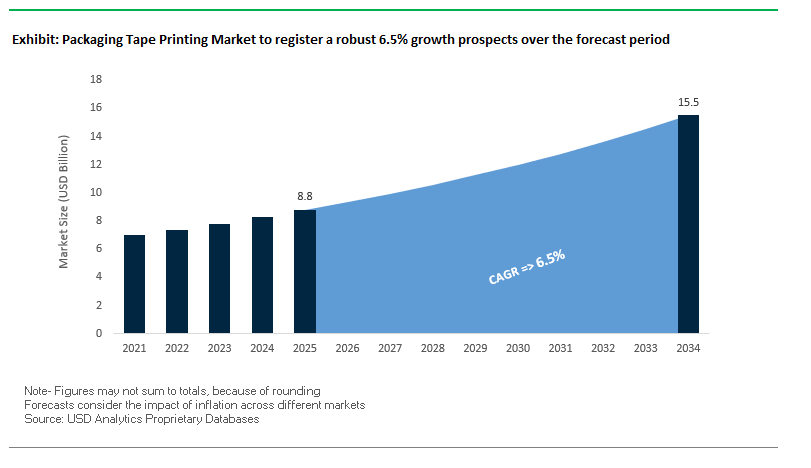
The Global Packaging Tape Printing Market is projected to grow from $8.8 billion in 2025 to $15.5 billion by 2034, representing a CAGR of 6.5%. This specialized sector transforms standard sealing solutions into critical branding, security, and supply chain tools. With the explosive growth of e-commerce and D2C channels, custom-printed tapes are no longer just functional—they are strategic marketing assets that enhance brand visibility and customer experience.
Key Insights for Industry Professionals:
E-Commerce Growth Drives Customization: Custom-printed tapes create a memorable unboxing experience while reinforcing brand identity in highly competitive markets.
Sustainability Innovations Are Reshaping Materials: Shift toward recycled content, water-based and UV-curable inks, and low-VOC adhesives aligns with corporate ESG targets.
Enhanced Security and Traceability: Tamper-evident tapes with serial numbers, QR codes, or intricate designs protect high-value and sensitive shipments.
Digital Printing Enables Flexibility and Efficiency: Short-run, mass-customized tape printing allows seasonal or promotional designs with reduced lead times and costs.
Operational Efficiency Is a Focus: Integration with automated case-sealing machines enhances packaging speed and reduces labor costs.
Recent Strategic Moves Highlight Technology, Sustainability, and Industry Consolidation
The Packaging Tape Printing Industry continues to evolve rapidly, marked by technological innovation, sustainability initiatives, and strategic mergers. In August 2025, Intertape Polymer Group (IPG) achieved TRUE Gold Zero Waste Certification at its Chicago facility, demonstrating a firm commitment to landfill reduction and circular economy practices. July 2025 witnessed Xerox Holdings completing its acquisition of Lexmark, strengthening its hybrid printing portfolio and expanding capabilities across industrial and commercial applications.
In May 2025, 3M launched ScotchBlue PROSharp Painter's Tape with Edge-Lock+ Technology, enhancing precision in professional painting applications. The same month, Durst Group acquired callas software, a move signaling integration and standardization in digital printing technologies. March 2025 saw IPG facilities attain TRUE Silver Zero Waste Certification, reflecting ongoing sustainability commitments across operations.
Key product innovations include January 2025’s Ahlstrom MasterTape® Cristal, a recyclable, paper-based transparent tape; and October 2024’s IPG iTRACK™ Data Collection System, enabling real-time monitoring of tape usage and sealing defects. Recognition for sustainability came in August 2024, when IPG was named Large Enterprise Manufacturer of the Year by the Canadian Manufacturing Journal.
Trends and Opportunities Transforming the Packaging Tape Printing Market
Integration of On-Demand Printing Systems into Automated Packaging Lines
The packaging tape printing market is witnessing accelerated adoption of on-demand printing systems seamlessly integrated into automated packaging lines, particularly across e-commerce and 3PL providers. This transition eliminates the reliance on pre-printed tape inventories by allowing companies to print variable data such as order numbers, barcodes, and shipping addresses directly onto the tape at the sealing stage. This not only streamlines operations but also enhances supply chain visibility and product traceability, which are critical for large-scale fulfillment networks.
The capital investment in automation is evident through solutions like TPC Packaging Solutions’ automated case sealers, which support integration with variable data printing. Similarly, continuous inkjet (CIJ) printers are being deployed for direct-to-box printing, further proving the demand for flexible, high-speed, and cost-efficient labeling alternatives. By eliminating manual labeling and reducing excess inventory storage, companies are driving higher throughput, lower costs, and improved operational efficiency in logistics-intensive environments.
Adoption of Biodegradable and Paper-Based Tape Substrates
Sustainability imperatives are also reshaping the market as regulators and corporations push for alternatives to plastic-based PVC and BOPP tapes. Under the EU’s Packaging and Packaging Waste Regulation (PPWR), brands are expected to move toward recyclable substrates. Paper-based tapes and biodegradable options have emerged as leading substitutes, aligning with corporate ESG targets and consumer demand for eco-friendly packaging.
Manufacturers are responding with certified products such as tesa® 60408, a paper-based tape with 92% bio-based carbon content and recycling-friendly certification. Water-activated tapes (WAT), made from kraft paper and starch-based adhesives, are gaining rapid adoption among e-commerce giants for their tamper-evident security and compatibility with corrugated box recycling. By simplifying end-of-life processing and enhancing brand trust, biodegradable and paper-based tapes are becoming a central pillar in sustainable packaging strategies.
Development of Smart Tapes with Embedded Tracking and Security Features
A major growth opportunity lies in the integration of RFID and NFC technologies into packaging tape substrates to enable real-time supply chain tracking. By embedding thin, flexible chips or conductive circuits into the tape, companies can track packages without manual scanning, providing instant visibility, inventory automation, and misroute detection. This represents a transformative upgrade for logistics-heavy industries such as pharmaceuticals, electronics, and high-value consumer goods.
Smart tapes also offer advanced anti-counterfeiting and tamper-evidence features. Invisible inks, phosphorescent markings, and water-activated adhesive bonds provide overt and covert security layers. If tampered with, the tape tears carton fibers, serving as an immediate visual indicator of breach. Product developments like BitRip’s smart label platform showcase the direction of innovation, where conductive inks and embedded sensors can be adapted to create tapes capable of monitoring environmental conditions such as temperature and shock, providing a new class of intelligent packaging solutions.
Expansion of Branded Tape Printing for E-Commerce Unboxing Experience
As e-commerce continues to dominate retail, branded tape printing is emerging as a cost-effective marketing tool that significantly enhances the customer unboxing experience. With 74% of U.S. consumers reporting that packaging design influences purchase decisions (Ipsos, 2024), custom-printed tapes are now central to reinforcing brand identity at the doorstep.
Beyond branding, social media engagement is amplifying the role of packaging aesthetics. A Packlane report showed that 42% of consumers are more likely to share products online if packaged uniquely, turning branded tape into a catalyst for free user-generated content. With on-demand digital printing services, even SMEs can access low-MOQ, high-resolution branded tape solutions, democratizing this marketing tool. Additionally, premium-quality paper tapes with crisp digital prints elevate brand perception by aligning with consumer preference for eco-friendly, premium-feel packaging—an advantage in a competitive online retail landscape.
Competitive Landscape Dominated by Leaders Advancing Sustainable, Functional, and Digitally Printed Packaging Tapes
The global packaging tape printing market is shaped by key players leveraging material science, adhesive innovation, and digital printing expertise to deliver high-performance, durable, and sustainable solutions. These companies are addressing growing demands for branding, security, automation, and environmental compliance.
3M: Leveraging Century-Long Innovation to Lead High-Performance Packaging Tapes
3M combines advanced adhesive technology with high-performance backing materials across its Scotch® Brand portfolio. In July 2025, it celebrated 100 years of adhesive innovation and introduced ScotchBlue PROSharp Painter's Tape with Edge-Lock+ Technology. 3M offers carton sealing tapes, reinforced tapes, water-activated tapes, and specialty adhesives optimized for diverse industrial and environmental conditions. The company focuses on material science-driven innovation to enhance efficiency, safety, and sustainability in packaging applications.
Tesa SE: Driving Industrial Adhesive Excellence and Sustainability in Printed Tapes
Tesa SE, a Beiersdorf AG subsidiary, excels in adhesive solutions for industrial and packaging applications. The company emphasizes sustainability by designing products with reduced environmental impact while maintaining high-performance standards. Its offerings include plate mounting and process tapes, as well as Tesa Softprint® foam tapes for flexographic printing. Tesa’s strategic approach focuses on future-proof, sustainable solutions, leveraging deep expertise in adhesive technology to address complex industrial challenges.
Shurtape Technologies: Innovating High-Performance and PCR-Based Sustainable Packaging Tapes
Shurtape Technologies provides a diverse portfolio of high-quality tapes for industrial, professional, and consumer applications. Recent developments include rAP 201 and rHP 235 packaging tapes, featuring high post-consumer recycled content. Shurtape’s offerings encompass carton sealing tapes with hot melt, acrylic, and natural rubber adhesives, along with specialty tapes for high-tack and performance-sensitive applications. The company focuses on innovation, performance, and sustainability to meet evolving packaging industry demands.
Intertape Polymer Group (IPG): Pioneering Automation-Ready and Sustainable Packaging Solutions
IPG is a global leader in carton-sealing tapes and water-activated tapes, with a strong emphasis on automation integration. In August 2025, its Chicago facility achieved TRUE Gold Zero Waste Certification, while the iTRACK™ Data Collection System provides actionable insights on tape usage and defects. IPG’s portfolio includes tamper-evident, printed, and high-performance tapes, supported by SealMatic and AMS case-sealing machines for enhanced operational efficiency. The company focuses on sustainable, high-performance solutions that optimize productivity and reduce environmental impact.
Flexography Holds Majority Market Share by Printing Technology in Packaging Tape Printing
Flexographic printing dominates packaging tape printing with a 65% share, cementing its role as the industry’s production backbone. Its success is tied to compatibility with BOPP and other plastic films, high-speed output, and cost efficiency in long runs, making it the preferred choice for branding, instructions, and security seals on shipping tapes. Advancements in water-based and UV-curable flexo inks have improved print durability and sustainability, ensuring compliance with both logistics requirements and environmental standards. Digital inkjet, while smaller at 22%, is growing rapidly, reshaping the market through its ability to print variable data, QR codes, serial numbers, and personalized messages, which is crucial for e-commerce and last-mile tracking. Gravure retains a niche for heavy-duty industrial tapes that require exceptional color density and abrasion resistance, while offset and other technologies have been rendered nearly obsolete due to substrate limitations. The market trajectory clearly positions flexography as the core enabler of volume-driven tape production, while digital printing expands its foothold in smart, data-rich logistics ecosystems.
E-commerce & Logistics Dominate Market Share by End-Use Industry in Printed Packaging Tapes
The e-commerce and logistics sector accounts for 55% of global demand for printed packaging tapes, making it the undisputed market driver. The exponential rise of online retail has turned tape from a functional sealing material into a critical logistics tool and branding medium. Printed tapes are used not only to secure packages but also to carry tracking barcodes, QR codes, tamper-evident seals, and branded logos, directly influencing supply chain efficiency and consumer perception. Consumer goods follow with a strong 20% share, where manufacturers leverage branded tapes as mobile billboards during transit and as brand reinforcement at the point of unboxing. Food & beverage, automotive, and healthcare applications, while smaller in volume, are highly specialized: food-grade tapes with compliance markings, automotive tapes designed for high tensile strength in pallet securing, and healthcare tapes incorporating precise lot information for sensitive medical shipments. The overwhelming share commanded by e-commerce illustrates how packaging tapes have evolved into functional, secure, and brand-enhancing assets in the digital retail era.
United States Packaging Tape Printing Market Driven by E-Commerce and Digital Printing
The United States packaging tape printing market is experiencing rapid growth, primarily driven by the expansion of e-commerce and logistics networks. As brands seek to enhance visibility and improve security, demand for custom printed packaging tape with branding, tamper-evident features, and security messaging is surging. Leading players such as 3M are offering advanced printed tape solutions that support branding and traceability across diverse sectors.
A major development is the adoption of digital printing technologies for packaging tape, enabling variable data printing (VDP) with QR codes, barcodes, and tracking elements. This is particularly important for the food, beverage, and e-commerce industries, which require advanced traceability and inventory control. The U.S. Environmental Protection Agency (EPA) and state-level regulatory bodies are enforcing stricter VOC emission controls, pushing companies to develop eco-friendly inks and water-based printing solutions. Furthermore, automation is central to market expansion, with investments in high-speed tape applicators and case sealers enabling companies to scale custom-printed tape production efficiently.
European Union Packaging Tape Printing Market Strengthened by PPWR and Circular Economy Regulations
The European Union packaging tape printing market is undergoing transformation under the Packaging and Packaging Waste Regulation (PPWR), which became effective in February 2025. By 2028, standardized labeling requirements will make it mandatory for packaging—including printed tapes—to clearly indicate material composition and disposal instructions, supporting circular economy goals. Additionally, the Regulation (EU) 2024/2865 introduced in December 2024 amends classification, labeling, and packaging requirements for chemicals, creating higher compliance needs for tape printing used in pharmaceuticals and chemicals sectors.
Corporate innovation is also shaping the market. In April 2025, Mondi Group acquired Schumacher Packaging’s Western Europe operations, strengthening its leadership in modern digital tape printing technologies. Similarly, DS Smith introduced its TapeBack solution, eliminating the need for single-use tear strips in e-commerce packaging—demonstrating sustainability-focused innovation in adhesive and printed tape design. These developments underscore the EU’s shift toward eco-friendly, recyclable, and digitally advanced printed packaging tapes.
China Packaging Tape Printing Market Growing Through Sustainability Mandates and Anti-Counterfeiting Demand
China’s packaging tape printing market is advancing under the government’s 14th Five-Year Plan, which emphasizes stricter control of plastic pollution and greater support for the remanufacturing industry. This is driving demand for recyclable and sustainable printed packaging tapes across logistics, retail, and manufacturing sectors.
The surge in e-commerce deliveries—175 billion parcels in 2024—has amplified demand for printed variable data tapes embedded with barcodes and QR codes to improve tracking, logistics efficiency, and last-mile delivery accuracy. Additionally, the market is experiencing heightened demand for anti-counterfeiting printed tapes in electronics, pharmaceuticals, and luxury goods, as manufacturers seek to safeguard brand integrity. Combined with government-backed tax incentives promoting green technology, these factors are making China a global hub for innovative and secure packaging tape printing solutions.
India Packaging Tape Printing Market Supported by FSSAI Compliance and Make in India Initiative
The Indian packaging tape printing market is being propelled by regulatory and manufacturing shifts. The Food Safety and Standards (Packaging) Regulations, 2018 mandate that printing inks for food packaging conform to IS 15495, banning harmful substances such as phthalates, toluene, and certain pigments. This compliance requirement is driving the adoption of eco-friendly inks and safe tape printing solutions.
Domestic growth is further boosted by the Make in India initiative, which has expanded local manufacturing and increased demand for printed tape applications in automotive, electronics, FMCG, and consumer goods sectors. Recent changes in GST rules allowing revised MRP printing on unsold stock until December 2025 highlight the need for flexible and cost-efficient printing solutions, including customized packaging tapes. Additionally, as India’s e-commerce and retail sectors expand, companies are investing in digital and short-run printing technologies to enable customization, branding, and regulatory compliance in packaging tape printing.
Japan Packaging Tape Printing Market Influenced by Plastic Circulation Law and Value-Added Labeling
The Japan packaging tape printing market is shaped by the Plastic Resource Circulation Promotion Law (2025), which mandates the redesign or reduction of single-use plastic products. This regulation is encouraging manufacturers to innovate with compostable and reusable tape materials combined with advanced printing applications.
Strategically, the market is moving from volume-driven growth to a profit-oriented model, focusing on premium printed tapes with enhanced functionality such as tamper-evident seals, high-performance adhesives, and customizable branding features. Japan’s broader label industry achieved $4.3 billion in shipments in 2024, reflecting a 2.4% year-on-year increase—the strongest growth in five years—indicating strong synergies with tape printing demand. In sectors such as food, beverages, and e-commerce, printed tapes are increasingly used to combine aesthetics, security, and compliance, aligning with Japan’s emphasis on quality, design, and sustainability.
Brazil Packaging Tape Printing Market Advancing Through PNRS and Industrial Applications
The Brazil packaging tape printing market is expanding under the National Solid Waste Policy (PNRS), which promotes reuse, recycling, and responsible disposal of packaging materials. These regulations are encouraging greater use of eco-friendly printed tape solutions, particularly in sectors where compliance and sustainability are becoming purchasing criteria.
Key demand stems from bulk storage and transportation sectors, where printed packaging tapes are widely used for agrochemicals, lubricants, and fuels. This growth is supported by Brazil’s expanding agricultural exports and industrial output, where printed tape offers a cost-effective, tamper-proof, and customizable packaging solution. The adoption of flexible printing technologies and recyclable tape materials is reinforcing Brazil’s role as a fast-emerging packaging hub in Latin America.
Packaging Tapes Market Report Scope
Packaging Tape Printing Market
Parameter
Details
Market Size (2025)
$8.8 Billion
Market Size (2034)
$15.5 Billion
Market Growth Rate
6.5%
Segments
By Printing Technology (Flexography, Gravure, Digital, Offset, Other Technologies), By Printing Ink (Water-Based, Solvent-Based, UV-Curable, Hot Melt, Other Inks), By Material (PP, PVC, Paper & Paperboard, Other Materials), By End-Use Industry (Food & Beverage, Automotive & Transportation, E-commerce & Logistics, Healthcare, Consumer Goods, Other End-Use Industries)
Study Period
2019- 2024 and 2025-2034
Units
Revenue (USD)
Qualitative Analysis
Porter’s Five Forces, SWOT Profile, Market Share, Scenario Forecasts, Market Ecosystem, Company Ranking, Market Dynamics, Industry Benchmarking
Companies
3M Company, Avery Dennison Corporation, Shurtape Technologies, LLC, Nitto Denko Corporation, Smurfit Kappa Group Plc, Mondi Group, DS Smith Plc, Pregis LLC, Amcor plc, WestRock Company, Intertape Polymer Group Inc., Tesa SE, Sonoco Products Company, Graphic Packaging Holding Company, International Paper Company
Countries
US, Canada, Mexico, Germany, France, Spain, Italy, UK, Russia, China, India, Japan, South Korea, Australia, South East Asia, Brazil, Argentina, Middle East, Africa
Packaging Tape Printing Market Segmentation
By Printing Technology
Flexography
Gravure
Digital
Offset
Other Technologies
By Printing Ink
Water-Based
Solvent-Based
UV-Curable
Hot Melt
Other Inks
By Material
PP
PVC
Paper & Paperboard
Other Materials
By End-Use Industry
Food & Beverage
Automotive & Transportation
E-commerce & Logistics
Healthcare
Consumer Goods
Other End-Use Industries
Countries Analyzed
North America (US, Canada, Mexico)
Europe (Germany, UK, France, Spain, Italy, Russia, Rest of Europe)
Asia Pacific (China, India, Japan, South Korea, Australia, South East Asia, Rest of Asia)
South America (Brazil, Argentina, Rest of South America)
Middle East and Africa (Saudi Arabia, UAE, Rest of Middle East, South Africa, Egypt, Rest of Africa)
Top Companies in Packaging Tape Printing Market
3M Company
Avery Dennison Corporation
Shurtape Technologies, LLC
Nitto Denko Corporation
Smurfit Kappa Group Plc
Mondi Group
DS Smith Plc
Pregis LLC
Amcor plc
WestRock Company
Intertape Polymer Group Inc.
Tesa SE
Sonoco Products Company
Graphic Packaging Holding Company
International Paper Company
* List Not Exhaustive
Methodology
USDAnalytics employs a comprehensive and systematic research methodology to provide accurate, actionable insights into the global Packaging Tape Printing Market. Our approach combines primary research, including interviews with industry stakeholders such as tape manufacturers, adhesive developers, printing technology providers, e-commerce and logistics companies, and regulatory experts, with secondary research covering corporate reports, government publications, trade journals, and industry databases. Advanced quantitative models and forecasting techniques are applied to analyze market size, growth rates, and trends across segments like printing technology, ink type, tape material, and end-use industries. We also assess regional dynamics across key markets, including the U.S., EU, China, India, Japan, and Brazil, integrating sustainability initiatives, digital printing adoption, automation, and regulatory compliance into the analysis. By leveraging both qualitative and quantitative insights, USDAnalytics delivers a precise market outlook, highlighting emerging opportunities in eco-friendly substrates, smart tapes, branded solutions, and high-performance industrial applications, enabling industry professionals to make informed strategic decisions.
Deliverables:
Comprehensive Market Research Report (PDF and Excel) with detailed tables, charts, and interactive visualizations.
Country-Specific Forecasts & Analysis.
Segment-Wise Revenue Forecasts (2025–2034).
Competitive Analysis, Benchmarking, and SWOT Profiles.
Recent Developments & Innovation Tracker.
Executive Summary & Analyst Commentary.
Post-Purchase Analyst Support for Client-Specific Questions and Custom Data Requirements.
Table of Contents: Packaging Tape Printing Market
1. Executive Summary
1.1. Market Highlights
1.2. Key Findings
1.3. Global Market Snapshot
2. Packaging Tape Printing Market Landscape & Outlook (2025–2034)
2.1. Introduction to Packaging Tape Printing Market
2.2. Market Valuation and Growth Projections (2025–2034)
2.3. Drivers: E-Commerce Growth, Sustainability, and Digital Printing
2.4. Challenges: Regulatory Compliance and Material Limitations
2.5. Future Outlook and Market Dynamics
3. Innovations Reshaping the Packaging Tape Printing Market
3.1. Trend: Integration of On-Demand Printing Systems into Automated Packaging Lines
3.2. Trend: Adoption of Biodegradable and Paper-Based Tape Substrates
3.3. Opportunity: Development of Smart Tapes with Embedded Tracking and Security Features
3.4. Opportunity: Expansion of Branded Tape Printing for E-Commerce Unboxing Experience
4. Competitive Landscape and Strategic Initiatives
4.1. Mergers, Acquisitions and Strategic Alliances
4.2. R&D and Material Innovation
4.3. Sustainability and Strategies
4.4. Market Expansion and Regional Focus
5. Market Share and Segmentation Insights: Packaging Tape Printing Market
5.1. By Printing Technology
5.1.1. Flexography
5.1.2. Gravure
5.1.3. Digital
5.1.4. Offset
5.1.5. Other Technologies
5.2. By Printing Ink
5.2.1. Water-Based
5.2.2. Solvent-Based
5.2.3. UV-Curable
5.2.4. Hot Melt
5.2.5. Other Inks
5.3. By Material
5.3.1. PP
5.3.2. PVC
5.3.3. Paper & Paperboard
5.3.4. Other Materials
5.4. By End-Use Industry
5.4.1. Food & Beverage
5.4.2. Automotive & Transportation
5.4.3. E-commerce & Logistics
5.4.4. Healthcare
5.4.5. Consumer Goods
5.4.6. Other End-Use Industries
6. Country Analysis and Outlook of Packaging Tape Printing Market
6.1. United States
6.2. Canada
6.3. Mexico
6.4. Germany
6.5. France
6.6. Spain
6.7. Italy
6.8. UK
6.9. Russia
6.10. China
6.11. India
6.12. Japan
6.13. South Korea
6.14. Australia
6.15. South East Asia
6.16. Brazil
6.17. Argentina
6.18. Middle East
6.19. Africa
7. Packaging Tape Printing Market Size Outlook by Region (2025-2034)
7.1. North America Packaging Tape Printing Market Size Outlook to 2034
7.1.1. By Printing Technology
7.1.2. By Ink Type
7.1.3. By Material
7.1.4. By End-Use Industry
7.2. Europe Packaging Tape Printing Market Size Outlook to 2034
7.2.1. By Printing Technology
7.2.2. By Ink Type
7.2.3. By Material
7.2.4. By End-Use Industry
7.3. Asia Pacific Packaging Tape Printing Market Size Outlook to 2034
7.3.1. By Printing Technology
7.3.2. By Ink Type
7.3.3. By Material
7.3.4. By End-Use Industry
7.4. South America Packaging Tape Printing Market Size Outlook to 2034
7.4.1. By Printing Technology
7.4.2. By Ink Type
7.4.3. By Material
7.4.4. By End-Use Industry
7.5. Middle East and Africa Packaging Tape Printing Market Size Outlook to 2034
7.5.1. By Printing Technology
7.5.2. By Ink Type
7.5.3. By Material
7.5.4. By End-Use Industry
8. Company Profiles: Leading Players in the Packaging Tape Printing Market
8.1. 3M Company
8.2. Avery Dennison Corporation
8.3. Shurtape Technologies, LLC
8.4. Nitto Denko Corporation
8.5. Smurfit Kappa Group Plc
8.6. Mondi Group
8.7. DS Smith Plc
8.8. Pregis LLC
8.9. Amcor plc
8.10. WestRock Company
8.11. Intertape Polymer Group Inc.
8.12. Tesa SE
8.13. Sonoco Products Company
8.14. Graphic Packaging Holding Company
8.15. International Paper Company
9. Methodology
9.1. Research Scope
9.2. Market Research Approach
9.3. Market Sizing and Forecasting Model
9.4. Research Coverage
9.5. Data Horizon
9.6. Deliverables
10. Appendix
10.1. Acronyms and Abbreviations
10.2. List of Tables
10.3. List of Figures
Packaging Tape Printing Market Segmentation
By Printing Technology
Flexography
Gravure
Digital
Offset
Other Technologies
By Printing Ink
Water-Based
Solvent-Based
UV-Curable
Hot Melt
Other Inks
By Material
PP
PVC
Paper & Paperboard
Other Materials
By End-Use Industry
Food & Beverage
Automotive & Transportation
E-commerce & Logistics
Healthcare
Consumer Goods
Other End-Use Industries
Countries Analyzed
North America (US, Canada, Mexico)
Europe (Germany, UK, France, Spain, Italy, Russia, Rest of Europe)
Asia Pacific (China, India, Japan, South Korea, Australia, South East Asia, Rest of Asia)
South America (Brazil, Argentina, Rest of South America)
Middle East and Africa (Saudi Arabia, UAE, Rest of Middle East, South Africa, Egypt, Rest of Africa)
The Packaging Tape Printing Market is expected to grow from USD 8.8 billion in 2025 to USD 15.5 billion by 2034, at a CAGR of 6.5%. Growth is driven by e-commerce expansion, demand for branded and tamper-evident tapes, and adoption of sustainable, recyclable materials.
Flexography holds the largest market share at 65%, offering high-speed, cost-efficient production on BOPP and plastic films. Digital printing is rapidly growing, enabling on-demand variable data printing for QR codes, barcodes, and personalized branding, essential for e-commerce and logistics applications.
Sustainability initiatives are driving adoption of paper-based, biodegradable, and water-activated tapes, along with low-VOC and UV-curable inks. Corporate ESG targets, EU PPWR regulations, and consumer demand for eco-friendly packaging are accelerating the shift from PVC and conventional plastic tapes to recyclable and compostable alternatives.
E-commerce and logistics dominate with 55% market share, leveraging tapes for branding, tamper-evidence, and supply chain tracking. Consumer goods, food & beverage, automotive, and healthcare also use printed tapes for secure packaging, regulatory compliance, and enhancing the unboxing experience.
The U.S. market grows on e-commerce and digital printing adoption, Europe on PPWR and circular economy compliance, China on anti-counterfeiting and sustainable solutions, India on FSSAI regulations and Make in India incentives, Japan on premium and eco-friendly tape designs, and Brazil on PNRS mandates and industrial applications. Each region emphasizes sustainability, traceability, and operational efficiency.